Hair Intelligence Library · Hair Biology

Hair Biology, from follicle to fibre

Hair is a living biological system at its root and an inert fibre above the scalp. This is the parent guide to how follicles build hair, why it sheds, what shapes texture and colour — and when a change deserves a dermatologist rather than another product.

Educational content. This page explains mechanisms; it does not diagnose. Persistent, sudden, patchy or painful hair loss should be examined.

Dermatologist reviewed Evidence-aware 66 child topics mapped No regrowth claims
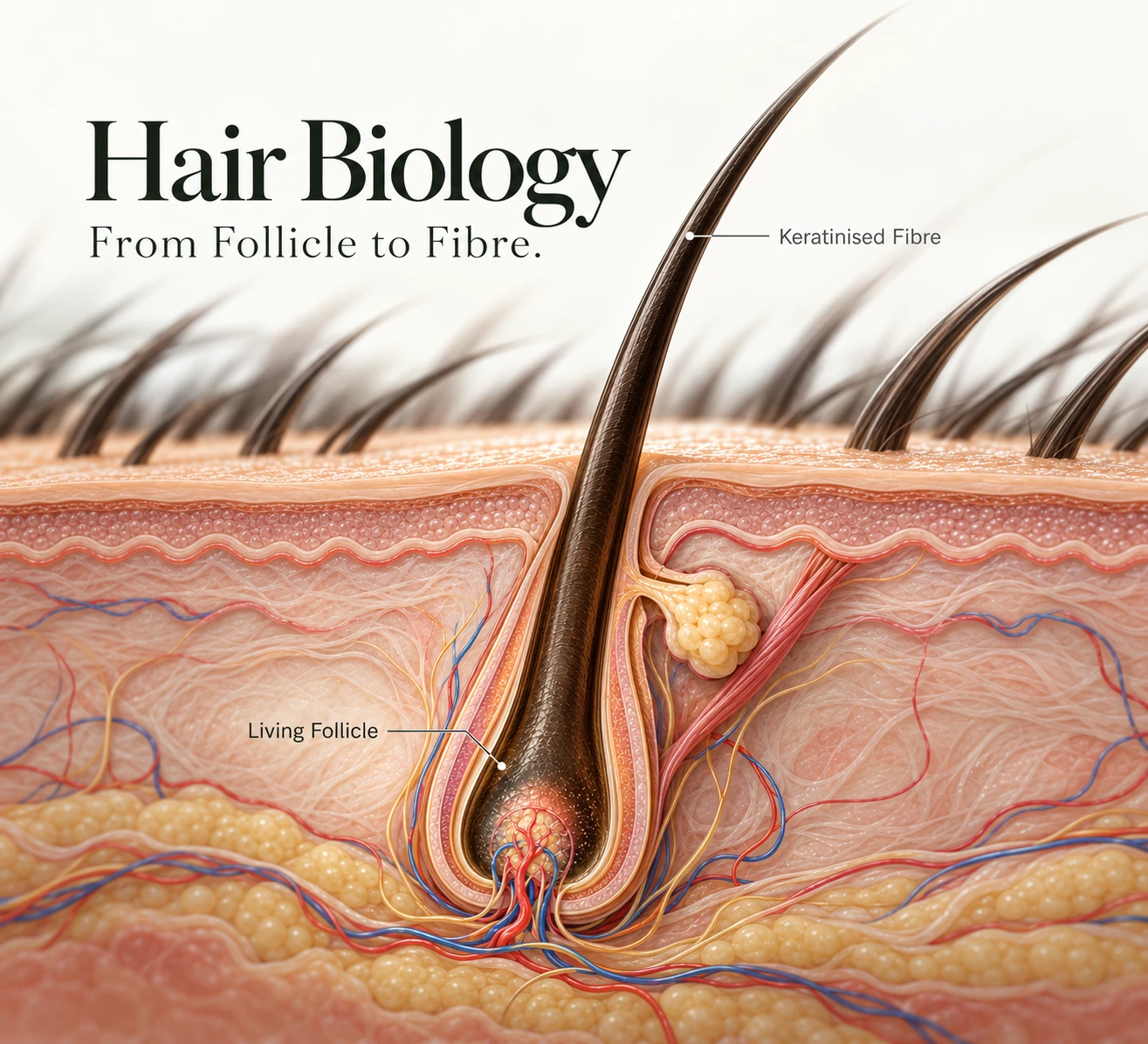
Hair biology: a living follicle below the surface, an inert keratinised fibre above it.
Reviewed by Dr. Amit S. Agarkar
Mechanisms, not diagnoses

Quick Clinical Answer

What you need to know in 30 seconds

Hair biology is the study of how hair is formed, grows, sheds, changes colour and interacts with the scalp. Hair growth begins inside follicles beneath the skin, where specialised cells divide and produce keratinised fibres. Genetics, hormones, age, nutrition, inflammation and scalp health can influence the growth cycle, hair diameter, texture, pigmentation and shedding pattern. The single most useful idea on this page: the part you can touch is not alive, and the part that is alive is the part you cannot see.

Where hair is madeInside the follicle, in the bulb — everything about the fibre is decided before it reaches the surface.
Why shedding happensEach follicle cycles independently through growth, transition, rest and release. Daily shedding is normal cycling.
What products can doImprove the condition and feel of the fibre and the scalp surface. They do not reprogramme the follicle.
When to be examinedSudden, persistent, patchy or painful change — appearance alone cannot identify the cause.

Medically reviewed by Dr. Amit S. Agarkar — MBBS, MD Dermatology, FCPS, DDV · Reviewed 26 July 2026 · Next review July 2027

What you'll learn on this page

  • What hair biology covers, and why the living root and inert fibre behave so differently
  • Every part of the follicle — bulb, matrix, dermal papilla, sebaceous gland, arrector pili
  • How a follicle actually builds a fibre, in six stages from signalling to emergence
  • The growth cycle — anagen, catagen, telogen, exogen — and what each phase explains
  • The three layers of the hair shaft, and the limit of what any product can change
  • Scalp biology: barrier, sebum, microbiome, pH, and six states people confuse
  • Why hair differs between individuals — genetics, hormones, age, nutrition, exposure
  • Which changes are ordinary variation, and which deserve a dermatologist
  • How to map what you are experiencing to the mechanism behind it
  • How hair biology makes product selection more rational — and 12 myths corrected

Overview

What is hair biology?

Hair biology is the study of how hair is formed, grows, sheds, changes colour and interacts with the scalp. It is one subject with two halves that behave nothing like each other — and almost every popular hair myth comes from mixing them up.

Below the surface sits a follicle: a small organ, richly supplied with blood, among the most metabolically active tissue in the body, responsive to hormones, nutrition, inflammation and illness. Above the surface sits the fibre it produced: keratinised, without living cells, incapable of healing, and changed only in its surface condition by anything you apply.

Hold that split and the confusing things become predictable. A conditioner transforms how hair feels tonight but cannot change what grows next month. Shedding can begin two or three months after an illness rather than during it. Two people on the same routine get different results. And a treatment that genuinely works still needs months before it shows as length.

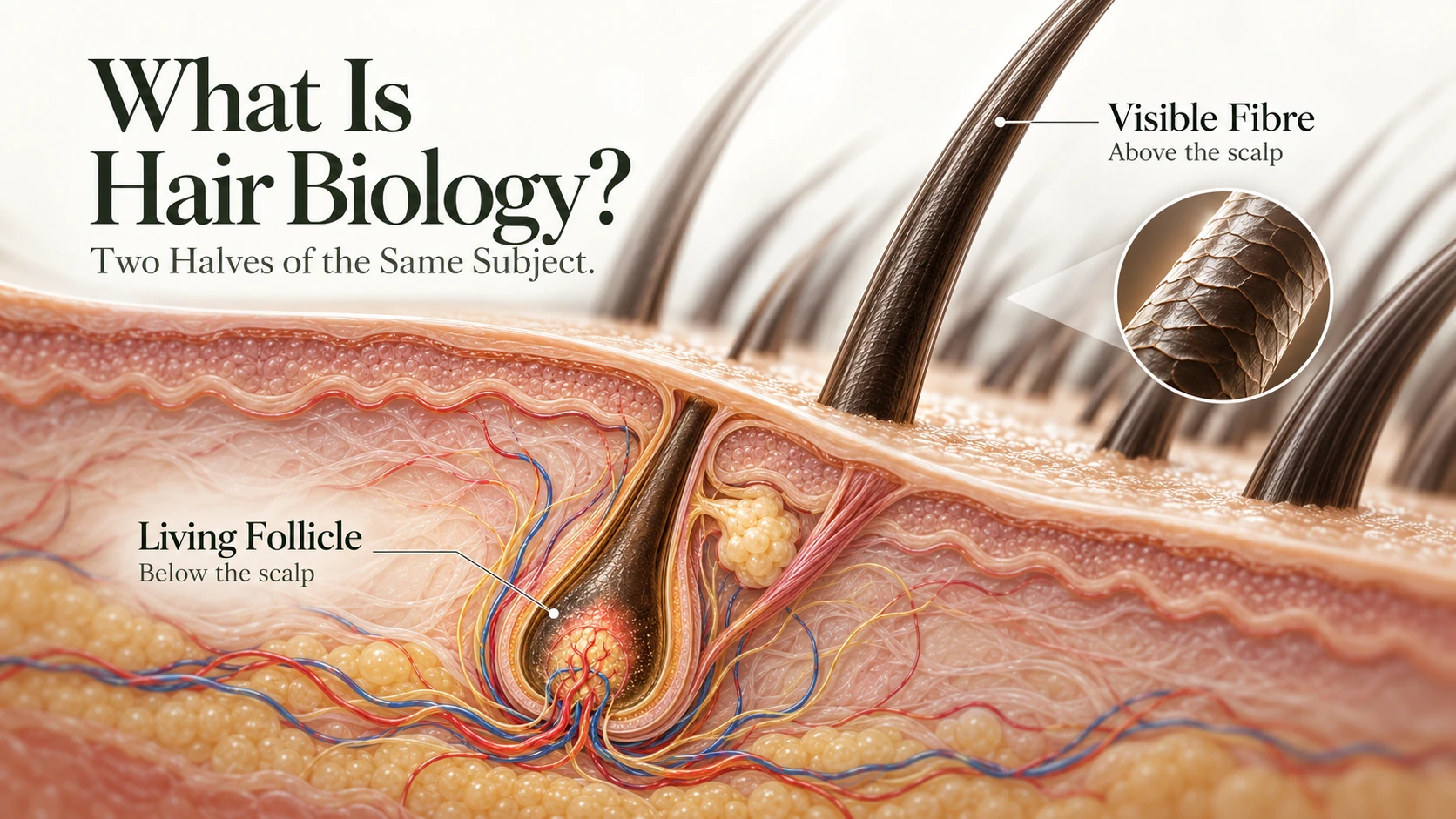
Two Halves Of The Same Subject
The living follicle versus the visible fibre
The follicle (below the scalp)The fibre (above the scalp)
Living, dividing, metabolically demanding tissueKeratinised structure containing no living cells
Responds to hormones, nutrition, illness, inflammationResponds to heat, chemistry, friction and moisture
Can repair, regress and re-form across cyclesCannot biologically heal — damage is permanent to that fibre
Determines diameter, shape, strength and colourDetermines how hair looks, feels and behaves today
Changed by medical treatment, assessed clinicallyChanged by cosmetic care, assessed by touch and appearance

Why this distinction matters clinicallyPatients often arrive having spent months on products for a follicular problem, or having sought medical treatment for a fibre problem. Getting this right first saves both time and money — and time matters more, because hair reveals its answers slowly.

Related reading: Hair follicle anatomy · Hair shaft structure · Breakage versus shedding

The living half is the half you cannot see.

Faculty 01 · Foundations of Hair Science

Hair Biology

Hair biology is the foundation beneath every discussion about hair growth, shedding, scalp health, damage, ingredients and treatment. Begin with the visible fibre, travel below the scalp into the follicle, follow the growth cycle, and understand how the scalp environment and blood supply support active hair formation.

Understand the structures themselves. Once you understand how hair is built, nourished and renewed, much of haircare marketing becomes easier to evaluate.

Five subjects, taught in the order the biology actually runs — from the fibre you can touch to the circulation that feeds the cells building it.

Five essential subjects. One clearer way to understand your hair.

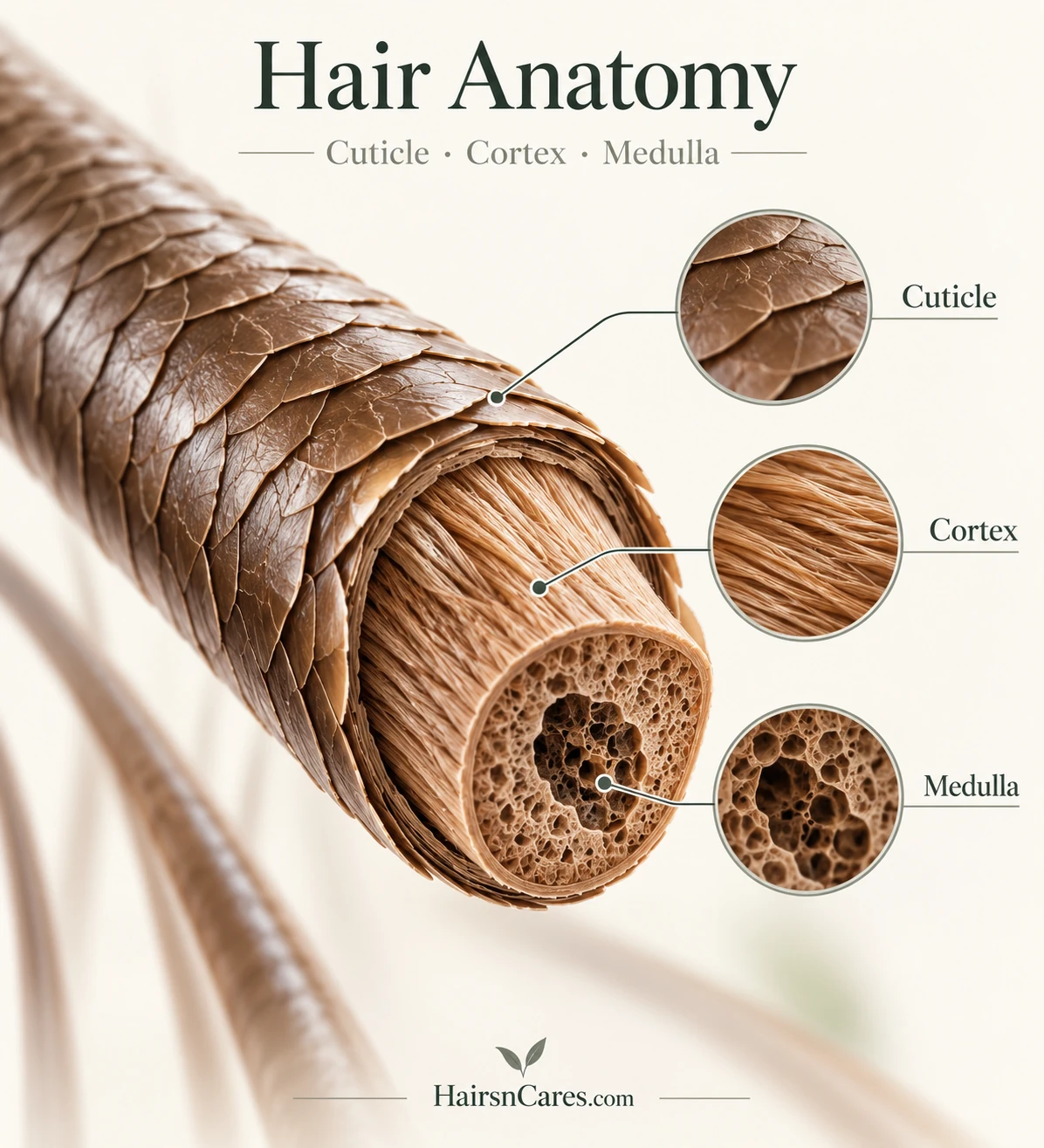
Cross-section of a hair shaft showing the cuticle, cortex and medulla

01 / Structure

Hair Anatomy

Cuticle · Cortex · Medulla

Explore the three structural regions of the visible hair shaft and understand how they influence surface smoothness, mechanical strength, pigmentation, moisture behaviour and visible damage. None of it contains living cells, which sets a firm limit on what any product applied to it can achieve.

  • Cuticle — the overlapping protective outer layer
  • Cortex — the main structural and pigment-containing region
  • Medulla — the variable central core, often absent in fine hair
Why this changes how you read haircare claims

Understanding these layers helps separate surface-conditioning claims from changes that would require biological action inside the follicle.
Explore Hair Anatomy

02 / Origin

The Hair Follicle

Bulb · Matrix · Dermal papilla

Travel beneath the scalp to the dynamic structure that produces the hair fibre. Understand where growth begins, where rapidly dividing cells form the shaft, and how signals from the dermal papilla influence follicular activity.

  • Hair bulb — the enlarged base of the follicle
  • Matrix — the active cell-production zone
  • Dermal papilla — the signalling and support interface
Why this changes how you read haircare claims

A product acting only on the visible hair shaft is not automatically acting on the biological machinery inside the follicle.

Enter the Hair Follicle

03 / Rhythm

The Growth Cycle

Anagen · Catagen · Telogen

Understand why hair grows, pauses and sheds at different times. Follow the repeating phases that determine active growth, follicular transition and rest — and the exogen release that ends each round. Follicles cycle independently, which is why healthy scalps shed continuously rather than all at once.

  • Anagen — active growth
  • Catagen — brief transition
  • Telogen — resting phase, before exogen release
Why this changes how you read haircare claims

Hair biology works in months and years, not overnight. Product timelines should be judged against the follicle's cycle rather than promotional promises.

Follow the Growth Cycle

04 / Environment

Scalp Biology

Barrier · Sebum · Microbiome

Explore the biological environment surrounding the follicles. Understand how the scalp barrier, natural oils and resident microorganisms contribute to comfort, cleansing needs and visible scalp condition — and where normal sebum ends and a clinical scalp condition begins.

  • Barrier — protection and water regulation
  • Sebum — natural lipid production, not poor hygiene
  • Microbiome — the scalp's community of microorganisms
Why this changes how you read haircare claims

Oiliness, flakes, dryness and sensitivity can look similar while arising from different scalp processes; one universal scalp solution is rarely appropriate.

Understand Scalp Biology

05 / Supply

Blood Supply

How nutrients reach the hair bulb

Understand how small blood vessels surrounding the lower follicle deliver oxygen and circulating nutrients to metabolically active cells within the hair bulb. Delivery happens at the base, beneath the skin — nothing travels up through the visible fibre.

  • Capillary network — around the lower follicle
  • Exchange — near the dermal papilla
  • Delivery — to actively dividing matrix cells
Why this changes how you read haircare claims

"Improves circulation" is a common promotional phrase with limited supporting evidence for topical cosmetics. Confirmed nutritional deficiency is a clinical finding; poor circulation is not the general explanation for hair loss, and massage is not a substitute for assessment.

Trace the Blood Supply

Start with structure. Continue into the biology behind shedding, scalp behaviour, product action and treatment timelines.

Further reading from trusted scientific sources

  • Hair anatomy — [INSERT VERIFIED HAIR ANATOMY REFERENCE]
  • Hair follicle — [INSERT VERIFIED HAIR FOLLICLE REFERENCE]
  • Hair growth cycle — [INSERT VERIFIED HAIR GROWTH CYCLE REFERENCE]
  • Scalp biology — [INSERT VERIFIED SCALP BIOLOGY REFERENCE]
  • Follicular blood supply — [INSERT VERIFIED FOLLICULAR BLOOD SUPPLY REFERENCE]

Verified third-party sources will be added here with the publishing organisation named in the link text, opening in a new tab. Sources already checked for this page are listed in the references section below. No link here implies endorsement or partnership.

This faculty provides general educational information and does not diagnose hair or scalp conditions. Sudden, patchy, painful, inflamed or persistent hair loss should be assessed by a qualified medical professional.

The Atlas · 66 Topics

Explore the complete Hair Biology Atlas

Eight clusters cover the whole subject, from the structure of a single follicle to the mechanisms behind visible hair loss. Every topic below has its own dedicated guide.

A note on Cluster H. Those pages explain mechanisms; they are not a way to work out which mechanism applies to you. Several produce a similar appearance, and telling them apart usually requires examination — sometimes trichoscopy or blood tests. If a pattern is sudden, patchy, painful or progressing, treat that as a reason to be assessed rather than a reason to keep reading.

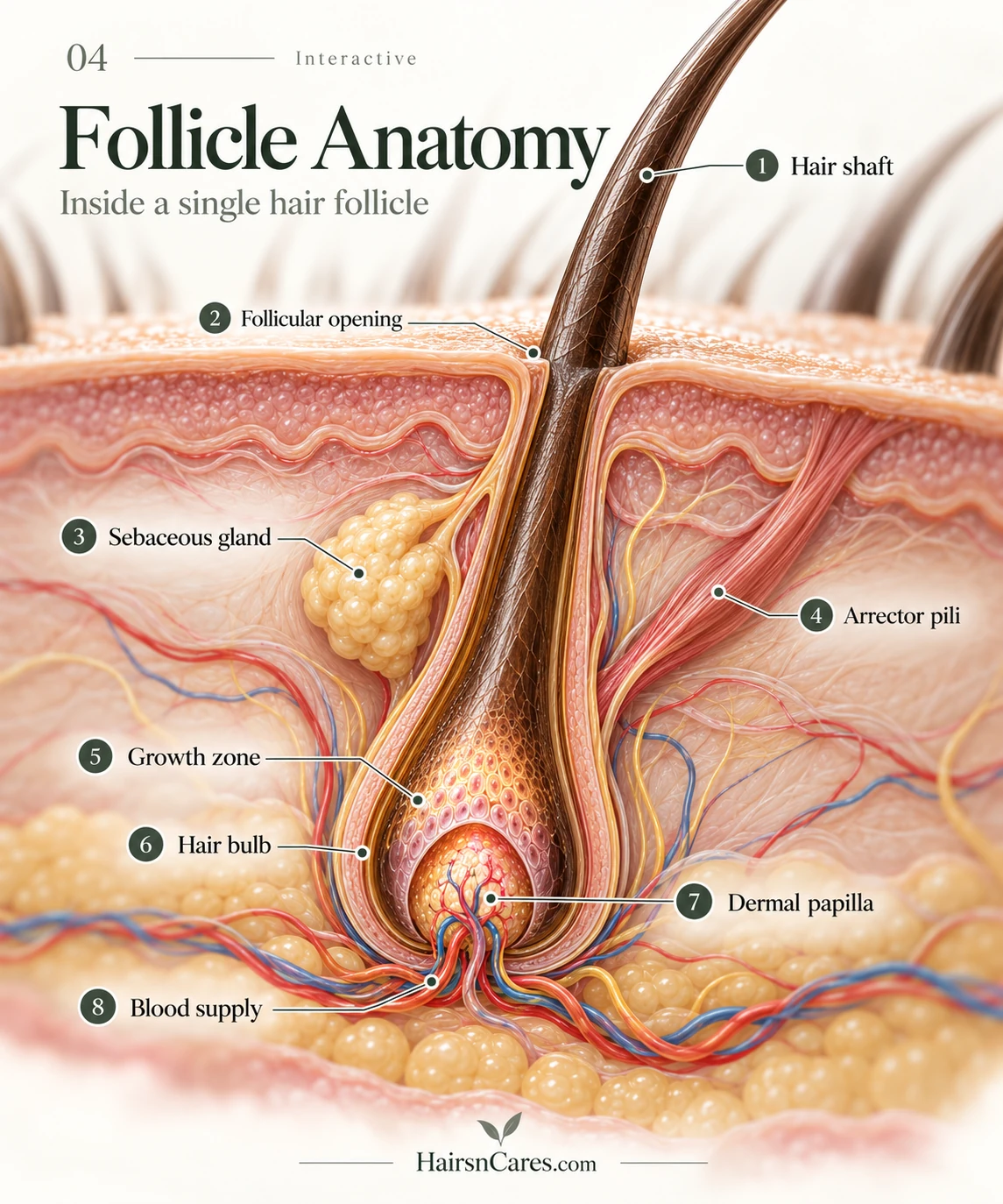
Follicle Anatomy · Interactive

Inside a single hair follicle

Select any marker on the cutaway to read what that structure does. Every part is also listed underneath, so nothing depends on the interaction.

Anatomical cutaway of a hair follicle beneath the scalpA cross-section through the scalp showing the hair shaft emerging at the surface, the follicular opening, a sebaceous gland, the arrector pili muscle, the hair bulb, the matrix growth zone, the dermal papilla and the capillary blood supply beneath it.

Follicle explorer

Select a marker

Tap or focus any marker on the cutaway to read what that structure does and why it matters clinically.

  • Hair shaft — the visible keratinised fibre above the scalp; contains no living cells.
  • Follicular opening — the pore where the fibre emerges and sebum reaches the surface.
  • Sebaceous gland — produces sebum, which lubricates the fibre and forms part of the surface film.
  • Arrector pili muscle — a small smooth muscle attached to the follicle that raises the hair.
  • Growth zone (matrix) — rapidly dividing cells that build the new fibre during active growth.
  • Hair bulb — the widened base housing the matrix and the pigment-producing melanocytes.
  • Dermal papilla — specialised cells that influence follicular activity and fibre calibre.
  • Blood supply — capillaries delivering oxygen and nutrients to the base of the follicle.

Follicles also sit in groups. What looks like one hair per pore is often two or three emerging together, which is why density is counted as follicular units rather than hairs.

Mechanism · Six Stages

How a follicle actually builds a hair

Six stages turn signalling at the base of the follicle into a fibre you can see, feel and style. Every property of that fibre is fixed before it reaches the surface.

Biological signallingSignals influenced by the dermal papilla govern whether the follicle stays in growth and how large a fibre it builds.
Matrix-cell activityRapidly dividing matrix cells in the bulb generate the material of the fibre — activity that depends heavily on blood supply and nutrition.
KeratinisationAs cells move upward they specialise, lose their nuclei and compact into a dense keratin-rich fibre with a defined internal architecture.
PigmentationMelanocytes in the bulb transfer pigment while the fibre is being built. Pigment is never added afterwards — which is why a grey hair stays grey.
EmergenceThe formed shaft travels up the follicular canal, passes the sebaceous duct and becomes visible above the scalp.
RenewalThe follicle cycles through growth, transition, rest and release, then begins the sequence again with a new fibre.

The consequence worth remembering: because the fibre is built below and then grows out slowly, anything that changes follicular activity — an illness, a deficiency, a medication, a treatment that works — becomes visible months later. This is the single biggest reason people misattribute cause and effect in hair.

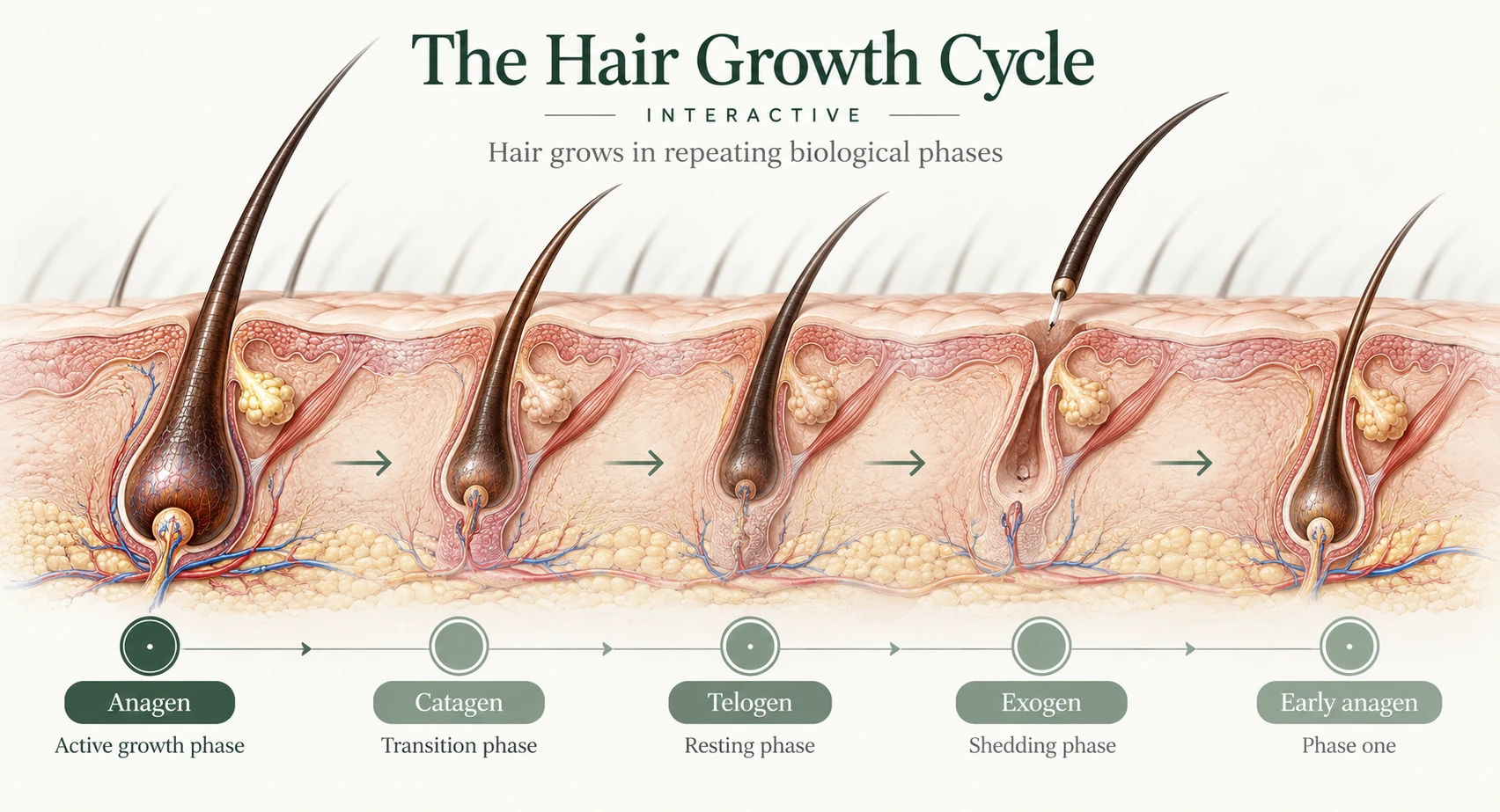
The Hair Growth Cycle · Interactive

Hair grows in repeating biological phases

Each follicle runs its own cycle independently of its neighbours. That independence is why healthy scalps shed continuously rather than all at once — and why coordinated shedding is a signal.

Phase one

Anagen — the active growth phase

The follicle is fully formed and actively producing fibre. Matrix cells divide, pigment is added and the shaft lengthens. Most scalp hairs are in this phase at any given time, and how long a follicle stays in anagen strongly influences how long that hair can grow.

  • Fibre is actively built and pigmented here, nowhere else
  • Anagen duration differs by body site and by individual — which is why eyelashes never reach waist length
  • A shortened anagen is a defining feature of miniaturisation

Phase two

Catagen — the transition phase

A brief transition in which active growth slows and the lower follicle regresses. The base of the fibre consolidates into a club shape and the follicle separates from its papilla, which travels upward with it.

  • The shortest phase of the cycle
  • Pigment production stops here
  • The club-shaped root forms now — not at the moment of shedding

Phase three

Telogen — the resting phase

The follicle is relatively inactive while the club hair is retained in place. Nothing appears to be happening from outside, which is exactly why a triggering event and the shedding that follows it can be separated by two to three months.

  • The fibre is held, not built
  • A rise in the proportion of telogen follicles is what produces an effluvium
  • Expect a delay between trigger and visible shedding — look back, not at today

Phase four

Exogen — the release phase

The release phase, when the old fibre sheds. A hair found on a pillow or in a brush with a small pale bulb at its base has completed this sequence normally. A hair that snapped mid-length has not — that is breakage, and it points somewhere completely different.

  • Shedding here is a normal endpoint, not a failure
  • Washing and brushing collect hairs that were already released
  • Compare with breakage versus shedding

Phase five

Early anagen — renewal

The follicle re-enters active growth and begins producing a new fibre. In healthy cycling, the replacement is comparable to what came before. Where miniaturisation is occurring, each successive cycle tends to produce a finer, shorter fibre — which is why thinning appears gradual rather than sudden.

  • New fibre begins below the surface and takes weeks to emerge
  • Short regrowing hairs along the hairline are usually normal, not breakage
  • Read about hair miniaturisation

Important: hair-cycle timing varies between follicles and between individuals. Sudden, persistent or excessive shedding cannot be accurately assessed from cycle timing alone, and no online table can tell you which phase your follicles are in.

Diagram of the anagen, catagen, telogen and exogen phases of the human hair growth cycleFive follicles side by side. In anagen the follicle is deep and actively producing a pigmented fibre. In catagen the lower follicle regresses and a club-shaped base forms. In telogen the club hair rests in a shortened follicle with the papilla below it. In exogen the club hair is released. In early anagen the follicle re-forms and begins a new fibre.AnagenCatagenTelogenExogenEarly anagen
Follicles cycle independently. Selecting a phase highlights it in the diagram. The diagram shows sequence, not duration — timings differ between follicles, body sites and individuals.

Hair-Fibre Science

The visible fibre has three structural layers

Almost everything a haircare product does happens in or on these layers — which is also the honest limit of what a product can do.

Cuticle

The outer protective layer of overlapping cells. Its condition governs smoothness, shine, friction and how the fibre handles moisture. When these scales lift or erode, hair feels rough and tangles more readily — most "damage" people describe is cuticle damage.

Cortex

The main structural region, holding keratin bundles, most of the pigment and most of the mechanical strength. Colouring, relaxing and permanent shaping work at this level, which is why they carry more risk than anything that acts on the surface.

Medulla

A central region that may be present, fragmented or absent depending on the fibre — and even along the length of a single fibre. Its presence tends to vary with thickness and is not a marker of hair health.

Magnified hair shaft cross-section showing the cuticle, cortex and medullaOn the left, a length of hair shows overlapping cuticle scales along its surface. On the right, a circular cross-section shows the cuticle as a layered outer ring, the cortex as the thick keratin-rich middle region, and the medulla as a small central core.Overlapping cuticle scalesCuticleCortexMedulla
Schematic cross-section. Proportions are drawn for clarity and are not to scale.

The distinction I repeat most oftenHaircare products primarily modify the surface condition and manageability of the visible fibre. They do not permanently alter the biological programming of the follicle. Improved feel is real and worth having — it is simply a different thing from changed growth, and conflating the two is how people end up disappointed by products that were never at fault.

Scalp Biology

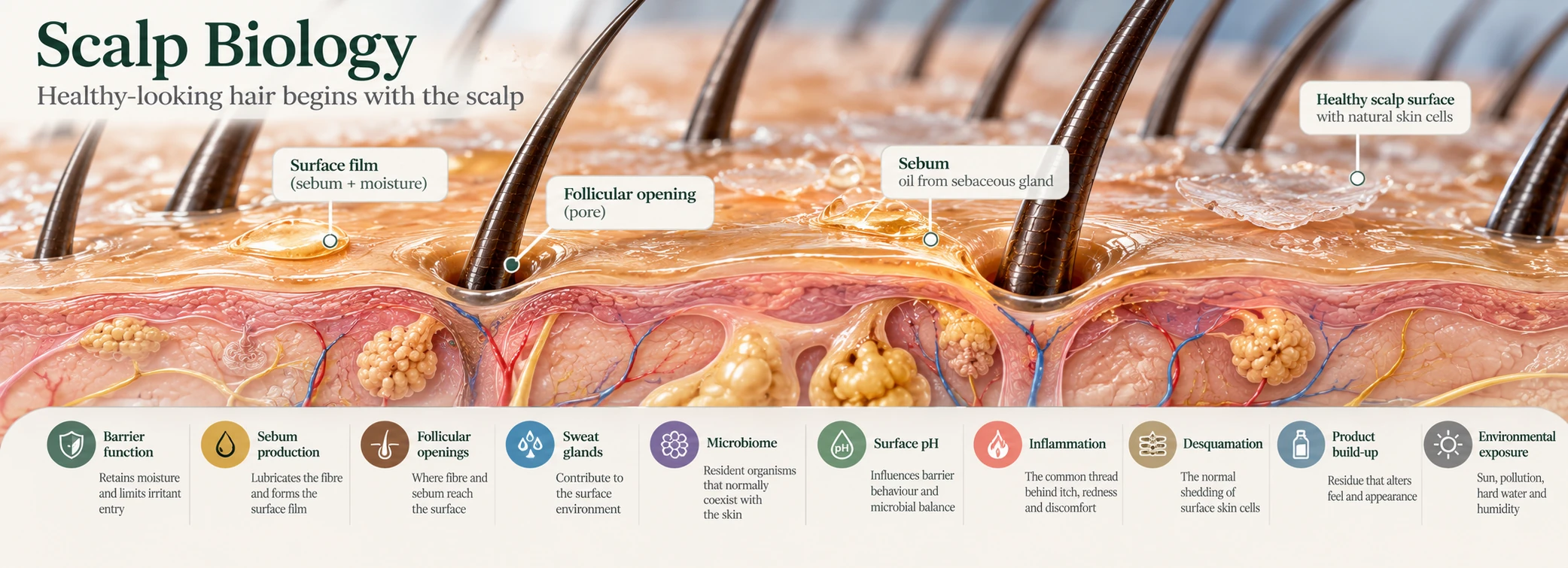
Healthy-looking hair begins with the scalp

The scalp is skin with an unusually high density of follicles and sebaceous glands. Every follicle sits inside it, which makes scalp condition and hair condition related questions rather than separate ones.

  • Barrier function — retains moisture and limits irritant entry
  • Sebum production — lubricates the fibre and forms the surface film
  • Follicular openings — where fibre and sebum reach the surface
  • Sweat glands — contribute to the surface environment
  • Microbiome — resident organisms that normally coexist with the skin
  • Surface pH — influences barrier behaviour and microbial balance
  • Inflammation — the common thread behind itch, redness and discomfort
  • Desquamation — the normal shedding of surface skin cells
  • Product build-up — residue that alters feel and appearance
  • Environmental exposure — sun, pollution, hard water and humidity
Follicular openings and the surface film at high magnification.

Six scalp states that are frequently confused

Flaking, itching and oiliness are symptoms, not diagnoses. The same appearance can arise from different processes, and the appropriate response differs accordingly.

Six Influences

Why hair differs between individuals

Six influences account for most of the variation people notice in themselves and compare in others. They rarely act alone, and only one of them is fully within your control.

Genetics

Influences density, colour, curl pattern, diameter and predisposition to certain forms of hair loss. It sets the range within which everything else operates.

Genetics and inheritance · Curl pattern

Hormones

Androgens, thyroid hormones, oestrogen and other signals may influence follicular activity, cycle length and fibre diameter in susceptible follicles.

Androgens and DHT · Thyroid and hair

Age

Growth cycles, pigmentation, fibre diameter and density all change over time. Some of what reads as loss is a gradual reduction in the calibre of each fibre.

Age-related thinning · Why hair greys

Scalp environment

Sebum, barrier function, inflammation and microbial balance affect comfort, flaking and washing needs — and, when inflammation persists, more than that.

Scalp barrier · Sebum production

Nutrition and systemic health

Protein, iron status and selected micronutrients can influence hair production when clinically deficient. Correcting a deficiency helps; supplementing without one generally does not.

Iron and ferritin · Protein intake

Haircare exposure

Heat, colouring, chemical processing, friction and grooming alter the visible fibre without necessarily damaging the follicle. This is the influence you actually control.

Heat damage · Chemical damage

Decision Support

When is a hair change worth investigating?

Most hair changes are ordinary. A smaller group deserves an examination rather than another product. The distinction is about pattern and pace — not about how worried you feel.

Common biological variation

  • Gradual changes with age
  • Natural differences in density between people and scalp regions
  • Different curl patterns and fibre shapes
  • Seasonal perception of increased shedding
  • Variation in fibre diameter across the scalp
  • Changes after a new routine, style or grooming habit

Reassess with a professional

  • Shedding that has continued beyond a few months
  • Density reducing rather than staying stable
  • Progressive hairline or crown change
  • Hair change following a new medicine or major illness
  • Persistent itch, flaking or discomfort despite reasonable care
  • Broken hairs together with scalp abnormalities

Seek assessment promptly

  • Sudden or heavy shedding
  • Patchy hair loss
  • Scalp pain, burning or marked inflammation
  • Suspected scarring, or areas where follicular openings appear lost
  • Eyebrow or body-hair loss
  • Hair loss with other systemic symptoms

To be clear: the third column is not a list of diagnoses and not a prediction. Several of those situations have straightforward, reversible explanations. They appear there because they are the cases where an examination gives a better answer than any amount of reading can.

Biology → Concern

Connect the biology with what you are experiencing

Start from the thing you have actually noticed. Each card lists the mechanisms most often involved, so you can read the relevant biology rather than all of it.

Biology → Product Science

How hair biology makes product choice rational

Every product has a target: the scalp surface, the fibre, the follicle or your systemic status. Matching the product to the target is most of what good selection involves.

What Each Category Can And Cannot Do
Product category, biological target and realistic expectation
CategoryTargetWhat it can doWhat it cannot do
ShampooScalp surfaceRemove oils, debris and styling residue; deliver scalp activesChange growth; frequency matters as much as formula
Conditioner & masksThe fibreImprove lubrication, detangling, smoothness and feelPermanently repair a fibre that has no living cells
Scalp treatmentsScalp conditionAddress a defined need — flaking, irritation, oilinessSubstitute for diagnosis when the need is undefined
Hair-loss treatmentThe follicleAct on follicular activity where clinically indicatedBe treated as interchangeable with cosmetic serums
SupplementsSystemic statusCorrect a confirmed deficiencyHelp without one — and some carry risk in excess
Heat & styling protectionThe fibreReduce damage from thermal and mechanical exposureReverse severe structural damage already present
Scalp acts on skin Fibre acts on the visible hair Follicle medical route, clinician-led Systemic depends on testing

The question worth asking before any purchaseWhich of the four targets does this product act on, and is that the target my problem actually sits at? A conditioner cannot help a follicular problem and a follicular treatment will not smooth a damaged cuticle. Most disappointment in haircare is a targeting error, not a product failure.

Myths vs Facts

12 hair biology myths — corrected

Almost every persistent hair myth comes from confusing the living follicle with the inert fibre, or from expecting a slow biological process to behave quickly.

Myth

“Hair is dead, so nothing matters.”

Fact

The fibre is not alive, but the follicle that makes it is very much alive — and responsive to hormones, nutrition, illness and inflammation. Half the subject is living tissue.

Myth

“Losing hair every day means something is wrong.”

Fact

Daily shedding is normal cycling. Every follicle eventually releases its fibre and starts again. What matters is a sustained change from your own usual pattern, not the presence of shed hairs.

Myth

“Washing hair often causes hair loss.”

Fact

Washing collects hairs that had already completed their cycle and were being held in place. Washing less often just means seeing more at once on the days you do.

Myth

“Cutting hair makes it grow faster or thicker.”

Fact

Length is decided at the follicle, not at the ends. Trimming removes split ends and improves how hair looks and behaves, but has no effect on growth rate or diameter.

Myth

“A protein or keratin treatment repairs damaged hair.”

Fact

It can temporarily fill, coat and smooth — genuinely improving feel and reducing breakage. It does not restore the original structure. Truly restored hair arrives as new growth.

Myth

“Scalp massage and better blood flow regrow hair.”

Fact

The follicle does depend on its blood supply, but poor circulation is rarely why hair thins. Massage may feel good and help distribute products; it is not a treatment for pattern hair loss.

Myth

“Grey hair can be reversed by pulling it out.”

Fact

Pigment is added while the fibre is being built, never afterwards. Removing a grey hair usually means the same follicle produces another unpigmented fibre — and plucking risks the follicle.

Myth

“Hair loss is inherited only from the mother's side.”

Fact

Predisposition to pattern hair loss involves contributions from both sides of the family and multiple genes. A clear family history on either side is relevant.

Myth

“Wearing hats or helmets causes baldness.”

Fact

Ordinary headwear does not cause pattern hair loss. Persistent tight tension on the same hairs — tight styles, not hats — is what causes traction-related damage over time.

Myth

“If a product hasn't worked in four weeks, it doesn't work.”

Fact

Hair is built below the surface and grows out slowly. Any change in follicular activity needs months to become visible as length. Four weeks is too early to judge almost anything.

Myth

“Dandruff just means a dry scalp, so use more oil.”

Fact

Flaking has several possible causes, and greasy scaling with microbial involvement is common. Adding oil to that can make it worse. Flaking is a symptom, not a diagnosis.

Myth

“More supplements mean better hair.”

Fact

Correcting a confirmed deficiency can help. Beyond that, extra intake does not add benefit, and some nutrients are harmful in excess. Test, then treat — not the other way around.

Medically Reviewed Content

Reviewed by Dr. Amit S. Agarkar

MBBS, MD Dermatology, FCPS, DDV · Dermatologist, Trichologist & Hair Transplant Surgeon, Mumbai

"Most people arrive having tried products for months. My first job is usually not to prescribe anything — it is to work out whether the problem sits at the follicle or on the fibre. Get that right and the rest is straightforward. Get it wrong and no amount of effort helps."

Reviewed: 26 July 2026 · Next scheduled review: July 2027

Where To Go Next

Choose the path that matches why you came here

Four routes through the same library, depending on what you are trying to work out.

Foundational guides to read next

Trusted external references

For readers who want to go further, these independent medical resources cover hair biology and the conditions discussed here. Each child guide in the Atlas carries its own topic-specific references.

  1. MedlinePlus — Hair loss: overview, causes and related issues
  2. MedlinePlus Medical Encyclopedia — Hair loss: patterns, assessment and when to seek care
  3. American Academy of Dermatology — hair and scalp care guidance
  4. NIAMS (NIH) — alopecia areata: how immune-mediated hair loss differs
  5. PubMed — research literature on the hair follicle cycle

External links open in a new tab and lead to independent organisations whose content HairsnCares does not control. References are educational, not treatment instructions. [ADD APPROVED TEXTBOOK CITATIONS]

FAQs · Curated Answers

Hair biology — 18 questions answered

The questions we hear most often, answered without hype and without diagnosis.

The visible hair fibre is made largely of keratin, a structural protein, along with lipids, water, trace minerals and pigment. These components are assembled inside the follicle before the fibre emerges above the scalp.

No. The hair you see and style is a keratinised fibre without living cells. The living, biologically active part sits inside the follicle beneath the skin, which is why care products can improve the condition of the fibre but cannot reprogramme the follicle.

Growth begins in the hair bulb at the base of the follicle, where matrix cells divide under signals influenced by the dermal papilla and the surrounding blood supply.

The hair follicle is a small tube-like organ within the skin that produces a hair fibre. It includes the bulb, matrix, dermal papilla, inner and outer root sheaths, a sebaceous gland and an arrector pili muscle.

Follicles cycle through anagen (active growth), catagen (transition), telogen (rest) and exogen (release of the old fibre), before re-entering early anagen and producing a new fibre. Timing varies between follicles and between individuals.

Everyone sheds hair daily as part of normal cycling, and the amount varies with hair length, density, washing frequency and grooming habits. What matters more than a single number is a sustained change from your own usual pattern, especially when density is visibly reducing.

Texture is influenced mainly by the shape of the follicle and the cross-sectional shape of the fibre it produces, together with how keratin is distributed within the cortex. Genetics is the dominant influence.

Colour comes from melanin produced by melanocytes in the hair bulb during active growth. The type and amount of melanin transferred into the fibre determine the shade.

Greying reflects reduced pigment production as melanocyte activity within the follicle declines. Age and genetics are the strongest influences, and oxidative processes are thought to contribute.

Visible thinning can reflect a reduction in fibre diameter, a reduction in the number of hairs in active growth, or both. Genetic predisposition, hormonal influences, nutritional deficiency, illness and inflammatory scalp conditions can all contribute, and the cause cannot be determined from appearance alone.

The fibre has no living cells, so structural damage cannot biologically heal. Conditioning products can temporarily improve smoothness, lubrication and appearance, while genuinely restored hair arrives as new growth from the follicle.

Washing does not create shedding. It collects hairs that had already completed their cycle and were being held in place. Washing less often usually means seeing more hairs at once on the days you do wash.

The scalp is the skin the follicle sits in. Barrier disruption, persistent inflammation, microbial imbalance or heavy build-up can affect comfort and scalp condition, and prolonged inflammatory disorders may affect follicles.

Yes. Androgens including DHT, thyroid hormones and reproductive hormones can influence follicular activity and cycle length in genetically susceptible follicles. Hormonal contributions are assessed clinically, not from photographs.

Clinically significant deficiencies, particularly of protein or iron, can affect hair production. Supplementing without a confirmed deficiency is not automatically beneficial, and some nutrients can be harmful in excess.

The follicle does depend on its blood supply, but poor circulation is not the usual reason hair thins. Massage may feel pleasant and help with product distribution; it is not a treatment for pattern hair loss.

Because hair is built inside the follicle and then grows out slowly, any change in follicular activity takes months to become visible as length. This is why credible assessment of a hair treatment is measured in months, not weeks.

Consider assessment for sudden or persistent heavy shedding, rapid reduction in density, patchy loss, scalp pain, burning or marked inflammation, progressive hairline or crown change, suspected scarring, or hair loss with other systemic symptoms.

No matching question yetTry a different word, or clear the filter to see all 18 answers. If your question isn't here, ask it directly.

Still have a question about your hair?

Hair biology explains mechanisms. Working out which mechanism applies to you needs your history — and often an examination.

Your Next Step

Understand your hair before choosing what comes next

Hair concerns often look alike while arising from very different biological, cosmetic or medical causes. Start with a structured assessment, read the relevant science, and seek professional guidance when the pattern is sudden, persistent or unclear.

Medical Disclaimer: This page provides general educational information about hair and scalp biology and does not constitute medical advice, diagnosis or treatment. It explains mechanisms; it cannot identify which mechanism applies to you. Persistent, sudden, patchy or symptomatic hair loss — and any scalp pain, burning, marked inflammation or suspected scarring — should be evaluated by a qualified dermatologist. No product referenced on HairsnCares is presented as a guaranteed treatment for hair loss. Individual results vary.

Your Cart (0)

Your cart is empty

Subtotal0
DeliveryFREE
Total0
🔒 Secure📦 Free above ₹499↩ Easy returns
💬 Hi! I'm Dr. Amit — your Hair Intelligence consultant
🌿
1
🌿
Dr. Amit
Virtual Dermatologist · Hairsncares.com
Online
What are you shopping for today?
Select a category to begin
AI-powered scalp diagnosis · Hairsncares.com
📸
Scalp Analyser
Upload scalp photo · Get conditions, root cause, and matched product protocol
📷
Drop scalp photo here or click to upload
JPG, PNG, WEBP · Clear, close-up, well-lit photo

Your image is processed privately by our AI engine and saved securely with your account.