DOCTOR-REVIEWED HAIRCARE INGREDIENT GUIDE

Haircare Ingredients Guide India: Know What Works, What Supports & What Needs Doctor Guidance

Before buying a shampoo, serum, supplement, oil or active hair-loss product, it helps to understand the ingredient behind it. Some ingredients have stronger clinical use in selected conditions, some support scalp comfort, some are mainly cosmetic, and some need doctor supervision. Every ingredient has a different role, evidence level, safety profile and suitability — no single one cures every hair loss, and cosmetic ingredients are not the same as prescription medicines. Results vary.

  • Evidence-tiered: medicine, support, cosmetic or deficiency-based
  • Doctor-guided actives clearly marked
  • Nutrients help mainly when a deficiency exists
  • Cosmetic ingredients support routines, not cures
  • Match the ingredient to your diagnosis
🧪
Ingredient Suitability PreviewAI Ingredient Finder — sample
ConcernHair fall / dandruff / frizz
Ingredient typeActive / supplement / cosmetic
Evidence levelStrong → cosmetic support
Doctor guidanceIf diagnosis is unclear
Product pathwayShampoo / serum / supplement / oil

Illustrative sample only. The AI tools screen patterns and do not diagnose, prescribe or endorse a brand. No ingredient cures hair loss; results vary.
🩺
Doctor-reviewedMD Dermatology
AI Hair & Scalp Testfree
📊
Evidence-labelledstrong → cosmetic
⚖️
Honest claimsno cures, no hype
🚚
India-widedelivery
Image slot
🩺
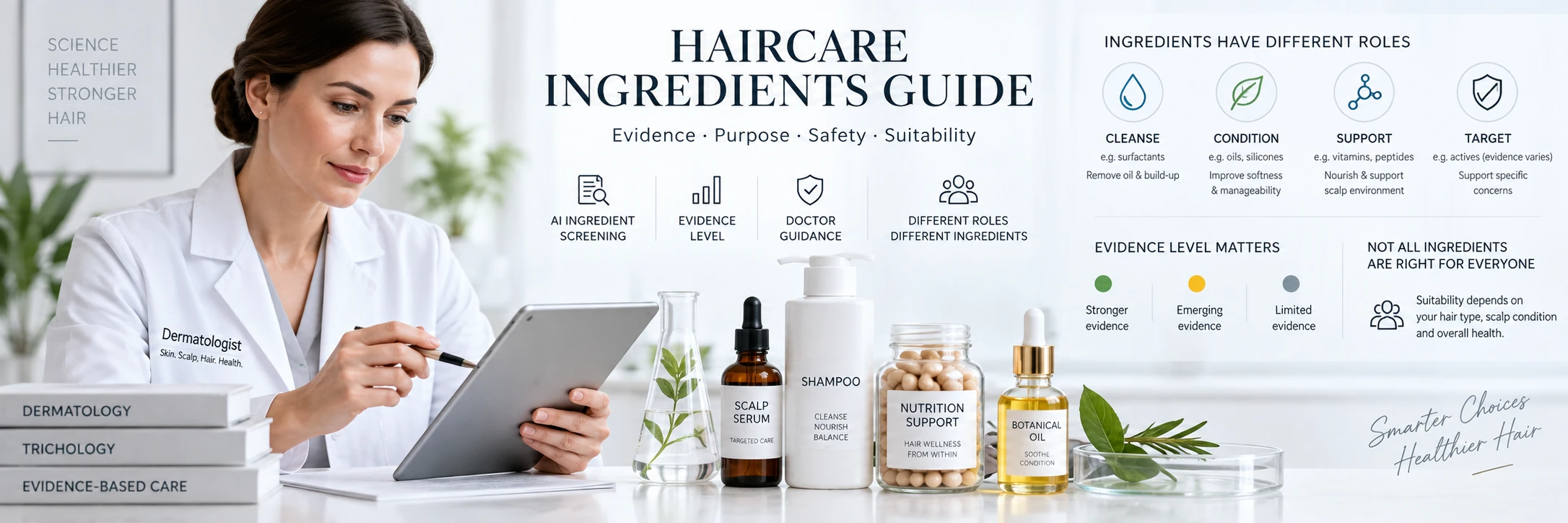
Doctor-reviewed ingredient guide — trust visualalt: "Dermatologist-reviewed ingredients guide and AI screening" · 1200×400 WebP · loading="lazy"
Quick Answer

Which haircare ingredients actually help hair growth?

It depends on the cause — ingredients are not interchangeable. Some have stronger evidence for selected conditions: Minoxidil for doctor-suitable pattern hair loss, or Ketoconazole for certain dandruff-prone and seborrheic-prone scalps. Nutrients like iron, vitamin D, B12, zinc or biotin may help mainly when a deficiency is present — not otherwise. Cosmetic ingredients like Redensyl, Procapil, caffeine, peptides or Rosemary Oil may support a haircare routine and the appearance of hair, but they are not medicines, do not guarantee regrowth, and results vary. Crucially, no ingredient cures every type of hair loss, and a cosmetic ingredient is not equal to a prescription medicine. The right ingredient is the one matched to your diagnosis — pattern loss, sudden shedding, deficiency, dandruff, dryness, frizz or breakage — so identify the cause first with the AI Hair Test or AI Scalp Test, read the evidence labels below, and see a doctor for anything sudden, patchy, progressive or medical. Results vary.

How to Read the Evidence

Ingredient Evidence Scale

Not all ingredients are equal. We label each by how strong the evidence is and whether a doctor should be involved — so you can tell a medicine from cosmetic support.

Strong / medicine-level

Strong evidence / medicine-level use — used in selected diagnosed conditions and often needs doctor guidance.

Moderate support

Moderate support — may have supportive evidence or common dermatology use in specific contexts.

Limited evidence

Limited evidence — may help selected users, but claims should be cautious.

Cosmetic support

Cosmetic support — mainly improves appearance, comfort, texture, scalp feel or routine consistency.

Deficiency-dependent

Deficiency-dependent — useful mainly when a nutritional deficiency or dietary risk exists.
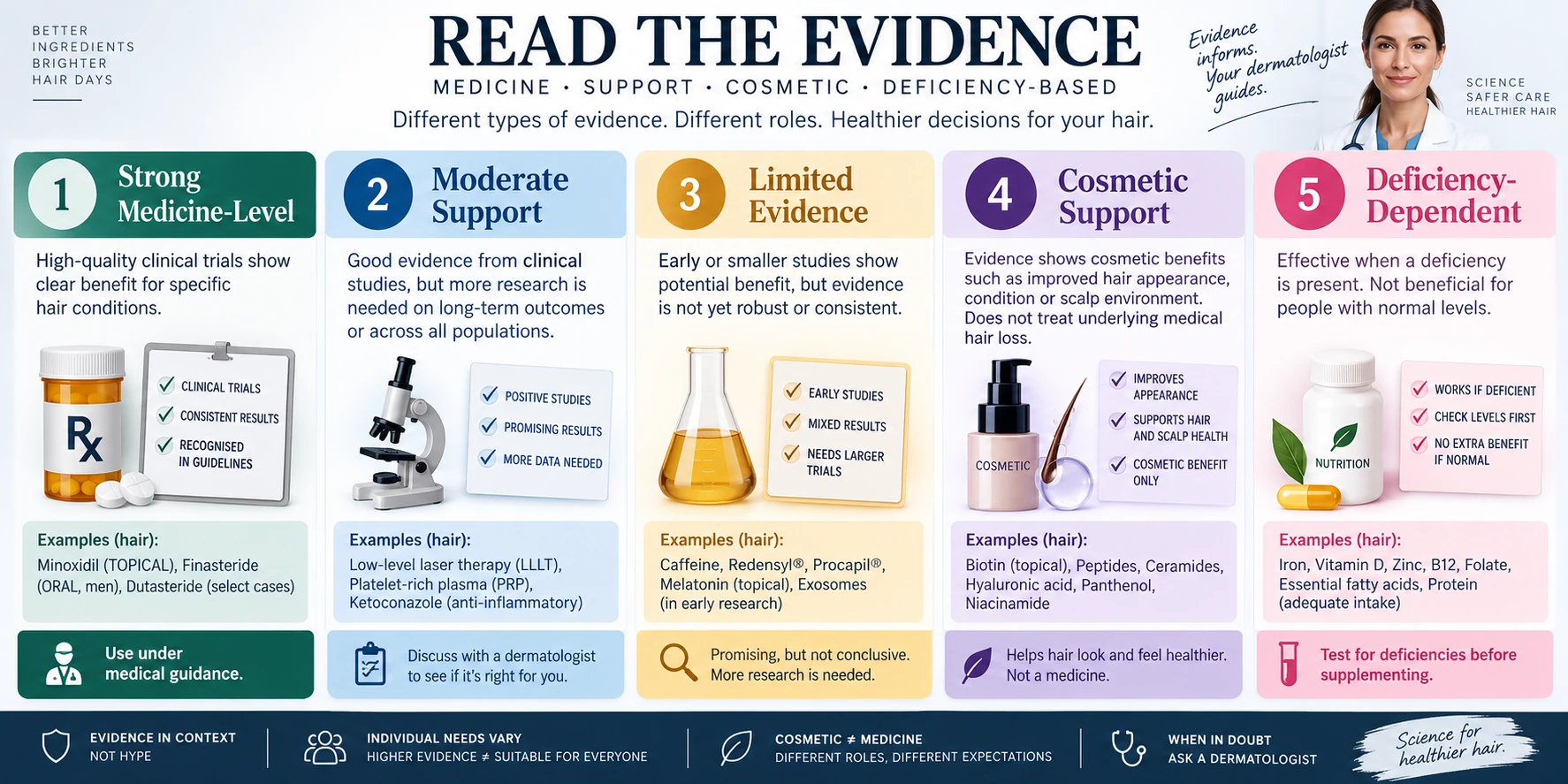
Image slot
📊
How to read the evidence — visualalt: "How to read ingredient evidence levels, dermatologist-reviewed" · 1200×600 WebP · loading="lazy"
By Purpose

Ingredient Categories

Grouped by what they are typically used for. Tap an ingredient to learn more, or screen your concern first with the AI tools.

🌱Hair Growth / Regrowth

From a doctor-guided medicine to cosmetic-support actives. Evidence varies widely across this group.

Minoxidil (medicine)RedensylProcapilCaffeinePeptidesRosemary OilSaw Palmetto (caution)

💪Hair Fall / Nutrition Support

Nutrients that help mainly when a genuine deficiency exists. Test, don't guess.

BiotinIronFerritin supportVitamin DVitamin B12ZincAmino acidsProteinFolate

🧴Dandruff & Scalp Care

Antifungal-type and exfoliating actives plus soothing agents. Some are doctor-guided for stubborn cases.

KetoconazoleZinc PyrithioneSalicylic AcidPiroctone OlamineSelenium SulfideTea Tree Oil (caution)NiacinamidePanthenol

💧Dry Hair / Frizz / Damage

Cosmetic shaft-care ingredients for moisture, smoothness and the look of damaged hair.

Hyaluronic AcidCeramidesPanthenolGlycerinAmino acidsPeptidesArgan OilJojoba OilShea ButterLight silicones

🌿Sensitive Scalp / Barrier Support

Gentle, soothing, barrier-supporting ingredients and fragrance-free formulas.
NiacinamidePanthenolCeramidesHyaluronic AcidMild surfactantsFragrance-free formulasSoothing botanicals (caution)
Image slot
🧪
Ingredient categories by purposealt: "Haircare ingredient categories by purpose" · 1200×700 WebP · loading="lazy"
Ingredient A–Z

Key Haircare Ingredients

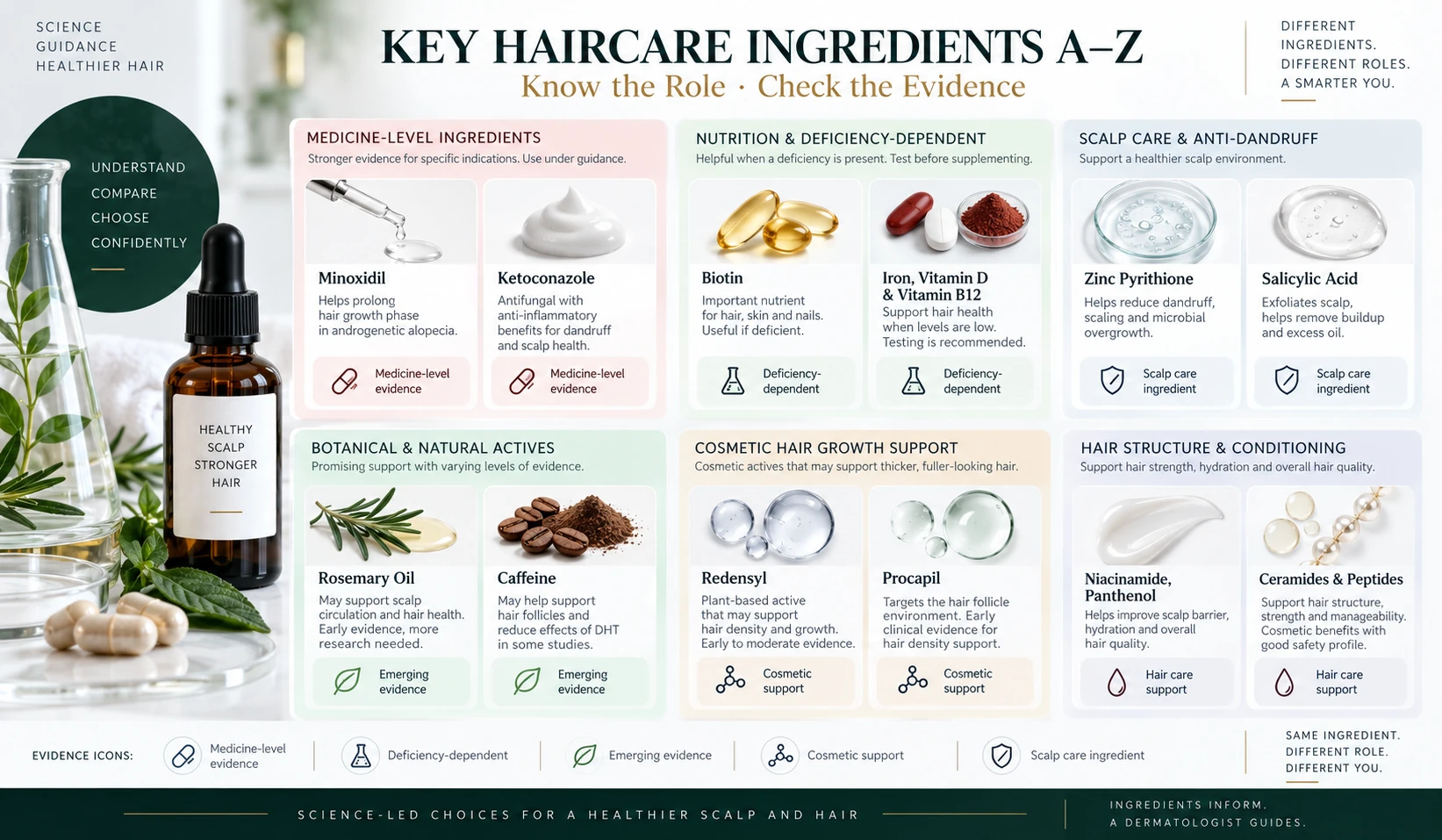
Each card shows the evidence level, what it is best for, the usual product types and whether a doctor should be involved.

Minoxidil
💊
Strong / medicine-level
Best for
selected pattern (androgenetic) hair loss
Product
Solution, foam
🩺 Doctor-guided — suitability check first
Biotin
💊
Deficiency-dependent
Best for
true biotin deficiency (uncommon)
Product
Supplements
🩺 Needed if deficiency is unclear; can skew lab tests
Rosemary Oil
🌿
Limited evidence
Best for
cosmetic routine support
Product
Hair oil
🩺 Caution: pregnancy, sensitivity, medical loss
Ketoconazole
🧪
Moderate support
Best for
selected dandruff / seborrheic-prone scalp
Product
Shampoo
🩺 Recommended for recurrent / severe cases
Redensyl
🧪
Cosmetic support
Best for
mild cosmetic support routines
Product
Serum, tonic
🩺 Cosmetic; not a medicine
Procapil
🧪
Cosmetic support
Best for
mild hair-fall support routines
Product
Serum, tonic
🩺 Cosmetic; no regrowth guarantee
Caffeine
Limited evidence
Best for
cosmetic haircare routines
Product
Shampoo, serum, tonic
🩺 Not a substitute for pattern-loss treatment
Zinc Pyrithione
🧴
Moderate support
Best for
dandruff-prone scalp
Product
Shampoo
🩺 OTC; doctor for stubborn cases
Salicylic Acid
🧪
Moderate support
Best for
flaky scalp, buildup
Product
Shampoo, exfoliant
🩺 Avoid inflamed/sensitive scalp unless guided
Iron
💪
Deficiency-dependent
Best for
low iron / ferritin shedding
Product
Supplements
🩺 Confirm with blood tests first
Vitamin D
☀️
Deficiency-dependent
Best for
confirmed low vitamin D
Product
Supplements
🩺 Dose by blood level; don't overdose
Vitamin B12
💉
Deficiency-dependent
Best for
vegetarian / vegan, low B12
Product
Supplements
🩺 Check level if symptoms
Niacinamide
🧴
Cosmetic support
Best for
scalp comfort, soothing
Product
Serum, scalp care
🩺 Cosmetic; generally gentle
Panthenol
💧
Cosmetic support
Best for
moisture, softness
Product
Conditioner, leave-in
🩺 Cosmetic; well tolerated
Ceramides
🛡️
Cosmetic support
Best for
damaged, rough hair
Product
Mask, leave-in
🩺 Cosmetic shaft support
Peptides
💉
Cosmetic support
Best for
cosmetic shaft / scalp support
Product
Serum, tonic
🩺 Cosmetic; not a treatment

Also available — full ingredient guides:

Image slot
📚
Ingredient A–Z — visual indexalt: "Key haircare ingredients A to Z" · 1200×700 WebP · loading="lazy"
Compare

Ingredient & Product Comparisons

Side-by-side, doctor-reviewed comparisons to help you choose between similar ingredients and formats.
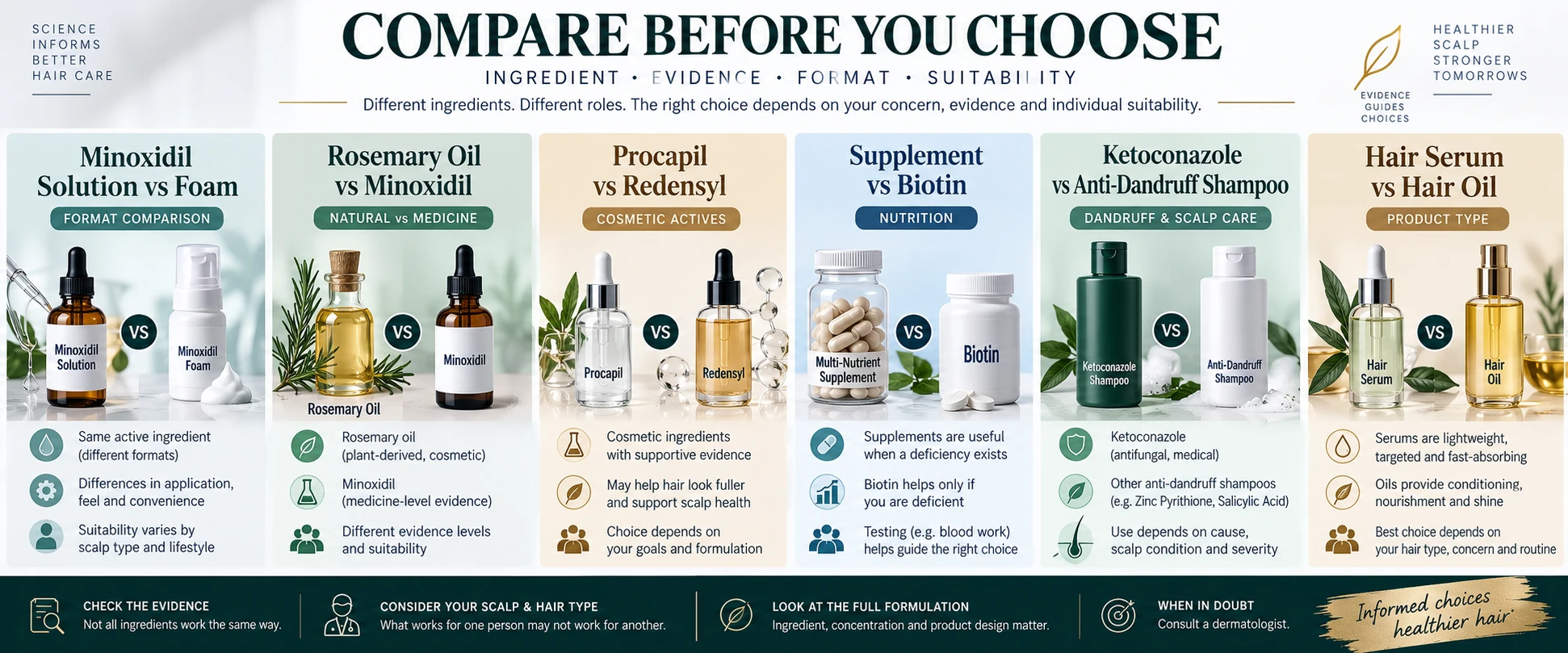
Image slot
⚖️
Ingredient comparisons — visualalt: "Ingredient and product comparisons" · 1200×500 WebP · loading="lazy"
Decision Guide

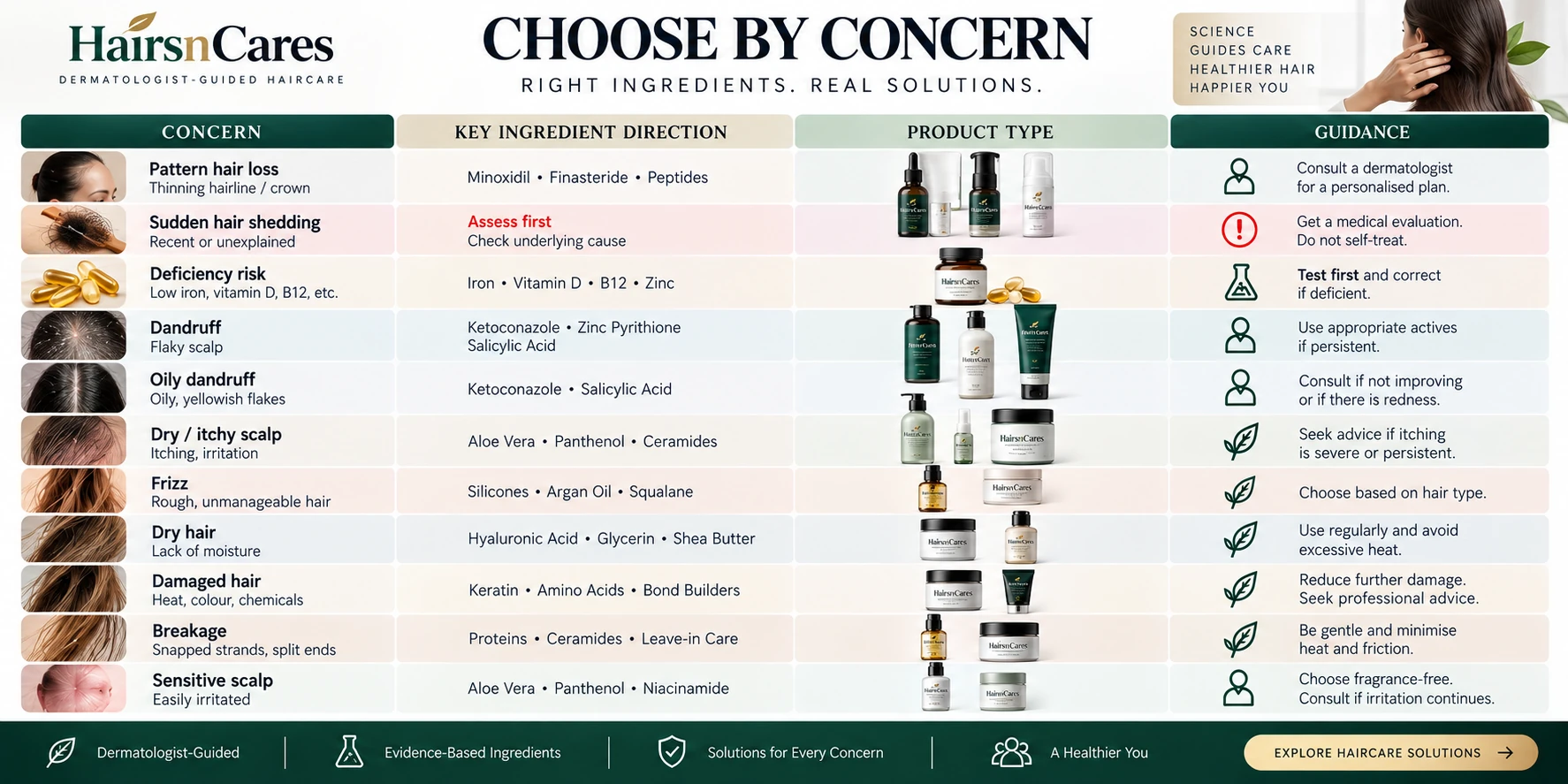
Choose Ingredients by Concern

A clean, extractable guide from concern to a likely ingredient direction and product type. It points to a pathway; it is not a diagnosis.

ConcernIngredient directionProduct typeDoctor needed?
Male pattern hair lossMinoxidil (doctor-guided)Solution / foamYes
Female pattern hair lossMinoxidil, selected casesSolution / foamYes
Crown thinningMinoxidil; cosmetic supportSolution / foam / serumYes
Widening partingAssess; Minoxidil if suitableSolution / foamYes
Sudden hair fallFind the cause first— (assess)Yes
Post-fever sheddingUsually settles; support nutritionSupplements if lowIf prolonged
Iron deficiency riskIron (if tests confirm)SupplementsTest first
Vitamin D deficiency riskVitamin D (if tests confirm)SupplementsTest first
DandruffKetoconazole / zinc pyrithioneShampoo / lotionIf severe
Oily dandruffAntifungal actives, lighter formulaShampooIf severe
Dry scalpPanthenol, niacinamide, soothingGentle scalp careIf sore
Itchy scalpSoothing + suitable activesShampoo / lotionIf persistent
FrizzGlycerin, smoothing, light siliconesSerum / leave-inNo
Dry hairHumectants, emollientsMask / leave-inNo
Damaged hairCeramides, amino acids, peptidesMask / leave-inNo
Hair breakageMoisture + light proteinConditioner / maskIf unexplained
Sensitive scalpNiacinamide, panthenol, fragrance-freeGentle scalp careIf reacting
Image slot
🎯
Choose ingredients by concern — guide visualalt: "Choosing haircare ingredients by concern, decision guide" · 1200×600 WebP · loading="lazy"
AI Ingredient Finder

Not Sure Which Ingredient You Need?

Answer a few quick questions about your concern, pattern, scalp, history and preferences, and the AI finder will suggest an ingredient category, an evidence level, a product type and safety notes, and flag when a doctor is needed. It distinguishes doctor-guided actives, deficiency-dependent nutrients and cosmetic support — it does not diagnose, prescribe or replace a dermatologist.

Selections pass to the AI tools; output is a suggested ingredient category, evidence level, product type, safety notes and a doctor-consult flag. It does not diagnose, prescribe or replace a dermatologist.
🩺
Doctor's Note

Ingredients Work Only When Matched to the Right Diagnosis

“As a dermatologist, I always tell patients not to buy haircare products only because one ingredient is trending. Minoxidil, Biotin, Rosemary Oil, Ketoconazole, Redensyl and Procapil all have very different roles, evidence and safety. The right ingredient depends on whether the concern is pattern hair loss, sudden shedding, dandruff, deficiency, scalp inflammation, breakage or cosmetic hair damage — and the same ingredient can be helpful for one person and unnecessary, or even unsafe, for another. Read the evidence label, respect the doctor-guided markers, and let me assess anything sudden, patchy, progressive or medical before you spend on a product.”

Reviewed by Dr. Amit Agarkar, MD DermatologyDermatologist & Hair Specialist · Last reviewed 1 June 2026

Sudden, patchy or progressive hair loss, or scalp red flags? Get assessed before choosing an ingredient.

Consult Dr. Amit's Team
Evidence & Safety

Medical References Behind This Guidance

These references are provided for patient education and do not replace a dermatologist's diagnosis or individual medical advice.

AAD

Hair Loss: Causes & Treatment

Dermatologist-led overview of how hair loss is evaluated and the evidence behind common treatments.

View reference ›
NIH / MedlinePlus

Hair Loss Overview

Patient-education summary of common causes of hair loss and when to seek medical care.

View reference ›
PubMed

Peer-Reviewed Literature

Searchable index of peer-reviewed research on hair-care and hair-loss ingredients.

View reference ›
Cochrane Library

Systematic Reviews

Independent systematic reviews assessing the evidence behind hair-loss interventions.

View reference ›
Questions

Frequently Asked Questions

Section image
FAQs — banner900×160 WebP
Which ingredient is best for hair growth?
There is no single best ingredient for hair growth, because it depends on the cause. For doctor-suitable pattern hair loss, Minoxidil has the strongest evidence among topical options, used under guidance. Where a nutritional deficiency exists, correcting iron, vitamin D, B12 or zinc can help. Cosmetic ingredients like Redensyl, Procapil, caffeine, peptides or Rosemary Oil may support a routine but are not medicines and do not guarantee regrowth. So the best ingredient is the one matched to your diagnosis, not the most hyped one. Use the AI Hair Test to clarify your situation, and see a doctor for pattern, sudden or patchy loss. Results vary.
Which ingredient is best for hair fall?
The best ingredient for hair fall depends entirely on why you are shedding. If it is nutritional, correcting a genuine iron, vitamin D, B12 or protein gap helps; if it is pattern hair loss, doctor-guided treatments like Minoxidil are relevant; if it is scalp-related, addressing dandruff or inflammation matters; and if it is breakage rather than root shedding, conditioning ingredients help. No single ingredient fixes all hair fall, and cosmetic ingredients are not the same as medicines. So identify the cause first, ideally with the AI Hair Test and a doctor for anything sudden, patchy or progressive, then match the ingredient to it. Results vary.
Does Minoxidil help hair growth?
Minoxidil has good evidence for supporting hair in selected cases of pattern (androgenetic) hair loss when used correctly and consistently under guidance, so for the right person and diagnosis it can help. However, it is a medicine, not a universal hair-growth product: it works for specific causes, takes months, can cause an early shedding phase, and the benefit lasts only with continued use. It is not suitable for sudden, patchy or unexplained loss, scalp infection, pregnancy, breastfeeding, teenagers or those with heart or blood-pressure concerns without a doctor. So Minoxidil helps growth in suitable pattern-loss cases, doctor-guided, rather than universally. Results vary.
Does Biotin help hair growth?
Biotin helps hair mainly in the specific situation of a true biotin deficiency, which is uncommon in people on a normal diet, by correcting that gap. In people who are not deficient, biotin supplements have limited evidence of benefit for hair, so the popular image of biotin as a guaranteed booster is overstated. It is generally safe at usual doses but is not a cure and is not needed by everyone, and importantly it can interfere with some blood tests, including thyroid and heart tests, so tell your doctor if you take it. So focus on genuine deficiencies rather than assuming biotin alone will help. Results vary.
Does Rosemary Oil help hair growth?
Rosemary oil is a popular natural option with some limited early interest for hair, and it may offer cosmetic support as part of a routine, but the evidence is limited and it is not equivalent to Minoxidil or a proven medical treatment. It can suit people wanting a gentle, natural addition, used diluted in a carrier oil. It is not a treatment for pattern, patchy, scarring or fungal hair loss, and it can cause irritation or allergy, so it should be diluted, patch tested, kept away from the eyes, and used with caution in pregnancy or breastfeeding. So it is cosmetic support with realistic expectations, not a cure. Results vary.
Is Redensyl better than Procapil?
Neither Redensyl nor Procapil is clearly better; both are cosmetic actives used in non-Minoxidil hair serums and tonics to support a hair routine, and neither is a prescription medicine or equivalent to Minoxidil. Their benefit varies between individuals and depends on consistent use and the underlying cause, and high-quality head-to-head evidence is limited. So choosing between them is more about formulation, tolerance and preference than a clear winner, and either can be a reasonable cosmetic option to try with realistic expectations for mild concerns. For genuine pattern or progressive loss, a doctor can advise evidence-based options. Results vary.
Is Rosemary Oil better than Minoxidil?
No, rosemary oil is not better than Minoxidil; they are very different. Minoxidil is a medicine with established evidence for selected pattern hair loss, used under guidance, while rosemary oil is a cosmetic natural oil with limited evidence and a supportive, routine role. Some people prefer rosemary oil for being gentle and natural, but it should not be expected to match a medicine, and it is not a treatment for medical hair loss. So they are not interchangeable: choose based on your diagnosis and goals, with rosemary oil as cosmetic support and Minoxidil as a doctor-guided treatment where suitable. Results vary.
Which ingredient is best for dandruff?
Several ingredients help dandruff, and the best one depends on your scalp. Ketoconazole and zinc pyrithione are common antifungal-type actives useful for many dandruff-prone and seborrheic-prone scalps, salicylic acid helps loosen thick flakes and buildup, and piroctone olamine is another gentle option. The right choice depends on flake type, oiliness, severity and tolerance, and not every case needs the strongest active. So match the ingredient to your scalp, often within a shampoo and sometimes a lotion routine, and see a doctor for severe redness, pain, pus, thick plaques, patchy loss or no improvement. Use the AI Scalp Test to guide selection. Results vary.
Is Ketoconazole good for dandruff?
Ketoconazole is a useful antifungal active for many dandruff-prone and seborrheic-prone scalps, particularly stubborn or recurrent cases, and it has moderate-to-strong support in those contexts when used in a suitable shampoo routine. However, it is not needed for every dandruff case, milder dandruff often responds to gentler actives, and it is not a complete solution for conditions like tinea capitis, which need medical care. Severe redness, pain, pus, crusting, thick plaques, patchy hair loss or scalp scaling in a child need a doctor rather than just a shampoo. So ketoconazole helps selected dandruff cases, with medical input for severe or red-flag symptoms. Results vary.
Which ingredient is best for dry scalp?
For a dry scalp, soothing and hydrating ingredients such as panthenol, niacinamide, glycerin, hyaluronic acid and ceramides help by calming and moisturising, alongside gentle, less frequent washing and avoiding harsh, stripping products. If dry flakes are involved, a mild approach is better than aggressive anti-dandruff actives, which can dry the scalp further. The right choice depends on whether it is simple dryness or a condition like seborrheic dermatitis or eczema. So choose gentle, hydrating ingredients for a dry scalp, and if there is heavy scaling, redness or soreness, see a doctor, as that may be a skin condition rather than simple dryness. Results vary.
Which ingredient is best for frizzy hair?
For frizzy hair, smoothing and moisturising ingredients help most: humectants like glycerin and panthenol add moisture, conditioning agents and light silicones smooth the cuticle, and anti-humidity ingredients resist frizz in damp weather. These work on the hair shaft to improve smoothness and manageability rather than treating any hair or scalp condition. The best choice depends on your hair's weight, with lighter formulas for fine hair and richer ones for coarse or curly hair. So pick smoothing, hydrating ingredients matched to your hair type, applied to the lengths, and combine with gentle drying and reduced heat. Frizz is cosmetic, so this is about appearance and manageability. Results vary.
Which ingredients help damaged hair?
Damaged hair benefits from conditioning and reinforcing ingredients such as ceramides, amino acids, peptides, panthenol and emollients like argan, jojoba or shea, which smooth, soften and temporarily strengthen the hair shaft and improve its appearance and manageability. These are cosmetic shaft-care ingredients; they improve damaged hair's feel and look but do not permanently repair structural damage, which ultimately needs trimming and gentler handling. Balancing protein-type and moisturising ingredients matters, since too much protein can make hair stiff. So use these ingredients to support damaged hair alongside reduced heat, gentle care and trims, with realistic expectations about what is cosmetic improvement versus repair. Results vary.
Which supplements help hair fall?
Supplements help hair fall mainly when a genuine nutritional deficiency exists, in which case correcting iron and ferritin, vitamin D, B12, zinc or protein can support recovery. They do not treat pattern hair loss, PCOS, thyroid hair loss, scarring alopecia or scalp infection, and taking them without a deficiency rarely helps and can occasionally harm. Biotin is only useful in true deficiency and can skew some blood tests. So test for deficiencies, ideally with a doctor, and supplement only what is genuinely needed rather than stacking products. Results vary and depend on deficiency status.
Should I take blood tests before supplements?
Blood tests are very helpful before taking targeted supplements like iron or vitamin D, because they show whether you are actually deficient and stop you taking nutrients you do not need, which at best wastes money and at worst can be harmful. For hair fall, useful tests often include iron and ferritin, vitamin D, B12, thyroid function and others a doctor suggests. A basic balanced multivitamin is low-risk, but specific high-dose nutrients without testing are not ideal. So especially for persistent hair fall, the best practice is to test, then treat the genuine gaps with a doctor's guidance, rather than guessing. Results vary and depend on deficiency status.
Are haircare ingredients safe during pregnancy?
Safety during pregnancy and breastfeeding depends entirely on the ingredient, so you should check with your doctor rather than assuming. Some actives, such as Minoxidil and certain medicated or strong ingredients, are generally not recommended in pregnancy or breastfeeding, and even some essential oils like rosemary are best used with caution. Gentle cosmetic conditioning and basic care are usually lower-risk. Hair changes around pregnancy are common and often settle afterwards. So favour gentle, simple products during pregnancy and breastfeeding, avoid medicated actives unless your doctor approves, and confirm any specific ingredient with them. Results vary.
Can ingredients cause side effects?
Yes, haircare ingredients can cause side effects, which vary by ingredient. Active medicines like Minoxidil can cause shedding, irritation, dryness or, rarely, systemic symptoms; antifungal and exfoliating scalp actives can irritate; essential oils can cause allergy or irritation; and supplements can cause harm if overused or taken without need. Most cosmetic ingredients are well tolerated but can still cause irritation or buildup in some people. So patch testing where relevant, following labels and doctor advice, not overusing products, and stopping if you react all help. Significant or persistent reactions, or any systemic symptoms from a medicine, should prompt medical advice. Results vary.
Can the AI Hair Test suggest ingredients?
Yes, the AI Hair Test and AI Ingredient Finder help explore which ingredient category may suit your concern, hair-loss pattern, scalp and history, returning a suggested direction, an evidence level, a product type and safety notes, and flagging when a doctor is needed. They distinguish doctor-guided actives, deficiency-dependent nutrients and cosmetic-support ingredients. However, they are screening and education aids: they do not diagnose, prescribe, confirm an ingredient is safe for you, or replace a dermatologist. So they can point you toward a sensible ingredient pathway and the right next step, while medical decisions, especially about actives like Minoxidil, remain with a doctor. Results vary.
Should I consult a doctor before Minoxidil?
Yes, it is strongly advisable to have a doctor involved before starting Minoxidil, because it is a medicine suitable only for selected cases of pattern hair loss, and a doctor confirms the diagnosis, checks suitability and advises on strength and format. You should especially see a doctor first if your hair loss is sudden, patchy or unexplained, if you suspect alopecia areata or scarring alopecia, if you have scalp infection or inflammation, if you are pregnant, breastfeeding or a teenager, or if you have heart or blood-pressure concerns. So Minoxidil is not a product to start blindly; a suitability check and doctor review come first. Results vary.
Are cosmetic ingredients enough for hair loss?
For genuine medical hair loss such as pattern loss, cosmetic ingredients alone are usually not enough, because ingredients like Redensyl, Procapil, caffeine or rosemary oil support a routine and the appearance of hair rather than treating the underlying cause, and they do not match doctor-guided treatments. They can be reasonable for very mild concerns or as supportive care, but they are not a substitute for proper treatment of progressive or significant loss. So cosmetic ingredients have a place for mild support and routine care, while genuine, progressive or patchy hair loss needs diagnosis and, often, doctor-guided treatment rather than cosmetic products alone. Results vary.
How do I choose the right ingredient?
Choose based on your diagnosis and the evidence, not on trends. First identify the concern: pattern loss, sudden shedding, deficiency, dandruff, dryness, frizz or breakage. Then match it to the right ingredient tier: doctor-guided actives like Minoxidil or Ketoconazole for suitable medical cases, nutrients where a deficiency exists, and cosmetic ingredients for appearance and routine support. Check the evidence level and whether a doctor should be involved, and avoid assuming a stronger or trendier ingredient is automatically better. So use the AI tools to clarify your concern, read the evidence labels, and see a doctor for anything sudden, patchy, progressive or medical. Results vary.

Question not answered here? Ask Dr Aria for general guidance, or book a consultation.

Ask Dr AriaConsult a Doctor

Choose Ingredients by Evidence and Diagnosis — Not by Hype

Haircare ingredients span a wide range, from doctor-guided medicines like Minoxidil and Ketoconazole, to nutrients that help only when you are deficient, to cosmetic ingredients that support a routine and the look of your hair. The smart move is to identify your concern, read the evidence label, respect the doctor-guided markers, and match the ingredient to your diagnosis rather than to a trend. No ingredient cures every hair loss, and cosmetic is not the same as medicine. Screen your concern with the AI Hair Test or AI Scalp Test, explore the ingredient pages, and see a doctor for anything sudden, patchy, progressive or medical. Results vary.

Medical disclaimer. Hairsncares provides educational and product guidance support. The AI tools help explore which ingredient category may suit your concern and flag when a doctor is needed, but do not diagnose, do not prescribe, do not confirm an ingredient is safe for you, do not endorse a brand, and do not replace a dermatologist. No ingredient cures every type of hair loss, and cosmetic ingredients are not equal to prescription medicines. Minoxidil and other actives are doctor-guided — not for sudden, patchy or unexplained loss, scalp infection or inflammation, pregnancy, breastfeeding, teenagers, or heart and blood-pressure concerns without a doctor. Supplements (iron, vitamin D, B12, zinc, biotin) help mainly when a genuine deficiency exists, ideally confirmed by blood tests; biotin can interfere with some lab tests, so tell your doctor. Essential oils such as rosemary need dilution and patch testing and carry pregnancy, breastfeeding and allergy cautions. Product data such as price, stock, ratings, offers and review count is dynamic and populated from the database and label; we do not fabricate these. Results vary.
Evidence Map

Haircare Ingredients by Evidence Level

Evidence levelIngredientsBest useDoctor guidance
StrongMinoxidil, Finasteride, DutasterideSelected pattern hair lossRequired or strongly recommended
Moderate to strongKetoconazoleDandruff / seborrhoeic scalpRecommended if persistent or severe
Deficiency-dependentBiotin, Iron, Vitamin D, B12, ZincNutritional-deficiency-related sheddingRecommended to test before supplementing
Cosmetic / supportiveBaicapil, Capixyl, Caffeine, Anagain, Amino Acids, Hyaluronic Acid, NiacinamideRoutine support, scalp comfort, hair feelOptional unless hair loss is medical
Hair-shaft cosmeticCoconut Oil, Castor Oil, Argan OilDryness, frizz, shine, thickness appearanceUsually optional
Quick Answers

How to Choose a Haircare Ingredient

Which hair ingredient has the strongest evidence?

Among topical and oral options, Minoxidil, Finasteride and Dutasteride have the strongest evidence for selected pattern hair loss, and are doctor-guided. Cosmetic actives and oils mainly play a supportive role.

Do I need a diagnosis before choosing ingredients?

For sudden, patchy, painful or unexplained hair loss, yes — a dermatologist diagnosis matters more than picking an ingredient. Cosmetic actives and oils can be used carefully without one.

Are supplements like Biotin necessary for everyone?

No. Supplements help mainly when there is a genuine deficiency, which is best confirmed by testing before supplementing.

Evidence-Tier Legend

Medicine vs Supplement vs Cosmetic Active vs Oil

Ingredients work very differently. Use evidence tiers to set realistic expectations — and choose by your actual need, not by trend. Results vary.

Prescription / Strong

Doctor-guided medicines (e.g. Finasteride, Dutasteride). Strong evidence in selected cases; not for everyone.

Deficiency-Dependent

Supplements (e.g. Biotin, Amino acids). Help mainly when a real nutritional gap exists.

Cosmetic Active

Serum/tonic actives (e.g. Capixyl, AnaGain, Baicapil, Caffeine). Limited, formula-dependent evidence.

Cosmetic Oil

Hair-shaft oils (e.g. Argan, Coconut, Castor). Condition and add shine; not regrowth treatments.

Hydration Support

Humectants (e.g. Hyaluronic acid). Moisture and scalp comfort; not a regrowth medicine.

Browse by Evidence Tier

Ingredient Guides, Grouped Safely

Prescription Medicines
Supplements (Deficiency-Dependent)
Choose Safely

Don't Choose Ingredients by Trend Alone

A trending ingredient is not the same as the right ingredient for your situation. Prescription medicines, deficiency-dependent supplements, cosmetic actives and conditioning oils all do different jobs — and none of them replaces a diagnosis for sudden, patchy, progressive or unexplained hair loss. Start by understanding your concern, then match the ingredient type.

Screen with the AI Hair Test or the AI Scalp Test, and ask a hair doctor for medical symptoms.

Helpful Comparisons

Compare Ingredients Head-to-Head

Find Your Fit

Use the AI Hair Test to Narrow Ingredients

Answer a few questions about your hair fall, scalp, routine and history to understand a safer next step.

Your Cart (0)

Your cart is empty

Subtotal0
DeliveryFREE
Total0
🔒 Secure📦 Free above ₹499↩ Easy returns
💬 Hi! I'm Dr. Amit — your Hair Intelligence consultant
🌿
1
🌿
Dr. Amit
Virtual Dermatologist · Hairsncares.com
Online
What are you shopping for today?
Select a category to begin
AI-powered scalp diagnosis · Hairsncares.com
📸
Scalp Analyser
Upload scalp photo · Get conditions, root cause, and matched product protocol
📷
Drop scalp photo here or click to upload
JPG, PNG, WEBP · Clear, close-up, well-lit photo

Your image is processed privately by our AI engine and saved securely with your account.