COSMETIC HAIR-SHAFT CONDITIONING OIL

Argan Oil for Hair in India: Benefits, Uses, Side Effects, Frizz Control, Shine & Dry Hair Guide

Cosmetic supportHair oil / serumCosmetic support

Argan Oil is a cosmetic haircare oil commonly used for dry hair, frizz, shine, roughness and manageability. It may support hair-shaft conditioning and smoothness, but it is not a guaranteed hair growth or hair regrowth ingredient, not a medicine, and it does not create follicles or reverse baldness. The right use depends on hair type, scalp type, oil tolerance and whether hair fall is truly from the root. Screen the cause first with the AI Hair Test. Results vary.

  • Cosmetic hair-shaft conditioning oil
  • For dry hair, frizz, shine, roughness, manageability
  • Not a guaranteed growth / regrowth oil
  • Use carefully on oily / dandruff / acne-prone scalp
  • Root shedding / pattern loss → see a doctor
🪴
Argan OilCosmetic support
CategoryCosmetic hair oil
EvidenceCosmetic (dryness / frizz / shine)
Best forDry, frizzy, rough hair on the lengths
Not forHair growth / regrowth / root hair fall
Key cautionOily / dandruff / acne-prone scalp

Illustrative summary only. This is education, not a diagnosis or prescription; results vary and depend on your situation.
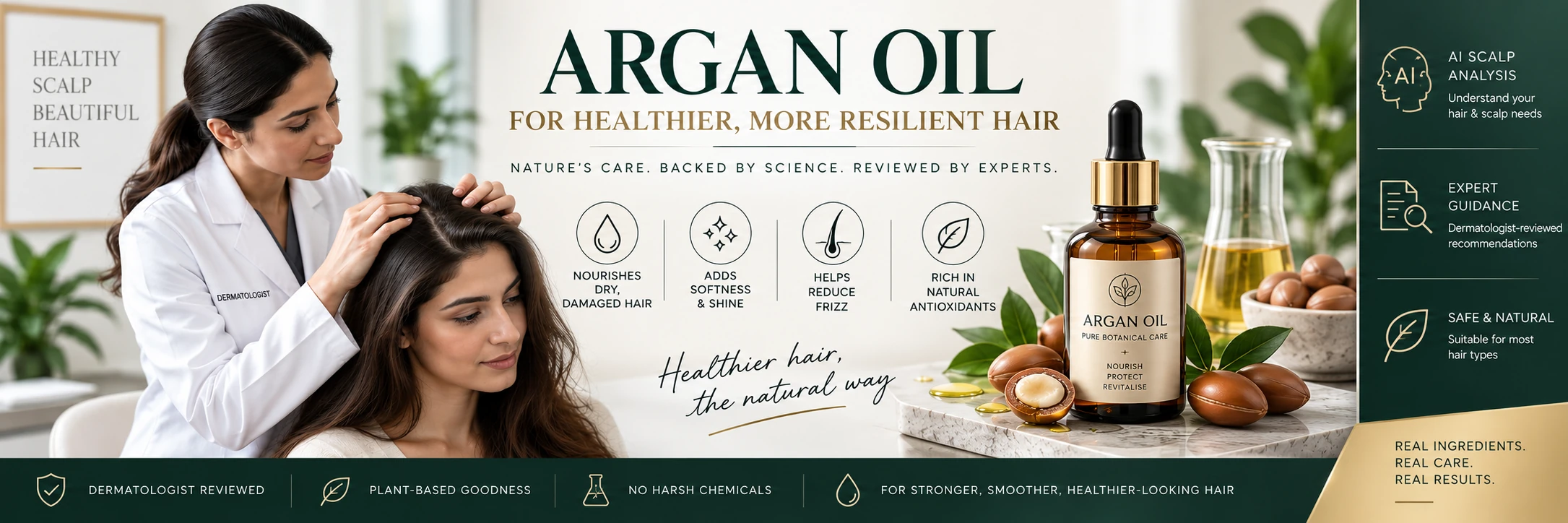
🩺
Doctor-reviewedMD Dermatology
AI Hair Testfree
🪴
Cosmetic oilshaft conditioning
⚠️
Use-carefullykeep off oily / flaky scalp
🚚
India-widedelivery
Image slot
🩺
Doctor-reviewed ingredient guide — trust visualalt: "Dermatologist-reviewed argan oil guide and AI screening" · 1200×400 WebP · loading="lazy"
Quick Answer

Is Argan Oil good for hair?

Argan Oil may help improve the appearance of dry, frizzy, rough or dull hair by supporting lubrication, shine and smoothness. However, it does not treat genetic baldness, patchy hair loss, scalp infection or medical hair fall, and users with oily scalp, dandruff or scalp acne should use oil carefully. It is a cosmetic hair-shaft conditioning oil — it coats and lubricates the hair shaft, reducing friction and the appearance of frizz and improving shine — mainly used on the mid-lengths and ends. It is not a guaranteed hair growth or regrowth ingredient, not a medicine, and it does not create new follicles or reverse baldness. Smoothing the shaft may reduce breakage and help hair look healthier, but that is different from growth at the root. So it is good for the look and feel of dry or frizzy hair, used carefully and usually off the scalp, while root shedding, patchy or progressive loss, or scalp redness/pus/pain/crusting need their cause assessed. Screen with the AI Hair Test, and see a doctor for root shedding or red flags. Results vary.

Cosmetic shaft conditioning — not a growth oil. Argan Oil is a cosmetic oil for dry hair, frizz and shine, not a guaranteed hair growth or regrowth ingredient, not a medicine, and it does not create follicles or reverse baldness. Use carefully on oily, dandruff-prone, seborrheic-dermatitis-prone or acne/folliculitis-prone scalp — apply mainly to mid-lengths and ends, not the scalp. Take care with a known argan or nut-derived allergy where relevant; avoid a fresh hair transplant unless your surgeon approves. See a doctor for root shedding, patchy or progressive loss, severe scalp redness, pus, pain or crusting, or scalp acne/folliculitis that worsens with oil.
The Basics

What Is Argan Oil?

Argan Oil is a plant-derived oil used in hair oils, serums, masks and leave-in products, commonly for hair softness, shine, dry ends and frizz.

It may be used in pure oil products or blended formulas, and it should be used according to your hair type and scalp tolerance.

It is a cosmetic hair-shaft conditioning ingredient, not a hair-loss treatment. So it sits at the cosmetic-support tier for dryness, frizz and shine: helpful for how hair looks and feels, used carefully and usually on the lengths, but not a growth or regrowth oil.
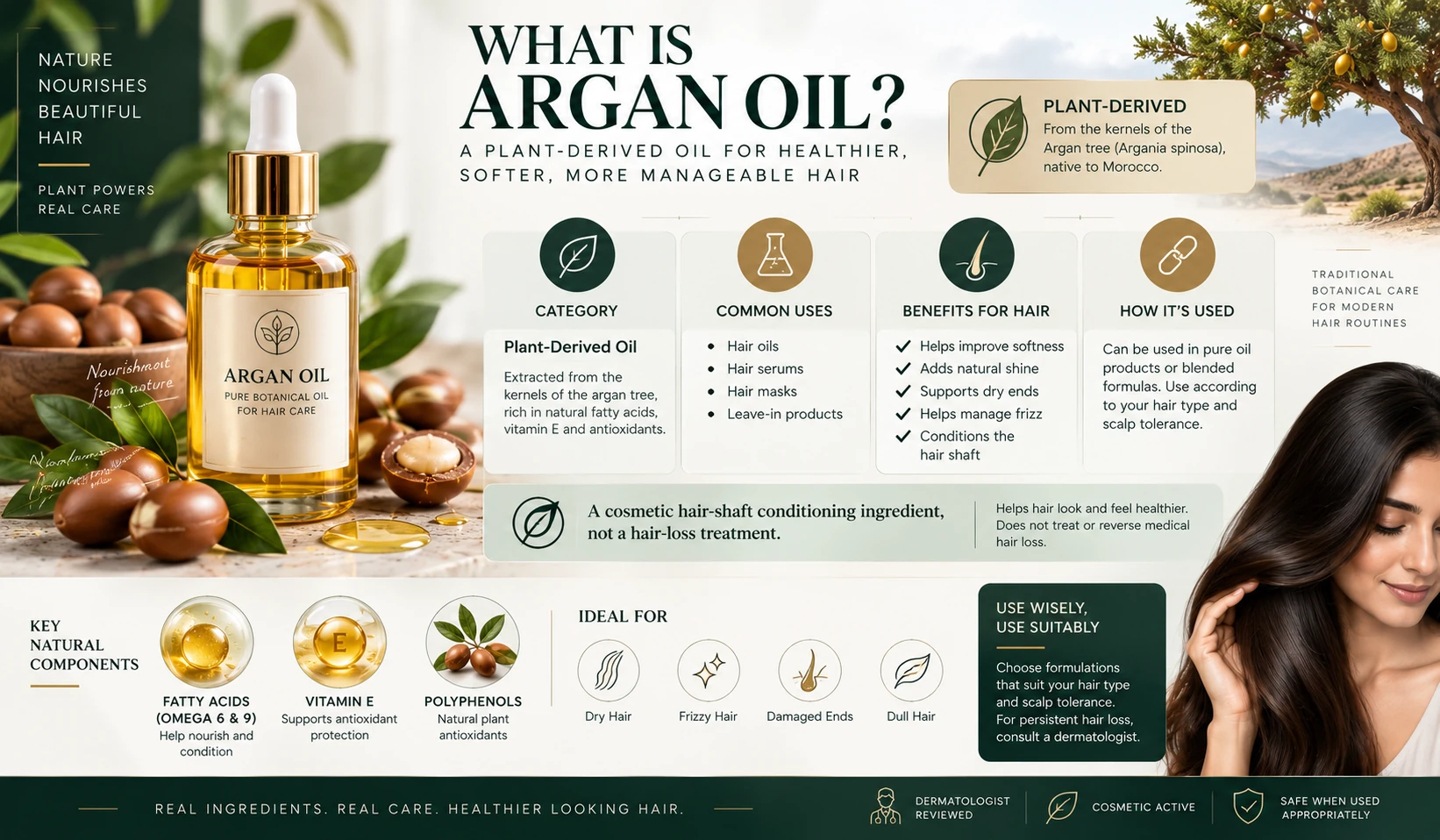
Image slot
🧪
Argan Oil — ingredient overview visualalt: "Argan Oil ingredient overview for haircare, dermatologist-reviewed" · 1200×700 WebP · loading="lazy"
Mechanism

How Argan Oil Works

Argan Oil helps coat and lubricate the hair shaft, which may reduce friction, roughness and the appearance of frizz and improve shine and manageability.

It helps dry ends feel smoother, and by reducing breakage from roughness it can help hair look healthier and retain length cosmetically.

It does not create new follicles or reverse baldness, and it does not treat the causes of hair loss. So it is a cosmetic, shaft-level action, with results depending on hair type and how it is used. Results vary.
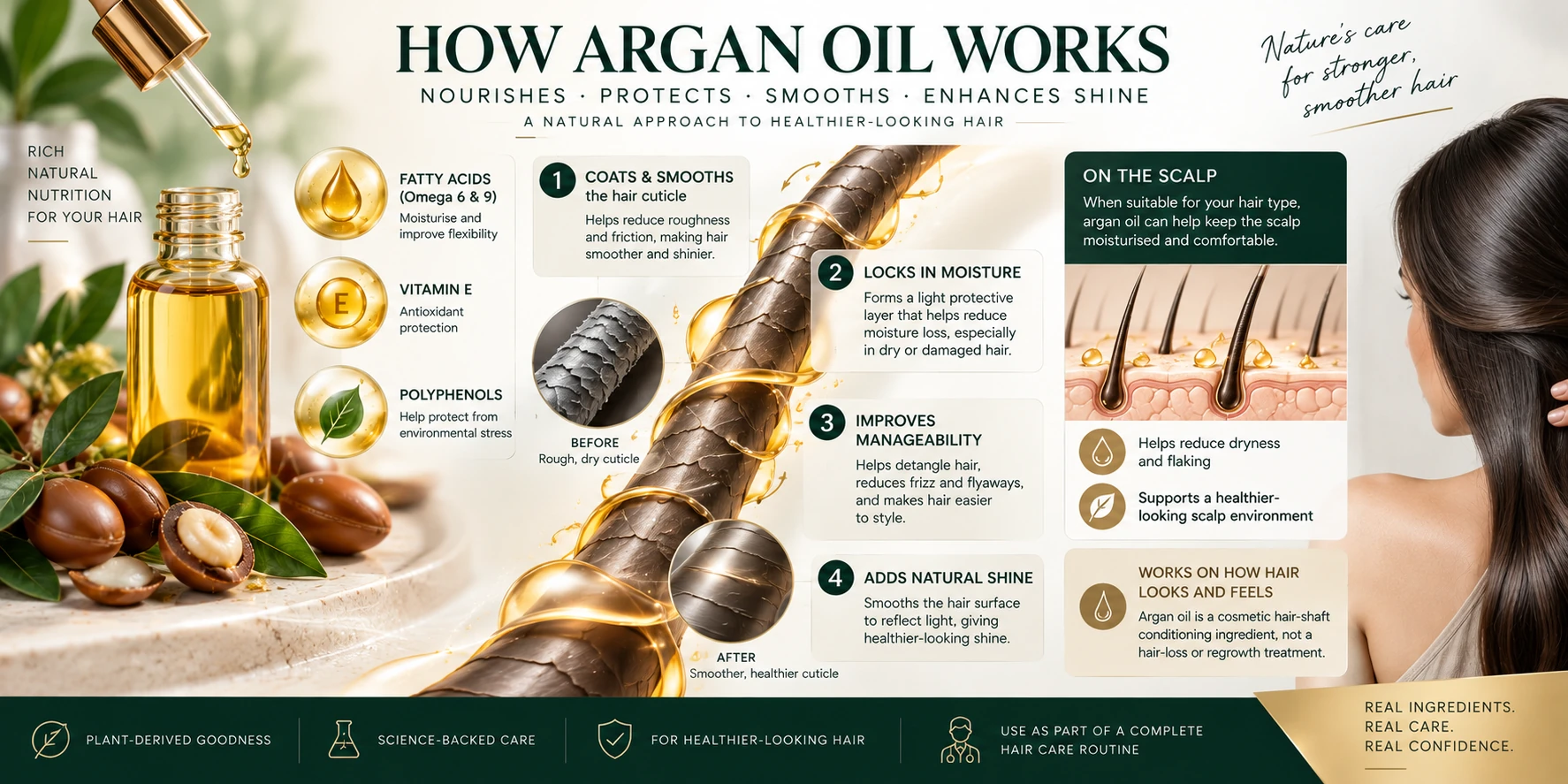
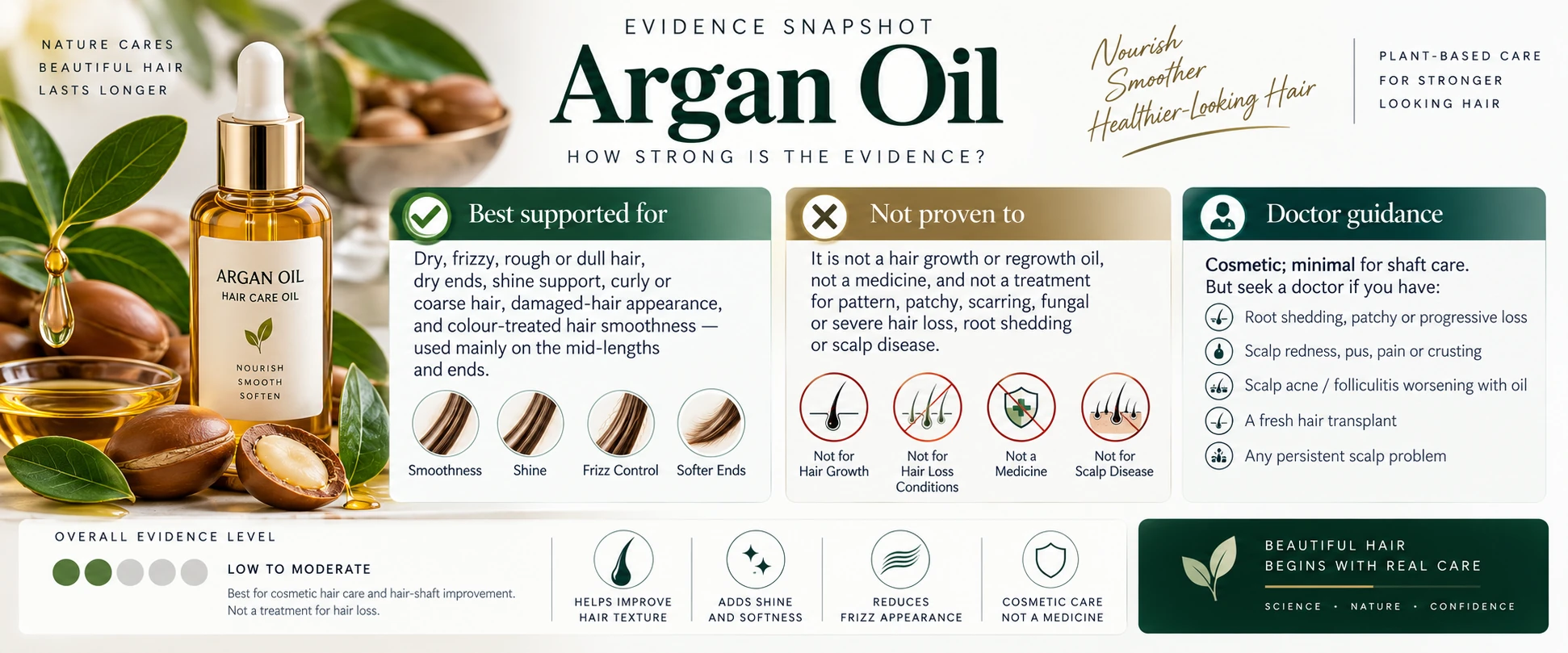
Image slot
⚙️
How Argan Oil works — mechanism visualalt: "How Argan Oil works on hair and scalp, illustrated" · 1200×600 WebP · loading="lazy"
Evidence

How Strong Is the Evidence?

Cosmetic support Argan Oil

Best supported for
Dry, frizzy, rough or dull hair, dry ends, shine support, curly or coarse hair, damaged-hair appearance, and colour-treated hair smoothness — used mainly on the mid-lengths and ends.
Not proven to
It is not a hair growth or regrowth oil, not a medicine, and not a treatment for pattern, patchy, scarring, fungal or severe hair loss, root shedding or scalp disease.
Doctor guidance
Cosmetic; minimal for shaft care. But root shedding, patchy or progressive loss, scalp redness/pus/pain/crusting, scalp acne/folliculitis worsening with oil, or a fresh transplant need a doctor.
Image slot
📊
Evidence snapshot — visualalt: "Evidence level snapshot for Argan Oil in haircare" · 1200×500 WebP · loading="lazy"
Suitability

Best For

Dry hair

Conditioning and softness for dry hair on the lengths.

Frizzy hair

Smoothness and frizz-control with small amounts.

Rough hair

Reduces the rough, dull feel of the hair shaft.

Dry ends

Targeted smoothing and shine for dry ends.

Curly / coarse hair

Definition, smoothness and shine for curly or coarse hair.

Colour-treated / damaged hair

Smoothness and shine appearance for processed or damaged-looking hair.

Caution

Not Suitable For / Use With Care

⚠️

Avoid or ask a doctor first

  • An oily scalp (heavy scalp use)
  • A dandruff-prone scalp
  • A seborrheic-dermatitis-prone scalp
  • Scalp acne or folliculitis
  • Itchy scalp after oiling
  • Argan / nut-derived allergy (where relevant)
  • A fresh hair transplant (unless surgeon-approved)
  • Patchy hair loss (expecting regrowth)
  • Progressive thinning (expecting oil treatment)
  • Severe scalp redness, pus, pain or crusting
  • Heavy scalp oiling despite buildup
🩺

See a doctor first if

  • Hair shedding from the root (not breakage)
  • Sudden, severe, patchy or progressive hair fall
  • Scalp redness, pus, pain or crusting
  • Scalp acne or folliculitis that worsens with oil
  • Suspected alopecia areata, scarring or fungal infection
  • A fresh hair transplant (before oiling)
  • Unclear diagnosis
🧪

How to use safely

  • Use small amounts
  • Apply mainly to mid-lengths and ends if scalp is oily or dandruff-prone
  • Use as pre-wash oil, leave-in oil or serum per the product label
  • Avoid heavy scalp application if oil worsens flakes or itching
  • Patch test if sensitive
  • Keep away from the eyes
  • Stop if irritation or acne-like bumps occur
Usage

How to Use Argan Oil Safely

Use small amounts and apply mainly to the mid-lengths and ends, especially if your scalp is oily or dandruff-prone. Use it as a pre-wash oil, leave-in oil or serum ingredient per the product label. Avoid heavy scalp application if oil worsens flakes or itching, patch test if sensitive, and keep it away from the eyes. A little generally goes a long way — too much leaves hair greasy and limp. Stop if irritation or acne-like bumps occur, and see a doctor for root shedding or scalp red flags rather than relying on oil.

Not sure if this ingredient fits your situation? Screen the cause first.

Take AI Hair TestAsk a Hair Doctor
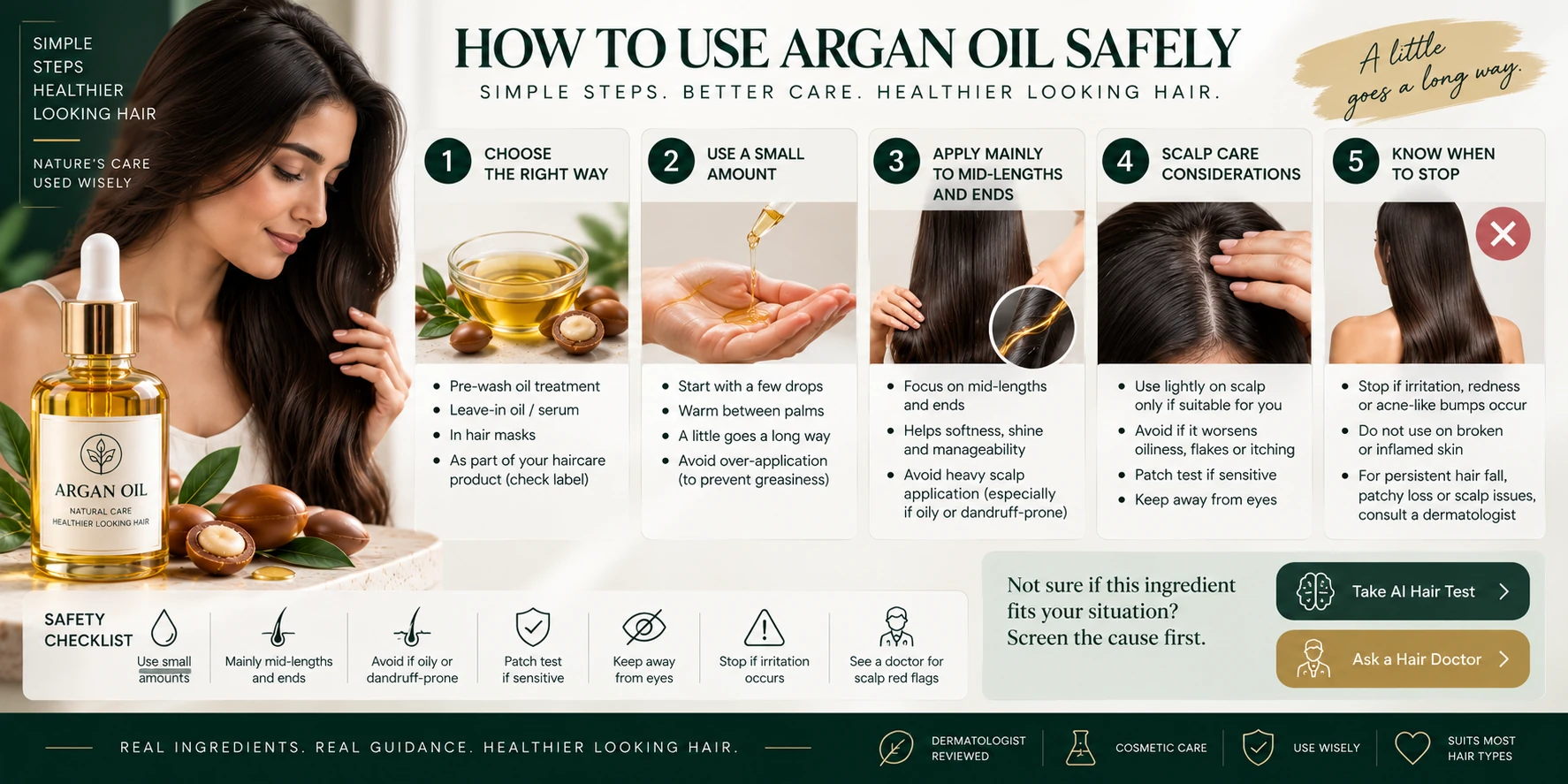
Image slot
📋
How to use Argan Oil — illustrated stepsalt: "How to use Argan Oil safely, step by step" · 1200×600 WebP · loading="lazy"
Safety

Possible Side Effects

Argan Oil is generally well tolerated as a cosmetic hair oil, but issues arise mainly from over-application or heavy scalp use in prone individuals.

Greasy buildupLimp hair if overusedWorsened dandruff (some)Scalp acne / folliculitis (prone users)Itching or irritationAllergy (formula / fragrance)Eye irritation if misapplied

Most issues come from overuse or heavy scalp application: greasy, limp hair, buildup, worsened flaking on dandruff-prone scalps, or breakouts in acne/folliculitis-prone people. Use small amounts on the lengths, keep oil off a prone scalp, patch test if sensitive, and take care with a known nut/argan allergy. Stop and seek advice if you get irritation, bumps or worsening symptoms rather than continuing.

Shop

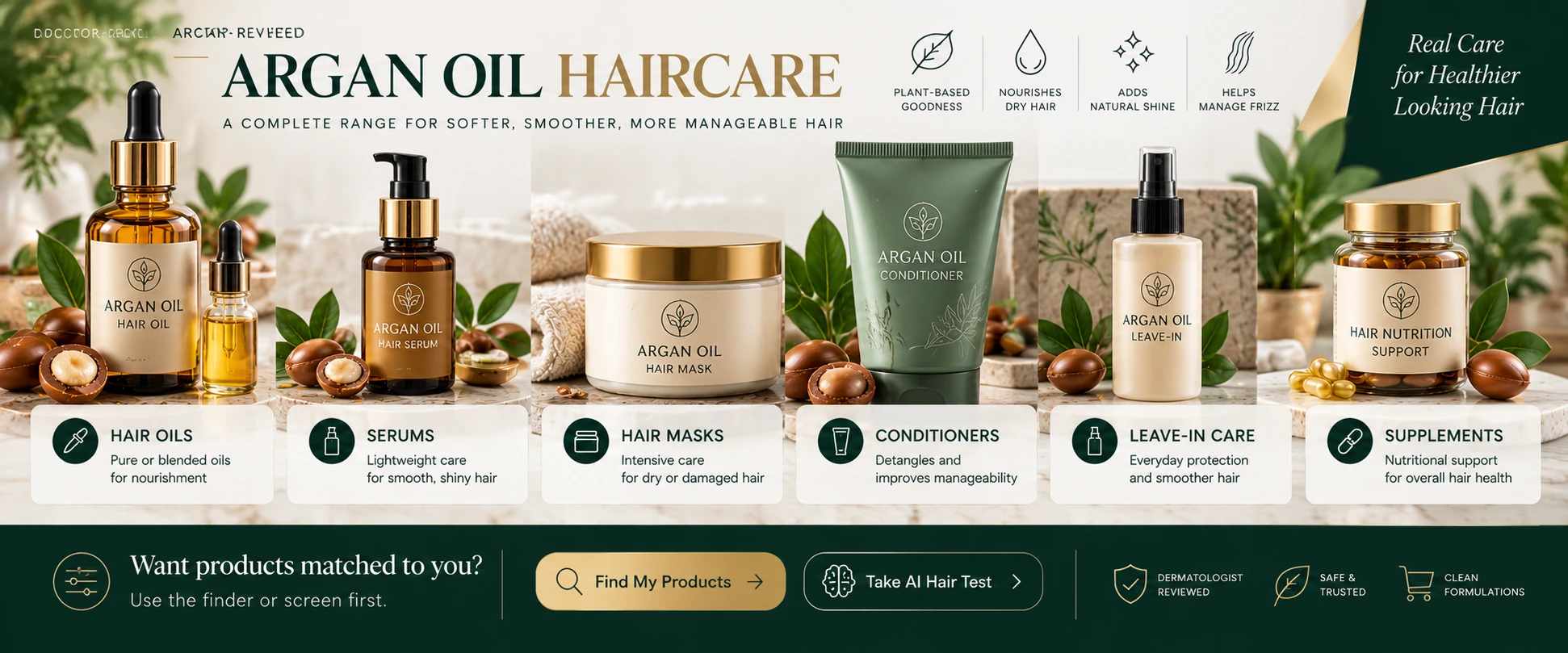
Argan Oil & Dry / Frizzy Hair Products

Cosmetic hair oils, serums and dry/frizzy/curly/colour-treated hair products that may feature argan oil. Prices, ratings and stock are dynamic placeholders from the database and official label.

Catalogue connected · pin-code aware
View all 500+ products →
Products for this ingredient are being curated.

Argan Oil is a cosmetic hair-shaft conditioning oil, not a guaranteed growth or regrowth oil and not a medicine. It improves the look and feel of dry, frizzy or rough hair, not the causes of hair loss. Use it mainly on the lengths, carefully on oily, dandruff-prone or acne-prone scalps. Root shedding, patchy or progressive loss, scalp acne/folliculitis worsening with oil, or scalp red flags need a doctor — not an oil. We do not fabricate prices, composition, ratings, stock or reviews; these are dynamic placeholders from the official label and database. Results vary.
Want products matched to you? Use the finder or screen first.

Find My ProductsTake AI Hair Test
Image slot
🛒
Shop strip — related range flat-layalt: "Doctor-reviewed product categories related to Argan Oil" · 1200×500 WebP · loading="lazy"
Compare

Argan Oil vs Rosemary Oil vs Coconut Oil vs Hair Serum

How this ingredient compares with similar options. It points to a pathway; it is not a diagnosis.

FeatureArgan OilRosemary OilCoconut OilHair Serum
CategoryCosmetic oilEssential oilCosmetic oilCosmetic serum
Main roleShaft conditioning / shineScalp routine (diluted)Conditioning / pre-washSmoothing / styling
Best for dry hairYesLimitedYesYes
Best for frizzYesLimitedSomeYes
Best for scalp useUse cautiously (lengths)Scalp (diluted)Use cautiouslyLengths
Hair growth claimsNone (cosmetic)Limited / cosmeticNone (cosmetic)None (cosmetic)
Oily scalp cautionUse on lengthsCautionHeavier; cautionLighter
Dandruff cautionCan worsen if heavyCan worsen if heavyCan worsen if heavyLower
Side-effect concernBuildup / limp hairIrritation if undilutedBuildup / heavinessLow (local)
PathwayHair oilHair oilHair oilHair serum
At a Glance

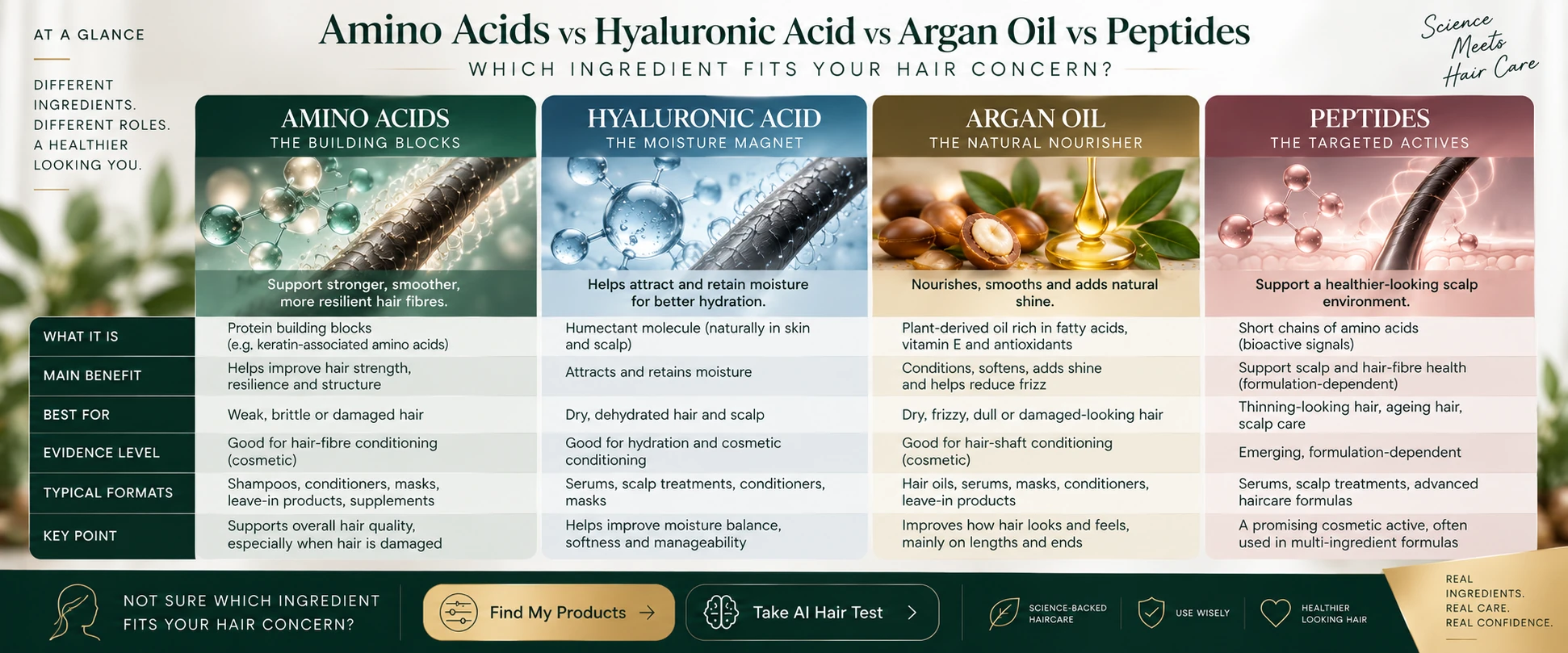
Amino Acids vs Hyaluronic Acid vs Argan Oil vs Peptides: Which Ingredient Fits Your Hair Concern?

Amino Acids are more relevant to protein/nutrition and hair-fibre support. Hyaluronic Acid supports hydration and scalp comfort. Argan Oil supports dry hair, frizz and shine as a cosmetic oil. Peptides may support cosmetic scalp or hair-fibre routines depending on formula. None of these should replace diagnosis for progressive, sudden, patchy or medically complex hair loss.

FeatureAmino AcidsHyaluronic AcidArgan OilPeptides
Main categoryNutrition / hair-fibreHumectant / hydrationCosmetic hair oilCosmetic hair/scalp active
Evidence levelDeficiency-dependent / cosmeticCosmetic (hydration)Cosmetic (frizz/shine)Limited–moderate
Best for nutrition supportYes (if low protein)NoNoNo
Best for hydrationNoYesSome (oil-based)Some
Best for frizz / shineLimitedSomeYesSome
Best for hair-fibre supportYes (feel/strength)SmoothnessSmoothnessFeel / repair
Best product typesSupplements / masksSerums / leave-insOils / serumsHair / scalp serums
Scalp-use cautionSupplement: medical historyOily scalp: buildupOily/dandruff-prone: avoid heavyLow (local)
Doctor guidanceLab / deficiency → doctorCosmetic; minimalCosmetic; minimalCosmetic; minimal
Product categoryHair supplementsScalp serumHair oilHair / scalp serum
Image slot
⚖️
Comparison — visualalt: "Argan Oil compared with related options" · 1200×500 WebP · loading="lazy"
🩺
Doctor's Note

A Cosmetic Conditioning Oil, Not a Root-Fall Treatment

"As a dermatologist, I position Argan Oil as a cosmetic hair-shaft conditioning ingredient. It can help dry, frizzy or rough hair feel smoother and look shinier, and I am happy for people to enjoy it, but it should not be used as a treatment for true root hair fall, pattern baldness or scalp disease. I also see oily and dandruff-prone patients make their scalp worse by oiling it heavily, so I keep argan oil on the lengths. Use it for the hair shaft with realistic expectations, and bring me root shedding or scalp red flags."

Reviewed by Dr. Amit Agarkar, MD DermatologyDermatologist & Hair Specialist · Last reviewed 1 June 2026

Hair shedding from the root, patchy or progressive loss, or a scalp that worsens with oil? Get assessed.

Consult Dr. Amit's Team
Evidence & Safety

Medical References Behind This Guidance

These references are provided for patient education and do not replace a dermatologist's diagnosis or individual medical advice.

AAD

Hair Loss: Causes & Treatment

Dermatologist-led overview of how hair loss is evaluated and the evidence behind common treatments.

View reference ›
NIH / MedlinePlus

Hair Loss Overview

Patient-education summary of common causes of hair loss and when to seek medical care.

View reference ›
PubMed

Peer-Reviewed Literature

Searchable index of peer-reviewed research on argan oil for hair.

View reference ›
Cochrane Library

Systematic Reviews

Independent systematic reviews assessing the evidence behind hair-loss interventions.

View reference ›
Questions

Frequently Asked Questions

Section image
FAQs — banner900×160 WebP
What is Argan Oil?
Argan Oil is a plant-derived oil used in hair oils, serums, masks and leave-in products, commonly for hair softness, shine, dry ends and frizz. It may be used in pure oil products or blended formulas, and it should be used according to your hair type and scalp tolerance. It is a cosmetic hair-shaft conditioning ingredient rather than a hair-loss treatment. So argan oil is a cosmetic oil mainly used to improve how dry, frizzy or rough hair looks and feels, used carefully and usually on the lengths rather than loaded onto the scalp. Results vary.
Is Argan Oil good for hair?
Argan Oil may help improve the appearance of dry, frizzy, rough or dull hair by supporting lubrication, shine and smoothness, so it can be good for those cosmetic concerns when used sensibly. However, it does not treat genetic baldness, patchy hair loss, scalp infection or medical hair fall, and users with oily scalp, dandruff or scalp acne should use oil carefully. So it can be good for the look and feel of dry or frizzy hair as a cosmetic oil, but it is not a hair-growth treatment, and root shedding or scalp problems need their cause assessed rather than addressed with oil. Results vary.
Does Argan Oil help hair growth?
Argan Oil is mainly a hair-shaft conditioning ingredient and is not a guaranteed hair-growth oil, so it should not be relied on to grow hair. By smoothing and protecting the hair shaft it may reduce breakage from roughness and friction, which can help hair look healthier and retain length, but that is different from stimulating growth at the root. So while caring for the hair shaft can support length retention cosmetically, argan oil does not grow new hair or treat the causes of hair loss, and genuine growth concerns need diagnosis and appropriate treatment rather than oil. Results vary.
Can Argan Oil stop hair fall?
Argan Oil cannot stop hair fall that comes from the root due to causes like pattern hair loss, telogen effluvium, thyroid problems or a deficiency, because it is a cosmetic hair-shaft oil rather than a treatment for these. It may reduce breakage along the lengths by improving smoothness, which can lessen hair that snaps off, but that is not the same as stopping root shedding. So if you are losing hair from the root, especially suddenly, in patches or progressively, the priority is to find the cause with the AI Hair Test and a doctor, rather than expecting argan oil to stop it. Results vary.
Can Argan Oil regrow hair?
Argan Oil cannot regrow hair. It does not create new follicles or reverse baldness, and it cannot restore hair in bald or scarred areas, since it is a cosmetic oil that works on the hair shaft rather than the follicle. Its benefits are to the appearance, smoothness and shine of existing hair. So rather than expecting regrowth, it is realistic to view argan oil as cosmetic hair-shaft conditioning, and to seek diagnosis and doctor-guided options such as appropriate medical treatments if genuine regrowth from hair loss is the goal. Results vary.
Is Argan Oil good for dry hair?
Yes, argan oil is well suited to dry hair, as one of its main cosmetic uses is to coat and smooth the hair shaft, helping dry, rough hair feel softer and look shinier and more manageable. Using small amounts, mainly on the mid-lengths and ends, works well for dryness. So it can be a good choice for dry hair as a conditioning oil, improving feel and appearance, with the amount and application adjusted to your hair so it nourishes without leaving hair greasy or weighed down. Results vary.
Is Argan Oil good for frizzy hair?
Argan Oil is commonly used for frizzy hair, since frizz is often linked to dryness and roughness, and a small amount smooths the hair surface, reduces friction and helps control the appearance of frizz while adding shine. It is usually applied to the lengths and ends rather than the scalp. So it can be a useful cosmetic option for frizz control, especially on dry, frizz-prone hair, with small amounts giving smoothness and shine, while heavier use risks a greasy look, so a little generally goes a long way. Results vary.
Is Argan Oil good for curly hair?
Argan Oil can suit curly hair, which is often dry and prone to frizz, where it may help define curls, smooth frizz and add shine as part of a curl-care routine, used on the lengths. The right amount depends on your curl type and how much moisture your hair needs. So it can be a helpful cosmetic oil for curly hair, supporting smoothness, definition and shine, with the amount and technique adjusted to your curls and porosity, and realistic expectations that it improves appearance rather than changing the hair structurally. Results vary.
Is Argan Oil good for colour-treated hair?
Argan Oil can be used on colour-treated hair, which is often drier and rougher after processing, where it may help smooth the hair, add shine and improve manageability as part of a gentle, moisture-focused routine. It is a cosmetic conditioning support rather than something that affects the colour itself. So it can be a useful part of a care routine for colour-treated hair, improving feel and appearance, used on the lengths and in suitable amounts, while any significant breakage or scalp issues after colouring are worth assessing separately. Results vary.
Should Argan Oil be applied on the scalp?
Argan Oil is generally best applied to the mid-lengths and ends rather than loaded onto the scalp, especially if your scalp is oily, dandruff-prone or acne-prone, because heavy scalp oiling can contribute to buildup, worsen flaking or trigger breakouts in prone individuals. If your scalp tolerates light oiling and is not prone to these issues, modest scalp use may be fine. So for most people, focusing argan oil on the hair lengths is the sensible approach, and heavy scalp application should be avoided if it worsens flakes, itching or bumps. Results vary.
Can oily scalp use Argan Oil?
If you have an oily scalp, argan oil is best used carefully and mainly on the mid-lengths and ends rather than the scalp, since adding oil to an already oily scalp can contribute to greasiness and buildup and may not feel comfortable. The hair lengths can still benefit from a small amount for smoothness and shine. So an oily scalp can still enjoy argan oil on the lengths for cosmetic benefits, while heavy scalp application is best avoided, and if oiliness comes with flaking or irritation it is worth assessing rather than oiling. Results vary.
Can Argan Oil worsen dandruff?
In some people, heavy oiling can worsen a dandruff-prone or seborrheic dermatitis-prone scalp, because the yeast involved in dandruff can be affected by oils and oil adds to buildup, so argan oil on the scalp is not automatically suitable for a flaky scalp. Using it on the lengths rather than the scalp avoids this. So if you are dandruff-prone, be cautious about scalp oiling with argan oil, focus on the hair lengths, use an appropriate anti-dandruff routine for the scalp, and see a doctor if flaking is stubborn rather than assuming oil will help. Results vary.
Can Argan Oil cause scalp acne?
In acne-prone or folliculitis-prone individuals, heavy oil on the scalp or hairline can sometimes contribute to clogged follicles, bumps or breakouts, so argan oil should be used carefully and kept mainly to the lengths if you are prone to scalp acne or bumps. Keeping oil off the scalp and hairline reduces this risk. So argan oil can occasionally contribute to scalp or hairline breakouts in prone people if applied heavily, and the response is to use it on the lengths, avoid the scalp, and stop and seek advice if you develop bumps or pustules rather than continuing. Results vary.
Is Argan Oil better than Rosemary Oil?
Argan Oil and Rosemary Oil are used for different purposes, so neither is simply better. Argan oil is mainly a cosmetic conditioning oil for dry hair, frizz and shine on the lengths, while rosemary oil is an essential oil sometimes used in scalp routines and is not the same as a medicine. Neither is a guaranteed hair-growth treatment. So rather than ranking them, choose based on your goal: argan oil for smoothing and shine on the hair, rosemary oil with appropriate dilution for scalp routines, with realistic cosmetic expectations and a doctor's input for genuine hair loss. Results vary.
Is Argan Oil better than hair serum?
Argan Oil and hair serums overlap, and neither is simply better, since many serums actually contain oils like argan along with other smoothing ingredients. A pure oil and a formulated serum can both smooth and add shine, with serums sometimes feeling lighter or offering extra benefits depending on the formula. So the choice comes down to texture preference and your hair, with argan oil being a single conditioning oil and serums being formulated blends, both giving cosmetic smoothness and shine rather than treating hair loss, so pick what suits your hair and feel. Results vary.
How often should I use Argan Oil?
How often to use argan oil depends on your hair type and how dry it is, but small amounts on the lengths a few times a week, or as a pre-wash treatment, suit many people, while very dry hair may take more and finer hair less to avoid a greasy look. Following the product label and adjusting to how your hair responds is sensible. So use it as often as your hair benefits from without becoming greasy or weighed down, typically modest amounts on the lengths, adjusting frequency to your hair type rather than over-applying. Results vary.
Is Argan Oil safe during pregnancy?
Topical argan oil used cosmetically on the hair is generally considered low-risk, but during pregnancy or breastfeeding it is still sensible to check any product with your doctor if you are unsure, particularly if you have a nut allergy or sensitive skin, since the overall product matters. Many people prefer to keep routines simple during this time. So cosmetic use of argan oil on the hair is usually low concern, but confirm with your doctor if unsure, be mindful of any nut-related allergy, and favour gentle, simple products during pregnancy or breastfeeding. Results vary.
Can the AI Hair Test suggest Argan Oil?
The AI Hair Test can help explore whether a cosmetic oil like argan oil might suit dry, frizzy or rough hair, or whether your scalp is oily, dandruff-prone or acne-prone, where heavy oiling may not suit, and whether your concern is breakage from the lengths versus root shedding or scalp red flags needing a doctor. It reinforces that argan oil is cosmetic hair-shaft conditioning, not a hair growth oil, and is a screening aid, not a diagnosis. So it can point you toward whether argan oil is sensible or whether to get assessed, while medical decisions remain with a doctor. Results vary.
When should I consult a dermatologist?
You should consult a dermatologist if your hair is shedding from the root rather than breaking from the lengths, if hair fall is sudden, severe, patchy or progressive, if you have scalp redness, pus, pain or crusting, scalp acne or folliculitis that worsens with oil, or if you suspect alopecia areata, scarring alopecia or a fungal infection, or your diagnosis is unclear. You should also seek advice after a hair transplant before oiling. So rather than using argan oil to manage anything beyond cosmetic hair-shaft care, see a doctor for these situations, because an oil cannot treat hair loss or scalp disease and may aggravate some scalp problems. Results vary.
Which Argan Oil product should I choose?
Which argan oil product suits you depends on your hair and scalp: a pure or blended hair oil suits dry, frizzy or coarse hair on the lengths, a lighter serum suits finer hair, and curly or colour-treated hair may prefer richer formulas, with application kept off an oily, dandruff-prone or acne-prone scalp. So pick a format matched to your hair texture, used mainly on the lengths in modest amounts, with realistic cosmetic expectations. Product prices, ratings and stock on our pages are dynamic placeholders from the official label and database. Results vary.

Question not answered here? Ask Dr Aria for general guidance, or book a consultation.

Ask Dr AriaConsult a Doctor

Smooth, Shiny Hair — but Not a Growth Oil

Argan Oil is a lovely cosmetic conditioning oil for dry, frizzy or rough hair, giving smoothness and shine when used in small amounts on the lengths. But it is not a medicine, not a guaranteed growth or regrowth oil, and it does not create follicles or reverse baldness — and it can aggravate oily, dandruff-prone or acne-prone scalps if applied heavily. The smart move is to use it on the hair shaft with realistic expectations, keep it off a prone scalp, and see a doctor for root shedding, patchy or progressive loss, or scalp red flags. Use the AI Hair Test to clarify your situation. Results vary.

Medical disclaimer. This is educational content reviewed by a dermatologist. The AI Hair Test helps explore whether a cosmetic oil may suit a routine and flags when a doctor is needed, but does not diagnose, prescribe, confirm a product is right for you, endorse a brand, or replace a dermatologist. Argan Oil is a cosmetic hair-shaft conditioning oil, not a guaranteed hair growth or regrowth ingredient, not a medicine, and it does not create new follicles or reverse baldness. It should not be used as sole care for male or female pattern hair loss, alopecia areata, scarring alopecia, fungal scalp infection, telogen effluvium or severe hair fall — these need diagnosis. Users with oily, dandruff-prone, seborrheic-dermatitis-prone or acne/folliculitis-prone scalp should use it carefully and mainly on the mid-lengths and ends; take care with a known argan or nut-derived allergy where relevant, and avoid a fresh hair transplant unless your surgeon approves. See a doctor for root shedding, patchy or progressive loss, scalp redness, pus, pain or crusting, or scalp acne/folliculitis that worsens with oil. Side effects can include greasy buildup, limp hair, worsened dandruff, scalp breakouts and irritation. Product price, stock, ratings and reviews are dynamic placeholders from the official label and database. Results vary.
Doctor-Reviewed Haircare Ingredient Guide

Argan Oil: Evidence, Safety & Best Use

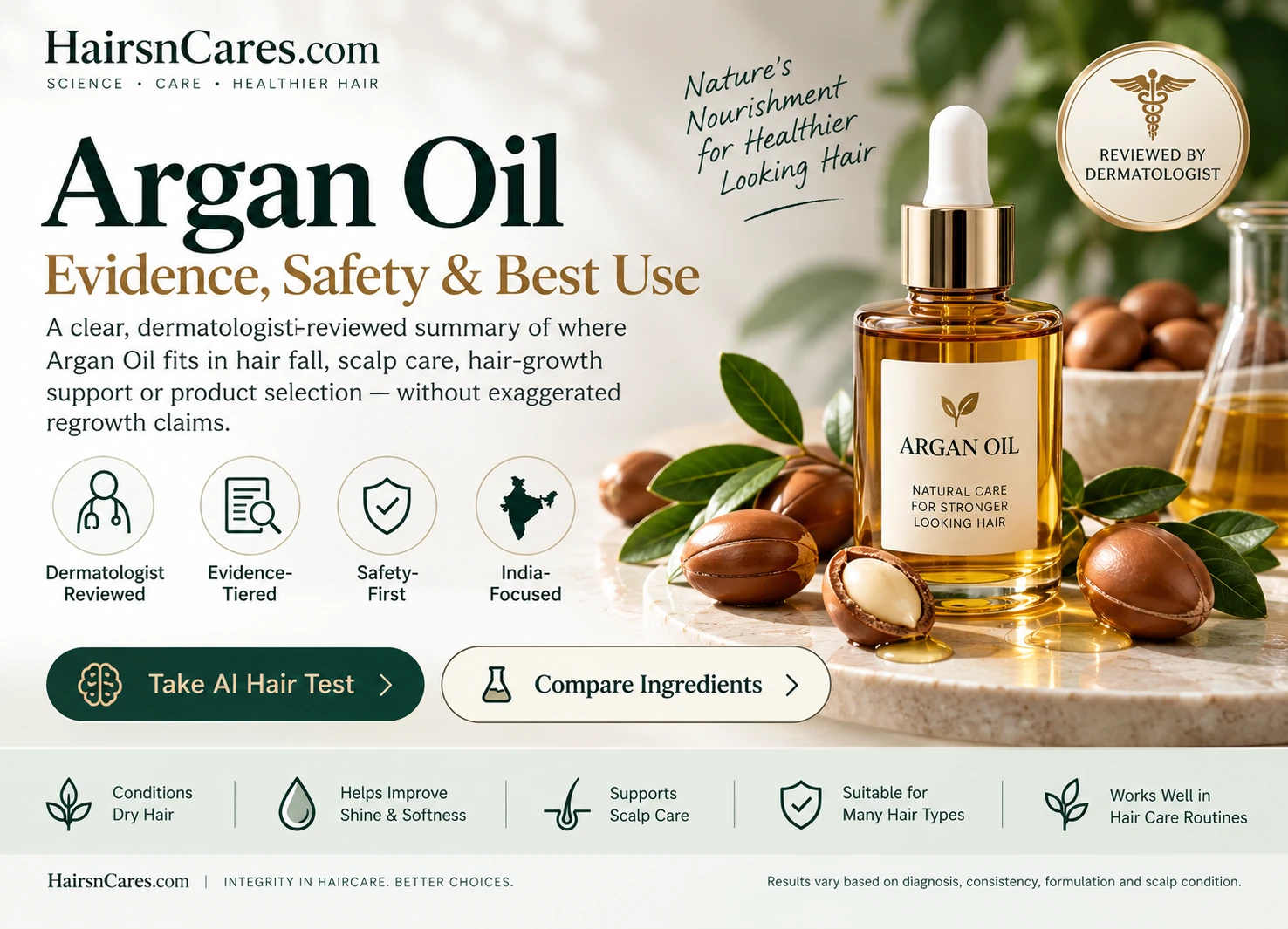
A clear, dermatologist-reviewed summary of where Argan Oil fits in hair fall, scalp care, hair-growth support or product selection — without exaggerated regrowth claims.

Reviewed by DermatologistEvidence-TieredSafety-FirstIndia-Focused

Results vary based on diagnosis, consistency, formulation and scalp condition.
🪴
Argan Oil

Premium ingredient visual slot · 720×520 WebP

Quick Summary

Argan Oil at a Glance

What it is

Cosmetic hair oil

Best for

Dryness, frizz, shine and manageability

Evidence level

Cosmetic (hair-shaft support)

Doctor guidance

Usually optional

Medical Review & Editorial Transparency

Reviewed for Safety, Evidence & Honest Claims

🩺

Reviewed by: Dr. Amit Agarkar, MD Dermatology

Medical focus: Dermatology, trichology, hair loss, scalp disorders and hair restoration.

Last reviewed: 1 June 2026

Editorial promise: This page explains benefits, limitations, side effects and safe use without exaggerating hair-growth claims.

Content Transparency

Who, How & Why This Guide Was Created

Who created this guide?

Prepared by the Hairsncares editorial team and medically reviewed by a dermatologist experienced in hair and scalp disorders.

How was it reviewed?

Checked for ingredient role, evidence level, safety warnings, medical limitations and suitability for Indian haircare users.

Why was it created?

To help you choose ingredients safely and understand when a dermatologist diagnosis matters more than trying products randomly.

Evidence Grade

Evidence Grade for Argan Oil

ParameterAssessmentWhat it means
Evidence levelCosmetic (hair-shaft support)How strong the support is for this ingredient in hair or scalp care.
Best use caseDryness, frizz, shine and manageabilityThe situation in which it may genuinely help.
Not suitable forPeople expecting regrowth; oily/acne-prone scalps if overused; fresh transplant area without surgeon approvalWhen a dermatologist diagnosis is needed before use.
Expected timelineCosmetic feel/shine quickly; not follicle regrowthResults vary based on diagnosis, consistency, formulation and scalp condition.
Suitability & Safety

Best For vs Avoid If

May be suitable for

  • Dryness, frizz, shine and manageability
  • People with a clear, non-emergency concern and realistic expectations
  • Use within a sensible, dermatologist-aware routine

Avoid or ask a doctor if

  • Hair loss is sudden, severe, patchy, painful or with scalp infection.
  • You are pregnant, breastfeeding, a teenager, or using prescription medicines.
  • You have an unclear diagnosis, scarring hair loss, fungal infection or active scalp disease.
Compare

Compare Argan Oil With Related Ingredients

Product Discovery

Explore Product Types Containing Argan Oil

Product results should be selected based on scalp type, diagnosis, sensitivity, routine compatibility and dermatologist guidance where needed.

Find Products After AI Hair Test
Visual Guide

Argan Oil Visual Guide

⚙️
How Argan Oil may support hair or scalp care.
🛡️
Safety and suitability depend on diagnosis and user profile.
📋
Routine compatibility matters more than random product use.
Quick Answers

Quick Answers About Argan Oil

Is Argan Oil good for hair growth?

Argan Oil may help in selected situations depending on its evidence level, diagnosis, formulation and consistency. It should not be treated as a guaranteed regrowth solution for every type of hair loss.

How long does Argan Oil take to work?

Timelines vary. Medicines and deficiency-based treatments may take months, while cosmetic oils or hydration ingredients may mainly improve feel, shine or manageability sooner.

Can I use Argan Oil without a diagnosis?

Cosmetic ingredients may be used carefully, but medicines, persistent hair fall, patchy loss, scalp disease or sudden shedding need dermatologist evaluation.

Can Argan Oil be combined with other ingredients?

Combination depends on scalp sensitivity, diagnosis, product type and whether the ingredient is cosmetic, supplement-based or prescription-guided.

Who should avoid Argan Oil?

People with allergies, irritation, active scalp disease, unclear diagnosis, pregnancy, breastfeeding or prescription-medicine concerns should check suitability before use.

Evidence LevelCosmetic Oil / Hair-Shaft Support

Supports hair feel, shine, lubrication or frizz control. Not a proven regrowth treatment.

AI Summary

Argan Oil for Hair in Simple Terms

Argan Oil is a cosmetic hair-shaft oil, not a medicine.

It may help with smoothing frizz and adding shine to lengths — but it should not be treated as a cure for all hair fall.

Bottom line: use this guide to understand evidence, safety and product type, then take the AI Hair Test or consult a dermatologist for medical hair loss. Results vary.

Ingredient Type

Is Argan Oil a Medicine or a Cosmetic Oil?

Argan Oil is a cosmetic hair oil used mainly for hair-shaft conditioning, lubrication, shine and manageability. It does not create new follicles.

Evidence-Safe Summary

What Argan Oil Can and Cannot Do for Hair

May Help With

  • Smoothing frizz and adding shine to lengths
  • Conditioning dry, coarse or rough hair
  • Improving manageability and slip

Cannot Promise

  • Guaranteed hair regrowth
  • A cure for every type of hair fall
  • A replacement for a dermatologist's diagnosis
  • Correcting pattern, patchy, scarring or medical hair loss on its own
Scalp Caution

Use Oils Carefully on Oily, Dandruff- or Acne-Prone Scalp

Argan Oil can help hair-shaft lubrication, but heavy oils may worsen buildup, flaking or discomfort on some scalps. Apply mainly to mid-lengths and ends unless advised otherwise, and keep heavy oil off an oily, flaky or inflamed scalp.

Shaft vs Scalp

A Hair-Shaft Oil, Not a Scalp Treatment

Argan oil is a cosmetic conditioning oil. It coats and smooths the hair shaft — softening frizz, adding shine and improving manageability — but it does not create new follicles or regrow hair. Its best use is on mid-lengths and ends. On an oily, dandruff- or acne-prone scalp, heavy oil can worsen buildup and discomfort, so keep it off the scalp in those cases.

See routines for dry hair and frizzy hair; browse hair oils.

Doctor-Guided Decision Matrix

Should You Consider Argan Oil?

Educational guidance, not a diagnosis. Results vary.

May Be Reasonable When

  • Dry, frizzy or coarse lengths needing slip
  • You apply it to mid-lengths and ends
  • Your scalp is not oily or flaky

Be Careful When

  • Oily, dandruff- or acne-prone scalp
  • Expecting regrowth from an oil
  • Heavy application near the roots
  • Pregnancy, breastfeeding, teens or medical conditions

See a Doctor First When

  • Sudden or severe hair fall
  • Patchy hair loss
  • Progressive thinning
  • Scalp pain, pus, crusting, scaling or infection
  • PCOS, thyroid, anaemia symptoms or postpartum shedding
Related Ingredient Guides

Explore More Haircare Ingredients

Personalised Hair Guidance

Does Argan Oil Fit Your Hair Concern?

This guide is educational. For sudden, patchy, progressive or unexplained hair loss, or scalp pain, pus or scaling, screen with an AI tool or see a dermatologist.

Your Cart (0)

Your cart is empty

Subtotal0
DeliveryFREE
Total0
🔒 Secure📦 Free above ₹499↩ Easy returns
💬 Hi! I'm Dr. Amit — your Hair Intelligence consultant
🌿
1
🌿
Dr. Amit
Virtual Dermatologist · Hairsncares.com
Online
What are you shopping for today?
Select a category to begin
AI-powered scalp diagnosis · Hairsncares.com
📸
Scalp Analyser
Upload scalp photo · Get conditions, root cause, and matched product protocol
📷
Drop scalp photo here or click to upload
JPG, PNG, WEBP · Clear, close-up, well-lit photo

Your image is processed privately by our AI engine and saved securely with your account.