Hair Loss: Causes & Treatment
Dermatologist-led overview of how hair loss is evaluated and the evidence behind common treatments.
View reference ›Coconut Oil is a traditional hair oil commonly used for pre-wash oiling, dry hair, frizz, roughness and hair-shaft lubrication. It may support hair manageability, but it is not a guaranteed hair growth or hair regrowth treatment, not a medicine, and it does not create follicles or reverse baldness. The right use depends on scalp type, dandruff tendency, acne tendency, hair texture and whether hair fall is truly from the root. Screen the cause first with the AI Hair Test. Results vary.
Illustrative summary only. This is education, not a diagnosis or prescription; results vary and depend on your situation.
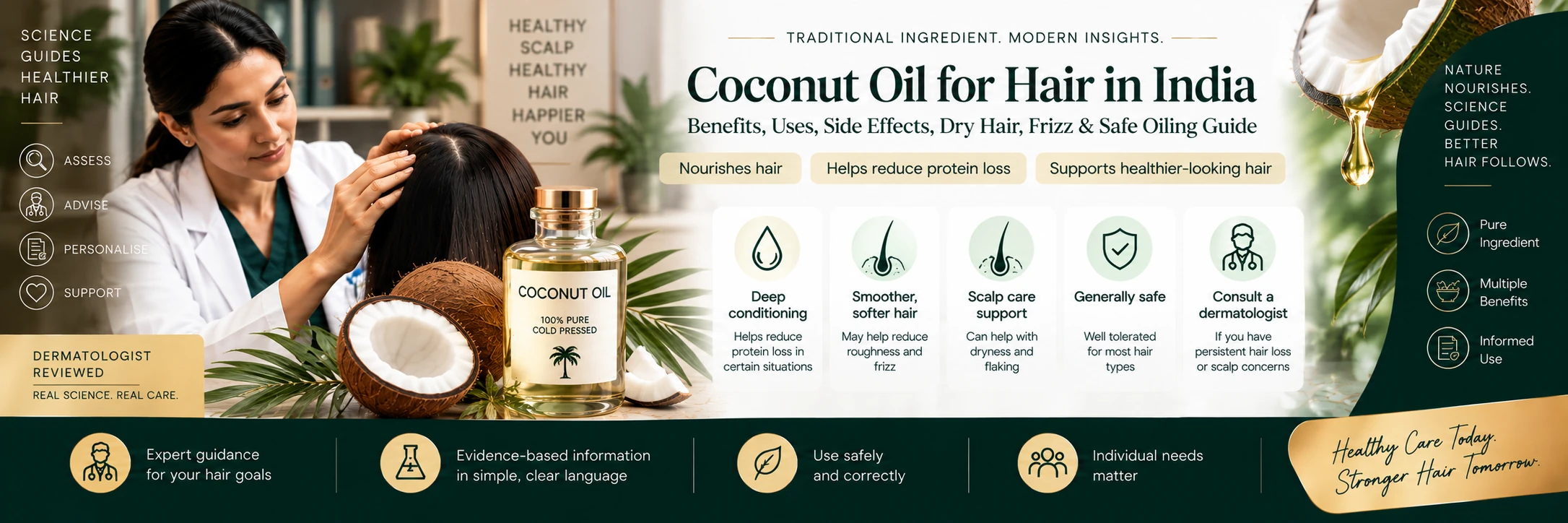
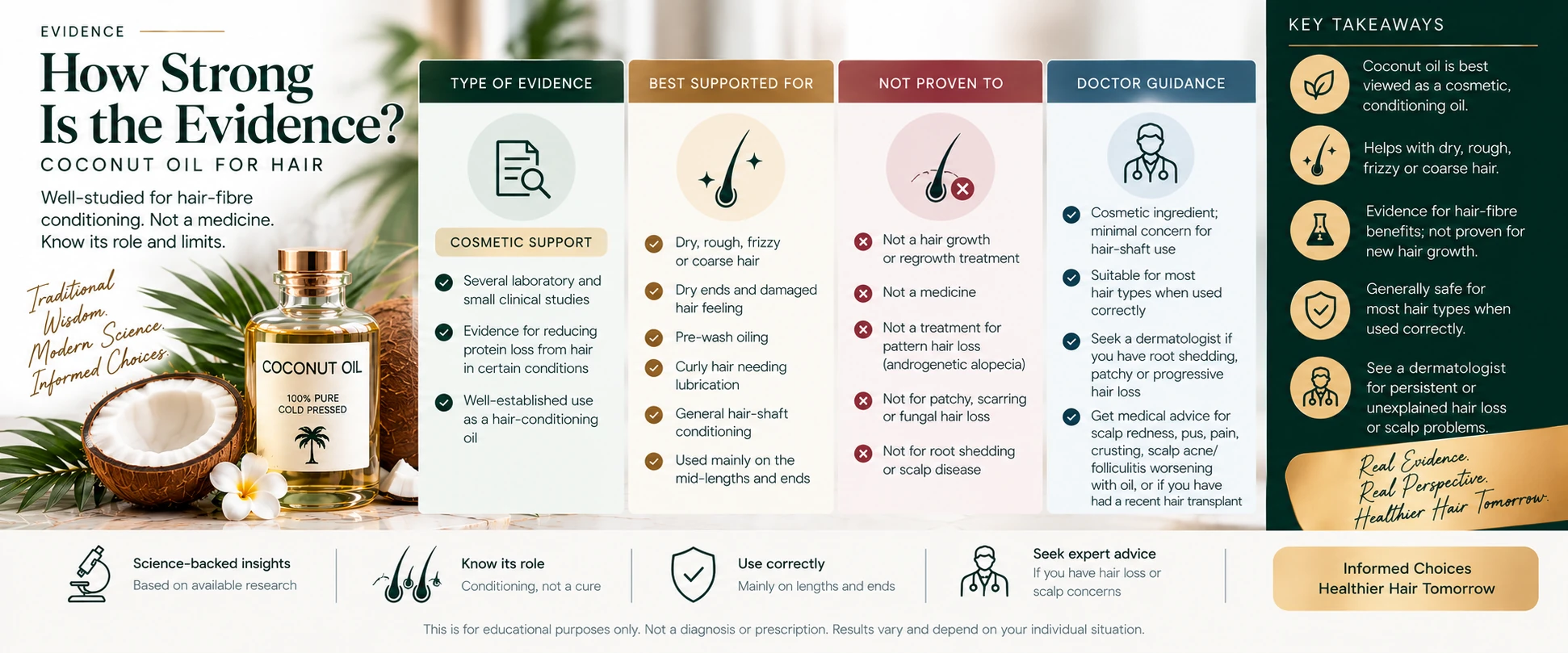
Coconut Oil may help lubricate the hair shaft, reduce roughness and support pre-wash conditioning in selected users. It does not cure genetic baldness, patchy hair loss, scalp infection or medical hair fall. It is a cosmetic hair-shaft conditioning and oiling ingredient — it coats and lubricates strands, may reduce friction and dryness appearance, and supports pre-wash conditioning — used mainly on the lengths and ends. It is not a guaranteed hair growth or regrowth treatment, not a medicine, and it does not create new follicles or reverse baldness. Users with oily scalp, dandruff, seborrheic dermatitis, scalp acne or folliculitis should use coconut oil carefully, because heavy oiling may worsen buildup or itching. So it is good for the feel and manageability of dry, rough or frizzy hair, used carefully and often as a washed-out pre-wash oil, while root shedding, patchy or progressive loss, or scalp redness/pus/pain/crusting need their cause assessed. Screen with the AI Hair Test, and see a doctor for root shedding or red flags. Results vary.
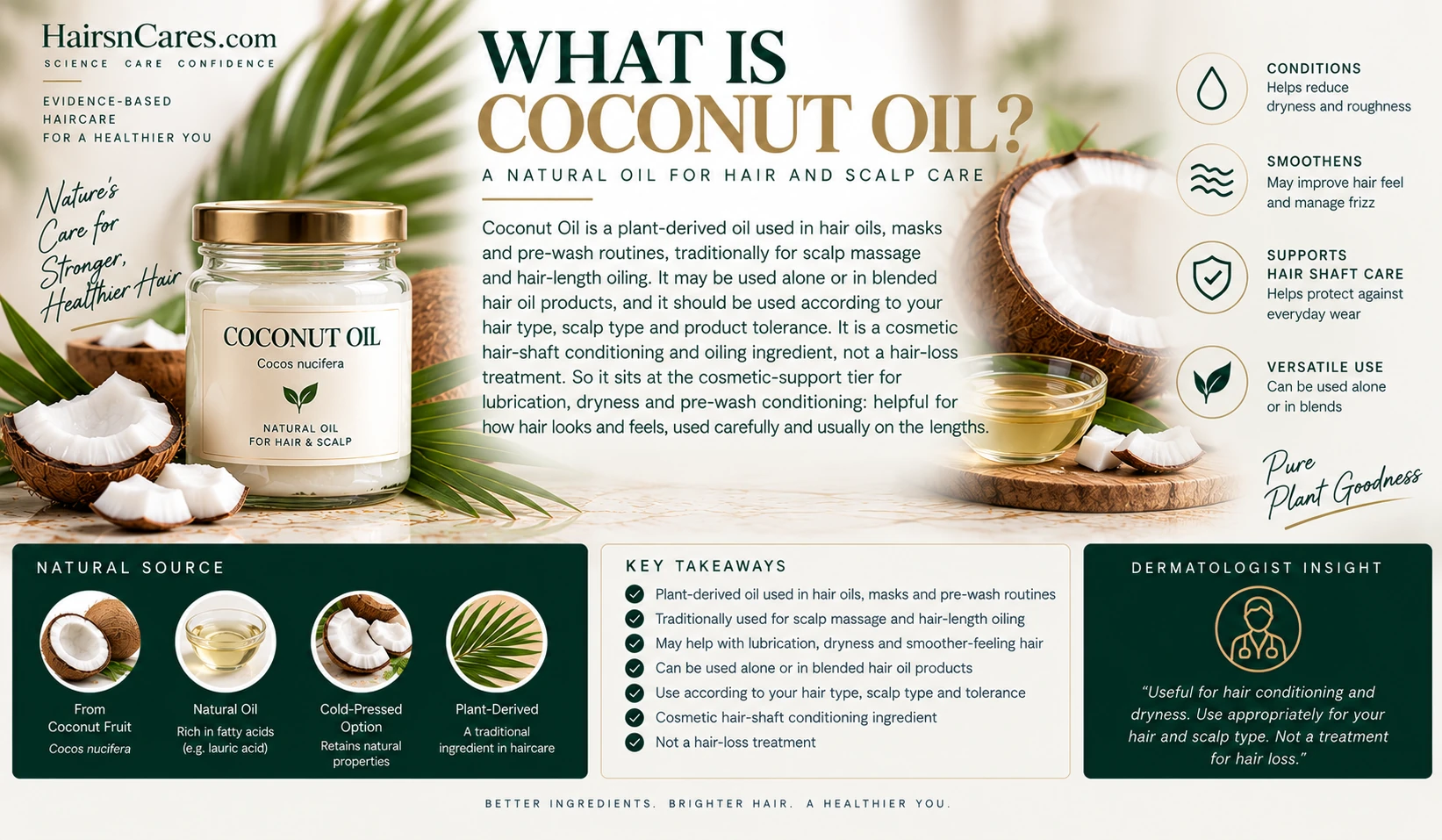
Coconut Oil is a plant-derived oil used in hair oils, masks and pre-wash routines, traditionally for scalp massage and hair-length oiling.
It may be used alone or in blended hair oil products, and it should be used according to your hair type, scalp type and product tolerance.
It is a cosmetic hair-shaft conditioning and oiling ingredient, not a hair-loss treatment. So it sits at the cosmetic-support tier for lubrication, dryness and pre-wash conditioning: helpful for how hair looks and feels, used carefully and usually on the lengths.
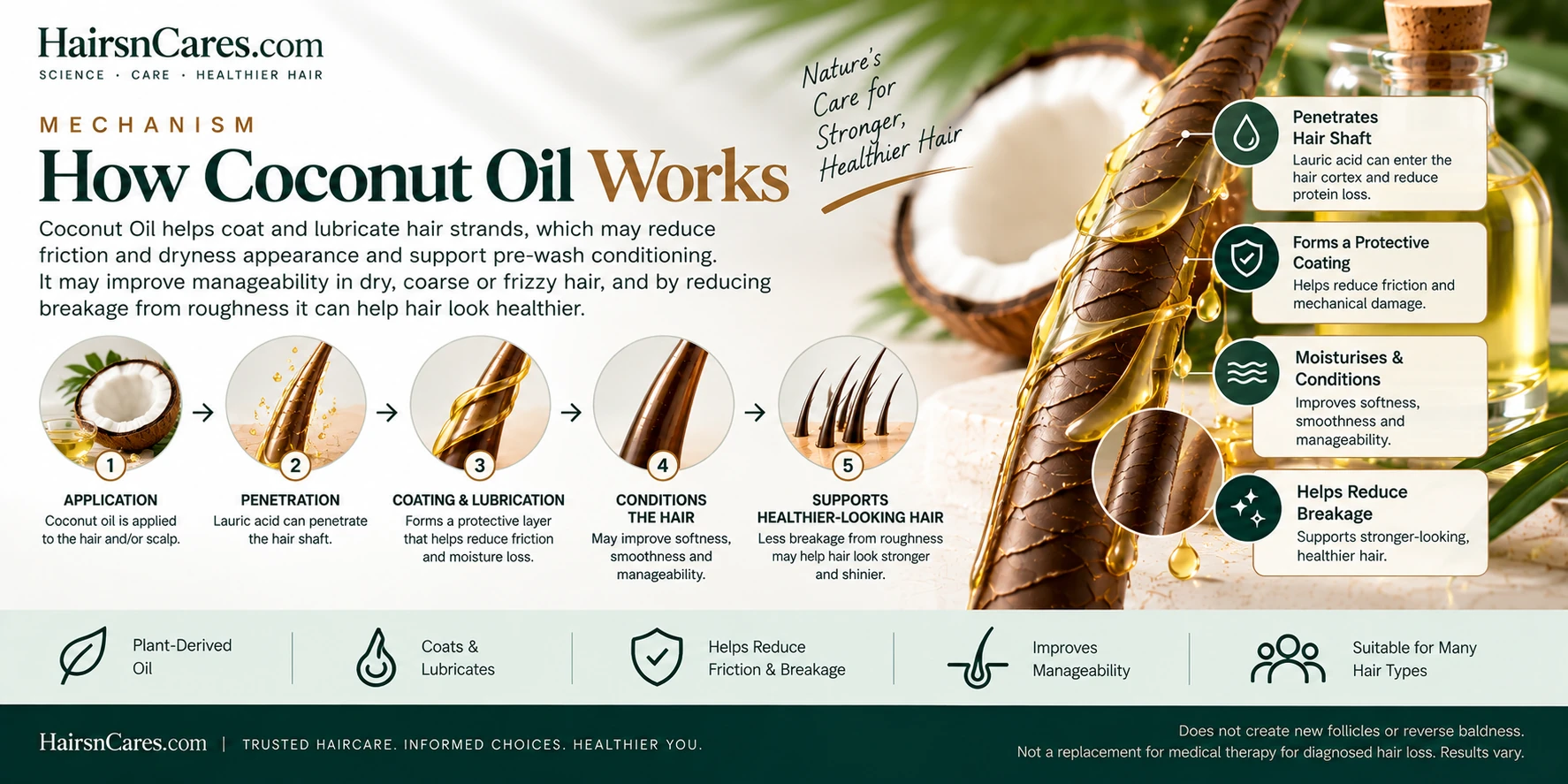
Coconut Oil helps coat and lubricate hair strands, which may reduce friction and dryness appearance and support pre-wash conditioning.
It may improve manageability in dry, coarse or frizzy hair, and by reducing breakage from roughness it can help hair look healthier.
It does not create new follicles or reverse baldness, and it does not replace medical therapy for diagnosed hair loss. So it is a cosmetic, shaft-level action, with results depending on hair type and how it is used. Results vary.
Lubrication and softness for dry hair on the lengths.
Reduces the rough, dull feel of the hair shaft.
Classic washed-out pre-wash conditioning treatment.
Targeted conditioning for dry ends.
Smoothness and frizz-control with small amounts.
Lubrication, smoothness and manageability for curly or coarse hair.
Use small amounts and prefer washed-out pre-wash use if your scalp becomes greasy easily. Apply mainly to the hair lengths and ends if your scalp is oily or dandruff-prone, and avoid leaving oil on too long if it worsens itching, flakes or bumps. Wash it out properly, and patch test if sensitive. A little goes a long way — too much leaves hair greasy and limp. Stop if scalp itching, redness, acne-like bumps or dandruff worsen, and see a doctor for root shedding or scalp red flags rather than relying on oil.
Not sure if this ingredient fits your situation? Screen the cause first.
Take AI Hair TestAsk a Hair Doctor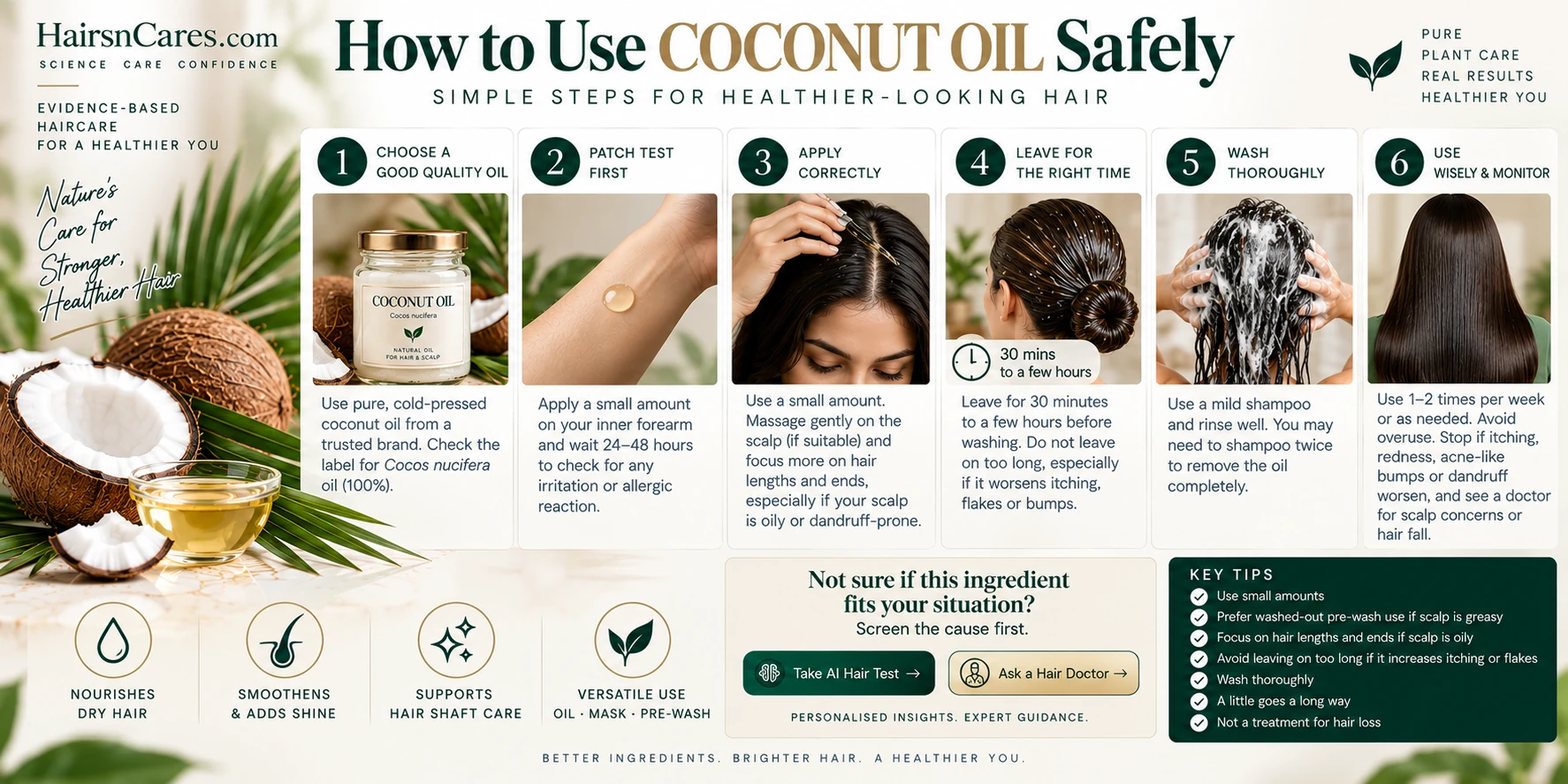
Coconut Oil is generally well tolerated as a cosmetic hair oil, but issues arise mainly from over-application or heavy scalp use in prone individuals.
Most issues come from overuse or heavy scalp application: greasy, limp hair, buildup, worsened flaking on dandruff-prone scalps, or breakouts in acne/folliculitis-prone people. Use small amounts on the lengths, prefer washed-out pre-wash use, keep oil off a prone scalp, and patch test if sensitive. Stop and seek advice if you get itching, bumps, worsened dandruff or irritation rather than continuing.
Cosmetic hair oils and dry/frizzy/curly/damaged hair products that may feature coconut oil. Prices, ratings and stock are dynamic placeholders from the database and official label.
Coconut Oil is a cosmetic hair-shaft conditioning and pre-wash oil, not a guaranteed growth or regrowth treatment and not a medicine. It improves the look and feel of dry, rough or frizzy hair, not the causes of hair loss. Use it mainly on the lengths, carefully on oily, dandruff-prone or acne-prone scalps, ideally washed out. Root shedding, patchy or progressive loss, scalp acne/folliculitis worsening with oil, or scalp red flags need a doctor — not an oil. We do not fabricate prices, composition, ratings, stock or reviews; these are dynamic placeholders from the official label and database. Results vary.
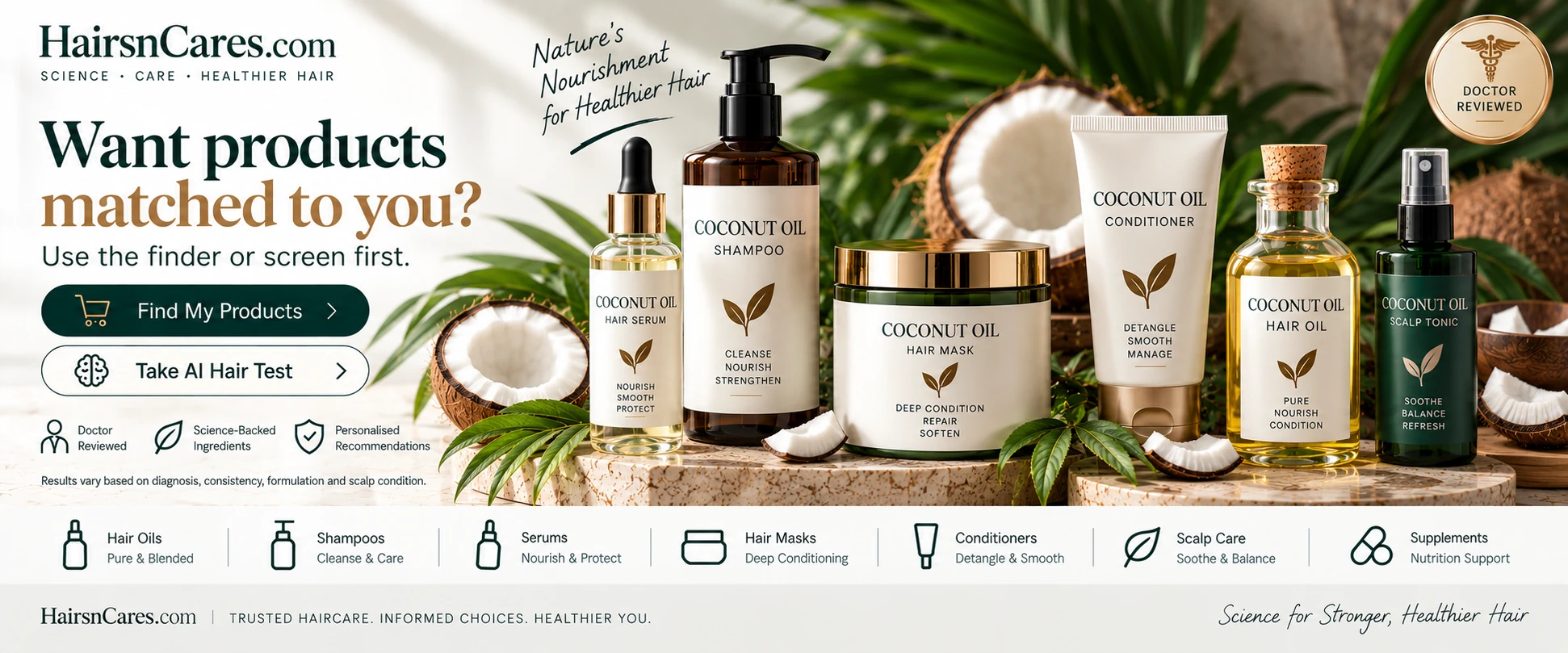
How this ingredient compares with similar options. It points to a pathway; it is not a diagnosis.
| Feature | Coconut Oil | Argan Oil | Castor Oil | Hair Serum |
|---|---|---|---|---|
| Category | Cosmetic oil | Cosmetic oil | Cosmetic (thick) oil | Cosmetic serum |
| Main role | Pre-wash / shaft conditioning | Shine / frizz on lengths | Coating / thickness look | Smoothing / styling |
| Texture | Medium (solidifies cool) | Light | Very thick | Light |
| Best for dry hair | Yes | Yes | Yes (heavy) | Yes |
| Best for frizz | Some | Yes | Some | Yes |
| Best for scalp massage | Pre-wash, if tolerated | Use on lengths | Heavy; lengths | Lengths |
| Oily scalp caution | Use on lengths | Use on lengths | Heavier; caution | Lighter |
| Dandruff caution | Can worsen if heavy | Can worsen if heavy | Can worsen if heavy | Lower |
| Hair growth claims | None (cosmetic) | None (cosmetic) | Limited / cosmetic | None (cosmetic) |
| Pathway | Hair oil | Hair oil | Hair / beard oil | Hair serum |
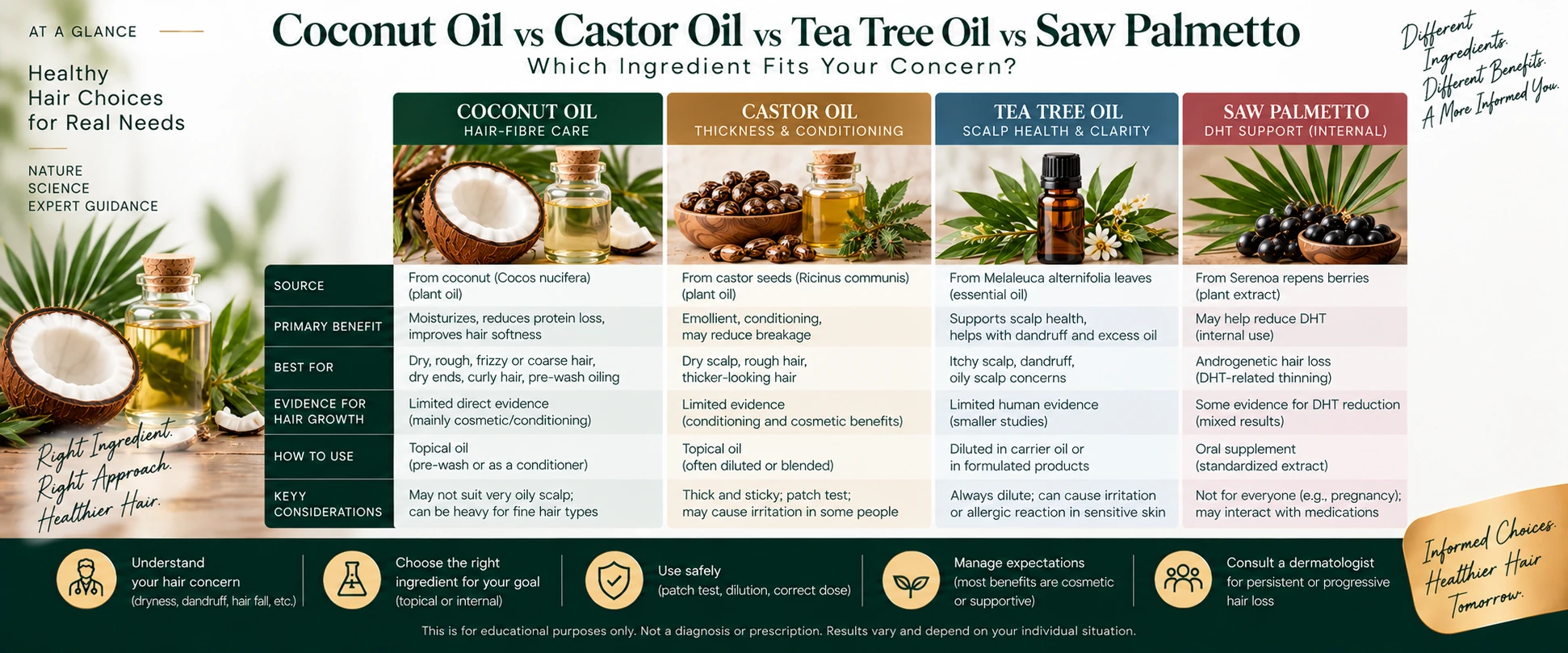
Coconut Oil and Castor Oil are mainly cosmetic hair oils for dryness, frizz, coating and grooming. Tea Tree Oil is an essential oil used in selected scalp-care products but has irritation risk. Saw Palmetto is a DHT-support ingredient with supplement and hormonal safety cautions. None should replace diagnosis for progressive, sudden, patchy or medically complex hair loss.
| Feature | Coconut Oil | Castor Oil | Tea Tree Oil | Saw Palmetto |
|---|---|---|---|---|
| Main category | Cosmetic hair oil | Cosmetic (thick) oil | Essential oil (scalp) | DHT-support supplement |
| Evidence level | Cosmetic | Limited / cosmetic | Limited / cosmetic | Limited–moderate |
| Best for dry hair | Yes | Yes (heavy) | No | No |
| Best for thickness appearance | Some | Temporary coating | No | No |
| Best for dandruff / oily scalp | No (can worsen) | No (can worsen) | Mild support (diluted) | No |
| Best for DHT-support claims | No | No | No | Marketed for it (cautious) |
| Scalp-use caution | Oily/dandruff: lengths only | Heavy; lengths only | Never undiluted; irritation | Supplement: medical history |
| Pregnancy / breastfeeding | Cosmetic; usually fine | Cosmetic; care near eyes | Check if unsure | Avoid unless doctor guides |
| Doctor guidance | Cosmetic; minimal | Cosmetic; minimal | For severe / sensitive scalp | Review before use |
| Product category | Hair oil | Hair / beard oil | Anti-dandruff / scalp | DHT-support / supplement |
"As a dermatologist, I consider Coconut Oil a useful cosmetic oil for selected dry or coarse hair routines, especially pre-wash oiling. People in India have used it for generations and it can genuinely help the hair shaft. But it is not a treatment for root hair fall or pattern baldness, and it may worsen dandruff or folliculitis in oil-sensitive scalps. I keep it on the lengths for those patients, recommend washing it out, and assess the actual cause separately when hair is shedding from the root. Enjoy it for the hair, and bring me the scalp and shedding concerns."
Hair shedding from the root, patchy or progressive loss, or a scalp that worsens with oil? Get assessed.
Consult Dr. Amit's TeamThese references are provided for patient education and do not replace a dermatologist's diagnosis or individual medical advice.
Dermatologist-led overview of how hair loss is evaluated and the evidence behind common treatments.
View reference ›Patient-education summary of common causes of hair loss and when to seek medical care.
View reference ›Searchable index of peer-reviewed research on coconut oil for hair.
View reference ›Independent systematic reviews assessing the evidence behind hair-loss interventions.
View reference ›
Question not answered here? Ask Dr Aria for general guidance, or book a consultation.
Ask Dr AriaConsult a DoctorCoconut Oil is a time-honoured cosmetic conditioning oil for dry, rough or frizzy hair, excellent as a washed-out pre-wash treatment. But it is not a medicine, not a guaranteed growth or regrowth oil, and it does not create follicles or reverse baldness — and it can aggravate oily, dandruff-prone or acne-prone scalps if applied heavily. The smart move is to use it on the hair shaft with realistic expectations, keep it off a prone scalp, and see a doctor for root shedding, patchy or progressive loss, or scalp red flags. Use the AI Hair Test to clarify your situation. Results vary.
A clear, dermatologist-reviewed summary of where Coconut Oil fits in hair fall, scalp care, hair-growth support or product selection — without exaggerated regrowth claims.
Results vary based on diagnosis, consistency, formulation and scalp condition.
 Coconut Oil
Cosmetic hair oil
Dryness, frizz, shine and breakage reduction
Cosmetic (hair-shaft support)
Usually optional
Reviewed by: Dr. Amit Agarkar, MD Dermatology
Medical focus: Dermatology, trichology, hair loss, scalp disorders and hair restoration.
Last reviewed: 1 June 2026
Editorial promise: This page explains benefits, limitations, side effects and safe use without exaggerating hair-growth claims.
Prepared by the Hairsncares editorial team and medically reviewed by a dermatologist experienced in hair and scalp disorders.
Checked for ingredient role, evidence level, safety warnings, medical limitations and suitability for Indian haircare users.
To help you choose ingredients safely and understand when a dermatologist diagnosis matters more than trying products randomly.
| Parameter | Assessment | What it means |
|---|---|---|
| Evidence level | Cosmetic (hair-shaft support) | How strong the support is for this ingredient in hair or scalp care. |
| Best use case | Dryness, frizz, shine and breakage reduction | The situation in which it may genuinely help. |
| Not suitable for | People expecting regrowth; oily/acne-prone scalps if overused; fresh transplant area without surgeon approval | When a dermatologist diagnosis is needed before use. |
| Expected timeline | Cosmetic feel/shine; not follicle regrowth | Results vary based on diagnosis, consistency, formulation and scalp condition. |
Product results should be selected based on scalp type, diagnosis, sensitivity, routine compatibility and dermatologist guidance where needed.
Find Products After AI Hair TestCoconut Oil may help in selected situations depending on its evidence level, diagnosis, formulation and consistency. It should not be treated as a guaranteed regrowth solution for every type of hair loss.
Timelines vary. Medicines and deficiency-based treatments may take months, while cosmetic oils or hydration ingredients may mainly improve feel, shine or manageability sooner.
Cosmetic ingredients may be used carefully, but medicines, persistent hair fall, patchy loss, scalp disease or sudden shedding need dermatologist evaluation.
Combination depends on scalp sensitivity, diagnosis, product type and whether the ingredient is cosmetic, supplement-based or prescription-guided.
People with allergies, irritation, active scalp disease, unclear diagnosis, pregnancy, breastfeeding or prescription-medicine concerns should check suitability before use.
Supports hair feel, shine, lubrication or frizz control. Not a proven regrowth treatment.
Coconut Oil is a cosmetic hair-shaft oil, not a medicine.
It may help with pre-wash conditioning for dry/coarse hair — but it should not be treated as a cure for all hair fall.
Bottom line: use this guide to understand evidence, safety and product type, then take the AI Hair Test or consult a dermatologist for medical hair loss. Results vary.
Coconut Oil is a cosmetic hair oil used mainly for hair-shaft conditioning, lubrication, shine and manageability. It does not create new follicles.
Coconut Oil can help hair-shaft lubrication, but heavy oils may worsen buildup, flaking or discomfort on some scalps. Apply mainly to mid-lengths and ends unless advised otherwise, and keep heavy oil off an oily, flaky or inflamed scalp.
Coconut oil is one of the few oils studied for penetrating the hair shaft, which is why a pre-wash application can help reduce some wash-related protein loss and leave dry, coarse or frizzy hair feeling smoother. Phrased carefully: this is hair-shaft support, not follicle stimulation — it does not regrow hair. Apply to lengths before washing; keep heavy oil off an oily, dandruff-prone scalp.
See dry hair and frizzy hair routines; browse hair oils.
Educational guidance, not a diagnosis. Results vary.
This guide is educational. For sudden, patchy, progressive or unexplained hair loss, or scalp pain, pus or scaling, screen with an AI tool or see a dermatologist.
Your cart is empty