Myth
"Ceramides permanently repair dead hair."
Fact
They may improve surface condition, manageability and moisture retention, but do not biologically regenerate the hair fibre.
HairsnCares Ingredient Intelligence · Lipid Barrier Science
Ceramides are lipid molecules associated with barrier structure and moisture retention. In haircare, ceramide and ceramide-inspired ingredients are used to support smoother cuticles, reduced roughness, better manageability and protection for dry, damaged or chemically treated hair.
Ceramides are an ingredient family, not one molecule — product format and delivery system matter. Cosmetic repair improves how hair looks and behaves; it is not permanent biological regeneration, and ceramides do not directly regrow hair. Scalp symptoms may need dermatologist assessment.
Quick Ingredient Answer
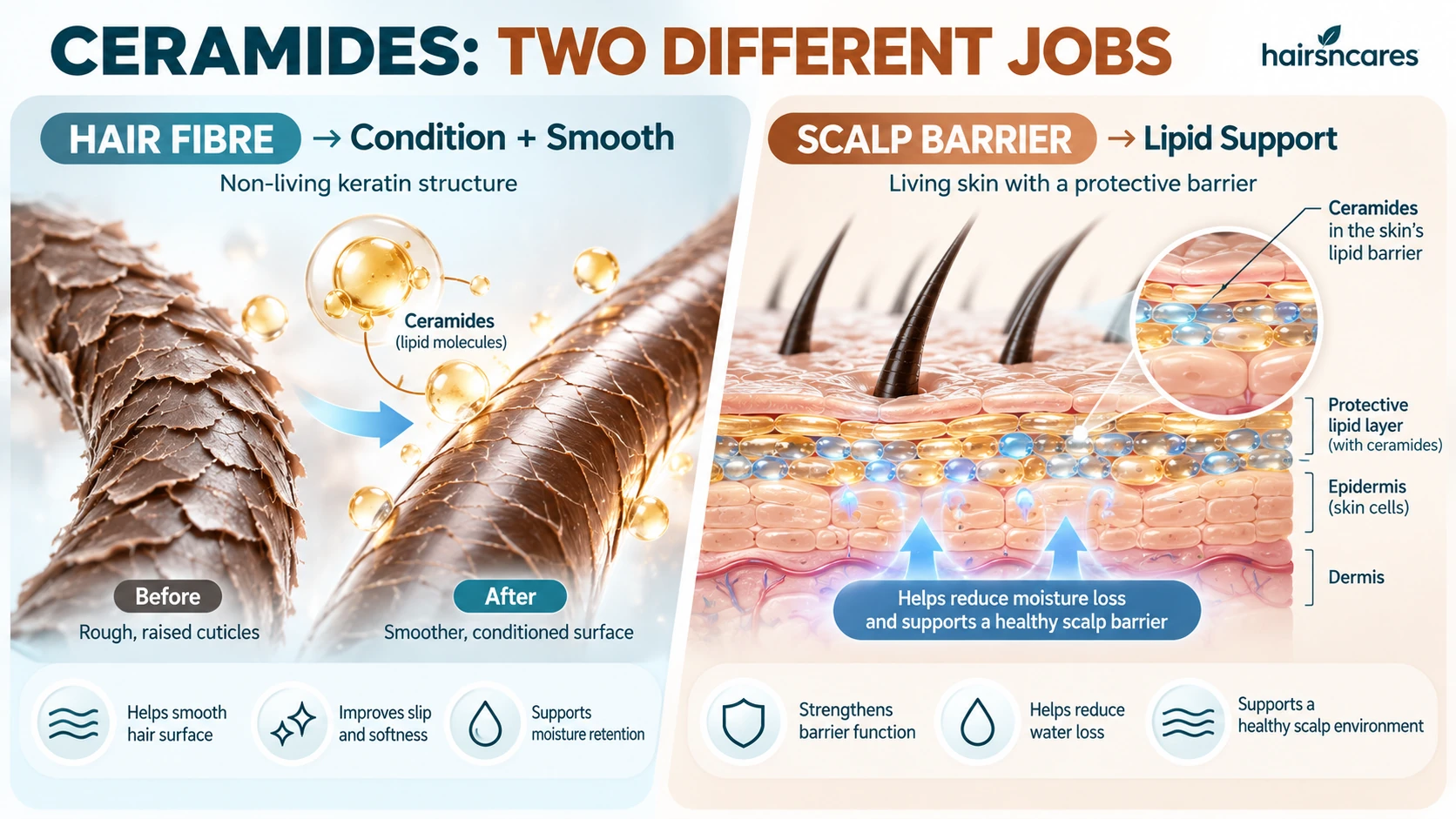
Ceramides are lipid molecules that help hold protective barrier structures together in skin, with related lipids inside the hair fibre. In haircare, ceramide and ceramide-inspired ingredients are used to smooth cuticles, reduce roughness and friction, and support moisture retention — most useful for dry, damaged, porous and chemically treated hair. Their performance depends on the ceramide type, delivery system and supporting lipids in the full formula. What ceramides cannot do: biologically regenerate the non-living hair fibre or directly regrow hair.
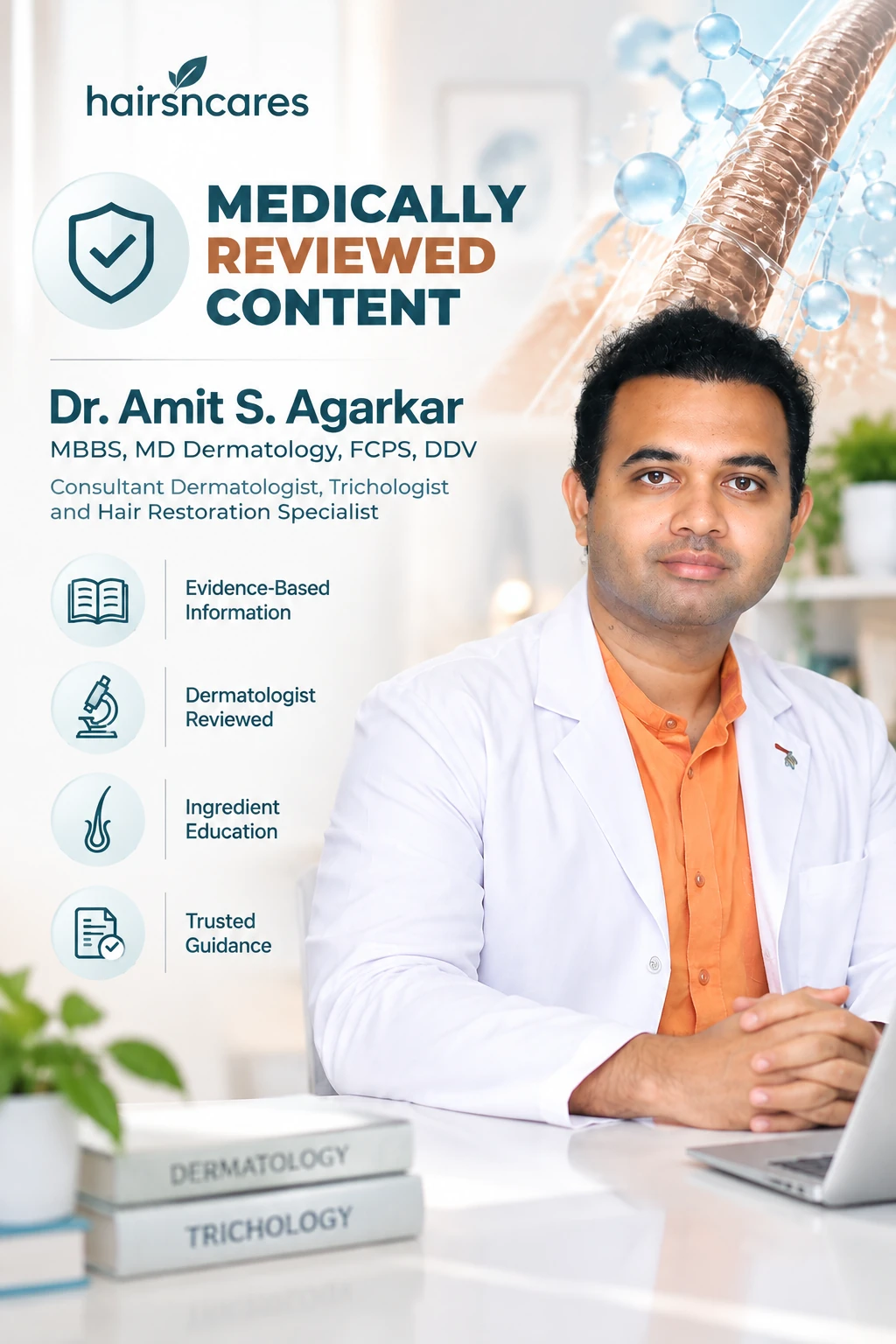
Medically reviewed by Dr. Amit S. Agarkar — MBBS, MD Dermatology, FCPS, DDV · Reviewed 24 July 2026 · Next review July 2027 · Evidence-led review methodology
Overview
Ceramides are lipids — each built from a sphingoid base joined to a fatty acid. They are important components of the skin barrier, and related lipids sit within the hair fibre's protective structures. In cosmetics they may be natural-derived, synthetic or bio-identical-inspired, and hair products may use true ceramides, pseudo-ceramides or lipid complexes.
A useful mental picture: ceramides function like part of the "mortar" between the protective "bricks" of a barrier. It's a helpful analogy — but a simplified one, and it should not be read as literal biological reconstruction of hair. Crucially, the ingredient name alone does not determine performance: supporting lipids, cholesterol, fatty acids, the delivery system and the complete formula decide what a ceramide product actually does.
On the hair fibre (cosmetic conditioning)
On the scalp barrier (living skin)
How Ceramides Work
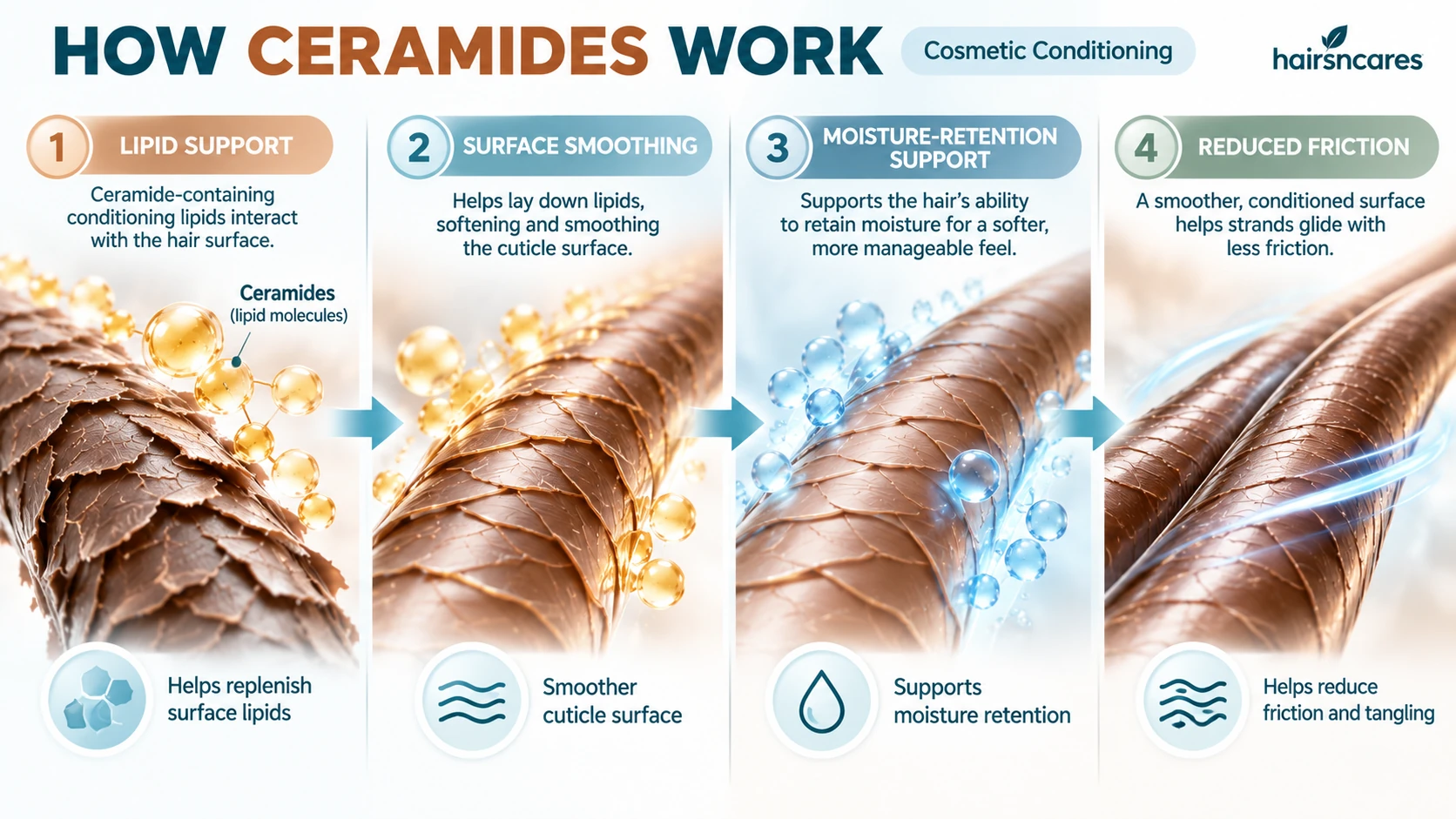
What ceramide-containing formulas may do at the surface of the scalp and hair — described honestly, as cosmetic conditioning rather than regeneration.
Ceramide-containing formulas may supplement or imitate protective lipid structures on the scalp surface and hair fibre.
Ceramides and conditioning agents may help reduce roughness along damaged, raised cuticles.
Improved surface conditioning may reduce moisture loss and improve softness over time.
Smoother fibres comb more easily and may experience less friction-related breakage.
Ceramide-Family Explorer
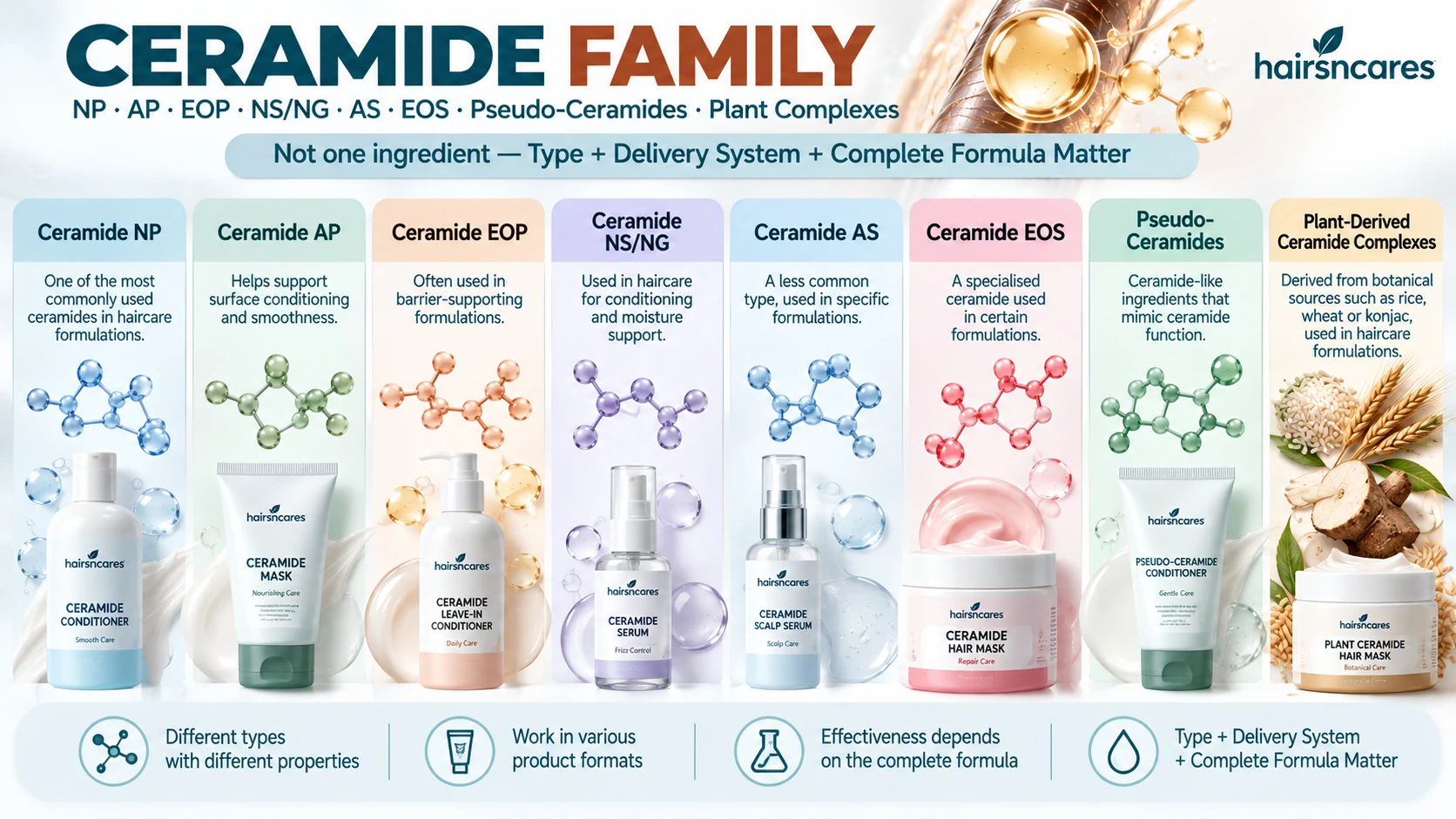
Select a type to see its class, role and honest limitations. Ceramide NP, AP, EOP, NS, AS and EOS, plus pseudo-ceramides and plant complexes, differ in structure and formulation use — and naming varies by supplier and INCI system.
Ceramide NP(formerly Ceramide 3)
One of the most common cosmetic ceramides, frequently used in barrier-support products across skin, scalp and hair. A dependable, well-studied choice — but its results still depend on the delivery system and supporting lipids around it.
Ceramide AP(formerly Ceramide 6-II)
A ceramide subtype used in barrier-support formulations, frequently combined with other ceramides within multi-lipid systems rather than used alone.
Ceramide EOP(formerly Ceramide 1)
A long-chain ceramide type often discussed in barrier architecture and included in advanced lipid complexes for its structural role.
Ceramide NSCeramide NG(formerly Ceramide 2)
A ceramide subtype used in cosmetic formulations, where naming may vary by supplier and INCI system — a reminder that labels require careful reading.
Ceramide AS(formerly Ceramide 5)
Another recognised ceramide class — included here precisely because it should not be treated as interchangeable with every other ceramide.
Ceramide EOS(formerly Ceramide 4)
A specialised long-chain ceramide associated with barrier structure. As with all specialised claims, formulation benefits should be evidence-supported rather than assumed.
Cetyl-PG Hydroxyethyl PalmitamideMyristoyl/Palmitoyl Oxostearamide/Arachamide MEA
Synthetic or designed lipid molecules that mimic selected ceramide functions. They may provide conditioning or barrier-support benefits and are valued for stability and cost — but they are not chemically identical to every natural ceramide.
Rice / Oryza Sativa ceramidesWheat / Triticum ceramidesKonjac ceramides
Ceramide complexes from rice, wheat, konjac and other plant sources. Ingredient identity and concentration must be verified — and plant origin does not guarantee superior performance or zero irritation.
Hair Benefits · Who May Benefit
Nine hair and scalp profiles where ceramide-containing products are commonly considered — each with a product-format direction and an honest caveat.
Supports moisture retention and surface conditioning for hair that feels parched.
Conditioner / mask
Review if dryness comes with scalp symptoms. Dry hair →
Helps roughness, porosity and cuticle disruption feel smoother and more manageable.
Mask / leave-in
Severe breakage may still need trimming. Damaged hair →
Bleaching alters the fibre and can raise porosity and fragility — lipid-rich care is often welcome.
Rich mask
Cannot restore original strength. Repair care →
Gentle cleansing, good conditioning and reduced friction support colour longevity.
Conditioner / leave-in
Routine matters more than one product. Colour care →
Chemical processing may weaken fibre integrity — conditioning support helps day-to-day feel.
Mask / serum
Introduce carefully around treatments. Repair care →
Textured hair sees more friction, dryness and mechanical stress — lipids support moisture and definition.
Leave-in / mask
Fine curls: watch for weigh-down. Curly hair →
Porous fibres lose moisture readily and often benefit from lipid-rich conditioning.
Rich mask / leave-in
Pair with protein thoughtfully. Porosity guide →
Smoothing and conditioning may improve manageability and reduce the appearance of frizz.
Serum / leave-in
Humidity plays a role too. Frizz care →
Scalp formats may support comfort — but distinguish dryness from dandruff, psoriasis and seborrheic dermatitis.
Scalp serum · doctor-guided
Persistent symptoms need assessment. Ask Dr. Amit →
Expert noteThe biggest disappointment with ceramide products comes from expecting them to "fix" split ends or reverse damage. They genuinely make damaged hair look and behave better — smoother, softer, easier to manage — but the improvement lives on the surface and is renewed with use. Split ends still need scissors.
Interactive · Educational only
Nine quick questions. The result is an educational pathway — never a diagnosis, prescription or guaranteed product result.
This checker provides educational ingredient guidance only. It does not diagnose scalp disease, prescribe treatment, set a mandatory routine or replace dermatologist consultation.
Formats, Hair Types & Porosity
The same ceramide behaves very differently in a shampoo, a mask or a scalp serum. Match the format to the job — and never swap a hair-length product onto an oily or inflamed scalp.
| Format | Main role | Best application area | Hair-type notes | Limitations |
|---|---|---|---|---|
| Ceramide shampoo | Primarily cleanses; limited conditioning | Scalp and roots | All types; mildness matters | Won't replace a conditioner |
| Ceramide conditioner | Routine slip, softness, manageability | Mid-lengths and ends | Most types | Light near an oily scalp |
| Ceramide hair mask | Richer conditioning | Mid-lengths and ends | Damaged, thick, bleached, porous | Can weigh down fine hair if overused |
| Ceramide leave-in | Ongoing surface conditioning | Lengths | Most types; small amount on fine hair | Amount matters |
| Ceramide hair serum | Smoothing and protection | Lengths and ends | Frizz-prone, coloured | May include silicones/oils by design |
| Ceramide scalp serum | Scalp-barrier support | Scalp only | Dry/compromised-feeling scalp | Not interchangeable with a lengths serum |
| Ceramide cream / balm | Targeted rich care | High-damage ends | Coarse, very damaged | May not suit oily or fine hair |
| Profile | Main need | Product direction | Common mistake |
|---|---|---|---|
| Fine hair | Condition without weight | Lightweight leave-in or conditioner | Heavy masks near the roots |
| Thick hair | Even conditioning | Richer masks; thorough distribution | Too little product spread unevenly |
| Straight hair | Smoothness, no grease | Light conditioner or serum | Over-applying near the scalp |
| Wavy hair | Balance definition and slip | Light-to-medium conditioning | Weighing down waves |
| Curly hair | Moisture retention | Leave-in plus mask | Under-conditioning |
| Coily hair | Maximum moisture | Rich mask and leave-in | Judging by squeaky-clean feel |
| Low-porosity hair | Avoid buildup | Lightweight formats; clarify per need | Layering heavy products |
| High-porosity hair | Retain moisture | Lipid-rich masks plus protein balance | Lipids only, ignoring protein |
| Colour-treated hair | Colour longevity | Gentle wash plus conditioning | Frequent strong cleansing |
| Bleached hair | Protect a fragile fibre | Rich masks; reduce friction | Expecting strength restoration |
| Heat-damaged hair | Smoothing, protection | Serum plus mask; heat-tool discipline | Skipping heat protection |
| Chemically straightened hair | Support weakened fibre | Mask plus gentle routine | Overloading with rich products |
| Oily scalp, dry ends | Separate scalp and ends | Light scalp cleanse; ends-only conditioning | Masking the scalp |
| Dry scalp, normal lengths | Scalp comfort | Scalp-appropriate formats; assess dryness vs dandruff | Assuming flakes mean dandruff |
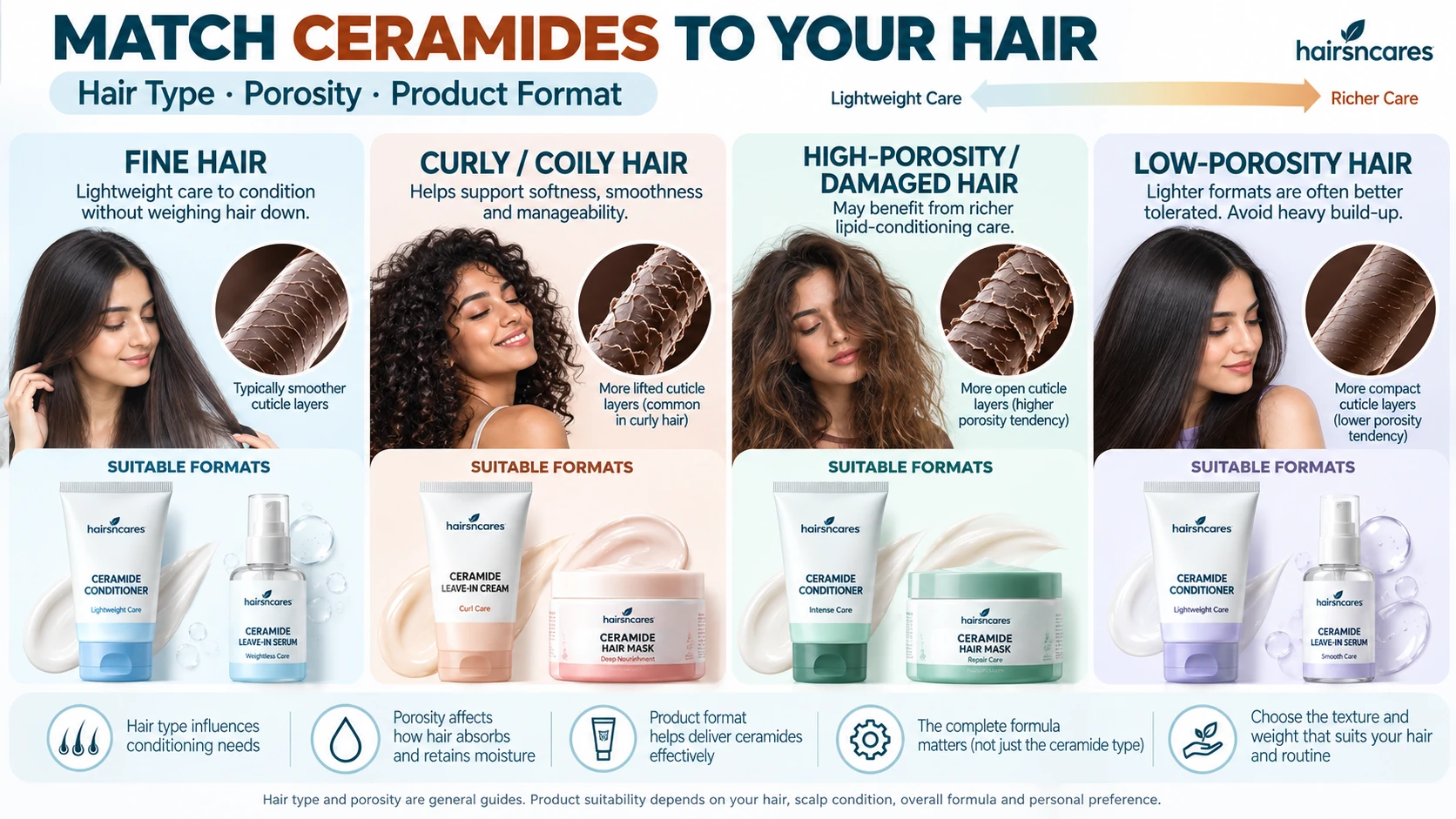
Porosity describes how readily hair absorbs and loses water — shaped by fibre structure and damage. High-porosity hair may benefit from richer conditioning; low-porosity hair can be weighed down by heavy products. Home porosity tests are imperfect, so your hair's response matters more than one online test. Pick a starting point:
Comparisons · Interactive Lab
Pick any two of fifteen ingredients for a side-by-side profile. No ingredient is universally best, none of these are fake "repair scores", and cosmetic conditioning is never permanent biological repair. Never use raw ingredients or DIY mixing.
Select exactly two:
Footnotes: descriptions reflect typical cosmetic roles, not fixed rankings or repair scores. Finished-formula performance may differ. Cosmetic conditioning improves feel and appearance; it does not permanently repair or regrow hair.
Ceramides give lipid support, surface smoothing, moisture retention and reduced friction. Proteins give temporary reinforcement and film formation, behaving differently by molecular size. Not interchangeable — some damaged hair benefits from both, but excess protein can feel stiff and excess lipid can weigh fine hair down.
Ceramides are lipid-family barrier/conditioning ingredients; silicones are conditioning polymers that reduce friction and boost shine, combability and (for some types) heat/humidity resistance. Silicones aren't automatically harmful, the two often coexist, and buildup depends on product design, hair type and cleansing.
Ceramides are specific lipid molecules or lipid-inspired ingredients used within structured conditioning systems; oils are complex triglyceride mixtures that lubricate and add shine, with some penetrating the fibre more than others. Neither replaces the other — format and hair type decide suitability.
Scalp-barrier products often combine ceramides with cholesterol, free fatty acids, humectants, occlusives and emollients. A balanced lipid system usually means more than one prominent hero ingredient — and no single "ideal ratio" applies universally.
"Ceramides permanently repair dead hair."
They may improve surface condition, manageability and moisture retention, but do not biologically regenerate the hair fibre.
"Ceramides directly regrow hair."
Ceramides are conditioning and barrier-support ingredients, not direct hair-growth medicines.
"All ceramides are identical."
Ceramide classes, pseudo-ceramides and lipid complexes differ in structure and formulation use.
"More ceramides always produce better results."
Product format, delivery system and hair type are equally important.
"Ceramides and proteins do the same thing."
Ceramides mainly give lipid and surface support; proteins give temporary reinforcement and film formation.
"Silicones make ceramides ineffective."
Silicones and ceramides can provide complementary conditioning benefits.
"Plant ceramides are always superior."
Origin alone does not determine efficacy or tolerability.
"Ceramide products are always lightweight."
Rich masks and creams may weigh down fine or low-porosity hair.
"A ceramide conditioner can treat scalp disease."
Cosmetic conditioners do not replace medical treatment for inflammatory or infectious scalp conditions.
"Ceramides permanently seal split ends."
Products may temporarily improve the appearance of split ends, but trimming is required to remove them.
"Ceramides can be useful in well-formulated products for dry, porous and chemically treated hair, but they should be understood as conditioning and barrier-support ingredients — not as direct hair-growth treatments or permanent biological repair."
Product Finder · Doctor-Curated
Product data loads from the live HairsnCares catalogue. Filter to shortlist, then let the Routine Finder personalise.
{{PRICE}} MRP {{MRP}} · {{DISCOUNT}}
{{STOCK_STATUS}} · {{RATING}} ({{REVIEW_COUNT}} reviews)
{{PRICE}} MRP {{MRP}} · {{DISCOUNT}}
{{STOCK_STATUS}} · {{RATING}} ({{REVIEW_COUNT}} reviews)
{{PRICE}} MRP {{MRP}} · {{DISCOUNT}}
{{STOCK_STATUS}} · {{RATING}} ({{REVIEW_COUNT}} reviews)
Availability, pricing, ratings and ingredient declarations load from the live catalogue. Genuine reviews only — nothing on this page is invented.
The Routine Finder walks the full journey: hair texture → chemical and heat damage → porosity tendencies → breakage, frizz and tangling → scalp condition → ceramides vs proteins vs oils vs silicones → matching products → dermatologist escalation when required.
The structural picture that decides how much lipid and protein your hair wants.
Frizz, tangling, breakage and scalp condition refine the routine.
Weigh ceramides, proteins, oils and silicones, then see matches.
Dermatologist review for persistent or unclear scalp symptoms.
The tool provides educational ingredient guidance and product discovery. It does not diagnose scalp disease or prescribe medical treatment.
Barrier lipid · balances lipid systems
Explore Ingredient →
Barrier lipid · conditioning support
Explore Ingredient →
Humectant · moisture support
Explore Ingredient →
Humectant · surface hydration
Explore Ingredient →
Conditioning · softness and slip
Explore Ingredient →
Soothing support · scalp comfort
Explore Ingredient →
Protein · temporary reinforcement
Explore Ingredient →
Protein-derived · conditioning support
Explore Ingredient →
Emollient lipid · softness and slip
Explore Ingredient →
Plant oil · shine and lubrication
Explore Ingredient →
Plant oil · penetrating conditioning
Explore Ingredient →
Conditioning polymers · smoothing
Explore Ingredient →
Gentle cleansing systems
Explore Ingredient →
Conditioning · comfort and balance
Explore Ingredient →
Safety · Use & Expectations
Technique, supporting ingredients, realistic expectations and the reaction ladder — clarity, not fear.
Cholesterol, fatty acids and squalane round out a lipid system so it behaves better than any single hero ingredient.
Glycerin, Hyaluronic Acid, Panthenol, Niacinamide and amino acids support hydration and softness.
Hydrolysed proteins and peptides add temporary reinforcement; use in balance to avoid stiffness.
Shea, argan, coconut and jojoba oils, silicones, polyquaterniums, fatty alcohols and gentle surfactants shape the sensory result.
Improved slip, easier detangling, softer feel, reduced roughness, better shine and less static.
Better manageability, reduced friction, reduced appearance of frizz, improved feel in damaged lengths and moisture retention — plus a more comfortable scalp in suitable scalp formulas.
Ceramide products cannot independently correct androgenetic alopecia, nutritional or hormonal hair loss, autoimmune or scarring alopecia, severe scalp inflammation or fungal infection.
Products may temporarily improve the look of split ends, but they cannot be permanently fused — trimming removes them.
Monitor product amount and placement.
Stop use and seek professional advice.
Seek urgent medical attention.
FAQs · Curated Answers
Honest answers to the questions we hear most often about ceramides for hair and scalp.
Ceramides are a family of lipid (fat-like) molecules, each built from a sphingoid base and a fatty acid. They are important components of the skin barrier, and related lipids sit within the hair fibre's protective structures. In haircare, "ceramides" refers to a family of true ceramides, pseudo-ceramides and lipid complexes — not one single ingredient or formula.
In well-formulated products, ceramides and ceramide-inspired ingredients may help smooth raised cuticles, reduce surface roughness and friction, support moisture retention and improve softness, shine and manageability. These are cosmetic, surface-conditioning benefits — the effect depends on the ceramide type, delivery system, product format and supporting lipids.
They can be a sensible choice for dry, porous and chemically treated hair, where the protective surface lipids and smooth cuticle have been disrupted. Ceramide-containing products may improve feel, reduce roughness and support moisture retention — improving the condition and behaviour of damaged hair without biologically regenerating the fibre.
No. Hair above the scalp is non-living, so cosmetic products can improve its surface condition, feel and manageability, but they do not permanently rebuild it. Ceramide benefits are real but cosmetic and ongoing — they fade as product is washed out, which is why consistent use matters more than any one application.
They may. By supporting surface lipids and reducing moisture loss, ceramide-containing conditioners, masks and leave-ins can help dry hair feel softer and more manageable. Pairing them with humectants and appropriate conditioning agents usually matters more than the ceramide alone.
Often, yes — smoothing raised cuticles and reducing friction can improve manageability and reduce the appearance of frizz. Frizz also responds to humidity, damage level and overall routine, so ceramides are one helpful lever rather than a complete fix.
They can suit curly and coily hair well, because textured fibres experience more friction, dryness and mechanical stress. Lipid-rich conditioning may support moisture retention and definition — though fine curls can be weighed down by very rich formats, so format and amount matter.
They're a reasonable choice. Colour-treated hair benefits from gentle cleansing, good conditioning and reduced friction, all of which ceramide-containing products can support. The complete routine — including wash frequency and heat use — influences colour longevity more than any single ingredient.
Bleaching alters the fibre and can increase porosity and fragility, so lipid-rich conditioning is often welcome. Ceramide masks and leave-ins may improve feel, reduce breakage from friction and support moisture retention — but they cannot restore the fibre's original strength, and severely damaged sections may still need trimming.
Ceramide scalp products may support barrier lipids, reduce moisture loss and improve comfort on a dry or compromised-feeling scalp. Because the scalp is living skin, persistent dryness, flaking or irritation should be assessed rather than assumed to be a simple barrier issue — it may be dandruff, psoriasis or seborrheic dermatitis.
They may improve comfort in a dry-feeling scalp when used in a suitable scalp formulation, but they are not a treatment for scalp disease. A dry or flaky scalp is not always a weak barrier — distinguishing simple dryness from dandruff or inflammatory conditions needs a professional eye if it persists.
No — ceramides are conditioning and barrier-support ingredients, not hair-growth medicines. They do not directly treat pattern hair loss or restart follicles. By reducing friction-related breakage, they may help you retain length you already have, but that is different from stimulating new growth.
Ceramide NP (formerly Ceramide 3) is a common cosmetic ceramide used in barrier-support products across skin, scalp and hair formulas. Like all ceramides, its real-world performance depends on the delivery system and the supporting lipids around it — the INCI name on the label does not by itself guarantee results.
Pseudo-ceramides are synthetic or designed lipid molecules that mimic selected functions of natural ceramides. They may provide conditioning or barrier-support benefits and are valued for stability and cost-effectiveness. They are not chemically identical to every natural ceramide, and should be judged on formula performance rather than the name.
Not automatically. Plant-derived ceramide complexes (from rice, wheat, konjac and others) and synthetic or bio-identical-inspired ceramides can both perform well. Origin alone does not determine efficacy or tolerability — ingredient identity, concentration, delivery and the complete formula decide, and plant origin does not guarantee zero irritation.
Ceramides are lipids that primarily support surface smoothing, moisture retention and reduced friction. Proteins (like hydrolysed keratin or wheat protein) provide temporary reinforcement and film formation, behaving differently by molecular size. They are not interchangeable — some damaged hair benefits from both, but excess protein can feel stiff and excess lipid can weigh hair down.
Ceramides are lipid-family ingredients used for barrier and conditioning support; silicones are conditioning polymers that reduce friction and improve shine, combability and — for some types — heat and humidity resistance. Silicones are not automatically harmful, the two can coexist in one formula, and buildup depends on product design, hair type and cleansing.
Often, yes — many damaged-hair routines combine lipid and protein care because they address different needs. The key is balance: too much protein can leave some hair stiff, so alternate or choose products thoughtfully and judge by how your hair feels. If your hair reacts unpredictably to protein, introduce changes one at a time.
Rich ceramide masks and creams can weigh down fine or low-porosity hair if overused or applied near the roots. Fine hair usually does better with lightweight ceramide conditioners or leave-ins, applied to mid-lengths and ends in small amounts. Format and placement matter as much as the ingredient.
See a dermatologist if you have a painful scalp, persistent burning, broken or oozing skin, thick scale or plaques, pustules, crusting, scalp swelling or suspected infection; sudden patchy hair loss or severe shedding; severe itching or reactions to multiple products; after a recent transplant, microneedling or chemical burn; or for persistent scalp symptoms in children.
Generic answers end where your individual hair begins. Get a personalised, dermatologist-designed assessment in minutes.
Your Next Step
The best product depends on hair texture, porosity, chemical damage, heat exposure, frizz, breakage, scalp condition, product weight and routine compatibility. A guided match beats another hopeful jar.
Medical Disclaimer: This HairsnCares ingredient-family guide is intended for general education and product discovery. It does not replace diagnosis, prescription or personalised advice from a qualified dermatologist. Ceramide products differ in ceramide type, concentration, delivery system, product format and supporting ingredients. Cosmetic products may improve the appearance, softness and manageability of damaged hair but cannot biologically regenerate non-living hair fibres or directly treat most forms of hair loss. Stop use and seek medical advice if significant irritation, swelling, broken skin, severe burning, persistent scalp scaling or unusual hair shedding occurs.
Your cart is empty