What is happening
- The follicle is shortened and resting
- A completed club hair is retained in place
- Lower-follicle activity is reduced
- No active shaft elongation
- The follicle prepares for renewed growth
Hair Biology · Process 03
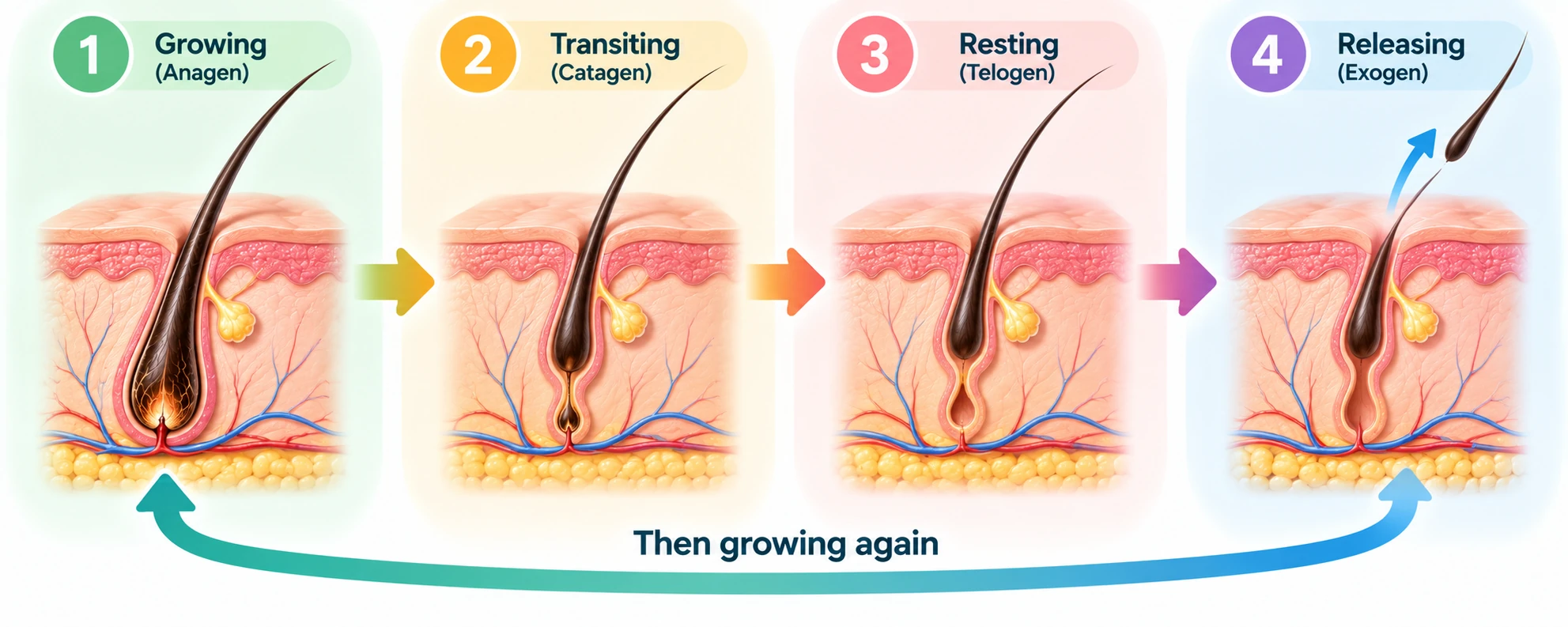
Every scalp follicle follows its own biological rhythm. During anagen it actively forms hair, during catagen it transitions, and during telogen it rests before the retained fibre is eventually released.
Educational content. This page explains normal cycling and shedding; it cannot determine the cause of an individual's shedding or thinning.
New to the follicle? See how the follicle works first.
Quick Clinical Answer
The hair-growth cycle is the repeating biological process through which each follicle grows, transitions, rests and releases a hair. Anagen is the active growth phase, catagen is a short transition phase and telogen is the resting phase. Exogen describes the release of the retained club hair. Hair growth is a cycle, not a continuous straight line — and each follicle keeps its own time.
Medically reviewed by Dr. Amit S. Agarkar — MBBS, MD Dermatology, FCPS, DDV · Reviewed 26 July 2026 · Next review July 2027
Overview
Each follicle operates independently, alternating between active fibre production, transition, rest and release. The balance between these phases influences visible density, shedding and the time required to evaluate a treatment.
This is the single most useful idea for interpreting your own hair. Density is not the result of continuous growth; it is the running balance between follicles that are producing and follicles that are resting. Shift that balance and the visible result follows — but only after a delay, because nothing about hair is instant.
The same logic explains three things people find maddening. Shedding often begins months after whatever caused it. A treatment that is genuinely working shows nothing for months. And one hair in a hand tells you almost nothing, because the follicle that released it is very likely already preparing the next.
A shed hair may mark the end of one cycle — not the end of the follicle. The premise of this guide
Previously in this faculty: Hair Anatomy and The Hair Follicle · Next: Scalp Biology
Interactive · The Rhythm of the Follicle
Four phases, each with its own anatomy. Select a phase to highlight it in the diagram and read what the follicle is doing, what you might notice, what is commonly misunderstood, and what it implies for treatment timelines.
Growing Transitioning Resting Releasing Growing again
Phase 01 · Growing
The follicle is fully developed and actively producing fibre. New material is added at the base and the existing shaft is pushed upward, so the hair lengthens from below rather than from the tip.
Phase 02 · Transitioning
A short, programmed transition. Active fibre production stops, the lower follicle regresses, and the base of the hair consolidates into a club shape in preparation for rest.
Phase 03 · Resting
The shortened follicle retains a fully formed club hair without lengthening it further. Activity in the lower follicle is reduced while it prepares for renewed growth.
Phase 04 · Releasing
The retained club hair is released from the follicle. Exogen overlaps conceptually with late telogen and the beginning of a new growth cycle, and a new fibre may already be developing beneath the one leaving.
Phase One
Anagen is the phase during which the follicle actively produces a hair fibre. The lower follicle is fully developed, matrix cells divide rapidly and the emerging hair continues to lengthen.
Hair does not grow from the tip. New fibre is formed within the lower follicle and added at the base, gradually pushing the existing shaft upward. Everything you can see was made below the surface, some time ago — which is why the ends of long hair are years old.
The length your hair can reach is set by how long its follicles stay in this phase, not by how you treat the ends.
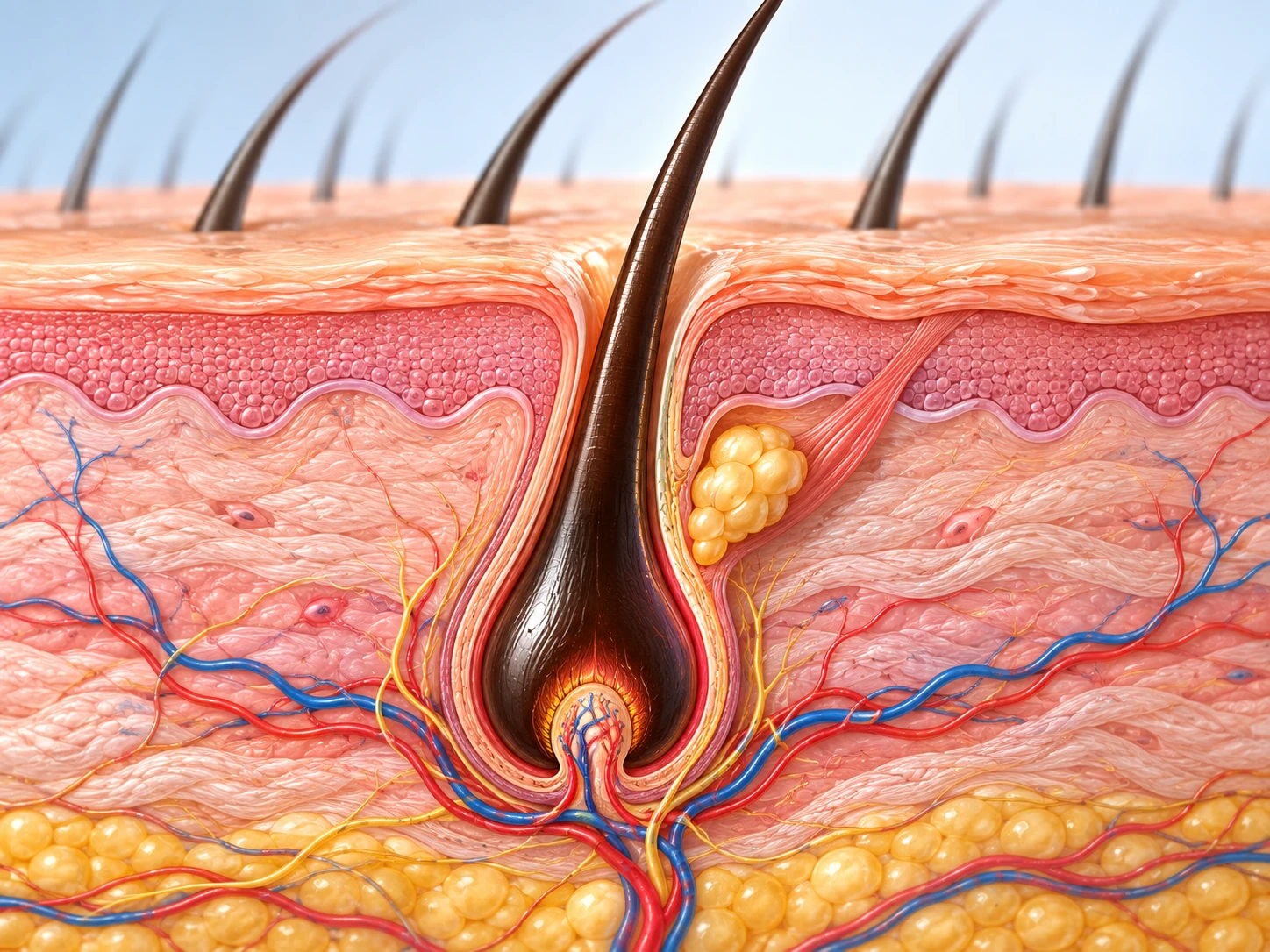
During active anagen, pigment-producing activity is usually coordinated with fibre formation. Pigment is incorporated while the shaft is forming, and the visible strand cannot later produce its own melanin. Greying therefore reflects changes in follicular pigmentation rather than pigment washing out of the hair you can see. More in melanin and hair colour.
Claim: “cutting the ends activates anagen”Trimming removes damaged or split fibre and genuinely improves how hair looks and behaves. It does not change the biological phase of the follicle below the scalp — the two events are several centimetres and several months apart. Where trimming helps is by removing lengths that were breaking, so hair retains the length it grows.
Phase Two
Catagen is a short transitional phase during which active fibre production stops and the lower follicle begins to regress. It is a normal, programmed part of the cycle — not a disease state.
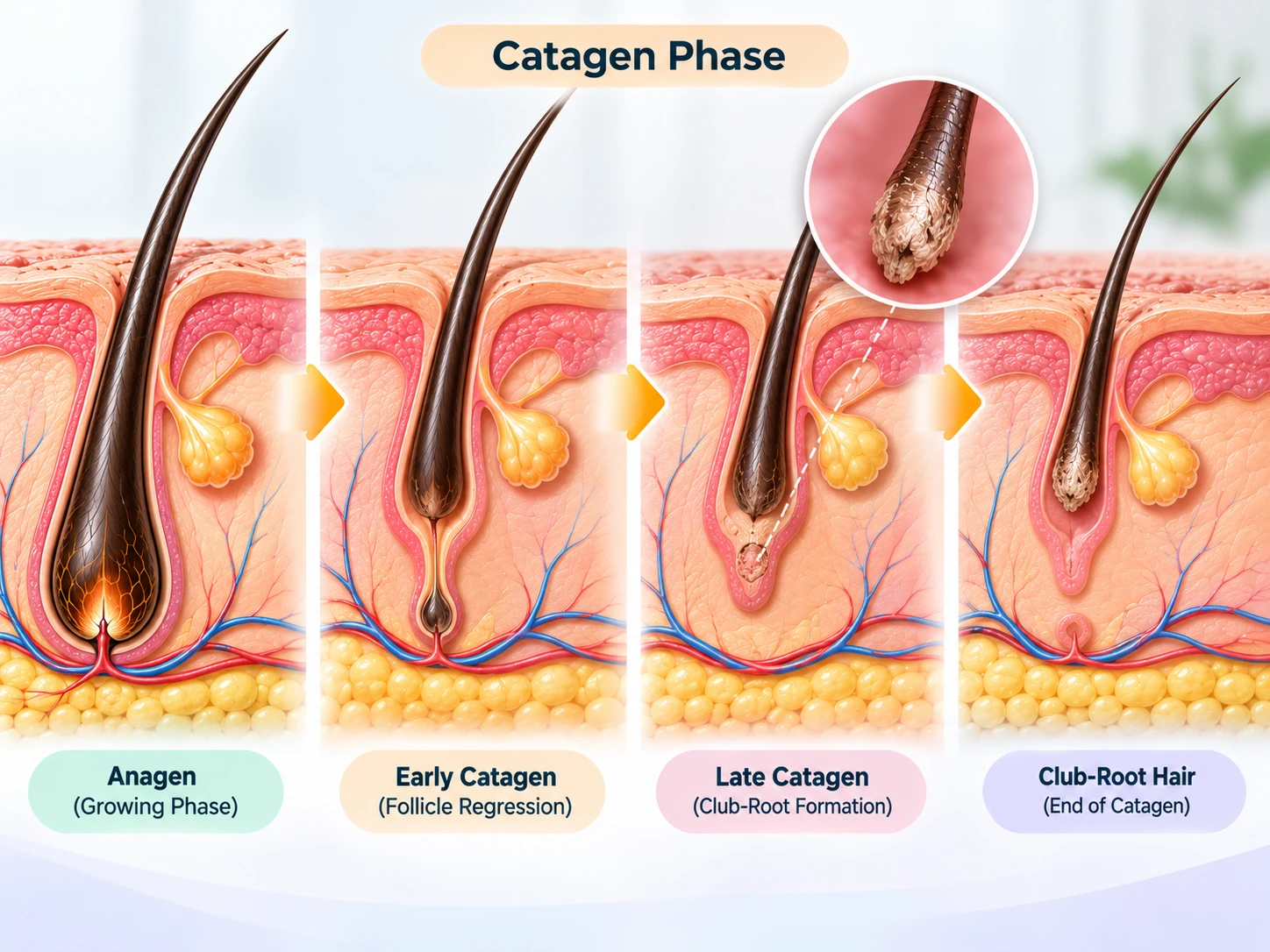
Be cautious with any claim to “block catagen completely”. A healthy follicle must transition through its normal cycle. The goal of treatment is not to abolish a biological phase but to address abnormal cycle behaviour where it exists — and an abnormal early shift out of anagen can occur in some conditions without catagen itself being the problem.
Phase Three
Telogen is the resting phase in which the shortened follicle retains a fully formed club hair but is no longer actively lengthening it.
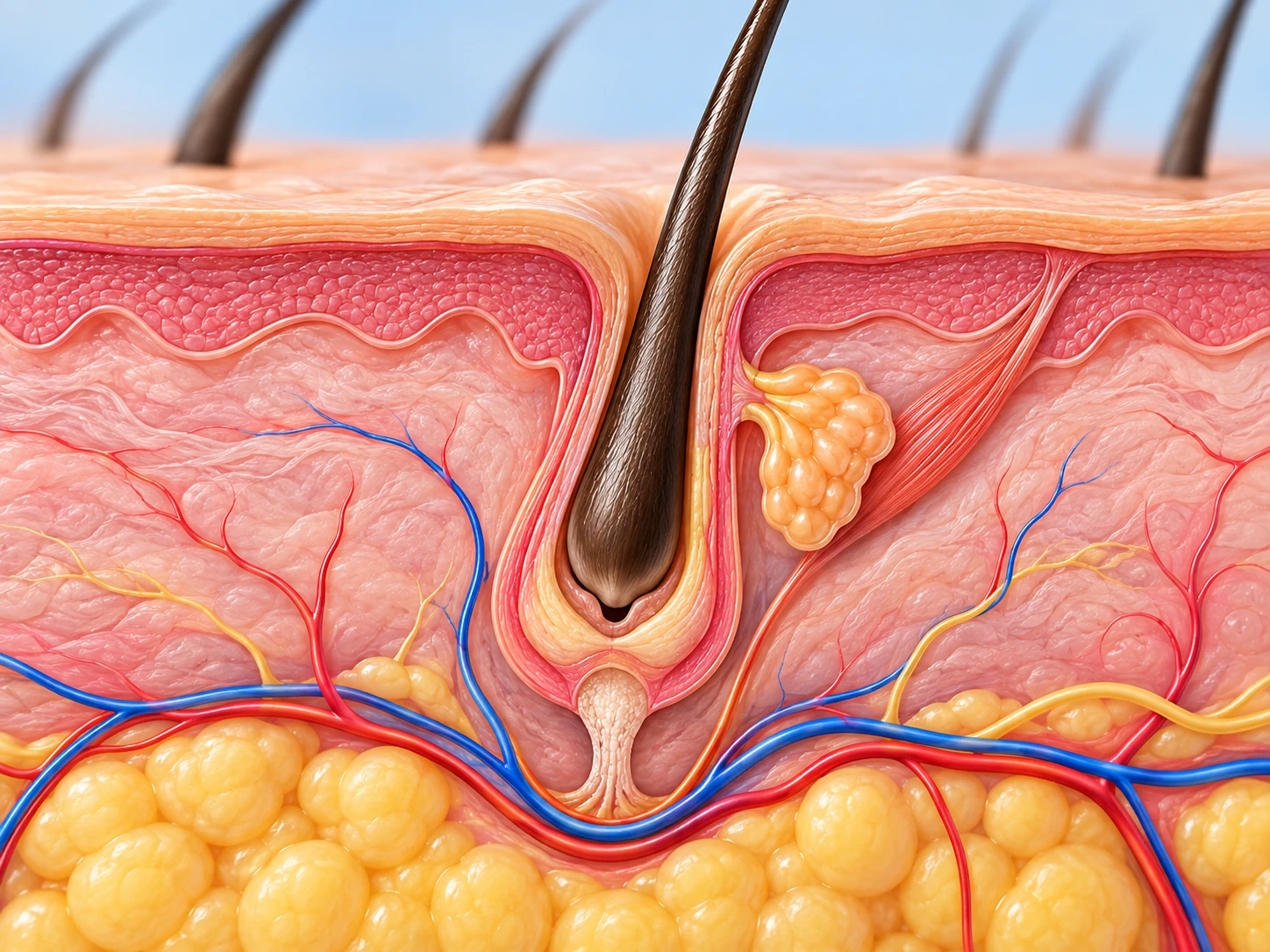
Claim: “a telogen hair means the root is dead”Telogen is a normal resting phase. The follicle may later return to anagen and produce another fibre. This is the single reassurance I give most often, and it is worth stating plainly: finding club-rooted hairs is evidence that your follicles are cycling, not evidence that they have stopped.
Phase Four
Exogen refers to the stage during which a retained club hair is released from the follicle. It overlaps conceptually with late telogen and the beginning of a new growth cycle.
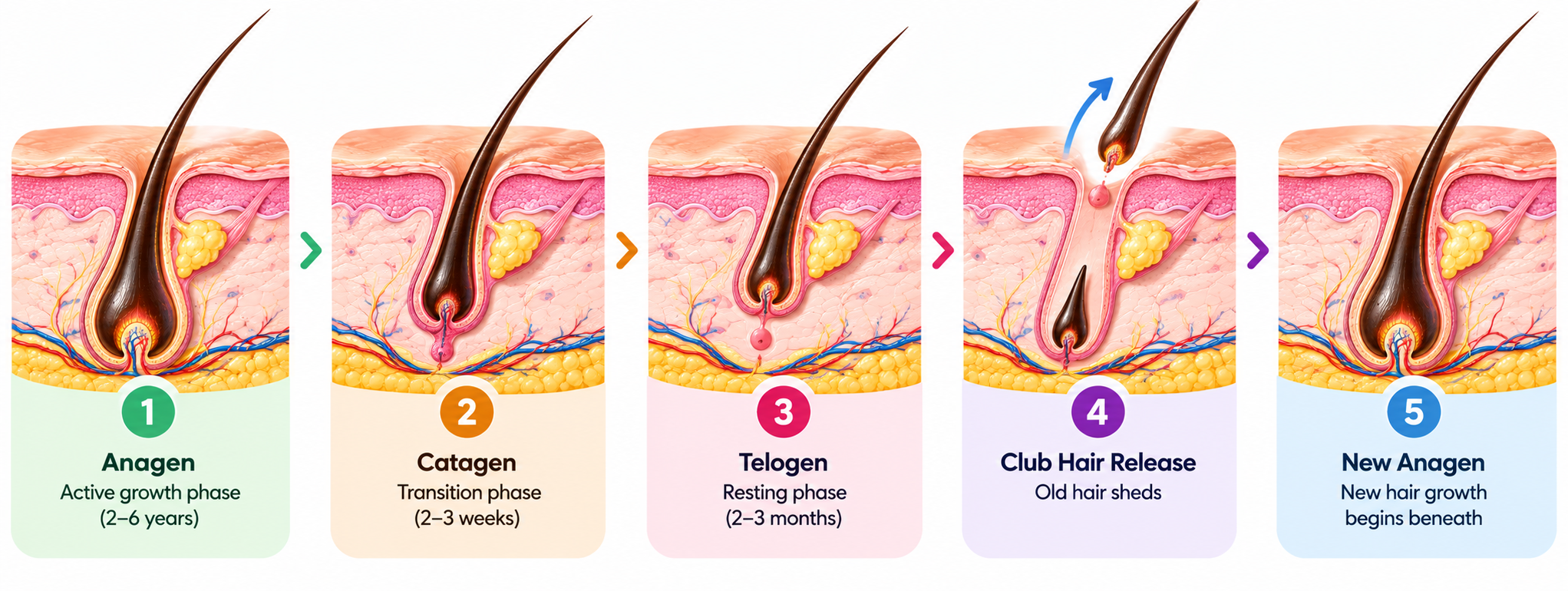
Why wash days look alarming: hair found during washing was often already detached or close to release. Washing, combing or simply running your hands through your hair may make the shedding visible without being its original biological cause. If you wash less often, you will see more hairs at once on the days you do — the total is unchanged.
Sequence
Five stages, then back to the beginning. The cycle is the unit of hair biology — not the day, and not the strand.
The follicle actively produces hair.
Production stops and the lower follicle regresses.
The follicle rests while retaining the club hair.
The old fibre is released.
A new growth phase begins, and the sequence starts again.
Shedding is part of renewal when the cycle remains balanced.
One caveat worth stating: a shed hair is not necessarily replaced on the same day. There is normally an interval between release and the emergence of the next fibre, and that interval is part of why density can appear to dip before it recovers.
Asynchrony · Interactive
Scalp follicles are usually asynchronous — different follicles sit in different phases simultaneously. That independence maintains visible coverage instead of producing periodic moulting. Select a scenario to bring it forward; all three remain visible for comparison.
Most follicles are producing hair while a smaller number rest. Hairs are released a few at a time, so density looks stable and shedding goes largely unnoticed.
More follicles than usual have moved into rest together. When they release, shedding becomes obvious and density may dip temporarily — the pattern behind a telogen effluvium.
Follicles are still cycling, but successive fibres are finer and shorter. Total hair count may change little while visible density falls, which is why thinning can appear without heavy shedding.
Two different problems, two different appearances. A telogen shift shows up as shedding. Miniaturisation shows up as thinning without necessarily much shedding. The diagrams are schematic illustrations of the principle, not measurements of any individual scalp — and distinguishing the two in practice needs examination.
Interpretation
Everyone sheds hair as part of normal renewal. What matters is pattern and pace relative to your own baseline — not a number counted in a shower.
On counting hairs: this page deliberately avoids a single "normal" daily figure. What you notice depends on hair length, density, curl pattern, washing frequency, combing habits and how many days have passed since the last wash. A change from your own usual pattern is far more informative than any number, and interpretation requires clinical context rather than arithmetic.
Cycle Disruption
Telogen effluvium is a shedding pattern in which more follicles than usual enter the resting phase, often producing diffuse shedding after a delay. Individual assessment is required — this section explains the mechanism only.
The delay is the part that confuses people most, and it follows directly from the cycle. Follicles must first shift into rest, then hold their fibres, and only then release them. By the time hair appears in the brush, the event that prompted it may be two or three months in the past — and long forgotten.
An illness, surgery, childbirth, major dietary change, significant physiological stress or another event.
More follicles than usual leave anagen earlier than they otherwise would have.
Those follicles hold their completed hairs. Externally, nothing appears to be happening.
The retained hairs are released, often over a period of weeks, and shedding becomes obvious.
Follicles re-enter growth, and regrowth becomes visible only after new fibres form and lengthen.
These are documented associations, not a checklist for self-diagnosis. Several may coincide, and in some cases no clear trigger is identified.
This is not a self-diagnosis tool. Diffuse shedding has several possible causes, and telogen effluvium can coexist with pattern hair loss. Do not stop, start or change any medicine on the basis of this page. If shedding is heavy, persistent, patchy or accompanied by scalp symptoms, seek assessment.
Comparison
Both produce hair loss, but they interrupt the cycle at completely different points — which is why they look different, behave differently and need different medical context.
Interrupts at rest
Interrupts during growth
The practical distinction is timing. A delayed, diffuse shed with club roots points one way; rapid loss during active growth points another. Neither can be confirmed from appearance alone, and anagen effluvium in particular belongs in conversation with the treating medical team rather than with a haircare routine.
Progressive Change
Pattern hair loss is not simply "more shedding". In genetically susceptible follicles, androgen-related signalling can gradually shorten the active growth phase and reduce the calibre of each successive fibre.
Why this matters for interpretation: someone with pattern hair loss may not notice dramatic shedding at all, because the change is in what is produced rather than in how much is released. Conversely, heavy shedding does not automatically mean pattern hair loss. The two can also coexist, and separating them is a clinical task.
Expectations
Six steps stand between a follicular response and a visible change in density. Every one of them takes biological time, and none of them can be skipped.
How I ask patients to judge progressAssess over months, using consistent photographs taken in the same light, at the same angle, with hair in the same state. Do not judge from one wash, one bad-light mirror moment or one handful of hair. And expect the first sign of improvement to be less shedding or shorter regrowth appearing along the part — not a sudden change in overall volume.
On shedding after starting a treatment: some people report a temporary increase in shedding when beginning selected hair-loss treatments, which may reflect cycle changes in certain contexts. It should not automatically be interpreted as proof that the treatment is working, and severe or persistent shedding warrants clinical review rather than perseverance.
Cycle Context
Understanding the cycle explains one of the most alarming and most normal parts of the process: transplanted hair usually sheds before it grows.
After transplantation the hair shafts within the transplanted units commonly shed while the follicles remain implanted in the recipient scalp. Losing the visible hair is not the same as losing the graft.
The transplanted follicles typically pass through a resting phase before entering renewed growth. Nothing appears to be happening during this period.
Follicles do not all restart at once. Emergence is staggered and variable, and the final result develops over an extended period rather than arriving together.
No guarantees here. This section explains cycle behaviour, not expected outcomes. Graft survival, density achieved, timelines and suitability are individual clinical matters that depend on diagnosis, donor supply, technique and long-term planning — and they belong in a surgical consultation.
Variation
Different body sites have different growth-phase durations. Because maximum length depends largely on how long a follicle stays in anagen, the same biology produces very different results in different places.
| Site | Relative anagen duration | What follows from it |
|---|---|---|
| Scalp | Longest | Hair can reach substantial length before the phase ends |
| Eyebrows and eyelashes | Much shorter | Hairs are released before they can grow long, keeping length self-limiting |
| Body hair | Shorter | Length is limited, and varies considerably by site and individual |
This also settles a common worry: eyebrow hairs that never seem to grow are not failing. They are doing exactly what their follicles are programmed to do — reaching the end of a short growth phase and being released. The same is true of body hair, and it is why trimming an eyebrow does not cause it to grow to scalp length.
Myths vs Reality
Nearly all of these come from expecting hair to behave continuously, or from expecting biology that runs in months to answer within weeks.
“All hair grows at the same time.”
Scalp follicles cycle asynchronously, sitting in different phases simultaneously. That independence is exactly what keeps coverage steady instead of producing periodic moulting.
“Shedding always means hair loss.”
Releasing hairs that have completed their cycle is part of normal renewal. Whether shedding matters depends on pattern, pace and whether density is actually reducing.
“A shed hair means a dead follicle.”
The follicle commonly remains within the scalp and may begin another cycle. A shed hair marks the end of one cycle, not the end of the follicle.
“Trimming hair speeds up the growth cycle.”
Trimming removes damaged fibre and helps hair retain length by reducing breakage. It does not change the biological phase or growth rate of the follicle below the scalp.
“Shampoo causes hair to fall.”
Washing may release hairs that were already detached or close to release. It makes shedding visible rather than causing it — and washing less often just concentrates the same total onto fewer days.
“Hair grows continuously without stopping.”
Each follicle alternates between production, transition, rest and release. Continuous growth is not how any follicle works, at any body site.
“Stress is always the cause of shedding.”
Significant stress may contribute in some individuals, but it is one possible factor among many. Attributing shedding to stress by default delays finding the actual reason.
“Hair regrows immediately after shedding.”
There is normally an interval between release and the emergence of the next fibre, and the new hair then needs time to gain length. Density can dip before it recovers.
“More shedding always means a treatment is working.”
Some people report a temporary increase in shedding after starting selected treatments, but this should not automatically be read as proof of benefit. Severe or persistent shedding deserves clinical review.
“Eyebrow hair could grow long if you stopped trimming it.”
Maximum length is set by how long the follicle stays in anagen. Eyebrow follicles have a short growth phase, so their hairs are released before they can lengthen — regardless of trimming.
“Every short hair is new regrowth.”
A short hair may be new growth, a broken fibre, or a miniaturised hair produced that way by its follicle. The tip and calibre distinguish them, not the length.
“If a product hasn't worked in four weeks, it doesn't work.”
A response has to pass through cycle change, fibre formation, subsurface lengthening and emergence before density looks different. Four weeks is too early to judge almost anything in hair biology.
Claim Translator · Interactive
Seven phrases that trade on the cycle. Open each one for what it can legitimately mean, and what would have to be true for it to be more than a slogan.
This is a real biological target — prolonging active growth is precisely what some clinically studied treatments aim to do. The question is whether this product does it, in humans, at the dose in the bottle.
Telogen is a normal, necessary phase. A follicle that never rested could not regenerate its lower structure and begin a new fibre. Abolishing rest is not a coherent goal, and a claim to do it suggests the biology has not been consulted.
Resting follicles restart on their own schedule as a matter of course, so "restarting the cycle" often describes something that was going to happen anyway. The meaningful claim would be influencing which follicles restart, and when — and that needs evidence, not phrasing.
The cycle makes this implausible. A follicle must respond, shift phase, build a new fibre, lengthen it below the surface and then emerge before density can look different. Thirty days is not enough time for that sequence, whatever changes in how hair feels.
Hairs already in telogen are going to be released regardless of what is applied afterwards; that outcome was set weeks earlier. Shedding already in progress cannot be halted instantly, and a product that appears to do so has usually coincided with the natural end of the shed.
Some people do report a temporary increase in shedding after starting selected treatments, and cycle changes may explain it in certain contexts. But the phrase is unfalsifiable as marketing: it converts every possible outcome into evidence of success. Severe or persistent shedding is a reason to review, not to reassure.
Growth rate and growth duration are different things, and it is duration that mostly determines the length you can reach. A product that changed rate meaningfully would be a notable finding. What most such products actually deliver is reduced breakage — hair retains more of the length it grew, which looks like faster growth and is genuinely useful.
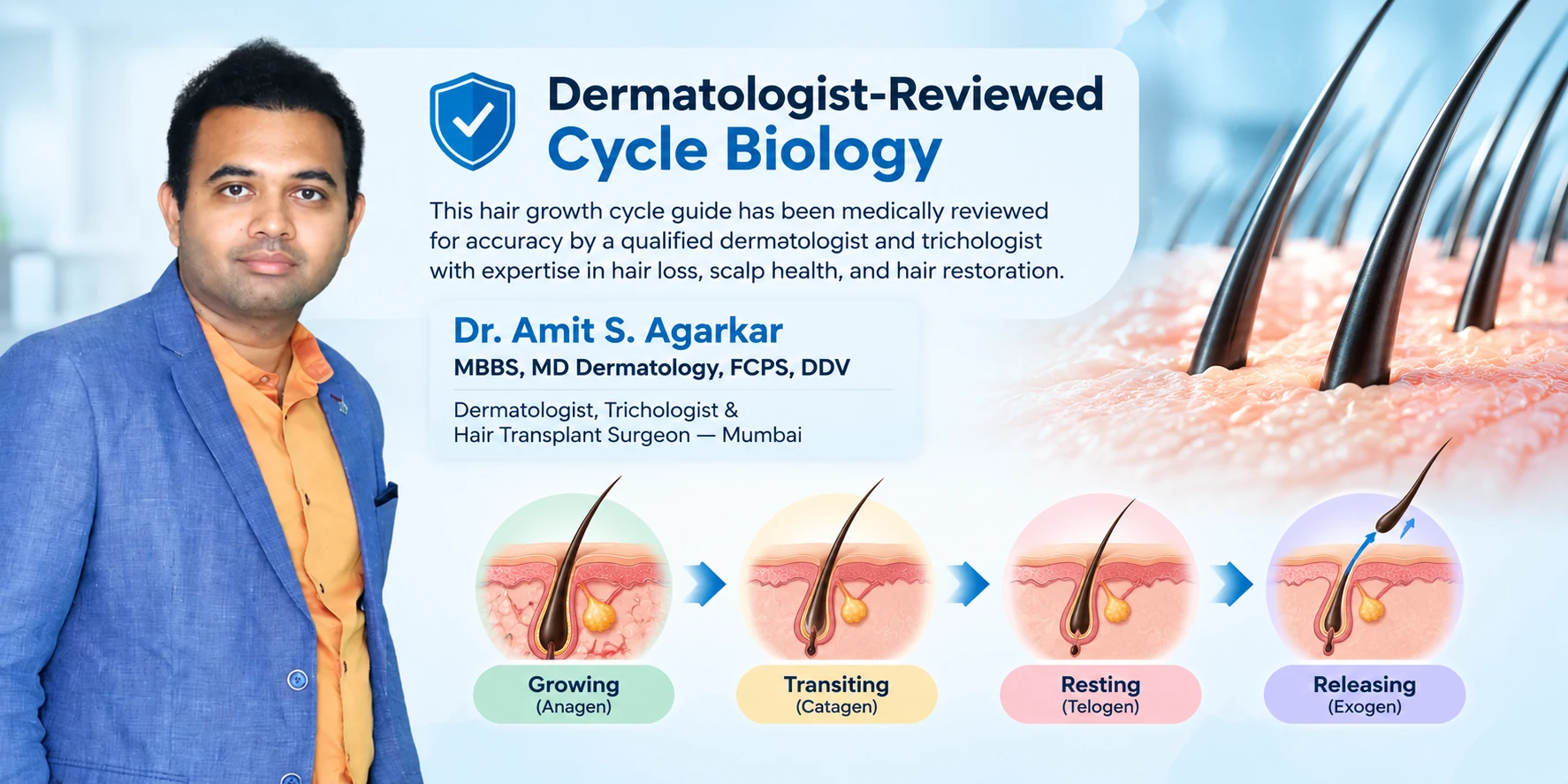
"Most people who come to me worried about shedding are looking at a normal process and reading it as a catastrophe — or looking at genuine miniaturisation and reading it as ordinary shedding. Understanding the cycle is what separates those two, and it is also what makes realistic treatment expectations possible."
Faculty 01 · Hair Biology
The Growth Cycle is the third of five subjects. Next comes the environment the whole process depends on.
01 / Structure
Cuticle, cortex and medulla — the fibre this cycle produces.
Explore hair anatomy →
02 / Origin · previous
Bulb, matrix and dermal papilla — the organ that runs this rhythm.
Understand the hair follicle →
04 / Environment · next
Barrier, sebum and microbiome — the skin every follicle sits inside.
Learn about scalp biology →
05 / Supply
How oxygen and nutrients reach the cells doing all this work.
Trace blood supply to the hair bulb →
Independent medical resources covering hair loss and shedding. Detailed cycle-regulation material is drawn from dermatology reference texts.
External links open in a new tab and lead to independent organisations whose content HairsnCares does not control, and no link implies endorsement or partnership. [ADD APPROVED TEXTBOOK CITATIONS — hair-cycle regulation, effluvium classification, anagen duration by site]
FAQs · Curated Answers
Short, medically responsible answers about the phases, shedding, effluvium, pattern hair loss and treatment timelines.
Each follicle passes through anagen, the active growth phase; catagen, a short transition; and telogen, the resting phase. Exogen describes the release of the retained club hair, after which a new growth phase begins.
The lower follicle is fully developed and matrix cells divide rapidly. New fibre is formed at the base and the existing shaft is pushed upward, so the hair lengthens. Pigment is incorporated during this phase, and most healthy scalp hairs are usually in anagen.
Active matrix division stops, fibre elongation ends and the lower follicle regresses. The base of the hair consolidates into a club shape and the follicle prepares to rest. Catagen is normally brief and is a programmed part of the cycle rather than a disease state.
The shortened follicle retains a fully formed club hair but no longer lengthens it. Lower-follicle activity is reduced while the follicle prepares for renewed growth. A follicle in telogen remains part of the skin and has not been destroyed or permanently switched off.
Exogen is the stage during which the retained club hair is released from the follicle. It overlaps conceptually with late telogen and the beginning of a new growth cycle, and a new fibre may already be developing beneath the one being shed.
Scalp anagen generally lasts for a period of years, which is why scalp hair can reach substantial length, while anagen at other body sites is much shorter. Duration varies between individuals and between follicles, so no single figure applies to everyone.
No. Scalp follicles are usually asynchronous, meaning different follicles sit in different phases simultaneously. That independence is what maintains visible coverage instead of producing periodic moulting.
Yes. Releasing hairs that have completed their cycle is part of normal renewal. The amount noticed varies with hair length, washing frequency, combing habits, curl pattern and how long it has been since the last wash, so a single count is difficult to interpret.
No. The follicle commonly remains within the scalp and may begin another cycle. A shed hair marks the end of one cycle rather than the end of the follicle.
It is usually a normal club-shaped root formed during catagen and retained through telogen. Finding club hairs among shed hairs is a feature of ordinary cycling and does not indicate that a follicle has been lost.
Telogen effluvium is a shedding pattern in which more follicles than usual enter the resting phase, often producing diffuse shedding after a delay. It may follow physiological stress, illness, major dietary change, childbirth, surgery or other triggers, although individual assessment is required.
Because affected follicles must first move into rest and then release their hairs, shedding typically becomes noticeable weeks to months after the triggering event rather than during it. This delay is why the cause is often not obvious at the time the shedding starts.
Significant physiological or psychological stress may contribute to a shift of follicles into the resting phase in some individuals. It is one possible contributor among many, and shedding should be interpreted with clinical context rather than attributed to stress by default.
Anagen effluvium involves interruption of actively growing matrix cells, which can lead to rapid hair loss or breakage during the growth phase. It is associated with certain chemotherapy medicines and severe toxic exposures, and it requires medical context rather than self-assessment.
In genetically susceptible follicles, androgen-related signalling can gradually shorten the active growth phase and contribute to miniaturisation. Successive cycles then produce finer, shorter fibres, so pattern hair loss is not simply a matter of increased shedding.
A follicle can remain in a resting or inactive state for an extended period, and whether it resumes activity depends on the underlying process. Follicles lost to scarring conditions are a different situation, and no product can promise that every inactive follicle will return to growth.
Yes, that is the normal course of the cycle — a resting follicle typically re-enters growth and produces a new fibre. Whether that happens reliably depends on the underlying biology, which is what clinical assessment is for.
A response has to travel through several steps: the follicle responds, cycle activity changes, a new fibre begins forming, lengthens below the surface, emerges, and then gains enough length and calibre to change how density looks. Each step takes biological time.
Some people report increased shedding after starting selected hair-loss treatments, and this may reflect cycle changes in certain contexts. It should not automatically be read as proof that a treatment is working, and severe or persistent shedding deserves clinical review.
After transplantation the visible shafts within the transplanted units may shed while the follicles remain implanted in the recipient scalp. The follicles then pass through a resting interval before entering new growth, and emergence is gradual and variable rather than simultaneous.
No. Trimming removes damaged or split fibre and improves how hair looks and behaves, but it does not change the biological phase or growth rate of the follicle below the scalp.
Washing may release hairs that were already detached or close to release, making shedding more visible on wash days. It is not usually the original biological cause of the shedding event.
Maximum length depends largely on how long a follicle stays in active growth. Eyebrow follicles have a much shorter growth duration than scalp follicles, so their hairs reach the end of the phase and are released before they can grow long.
Not necessarily. A short hair may be newly emerging, or it may be a broken fibre, or a miniaturised hair produced that way by its follicle. Telling them apart involves looking at the tip, the calibre and the pattern rather than the length alone.
Pattern, pace and history matter more than any count. That interpretation needs examination rather than a web page.
Your Next Step
Hair growth follows a biological cycle. Understanding anagen, catagen, telogen and exogen helps interpret shedding patterns realistically and set sensible expectations for any treatment.
Medical Disclaimer: This page provides general educational information about the hair-growth cycle. It does not diagnose the cause of shedding, thinning or hair loss, and it cannot determine which phase an individual's follicles are in. Sections on effluvium, pattern hair loss and transplantation describe biological mechanisms only and are not treatment recommendations or outcome predictions. Do not start, stop or change any medicine on the basis of this page. Sudden, heavy, patchy or persistent shedding, or shedding with scalp symptoms or other systemic symptoms, should be assessed by a qualified medical professional. Individual results vary.
Your cart is empty