Hair Biology · Structure 02

The Hair Follicle: Bulb, Matrix and Dermal Papilla Explained

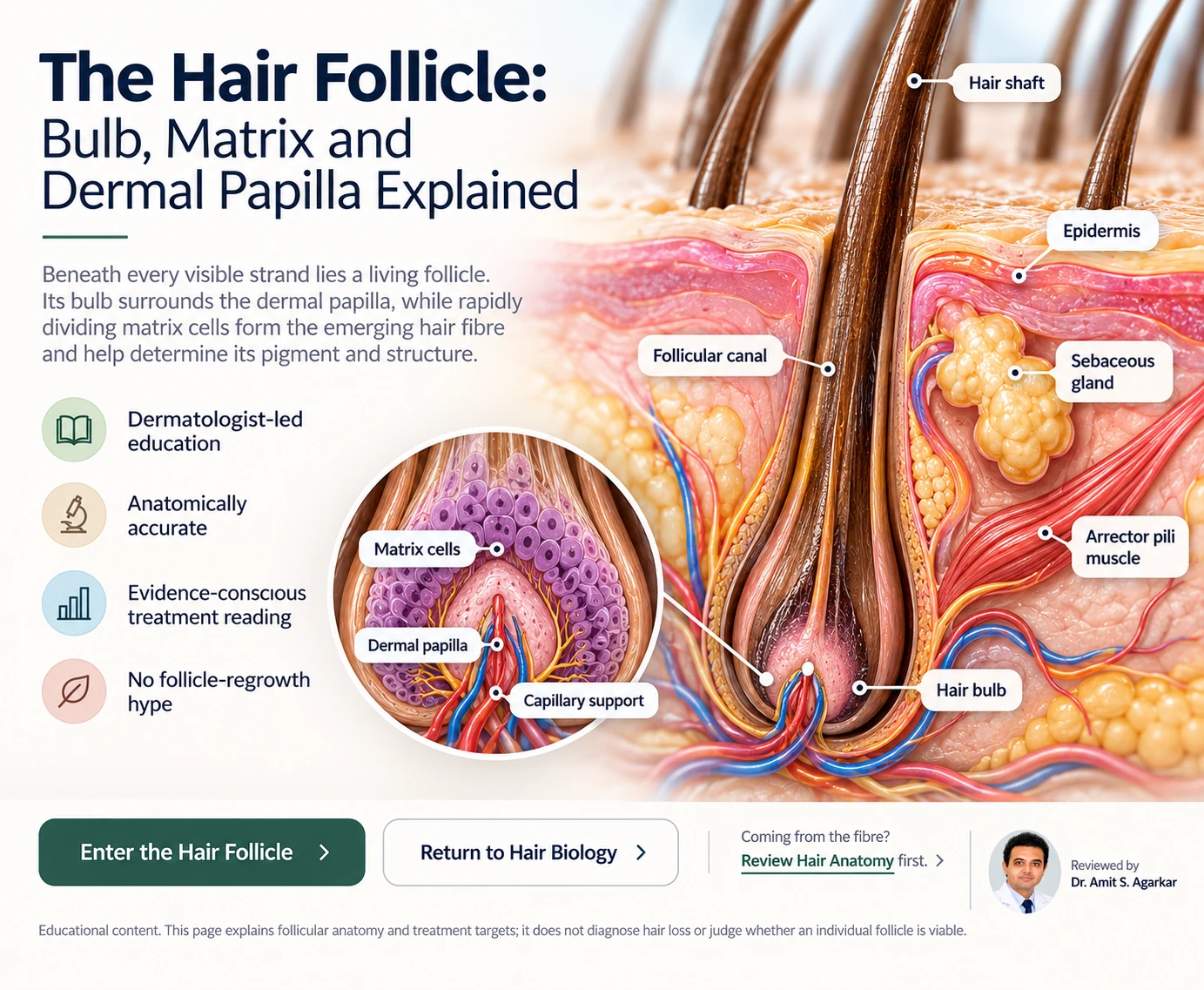
Beneath every visible strand lies a living follicle. Its bulb surrounds the dermal papilla, while rapidly dividing matrix cells form the emerging hair fibre and help determine its pigment and structure.

Educational content. This page explains follicular anatomy and treatment targets; it does not diagnose hair loss or judge whether an individual follicle is viable.

Coming from the fibre? Review Hair Anatomy first.

Dermatologist-led education Anatomically accurate Evidence-conscious treatment reading No follicle-regrowth hype
One terminal follicle: canal, sebaceous gland, arrector pili, bulb, matrix, papilla and its capillary support.
Reviewed by Dr. Amit S. Agarkar
The living organ

Quick Clinical Answer

What is a hair follicle?

A hair follicle is a specialised tubular structure within the skin that produces and anchors a hair fibre. At its lower end, the follicle expands into the hair bulb. Rapidly active matrix cells within the bulb form the growing hair shaft around the dermal papilla, which participates in signalling and receives support from surrounding blood vessels and connective tissue.

The follicle is livingResponsive to hormones, nutrition, illness and inflammation — and it cycles repeatedly through growth, transition and rest.
The matrix builds the fibreCells divide, move upward, specialise and become keratinised. Pigment is added while the fibre forms, never afterwards.
The papilla signalsIt sits inside the bulb and influences follicle size and cycling — but it does not itself become the hair.
Size sets calibreFollicle size influences the thickness of the hair produced. Miniaturisation makes each successive fibre finer.

Medically reviewed by Dr. Amit S. Agarkar — MBBS, MD Dermatology, FCPS, DDV · Reviewed 26 July 2026 · Next review July 2027

What you'll learn on this page

  • What a follicle is, where it sits, and how it differs from the visible shaft
  • What the hair bulb does, and what the pale root on a shed hair actually is
  • How matrix cells build a fibre in stages — and how pigment gets in
  • What the dermal papilla does, and what it definitely does not do
  • How the three structures work as one unit, step by step
  • The supporting cast: root sheaths, sebaceous gland, arrector pili, bulge, capillaries
  • How the follicle changes shape as it cycles through anagen, catagen and telogen
  • What miniaturisation means, and why a fine hair is not automatically a damaged one
  • Whether a follicle can die — and why the phrase is imprecise
  • Which treatments act on follicular biology, and which act only on the surface
  • Seven follicle marketing claims, translated back into biology

Overview

The follicle is the living organ. The visible hair is its finished fibre.

The hair follicle is a specialised mini-organ extending from the skin surface into the dermis. At its lower end, the bulb contains rapidly active cells that form the hair shaft. These cells grow around the dermal papilla, which helps coordinate biological signals and receives support from the surrounding tissue.

Almost every meaningful question about hair growth, thinning and treatment is a question about this organ rather than about the strand you can hold. The strand is the output. The follicle is the factory — and it is the only part that hormones, medicines, nutrition, illness and inflammation can actually reach.

That is also why the timescales are what they are. A change in follicular activity has to be built into a fibre and then grown out before you can see it, which takes months. And it is why a product that transforms how your hair feels tonight has told you nothing about whether it will change what grows next.

To understand hair growth, thinning and treatment, look below the visible strand — into the follicle that creates it. The premise of this guide

Previous in this faculty: Hair Anatomy — cuticle, cortex and medulla · Next: The Growth Cycle

Interactive · The Living Architecture Beneath the Scalp

Explore the follicle from surface to bulb

Ten regions, selectable from the list. Choosing one highlights it in the cutaway and reports its location, function, whether it is living tissue, its role in hair formation, its relevance to hair loss, and whether products can realistically reach it. Every region is also described in the static list beneath the readout.

The three core structures

Surrounding anatomy

Use Tab to move through the list and Enter or Space to select. Selecting a region does not hide anything — the full description of each is also below.

Longitudinal cutaway of a terminal hair follicle from the scalp surface to the bulbA vertical section through scalp skin. At the top, a hair shaft emerges through a follicular opening. The follicular canal descends through the skin, with a sebaceous gland opening into its upper part and an arrector pili muscle attached to its side at the bulge region. Lower down the follicle widens into the hair bulb, which contains the matrix around a dermal papilla at its base. A capillary network supports the tissue beneath and around the bulb. Inner and outer root sheath layers line the canal.Skin surfaceDeep dermis
Proportions are drawn for clarity. Follicle depth, bulb size and shaft calibre all vary between individuals and across the scalp, and change as a follicle cycles.

Region 07 · the follicle's active base

Hair bulb

The enlarged lower region of a growing follicle. It surrounds the dermal papilla and contains actively producing cells that contribute to the hair shaft and its inner root sheath.

Location
The deepest part of an actively growing follicle, well below the skin surface.
Main function
Houses the cell populations that build the fibre, together with the pigment-producing melanocytes that colour it.
Living tissue?
Yes — living
Role in hair formation
This is where formation happens. Bulb activity determines whether a fibre is being produced at all, and how thick it is.
Relevance to hair loss
Bulb activity changes across cycle transitions and in several forms of hair loss. A smaller bulb tends to mean a finer fibre.
Can products reach it?
Not reliably with rinse-off cosmetics. Selected topical medicines are formulated for skin and follicular delivery; systemic treatment reaches it through the circulation.
  • 01 Follicular opening — the pore at the surface where the fibre emerges and sebum reaches the scalp.
  • 02 Hair shaft — the keratinised fibre. The only part above the skin, and the only part with no living cells.
  • 03 Sebaceous gland — opens into the upper canal, releasing sebum onto the scalp and the emerging fibre.
  • 04 Outer root sheath — a continuation of epidermal tissue forming the follicle's outer epithelial wall.
  • 05 Inner root sheath — a temporary layer that guides and shapes the developing fibre inside the follicle.
  • 06 Bulge region — an upper-follicle area associated with epithelial stem-cell populations used in renewal.
  • 07 Hair bulb — the widened base of a growing follicle, containing the matrix and the melanocytes.
  • 08 Matrix — rapidly active cells that divide, rise, specialise and become the fibre.
  • 09 Dermal papilla — connective-tissue cells inside the bulb that participate in signalling and cycling.
  • 10 Capillary support — vessels supplying oxygen and circulating nutrients to the surrounding living tissue.

Core Structure One

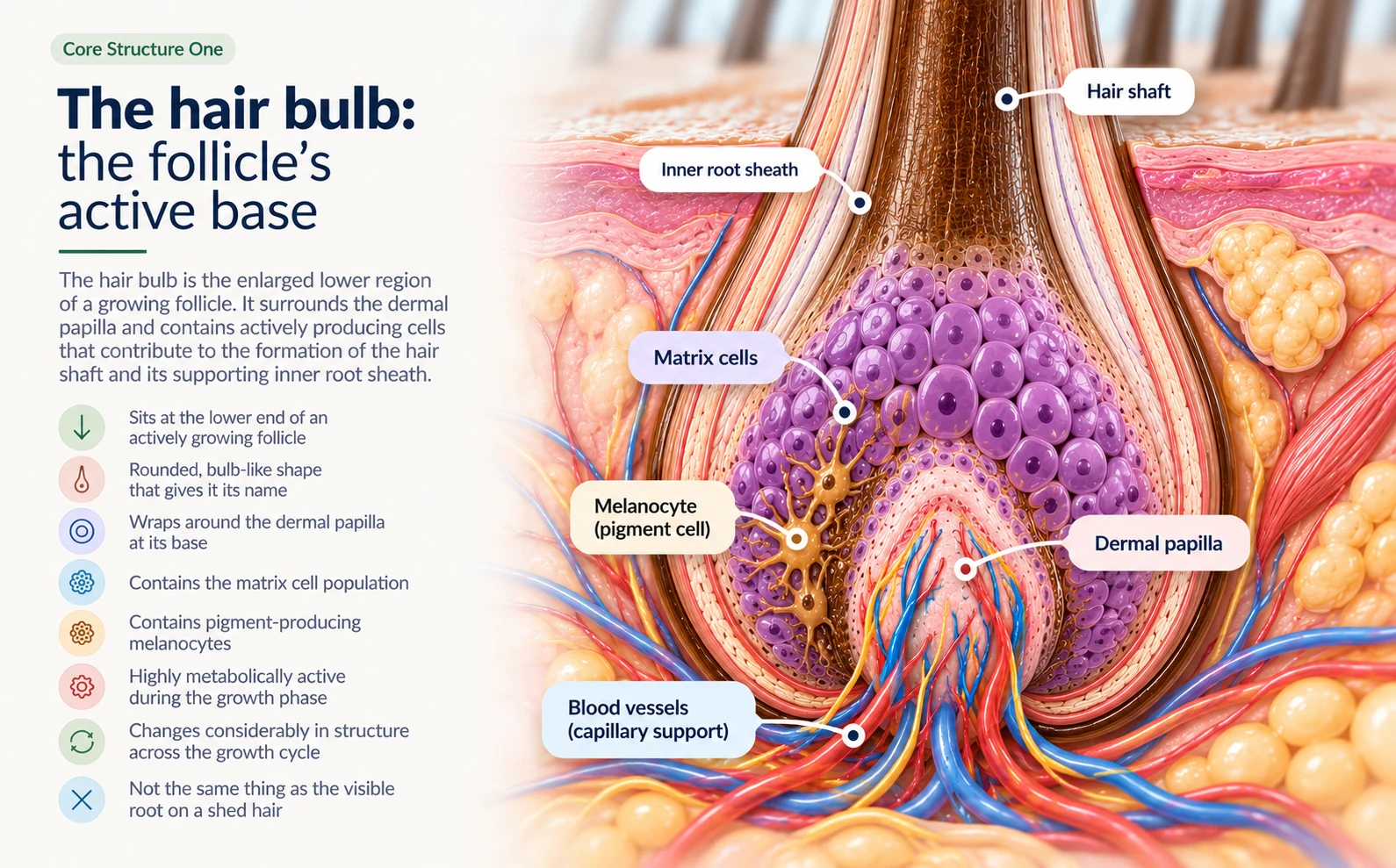
The hair bulb: the follicle's active base

The hair bulb is the enlarged lower region of a growing follicle. It surrounds the dermal papilla and contains actively producing cells that contribute to the formation of the hair shaft and its supporting inner root sheath.

  • Sits at the lower end of an actively growing follicle
  • Rounded, bulb-like shape that gives it its name
  • Wraps around the dermal papilla at its base
  • Contains the matrix cell population
  • Contains pigment-producing melanocytes
  • Highly metabolically active during the growth phase
  • Changes considerably in structure across the growth cycle
  • Not the same thing as the visible root on a shed hair
The working end of the organ: matrix cells wrapped around the papilla, with pigment cells alongside.

A terminology point worth getting right. People often call the pale tissue on the end of a shed hair a "hair bulb". The small club-shaped material on a naturally shed telogen hair is not the complete living follicular bulb. The follicle remains inside the skin. Normal shedding does not pull a follicle out.

Claim: “my follicle came out with the shed hair”A naturally shed hair may carry a small club-shaped root at its end, but the follicle itself remains within the scalp and may produce another hair if its biological machinery remains functional. I hear this weekly, and the relief when it is explained is genuine — finding club-shaped roots in a brush is a sign of normal cycling, not of follicles being lost.

When bulb activity changes

Bulb activity is not constant. It changes normally as follicles cycle, and it can change in several conditions. The list below is educational context, not a way to identify which applies to you.

  • Normal growth-cycle transitions
  • Pattern hair loss
  • Telogen effluvium
  • Alopecia areata
  • Chemotherapy-related interruption of hair production
  • Severe systemic stress or illness

Core Structure Two

The matrix: where the hair fibre is built

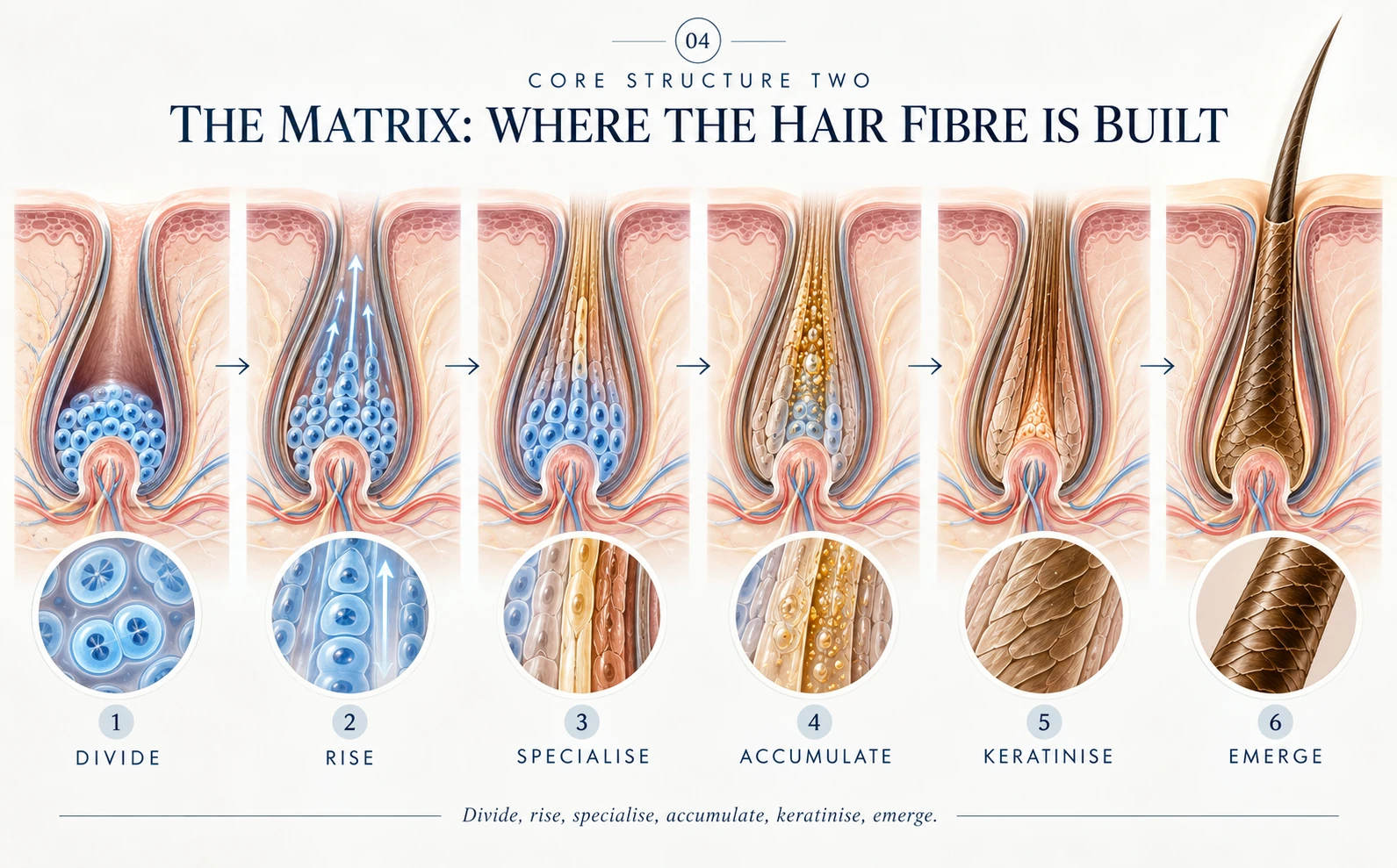
The hair matrix is a population of rapidly active cells within the lower bulb. As these cells divide and move upward, they differentiate, accumulate keratin and contribute to the formation of the hair shaft and inner root sheath.

It is worth being precise about the sequence, because "the matrix makes keratin" compresses a staged process into a single event — and the staging is exactly what explains the delays people find confusing.

Cells divideMatrix cells in the lower bulb proliferate. This is among the most rapidly dividing cell populations in the body, which is also why it is sensitive to systemic disruption.
Cells move upwardNewly formed cells are displaced towards the surface as more are produced beneath them.
Cells specialiseThey commit to becoming cuticle, cortex or — where present — medulla, and separately the layers of the inner root sheath.
Structural proteins accumulateKeratins and associated proteins build up inside the cells and organise into the architecture the finished fibre depends on.
Cells become keratinisedThey lose their living contents and consolidate into dense, durable material. From this point the fibre is a structure rather than a tissue.
The fibre emergesThe completed shaft travels up the canal, passes the sebaceous duct and becomes visible above the scalp.
Divide, rise, specialise, accumulate, keratinise, emerge. Every property of the fibre is fixed along the way.

How pigment gets in

Transfer during formation

Melanocytes near the matrix transfer pigment during active hair formation, and that pigment becomes incorporated into the developing fibre. The visible shaft does not create new pigment after it has formed — which is why a grey hair stays grey along its whole length.

Dye versus biology

Hair dye changes the visible fibre. It does not change the follicle's pigment programme, so the next fibre emerges in its own natural colour regardless of what the last one was coloured.

Greying

Greying involves changes in follicular pigment production and incorporation rather than anything happening to the hair you can see. Read more in melanin and hair colour.

Why rapidly dividing cells are vulnerable: matrix activity may be affected by major systemic illness, severe nutritional deficiency, certain medicines, chemotherapy, and inflammatory or autoimmune processes. This is a general biological point rather than a diagnosis — and because production is affected before anything becomes visible, the shedding that follows usually appears weeks to months later.

What this means for product claimsShampoo primarily cleans the scalp and fibre surface. Conditioner primarily acts on the shaft. Cosmetic oils may improve lubrication or reduce friction. A claim that a rinse-off cosmetic directly "feeds matrix cells" requires strong evidence, because systemic nutrient delivery occurs through circulation. Prescription or clinically studied treatments may influence follicular biology through more specific mechanisms — which is a different category of claim, and should be judged on its own evidence.

Core Structure Three

The dermal papilla: a signalling interface at the follicle base

The dermal papilla is a specialised cluster of connective-tissue cells positioned within the lower hair bulb. It interacts with surrounding follicular cells and participates in signals that influence follicle size, growth activity and cycling.

What it is and where it sits

  • Positioned inside the base of the bulb, wrapped by matrix cells
  • A specialised connective-tissue cell population, distinct from the epithelial follicle
  • Closely associated with nearby blood vessels
  • A significant focus of follicle-regeneration research
What it does

  • Participates in signalling relationships with matrix cells
  • Influences follicle characteristics, including the calibre of the fibre
  • Important in growth-cycle transitions
  • Provides signalling support rather than forming the fibre directly

An accuracy point that gets lost constantly: the dermal papilla does not itself become the visible hair shaft. Matrix-derived cells form the hair fibre under the influence of the surrounding follicular environment and its signalling relationships. The papilla is the conductor, not the orchestra.

How blood supply relates to it

  • Blood vessels approach and support the tissue surrounding the dermal papilla
  • Oxygen and circulating nutrients diffuse to active follicular cells
  • Blood does not flow through the visible hair shaft
  • The hair shaft contains no functioning blood vessels

Claim evaluation

“Stimulates the dermal papilla”

This phrase appears on a great many labels. It is not automatically false — dermal papilla cells are a legitimate research target — but the distance between a laboratory signal and visible hair on a human head is large. Seven questions close most of that gap.

  • Was the evidence from isolated cells, animals or humans?
  • Was the ingredient applied to the scalp, or added directly to cultured cells?
  • Was improved laboratory signalling translated into visible human hair growth?
  • Was the study controlled?
  • Was the tested concentration present in the marketed product?
  • Was the result independently reproduced?
  • Was the change clinically meaningful, or only statistically detectable?

A "no" or "unknown" to several of these does not make a product useless — it means the follicular claim is unproven, and the product should be judged on what it demonstrably does instead.

Sequence

Bulb, matrix and dermal papilla: one working unit

Six steps from signalling to a visible strand. Each depends on the one before it, which is why disruption anywhere along the chain shows up months later at the surface.

The dermal papilla supports signallingIt interacts with surrounding follicular cells and the local tissue environment.
Matrix cells respond and divideThese active cells multiply during the growth phase.
Cells move upward and specialiseThey form the organised components of the emerging hair.
Keratinisation creates the fibreThe developing cells become the non-living structural material of the shaft.
Pigment is incorporatedMelanocytes transfer pigment during active fibre formation.
The hair emerges from the scalpThe completed fibre becomes visible above the skin.

The Dividing Line

Living follicle versus visible fibre

Two halves of one subject that behave nothing like each other. Almost every persistent hair myth comes from treating them as the same thing.

Below the surface

The hair follicle

  • Located within the skin
  • Contains living cells
  • Receives biological signals
  • Changes through the growth cycle
  • Produces the hair fibre
  • Can miniaturise
  • Can be influenced by hormonal, genetic, inflammatory and systemic factors

Above the surface

The hair shaft

  • Extends above the scalp
  • Consists of keratinised material
  • Has no living cells
  • Has no blood vessels
  • Cannot heal biologically
  • Can be cleansed, conditioned, coated, coloured and damaged
  • Can break independently of follicular hair loss

The follicle determines production. Haircare determines much of the fibre's surface condition after production.

Anatomical Index

The follicle does not work alone

Seven supporting structures, briefly. Each is anatomically part of the follicular unit even though none of them builds the fibre.

Outer root sheath

A continuation of epidermal tissue surrounding the follicle and forming part of the follicular epithelial structure.

Inner root sheath

A temporary supporting structure that helps guide and shape the developing hair fibre within the follicle.

Sebaceous gland

Releases sebum into the upper follicular canal, contributing lipids to the scalp and the emerging fibre.

Arrector pili muscle

A small muscle attached to the follicle that contributes to goosebumps and is anatomically associated with the follicular unit.

Bulge region

A specialised area associated with epithelial stem-cell populations important for follicular renewal and skin repair.

Connective tissue sheath

The surrounding supportive tissue layer outside the epithelial follicle.

Capillary network

Supplies the surrounding living tissue with oxygen and circulating nutrients.

Transformation

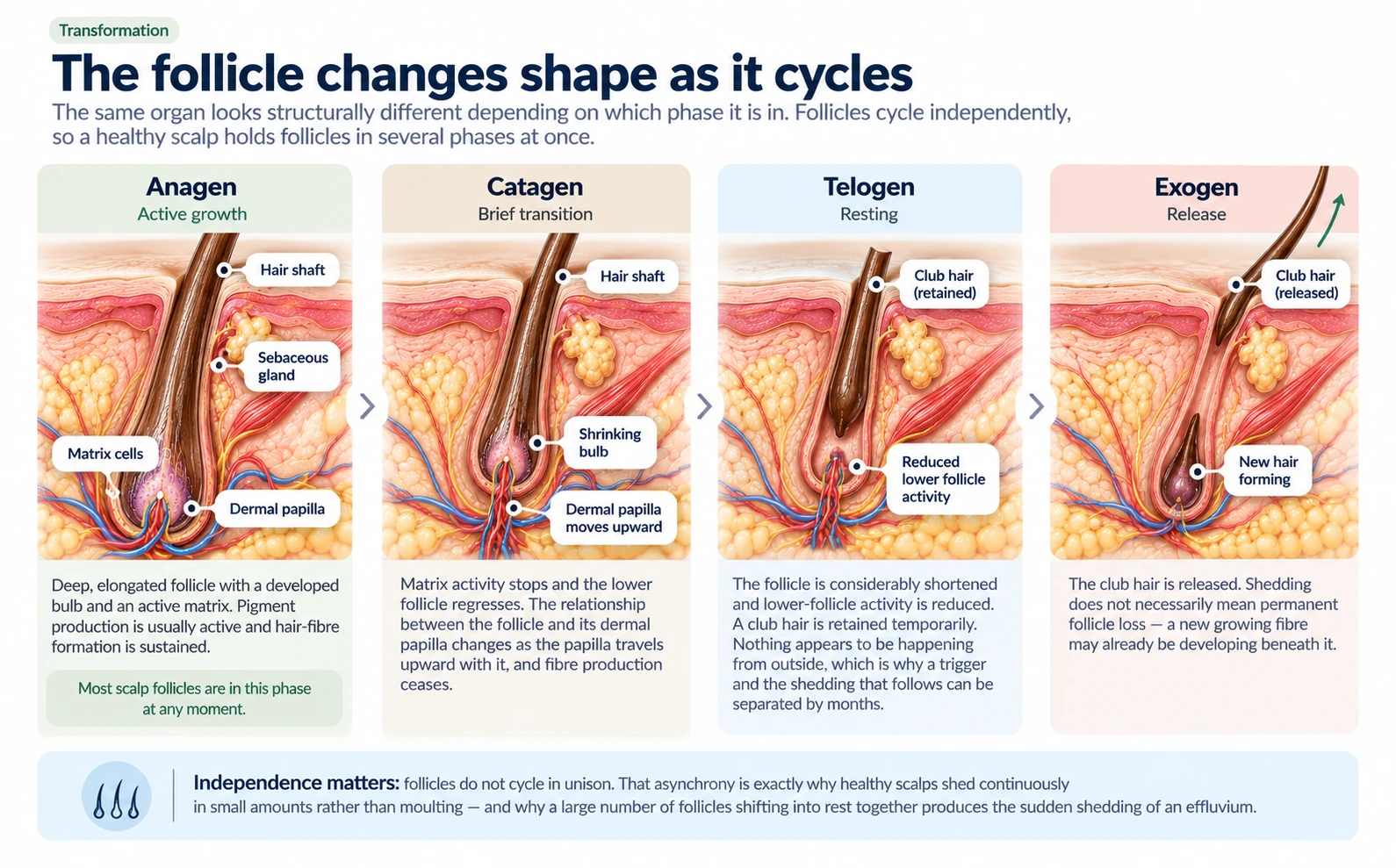
The follicle changes shape as it cycles

The same organ looks structurally different depending on which phase it is in. Follicles cycle independently, so a healthy scalp holds follicles in several phases at once.

Anagen — active growth

Deep, elongated follicle with a developed bulb and an active matrix. Pigment production is usually active and hair-fibre formation is sustained. Most scalp follicles are in this phase at any moment.

Catagen — brief transition

Matrix activity stops and the lower follicle regresses. The relationship between the follicle and its dermal papilla changes as the papilla travels upward with it, and fibre production ceases.

Telogen — resting

The follicle is considerably shortened and lower-follicle activity is reduced. A club hair is retained temporarily. Nothing appears to be happening from outside, which is why a trigger and the shedding that follows can be separated by months.

Exogen — release

The club hair is released. Shedding does not necessarily mean permanent follicle loss — a new growing fibre may already be developing beneath it.

One follicle, four structural states. The diagram shows sequence, not duration.

Independence matters: follicles do not cycle in unison. That asynchrony is exactly why healthy scalps shed continuously in small amounts rather than moulting — and why a large number of follicles shifting into rest together produces the sudden shedding of an effluvium.

Progressive Change

What is follicle miniaturisation?

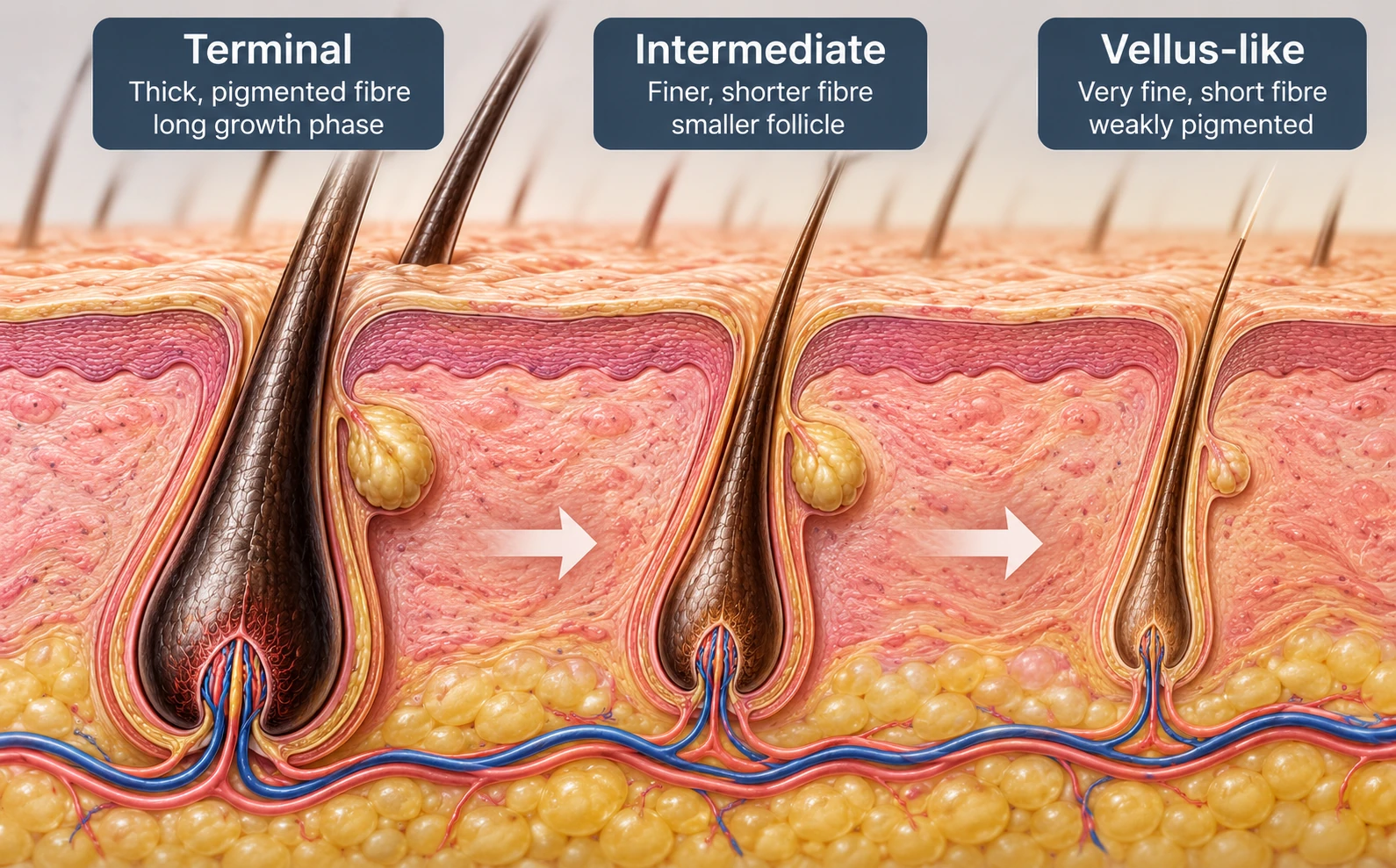
Follicle miniaturisation is a progressive process in which susceptible follicles produce hairs of decreasing diameter and often shorter growth duration. The follicle usually remains present, but the resulting fibre becomes finer, shorter and less visibly pigmented.

Terminal

A full-size follicle producing a thick, pigmented fibre with a long growth phase.

Intermediate

A smaller follicle producing a noticeably finer, shorter fibre. Often the first visible stage.

Vellus-like

A much smaller follicle producing a very fine, short, weakly pigmented fibre that contributes little visible density.

The follicle is still there in each case. What changes is the calibre of what it produces.
  • Reduced shaft diameter and shorter anagen duration
  • Reduced visible density, often in a patterned distribution
  • Genetic and hormonal susceptibility in pattern hair loss
  • Early recognition may matter, because established change is harder to influence
  • Miniaturisation is not the same as a follicle being physically removed

An important distinction: a finer hair is not necessarily a damaged hair shaft. It may have been produced that way by a miniaturising follicle. Conditioning a fine fibre will not thicken it, because its calibre was set before it emerged — and equally, not every fine hair is pathological. Diameter varies naturally.

How this is actually assessedPersistent patterned thinning warrants clinical history, scalp examination, trichoscopy, comparison of shaft diameters across scalp regions, family history and a review of medical and nutritional factors. Variation in shaft calibre across a region is one of the things I look for directly — and it is not something a photograph or an app screenshot establishes.

Imprecise Language

Can hair follicles die or become permanently inactive?

"Dead follicle" is commonly used and biologically imprecise. A follicle can be in several very different states, and they carry different recovery potential.

Actively producing a terminal hairFull function. The ordinary state of most scalp follicles.
Producing a miniaturised hairStill working, but making a finer, shorter fibre than it once did.
Resting temporarilyIn telogen. Not producing, and not dead — this is a normal phase.
Empty between cyclesThe old fibre has been released and the next has not yet emerged.
InflamedAffected by an inflammatory process. Outcome depends on the cause and how long it persists.
Structurally damagedFor example after sustained traction. Recovery potential varies with the degree of damage.
Replaced by scar tissueThe follicular structure has been lost and fibrous tissue occupies its place.
Permanently lost in scarring conditionsA different situation clinically, with different expectations.

A follicle in telogen is not dead. A miniaturised follicle is not necessarily absent. A shed hair does not prove follicle death. Some follicles may regain activity depending on the underlying process, while a scarred or destroyed follicle has different recovery potential. Online images cannot determine viability, and professional assessment may be needed. Nobody can promise that every dormant follicle can be revived, and no product should imply that all follicles can be regenerated.

Target Map

Which treatments act on the follicle?

A map of biological targets, not a recommendation. What any of these would mean for you depends on a diagnosis this page cannot make.

Biological Target, Broad Role And Key Caveats
Treatment categories and where they act — educational overview only
ApproachActs onBroad roleKey caveats
Topical minoxidilFollicle, topicallyApplied to the scalp and used for certain forms of pattern hair loss. May support follicular activity and prolong growth in responsive follicles.Requires consistent use; does not work equally for everyone; should be used with appropriate medical and safety guidance.
Finasteride and other anti-androgen strategiesAndrogen signallingTarget androgen-related signalling rather than physically rebuilding the shaft.Most relevant to appropriately selected patients; carry important suitability and safety considerations; require clinician guidance where prescription status applies.
Corticosteroid or anti-inflammatory treatmentInflammatory processMay be used for selected inflammatory or autoimmune conditions affecting follicles.Depends entirely on diagnosis. Not a universal hair-growth treatment.
Platelet-derived and procedural approachesFollicular environmentSeek to influence the environment around the follicle.Evidence and protocols vary; outcomes depend on diagnosis, technique and patient selection; must not be presented as guaranteed regeneration.
Hair transplantationFollicle relocationRelocates suitable follicles from a donor area to a recipient area.Does not create unlimited new donor follicles; depends on donor supply and long-term planning.
Cosmetic productsScalp and fibre surfaceMainly support scalp cleansing, comfort or fibre condition.Should not automatically be described as follicle treatments; growth claims need credible human evidence.

This section explains biological targets and does not provide an individual treatment recommendation. Suitability, dosing, duration, monitoring and safety all depend on a diagnosis and on your medical history. Nothing here should be started, stopped or combined on the basis of a web page.

Claim Translator · Interactive

Translate follicle marketing into biology

Seven phrases that appear on follicle-targeting products. Open each one for what it can legitimately mean, and the questions that separate a real mechanism from a hopeful one.

Living follicular cells are nourished through the bloodstream. For a topical to contribute meaningfully it would have to reach relevant living tissue at a relevant concentration — which is a formulation and evidence question, not a marketing one.

  • Does the ingredient reach relevant living tissue?
  • Is the claim based on human evidence?
  • Is the tested dose present in the product?
  • Is the effect nutritional, pharmacological or cosmetic?

Dormancy may refer loosely to resting, miniaturised or inactive follicles. These are biologically different states, and no cosmetic should imply universal reactivation without strong evidence. A resting follicle will restart on its own schedule; a scarred one will not restart at all.

This may refer to reducing breakage near the scalp, improving shaft condition, or influencing follicular production — three quite different things. The exact meaning should be defined, because only the last would be a follicular claim, and it is the one least often supported.

Laboratory evidence involving dermal papilla cells does not automatically prove visible human hair growth. Cultured cells are exposed to a compound directly, at a chosen concentration, without skin in the way. That is a legitimate early research step and not a clinical result. The seven questions in the dermal papilla section above are the ones worth asking.

The claim should distinguish a temporary change in skin blood flow from a demonstrated improvement in hair density or follicular function. Many things transiently redden the scalp. Poor circulation is not the general explanation for hair loss, so increasing it is not a general treatment.

This phrase is usually biologically imprecise and may overstate what the product can achieve. If a follicle has genuinely been lost and replaced by scar tissue, nothing topical reawakens it. If it was only resting, it was never dead. The phrase works by being unfalsifiable — which is reason enough to treat it carefully.

Living follicular cells receive nutrients through the body's circulation. Products applied to the shaft do not feed the follicle through the length of the hair — the fibre is not a channel, and there is nothing living in it to carry anything anywhere.

Delivery

Surface contact is not the same as follicular action

Four tiers of reach. Being applied to the scalp puts a product in contact with skin — it does not by itself mean the product acts on living follicular tissue.

Tier 01

Acts primarily on the visible shaft

  • Conditioner
  • Hair mask
  • Styling polymers
  • Heat protectant
  • Hair oil applied to the lengths
  • Hair colour

Tier 02

Acts primarily on the scalp surface

  • Shampoo
  • Anti-dandruff cleanser
  • Scalp exfoliant
  • Cosmetic scalp serum

Tier 03

May be formulated for follicular or skin delivery

  • Selected topical medicines
  • Selected clinically studied scalp formulations

Formulated for delivery is not the same as proven to work. Both need to be established separately.

Tier 04

Acts systemically

  • Oral medicines
  • Nutritional correction where a deficiency exists
  • Hormonal or medical management

Not every serum is follicle-targeting, and follicular penetration is not the same as proven clinical benefit. Whether anything reaches living tissue depends on molecular properties, the vehicle, concentration, contact time, skin-barrier condition, the follicular pathway itself, frequency of use — and finally on human clinical evidence. A product can satisfy several of those and still not change hair.

Myths vs Reality

Ten common hair-follicle myths

Most of these come from treating the visible strand as if it were the living organ, or from treating a laboratory result as if it were a clinical one.

Myth

“Pulling out a hair removes the follicle.”

Reality

The fibre may be removed, but the follicular structure usually remains within the skin. Repeated forceful pulling can damage a follicle over time — that is a separate concern from one hair coming away.

Myth

“A white bulb on a shed hair means the follicle has died.”

Reality

A club-shaped root is common in naturally shed telogen hairs and does not prove follicle death. Finding them in a brush is a sign of ordinary cycling.

Myth

“Trimming hair makes follicles grow faster.”

Reality

Cutting affects only the visible shaft. Growth rate is set at the follicle, several centimetres away from the scissors, and is entirely unaffected.

Myth

“Shaving makes the follicle produce thicker hair.”

Reality

The blunt cut end can feel coarser as it grows back, but shaving does not increase follicle size — and follicle size is what determines calibre.

Myth

“Oil travels down the shaft and feeds the follicle.”

Reality

The visible shaft is not a transport tube for nutrient delivery. It contains no living cells and no vessels. Oils lubricate the surface, which is worthwhile and entirely different.

Myth

“Every resting follicle can be reactivated.”

Reality

Recovery potential depends on the underlying biological state and whether the follicle remains structurally viable. Resting, miniaturising and scarred follicles have very different prospects.

Myth

“Poor scalp circulation causes all hair loss.”

Reality

Hair loss has many possible genetic, hormonal, autoimmune, inflammatory, medical and nutritional causes. Circulation is rarely the explanation, and treating it as the default delays the real answer.

Myth

“Visible damage means the follicle is damaged.”

Reality

The shaft may be damaged while the follicle remains entirely healthy. Rough, breaking ends and a thinning crown are different problems with different solutions.

Myth

“Fine hair always means follicle miniaturisation.”

Reality

Hair diameter varies naturally between people, across the scalp and by site. Clinical interpretation requires pattern and context, not a single strand.

Myth

“Any ingredient tested on dermal papilla cells regrows human hair.”

Reality

Cell-culture results are an early research step, not proof of clinical efficacy. A compound added directly to cells in a dish has bypassed skin, dose, vehicle and everything else that decides whether it works on a head.

Medically Reviewed Content

Dermatologist-reviewed follicle biology

MBBS, MD Dermatology, FCPS, DDV · Dermatologist, Trichologist & Hair Transplant Surgeon, Mumbai

"This guide explains the anatomy and function of the hair follicle, including the bulb, matrix and dermal papilla. It is designed to improve understanding of hair growth, thinning and product claims — but it does not diagnose an individual hair-loss condition, and it cannot tell you whether a particular follicle is still viable."

Reviewed: 26 July 2026 · Last updated: 26 July 2026 · Next scheduled review: July 2027

Faculty 01 · Hair Biology

Continue through the Hair Biology faculty

The Hair Follicle is the second of five subjects. Next comes the rhythm the follicle runs on.

Related follicle science

Hair-loss mechanisms and concerns

Treatment and product science

Trusted external references

Independent medical resources covering hair loss and follicular conditions. Detailed follicular ultrastructure and signalling material is drawn from dermatology reference texts.

  1. MedlinePlus — hair loss: overview, causes and related issues (opens in a new tab)
  2. NIAMS (NIH) — alopecia areata: how immune-mediated hair loss affects follicles (opens in a new tab)
  3. American Academy of Dermatology — hair and scalp care guidance (opens in a new tab)
  4. PubMed — research literature on the follicle, dermal papilla and matrix (opens in a new tab)

External links open in a new tab and lead to independent organisations whose content HairsnCares does not control, and no link implies endorsement or partnership. [ADD APPROVED TEXTBOOK CITATIONS — follicular anatomy, dermal papilla signalling, miniaturisation]

FAQs · Curated Answers

The hair follicle — 20 questions answered

Short, medically responsible answers about the bulb, matrix, dermal papilla, shedding, viability and what products can realistically reach.

A hair follicle is a specialised tubular structure within the skin that produces and anchors a hair fibre. At its lower end it expands into the hair bulb, where rapidly active matrix cells form the growing shaft around the dermal papilla.

The follicle sits within the skin, extending from an opening at the surface down into the dermis. In an actively growing scalp follicle the lower end reaches deeper still, into or near the subcutaneous fat. Only the fibre it produces is visible above the scalp.

The hair bulb is the enlarged lower region of a growing follicle. It surrounds the dermal papilla and contains actively producing cells, including pigment-producing melanocytes, that contribute to the formation of the hair shaft and its inner root sheath.

The hair matrix is a population of rapidly active cells in the lower bulb. As these cells divide and move upward they differentiate, accumulate structural proteins and become the keratinised fibre together with its supporting inner root sheath.

The dermal papilla is a specialised cluster of connective-tissue cells positioned within the lower hair bulb. It interacts with surrounding follicular cells and participates in signals that influence follicle size, growth activity and cycling.

Matrix cells produce the hair shaft. They divide in the lower bulb, travel upward, specialise into the layers of the fibre and its sheath, and become keratinised along the way. The dermal papilla influences this process through signalling but does not itself form the fibre.

No. The dermal papilla remains a connective-tissue structure at the base of the follicle. Matrix-derived cells form the hair fibre under the influence of the surrounding follicular environment and its signalling relationships.

The fibre is released, but the follicle remains within the skin. In normal cycling the follicle may already be preparing or growing a replacement fibre. Shedding a hair is not the same as losing a follicle.

Usually not. The fibre may come away, sometimes with parts of its sheath attached, but the follicular structure generally remains in the skin. Repeated forceful pulling can damage a follicle over time, which is a separate concern from a single hair being removed.

That small pale club-shaped material is the root end of a hair shed at the end of its cycle, not the living follicular bulb. Finding it is a normal feature of telogen shedding and does not indicate that a follicle has died.

The phrase is biologically imprecise. A follicle may be actively producing, producing a finer hair, resting, empty between cycles, inflamed, structurally damaged, or replaced by scar tissue. Follicles lost to scarring conditions have different recovery potential from those that are simply resting or miniaturising, and viability cannot be judged from a photograph.

Sometimes, depending on the underlying process, how long it has been present and whether appropriate treatment is used. Recovery cannot be promised for every follicle, and outcomes vary between individuals, which is why assessment matters before starting anything.

In pattern hair loss, genetic susceptibility together with androgen-related signalling gradually shortens the growth phase and reduces the calibre of the fibre produced. Other processes, including some inflammatory conditions and sustained traction, can also affect follicles. The cause is established clinically, not from appearance alone.

Shampoo acts on the scalp surface and the fibre, removing oil, debris and residue. Brief contact with a rinse-off cleanser is not a plausible route for meaningfully influencing living cells deep in the bulb, and cleansing benefits should not be described as follicular treatment.

Oils lubricate the fibre, reduce friction and can improve the feel of the scalp surface. They do not travel down the shaft to feed the follicle, because the visible hair is not a transport channel. Nutrients reach living follicular cells through the circulation.

Through the bloodstream. Capillaries supply the tissue surrounding the lower follicle, and oxygen and circulating nutrients diffuse to the active cells from there. This is why systemic health and confirmed deficiencies matter, and why nothing applied to the length of a hair can deliver nutrition.

The bulge is a specialised area of the upper follicle associated with epithelial stem-cell populations that contribute to follicular renewal at the start of each cycle and to skin repair. Its preservation is part of why a follicle can keep producing new hairs across many cycles.

In anagen the follicle is deep and elongated with a developed bulb and active matrix, producing pigmented fibre. In telogen it is considerably shorter, lower-follicle activity is reduced and a club hair is retained until it is released. Follicles cycle independently, so a healthy scalp contains follicles in different phases at once.

No. Hair diameter varies naturally between individuals, across the scalp and by body site, and fine hair can be entirely normal. Miniaturisation is interpreted from pattern, distribution, comparison of shaft diameters and history — not from a single fine hair.

The word dormant is used loosely for resting, miniaturised and permanently lost follicles, which are biologically different states. A cosmetic should not imply universal reactivation, and claims of that kind need credible human evidence rather than cell-culture findings.

No matching question yetTry a different word, or clear the filter to see all 20 answers. If your question isn't here, ask it directly.

Wondering whether your follicles are still producing?

That question cannot be answered from a photograph or a web page. It needs history, examination and often trichoscopy.

Your Next Step

Understand the follicle before choosing a growth claim

The bulb, matrix and dermal papilla form a living biological system. Understanding their roles helps distinguish genuine follicular treatment from products that act mainly on the scalp surface or the visible hair fibre.

Return to Hair Biology · Ask a dermatologist

Medical Disclaimer: This page provides general educational information about hair-follicle anatomy and biology. It does not diagnose the cause of hair loss or determine whether an individual follicle is viable. Treatment sections describe biological targets only and are not individual recommendations. Sudden, patchy, painful, inflamed, scarring or persistent hair loss should be assessed by a qualified medical professional. Individual results vary, and no product or procedure referenced on HairsnCares is presented as guaranteed follicular regeneration.

Your Cart (0)

Your cart is empty

Subtotal0
DeliveryFREE
Total0
🔒 Secure📦 Free above ₹499↩ Easy returns
💬 Hi! I'm Dr. Amit — your Hair Intelligence consultant
🌿
1
🌿
Dr. Amit
Virtual Dermatologist · Hairsncares.com
Online
What are you shopping for today?
Select a category to begin
AI-powered scalp diagnosis · Hairsncares.com
📸
Scalp Analyser
Upload scalp photo · Get conditions, root cause, and matched product protocol
📷
Drop scalp photo here or click to upload
JPG, PNG, WEBP · Clear, close-up, well-lit photo

Your image is processed privately by our AI engine and saved securely with your account.