Myth
"Everyone with hair fall needs zinc"
Fact
Zinc is only one possible factor among many causes of hair loss. A complete clinical assessment is required before attributing shedding to zinc.
HairsnCares Clinical Nutrient Intelligence · Zinc, Copper & Hair Health
Zinc supports enzyme activity, protein and DNA synthesis, cell division, immunity and wound healing. Genuine deficiency may contribute to alopecia or diffuse shedding — but serum zinc has important interpretation limitations, and unnecessary supplementation can cause copper deficiency with anaemia and neurological injury.
Serum zinc is affected by time of collection, meals, illness and inflammation — one result cannot be read in isolation. Elemental zinc differs from compound weight. Sustained zinc excess can deplete copper. Zinc Pyrithione shampoo ≠ oral zinc supplement. This page will not provide a dose, a universal target or a guaranteed regrowth claim.
Explore Clinician-Guided Zinc Products →
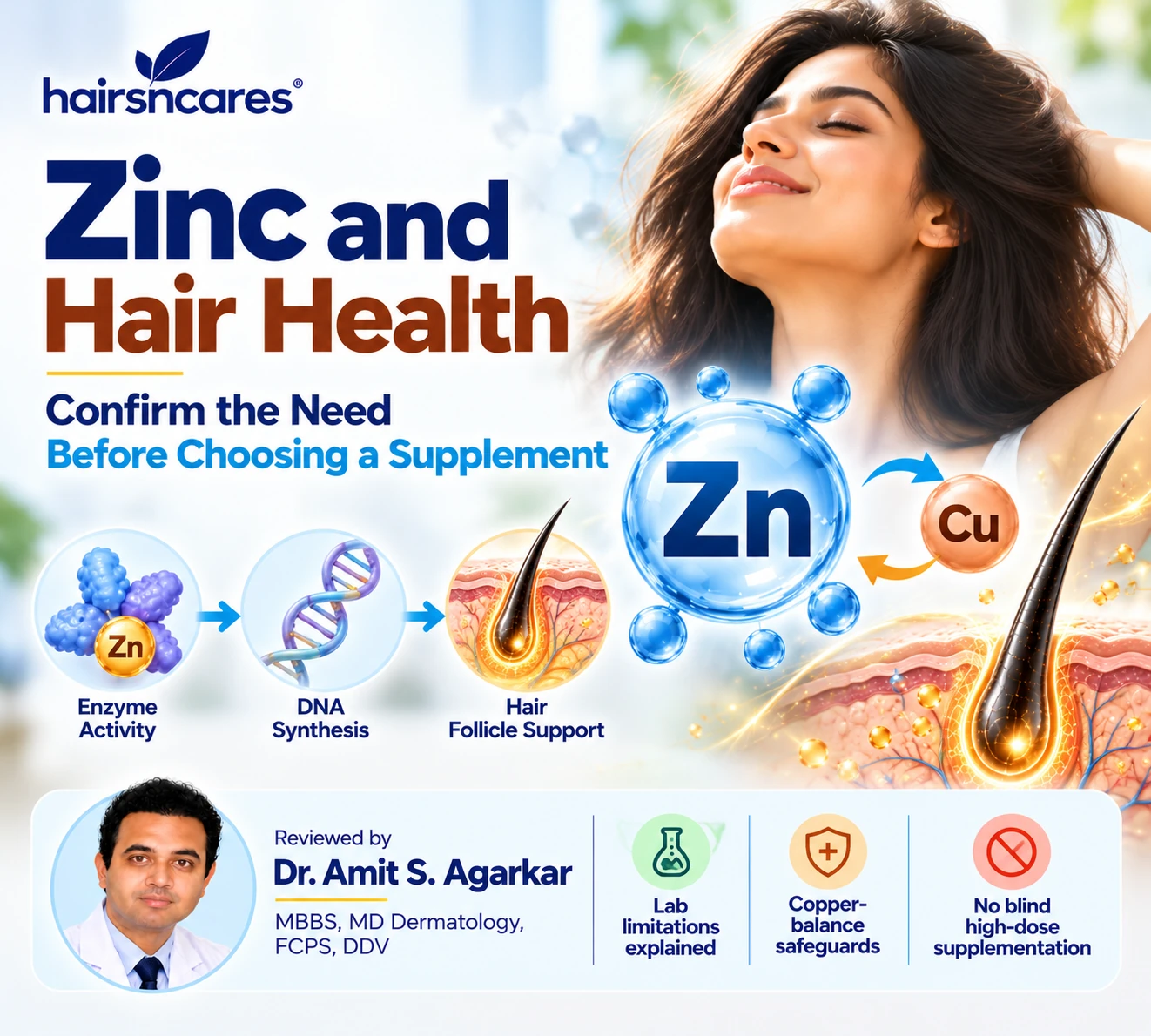
Quick Clinical Answer
Zinc is an essential trace mineral supporting enzyme function, protein and DNA synthesis and cell division. Clinically significant deficiency may contribute to alopecia. However, serum zinc has substantial interpretation limitations — it is affected by meal timing, illness, inflammation and other factors. Hair loss alone does not diagnose deficiency. Supplementation is appropriate when intake or status is inadequate and clinical guidance supports it. Crucially, excess zinc can deplete copper and cause anaemia and neurological complications.
Medically reviewed by Dr. Amit S. Agarkar — MBBS, MD Dermatology, FCPS, DDV · Reviewed 24 July 2026 · Next review July 2027 · Review methodology
Overview
An essential trace mineral with enzyme, immunity and growth roles. Hair relevance is secondary to several systemic priorities — and the copper balance must never be overlooked.
| Form | Category | Key distinction | Elemental-zinc rule |
|---|---|---|---|
| Zinc Sulphate | Oral supplement / medicine | Common, stable; GI tolerance varies | Check elemental Zn per serving |
| Zinc Gluconate | Supplement / cold lozenge | Lozenges ≠ haircare products | Compare elemental Zn, not compound weight |
| Zinc Citrate | Supplement | No universal superiority claim | Verify per label |
| Zinc Picolinate | Supplement | Marketing may exceed evidence | Compare elemental Zn |
| Zinc Bisglycinate | Supplement | Chelated form; can still cause excess | Full-formula check required |
| Zinc Oxide | Supplement and topical | Route of administration differs | Oral and topical are not interchangeable |
| Zinc Pyrithione | Topical anti-dandruff active | Not a dietary supplement | Does not correct deficiency |
Supplement labels declare the zinc compound weight and the elemental zinc amount separately. Only compare products using elemental zinc per labelled serving.
elemental zinc by weight
elemental zinc by weight
elemental zinc by weight
elemental zinc by weight
elemental zinc by weight
elemental zinc by weight (oral use)
Approximate values for education only. Always use the nutrition/supplement facts panel on the specific product for the declared elemental zinc per serving.
Zinc Biology
Zinc is essential. Essential does not mean supplemental zinc improves hair when status is already adequate.
Zinc is a cofactor or structural component in a large number of enzymes across virtually every metabolic pathway. This ubiquitous biological role explains why deficiency can affect so many tissue systems simultaneously.
Zinc supports DNA replication and transcription, and participates in protein synthesis. Tissues with high cell turnover — including hair follicles — depend on adequate DNA and protein synthesis to maintain normal activity.
Zinc is involved in intercellular signalling and is required for normal cell division. Rapidly dividing cells such as those in the follicular matrix and epithelium are sensitive to deficiency.
Zinc is required for the normal development and function of T-lymphocytes, natural killer cells and other immune components. Deficiency is associated with increased infection susceptibility and impaired immune regulation.
Most body zinc is located in muscle and bone. Only a small fraction circulates in blood. This is why serum zinc does not reliably reflect total body zinc stores, and why a borderline serum value must be interpreted with clinical context.
Hair-Loss Evidence
Deficiency-related hair findings are real. The extension to every hair-loss type is not supported.
Alopecia is a recognised manifestation of clinically significant zinc deficiency. It typically presents as diffuse non-scarring shedding. It may coexist with dermatitis, poor wound healing, altered taste and other deficiency features. Hair findings alone are not diagnostic. Correction of deficiency may support recovery.
Direct deficiency link. Clinical assessment and testing required first.
Zinc deficiency may be one of several nutritional or physiological contributors to diffuse non-scarring shedding. Full assessment of all possible causes — iron, thyroid, hormones, protein, stress, medicines — is required before attributing shedding to zinc.
One of many possible factors. Full assessment first.
Some studies have reported lower zinc levels in alopecia areata populations. Findings are inconsistent. Alopecia areata is an autoimmune condition requiring appropriate dermatological assessment and treatment — not routine zinc supplementation.
Inconsistent associations. Specialist assessment required.
Zinc deficiency does not cause androgenetic alopecia. Low zinc may coexist without being causative. Zinc does not counteract DHT sensitivity or reverse follicular miniaturisation. Evidence-based treatments — Minoxidil, Finasteride, Dutasteride — must not be replaced by zinc.
Not causative. Does not replace pattern-loss treatment.
Postpartum shedding is primarily a physiological hair-cycle phenomenon. Nutritional changes and blood loss may justify nutrient assessment including zinc in some cases. Zinc supplementation alone does not address physiological postpartum shedding.
Physiological process. Nutritional assessment in context.
Zinc deficiency can affect skin and nail quality. Hair-fibre breakage from bleaching, heat, tension or chemical damage cannot be corrected by oral zinc. Zinc does not reconstruct a physically damaged hair shaft.
Oral zinc cannot repair structural hair damage.
Expert noteWhen I see diffuse shedding in a vegan patient, zinc is always part of the panel — alongside iron, B12 and thyroid. A low serum zinc collected during an illness episode is not the same as a confirmed deficiency, which is why I always want to know the clinical context of the test. Zinc supplementation for hair is only clinician-recommended at HairsnCares when deficiency is established — and always with copper monitoring if the dose is sustained.
Laboratory Testing
Serum zinc is the most common clinical test. It has important limitations that every consumer ordering a zinc panel should understand.
| Test | What it assesses | Key limitation |
|---|---|---|
| Serum Zinc | Circulating zinc at the time of sampling | Affected by time of day, fasting, illness, inflammation, age and sex. Does not fully reflect total body zinc. Single result may need confirmation. |
| Plasma Zinc | Same as serum zinc; different collection tube | Similar limitations; contamination during collection can affect trace-mineral results. Method standardisation matters. |
| Copper | Circulating copper; important if high-dose zinc is used | Relevant to monitor alongside sustained zinc supplementation. Low copper may signal excess zinc exposure. |
| Ceruloplasmin | A copper-transport protein; marker of copper status | May decrease in copper deficiency. Ordered when copper deficiency is suspected after zinc exposure. |
| Full Blood Count | Haemoglobin, white cells, platelets — red-cell size | May reveal anaemia or low WBC from copper deficiency. Normal FBC does not exclude all nutritional deficits. |
| CRP (C-Reactive Protein) | Inflammation marker | Helps interpret a low serum zinc — if CRP is high, the zinc drop may reflect acute-phase response, not true deficiency. |
| Albumin | Protein status; zinc carrier | Low albumin can lower measured serum zinc independently of true zinc stores. Important in malnourished or ill patients. |
| Hair Mineral Analysis | Hair-mineral content via commercial labs | Not a standard diagnostic method for zinc deficiency. Cosmetic exposure and analytical variation limit reliability. Do not use to prescribe supplements. |
Interactive · Educational only
Select tests from your report to see plain-language explanations. This tool explains — it does not interpret results or recommend doses.
Use the reference range on your original laboratory report. Discuss abnormal values or copper or neurological concerns with a qualified clinician. This tool is educational only.
Interactive · Educational triage only
⚠ Educational triage only. Does not diagnose zinc or copper deficiency, recommend a dose or replace clinician assessment. Neurological symptoms require urgent medical review — not a supplement choice.
Risk Factors
Risk factors indicate context for clinical assessment — not confirmed deficiency.
Plant foods provide zinc, but phytate content reduces bioavailability. Vegans who do not actively plan zinc intake may have lower status.
→ Dietary review with dietitian; testing when clinically indicatedSimilar considerations to vegan diets, though dairy and eggs contribute zinc. Bioavailability still lower than from animal sources.
→ Dietary review; phytate-reduction food preparationInflammatory bowel disease (Crohn's, ulcerative colitis), coeliac disease, chronic diarrhoea and short-bowel conditions can reduce zinc absorption and increase losses.
→ Gastroenterology review; periodic nutritional monitoringGastric bypass, sleeve gastrectomy and intestinal resection can alter zinc absorption. Long-term nutritional monitoring is appropriate post-surgery.
→ Bariatric team nutritional follow-up including zincAlcohol can impair zinc absorption and increase renal zinc excretion. Poor dietary intake may compound this.
→ Nutritional assessment as part of broader medical careRequirements change during pregnancy and breastfeeding. Prenatal supplements may already contain zinc. Duplicate intake should be reviewed.
→ Obstetric guidance; do not self-prescribe high-dose zincInfants transitioning from breast milk to complementary foods need adequate zinc from solids. Breast milk zinc declines over time.
→ Paediatric dietary guidance; not an e-commerce supplement decisionLow total food intake reduces all micronutrient intake including zinc.
→ Dietitian review; complete nutritional assessmentHospitalisation, malignancy, chronic kidney disease and other conditions affecting appetite or metabolism may affect zinc status.
→ Clinical nutritional assessment by the treating teamFood Sources
Zinc from animal foods has higher bioavailability. Plant foods provide zinc but phytates reduce absorption. Active preparation and planning matter.
Among the richest zinc sources per serving. Non-vegetarian. Shellfish allergen — label caution.
Red meat is a reliable, highly bioavailable zinc source. Widely consumed in non-vegetarian households.
Moderate zinc content. The most widely consumed meat across India. Good addition to a balanced diet.
Contributes zinc, particularly in coastal regions of India. Variety and portion size affect intake.
Moderate zinc per egg. No phytate interference. Practical for ovo-vegetarian diets.
Moderate zinc per serving. Low phytate context improves relative availability. Staple in lacto-vegetarian diets.
Popular across India. Good zinc content. Soaking before cooking reduces phytates and improves absorption.
Widely consumed daily in India. Moderate zinc. Soaking and long cooking reduce phytate effect.
Good plant zinc source. Soak overnight and discard soaking water before cooking.
Among the richest plant zinc sources per serving. Suitable as a snack or salad addition.
Good zinc content. Common in Indian chutneys and cooking. Lower phytate than some other plant sources.
Moderate zinc. Common Indian snacks. Lower phytate levels than legumes improve relative availability.
Moderate zinc. Fermented soy products (miso, tempeh) may have improved bioavailability compared with non-fermented soy.
Provide zinc alongside fibre. Traditional preparation — fermentation of batter (idli, dosa), soaking and sprouting — reduces phytate content.
May provide significant zinc per serving. Check the nutrition label for elemental zinc per 100 g or per serving. Amounts vary widely by brand.
India's dietary patterns vary enormously. Coastal communities with regular fish and shellfish intake tend to have higher zinc access. Inland vegetarian and vegan communities face greater bioavailability challenges because of phytate-rich staples (rice, roti, dals, legumes).
For lacto-vegetarians, paneer, curd and milk provide moderate zinc without phytate interference. These are practical and culturally familiar zinc contributors in Indian vegetarian diets.
Some fortified breakfast cereals, infant foods and nutritional supplements carry added zinc. FSSAI standards regulate fortification for some food categories. Product labels must be checked for zinc content — not all fortified foods contain zinc at meaningful levels.
Supplement Forms
No single form is universally superior. Elemental zinc per serving and product quality are the meaningful comparisons.
One of the most widely studied and used zinc supplement forms. Also used in some prescription formulations and oral rehydration or supplementation programmes. Gastrointestinal tolerability can vary — taking with a small amount of food may help. The compound weight of zinc sulphate is not the elemental zinc amount. A 220 mg zinc sulphate capsule provides approximately 50 mg elemental zinc — which represents a high supplemental dose.
Check elemental zinc per servingGI tolerance variesHigh compound weight ≠ high elemental zincCommonly used in tablets and lozenges. Products designed as cold-symptom lozenges (zinc gluconate or zinc acetate) are formulated for short-term mucous-membrane contact — they are not equivalent to daily nutritional supplements. Regular lozenge use can deliver substantial elemental zinc and risk copper depletion over time. Do not substitute cold lozenges for a daily zinc supplement intended for hair or nutritional support.
Lozenges ≠ nutritional supplementsRepeated lozenge use can cause copper depletion Cold lozenges not for daily hair useA commonly available supplement form with reasonable zinc content per unit of compound. No consistent clinical evidence establishes superiority over other forms at equivalent elemental doses. Marketing of "gentle" or "superior absorption" should be evaluated against the product's elemental-zinc labelling and clinical context.
Reasonable zinc content by weightNo universal superiority establishedFrequently marketed as the best-absorbed zinc form. Some comparative studies suggest it may have absorption advantages over certain other forms, but evidence across all studies is not uniform and no form has been established as universally superior in every individual. Product quality, elemental-zinc amount and clinical context remain the most important factors.
Marketing may exceed evidenceCompare elemental Zn per servingQuality and dose matter most No confirmed universal superiorityA chelated zinc compound where zinc is bound to two glycine amino acid molecules. Marketed as "gentle on the stomach" or "highly bioavailable." Chelated does not mean risk free — zinc bisglycinate still delivers elemental zinc that accumulates and can impair copper absorption when chronically excessive. Product-specific evidence should be assessed, not assumed from the chelated description alone.
Chelated ≠ risk freeStill contributes to total elemental zinc intake Copper monitoring still relevant with chronic useZinc Pyrithione is a topical compound used as an antifungal and antimicrobial active in anti-dandruff shampoos and scalp treatments. It is not a dietary zinc supplement. It does not correct systemic zinc deficiency when applied to the scalp. Conversely, oral zinc supplements do not replace scalp-specific anti-dandruff treatment. The two product categories serve entirely different clinical purposes.
Zinc Pyrithione's regulatory status (cosmetic vs drug active) varies by country and product formulation. In anti-dandruff treatment, it requires appropriate scalp-specific product selection and, when dandruff is persistent or severe, dermatologist assessment.
Topical onlyDoes not correct systemic deficiency Compare zinc pyrithione shampoo products →Copper Balance · Critical Safety
This is the most important safety section on this page. Sustained high zinc supplementation can deplete copper with serious consequences.
⚠ Hair-focused zinc supplementation must never create a copper-deficiency neurological problem. Sustained zinc use above ordinary dietary amounts requires copper monitoring.
New numbness · Pins and needles · Weakness in arms or legs · Difficulty walking · Poor balance · Repeated falls · Loss of coordination · Unexplained anaemia not responding to iron · Low white-cell count · Severe fatigue · Cognitive changes — especially in someone using zinc supplements long term
Drug & Supplement Interactions
Do not stop prescribed medicine. Discuss timing and compatibility with a pharmacist or clinician.
| Category | Possible effect | Action |
|---|---|---|
| Quinolone antibiotics (ciprofloxacin, levofloxacin) | Zinc may bind quinolones in the GI tract, reducing absorption of both | Pharmacist guidance on timing; do not stop antibiotic |
| Tetracycline antibiotics (doxycycline, minocycline, tetracycline) | Zinc can reduce antibiotic absorption — especially relevant as tetracyclines are used in dermatology | Pharmacist or prescribing clinician guidance on timing |
| Penicillamine (Wilson disease, rheumatoid arthritis) | Zinc can reduce penicillamine absorption and action | Specialist guidance essential; do not combine without medical review |
| Thiazide diuretics | Selected thiazide diuretics may increase urinary zinc loss | Clinician review if zinc loss is suspected; do not supplement automatically |
| Supplemental iron (large doses) | High supplemental iron taken at the same time may reduce zinc absorption | Timing and coordination with pharmacist or clinician; food-iron has lesser effect |
| Other zinc-containing products (multivitamin, immunity supplement, lozenge) | Unintentional duplicate zinc exposure; increased copper-depletion risk | List all products to a pharmacist; total elemental zinc from all sources must be reviewed |
Product Discovery · Clinician-Guided
Products load from the verified HairsnCares catalogue. Elemental zinc, copper amounts and copper-deficiency warnings are all declared per product. Nothing is invented.
{{REGULATORY_CATEGORY}} · {{PRESCRIPTION_STATUS}}
Copper: {{COPPER_AMOUNT}} · {{COPPER_DEFICIENCY_WARNING}}
By {{MANUFACTURER}}
{{REGULATORY_CATEGORY}} · {{PRESCRIPTION_STATUS}}
Copper: {{COPPER_AMOUNT}} · {{COPPER_DEFICIENCY_WARNING}}
Selenium: {{SELENIUM_AMOUNT}} · Other: {{OTHER_NUTRIENTS}}
By {{MANUFACTURER}}
Product elemental zinc, copper amounts, vegan status, capsule shell and pregnancy/copper warnings load from the verified catalogue. Verify with the product label and pharmacist before purchase.
18 Myths · Corrected
18 common claims about zinc, hair and copper safety evaluated against clinical evidence.
"Everyone with hair fall needs zinc"
Zinc is only one possible factor among many causes of hair loss. A complete clinical assessment is required before attributing shedding to zinc.
"Low zinc always causes hair loss"
Zinc deficiency may contribute to alopecia, but hair loss has many possible causes. Serum zinc alone does not explain or exclude them.
"White spots on nails prove zinc deficiency"
Nail white spots (leukonychia) have many causes including minor trauma. They are not a reliable sign of zinc deficiency.
"More zinc means faster hair growth"
Excess zinc can cause copper deficiency and neurological harm — not better hair. More is not more here.
"A normal serum zinc excludes deficiency"
Serum zinc reflects only a fraction of body zinc and is affected by illness, inflammation and other factors. A normal result does not fully exclude tissue inadequacy.
"One low serum zinc result proves deficiency"
Illness, inflammation, timing and albumin can all lower serum zinc temporarily. A low result requires clinical context and often confirmation.
"Zinc Picolinate is always the best form"
Some studies suggest absorption advantages, but no form is established as universally superior. Elemental zinc per serving and product quality matter more.
"Chelated zinc cannot cause side effects"
Chelated forms such as zinc bisglycinate still deliver elemental zinc. Chronic excess can still deplete copper regardless of the chelating ligand.
"50 mg zinc is a standard hair dose"
50 mg elemental zinc is a high supplemental dose that can impair copper absorption. It should not be self-prescribed for hair growth.
"Zinc with copper is automatically balanced"
A fixed product ratio is not personalised medical guidance. The appropriate copper amount depends on your dose, status and clinical situation.
"Zinc treats every case of dandruff"
Dandruff and seborrhoeic dermatitis require scalp-specific assessment and targeted treatment. Oral zinc does not treat dandruff.
"Zinc Pyrithione shampoo corrects zinc deficiency"
Zinc Pyrithione is a topical anti-dandruff active, not a dietary supplement. It does not correct systemic zinc deficiency.
"Vegetarian diets cannot provide zinc"
Plant-based diets can provide zinc when thoughtfully planned. Bioavailability is lower, but preparation methods and dietary diversity help.
"Soaking foods guarantees adequate zinc"
Soaking legumes and grains may improve bioavailability but does not guarantee adequacy, particularly in established deficiency or malabsorption.
"Zinc supplements are harmless because zinc is essential"
Essential minerals cause toxicity when intake is chronically excessive. Zinc is no exception — excess leads to copper deficiency.
"Zinc lozenges make good daily hair supplements"
Cold-remedy lozenges are designed for short-term use. Regular daily use creates substantial zinc exposure and risks copper depletion.
"Copper deficiency is only a blood problem"
Copper deficiency can produce serious neurological complications — including myelopathy resembling Vitamin B12 deficiency — alongside anaemia.
"Zinc alone can treat genetic pattern hair loss"
Pattern hair loss is driven by genetics and androgen sensitivity. Zinc does not counteract DHT or restore miniaturised follicles.
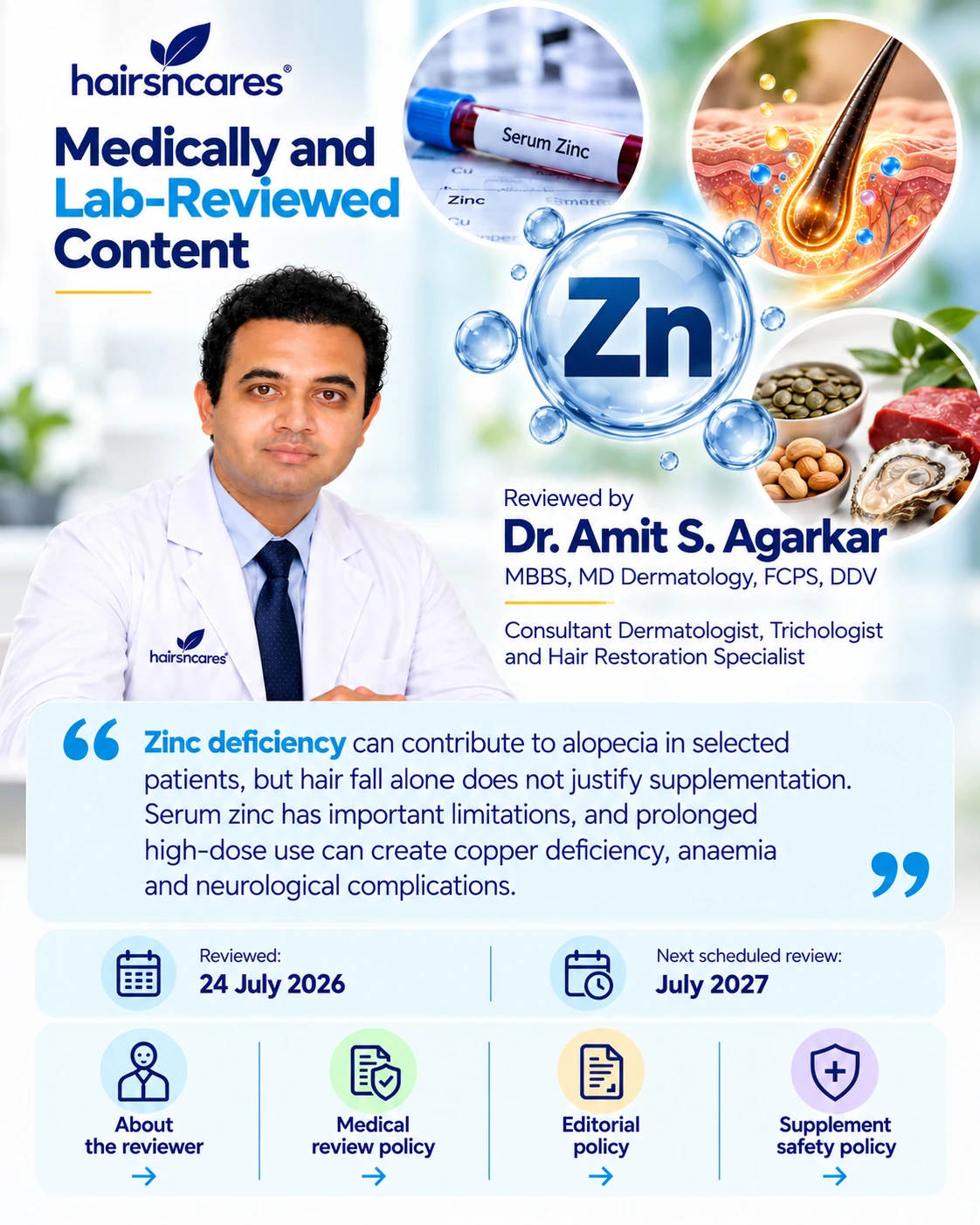
"Zinc deficiency can contribute to alopecia in selected patients, but hair fall alone does not justify supplementation. Serum zinc has important limitations, and prolonged high-dose use can create copper deficiency, anaemia and neurological complications that are genuinely serious."
FAQs · Medically Reviewed
Evidence-grounded answers without doses, universal targets or guaranteed regrowth claims.
Zinc is an essential trace mineral the body cannot produce itself. It must be obtained through diet or supplements. It is required for the activity of many enzymes, DNA synthesis, protein synthesis, cell signalling and division, immune function, wound healing and normal growth. Most body zinc is stored in muscle and bone rather than in circulating blood.
Zinc participates in the catalytic activity of a wide range of enzymes and supports protein synthesis, DNA synthesis, cell signalling and immune function. It contributes to growth and development, wound healing, and the senses of taste and smell. Adequate zinc is essential for health; supplementing above an adequate level has not been shown to improve hair, immunity or any other outcome in people who are not genuinely deficient.
Clinically significant zinc deficiency can cause alopecia alongside other features such as dermatitis, impaired wound healing, diarrhoea and altered taste or smell. Hair findings alone are not diagnostic of zinc deficiency. Hair loss has many causes including hormonal factors, genetic predisposition, iron deficiency, thyroid disease, stress and other nutritional factors. Clinical assessment is required before attributing hair loss to zinc.
Correcting genuine zinc deficiency may support hair recovery as part of broader health improvement. Evidence does not support using zinc as a routine hair-growth supplement in people without established inadequacy. The American Academy of Dermatology advises using zinc supplements for hair loss only when appropriate testing identifies deficiency.
In cases where zinc deficiency has contributed to alopecia, correcting it may support some hair recovery — but this cannot be guaranteed, and the extent depends on diagnosis, severity and duration of deficiency. Zinc does not treat genetic pattern hair loss, alopecia areata or scarring alopecia, and it cannot repair a physically fractured or chemically damaged hair shaft.
Zinc testing is most useful when there are clinical risk factors — such as a restricted diet, malabsorption condition, gastrointestinal surgery, chronic diarrhoea, pregnancy or characteristic clinical features. Hair loss alone without other risk factors or features of deficiency does not automatically indicate a serum-zinc test is required. A dermatologist can advise whether testing is appropriate for your specific presentation.
Serum zinc and plasma zinc are the most commonly used clinical tests for zinc status. Both have significant limitations — results are affected by time of collection, fasting status, recent illness, infection, inflammation, age, sex and other factors. A single result must be interpreted with clinical context and the laboratory reference range. Hair mineral analysis is not a standard diagnostic method for zinc deficiency.
Serum zinc is a useful but imperfect marker. It reflects only a small fraction of total body zinc. It can fluctuate with time of day, meals, infection, inflammation, surgical stress and other factors. A low result may represent true deficiency, but it should be confirmed and contextualised. A normal result does not fully exclude tissue-level inadequacy in all situations. Clinical assessment alongside the test result is important.
Yes. Acute infection, inflammation, surgery, trauma and other physiological stresses can temporarily lower serum zinc concentrations even when zinc intake and stores are adequate. This is a well-recognised interpretation challenge. If a zinc test was performed during a period of illness or significant stress, the result may need to be repeated or interpreted with extra caution.
Zinc deficiency can produce a range of effects depending on severity and age, including impaired growth, poor appetite, altered taste or smell, impaired wound healing, dermatitis, recurrent infections, diarrhoea, alopecia and, in severe cases, neurological features. Mild deficiency may have subtle findings. No single symptom is diagnostic. Clinical assessment, dietary history and appropriate laboratory testing are required.
Yes. Alopecia is a recognised manifestation of zinc deficiency, particularly in clinically significant cases. Hair loss from zinc deficiency typically presents as diffuse non-scarring shedding rather than pattern or scarring types. However, hair loss alone does not diagnose zinc deficiency — other features and appropriate testing are required. Correction of deficiency may support hair recovery, but regrowth cannot be guaranteed.
Acrodermatitis enteropathica is a rare inherited disorder of zinc absorption presenting in infancy or early childhood. It causes severe dermatitis, diarrhoea and alopecia, among other features. It requires formal medical diagnosis and lifelong specialist management — it cannot be addressed through a consumer supplement questionnaire. Any suspected case in an infant or child requires urgent paediatric assessment.
Zinc is found in both animal and plant foods. Rich animal sources include oysters and shellfish, meat, poultry, fish, eggs and dairy products. Plant sources include chickpeas, lentils, beans, soy products, nuts, seeds, whole grains and fortified cereals. Animal sources generally have higher bioavailability. Plant sources contain phytates that can reduce zinc absorption; food preparation methods such as soaking and fermentation may improve availability.
Yes, with appropriate dietary planning. Vegetarian and vegan diets tend to have lower zinc bioavailability because of phytate content in plant foods. Strategies that may help include soaking legumes, using sprouted grains and seeds, choosing fermented foods and combining zinc-rich plants. Supplementation may be appropriate in some cases, but blanket supplementation without assessment is not recommended. Fortified cereals and plant beverages can contribute to intake.
Elemental zinc refers to the actual amount of zinc mineral in a product, distinct from the weight of the full zinc compound (such as zinc sulphate or zinc gluconate). A supplement label declaring a compound amount must be read alongside the elemental-zinc declaration in the nutrition or supplement facts panel. Different compounds deliver different proportions of elemental zinc per unit weight, so products can only be meaningfully compared using the elemental-zinc amount per labelled serving.
Zinc sulphate and zinc gluconate are different zinc salts used in supplements and some medicines. They differ in the proportion of elemental zinc per unit of compound weight, gastrointestinal tolerability and product formulations. Zinc gluconate is common in tablets and lozenges; zinc sulphate is used in supplements, oral solutions and some medical treatments. Lozenges developed for cold-symptom relief are not the same as nutritional zinc supplements and should not be used as a haircare product.
Some studies have suggested Zinc Picolinate may have absorption advantages over certain other forms, but findings across studies are not uniform. No zinc supplement form has been established as universally superior for every person in every context. Product quality, the elemental-zinc amount per serving, overall dietary pattern and clinical context matter more than form alone. Marketing claims of universal superiority should be viewed critically.
Yes. High zinc intake can cause nausea, vomiting, abdominal discomfort, diarrhoea, dizziness and headaches acutely. Sustained high intake — particularly above 50 mg elemental zinc daily — can progressively impair copper absorption, leading to copper deficiency, anaemia, reduced white-cell count and potentially serious neurological complications. Multiple zinc-containing products can create unintended excessive exposure. Zinc is essential, but essential does not mean more is better.
Yes. This is one of the most important safety concerns with zinc supplementation. Sustained high zinc intake — typically from supplements rather than food alone — can compete with copper for intestinal absorption. This can lead to copper deficiency, which may cause anaemia, low white-cell count and neurological complications including numbness, weakness, balance problems and myelopathy. Neurological copper-deficiency injury may be mistaken for Vitamin B12 deficiency.
Copper deficiency from zinc excess can produce anaemia (which may not respond to iron treatment), a low white-cell count, fatigue and neurological symptoms. Neurological features may include numbness, tingling, weakness in the arms or legs, poor balance, difficulty walking and cognitive changes. These symptoms require prompt medical assessment. Do not try to self-treat suspected copper deficiency while continuing high zinc supplementation — both require medical review.
Yes. Zinc can bind to certain antibiotics in the gastrointestinal tract and reduce the absorption of both zinc and the antibiotic. This interaction is particularly relevant with quinolone antibiotics (such as ciprofloxacin and levofloxacin) and tetracycline antibiotics (such as doxycycline). This is especially important because tetracyclines are frequently prescribed for dermatological conditions where hair supplements might be considered simultaneously. Product labelling and pharmacist guidance should be followed.
Large supplemental iron amounts taken at the same time as zinc may reduce zinc absorption. When both are needed, the timing and method of use may require pharmacist or clinician guidance. Food-based iron and zinc intake does not appear to cause the same magnitude of interaction. Do not assume iron supplements and zinc supplements can always be taken together without review.
No. Zinc Pyrithione is a topical compound used in anti-dandruff shampoos and other scalp products as an antimicrobial or antifungal active. It is not a dietary zinc supplement and does not correct systemic zinc deficiency. Conversely, oral zinc supplements do not replace the need for anti-dandruff scalp treatment. They serve completely different purposes and must not be confused.
Zinc Pyrithione in scalp shampoo formulations is used for dandruff and seborrhoeic dermatitis management in dermatology and consumer products. This is a topical application, not a systemic nutritional intervention. Oral zinc supplementation is not an evidence-based treatment for common dandruff. Dandruff or seborrhoeic dermatitis should be assessed and managed with appropriate scalp-specific products and, when persistent, dermatologist review.
Zinc lozenges are developed as a short-term cold-symptom intervention, not as daily hair or nutritional supplements. Regular daily lozenge use can provide a substantial elemental zinc dose and, over time, risk copper depletion. Cold-lozenge regimens must not be adapted into haircare routines. Intranasal zinc products carry their own specific risks — including permanent loss of smell — and must never be used for hair or immunity support.
Seek professional assessment for any hair loss that concerns you, particularly diffuse or rapidly worsening shedding, or hair loss accompanied by skin changes, digestive symptoms, poor growth or altered taste. Seek urgent medical assessment for any neurological symptoms — numbness, tingling, weakness, balance problems or cognitive changes — particularly if you have been taking zinc supplements long term. If you follow a very restricted diet, have had gastrointestinal surgery or have a malabsorption condition, discuss zinc monitoring with your clinician rather than self-supplementing.
Your individual lab results, dietary history, copper status and specific hair-loss diagnosis need a clinician's assessment — not just a FAQ answer.
Your Next Step
Correct hair-loss diagnosis. Appropriate serum-zinc testing. Review of collection timing and illness. Dietary and malabsorption assessment. Duplicate-product review. Copper-status monitoring. Clinician-guided treatment when deficiency is established. Avoidance of chronic high-dose use. Patience with the hair cycle.
Medical Disclaimer: This HairsnCares guide is intended for general education and responsible product discovery. It does not diagnose zinc deficiency, copper deficiency, anaemia, neuropathy, telogen effluvium or any other hair-loss condition and does not replace advice from a qualified dermatologist, physician, gastroenterologist, haematologist, neurologist, obstetrician, paediatrician, dietitian or pharmacist. Serum or plasma zinc must be interpreted using the original laboratory reference interval together with collection timing, illness, inflammation, diet, medicine use and malabsorption history. Do not begin, increase, stop or combine zinc products without appropriate guidance when high-dose use, pregnancy, childhood, malabsorption or prescription treatment is involved. Excess zinc can cause copper deficiency, anaemia and serious neurological complications.
Your cart is empty