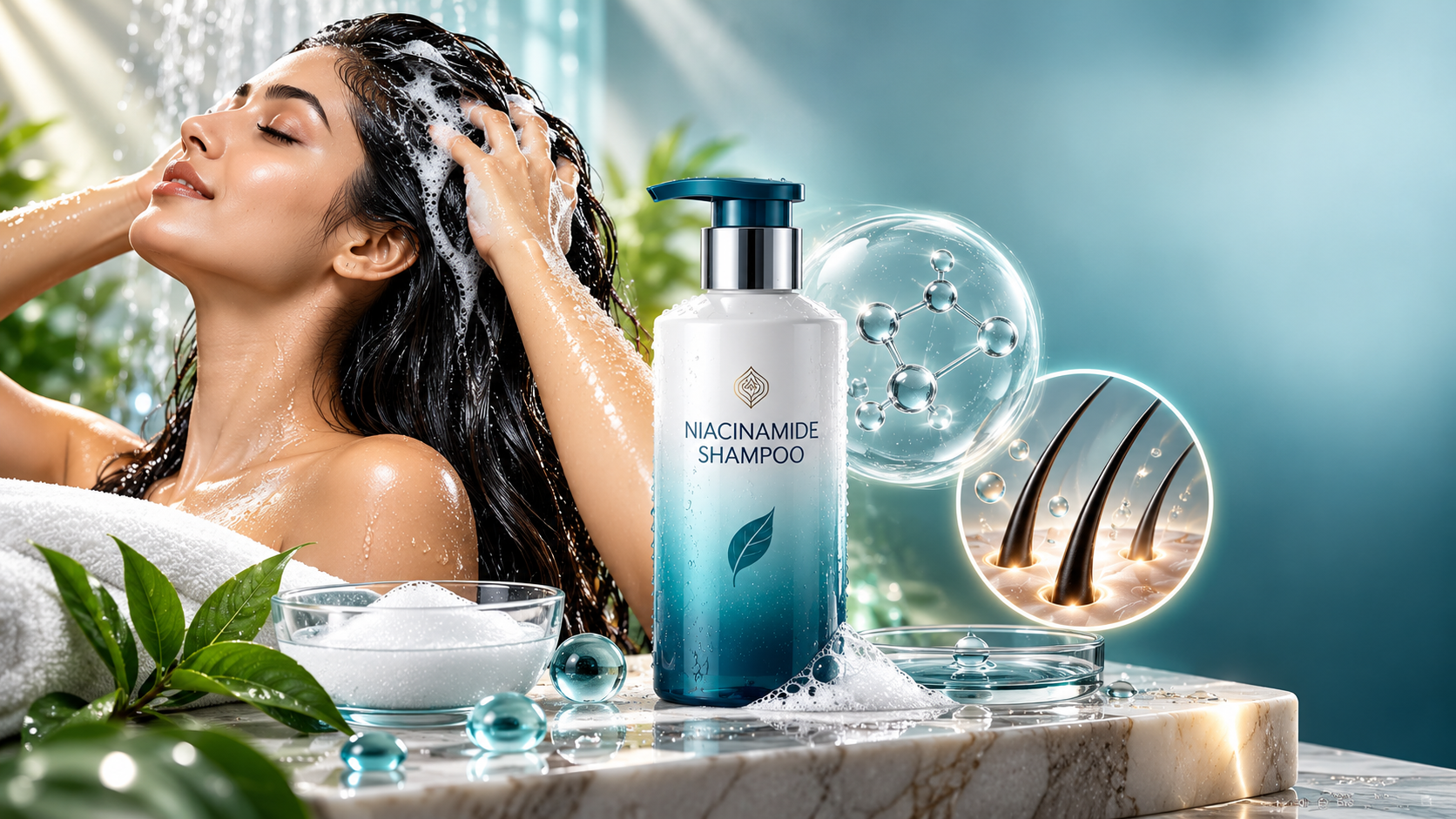
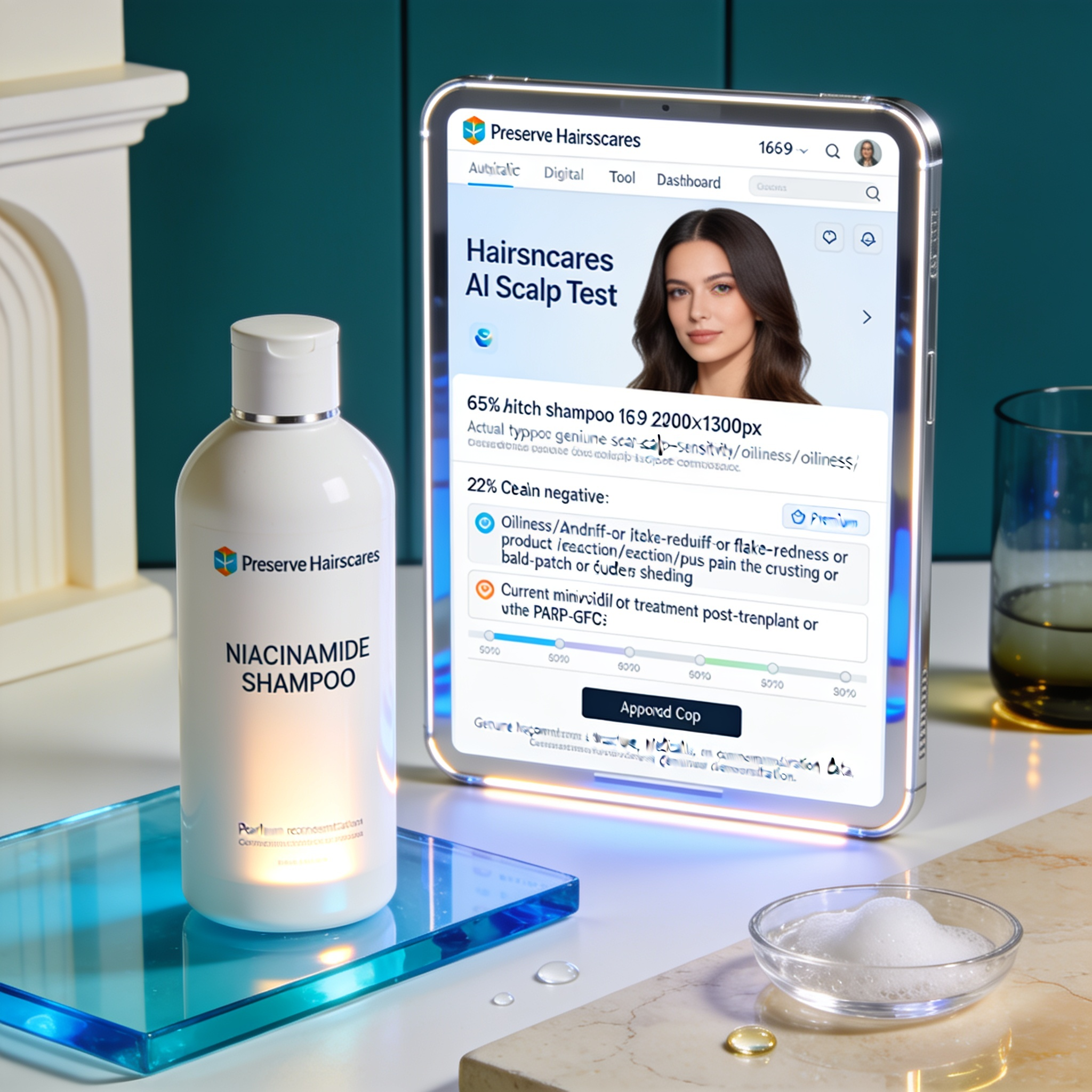
A dermatologist-guided guide to using niacinamide (vitamin B3) shampoo safely — including when it may support scalp comfort, barrier-friendly cleansing, oily scalp balance, mild itch-prone routines, side effects, product selection, and when scalp or hair fall symptoms need medical evaluation.
⚠️Niacinamide shampoo is a supportive wash-off product, not a cure for dandruff, scalp disease or hair loss. Persistent itching, redness, flakes, painful scalp, pus, crusting, bald patches or progressive hair fall needs dermatologist evaluation.
Niacinamide, vitamin B3, and nicotinamide all refer to the same ingredient — a water-soluble form of vitamin B3 widely used in skincare for barrier support, oil-balance and anti-inflammatory positioning. In shampoo, it appears for scalp barrier-support and oily scalp comfort roles. All three names may appear on product labels. This guide covers all three. See our full niacinamide ingredient guide →
Dermatologist Reviewed
Reviewed by Dr. Amit Agarkar, MD Dermatology
Niacinamide (vitamin B3) shampoo is used in scalp-barrier, sensitive-scalp and oily-scalp support routines. It may support scalp comfort, gentle oil balance and barrier-friendly cleansing depending on formulation. As a shampoo, its role is wash-off and supportive — not curative. Niacinamide shampoo should not be treated as a standalone treatment for dandruff, seborrheic dermatitis, eczema, psoriasis, scalp infection, androgenetic alopecia or any other medical scalp or hair condition. It is a skincare-inspired ingredient that provides gentle cleansing support — not the antifungal, keratolytic or medical efficacy of actives like ketoconazole, salicylic acid or minoxidil. If scalp symptoms include persistent itching, redness, burning, severe dandruff, pus, crusting, painful scalp, bald patches or sudden shedding, dermatologist evaluation is more important than shampoo selection alone.
Niacinamide shampoo may support scalp comfort, oily scalp balance and barrier-friendly cleansing in suitable users. Its primary value in shampoo is as a gentle, non-stripping cleanser that respects the scalp's natural lipid barrier — particularly useful for users who experience tightness, redness or discomfort from harsh cleansers.
However, niacinamide shampoo is not a dandruff cure, not a replacement for anti-dandruff actives when dandruff is the problem, and not a standalone hair loss treatment. For scalp conditions requiring medical treatment — seborrheic dermatitis, eczema, psoriasis, scalp infection, androgenetic alopecia — the right medical active matters more than the supportive ingredient.
Also known as: Vitamin B3 shampoo, nicotinamide shampoo, scalp barrier shampoo
Not best for: severe dandruff, scalp infection, painful scalp, pus, bald patches
Frequency: follow product label or dermatologist advice
Red flags → see a doctor: pain, pus, crusting, bald patches, progressive shedding
Series positioning: Niacinamide shampoo is the clearest departure from the anti-dandruff and hair fall series into scalp wellness. Its primary claim is not about treating a specific scalp disease but about supporting the quality of the scalp environment — gentler, more balanced, less irritating cleansing. This makes it complementary to medical actives, not competitive with them.
Niacinamide (vitamin B3) shampoo may help support the scalp barrier, reduce mild inflammation, and regulate sebum production in oily scalps. Evidence for topical niacinamide on scalp health is emerging but limited. It does not treat hair loss, cure dandruff, or replace medicated shampoos. Best used as part of a balanced scalp care routine. Patch-test if you have sensitive skin.
Clinical Matrix
What Niacinamide Shampoo Can & Cannot Do
✓ Can Help Support
Scalp barrier-friendly routine
Sensitive scalp comfort
Oily scalp balance depending on formula
Mild itch-prone scalp routine (gentle cleansing)
Scalp freshness
Gentle cleansing routine
Hair fall-support routine when scalp irritation is a contributing factor
Non-stripping alternative to harsh actives when mild cleansing is needed
People with oily or mildly irritated scalps looking for a barrier-supporting, anti-inflammatory shampoo ingredient. Suits most hair types as a regular wash.
Not a Substitute For
Ketoconazole or zinc pyrithione for dandruff, minoxidil for hair loss, or prescription scalp treatments. Niacinamide is a cosmetic support ingredient, not a clinical therapy.
See a Dermatologist If
Scalp oiliness is excessive despite balanced washing, you develop seborrheic dermatitis, or notice hair thinning alongside scalp issues. Hormonal evaluation may be needed.
Scalp Barrier Science
How Niacinamide Shampoo Supports the Scalp Environment
01
Scalp Barrier Support
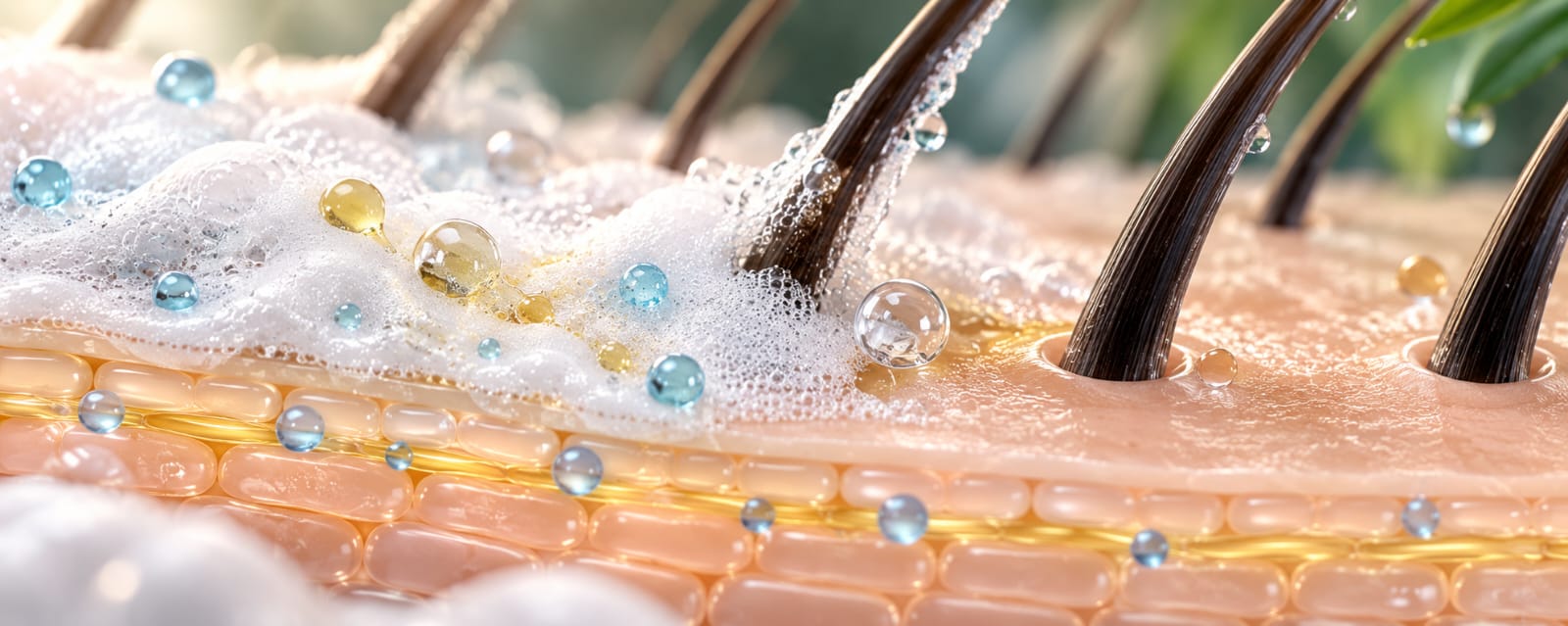
Niacinamide is used in skincare for ceramide synthesis support and barrier function positioning. In shampoo, the contact time is brief — so the value is more about not disrupting the barrier with harsh surfactants than actively repairing it. Formulation quality and surfactant choice matter as much as the niacinamide concentration.
02
Oily Scalp Balance Support
Niacinamide is used in some oily scalp formulations for sebum-regulation positioning. It may support a fresher scalp feel by gently cleansing without over-stripping. However, it is not an antifungal and will not address yeast-linked oily dandruff as effectively as dedicated anti-dandruff actives.
03
Sensitive Scalp Comfort
Niacinamide has anti-inflammatory positioning in dermatology. In shampoo, users with sensitive, irritation-prone or eczema-adjacent scalps who experience tightness or redness from harsh cleansers may find barrier-friendly formulations with niacinamide more comfortable — when the sensitivity is not caused by active scalp disease needing medical treatment.
04
Wash-Off Product Reality
The contact time of shampoo (typically 2–5 minutes, then rinsed) limits how much barrier-active ingredient can penetrate compared with leave-on serums and moisturisers. Niacinamide shampoo's primary benefit is gentle cleansing that respects the barrier — not the deep niacinamide effects observed in leave-on skincare.
These are supportive scalp care benefits. They are real within the wash-off shampoo context — but should not be confused with the efficacy of leave-on treatments or medical actives for scalp disease.
🧊
Scalp Barrier Support Routine
Niacinamide shampoo's primary value is as a barrier-friendly cleanser — one that gently removes excess oil and product buildup without the stripping effect that harsh surfactants have on a sensitive or already-compromised scalp.
💧
Sensitive Scalp Comfort
Users who experience tightness, redness or discomfort from harsh cleansers may find niacinamide shampoo more comfortable. This is a formulation benefit — the combination of niacinamide with gentle surfactants and barrier co-ingredients makes the overall cleansing experience milder.
⚖️
Oily Scalp Balance
May be included in oily scalp formulations to support a fresher scalp feel without the dryness rebound that aggressive cleansing can cause. Balance is the goal — not stripping oiliness so completely that the scalp over-produces sebum in response.
🤚
Mild Itch-Prone Routine
May support comfort in mild itch-prone scalps where the itch is linked to dryness, irritation or over-cleansing rather than active dandruff or scalp disease. Persistent or severe itch needs diagnosis — not a gentler shampoo alone.
🔄
Hair Fall-Support Pairing
Can be used as the shampoo component in a hair fall-support routine — particularly when the user is also using minoxidil, anti-dandruff actives or scalp serums and needs a non-harsh base shampoo that doesn't add to scalp irritation load.
🤖
AI Scalp Test Matching
AI Scalp Test assesses your scalp sensitivity, oiliness, itch, dandruff pattern and red flags to determine whether niacinamide, mild shampoo, zinc pyrithione, ketoconazole, salicylic acid or dermatologist evaluation is the right first step.
Many patients ask whether Niacinamide Shampoo alone can solve their hair concerns. The honest answer: shampoo is a wash-off product that stays on the scalp for a short time. It can support scalp cleanliness, comfort and scalp comfort — but it cannot treat root-level hair loss, hormonal imbalance, nutritional deficiency or conditions that need prescription treatment. A good shampoo works best as part of a complete routine, not as a standalone cure.
Scalp Suitability
Who Should — and Shouldn't — Rely on Niacinamide Shampoo
🟢
Sensitive Scalp
Primary match. Users who experience tightness, mild redness or irritation from harsh shampoos — niacinamide shampoo's gentle formulation is better suited to this scalp type.
Best Match🟢
Oily Scalp Needing Balance
Oily scalp users who need regular cleansing without the tightness of strong clarifying shampoos — niacinamide formulations can support a balanced approach.
Good Match🟢
Users on Active Treatments
Minoxidil users, post-dandruff-treatment maintenance users, or those on active scalp therapy who need a gentle base shampoo that doesn't add to scalp irritation load.
Suitable Pairing⚠️
Active Dandruff
Niacinamide is not an anti-dandruff active. If dandruff is the primary concern, anti-dandruff actives (ketoconazole, zinc pyrithione) are more appropriate. Niacinamide can be a supportive co-ingredient.
Anti-Dandruff First⚠️
Severe Oily Scalp with Flakes
Greasy oily dandruff may need selenium sulphide or ketoconazole as the primary active. Niacinamide shampoo alone may not provide sufficient oil and flake control for severe oily dandruff.
Consider Stronger Active⚠️
Active Scalp Dermatitis
Active eczema, psoriasis or contact dermatitis on the scalp needs medical diagnosis and treatment — a supportive shampoo alone is insufficient.
Medical Evaluation🔴
Pus / Painful / Crusting
Medical red flags requiring dermatologist evaluation. Niacinamide shampoo is not appropriate self-management for these presentations.
See Doctor🔴
Bald Patches / Sudden Shedding
Requires medical diagnosis — not shampoo change. Niacinamide shampoo cannot address alopecia areata, androgenetic alopecia or any medical hair loss pattern.
Diagnose First🔴
Post-Transplant Scalp
Never change shampoo on a post-transplant scalp without explicit surgeon clearance.
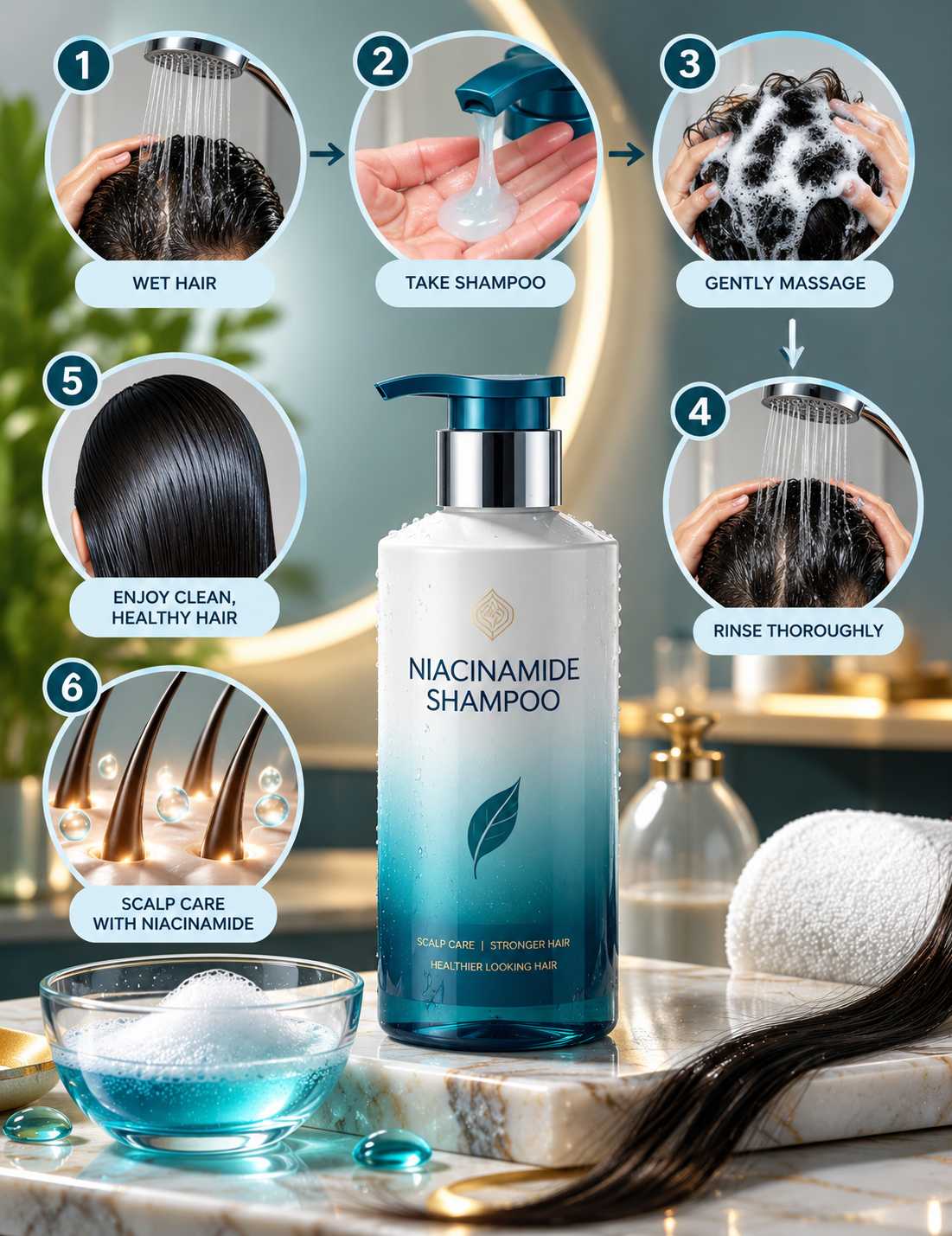
Niacinamide shampoo uses a 9-step HowTo — the same structure as caffeine and biotin pages — with the first step ("Identify Your Scalp Type") anchoring the choice of whether niacinamide is appropriate or whether an anti-dandruff active is needed first.
1
Identify Your Scalp Type
Check whether your concern is sensitivity, oiliness, mild itch, dryness, scalp buildup or hair fall. Niacinamide shampoo is most relevant for sensitive, irritation-prone or oily scalp needing gentle cleansing. If dandruff, scaling, infection or medical hair fall is present, the medical active matters more than the barrier ingredient.
2
Wet Scalp Properly
Use lukewarm water. Hot water can trigger vasodilation and worsen scalp sensitivity in already-reactive skin.
3
Apply to Scalp and Roots
Focus gentle cleansing on scalp and roots. Avoid rough application on fragile or dry lengths.
4
Massage Gently
Use fingertips. Avoid aggressive rubbing — for a sensitive scalp shampoo, this is counterproductive. Gentle circular movements distribute the product without additional mechanical irritation.
5
Follow Label Contact Time
Follow product label. Brief contact time (typical for most shampoos) is designed for this wash-off formulation. Do not extend it expecting more benefit.
6
Rinse Thoroughly
Remove all residue. Shampoo residue on a sensitive or barrier-compromised scalp can contribute to irritation that the niacinamide formulation was trying to avoid.
7
Condition Lengths if Needed
Apply conditioner to mid-lengths and ends if hair is dry, frizzy, curly or colour-treated. Scalp applications of conditioner are generally avoided in barrier-focused routines.
8
Pair With Correct Routine
If dandruff, itching or hair fall is active alongside sensitivity, pair niacinamide shampoo with the appropriate medical active (anti-dandruff shampoo, minoxidil) or seek dermatologist guidance on the best combination approach.
9
Track Response
Monitor scalp comfort over 4–6 weeks. If sensitivity worsens, new symptoms appear, dandruff flares, hair fall increases, or scalp pimples or pus develop — stop and consult a dermatologist. A new symptom during shampoo use should never be self-managed.
Niacinamide is a barrier-supportive ingredient. It is not an antifungal (like ketoconazole), not a keratolytic (like salicylic acid), and not an anti-dandruff active (like zinc pyrithione). Choosing niacinamide shampoo over these actives when dandruff or scalp disease is present is the most common misuse of this ingredient category.
Stop Immediately If:
Burning, rash, swelling, worsening scalp symptoms, new bald patches, scalp pain or pus. Stop use and consult a dermatologist before resuming any shampoo.
Expert Note
The most common shampoo mistake is rushing the process. Apply to the scalp (not just hair lengths), massage gently with fingertips (never nails), follow the recommended contact time if it is a medicated shampoo, and rinse thoroughly. Incomplete rinsing is a leading cause of scalp irritation and product buildup that patients often blame on the shampoo itself.
Frequency & Routine
Niacinamide Shampoo in the Broader Scalp Care Landscape
Key principle: Follow your product label or dermatologist's advice. Frequency varies by scalp oiliness, sensitivity, dandruff, hair texture and tolerance. Track symptoms across 4–6 weeks rather than switching every few days.
Niacinamide Shampoo
Sensitive scalp, barrier-friendly routine, oily scalp comfort. Not antifungal or keratolytic.
Ketoconazole
Yeast-linked dandruff, seborrheic dermatitis. Antifungal. Not daily for everyone.
Zinc Pyrithione
Mild-to-moderate dandruff, maintenance. Anti-dandruff. Gentler than ketoconazole.
Salicylic Acid
Scalp buildup, thick flakes. Keratolytic. Can dry sensitive scalp if overused.
Medical hair loss treatment. Applied after washing. Not a shampoo.
The most common error: Using niacinamide shampoo for dandruff or scalp disease because it sounds gentler and more "natural" than ketoconazole or zinc pyrithione. Gentle is not the same as effective for scalp disease. When medical actives are needed, they should be used — niacinamide shampoo is a supportive complement, not a substitute.
Identifying whether sensitivity, dandruff, buildup or disease is dominant
Diagnosis-first approach
Gold standard before choosing product
Essential for persistent or severe symptoms
Key positioning: Niacinamide shampoo sits in the gentle/supportive tier — complementary to medical actives, not competitive with them. When dandruff is present, combine it with the right anti-dandruff active rather than replacing it.
All products are supportive wash-off shampoos. Not standalone treatments for dandruff, scalp disease or medical hair fall. Prices on individual product pages.
Products for this guide are being curated. Take the AI Scalp Test for personalised, sensitivity-and-barrier-matched picks meanwhile.
Routine Builder
Sensitive & Oily Scalp Routine Combinations
🧊
Sensitive Scalp Barrier Routine
Niacinamide shampoo as per label frequency
Gentle conditioner for lengths
Avoid harsh scrubbing or hot water
AI scalp tracking for comfort and response monitoring
Our AI Scalp Test assesses scalp sensitivity, oiliness, itch pattern, dandruff score, product reaction history and red flags to determine whether niacinamide shampoo, a mild alternative, or anti-dandruff medical actives are the most appropriate next step for your scalp.
AI screening only. Does not diagnose, prescribe or replace dermatologist evaluation.
AI Scalp Test · WebP
Safety & Scalp Red Flags
Stop Using Niacinamide Shampoo and Consult a Doctor If:
🔥
Burning or Rash
Stop immediately. May indicate contact reaction to shampoo base or fragrance. Consult before resuming any shampoo.
🤧
Swelling
Swelling of scalp, face or eyes — stop and seek medical attention. May indicate allergic reaction to formulation ingredients.
💆
Worsening Itch or Redness
If itch or redness worsens after starting niacinamide shampoo, stop use. Worsening symptoms signal either a wrong product match or an underlying condition needing diagnosis.
🩸
Pus, Boils or Crusting
Medical red flags requiring dermatologist evaluation. Niacinamide shampoo is not appropriate self-management for infected or crusted scalp.
🔴
Bald Patches or Sudden Shedding
Requires dermatologist diagnosis. Niacinamide shampoo cannot address alopecia areata, androgenetic alopecia or any cause of sudden shedding.
👁️
Eye Irritation
Rinse immediately with water. Seek medical attention if irritation persists.
Scalp Red Flags — When Niacinamide Shampoo Is Not Enough
These scalp presentations require dermatologist evaluation. A barrier-friendly shampoo cannot address medical scalp conditions.
🍄 Severe Persistent Dandruff
Greasy flakes, heavy scalp scaling or refractory dandruff needs anti-dandruff medicated shampoo and potentially dermatologist assessment.
🪨 Thick Silvery Scales
Possible scalp psoriasis — requires dermatologist diagnosis before any shampoo self-treatment.
💆 Painful Scalp
Scalp pain is a medical red flag requiring evaluation — not a symptom to self-treat with a gentler shampoo.
💛 Pus or Crusting
Possible scalp infection or severe seborrheic dermatitis needing medical treatment — not shampoo self-management.
⭕ Bald Patches
Alopecia areata, scarring alopecia or tinea capitis — all require urgent dermatologist evaluation.
🔴 Persistent Redness
Redness that doesn't improve with 4–6 weeks of gentle cleansing may indicate contact dermatitis, eczema, psoriasis or scalp infection.
🔥 Burning After Shampoo
May indicate contact allergy, eczema or over-sensitive scalp needing dermatologist patch testing.
💆 Itch With Hair Fall
Scalp inflammation contributing to hair fall needs proper diagnosis and treatment — not a gentler shampoo alone.
💉 Post-Transplant Scalp
Never change shampoo on post-transplant scalp without explicit surgeon clearance.
If you notice increased itching, redness, burning, pimples on the scalp, or worsening flakes after using niacinamide shampoo — stop immediately. These are not signs of “scalp detox” or “purging.” They may indicate irritation, allergy, contact dermatitis or worsening of an existing scalp condition. Consult a dermatologist before resuming.
Myths vs Facts
Common Myths About Niacinamide Shampoo
Myth
Niacinamide shampoo regrows hair.
✓ Fact
Niacinamide shampoo may support scalp comfort as part of a broader routine, but it is not a proven standalone hair-regrowth medicine and should not replace minoxidil or medical hair fall treatment where indicated.
Myth
Niacinamide shampoo cures dandruff.
✓ Fact
Dandruff typically requires anti-dandruff actives — ketoconazole, zinc pyrithione, selenium sulphide or salicylic acid — depending on severity and type. Niacinamide is a barrier-supportive ingredient, not an antifungal or anti-dandruff active.
Myth
Sensitive scalp always needs niacinamide shampoo.
✓ Fact
Scalp sensitivity can result from contact dermatitis, allergy, eczema, psoriasis, infection or product reactions — conditions that may need specific medical diagnosis and treatment, not just a gentler shampoo.
Myth
Oily scalp means washing aggressively.
✓ Fact
Harsh washing can strip the scalp and trigger rebound sebum overproduction. A balanced cleansing routine — including barrier-friendly shampoos — is more sustainable than aggressive stripping for oily scalp management.
Myth
If scalp itches, a gentler shampoo is always the answer.
✓ Fact
Persistent itch may need diagnosis for dandruff, contact allergy, eczema, psoriasis, folliculitis or infection. A barrier-friendly shampoo helps with over-cleansing-related itch, but cannot address these medical causes.
Myth
Barrier-friendly shampoos treat all scalp disease.
✓ Fact
Barrier-friendly formulations support routine comfort and scalp environment, but do not replace medical actives — ketoconazole for yeast, salicylic acid for buildup, topical steroids for inflammation — when scalp disease is present.
Niacinamide shampoo (also called vitamin B3 shampoo or scalp barrier shampoo) is used in sensitive scalp, oily scalp balance and barrier-friendly cleansing routines. It is a wash-off product that may support scalp comfort and gentle cleansing. It is not a dandruff cure, not a hair-regrowth treatment, and should not replace medical anti-dandruff actives when dandruff is the primary problem.
Niacinamide shampoo may support scalp comfort, oily scalp balance and barrier-friendly cleansing in suitable users — particularly those with sensitive, irritation-prone or oily scalps. It should not be used as a treatment for dandruff, scalp disease or medical hair fall.
Niacinamide shampoo is primarily positioned for sensitive scalp users who experience tightness or discomfort from harsh cleansing. However, scalp sensitivity has many causes — dermatitis, allergy, psoriasis, eczema — that need diagnosis if persistent. Niacinamide shampoo alone is not sufficient for medical scalp sensitivity presentations.
Niacinamide is used in oily scalp formulations for oil-balance support. It may help scalp feel fresher without stripping. However, it is not antifungal and will not address yeast-linked oily dandruff as effectively as ketoconazole or selenium sulphide where those actives are needed.
Niacinamide shampoo may support comfort in mild itch linked to over-cleansing or scalp irritation. Persistent or severe itch — particularly with flaking, redness, pain or hair loss — requires dermatologist diagnosis, not shampoo switching.
Niacinamide shampoo is not a primary dandruff treatment. Dandruff typically responds better to ketoconazole, zinc pyrithione, selenium sulphide or salicylic acid. Niacinamide may be supportive alongside these actives but cannot replace them for active dandruff management.
Niacinamide shampoo is not a proven standalone hair-regrowth medicine. It may support scalp comfort as part of a broader routine but should not be expected to produce regrowth results comparable to leave-on medical treatments like minoxidil.
Niacinamide shampoo may support scalp comfort as part of a hair fall-support routine when scalp irritation or over-cleansing is contributing to poor scalp environment. True hair fall needs diagnosis — medical evaluation, not shampoo change alone, is the priority.
Niacinamide shampoo may support comfort in mild irritation linked to harsh cleansing. But scalp irritation from contact dermatitis, eczema, psoriasis, dandruff, folliculitis or allergy needs medical diagnosis if persistent — gentle shampoo is supportive, not curative for these conditions.
Niacinamide is used in barrier-support positioning in skincare. In shampoo — with its brief 2–5 minute contact time — the primary benefit is gentle cleansing that avoids stripping the barrier, rather than actively rebuilding it. Leave-on formulations are more effective for barrier repair.
No. Ketoconazole is an antifungal active for yeast-linked dandruff and seborrheic dermatitis. Niacinamide shampoo has no antifungal properties. If dandruff is the primary problem, niacinamide shampoo should not replace ketoconazole.
No. Minoxidil is a leave-on medical treatment for androgenetic alopecia with established clinical evidence. Niacinamide shampoo is a wash-off supportive cleanser. They are not interchangeable for hair loss management.
Follow your product label or dermatologist's advice. Frequency varies by scalp oiliness, sensitivity and tolerance. Overwashing may worsen dryness; under-washing may worsen oiliness in prone scalps.
Some niacinamide formulations are designed for gentle daily use; others are not. Follow product label guidance. Daily use may suit oily scalp types but could worsen dryness in already-dry or sensitive scalps.
Follow the product label. Extended contact time does not improve results and may increase scalp irritation risk. Niacinamide shampoo is a wash-off product — brief contact is the design intent.
Niacinamide shampoo does not typically cause hair fall. Visible shedding during washing is usually pre-existing telogen-phase hair. If hair fall worsens significantly after any shampoo change, stop use and consult a dermatologist.
Niacinamide shampoo is generally gentler than harsh cleansers, but scalp dryness can occur depending on formulation and scalp type. Reduce frequency if dryness occurs. Follow with conditioner on lengths.
Scalp irritation can occur with any shampoo, particularly in fragrance-reactive or allergic scalps. Stop use and consult a doctor if burning, rash or swelling occurs.
Yes. Apply conditioner to mid-lengths and ends only — not to the scalp. This is standard for most shampoos, including niacinamide. Conditioner helps protect dry or curly lengths.
Consult your dermatologist before combining niacinamide shampoo with minoxidil. Gentle shampoo may be preferable to avoid scalp irritation that can be worsened by minoxidil. Shampoo is typically applied and rinsed before minoxidil is applied.
Do not change your shampoo on a post-transplant scalp without explicit clearance from your hair transplant surgeon.
They serve different purposes. Ketoconazole is antifungal for yeast-linked dandruff and seborrheic dermatitis. Niacinamide shampoo is a barrier-supportive gentle cleanser. If dandruff is the concern, ketoconazole is more appropriate. For sensitive scalp without active dandruff, niacinamide shampoo may be preferable.
Salicylic acid is a keratolytic for scalp buildup and thick flakes — it exfoliates and can be drying for sensitive scalps. Niacinamide is gentler and better for sensitivity and barrier support. If buildup is the issue, salicylic acid is more appropriate. If sensitivity is the issue, niacinamide shampoo may be more comfortable.
Zinc pyrithione targets dandruff-prone scalps as an anti-dandruff active. Niacinamide focuses on scalp comfort and barrier support. For active dandruff, zinc pyrithione is more targeted. For sensitive scalp without active dandruff, niacinamide may suit better. They can be used in the same routine on alternating days.
Stop niacinamide shampoo if you experience burning, redness, rash, swelling, scalp pimples, worsening hair fall, worsening dandruff, scalp pain or new bald patches. Consult a dermatologist before resuming any shampoo.
Consult a dermatologist if scalp symptoms persist despite 4–6 weeks of correct shampoo use, if you have scalp pain, pus, bleeding, thick silvery scales, crusting, patchy hair loss, sudden shedding, worsening itch or redness, or if you are unsure whether your condition is dandruff, eczema, psoriasis or infection.
Still unsure whether niacinamide shampoo is right for your scalp?
Niacinamide shampoo (vitamin B3 shampoo, scalp barrier shampoo) is a supportive wash-off shampoo used in sensitive scalp, oily scalp, scalp comfort and barrier-friendly cleansing routines. It does not diagnose, treat, cure or prevent dandruff, seborrheic dermatitis, eczema, psoriasis, scalp infection, medical hair loss, baldness, alopecia, PCOS-related hair fall, thyroid-related hair fall, postpartum shedding, nutritional deficiency hair fall or medication-related shedding. It should not replace ketoconazole, zinc pyrithione, selenium sulphide, salicylic acid, topical prescription treatments, minoxidil, finasteride, PRP, GFC, nutritional correction, hair transplant care or dermatologist evaluation when indicated. Use as per product label or doctor guidance. Stop if irritation or allergy symptoms occur. This guide has been reviewed by Dr. Amit Agarkar, MD Dermatology, Hairsncares.
Build a Scalp Barrier Routine That Actually Works
Take the AI Scalp Test to find whether niacinamide shampoo, anti-dandruff actives or dermatologist evaluation is your most appropriate next step for a healthier, more comfortable scalp.