AI-POWERED WOMEN'S HAIR DIAGNOSIS FOR INDIA

Iron Deficiency Hair Fall in Women: Signs, the Ferritin Test and Safe Support

If your hair is shedding diffusely and you also feel tired, look pale, or have heavy periods, low iron is one of the first things worth checking. Low iron — especially low ferritin, your iron store — can disturb the hair cycle and cause diffuse shedding across the whole scalp. The reassuring part: it's very treatable, and hair usually improves once iron is safely restored. But there's a firm rule — iron only after testing, because too much iron is harmful. Hairsncares helps you spot the pattern, ask for the right ferritin test, and support your hair safely.
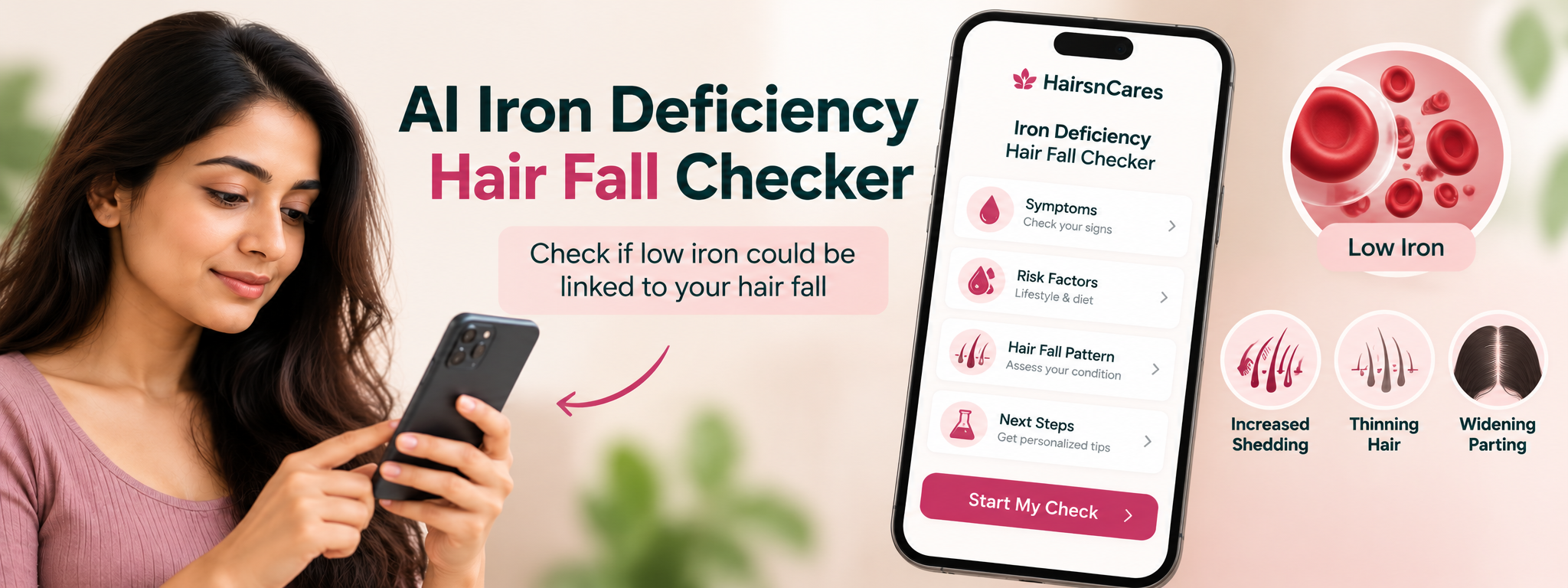
  • AI iron deficiency hair checker
  • Why ferritin matters most
  • Heavy periods, diet & pregnancy
  • Iron only after testing
  • Vitamin C aids absorption
  • The thyroid & iron overlap
Hero image
📷
Hero visualalt: "Woman using the AI iron deficiency hair fall checker — Hairsncares" · 520×150 WebP
🥩
Your Iron Hair CheckAI Checker — sample preview
Shedding typeDiffuse, whole scalp
Other signsFatigue, pale, heavy periods
Key testFerritin + iron studies
Safety ruleIron only after testing
OutlookVery treatable; results vary

Illustrative sample only. AI screening helps guide decisions and does not replace a doctor's diagnosis. It does not advise taking iron without testing.

SheddingDiffuse?
FerritinTest it
CausePeriods/diet
ThyroidOverlap
AI shedding checkin 90 seconds
🩺
Doctor-reviewedwomen's hair guidance
🥩
Ferritin-firsttest before iron
👩‍⚕️
Treatable causedoctor-guided
🚚
India-widedelivery
Quick Answer

Can low iron make my hair fall out — and should I just take iron?

Yes, low iron is a common, treatable cause of hair shedding in women. Low ferritin (your iron store) can disturb the hair cycle and cause diffuseshedding across the whole scalp — similar to telogen effluvium — often alongside fatigue, pale skin, breathlessness or heavy periods. But the answer to "should I just take iron?" is no, not without testing. Too much iron is harmful, and your shedding might have another cause. The safe path: ask your doctor for a ferritin and iron studies blood test (often with thyroid tests, since the two overlap). If iron is genuinely low, your doctor guides safe correction and finds the underlying cause, such as heavy periods. Vitamin C helps absorption, and iron-rich food supports your levels. Hair usually improves over several months once iron is restored — though recovery takes time and results vary.

Doctor-Reviewed Women's Hair Loss GuideIron Deficiency Hair Fall

Low ferritin can contribute to diffuse shedding, but iron should be taken only after testing and doctor advice.

AI Summary

Iron Deficiency Hair Fall in Simple Terms

Iron Deficiency Hair Fallis part of the women's hair-loss spectrum. It may overlap with shedding, thinning, hormonal changes, nutritional gaps, scalp symptoms, female pattern loss or life-stage triggers.

The correct next step depends on pattern, duration, age, periods, pregnancy or breastfeeding status, weight changes, stress, scalp symptoms, medical history, current medicines and previous product use.

Bottom line: use this page for education and screening direction — it does not diagnose or prescribe. Take the AI Hair Test for structured screening and consult a dermatologist when symptoms are progressive, severe, patchy, painful or medically complex. Results vary.
The Basics

What Is Iron Deficiency Hair Fall?

Section image
🥩
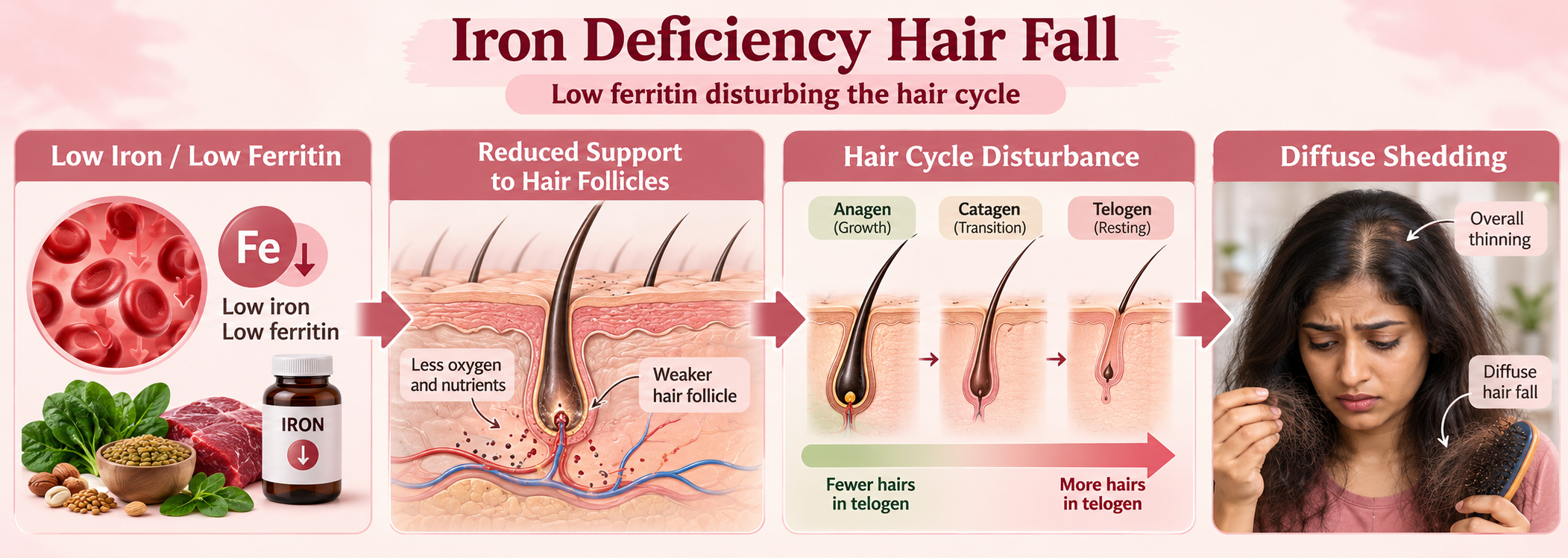
Iron deficiency hair fall — explainer diagramalt: "Low ferritin disturbing the hair cycle, diffuse shedding" · 900×320 WebP

Iron deficiency hair fall is diffuse shedding linked to low iron stores. The most useful measure is ferritin — the protein that stores iron. When ferritin falls, the hair growth cycle can be disturbed and more hairs than usual move into the resting and shedding phase, causing diffuse thinning across the whole scalp (similar to telogen effluvium) rather than bald patches.

Importantly, you can have a normal haemoglobin but still have low ferritin— depleted stores that may affect hair before full anaemia develops. That's why a ferritin test is so valuable.

The reassuring part: this is very treatable, and the follicles are healthy, so hair generally recovers once iron is safely restored and the cause (often heavy periods) is addressed. But the firm safety rule is iron only after testing — too much iron is harmful, so never self-prescribe. Vitamin C aids absorption, and thyroid problems commonly overlap, so both are usually checked together.

Shedding with fatigue or heavy periods? Check the pattern and the right test.

Check My Shedding
What to Notice

Signs & Symptoms

Iron-related shedding rarely comes alone — these wider signs of low iron are the clue.

1

Diffuse thinning across the whole scalp

2

More hair on the brush, pillow and shower

3

Fatigue and low energy

4

Pale skin or inner eyelids

5

Breathlessness or dizziness on exertion

6

Brittle or spoon-shaped nails

7

Heavy menstrual periods

8

An iron-poor or restricted diet

9

No bald patches or scarring (reassuring)

Recognise these signs? Screen them and see which tests to discuss.

Screen My Symptoms
The Mechanism

How Low Iron Affects Hair

These are the main ways low iron shows up in your hair and body. Women's-health triggers often overlap, so testing matters.
Section image
📋
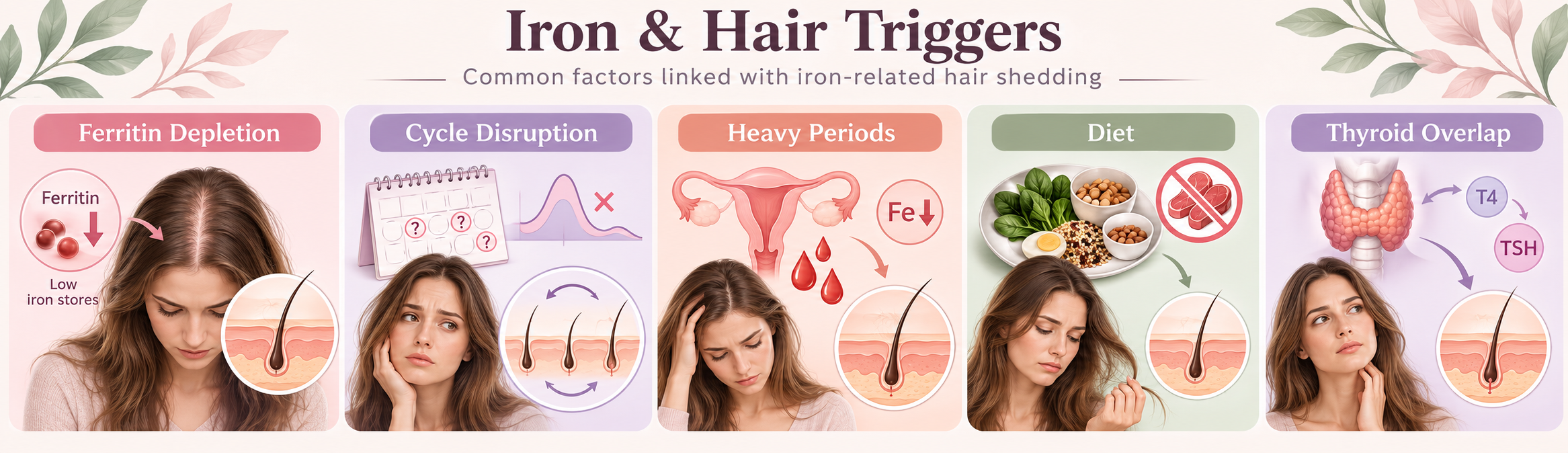
Iron & hair triggers — illustrated gridalt: "Ferritin depletion, cycle disruption, heavy periods, diet, thyroid overlap" · 900×260 WebP

📉 Ferritin depletion

Low iron stores can affect hair before full anaemia.

Action: test ferritin

🔄 Hair-cycle disruption

Low iron pushes more hairs into the shedding phase.

Result: diffuse shedding

🟨 Heavy periods

Menstrual blood loss steadily depletes iron.

Cause: very common

🥗 Iron-poor diet

Low dietary iron, including some unplanned veg diets.

Cause: common

🫂 Pregnancy demand

Pregnancy raises iron needs; manage with antenatal care.

Action: doctor advice

🩸 Thyroid overlap

Thyroid problems often coexist and add to shedding.

Action: test thyroid too

Want your triggers mapped? The checker weighs iron against other causes.

Map My Triggers
Understand

Common Causes of Low Iron in Women

Knowing the likely cause guides safe, lasting correction — not just topping up iron.

CauseWhy it lowers ironWhat helps
Heavy periodsRegular menstrual blood loss depletes storesDoctor assessment of periods + safe iron correction
Iron-poor dietLow intake of iron-rich foodsIron-rich nutrition with vitamin C; advice as needed
Pregnancy / breastfeedingHigher iron demandAntenatal care; iron strictly on medical advice
Poor absorptionGut conditions reduce iron uptakeDoctor investigation of the cause
Rapid growth / blood donationIncreased use or loss of ironMonitoring and doctor-guided correction
Coexisting thyroid issueAdds to shedding independentlyTest and treat thyroid alongside iron

Because several of these are common in women, iron is one of the first things to check in diffuse shedding — but the goal is to find and fix the cause, not simply take iron. And iron is taken only after testing confirms a need.

Not sure what's driving it? Screen your symptoms for a clearer picture.

Screen Now
The Timeline

What Recovery Tends to Look Like

Iron recovery follows safe correction — and takes patience, because hair grows slowly and stores rebuild gradually.

0
Testing
Confirm & find cause

A ferritin and iron blood test confirms deficiency, and your doctor looks for the cause, such as heavy periods, before starting safe correction.

1–3
Early months
Stores rebuilding

As iron is safely restored, shedding usually settles first. Iron stores take time to replenish, so it's important to continue as advised and not stop early.

3–6
Regrowth begins
Short new hairs

With stores rebuilding, the hair cycle normalises and short regrowth hairs appear. Vitamin C and iron-rich food support the process.

6+
Recovery
Density rebuilds

Visible density recovers over several months. Recheck levels as advised; if hair hasn't recovered once iron is stable, a dermatologist checks for other causes.

Want to track recovery against this timeline? Set a baseline today.

Start Tracking
Be Thorough

Other Causes to Rule Out

In women, several causes of diffuse shedding overlap with low iron. Proper tests prevent guesswork — and unsafe supplementation.

🩸

Thyroid changes

Why
Thyroid disorders cause diffuse shedding and often coexist.
Clue
Fatigue, weight or temperature changes.
🌿

Menopause

Why
Hormonal change thins hair around midlife.
Clue
Widening parting, hot flushes.
🥽

PCOS / hormonal

Why
Hormonal conditions affect hair too.
Clue
Irregular periods, acne, facial hair.
🫂

Postpartum shedding

Why
Common after childbirth; iron demand is higher.
Clue
Shedding a few months post-birth.
🧠

Stress & telogen effluvium

Why
Stress or illness triggers diffuse shedding.
Clue
Shedding 2–3 months after a trigger.
🧬

Female pattern loss

Why
Can coexist and persist after iron is corrected.
Clue
Widening parting, family history.

Want these checked properly? A doctor can test iron and thyroid together.

See a DoctorScreen First
Self-Assessment

Screen Your Iron Deficiency Hair Fall

Section image
📱
Iron Deficiency Hair Fall Checker — app screen previewalt: "Iron deficiency hair fall self-assessment on a smartphone" · 900×150 WebP
  1. 1 Is your shedding diffuse across the whole scalp?
  2. 2 Do you feel unusually tired or low on energy?
  3. 3 Is your skin or are your inner eyelids pale?
  4. 4 Do you get breathless or dizzy on exertion?
  5. 5 Are your nails brittle or spoon-shaped?
  6. 6 Do you have heavy menstrual periods?
  7. 7 Is your diet low in iron-rich foods?
  8. 8 Are you pregnant or recently postpartum?
  9. 9 Any thyroid symptoms (fatigue, weight, cold)?
  10. 10 Any bald patches or scalp symptoms?
Your AI check gives you
  • Iron-pattern likelihood
  • Other causes to consider
  • Tests to discuss (ferritin, iron)
  • Safe, iron-after-testing guidance
  • Red-flag / urgency flags
  • Doctor referral pointers
  • Progress tracker baseline
Start Checker
Medical Safety

When to See a Doctor

Iron deficiency is very treatable, but it needs testing first. Please see a doctor before taking any iron — and especially if any of the following apply.

Section image
Red-flag symptoms — when to see a doctoralt: "Diffuse shedding with fatigue, breathlessness, heavy periods" · 900×240 WebP
  • Before taking any iron supplement (test first)
  • Marked fatigue, breathlessness or dizziness
  • Very pale skin or a fast heartbeat
  • Heavy or prolonged menstrual periods
  • Very heavy or persistent shedding
  • Any bald patches or scalp scarring
  • Thyroid symptoms alongside (fatigue, weight, cold)
  • Pregnancy or breastfeeding with concerns
  • Blood in stools or unexplained bleeding
  • Hair loss that is causing distress
Consult a Doctor
Shop by Need

Best Product Categories for Supportive Care

These support your hair and scalp while a doctor confirms and corrects iron. They do not replace blood tests or treatment of the cause. Iron and vitamin products are for use only when deficiency is suspected or confirmed, under medical guidance.
Section image
🛍
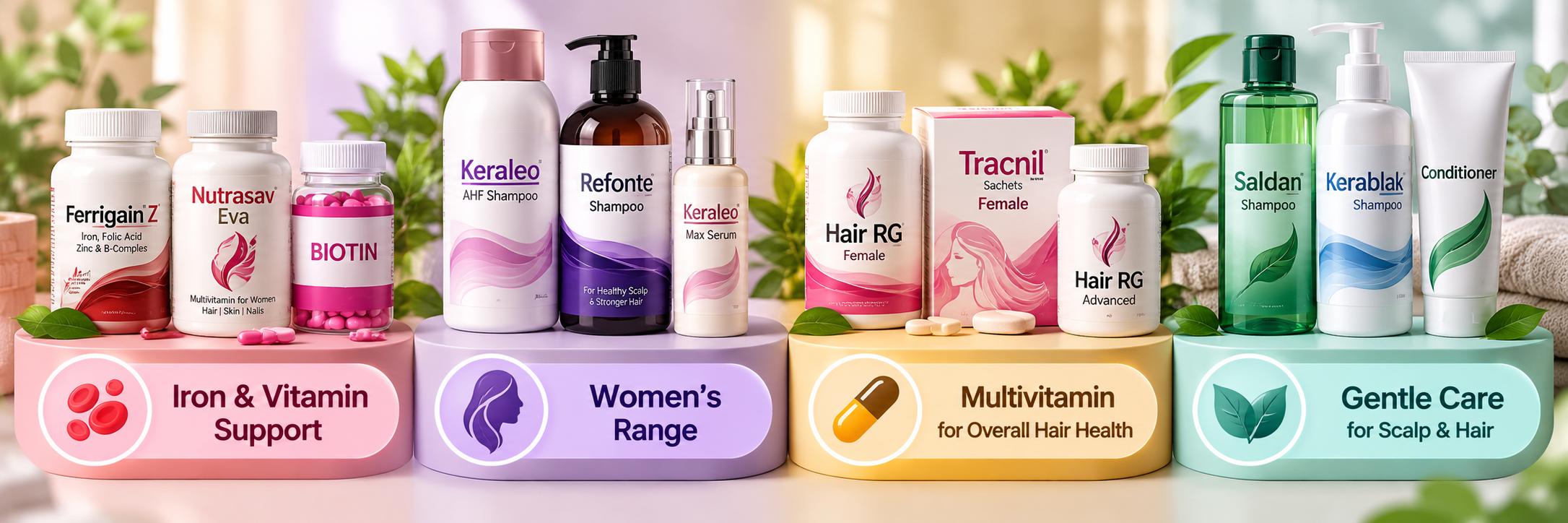
Support categories — shelf overviewalt: "Iron & vitamin support, women's range, multivitamin, gentle care" · 900×260 WebP
🥩

Iron & vitamin support

For confirmed low iron, with vitamin C to aid absorption — after testing.

Best for: confirmed deficiency
Shop
👩

Women's hair fall range

Gentle supportive care for diffuse shedding.

Best for: women's shedding
Shop
🩸

Hair multivitamins

Broad nutrition support for hair health.

Best for: general support
Shop
💧

Anti-shedding serums

Supportive leave-on serums during shedding.

Best for: support
Shop
💊

Gentle shampoos

Mild cleansing kind to shedding-prone hair.

Best for: daily care
Shop
🧼

Strengthening care

For finer, weaker hair during recovery.

Best for: fragile hair
Shop

Not sure which fits you? The Product Finder matches support to your result.

Open Product FinderIron & Vitamin
Featured

Supportive Products for Iron Deficiency Hair Fall

Sample selection. Prices, ratings and availability shown are placeholders.

Products coming soon

We're curating the right supportive products for this concern. In the meantime, browse the full Hairsncares shop or take the AI Hair Test for a tailored match.

Browse all products

These products offer gentle, supportive care for the hair and scalp during an iron-related shedding phase, used alongside doctor-guided care. They do not replace blood tests, iron correction or treatment of the underlying cause, and no product or supplement is guaranteed to regrow hair. Iron and vitamin products are for use only when deficiency is suspected or confirmed by testing and under medical guidance — iron should never be taken speculatively, because excess iron is harmful. Thyroid problems commonly coexist and should be tested. Pregnancy and breastfeeding iron should be taken strictly on medical advice as part of antenatal care. Prescription (Rx) items require a valid prescription and are doctor-guided. Prices, ratings and availability are placeholders to be populated dynamically. Results vary.

Before taking iron or adding to cart, confirm low iron with a ferritin test.

Check FirstIron & Vitamin
Ecommerce Pathways

Recommended Hairsncares Product Pathways

Where to go next for supportive care — matched to women's hair-loss needs. These categories support hair and scalp health; they do not replace blood tests or treatment of the cause. Iron is for use only after testing confirms a need.

For Women

Choose Your Support Pathway

For iron-related shedding, the key pathway is iron and vitamin support — but only once a doctor confirms deficiency. The other pathways support women's hair more broadly. Iron and vitamin products should be used only when deficiency is suspected or confirmed, under medical guidance.

🥩

Iron & Vitamin Hair Support

/products/iron-vitamin-hair-support/

The most important pathway here — for deficiency-related hair fall, low ferritin, low iron and fatigue-related shedding, with vitamin C to aid absorption. Use only after doctor evaluation confirms a need; excess iron is harmful.

Explore ›
👩

Women's Hair Fall Support

/products/women-hair-fall/

The core women's range for general shedding, diffuse thinning, a widening parting, hormonal hair fall and chronic hair fall support — gentle supportive care while iron is corrected.

Explore ›
🥽

PCOS Hair Loss Support

/products/pcos-hair-loss/

A related pathway for hormonal hair-loss comparison, useful where shedding overlaps with irregular periods, acne, facial hair, insulin resistance or androgen sensitivity alongside low iron.

Explore ›
🫂

Postpartum Hair Support

/products/postpartum-hair-support/

A related women's life-stage pathway for diffuse shedding and nutrient support — relevant because pregnancy raises iron demand. Choose pregnancy- and breastfeeding-safe options, with iron strictly on medical advice.

Explore ›

Medical safety: These products support hair and scalp health. They do not replace blood tests, iron correction, thyroid treatment or medical diagnosis. Iron and vitamin products should be used only when deficiency is suspected or confirmed and under appropriate medical guidance, because excess iron is harmful. Pregnancy, lactation, thyroid disease and chronic medical conditions need doctor review. Results vary.

Build a Habit

Supportive Hair Routine

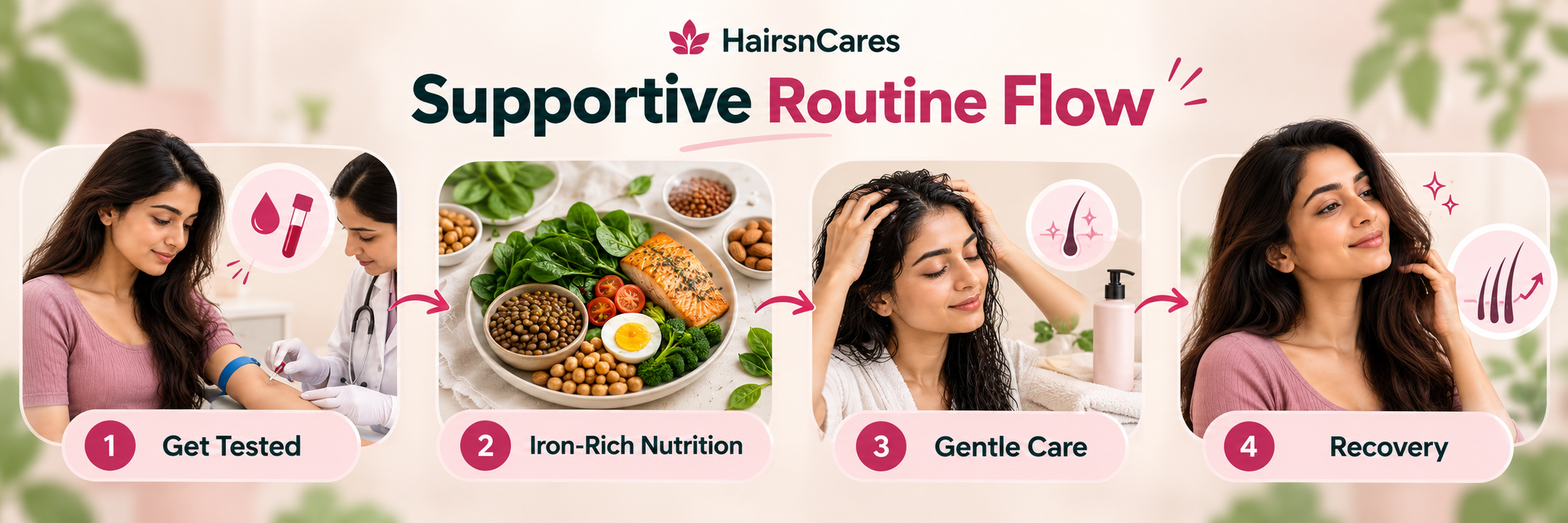
A gentle routine that supports your hair while a doctor confirms and corrects iron. Take iron only after testing, and use active or prescription items only under medical guidance — avoid them in pregnancy or breastfeeding unless a doctor advises.
Section image
📝
Supportive routine flow — illustrated stepsalt: "Get tested, iron-rich nutrition, gentle care, recovery" · 900×240 WebP
Screen

Use the AI checker to see whether iron fits.

Ferritin

Ask your doctor for ferritin and iron studies.

Find cause

Let your doctor look for heavy periods or other causes.

Correct safely

Take iron only if confirmed, exactly as advised.

Iron foods

Lean meats, lentils, beans, tofu, greens, fortified cereals.

Vitamin C

Pair plant iron with citrus, tomato or pepper.

Timing

Avoid tea/coffee right at iron-rich meals.

Protein

Adequate protein supports the hair cycle.

Wash

Gentle shampoo on wash days; don't over-wash.

Condition

Strengthening conditioner for finer hair.

Handle

Avoid tight styles, harsh chemicals and excess heat.

Protect

Silk pillowcase and soft ties reduce breakage.

Daily

Supportive serum as new hairs come through.

Continue

Keep iron as advised; stores rebuild slowly.

Recheck

Recheck ferritin as your doctor advises.

Review

See a dermatologist if hair hasn't recovered once stable.

Want a routine built around your result? Generate a personalised plan in minutes.

Build My Routine
Know Your Actives

Ingredient & Treatment Guide

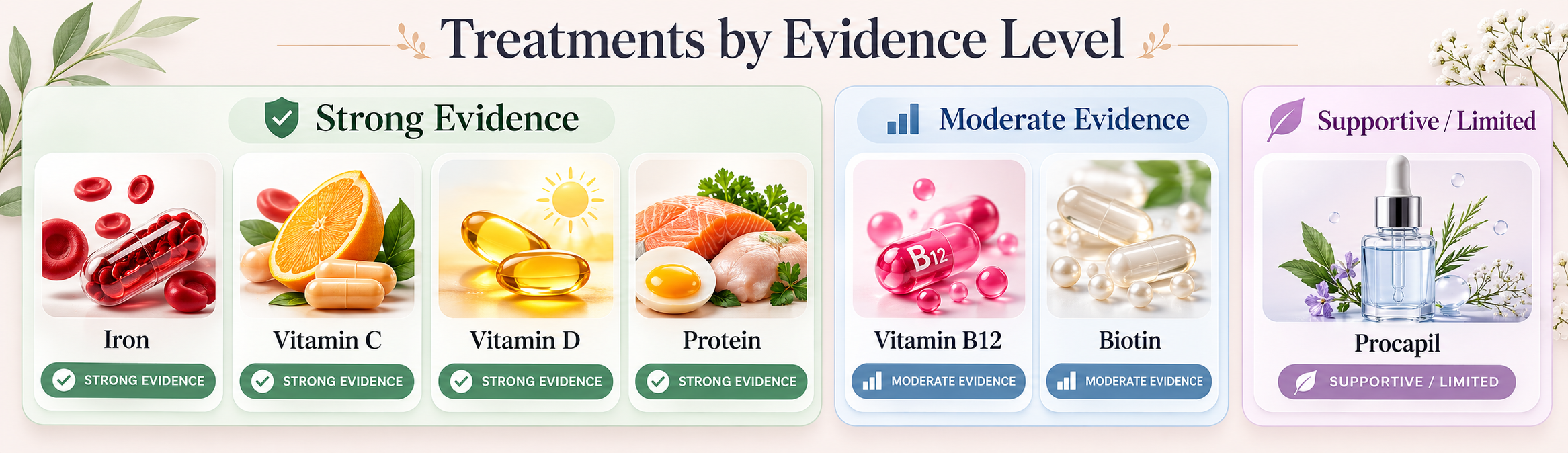
Evidence labels are a simple guide: strong, moderate, supportive or mainly cosmetic. Rx marks prescription items; the rose tag flags pregnancy/lactation caution. Iron is taken only after testing.
Section image
🧪
Treatments by evidence level — visual guidealt: "Iron, vitamin C, vitamin D, protein, B12, biotin, procapil with evidence levels" · 900×260 WebP
🫂

Pregnancy & breastfeeding note: Iron supplementation in pregnancy or breastfeeding should be taken strictly on medical advice as part of antenatal care, never self-prescribed. Avoid Minoxidil in pregnancy or breastfeeding unless a doctor advises, and take all supplements only on medical advice.

Iron

Strong (if low)

The central factor here: correcting confirmed low iron helps hair recover.

Best for: confirmed low ferritin.

Caution: take ONLY after testing; excess iron is harmful.

Related products

Vitamin C

Strong (absorption)

Helps the body absorb iron, especially plant iron.

Best for: alongside iron-rich food/iron.

Caution: supports absorption; not a hair treatment alone.

Related products

Vitamin D

Strong (if low)

Deficiency is linked to increased shedding.

Best for: confirmed deficiency.

Caution: correct after testing; avoid excess.

Related products

Protein / amino acids

Moderate

Hair is largely protein; adequate intake supports growth.

Best for: low intake.

Caution: aim for a balanced diet first.

Related products

Vitamin B12

Moderate (if low)

Low B12 can contribute, especially with low iron.

Best for: confirmed low B12.

Caution: test before supplementing.

Related products

Folate

Moderate (if low)

Works with iron and B12 in blood and hair health.

Best for: confirmed low folate.

Caution: test before supplementing.

Related products

Zinc

Supportive

A mineral involved in hair tissue health.

Best for: confirmed low zinc.

Caution: excess can be harmful; test first.

Related products

Biotin

Supportive

A B-vitamin involved in hair structure.

Best for: confirmed deficiency.

Caution: limited benefit without deficiency; can affect lab tests.

Related products

Caffeine

Cosmetic

A common topical haircare ingredient.

Best for: supportive cosmetic use.

Caution: evidence is limited.

Related products

Procapil

Moderate

A cosmetic complex studied for follicle support.

Best for: supportive density.

Caution: supportive, not a cure.

Related products

Rosemary oil

Supportive

A botanical with some small-study interest.

Best for: supportive cosmetic use.

Caution: patch test; dilute; can irritate.

Related products

Minoxidil Rx Preg caution

Strong (pattern)

For pattern loss, not iron shedding itself; doctor-guided.

Best for: coexisting pattern loss.

Caution: prescription; not in pregnancy/breastfeeding.

Related products

Thinking about iron? Test ferritin first and get assessed.

Ask a DoctorAll Ingredients
🩺
Doctor's Note

Test Ferritin Before You Touch Iron

"Low iron is one of the most common and satisfying causes of women's hair shedding to treat, because when we get it right, the hair really does come back. But I'm strict about one thing: test ferritin first. I see women who have been taking iron for months on a hunch — sometimes their iron was fine all along, and too much iron is genuinely harmful. So we check ferritin and iron studies, usually the thyroid too, find why iron is low — heavy periods are the classic reason — and only then correct it safely with vitamin C to help it along. Confirm it, fix the cause, and let the hair recover."

Reviewed by Dr. Amit Agarkar, MD DermatologyDermatologist & Hair Specialist · Last reviewed 1 June 2026

Shedding with fatigue or heavy periods? Book an assessment and a ferritin test.

Consult Dr. Amit's Team
Bundles

Supportive Hair Kits

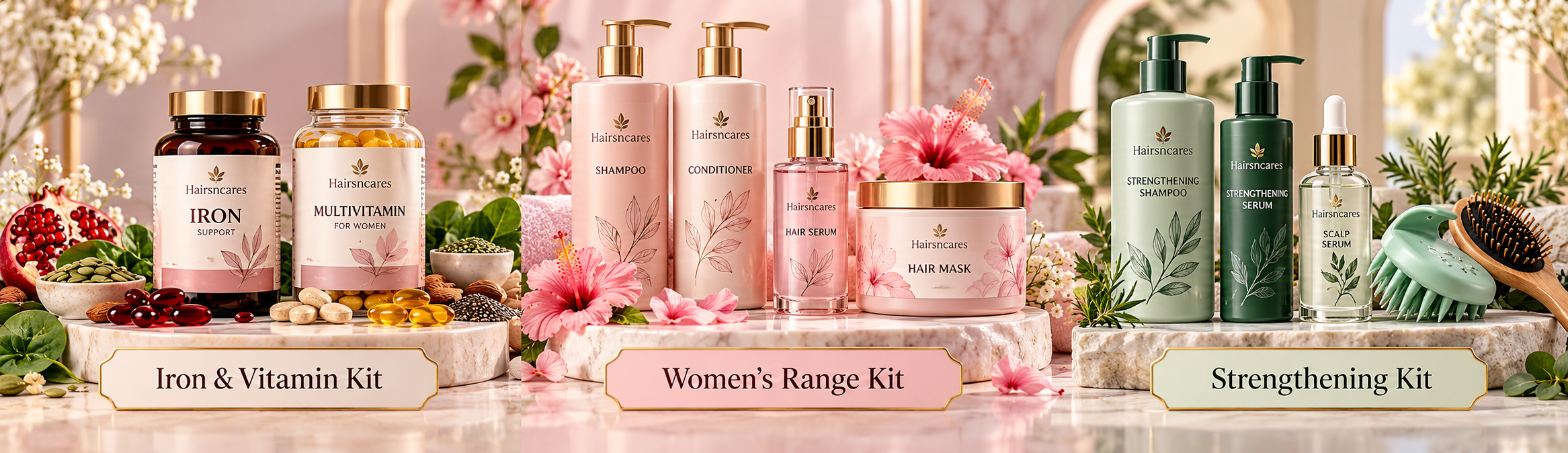
Curated supportive combinations to use alongside doctor-guided iron correction. Timelines are general estimates; results vary and are not guaranteed.
Section image
🎁
Kits & bundles — product flat-layalt: "Supportive kits: iron & vitamin, women's range, strengthening" · 900×260 WebP

Kits coming soon

Curated kits for this concern aren't ready just yet. Browse the full Hairsncares shop to build the routine that fits your needs.

Browse all products

Prefer a kit tailored to you? Build a custom plan from your screening result.

Build a Custom KitTake the Checker
Stay Consistent

Track Ferritin & Hair Recovery

Tracking your ferritin alongside shedding and density shows whether iron correction is working — and reminds you to recheck levels rather than stopping early.

Section image
📈
Recovery tracking — ferritin alongside densityalt: "Tracking ferritin, shedding and hair density over months" · 900×200 WebP
Ferritin levelFrom blood tests
Shedding amountDaily/weekly
Overall densityWhole-scalp photos
Energy levelsHow you feel
Period heavinessIf relevant
Thyroid statusIf tested
Iron adherenceAs advised
Improvement scoreOverall trend
Recheck reminderRetest ferritin
Start Progress Tracker
Evidence & Safety

Medical References Behind This Guidance

These references are provided for patient education and do not replace a dermatologist’s diagnosis or individual medical advice.

AAD

Hair Loss: Causes & Treatment

Dermatologist-led overview of how hair loss is evaluated and the evidence behind common treatments.

View AAD reference ›
NIH / MedlinePlus

Iron-Deficiency Anemia

Patient-education summary of iron-deficiency anemia, which can contribute to hair shedding.

View MedlinePlus reference ›
PubMed

Peer-Reviewed Literature

Searchable index of peer-reviewed research on iron deficiency and hair shedding.

Search PubMed ›
Cochrane Library

Systematic Reviews

Independent systematic reviews assessing the evidence behind hair-loss interventions.

View Cochrane Library ›
Red Flags

When Should Women See a Dermatologist?

Monitor

Mild, Recent Shedding

Short-term shedding without pain, patches or rapid thinning can be tracked with photos and routine consistency.

Screen

Take the AI Hair Test

Use the AI Hair Test to organise symptoms, triggers, pattern and next-step direction. It does not diagnose or prescribe.

Doctor Review

Medical Cause Possible

PCOS, thyroid symptoms, heavy periods, postpartum shedding, menopause thinning, deficiency signs or medication-related shedding need medical context.

Urgent

Do Not Delay

Patchy loss, pain, pus, crusting, bleeding, a scarring-looking scalp, sudden severe shedding, or teenage hair loss with illness needs prompt evaluation.

Test-Guided Care

Do Not Guess Deficiencies or Hormones

Iron / Ferritin

Iron should be taken only if testing confirms deficiency. Excess iron can be harmful.

Vitamin D

Vitamin D should be corrected based on a 25-OH-D test. High-dose vitamin D can be unsafe without medical guidance.

Thyroid

Thyroid hair loss improves through thyroid management, not hair supplements alone.

PCOS / Hormones

Hormonal treatment, anti-androgens or contraceptive decisions must be doctor-led.
Questions

Frequently Asked Questions

Section image
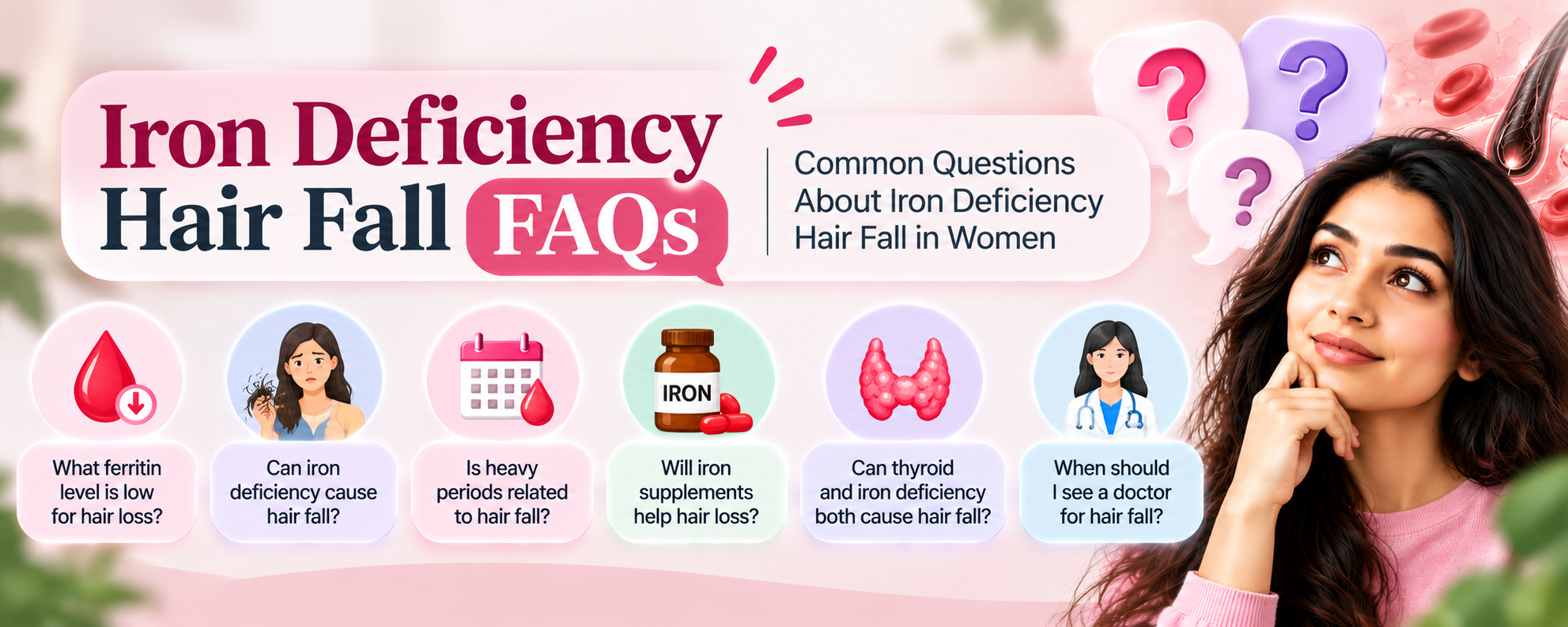
Iron deficiency hair fall FAQs — banneralt: "Frequently asked questions about iron deficiency hair fall in women" · 900×160 WebP
Can iron deficiency cause hair loss in women?
Yes. Low iron, particularly low ferritin (the body's iron store), is a common and treatable cause of hair shedding in women. When iron stores fall, the hair growth cycle can be disturbed and more hairs than usual move into the resting and shedding phase, causing diffuse thinning across the whole scalp rather than bald patches. The good news is that hair usually improves once iron is safely restored under medical guidance, although recovery takes time and results vary. Iron should only be taken after a blood test confirms deficiency.
What is ferritin and why does it matter for hair?
Ferritin is the protein that stores iron in the body, and it is the most useful blood test for assessing iron status in relation to hair. You can have a normal haemoglobin but still have low ferritin, meaning depleted iron stores that can affect hair before full anaemia develops. Many dermatologists consider hair shedding more likely when ferritin is low. Checking ferritin, rather than guessing, is the reliable way to know whether iron is contributing to your shedding and whether correction is needed.
What does iron deficiency hair loss look like?
It is usually diffuse, meaning hair thins fairly evenly across the whole scalp with increased everyday shedding, more hair on the brush, pillow and shower drain, rather than distinct bald patches. The shedding pattern is similar to telogen effluvium. It is often accompanied by other signs of low iron such as fatigue, pale skin, breathlessness on exertion or brittle nails. Because this pattern overlaps with other causes like thyroid problems, blood tests are needed to confirm that iron is the issue.
Why are women more prone to iron deficiency hair fall?
Women are more prone largely because of menstrual blood loss, especially with heavy periods, which steadily depletes iron. Pregnancy also increases iron demand, and diets low in iron-rich foods, including some vegetarian diets without careful planning, can contribute. Absorption problems and certain gut conditions can also play a part. Because these factors are common, iron deficiency is one of the first things worth checking when a woman has diffuse hair shedding, alongside thyroid tests.
Should I take iron supplements for hair loss?
Only after a blood test confirms you are deficient and under medical guidance. This is important: iron should never be taken speculatively, because too much iron is harmful and can cause its own health problems. If testing shows low iron or low ferritin, your doctor will advise how to correct it safely and look for the underlying cause, such as heavy periods. Taking iron without confirmed deficiency is not safe, so testing first is essential rather than self-prescribing.
Is it safe to take iron without testing?
No. Taking iron without confirming a deficiency by testing is not safe, because excess iron can build up and cause harm, and your symptoms might be due to another cause that iron would not fix. A blood test for ferritin and iron studies is quick and tells you whether iron is genuinely low. If it is, your doctor guides safe correction; if it is not, you avoid unnecessary and potentially harmful supplementation and can look for the real cause of your shedding.
How long does it take for hair to recover after iron is corrected?
Recovery is gradual. Once iron is safely restored, shedding usually settles first, and visible regrowth follows over several months because hair grows slowly. Many women notice improvement within three to six months of iron stores being rebuilt, though results vary and depend on correcting the underlying cause, such as heavy periods. It is important to continue as your doctor advises and recheck levels, rather than stopping early, since iron stores take time to replenish fully.
What foods help iron levels for hair?
Iron-rich foods include lean red meat, poultry and fish for those who eat them, and plant sources such as lentils, beans, tofu, dark leafy greens, fortified cereals and seeds. Pairing plant iron with vitamin C, for example citrus, tomatoes or peppers, helps absorption, while tea and coffee with meals can reduce it. A balanced, iron-aware diet supports healthy levels, but if you are already deficient, food alone may not be enough and your doctor may advise supplementation alongside dietary changes.
Does vitamin C help iron absorption?
Yes. Vitamin C helps the body absorb iron, particularly the non-haem iron found in plant foods, which is why pairing iron-rich plant foods with vitamin C sources such as citrus fruit, tomatoes or peppers is helpful. Some iron supplements are formulated with vitamin C for this reason. This is a useful supportive measure, but it works alongside, not instead of, confirming and correcting a deficiency under medical guidance. Vitamin C does not treat hair loss on its own.
Can iron deficiency and thyroid problems happen together?
Yes, very commonly. Iron deficiency and thyroid problems are both frequent in women and both cause diffuse hair shedding, so they often coexist and can add together. This is why doctors usually check ferritin and iron studies alongside thyroid function tests when a woman has hair shedding. If both are present, each needs to be addressed for the hair to recover. The overlap is a key reason not to assume a single cause and to rely on blood tests rather than guessing.
What helps my hair while iron is being corrected?
While your doctor guides safe iron correction, gentle supportive haircare helps the hair you have: a mild shampoo, a supportive serum, careful handling, and avoiding harsh chemicals and excessive heat. Iron-rich nutrition with vitamin C supports your levels, and adequate protein supports the growth cycle. These steps support hair health and appearance rather than replacing iron correction or treating the underlying cause, there is no instant fix, and results vary as your iron stores rebuild.
Does Minoxidil help iron deficiency hair loss?
For shedding caused mainly by low iron, the priority is safely restoring iron and treating the cause, after which hair usually recovers, so Minoxidil is not the first step. Minoxidil is mainly used for pattern hair loss, which can sometimes coexist. A dermatologist may consider it if pattern loss is also present or if thinning persists after iron is corrected. Any use should be doctor-guided, and Minoxidil is generally avoided in pregnancy or breastfeeding without medical advice.
Is iron deficiency hair loss permanent?
Usually not. Because iron deficiency disturbs the hair cycle rather than destroying the follicles, hair generally recovers once iron is safely restored and the underlying cause is addressed, although it takes time and results vary. Persistent loss is more likely if the deficiency is prolonged and untreated, or if another cause such as pattern hair loss coexists. If your iron is corrected and stable but hair has not recovered, a dermatologist can assess for other contributing factors.
Should I take an AI check before buying products?
It helps. An AI checker can explore whether your shedding fits an iron-related pattern, highlight other possible causes such as thyroid problems, and suggest the ferritin and iron tests to discuss with your doctor, so you act safely rather than buying iron or products blindly. It supports screening and education only, does not replace a doctor's diagnosis, and does not advise taking iron without testing. Confirming low iron with a blood test is far more useful than guessing.
When should I see a doctor for iron deficiency hair fall?
See a doctor if you have diffuse hair shedding along with symptoms of low iron such as fatigue, pale skin, breathlessness, dizziness or brittle nails, or if you have heavy periods or a diet low in iron. Also see a doctor before taking any iron, so deficiency can be confirmed and the cause found, and if shedding is heavy or persistent or there are scalp symptoms. Iron deficiency is very treatable, and earlier assessment helps both your hair and your overall health.
Can pregnancy cause iron deficiency hair fall?
Pregnancy increases the body's iron demand, so iron deficiency is more common in and after pregnancy and can contribute to hair shedding, which often overlaps with normal postpartum shedding. Any iron supplementation in pregnancy or breastfeeding should be taken strictly on medical advice, as part of antenatal care, rather than self-prescribed. If you are pregnant or recently had a baby and are concerned about hair shedding or low iron, your doctor or midwife can check your levels and advise safely.

Question not answered here? Ask Dr Aria for instant guidance or book a consultation.

Ask Dr AriaConsult a Doctor

Could Low Iron Be Behind It?

If you're shedding diffusely and feeling tired, pale or run-down, low iron is one of the first things worth checking — and it's very treatable. Use the Hairsncares AI Iron Deficiency Hair Fall Checker to spot the pattern, ask for the right ferritin test, and support your hair safely. Remember the rule: iron only after testing, because excess iron is harmful. See a doctor for proper care.

Medical disclaimer.Hairsncares provides educational and product guidance support. AI screening helps guide decisions but does not replace a doctor's diagnosis. Iron deficiency hair fall is diffuse shedding linked to low iron stores (low ferritin) disturbing the hair cycle; it is usually treatable once iron is safely restored, though recovery takes time and results vary. Iron should only be taken after a blood test confirms deficiency and under medical guidance — iron must never be taken speculatively, because excess iron is harmful; supplements do not replace finding and treating the underlying cause. Thyroid problems commonly coexist and should be tested. The products on this page support hair and scalp health and do not replace blood tests, iron correction, thyroid treatment or medical diagnosis; no product or supplement is guaranteed to regrow hair. Iron and vitamin products should be used only when deficiency is suspected or confirmed and under medical guidance. Iron supplementation in pregnancy or breastfeeding should be taken strictly on medical advice as part of antenatal care. Pregnancy, breastfeeding, thyroid disease and chronic medical conditions need doctor review. Prescription (Rx) medicines such as Minoxidil are doctor-guided and generally not recommended in pregnancy or breastfeeding without medical advice. Results vary.
Doctor-Reviewed Hair-Loss Guide

Iron Deficiency Hair Fall: Causes, Treatment Options & When to See a Doctor

A clear, dermatologist-reviewed overview of Iron Deficiency Hair Fall — what it is, the evidence behind treatment options, and the red flags that mean a doctor should look first. No exaggerated regrowth claims.

Common, treatable causeConfirm with iron/ferritin testsDo not self-dose iron without testingExcess iron can be harmful

Results vary based on diagnosis, consistency, formulation and scalp condition.

🩺
Iron Deficiency Hair Fall

Premium concern visual slot · 720×520 WebP

Quick Summary

Iron Deficiency Hair Fall at a Glance

What it is

Shedding linked to low iron or ferritin — a common, treatable cause of hair fall, especially in women

Who it affects

People with low iron, heavy periods or restricted diets

Treatment evidence

Correcting a confirmed deficiency can improve shedding; test before supplementing

Doctor guidance

Recommended — test iron and ferritin before supplementing

Medical Review & Editorial Transparency

Reviewed for Safety, Evidence & Honest Claims

🩺

Reviewed by: Dr. Amit Agarkar, MD Dermatology

Medical focus: Dermatology, trichology, hair loss, scalp disorders and hair restoration.

Last reviewed: 1 June 2026

Editorial promise: This page explains causes, treatment evidence, limitations and safe next steps without exaggerating hair-growth claims.

Content Transparency

Who, How & Why This Guide Was Created

Who created this guide?

Prepared by the Hairsncares editorial team and medically reviewed by a dermatologist experienced in hair and scalp disorders.

How was it reviewed?

Checked for accuracy of causes, treatment evidence, safety warnings, limitations and suitability for Indian users.

Why was it created?

To help you understand this concern and choose safe next steps, and to know when a dermatologist diagnosis matters most.

Treatment & Evidence

Treatment & Evidence Overview for Iron Deficiency Hair Fall

ParameterAssessmentWhat it means
What it isShedding linked to low iron or ferritin — a common, treatable cause of hair fall, especially in womenThe nature of this concern in plain terms.
Who it affectsPeople with low iron, heavy periods or restricted dietsThe people in whom it is most commonly seen.
Best-evidence optionsCorrecting a confirmed deficiency can improve shedding; test before supplementingWhere the strongest support lies — most are doctor-guided.
When to see a doctorSelf-dosing iron without testing — excess iron is harmfulSituations needing diagnosis before any treatment.
Expected timelineHair often improves over months once iron is restoredResults vary based on diagnosis, consistency, formulation and scalp condition.
Next Steps & Safety

Sensible Next Steps vs See a Doctor First

Sensible next steps

  • Screen the likely cause with the AI Hair Test before buying products
  • Use doctor-guided, evidence-based options with realistic expectations
  • Track monthly photos and review progress with a clinician

See a doctor first if

  • Hair loss is sudden, severe, patchy, painful or with scalp infection.
  • You are pregnant, breastfeeding, a teenager, or using prescription medicines.
  • You have an unclear diagnosis, scarring hair loss, fungal infection or active scalp disease.

Do not start iron supplements without testing — too much iron is harmful. Confirm a deficiency with a doctor first.

Treatments & Ingredients

Treatments & Ingredients for Iron Deficiency Hair Fall

Product Discovery

Explore Products for Iron Deficiency Hair Fall

Product results should be selected based on diagnosis, scalp type, sensitivity, routine compatibility and dermatologist guidance where needed.

Find Products After AI Hair Test
Visual Guide

Iron Deficiency Hair Fall Visual Guide

🧫
What Iron Deficiency Hair Fall can look like and how it is assessed.
📊
Treatment options and where the evidence is strongest.
🛡️
Red flags that mean a dermatologist should look first.
Quick Answers

Quick Answers About Iron Deficiency Hair Fall

What causes Iron Deficiency Hair Fall?

Shedding linked to low iron or ferritin — a common, treatable cause of hair fall, especially in women. The exact cause should be confirmed, because look-alike conditions are treated differently.

Can Iron Deficiency Hair Fall be treated?

Correcting a confirmed deficiency can improve shedding; test before supplementing. Most effective options are doctor-guided, and results depend on diagnosis, consistency and realistic expectations.

How long does treatment take?

Hair often improves over months once iron is restored.

Do I need a diagnosis first?

For sudden, patchy, painful or unexplained loss, yes — see a dermatologist before treating. A suitability screen helps you understand likely causes.

When should I see a doctor urgently?

Self-dosing iron without testing — excess iron is harmful — these need evaluation before any product or medicine.

💬 Ask Dr Aria
Your Cart (0)

Your cart is empty

Subtotal0
DeliveryFREE
Total0
🔒 Secure📦 Free above ₹499↩ Easy returns
💬 Hi! I'm Dr. Amit — your Hair Intelligence consultant
🌿
1
🌿
Dr. Amit
Virtual Dermatologist · Hairsncares.com
Online
What are you shopping for today?
Select a category to begin
AI-powered scalp diagnosis · Hairsncares.com
📸
Scalp Analyser
Upload scalp photo · Get conditions, root cause, and matched product protocol
📷
Drop scalp photo here or click to upload
JPG, PNG, WEBP · Clear, close-up, well-lit photo

Your image is processed privately by our AI engine and saved securely with your account.