Dermatologist-Guided Hair Fall ScienceCaffeine · Peptides · Biotin · KetoconazoleAI Hair Test AvailableShampoo Is Supportive, Not CurativeScalp Freshness + Routine ConsistencyNot a Minoxidil ReplacementDermatologist-Guided Hair Fall ScienceCaffeine · Peptides · Biotin · KetoconazoleAI Hair Test AvailableShampoo Is Supportive, Not CurativeScalp Freshness + Routine ConsistencyNot a Minoxidil Replacement
✓ Dermatologist Reviewed☕ Hair Fall-Support Shampoo🌿 Scalp Freshness Support💆 Thin Hair Routine⚠️ Wash-Off Product Reality🚫 Not a Minoxidil Replacement
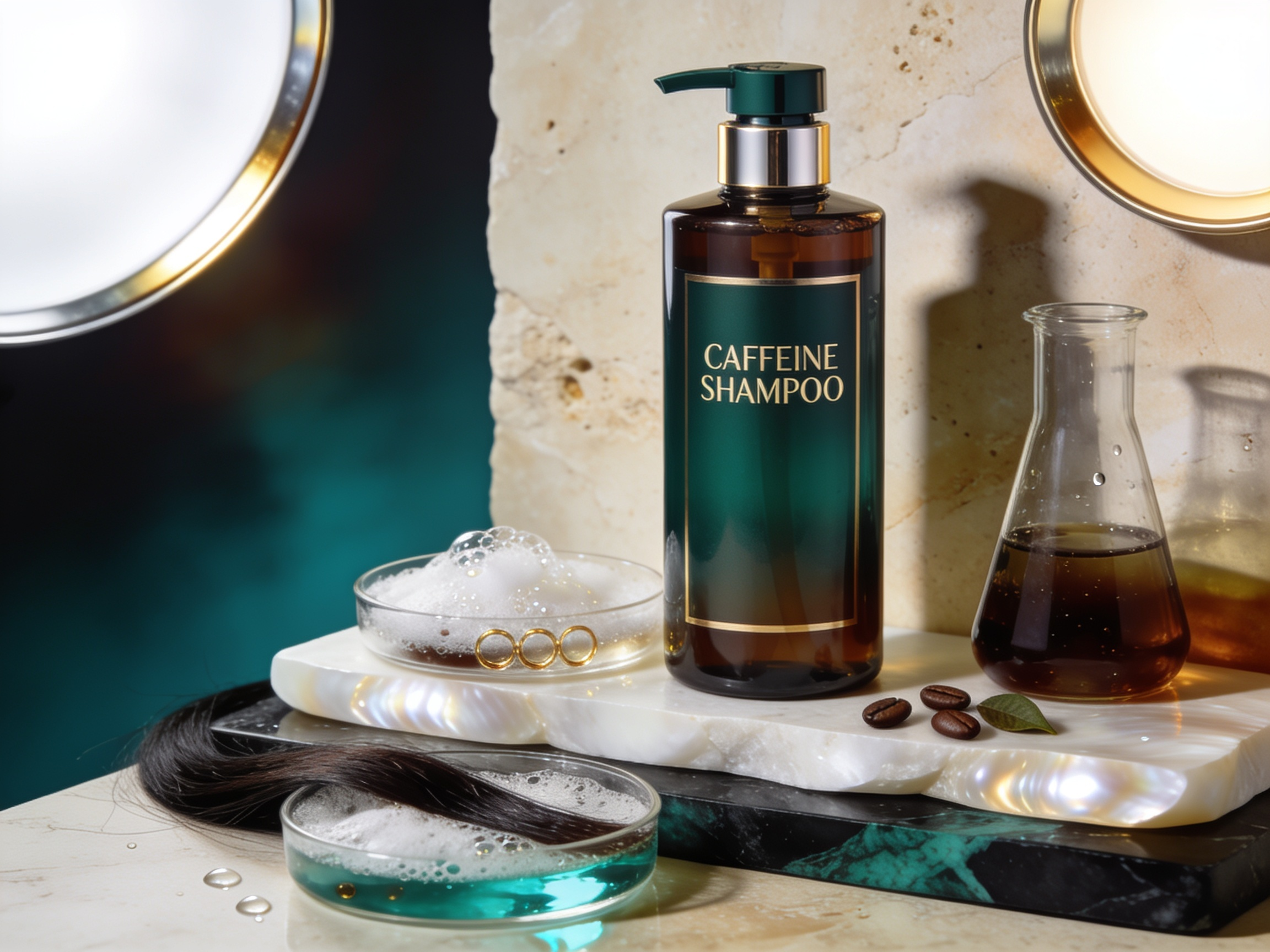
A dermatologist-guided guide to using caffeine shampoo safely — including when it may support a hair fall routine, what it cannot do, wash-off product reality, how to use it correctly, side effects, product selection, and when hair loss needs medical evaluation.
⚠️Caffeine shampoo is a supportive wash-off product, not a guaranteed hair-regrowth medicine. Progressive thinning, bald patches, sudden shedding, postpartum hair fall, PCOS, thyroid symptoms or nutritional deficiency signs need dermatologist evaluation — not shampoo change alone.
What caffeine shampoo can and cannot do for hair loss
The in-vitro evidence for caffeine on hair follicles — context matters
How long caffeine shampoo must stay on scalp to have any effect
Caffeine shampoo vs minoxidil — why they are not comparable
Which hair loss types may respond and which definitely will not
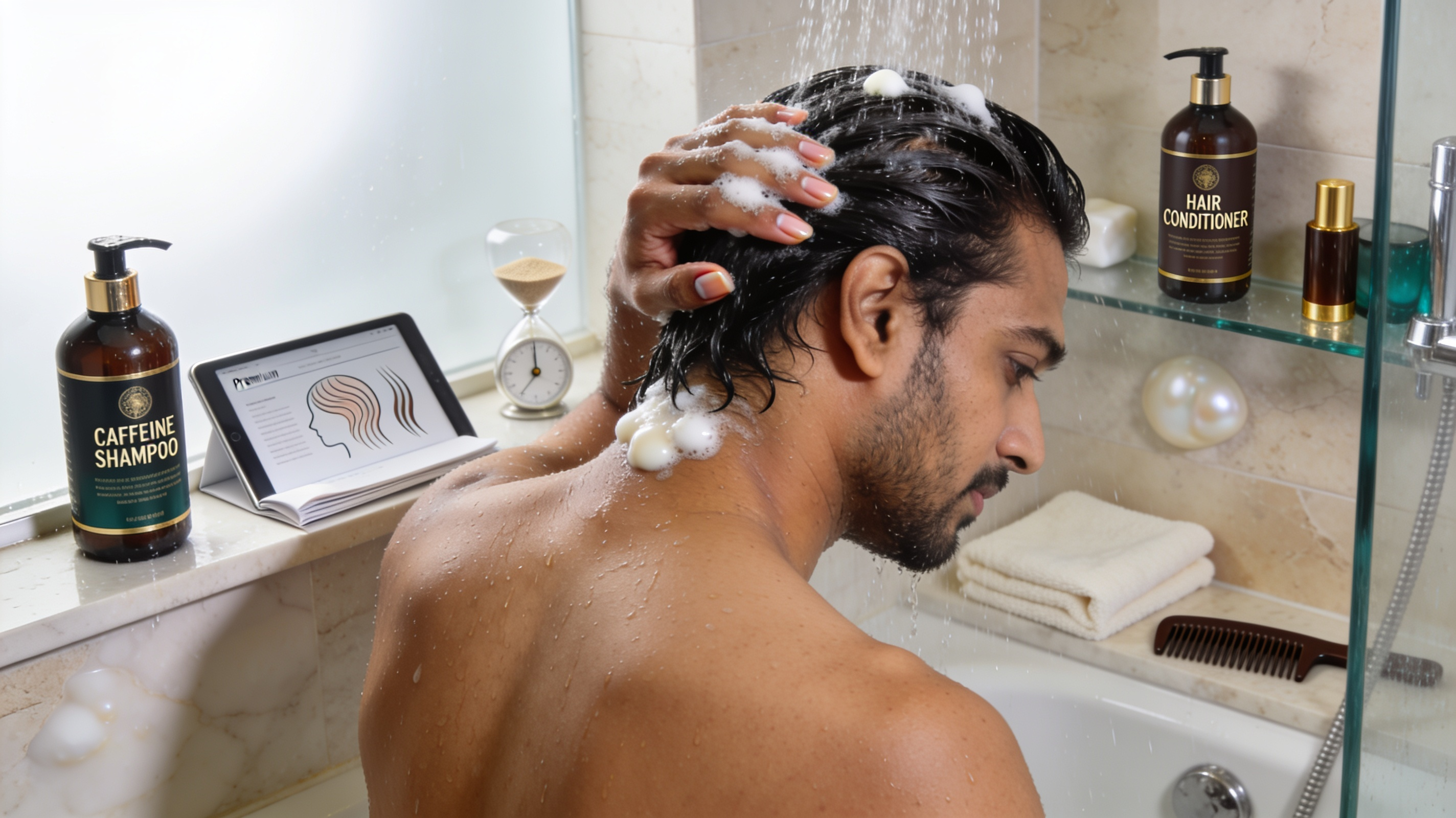
How to use caffeine shampoo for maximum potential contact time
Marketing hype vs clinical reality for caffeine hair products
When hair loss needs prescription treatment, not a shampoo upgrade
☕
Wash-Off Product Reality: Caffeine shampoo spends minutes on your scalp before being rinsed away. This is fundamentally different from leave-on treatments like minoxidil, which remain in contact with the scalp for hours. Realistic expectations are essential: caffeine shampoo may support your hair fall routine and scalp environment, but it cannot replicate the efficacy of leave-on medical treatments for true hair loss conditions. Take the AI Hair Test to understand your hair fall pattern →
Dermatologist Reviewed
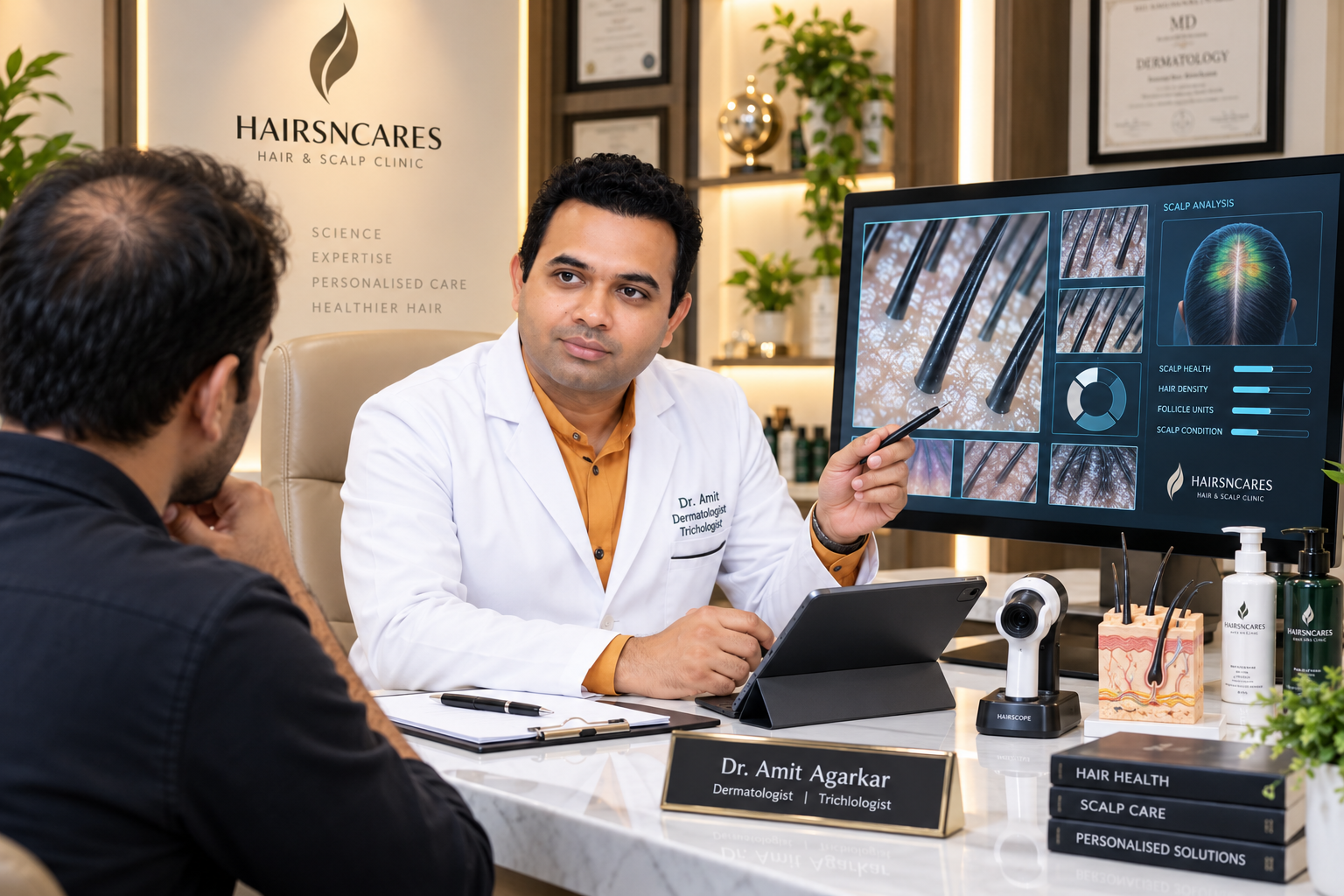
Reviewed by Dr. Amit Agarkar, MD Dermatology
Caffeine shampoo is commonly used in hair fall-support and thin-hair routines. It may support scalp freshness, cleansing consistency, hair shaft feel and routine adherence. However, shampoo is a wash-off product and should not be treated as a standalone treatment for androgenetic alopecia, hormonal hair loss, postpartum shedding, PCOS-related hair fall, thyroid-related hair fall, nutritional deficiency or alopecia areata. The most critical message: if hair fall is sudden, progressive, patchy, or associated with scalp pain, dandruff, PCOS, thyroid symptoms or postpartum changes, a dermatologist evaluation is more important than changing shampoo alone. Caffeine shampoo is a supportive addition to a well-planned hair fall routine — not the foundation of one.
Caffeine shampoo can be part of a hair fall-support routine — particularly for users wanting scalp freshness and a thin-hair-friendly cleansing option. But the critical framing is the word "part of". Caffeine shampoo is a wash-off product. It rinses away within minutes. This gives it fundamentally limited scalp contact compared to leave-on treatments like minoxidil, which stay in contact for hours and have established clinical evidence for androgenetic alopecia.
True root-level hair loss — whether genetic, hormonal, nutritional or inflammatory — needs diagnosis and cause-based treatment. A shampoo change alone cannot reverse androgenetic alopecia, stop postpartum shedding, correct a thyroid disorder or fix a nutritional deficiency.
Best for: supportive hair fall routine, thin-looking hair, scalp freshness, lightweight cleansing
Wash-off reality: minutes of scalp contact vs hours for leave-on treatments
Not a replacement for: minoxidil, dermatologist evaluation, nutritional correction
Frequency: follow product label or dermatologist advice
Red flags → see a doctor: bald patches, progressive thinning, sudden shedding, PCOS/thyroid symptoms
Category distinction: This is the first page in the Hairsncares shampoo series that crosses from anti-dandruff actives into the hair fall-support positioning. The wash-off limitation and minoxidil comparison are therefore the most important medical disclosures on this page — more important than the caffeine chemistry itself.
Caffeine shampoo contains caffeine that has shown some stimulatory effects on hair follicles in laboratory studies. However, contact time during a typical wash is too short for meaningful absorption. It does not treat androgenetic alopecia, regrow hair, or replace FDA-approved therapies. May provide mild cosmetic volumizing. Leave-on caffeine formulations have more potential than wash-off shampoos.
Clinical Matrix
What Caffeine Shampoo Can & Cannot Do
✓ Can Help Support
Hair fall-support routine
Scalp freshness and cleansing consistency
Thin-hair-friendly lightweight cleansing
Hair shaft feel and volume appearance
Breakage-reduction routine when paired with conditioner
Routine consistency and habit formation
Oily scalp cleansing depending on formulation
Combination routine with doctor-guided serum/minoxidil/supplements
People with early, mild thinning who want to add a complementary product to their existing routine. Not a standalone treatment — best combined with proven therapies if indicated.
Not a Substitute For
Minoxidil, finasteride, or dermatologist-managed hair loss plans. In-vitro results do not equal clinical efficacy. Caffeine shampoo is a cosmetic adjunct, not a medicine.
See a Dermatologist If
Hair loss follows a pattern (Norwood/Ludwig), shedding is sudden or severe, or you have been relying solely on caffeine shampoo for over 6 months without improvement. Early intervention matters.
Realistic Scalp Support Science
How Caffeine Shampoo Works — & Its Real Limitations
01
Caffeine in Haircare
Caffeine is used in haircare formulations for hair fall-support positioning. Some in-vitro and laboratory studies show caffeine can affect hair follicle biology. However, extrapolating cell-culture results to the clinical experience of washing your scalp with a rinse-off shampoo requires realistic calibration.
02
Wash-Off Product Reality
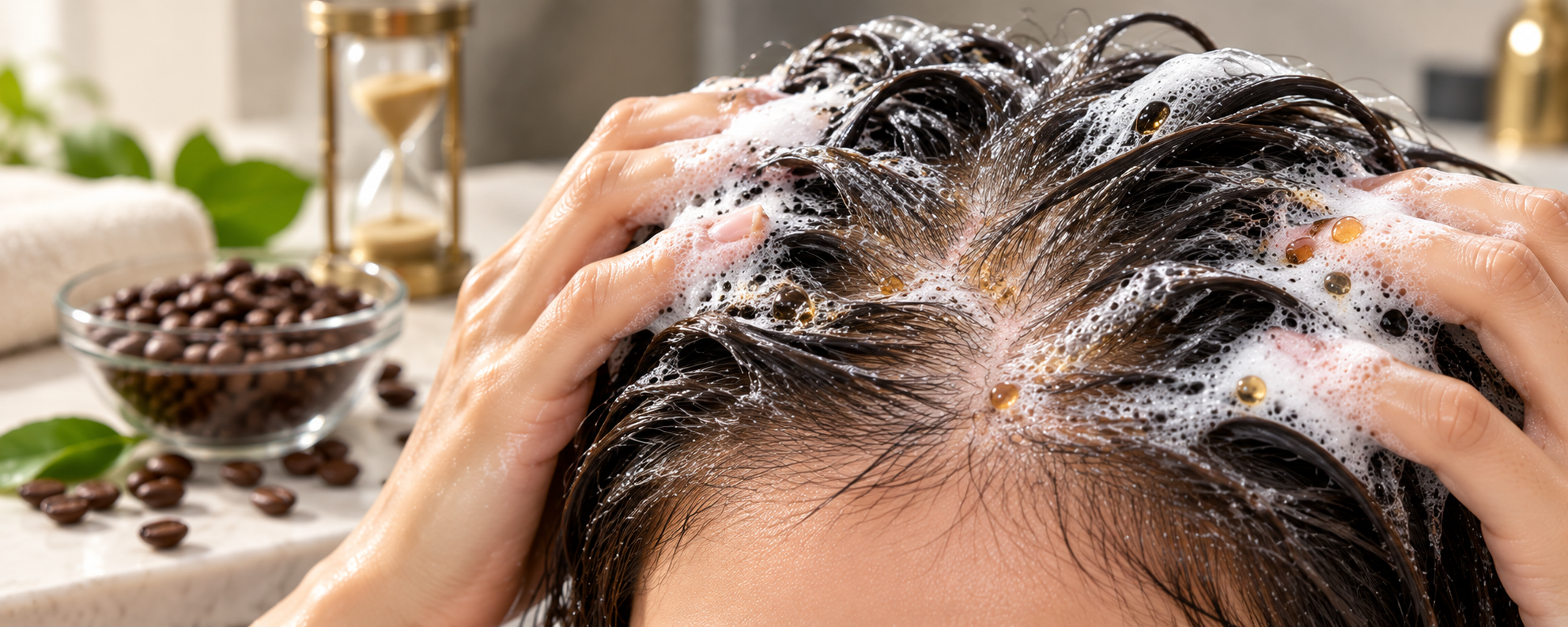
Shampoo stays on the scalp for 2–5 minutes before rinsing. This short contact time limits how much active ingredient can penetrate the scalp compared with leave-on formulations (serums, minoxidil, topical treatments) which maintain scalp contact for hours. Realistic expectations are essential.
03
Scalp Freshness & Routine Consistency
A well-formulated caffeine shampoo can support scalp freshness, oil control, routine consistency and a cleaner scalp environment. These benefits — while not the same as hair regrowth — are genuinely useful as part of a broader, dermatologist-guided hair fall management plan.
04
Diagnosis Comes First
The cause of hair fall determines the correct treatment. Androgenetic alopecia, postpartum shedding, PCOS, thyroid disease, nutritional deficiency, alopecia areata and scalp disease each require different approaches. Starting with the right shampoo is less important than starting with the right diagnosis.
These benefits are real but should be understood within the wash-off shampoo framework — not confused with the efficacy of leave-on medical treatments for hair loss.
☕
Hair Fall-Support Routine
Caffeine shampoo is a useful component of a broader hair fall-support routine — particularly when used alongside appropriate medical guidance, diagnosis and treatment. It should not be expected to be the primary or sole treatment for active hair fall.
🌿
Thin Hair-Friendly Cleansing
Many caffeine shampoo formulations are lightweight and volume-supportive, making them suitable for users with fine or thinning-looking hair who want scalp cleansing without heaviness or product buildup on already-limp hair.
✨
Scalp Freshness
May support scalp freshness and oil management, especially for users with an oily scalp that can contribute to discomfort or affect hair fall routine adherence.
💆
Volume Appearance Support
A well-formulated caffeine shampoo may make hair feel lighter and fuller-looking after cleansing — a cosmetic benefit that supports confidence and routine consistency, even if not a medical treatment.
🔄
Routine Pairing
Can be paired with doctor-guided serums, minoxidil (applied separately after washing), hair supplements when indicated, or anti-dandruff shampoo when dandruff co-exists. Consult a dermatologist before combining active treatments.
🤖
AI Hair Test Matching
AI Hair Test assesses your hair fall pattern, scalp type, potential causes and whether caffeine shampoo, anti-dandruff shampoo, minoxidil guidance, supplement screening or doctor consultation is your most urgent need.
Many patients ask whether Caffeine Shampoo alone can solve their hair concerns. The honest answer: shampoo is a wash-off product that stays on the scalp for a short time. It can support scalp cleanliness, comfort and scalp stimulation — but it cannot treat root-level hair loss, hormonal imbalance, nutritional deficiency or conditions that need prescription treatment. A good shampoo works best as part of a complete routine, not as a standalone cure.
Hair Fall Suitability
Who Should — and Shouldn't — Rely on Caffeine Shampoo Alone
🟢
Early Hair Fall Concern
Early increased shedding without visible thinning, bald patches or hair fall lasting less than 4 weeks — may add caffeine shampoo to routine while awaiting dermatologist evaluation.
Supportive Role🟢
Thin-Looking Fine Hair
Hair that appears thin but is not actively losing density — caffeine shampoo may support volume feel and cleansing routine without weighing hair down.
Good Match🟢
Oily Scalp with Hair Fall
Oily scalp where frequent washing is needed — a caffeine shampoo with appropriate formulation for oily scalp may suit the routine if scalp tolerates well.
May Suit⚠️
Active Androgenetic Alopecia
Visible thinning, receding hairline or crown thinning needs dermatologist evaluation and likely minoxidil guidance. Caffeine shampoo alone is insufficient for androgenetic alopecia.
Doctor First⚠️
Active Dandruff or Scalp Disease
Dandruff-related hair fall needs anti-dandruff shampoo (ketoconazole, zinc pyrithione) rather than caffeine shampoo as the primary active. Correct the scalp condition first.
Anti-Dandruff First⚠️
Postpartum / PCOS / Thyroid
Hormonal hair fall causes need medical diagnosis and cause-based treatment. Caffeine shampoo is not a treatment for any of these conditions.
Medical Evaluation🔴
Bald Patches / Patchy Hair Loss
Patchy hair loss may indicate alopecia areata or scarring alopecia — both need urgent dermatologist evaluation. Shampoo is irrelevant to diagnosis and cannot treat these conditions.
See Doctor Urgently🔴
Sudden Heavy Shedding
Acute telogen effluvium (sudden heavy shedding post-illness, fever, crash diet, surgery) needs dermatologist evaluation to identify the trigger and timeline, not a shampoo change.
Investigate First🔴
Post-Transplant Scalp
Never change shampoo or apply new products on a post-transplant scalp without explicit surgeon clearance.
Caffeine shampoo uses a 9-step HowTo that begins with "Identify the Hair Fall Pattern" — a step unique to this page. Unlike anti-dandruff pages where step 1 is about matching scalp type, here the first question is whether shampoo is even the right primary response.
Most important safety principle: If hair fall is active, progressive, patchy or associated with medical symptoms — start with AI Hair Test and dermatologist evaluation, not shampoo selection. Shampoo is supportive, not curative.
1
Identify the Hair Fall Pattern
Before relying on shampoo, assess whether hair fall is shedding (telogen effluvium), breakage, pattern thinning (androgenetic), bald patches (alopecia areata), or scalp disease-related (dandruff, seborrheic dermatitis). Each requires a different primary response. If you are unsure, take the AI Hair Test or consult a dermatologist before choosing a shampoo.
2
Wet Scalp Properly
Use lukewarm water to fully wet scalp and hair. Avoid hot water, which can increase scalp oil production and may temporarily worsen shedding appearance during washing.
3
Apply to Scalp
Focus caffeine shampoo on the scalp and roots. Avoid heavy application on dry or already-fragile lengths — particularly if breakage is a concern alongside hair fall.
4
Massage Gently — Not Aggressively
Use slow fingertip movements. Avoid aggressive scalp rubbing, which can increase the perception of shedding during washing and worsen breakage of fragile hair shafts.
5
Follow Label Contact Time Only
If the product recommends a leave-on time, follow the label only. Exceeding label instructions does not improve results and may irritate the scalp.
6
Rinse Thoroughly
Remove all shampoo residue. Product buildup on a hair-fall-prone scalp can worsen scalp condition and interfere with any topical treatment (minoxidil, serums) applied post-washing.
7
Condition Lengths Only
Apply conditioner to mid-lengths and ends only — not to the scalp. Conditioner on an oily or hair-fall-prone scalp can contribute to buildup and may interfere with scalp-targeted treatments.
8
Pair With the Correct Routine
Caffeine shampoo is a supportive component. For active hair fall, pair with AI hair test, dermatologist evaluation, and cause-based treatment (minoxidil if indicated, nutritional support if deficient, anti-dandruff if scalp disease is present). Shampoo alone is not the treatment plan.
9
Track Response
Monitor scalp and hair fall pattern. Stop and consult a doctor if burning, redness, rash, worsening hair fall, new bald patches, dandruff flare or scalp irritation occurs. Do not interpret continued hair fall as a sign that you need a stronger shampoo — it is a sign that you need a diagnosis.
Caffeine shampoo: 2–5 minutes scalp contact, then rinsed away. Minoxidil: applied to scalp, not rinsed, remains in contact for hours. This fundamental difference in contact time and mechanism means they cannot be compared as equivalent hair fall treatments — they are not interchangeable.
Stop and See a Doctor If:
Burning, rash, swelling, worsening hair fall, new bald patches, scalp pain, pus, dandruff flare or PCOS/thyroid symptoms emerge. Do not increase shampoo frequency as a response to continued hair fall.
Expert Note
The most common shampoo mistake is rushing the process. Apply to the scalp (not just hair lengths), massage gently with fingertips (never nails), follow the recommended contact time if it is a medicated shampoo, and rinse thoroughly. Incomplete rinsing is a leading cause of scalp irritation and product buildup that patients often blame on the shampoo itself.
Frequency & Routine Expectations
Caffeine Shampoo in the Broader Hair Fall Treatment Landscape
Key principle: Follow your product label or dermatologist's advice. Frequency varies by scalp type, oiliness, sweat, dandruff, hair texture and product tolerance. The most important expectation to manage: changing shampoo frequency cannot fix a medical cause of hair fall.
Caffeine Shampoo
Hair fall-support routine and thin-hair-friendly cleansing. Wash-off product — supportive, not curative.
Ketoconazole
Dandruff and seborrheic dermatitis support. Important when scalp disease contributes to hair fall.
Zinc Pyrithione
Mild-to-moderate dandruff maintenance. Scalp health support between active washes.
Mild Daily Shampoo
Sensitive scalp or frequent washing. Scalp hygiene without actives on rest days.
Sulphate-Free Shampoo
Dry, curly or colour-treated hair. Low-irritation option for delicate hair types.
Minoxidil (leave-on)
Medical treatment for selected hair loss types under guidance. Not a shampoo — applied after washing and left on.
Critical reminder: Do not keep changing shampoos every few days expecting hair regrowth. Track your hair fall pattern, note whether it is shedding, breakage or thinning, and bring this information to a dermatologist or AI Hair Test for an informed evaluation.
Hair Fall Solution Comparison
Caffeine Shampoo vs Minoxidil vs Other Hair Fall Options
This is the first page in this shampoo series to compare a shampoo against medical hair fall treatments, including minoxidil. This comparison matters because caffeine shampoo is frequently positioned by marketing as a hair-growth product.
Option
Best For
Main Role
Evidence Position
Key Caution
Caffeine Shampoo
Supportive hair fall routine, thin hair, scalp freshness
Not optional for progressive thinning or bald patches
Key message: Caffeine shampoo and minoxidil are not equivalent. They differ in mechanism, contact time, evidence base and clinical role. Use this table to understand the landscape, not to substitute a product for a diagnosis.
All products are supportive wash-off shampoos. Not standalone hair loss treatments. Not replacements for minoxidil or medical care when indicated. Prices on individual product pages.
Products for this guide are being curated. Take the AI Hair Test for personalised, pattern-checked picks meanwhile.
Routine Builder
Hair Fall Routine Combinations
☕
Early Hair Fall Routine
Caffeine shampoo as per label frequency
AI hair test to assess pattern and cause
Hair fall serum if suitable and dermatologist-approved
Is Caffeine Shampoo Right for Your Hair Fall Pattern?
Our AI Hair Test goes beyond scalp type — it assesses your hair fall duration, shedding pattern, potential medical causes, scalp condition and lifestyle factors to determine whether caffeine shampoo is a useful addition to your routine, or whether you need diagnostic evaluation first.
AI screening only. Does not diagnose, prescribe or replace dermatologist evaluation. For active hair fall, medical evaluation remains the priority.
AI Hair Test · WebP
Safety & Hair Fall Red Flags
Stop Using Caffeine Shampoo and Consult a Doctor If:
🔥
Burning or Rash
Burning, rash or severe redness after shampoo use — stop and consult a doctor before resuming. May indicate contact reaction or scalp condition aggravation.
🤧
Swelling
Swelling of scalp, face or eyes after shampoo use — stop and seek medical attention. May indicate allergic reaction to shampoo ingredients or fragrance.
🔴
Worsening Hair Fall
Hair fall that worsens significantly after starting a new shampoo — stop use, but also recognise that worsening hair fall is usually a sign the underlying cause needs evaluation, not a different shampoo.
💧
Scalp Pimples or Pus
Scalp folliculitis, pimples or pus after shampoo use needs dermatologist evaluation. May indicate folliculitis, contact reaction or secondary infection.
❄️
Dandruff Flare
Worsening dandruff after starting caffeine shampoo — the formulation may not suit your scalp type. Consider anti-dandruff shampoo evaluation and dermatologist assessment.
👁️
Eye Irritation
If shampoo enters eyes, rinse immediately with water. Seek medical attention if irritation persists.
Hair Fall Red Flags — When Shampoo Is Not Enough
These hair fall presentations require dermatologist evaluation — not a shampoo change. If you recognise any of these patterns, please consult a dermatologist or take the AI Hair Test immediately.
📉 Hair Fall > 6–8 Weeks
Persistent shedding beyond 6–8 weeks needs medical evaluation to identify the cause and trigger, not a product change.
👁️ Visible Thinning
Visible reduction in hair density, especially at the crown or partition line, needs dermatologist diagnosis.
↩️ Receding Hairline
Hairline recession is a sign of androgenetic alopecia or traction alopecia and requires medical evaluation and treatment planning.
⭕ Bald Patches
Any patchy hair loss needs urgent evaluation — may indicate alopecia areata, scarring alopecia or tinea capitis, all of which need specific medical treatment.
🤰 Postpartum Shedding
Postpartum telogen effluvium is normal but distressing. Requires understanding of the timeline and reassurance, plus evaluation if severe or persistent.
🩸 PCOS Symptoms
Hair fall with irregular periods, acne, weight gain or PCOS symptoms needs hormonal evaluation before any haircare product selection.
🦋 Thyroid Symptoms
Hair fall with fatigue, weight change, cold/heat intolerance or thyroid symptoms needs thyroid evaluation and treatment.
🥗 After Crash Diet
Hair fall after crash dieting, weight loss surgery or prolonged illness needs nutritional evaluation and correction, not a cosmetic shampoo.
If you notice increased itching, redness, burning, pimples on the scalp, or worsening flakes after using caffeine shampoo — stop immediately. These are not signs of “scalp detox” or “purging.” They may indicate irritation, allergy, contact dermatitis or worsening of an existing scalp condition. Consult a dermatologist before resuming.
Myths vs Facts
Common Myths About Caffeine Shampoo
Myth
Caffeine shampoo regrows lost hair.
✓ Fact
Caffeine shampoo may support a hair fall routine but is not a proven standalone hair-regrowth medicine comparable to minoxidil. Marketing language often overstates wash-off shampoo's clinical role.
Myth
Shampoo alone can stop genetic hair loss.
✓ Fact
Androgenetic alopecia is driven by genetics and DHT — a hormonal mechanism that shampoo cannot address. Meaningful response requires dermatologist-guided medical treatment.
Myth
More contact time means better results.
✓ Fact
Exceeding label instructions may irritate the scalp. Even extended contact time cannot replicate the hours-long scalp exposure of leave-on treatments like minoxidil. Follow the product label.
Myth
Caffeine shampoo replaces minoxidil.
✓ Fact
Minoxidil is a leave-on medical treatment with established clinical evidence for androgenetic alopecia. Caffeine shampoo is a wash-off product. They cannot be substituted for each other.
Myth
Hair fall means the shampoo is wrong.
✓ Fact
Hair fall may be due to genetics, hormones, stress, illness, nutrition, dandruff, medication or alopecia. Changing shampoo is rarely the primary solution and delays proper diagnosis.
Myth
All anti-hair-fall shampoos work the same.
✓ Fact
Different formulas target scalp oiliness, dandruff, breakage, volume or cosmetic feel differently. Matching the right formulation to the right hair fall cause — ideally with diagnosis — gives better outcomes.
Caffeine shampoo is used in hair fall-support, thin-hair and scalp freshness routines. It is a wash-off product that may support routine consistency, scalp cleansing, hair shaft feel and volume appearance. It is not a standalone hair-regrowth treatment, not a replacement for minoxidil, and should not be expected to cure genetic hair loss or medical hair fall conditions by itself.
Caffeine shampoo can be part of a hair fall-support routine. However, as a wash-off product, its scalp contact time is limited to minutes. True root-level hair loss needs diagnosis and cause-based treatment — such as minoxidil, hormonal treatment, nutritional correction or scalp-disease management, depending on the cause.
Caffeine shampoo is not a proven standalone hair-regrowth medicine. It may support scalp freshness and routine consistency, but there is no strong clinical evidence that wash-off caffeine shampoo produces meaningful hair regrowth comparable to leave-on medical treatments like minoxidil.
Caffeine shampoo may suit users wanting thin-hair-friendly, lightweight cleansing. Some formulations help hair feel fuller after washing. However, thinning hair usually needs medical evaluation to identify whether the cause is androgenetic alopecia, hormonal, nutritional or scalp-disease related.
Caffeine shampoo is used by men in hair fall-support routines. However, male pattern baldness (androgenetic alopecia) typically requires minoxidil and/or finasteride under dermatologist guidance for meaningful response. Caffeine shampoo is supportive, not a replacement for these treatments.
Caffeine shampoo may be used by women in hair fall-support routines. Female hair fall has many causes — PCOS, thyroid, postpartum shedding, nutritional deficiency, androgenetic alopecia, alopecia areata. A dermatologist evaluation is important before relying on shampoo alone for female hair fall.
No. Androgenetic alopecia typically requires medical treatment — minoxidil and/or finasteride (men), or appropriate therapy for women — under dermatologist guidance. Caffeine shampoo is a supportive wash-off product and cannot substitute for these treatments.
No. Minoxidil is a leave-on medical treatment with established clinical evidence for androgenetic alopecia. Caffeine shampoo is a wash-off product with minutes of scalp contact. They have fundamentally different mechanisms, contact times and evidence bases. A dermatologist should guide whether minoxidil is appropriate.
Follow your product label or dermatologist's advice. Frequency varies by scalp type, oiliness, sweat, dandruff, hair texture and product tolerance. Overwashing may worsen dryness; under-washing may worsen oiliness or dandruff in some scalp types.
Some formulations are designed for daily use; others are not. Follow product label guidance. Daily use may not suit all hair and scalp types, particularly dry or sensitive scalps.
Follow the product label. Exceeding recommended contact time does not improve results and may increase scalp irritation. Even with extended contact time, caffeine shampoo cannot match the hours-long exposure of leave-on treatments.
Caffeine shampoo does not typically cause hair fall. Visible shedding during washing is usually pre-existing telogen phase hair. If hair fall worsens significantly after starting a new shampoo, stop use and consult a dermatologist — but also recognise that worsening hair fall usually signals an underlying cause that needs evaluation.
Scalp dryness can occur depending on formulation and individual scalp type. Reduce wash frequency or switch formulation if dryness occurs. Using conditioner on lengths and ends helps.
Scalp irritation can occur with any shampoo, especially in sensitive, eczema-prone or psoriasis-prone scalps. Stop use and consult a doctor if burning, rash or swelling occurs.
Yes. Apply conditioner to mid-lengths and ends only — not to the scalp. Conditioner on the scalp may contribute to greasiness or product buildup.
Consult your dermatologist before combining caffeine shampoo with minoxidil or other scalp products. Generally, shampoo is applied and rinsed before minoxidil is applied (and not rinsed). Timing and spacing matter. Avoid stacking irritating products without guidance.
Do not change your shampoo or apply any new haircare product on a post-transplant scalp without explicit clearance from your hair transplant surgeon.
For genetic or medical hair loss, minoxidil — where appropriate — has far more clinical evidence. Caffeine shampoo is a supportive wash-off routine product. They are not equivalent, cannot be substituted for each other, and serve different roles. Consult a dermatologist about whether minoxidil is indicated for your hair fall pattern.
They serve different purposes. Ketoconazole shampoo is antifungal and targets dandruff/seborrheic dermatitis-related scalp inflammation that may contribute to hair fall. Caffeine shampoo is for general hair fall-support routines. If dandruff is driving hair fall, ketoconazole is more appropriate. Some products combine both.
Both are wash-off hair fall-support shampoos with limited clinical evidence compared with medical treatments. Biotin shampoo cannot correct true biotin deficiency — only oral supplementation after a confirmed blood test can. Neither is a substitute for medical hair fall evaluation and diagnosis.
Stop caffeine shampoo if you experience burning, redness, rash, swelling, scalp pimples, worsening hair fall, dandruff flare or increased itching. Consult a dermatologist before resuming. Do not increase frequency hoping for better results — worsening hair fall needs investigation, not more shampoo.
Consult a dermatologist if hair fall has been present for more than 6–8 weeks, if you notice visible thinning, receding hairline, crown thinning, widening partition, bald patches, postpartum shedding, hair fall with hormonal symptoms (PCOS, thyroid), hair fall after illness or crash diet, or if you are simply unsure of the cause. Shampoo change is not the first priority for any of these presentations.
Still unsure whether caffeine shampoo is right for your hair fall pattern?
Caffeine shampoo is a supportive wash-off shampoo used in hair fall-support, thin-hair and scalp freshness routines. It does not diagnose, treat, cure or prevent medical hair loss, baldness, alopecia, PCOS-related hair fall, thyroid-related hair fall, postpartum shedding, nutritional deficiency hair fall or medication-related shedding. It is a wash-off product with minutes of scalp contact and should not be expected to produce results comparable to leave-on medical treatments such as minoxidil. It should not replace minoxidil, finasteride, dutasteride, PRP, GFC, nutritional correction, hair transplant care or dermatologist evaluation when indicated. Use as per product label or doctor guidance. Stop if irritation or allergy symptoms occur. This guide has been reviewed by Dr. Amit Agarkar, MD Dermatology, Hairsncares.
Start With a Hair Fall Diagnosis, Not a Shampoo
The AI Hair Test helps you understand your hair fall pattern before choosing products. Caffeine shampoo can be a supportive part of a correctly diagnosed routine — it is rarely the first step.