🧹
Scalp Buildup Support
Primary indication. When product residue, dry shampoo, oil or styling cream makes scalp feel coated and heavy, ACV shampoo's acidic clarifying action may provide a cleaner scalp feel.
A dermatologist-guided guide to using apple cider vinegar shampoo (ACV shampoo) safely — including when it supports product buildup, oily scalp freshness, dull hair, hard-water feel, acidic irritation risk, and when scalp symptoms need medical evaluation.
What apple cider vinegar shampoo can and cannot do
The pH-balancing claim — what evidence actually supports
How ACV shampoo differs from rinsing with raw ACV
Best scalp types and hair textures for ACV shampoo
ACV shampoo vs salicylic acid vs piroctone olamine for buildup
How often to use without stripping natural oils
Risks of ACV on colour-treated or chemically processed hair
When buildup and flaking need medical evaluation, not ACV
Apple cider vinegar (ACV) is fermented apple juice — acetic acid is its primary active component (typically 5–8% concentration in raw ACV, less in formulated shampoos). In haircare, it appears as an ingredient in "clarifying shampoo," "scalp buildup shampoo," "pH balance shampoo" or "ACV hair rinse." The key chemistry: acetic acid is an organic acid with a simple two-carbon structure (CH3COOH) — completely different from the botanical polysaccharides (aloe vera), terpene essential oils (tea tree), or sphingolipids (ceramide) of other series members. ACV is the first food-fermented ingredient and the most acidic in the 16-page series. See our apple cider vinegar ingredient guide →
This is the most important safety point for this page and distinguishes ACV from every other ingredient in the series. Published dermatology literature documents chemical burns from vinegar misuse on skin, including an atopic dermatitis case (PMID 29224370). Raw ACV has a pH of approximately 2–3 — highly acidic compared to the scalp's natural pH of 4.5–5.5. Misapplication of raw, undiluted, DIY-concentrated or leave-on vinegar to the scalp can cause significant skin damage. Rules: Use only formulated ACV shampoo products — never raw vinegar. Never leave ACV products on longer than the label recommends. Never apply to broken, inflamed, open-wound or already-irritated scalp. Avoid eye contact — rinse immediately if it occurs. Source: PubMed PMID 29224370 →

Apple cider vinegar shampoo is used in scalp buildup, product residue, oily scalp, hard-water feel, dull hair and clarifying routines. ACV's active component — acetic acid — is marketed for pH-balance-style cleansing and clarifying. The most important clinical context for this page: ACV is the most evidence-poor and safety-cautious ingredient in this 16-page series. While some in-vitro antimicrobial activity has been documented, clinical evidence for scalp benefit is very limited, and published case reports of chemical burns from vinegar misuse underscore that acidic home remedies can cause real scalp damage. A formulated ACV shampoo is substantially safer than raw vinegar application — but the distinction must be clearly made. Shampoo is a wash-off product and should not be treated as a standalone treatment for dandruff, seborrheic dermatitis, psoriasis, eczema, scalp infection or hair loss.
Apple cider vinegar shampoo uses diluted acetic acid to help remove product buildup and may temporarily smooth the hair cuticle. pH-balancing claims are largely marketing. It does not treat dandruff, cure hair loss, or replace medicated shampoos. Can be drying with overuse and may fade hair colour. Best as an occasional clarifying wash, not a daily shampoo.
People with oily scalps or heavy product buildup looking for an occasional clarifying shampoo. Works well as a weekly reset wash between gentler cleansers.
Antifungal shampoos for dandruff, salicylic acid shampoos for scalp psoriasis, or prescription treatments. ACV shampoo is a cosmetic clarifier, not a therapy.
Scalp flaking or itching persists after switching to ACV shampoo, you develop scalp dryness or irritation, or notice increased shedding. Clarifying alone does not treat scalp disease.
Apple cider vinegar's primary active is acetic acid (CH3COOH) — a simple two-carbon organic acid. Raw ACV is approximately pH 2–3. The scalp's natural pH is approximately 4.5–5.5. Formulated ACV shampoos are buffered to safer pH levels while retaining some of the clarifying character. The acidic environment may help dissolve alkaline mineral deposits and product residue.
ACV shampoo's primary cosmetic positioning is clarifying — removing product buildup, excess oil and residue from scalp and hair. This is a physical cleansing role, enhanced by the acidic pH dissolving some alkaline-pH deposits. The evidence for this is largely experiential/consumer; there are no large RCTs validating ACV shampoo for scalp buildup.
ACV shampoos may help oily or sweaty scalp feel cleaner. The acidic clarifying wash removes the heavy, coated feel that can come from heavy products, oils, dry shampoo or natural sebum accumulation. This is the strongest practical indication for ACV shampoo use.
Published dermatology literature documents chemical burns from vinegar misuse (PMID 29224370). Raw ACV is significantly more acidic than formulated shampoos. Even formulated products can irritate if overused, applied to broken skin, used with extended contact time, or applied to sensitive/inflamed scalps. Formulated shampoo is safer — but caution remains essential.
All benefits are scalp-freshness and clarifying-feel improvements. ACV shampoo is an occasional clarifying tool — not a treatment for scalp disease or hair loss.
Primary indication. When product residue, dry shampoo, oil or styling cream makes scalp feel coated and heavy, ACV shampoo's acidic clarifying action may provide a cleaner scalp feel.
Oily or sweaty scalp that needs occasional thorough cleansing beyond what mild shampoo provides — ACV's stronger clarifying nature may support a fresher, lighter scalp feel.
When dullness is from product/mineral coating rather than hair shaft damage, ACV clarifying may support a temporary glossier hair feel by removing the residue layer causing optical dullness.
May support hair that feels rough or coated from hard-water mineral deposits on the hair shaft surface. Note: significant mineral buildup may need chelating shampoo (EDTA) rather than ACV alone.
For frequent users of heavy hair oils, styling creams, gel, dry shampoo or leave-in treatments — an occasional ACV clarifying wash may help reset the scalp and hair before the next product application cycle.
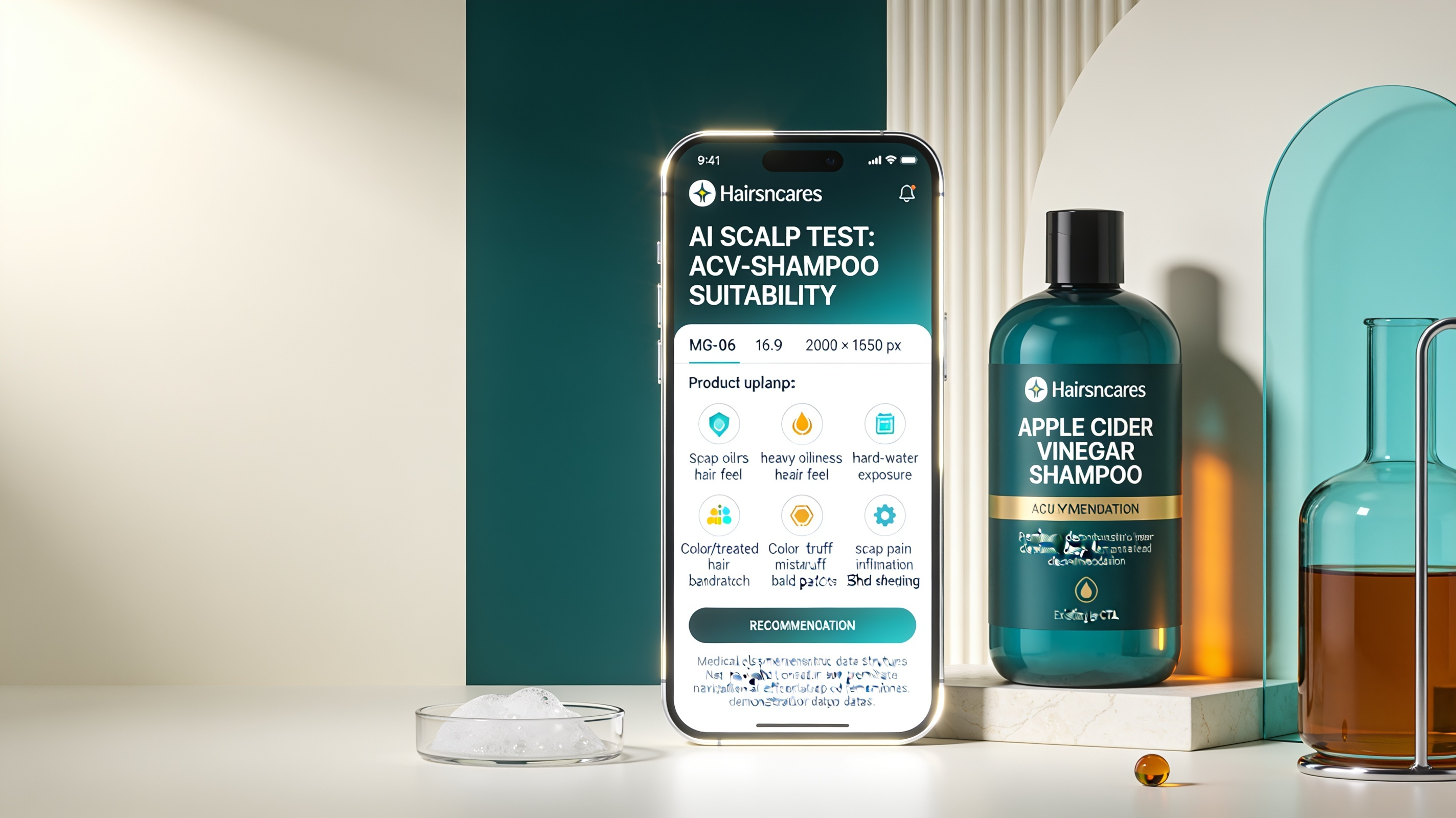
AI Scalp Test assesses product buildup level, oiliness, hard-water exposure, sensitivity and dandruff risk to recommend ACV, salicylic acid, chelating shampoo, mild shampoo or dermatologist care.
Many patients ask whether Apple Cider Vinegar Shampoo alone can solve their hair concerns. The honest answer: shampoo is a wash-off product that stays on the scalp for a short time. It can support scalp cleanliness, comfort and pH balancing — but it cannot treat root-level hair loss, hormonal imbalance, nutritional deficiency or conditions that need prescription treatment. A good shampoo works best as part of a complete routine, not as a standalone cure.

Primary match. Heavy product users whose scalp feels coated, grimy or heavy between washes — ACV shampoo's clarifying action is most relevant here.
Best MatchOily scalp that needs stronger occasional cleansing — ACV may provide more clarifying action than mild shampoo when used occasionally.
Good MatchHair that looks dull and feels coated rather than shiny and clean — ACV clarifying may remove residue contributing to dullness.
SuitableACV's acidic clarifying nature can worsen dryness. For dry or sensitive scalp, aloe vera, ceramide or niacinamide shampoo is more appropriate than ACV.
Wrong MatchClarifying and acidic shampoos may strip colour with frequent use. If colour-treated, use ACV shampoo infrequently or use a colour-safe clarifying formula. Check with your colour professional.
Infrequent OnlyACV shampoo has no antifungal properties and cannot treat dandruff. Acidic products on an inflamed scalp can worsen irritation. Anti-dandruff actives needed.
Anti-Dandruff FirstAbsolute contraindication. Acidic products on broken, inflamed or open-wound scalp skin can cause chemical damage. Do not use ACV shampoo on any compromised scalp skin.
Absolute ContraindicationMedical evaluation required. ACV shampoo cannot address root-level hair loss.
See Doctor UrgentlyNo acidic products on a post-transplant scalp without explicit surgeon clearance.
Surgeon Clearance10-step guide — Step 1 (Patch Test), Step 7 (Rinse Thoroughly & Avoid Eyes) and Step 9 (Never Raw Undiluted ACV) are the critical additions beyond the standard template. The eye-contact caution in Step 7 is unique to acidic products in the series.
If you have sensitive skin, eczema, acid sensitivity, scalp wounds or previous product reactions, patch-test before scalp use. Apply a small amount to inner forearm or behind the ear. Wait 24–48 hours. ACV shampoos are acidic and can irritate in sensitive users.
Is the concern product buildup, oiliness, hard-water feel, dandruff, dryness, sensitivity, itch or hair fall? ACV shampoo is for product buildup and oily scalp freshness. Dandruff, scalp pain or open wounds need medical evaluation — not ACV shampoo.
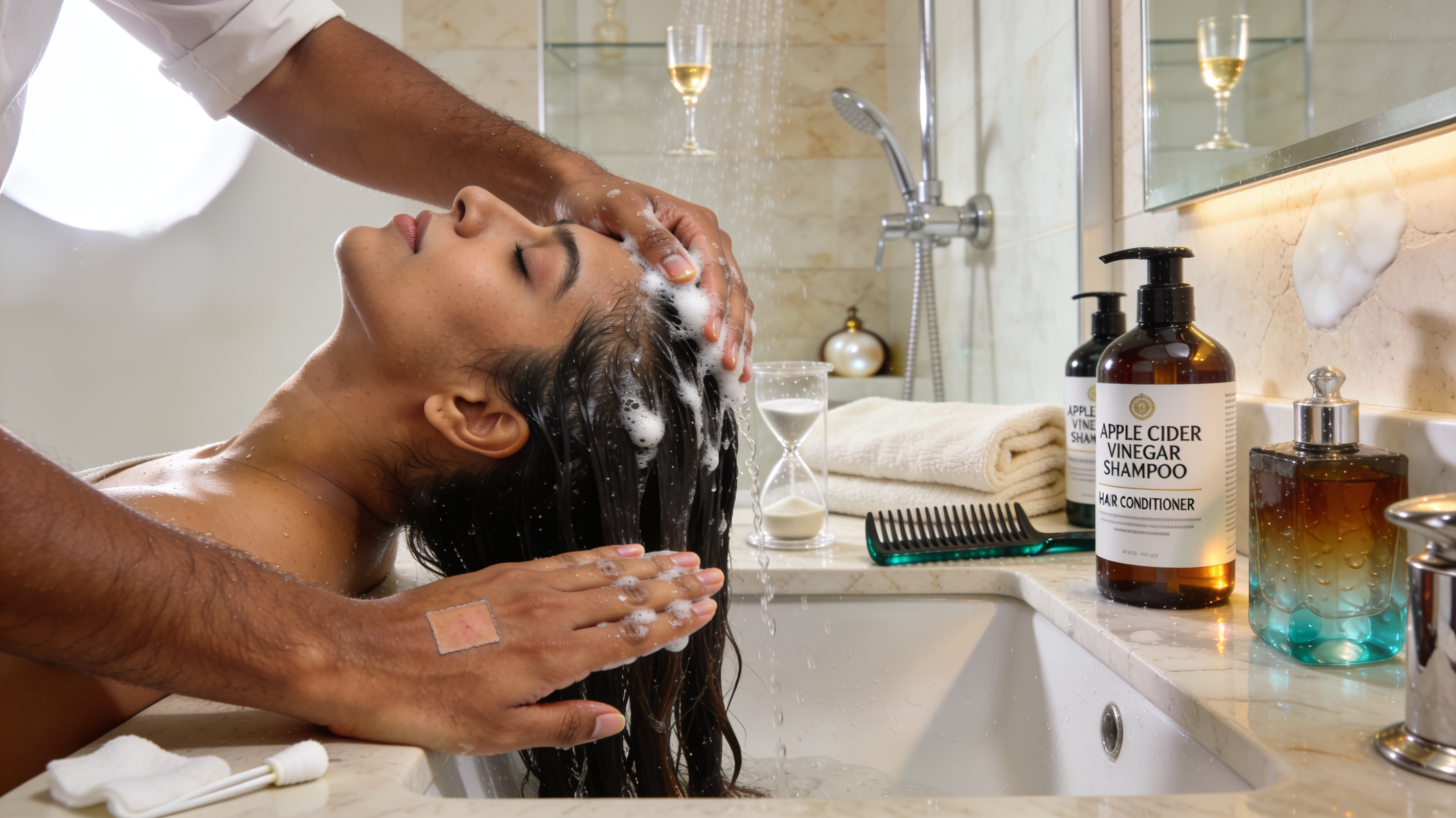
Use lukewarm water. Fully wet scalp and hair before applying shampoo.
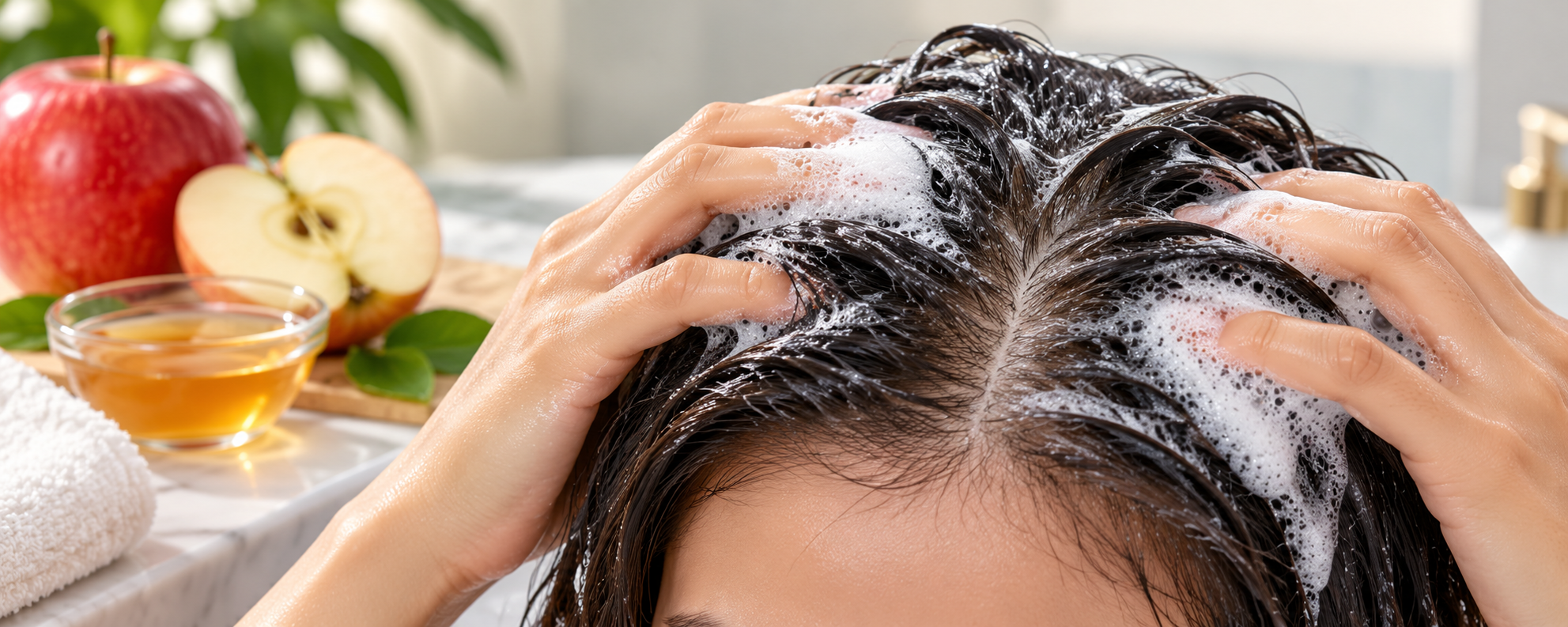
Focus on scalp and roots. Allow foam to run gently through lengths. Do not scrub inflamed, irritated or open-skin areas.
Use fingertips, never nails. Avoid aggressive scrubbing — particularly on any area with redness or broken skin.
If the product recommends a contact time, follow the label only. Do not extend contact — acidic formulas increase irritation and dryness risk with extended contact time.
This step is unique to acidic products in the series. ACV products can sting eyes significantly more than neutral shampoos. Keep away from eyes during application. Tilt head back, rinse thoroughly, and if eye contact occurs — rinse immediately with clean water for several minutes. Seek medical attention if stinging persists.
Apply conditioner to mid-lengths and ends after every ACV wash. Clarifying shampoos remove product buildup but also natural oils. Hair lengths need conditioner to restore manageability after a clarifying wash — especially for dry, frizzy, colour-treated or curly hair.
Absolute rule — the most important safety point for this entire page. Never apply undiluted apple cider vinegar directly to the scalp. Published case reports document chemical burns (PMID 29224370). Raw ACV at pH 2–3 is far more acidic than any formulated shampoo. Avoid all DIY strong vinegar mixtures on scalp — especially on any broken, inflamed, sensitive or post-procedure skin.
Monitor scalp comfort and hair feel over 4–6 weeks. Stop and consult a doctor if burning, stinging that persists, rash, excessive dryness, worsening flaking, scalp pimples, hair fall worsening or bald patches appear.
Published case studies report chemical burns from applying raw or concentrated vinegar to skin. This is not theoretical — it has happened to real patients. Never use raw ACV on scalp. Never leave ACV products on longer than label states. Never apply to broken or inflamed scalp skin. Reference: PMID 29224370.
Most dermatologists recommend clarifying shampoos — including ACV shampoos — for occasional use only (every 1–2 weeks, not daily). Daily use can strip natural scalp oils, worsen frizz, and dry scalp and hair — particularly in non-oily scalp types.
Clarifying shampoos can accelerate colour fade in colour-treated, bleached or highlighted hair. If your hair is colour-treated, use ACV shampoo infrequently (once a month or less) or switch to a colour-safe clarifying formula. Consult your hair colour professional before starting.
The most common shampoo mistake is rushing the process. Apply to the scalp (not just hair lengths), massage gently with fingertips (never nails), follow the recommended contact time if it is a medicated shampoo, and rinse thoroughly. Incomplete rinsing is a leading cause of scalp irritation and product buildup that patients often blame on the shampoo itself.
Key principle: ACV shampoo is for occasional use, not daily. Follow your product label or dermatologist's advice. Frequency depends on product buildup level, oiliness and hair type. Overuse causes dryness, frizz, colour fade and scalp irritation.
Product buildup, oily scalp freshness. Clarifying. Occasional use only.
Scalp buildup and thick scale. Keratolytic. More targeted than ACV.
Oily scalp freshness, mild itch. Botanical. Irritation caution.
Dandruff/seborrheic dermatitis. Antifungal. Not for buildup.
Dandruff maintenance. Anti-dandruff. Not clarifying.
Dry, curly, colour-treated. Low-stripping cleansing.
Frequent washing, sensitive scalp. No clarifying action.
The most important distinction for this page: Buildup and dandruff often feel similar (heavy scalp, flakes, oiliness) but need completely different treatments. ACV shampoo addresses buildup and oiliness. Dandruff needs antifungal or anti-dandruff actives. Using ACV shampoo instead of ketoconazole for moderate dandruff delays effective treatment. AI Scalp Test helps differentiate buildup from dandruff.
| Option | Best For | Main Role | Evidence Position | Key Caution |
|---|---|---|---|---|
| Apple Cider Vinegar Shampoo | Product buildup, oily scalp freshness, dull hair, heavy hair feel | Acidic clarifying wash; buildup removal support | Very limited clinical evidence; primarily consumer/traditional use; case reports of chemical burns from misuse | Acid burn risk (raw/undiluted); never use raw ACV on scalp; colour-treated caution; dry scalp mismatch |
| Salicylic Acid Shampoo | Scalp buildup and thick adherent flakes | Keratolytic — chemically dissolves scalp scale | Established keratolytic evidence; more targeted for thick scale than ACV | Can dry sensitive scalp; not for eczema-prone scalp; avoid on broken skin |
| Tea Tree Shampoo | Oily scalp freshness and mild flake-prone support | Botanical essential oil cleansing | Limited RCT evidence for mild dandruff; less burn risk than raw ACV | Essential oil allergy/irritation possible; patch test essential |
| Ketoconazole Shampoo | Dandruff and seborrheic dermatitis — first-line treatment | Antifungal — targets Malassezia yeast | Strong RCT evidence; medically recommended first-line for dandruff | Not a clarifying shampoo; not for product buildup |
| Zinc Pyrithione Shampoo | Mild-to-moderate dandruff maintenance | Anti-dandruff active; antimicrobial | Consistent evidence for dandruff maintenance | Not a clarifying shampoo; not for product buildup |
| Chelating Shampoo | Hard-water mineral buildup — calcium/magnesium deposits | EDTA-based mineral chelation | More mechanistically targeted for mineral deposits than ACV | Not widely available; may not suit all hair types |
| Mild Daily Shampoo | Gentle cleansing for frequent wash or sensitive scalp | Non-clarifying, low-stripping cleanse | No clarifying or anti-dandruff action; suitable for maintenance | Insufficient for product buildup removal |
| Dermatologist | Persistent scalp symptoms, dandruff, hair fall, inflamed scalp | Diagnosis and treatment planning | Gold standard when scalp symptoms persist or worsen | Essential when scalp burns, pain, pus, bald patches or hair fall occur |
Series note (page 16 of 16): ACV has the weakest evidence position in the entire 16-page series. Every other ingredient — from ketoconazole (strong antifungal RCT evidence) to niacinamide (established B3 barrier evidence) to panthenol (humectant hair shaft data) to ceramide (structural lipid science) — has a more validated evidence base than ACV. The series's honest positioning of ACV: clarifying support only, with significant safety cautions, limited evidence, and no proven scalp disease efficacy.
All products are formulated ACV shampoos — not raw vinegar. Occasional use only. Not standalone treatments for dandruff, scalp disease or medical hair fall. Prices on individual product pages.
Our AI Scalp Test assesses product buildup level, oiliness, hard-water exposure, sensitivity, dandruff pattern and scalp health to determine whether ACV shampoo, salicylic acid, tea tree, chelating shampoo, anti-dandruff actives or dermatologist evaluation is the right first step.
AI screening only. Does not diagnose, prescribe or replace dermatologist evaluation.
Stop immediately. ACV shampoos are acidic — burning on application or after rinsing signals scalp irritation. Do not resume without dermatologist advice.
Stop and seek medical attention. Possible allergic or irritant contact reaction to ACV shampoo ingredients.
If scalp or hair becomes excessively dry, tight or frizzy after ACV shampoo, the formula is stripping too aggressively for your scalp type. Reduce frequency or stop.
Folliculitis or contact reaction. Stop and consult a dermatologist — never apply ACV to any area with open skin or pustules.
Medical red flag. ACV shampoo cannot address root-level hair loss.
Rinse immediately with clean water for several minutes. Seek medical attention if stinging persists — ACV products are more irritating to eyes than neutral shampoos.
These signs are specific to acidic products and clarifying shampoos. Stop product use and consult a dermatologist if they appear.
Immediate burning on any area — stop rinsing immediately with water. Do not reapply. Signals irritation or broken skin exposure to acid.
If scalp feels tighter or drier after ACV shampoo use, the formula is too clarifying for your scalp type. ACV suits oily scalp, not dry.
Classic distribution of contact dermatitis from shampoo. Stop immediately and see a dermatologist.
If colour-treated hair becomes visibly lighter, duller or brassy after ACV clarifying, reduce frequency dramatically or switch to colour-safe alternatives.
Over-clarifying or excess acidity stripping natural oils. Reduce ACV frequency and add deep conditioning treatment.
If flaking increases after ACV wash, this may signal dandruff rather than buildup — anti-dandruff actives are needed, not more ACV.
⚠️ Critical reminder: Never apply raw undiluted apple cider vinegar directly to scalp. Published dermatology literature (PMID 29224370) documents chemical burns from vinegar misuse. Use only formulated ACV shampoo products. Never apply to broken, inflamed or open-skin scalp areas. Source: PubMed PMID 29224370 →
Dandruff needs ketoconazole, zinc pyrithione — not ACV clarifying.
Possible psoriasis — medical diagnosis and prescription treatment.
Medical red flag — stop all clarifying products immediately.
Urgent dermatologist evaluation.
Medical hair loss — needs diagnosis, not clarifying shampoo.
No acidic products without surgeon clearance on transplanted scalp.
Hormonal hair fall needs medical evaluation, not ACV shampoo rotation.
Absolute contraindication for acidic products. Stop all ACV shampoo immediately.
If you notice increased itching, redness, burning, pimples on the scalp, or worsening flakes after using ACV shampoo — stop immediately. These are not signs of “scalp detox” or “purging.” They may indicate irritation, allergy, contact dermatitis or worsening of an existing scalp condition. Consult a dermatologist before resuming.
Apple cider vinegar shampoo regrows hair.
ACV shampoo may support scalp freshness and clarifying routines, but it is not a hair-regrowth treatment. No clinical evidence supports ACV shampoo as a hair loss therapy.
ACV shampoo cures dandruff.
Dandruff needs anti-dandruff actives — ketoconazole, zinc pyrithione, selenium sulphide. ACV has no proven antifungal activity comparable to these actives. Using ACV instead of proper dandruff treatment delays effective care.
Raw ACV works better than shampoo.
Raw undiluted ACV has caused chemical burns in published dermatology case reports (PMID 29224370). Formulated products are dramatically safer. Never apply raw vinegar to scalp.
Clarifying means detox.
The scalp does not need "detox" — this is a marketing concept. Clarifying means removing product residue, oil and buildup. It is a physical cleansing role, not a biological detoxification process.
ACV suits every scalp type.
Dry scalp, sensitive scalp, eczema-prone, psoriasis-prone and inflamed scalps may worsen with acidic/clarifying products. ACV is most appropriate for oily, buildup-prone scalp in people without sensitivity or scalp disease.
Hard-water hair always needs ACV.
Hard-water mineral deposits (calcium, magnesium) may specifically respond better to chelating shampoo (EDTA-based) than to ACV. ACV and chelating shampoos address buildup through different mechanisms.
Doctor-Reviewed Resources
Still unsure whether ACV shampoo is right for your scalp?
Ask a Hair Doctor →Use real authority URLs only. All external links open in a new tab.
Key clinical reference for this page. Documents published evidence on apple cider vinegar's claimed home remedy uses, including dermatology context. This reference underpins the critical safety warning against applying undiluted or misused vinegar preparations to skin and scalp — chemical burns have been reported.
AAD clinical guidance establishing ketoconazole, zinc pyrithione and selenium sulphide as evidence-based first-line treatments — the framework establishing why ACV shampoo is not a primary dandruff treatment and what to use instead.
AAD evidence on hair loss evaluation — confirming ACV shampoo is not a hair loss treatment and when medical evaluation is needed for hair fall associated with scalp concerns.
Search PubMed for peer-reviewed literature on apple cider vinegar in dermatology, acetic acid safety, contact dermatitis from acidic products, scalp pH and clarifying shampoo research. Note: clinical evidence specifically supporting ACV shampoo for scalp use is very limited.
Apple cider vinegar shampoo (ACV shampoo, apple cider vinegar hair rinse, clarifying shampoo, product buildup shampoo) is a supportive wash-off shampoo used in scalp buildup, product residue, oily scalp freshness, hard-water feel, dull hair and clarifying routines. It does not diagnose, treat, cure or prevent dandruff, seborrheic dermatitis, eczema, psoriasis, scalp infection, folliculitis, medical hair loss, baldness, alopecia, PCOS-related hair fall, thyroid-related hair fall, postpartum shedding, nutritional deficiency hair fall or medication-related shedding. It cannot permanently "detox" or "rebalance" scalp pH. It should not replace ketoconazole, zinc pyrithione, selenium sulphide, salicylic acid, topical prescriptions, minoxidil, finasteride, PRP, GFC, nutritional correction, hair transplant care or dermatologist evaluation when indicated. Do not apply undiluted apple cider vinegar directly to scalp — published case reports document chemical burns from vinegar misuse (PMID 29224370). Use only formulated ACV shampoo products. Use as per product label or doctor guidance. Stop if burning, irritation, allergy symptoms, severe dryness, colour stripping, rash or scalp worsening occurs. This guide has been reviewed by Dr. Amit Agarkar, MD Dermatology, Hairsncares.
AI Scalp Test differentiates product buildup from dandruff or scalp disease, assesses oiliness, sensitivity and acid risk to recommend whether ACV shampoo, salicylic acid, anti-dandruff actives or dermatologist evaluation is the most appropriate next step.
Your cart is empty