💧
Oily Scalp Freshness
Tea tree shampoo's most practical everyday benefit — it may support a fresher, cleaner scalp feel in oily or sweaty scalps, reducing the heavy, greasy sensation between washes.
A dermatologist-guided guide to using tea tree shampoo (tea tree oil shampoo) safely — including when it supports oily scalp freshness, itchy scalp comfort, mild dandruff-prone flakes, essential oil safety, patch testing, product selection and when scalp symptoms need medical evaluation.
What tea tree shampoo can and cannot do for dandruff and oily scalp
The 5% tea tree study — one trial does not make a cure
Tea tree shampoo vs ketoconazole vs piroctone olamine compared
Best scalp types for tea tree shampoo — oily, itchy, or mild flaking
Concentration matters — most commercial shampoos have less than 2%
How often to use without irritating sensitive scalps
Allergic contact dermatitis risk with tea tree oil in shampoo
When natural antifungal shampoos are not enough for scalp disease
Tea tree oil (Melaleuca alternifolia leaf oil) is an essential oil extracted from the tea tree plant, native to Australia. In haircare, it is used as "tea tree shampoo," "tea tree oil shampoo," "natural anti-dandruff shampoo" or "botanical scalp shampoo." The primary active compound is terpinen-4-ol — a cyclic monoterpene alcohol. Unlike the ring-based actives (ketoconazole, zinc pyrithione), protein structures (keratin) or lipids (ceramides) elsewhere in this series, tea tree oil is the first botanical essential oil ingredient — the most natural-positioned, but also requiring more caution around irritation and allergy than synthetic actives. See our tea tree oil ingredient guide →
"Natural" does not mean safe for everyone. Tea tree oil is an essential oil that can cause contact irritation or allergic contact dermatitis — symptoms include redness, burning, stinging, scaling, dryness or rash. Risk is higher with: undiluted essential oil applied directly to scalp, oxidised (old or improperly stored) tea tree oil products, high-concentration formulas, individuals with fragrance or essential-oil sensitivity, and eczema/psoriasis-prone scalps. Key rules: always use formulated shampoo products (not raw essential oil), patch test before first use, follow label contact time, and stop immediately if burning or rash occurs. Source: PubMed PMID 12451368 →
Tea tree shampoo is commonly used in oily scalp, itchy scalp, scalp freshness and mild dandruff-prone routines. Tea tree oil is a botanical essential oil used in some scalp-care products for cleansing and anti-dandruff positioning. A small clinical study (Satchell et al., 2002, PubMed PMID 12451368) found that a 5% tea tree oil shampoo may reduce mild-to-moderate dandruff in some users, but this should not be overclaimed. Shampoo is a wash-off product, and tea tree shampoo is not a standalone treatment for dandruff, seborrheic dermatitis, psoriasis, eczema, scalp infection or hair loss. Importantly, tea tree oil can irritate or trigger allergic reactions in some users — patch testing before use is recommended for sensitive individuals, and undiluted essential oil should never be applied directly to the scalp. If scalp symptoms include persistent itching, burning, redness, pus, crusting, bald patches or sudden shedding, dermatologist evaluation is more important than shampoo selection.
Tea tree shampoo contains Melaleuca alternifolia extract with documented antifungal and antibacterial properties. One clinical study showed a 5% formulation reduced dandruff severity. Most commercial shampoos contain less than 2%. It does not cure chronic seborrheic dermatitis, treat hair loss, or replace prescription antifungals. Works best for mild dandruff and oily, itchy scalps. Patch-test before use — tea tree can cause contact allergy.
People with mild dandruff, oily scalp, or scalp itchiness who prefer a naturally-derived antifungal. Works well as a maintenance shampoo between medicated washes.
Ketoconazole or selenium sulphide for moderate-to-severe dandruff, prescription treatments for scalp psoriasis, or clinical hair loss therapy. Tea tree is a cosmetic-grade antifungal.
Dandruff persists beyond 4 weeks of use, you develop scalp redness or contact dermatitis from tea tree, or flaking becomes thick and crusty. Step up to a medicated shampoo under guidance.
Tea tree oil's primary active compound is terpinen-4-ol — a cyclic monoterpene alcohol with demonstrated in-vitro antimicrobial and antifungal properties. This laboratory activity against Malassezia yeast (the organism linked to dandruff) forms the scientific basis for tea tree oil's anti-dandruff positioning. However, in-vitro activity does not always translate to clinical efficacy in wash-off use.
A small randomised controlled trial (Satchell et al., 2002, PMID 12451368) found that a 5% tea tree oil shampoo reduced dandruff severity in mild-to-moderate cases, with improvements in overall dandruff score. This is the most-cited clinical evidence. However, it is a single small trial, unlike the more robust evidence base supporting ketoconazole, zinc pyrithione or selenium sulphide.
Tea tree shampoos are widely used in oily scalp routines because of tea tree oil's cleansing properties and characteristic fresh scent. The cleansing effect may support a fresher scalp feel in oily or sweat-prone scalps — independent of the anti-dandruff mechanism. This freshness benefit is the strongest practical positioning for tea tree shampoo in routine use.
Tea tree oil is a complex mixture of over 100 terpene compounds. It can cause contact irritation or allergic contact dermatitis in some users — including redness, burning, stinging, scaling and dryness. Oxidised tea tree oil (from products stored long or incorrectly) carries higher allergy risk. These safety considerations make tea tree shampoo distinctly different from synthetic scalp actives in the risk profile.
All benefits are scalp-comfort and freshness support within the wash-off botanical context. Persistent or severe scalp conditions need medical evaluation regardless of shampoo choice.
Tea tree shampoo's most practical everyday benefit — it may support a fresher, cleaner scalp feel in oily or sweaty scalps, reducing the heavy, greasy sensation between washes.
May support scalp comfort in mild itch-prone scalps, particularly when itching is linked to oiliness or mild scalp irritation. Persistent or severe itch needs diagnosis — not a shampoo switch.
Based on limited clinical evidence (PMID 12451368), 5% tea tree oil shampoo may help mild-to-moderate dandruff in some users. Not a replacement for established anti-dandruff actives in moderate-to-severe cases.
Tea tree's cleansing properties may support scalp odour control and light product buildup management in oily scalps — a routine hygiene benefit rather than a medical treatment.
For users who prefer botanical or natural-ingredient scalp care over synthetic actives. Important caveat: botanical does not mean risk-free — patch testing and appropriate cautions apply.
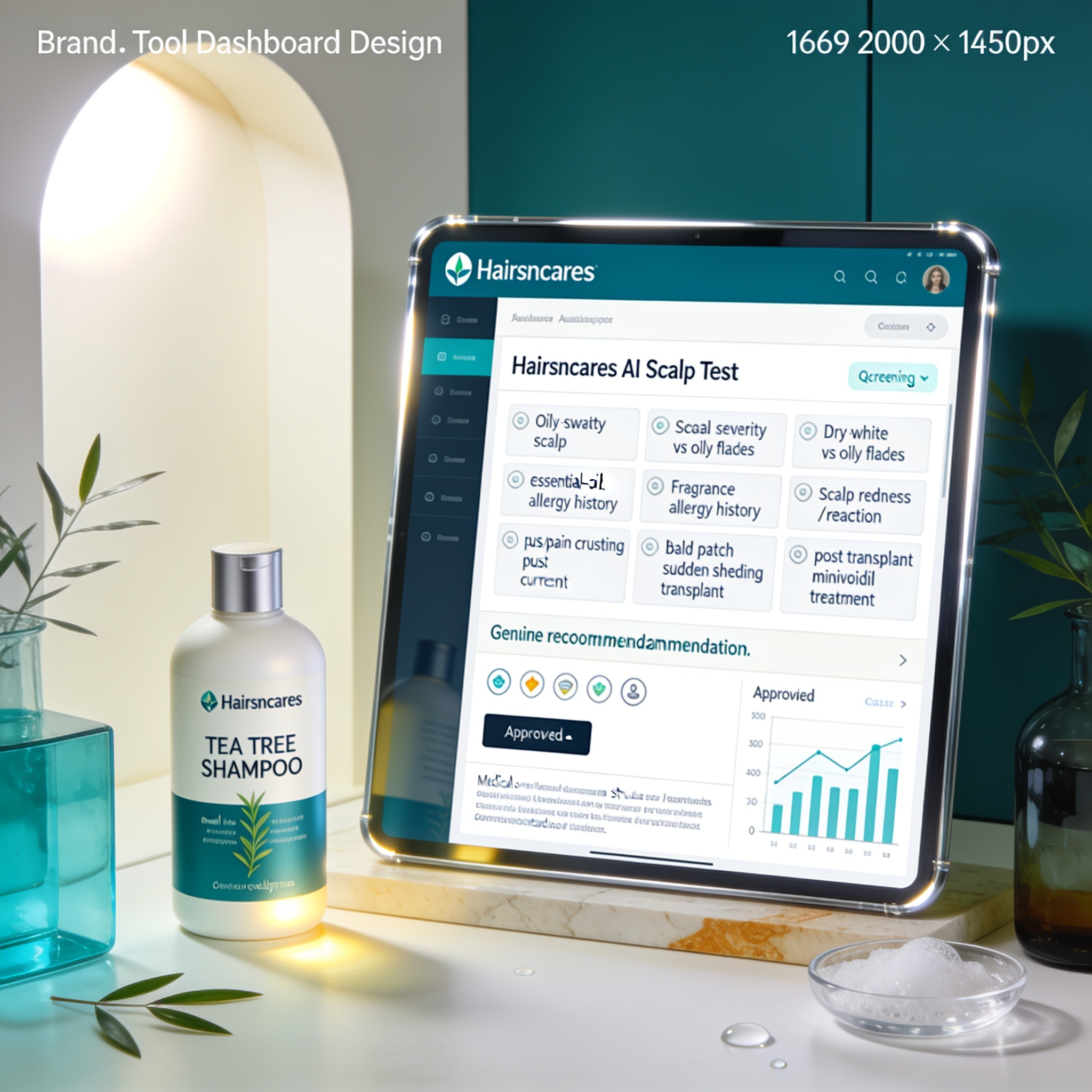
AI Scalp Test assesses oiliness, itch, flake type, dandruff pattern, sensitivity risk and essential-oil allergy history to determine whether tea tree shampoo or medical actives are the right scalp routine.
Many patients ask whether Tea Tree Shampoo alone can solve their hair concerns. The honest answer: shampoo is a wash-off product that stays on the scalp for a short time. It can support scalp cleanliness, comfort and antimicrobial — but it cannot treat root-level hair loss, hormonal imbalance, nutritional deficiency or conditions that need prescription treatment. A good shampoo works best as part of a complete routine, not as a standalone cure.

Primary match. Oily, sweaty or scalp-odour-prone users who want a botanical cleansing shampoo for freshness support.
Best MatchMild itch linked to oiliness or scalp buildup — tea tree shampoo's cleansing effect may improve comfort when symptoms are mild.
Good MatchMild, non-inflammatory dandruff-prone flaking without redness, pain or scalp odour — tea tree shampoo may support routine management if tolerated after patch testing.
SuitableHigher risk of irritation or allergic reaction from tea tree oil. Patch test is essential. Ceramide or niacinamide shampoo may be more appropriate for primary scalp sensitivity management.
Patch Test EssentialTea tree shampoo can be drying on hair lengths with frequent use. Use conditioner on lengths. Reduce frequency or use mild rotation if dryness worsens.
Use With ConditionerKnown sensitivity to essential oils, fragrance or contact dermatitis history: do not use tea tree shampoo without dermatologist guidance and a completed patch test.
Dermatologist FirstNeeds medical anti-dandruff actives (ketoconazole, zinc pyrithione). Tea tree shampoo alone is insufficient for moderate-to-severe cases.
Anti-Dandruff Actives NeededMedical evaluation is required. Tea tree shampoo cannot address any root-level hair loss cause.
See Doctor UrgentlyChildren: consult doctor before use. Post-transplant: no shampoo change without surgeon clearance.
Doctor Clearance RequiredTea tree shampoo is the only page in the series with 10 HowTo steps — the addition is Step 1 (Patch Test) and Step 9 (Never Apply Undiluted Tea Tree Oil), both unique to the essential oil safety context.
Patch testing is specifically recommended for tea tree shampoo — more than for any other shampoo in this series. Apply a small amount to inner forearm or behind the ear. Wait 24–48 hours. If burning, rash or redness appears: do not use on scalp. Tea tree oil allergy is a known contact dermatitis trigger. This caution applies even to users who have previously tolerated other essential oils.
Is the concern oiliness, itch, mild flakes, dandruff, buildup, dryness or hair fall? Tea tree shampoo suits oily, sweaty or mild itch-prone scalp. Severe dandruff, scalp pain or crusting need medical evaluation before any shampoo selection.
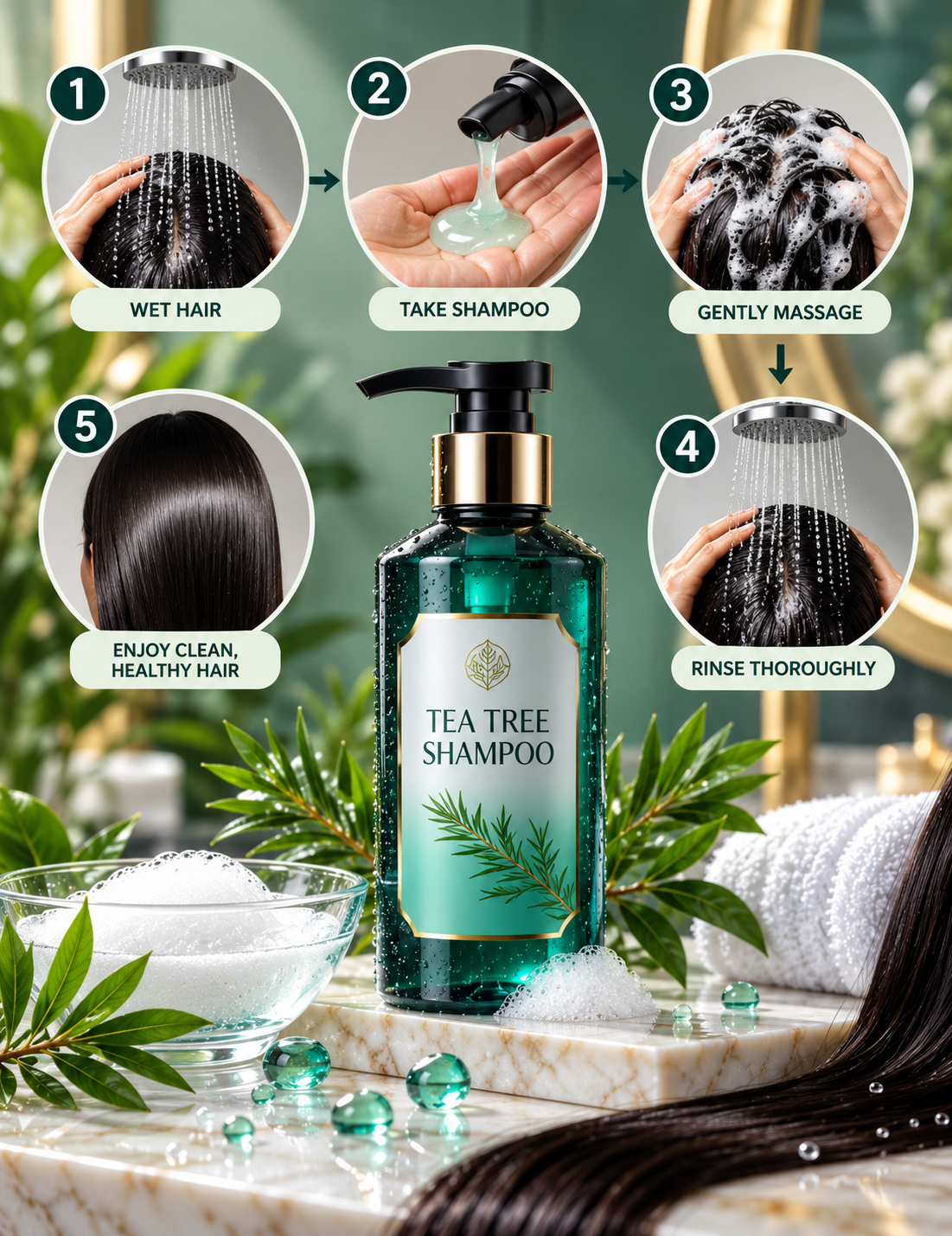
Use lukewarm water. Fully wet both scalp and hair before applying shampoo.
Focus on scalp and roots. Allow foam to run gently through lengths. Do not scrub flaky or irritated areas.
Use fingertips, never nails. Scratching flakes or irritated scalp introduces secondary infection risk and worsens barrier damage.
If the product recommends contact time, follow the label only. Extended contact with tea tree oil formulas increases irritation risk, especially in sensitive users.
Remove all shampoo residue. Essential oil product buildup on scalp increases irritation risk with subsequent applications.
Apply conditioner to mid-lengths and ends. Tea tree shampoo may feel drying on hair lengths with frequent use, particularly for dry, curly or colour-treated hair. Conditioner is not optional for these hair types.
This is the most important unique safety rule for this page. Never apply raw or undiluted tea tree essential oil directly to the scalp. Undiluted essential oils can cause severe burning, contact dermatitis or allergic reaction. The concentration matters — always use products formulated with appropriate dilution (typically ≤5% tea tree oil). Old or oxidised products carry higher allergy risk.
Monitor scalp comfort over 4–6 weeks. Stop and consult a doctor if burning, rash, swelling, worsening dandruff, new bald patches, facial swelling or scalp pain appear. Essential oil allergy can develop even after previously tolerating the product — ongoing monitoring matters.
Tea tree oil allergy (contact dermatitis) presents as rash, redness, itch or burning at scalp, hairline, ears or neck. Risk is higher with oxidised products (check expiry and storage). If any of these develop, stop immediately and consult a dermatologist — do not re-try without medical advice.
For oily scalp management, wash frequency is often the most important variable — more than which shampoo is chosen. Washing too infrequently allows oil buildup; overwashing may trigger rebound sebum production. AI Scalp Test helps identify your correct frequency for your scalp type.
Burning, rash, swelling, scalp pimples, worsening dandruff, hair fall increase, new bald patches or facial/eye swelling. Essential oil reactions can range from mild to serious. Do not continue use once these symptoms appear.
The most common shampoo mistake is rushing the process. Apply to the scalp (not just hair lengths), massage gently with fingertips (never nails), follow the recommended contact time if it is a medicated shampoo, and rinse thoroughly. Incomplete rinsing is a leading cause of scalp irritation and product buildup that patients often blame on the shampoo itself.
Key principle: Follow your product label or dermatologist's advice. Frequency depends on scalp oiliness, sensitivity, dandruff and tolerance. Overuse may worsen dryness or irritation. Never use undiluted essential oil.
Oily scalp freshness, mild itch, mild flake-prone routine. Botanical. Patch test required.
Dandruff/seborrheic dermatitis. Antifungal. Stronger evidence. Not daily for everyone.
Mild-to-moderate dandruff maintenance. Good evidence. Anti-dandruff.
Scalp buildup and thick flakes. Keratolytic. Can dry sensitive scalp.
Oily greasy dandruff. Stronger anti-dandruff. Can be drying. Colour caution.
Frequent washing, sensitive scalp. No medicated active.
Dry, curly, colour-treated hair. Gentle. No anti-dandruff active.
The most important distinction: Tea tree shampoo is a botanical freshness and mild support shampoo — not a first-line medical anti-dandruff treatment. When dandruff is moderate-to-severe, recurrent, inflammatory or associated with itching, redness and oily flakes, proven antifungal actives (ketoconazole) or anti-dandruff actives (zinc pyrithione, selenium sulphide) are more appropriate. Tea tree shampoo may be used in rotation with anti-dandruff actives as a gentler wash-day option.
| Option | Best For | Main Role | Evidence Position | Key Caution |
|---|---|---|---|---|
| Tea Tree Shampoo | Oily scalp freshness, mild itch and mild dandruff-prone support | Botanical scalp cleansing and freshness support | Limited (one small RCT for mild-to-moderate dandruff, PMID 12451368); not as strong as ketoconazole or ZPT | Essential oil irritation/allergy risk; patch test essential; avoid undiluted oil |
| Ketoconazole Shampoo | Dandruff and seborrheic dermatitis — first-line antifungal treatment | Antifungal — targets Malassezia yeast directly | Strong RCT evidence; recommended as first-line by dermatologists for dandruff | Not for daily use unless directed; avoid in pregnancy without guidance |
| Zinc Pyrithione Shampoo | Mild-to-moderate dandruff maintenance and management | Anti-dandruff — antibacterial and antifungal scalp active | Consistent evidence for dandruff maintenance; widely used OTC first-line | Not for severe/inflamed seborrheic dermatitis without medical guidance |
| Salicylic Acid Shampoo | Scalp buildup, thick flakes and scale removal | Keratolytic — dissolves scalp buildup and flake scale | Established keratolytic evidence; often combined with anti-dandruff actives | Can dry sensitive scalp; not for eczema-prone scalp; avoid on broken skin |
| Selenium Sulphide Shampoo | Oily dandruff and greasy flakes | Strong anti-dandruff support — sebostatic + antifungal | Good evidence for oily dandruff; stronger than tea tree | Can be drying, irritating or discolour colour-treated hair; not for daily use |
| Piroctone Olamine Shampoo | Mild-to-moderate dandruff and scalp-comfort maintenance | Anti-dandruff — antifungal scalp-comfort positioning | Good evidence; gentler profile than selenium sulphide | Not for severe seborrheic dermatitis without medical guidance |
| Mild Daily Shampoo | Frequent washing and sensitive scalp | Gentle non-medicated cleansing | No anti-dandruff evidence; suitable for non-active scalp maintenance | Insufficient for dandruff management |
| Dermatologist | Persistent, painful, recurrent or severe scalp symptoms | Diagnosis and prescription treatment | Gold standard for correct diagnosis — distinguishes dandruff, eczema, psoriasis, infection | Essential when OTC shampoos fail or symptoms suggest medical condition |
Series unique note: Tea tree is the only page in the series where "Essential oil irritation/allergy risk; patch test essential" appears as the primary Key Caution column entry. All other shampoo actives in the series (ketoconazole, zinc pyrithione, salicylic acid, niacinamide, ceramide, keratin, panthenol, biotin, caffeine) do not carry a primary essential-oil allergy risk. This caution is botanically unique to tea tree oil.
All products are supportive wash-off shampoos. Patch test before use if sensitive. Not standalone treatments for dandruff, scalp disease or medical hair fall. Prices on individual product pages.
Our AI Scalp Test assesses oiliness, itch severity, flake type, dandruff pattern, essential-oil sensitivity, scalp redness and hair fall patterns to determine whether tea tree shampoo, ketoconazole, zinc pyrithione, ceramide, mild shampoo or dermatologist evaluation is your most appropriate next step.
AI screening only. Does not diagnose, prescribe or replace dermatologist evaluation.
Stop immediately. Contact irritation or allergic contact dermatitis from tea tree oil. Do not resume without dermatologist advice.
Facial, eye or throat swelling or breathing difficulty — seek emergency care. Possible allergic reaction.
If itch or rash worsens specifically after tea tree shampoo use, this signals contact sensitivity. Stop and consult a dermatologist.
May indicate folliculitis, secondary infection or contact reaction. Stop and see a doctor.
Medical red flags. Tea tree shampoo cannot address any root-level hair loss cause. Seek dermatologist evaluation.
Pain, crusting, bleeding or pus on scalp — possible scalp infection, psoriasis or dermatitis. Medical treatment needed.
These signs are unique to essential oil-based products — they signal contact irritation or early allergic sensitisation. Stop product use and consult a dermatologist if they appear.
Mild stinging can be normal in some sensitive users, but persistent or worsening stinging after the first few uses signals irritation. Stop use.
If scalp itch is specifically worse after tea tree shampoo application (not just generally), this signals contact sensitivity rather than improvement.
Tea tree shampoo can worsen scalp dryness in non-oily scalp types. If scaling increases, this product is mismatched to your scalp type.
Classic distribution of allergic contact dermatitis from shampoo products — rash on hairline, behind ears, around neck. Stop immediately and see a doctor.
Stacking multiple essential-oil or fragrance products increases sensitisation risk. Simplify the routine if burning appears with multiple botanical products.
Pre-existing fragrance allergy is a contraindication for tea tree shampoo use without dermatologist patch-test confirmation. Do not self-trial.
Needs ketoconazole, zinc pyrithione or dermatologist — not botanical shampoo alone.
Possible psoriasis — requires dermatologist diagnosis and prescription treatment.
Pain is never a normal response to shampoo or oily scalp — medical evaluation needed.
Alopecia areata, scarring or tinea — urgent dermatologist evaluation.
Medical hair loss — needs diagnosis and cause-based treatment, not scalp freshness shampoo.
No botanical products without surgeon clearance on transplanted scalp.
Hormonal hair fall needs medical evaluation — not tea tree shampoo rotation.
Rinse with water immediately. Seek medical attention if tea tree product contacts eyes.
Never swallow tea tree oil. Tea tree essential oil is toxic if ingested. Keep products away from children. Seek emergency care if swallowed. Source: NCCIH Tea Tree Oil Safety →
If you notice increased itching, redness, burning, pimples on the scalp, or worsening flakes after using tea tree shampoo — stop immediately. These are not signs of “scalp detox” or “purging.” They may indicate irritation, allergy, contact dermatitis or worsening of an existing scalp condition. Consult a dermatologist before resuming.
Tea tree shampoo regrows hair.
Tea tree shampoo may support scalp freshness and mild flake routines, but it is not a hair-regrowth treatment. No clinical evidence supports tea tree shampoo as a hair loss therapy.
Tea tree shampoo cures dandruff permanently.
Dandruff can relapse and typically requires ongoing management. Anti-dandruff actives (ketoconazole, zinc pyrithione) have stronger evidence for dandruff management than tea tree shampoo alone.
Natural means irritation-free.
Tea tree oil is natural but can cause contact irritation or allergic contact dermatitis in some users — including burning, redness, scaling and rash. Natural origin does not determine safety.
Applying undiluted tea tree oil works faster.
Undiluted essential oil on the scalp can cause severe burning, contact dermatitis or allergic reaction. Always use formulated products with appropriate dilution — typically ≤5% concentration.
Itchy scalp always needs tea tree.
Scalp itch can come from dandruff, eczema, psoriasis, allergy, infection, lice, folliculitis or over-cleansing — each needing a different treatment. Tea tree suits mild itch from oiliness, not all itch types.
All anti-dandruff shampoos work the same way.
Tea tree (botanical freshness), ketoconazole (antifungal), zinc pyrithione (anti-dandruff), selenium sulphide (sebostatic) and salicylic acid (keratolytic) all have different mechanisms, evidence strength and safety profiles.
Still unsure whether tea tree shampoo is right for your scalp?
Ask a Hair Doctor →Use real authority URLs only. All external links open in a new tab.
Satchell et al. (2002) — the key clinical reference for this page. Found that 5% tea tree oil shampoo reduced dandruff severity in mild-to-moderate cases in a small RCT. The most-cited clinical evidence for tea tree shampoo efficacy.
AAD clinical guidance establishing ketoconazole, zinc pyrithione and selenium sulphide as first-line anti-dandruff treatments — the evidence basis for positioning tea tree shampoo as supportive rather than primary treatment for dandruff.
NCCIH safety guidance on tea tree oil — including warnings about topical irritation, allergy risk, not swallowing, and cautions for undiluted application. The authoritative safety source used in this page's essential oil safety sections.
AAD evidence on hair loss evaluation — confirming that tea tree shampoo is not a hair loss treatment and establishing when medical evaluation is needed for hair fall associated with scalp conditions or progressive thinning.
Tea tree shampoo (tea tree oil shampoo, natural anti-dandruff shampoo, botanical scalp shampoo) is a supportive wash-off shampoo used in oily scalp, itchy scalp, scalp freshness, buildup-prone scalp and mild dandruff-prone routines. It does not diagnose, treat, cure or prevent dandruff, seborrheic dermatitis, eczema, psoriasis, scalp infection, folliculitis, lice, medical hair loss, baldness, alopecia, PCOS-related hair fall, thyroid-related hair fall, postpartum shedding, nutritional deficiency hair fall or medication-related shedding. It should not replace ketoconazole, zinc pyrithione, selenium sulphide, salicylic acid, topical prescription treatments, minoxidil, finasteride, PRP, GFC, nutritional correction, hair transplant care or dermatologist evaluation when indicated. Do not swallow tea tree oil or apply undiluted tea tree essential oil directly to the scalp. Patch test before first use, especially if sensitive to essential oils or fragrances. Use as per product label or doctor guidance. Stop if irritation, allergy symptoms, burning or scalp worsening occurs. This guide has been reviewed by Dr. Amit Agarkar, MD Dermatology, Hairsncares.
AI Scalp Test distinguishes oily scalp from dandruff, assesses sensitivity, essential-oil allergy risk and flake type to determine whether tea tree shampoo, ketoconazole, zinc pyrithione, ceramide or dermatologist evaluation is your most appropriate first step.
Your cart is empty