Founded
1981
Established as a joint venture between L'Oréal and Nestlé, built specifically around dermatology rather than as a division of a broader pharmaceutical business.
Source: Galderma corporate communicationsDermatology Brand Intelligence
HairsnCares reads brands the way a clinician does — by category, formulation and approved indication rather than by name. This guide sets out what Galderma is as a company, which parts of its portfolio relate to scalp skin, what the safety boundaries are, and the current status of verified listings on this platform.
Brand guide and product-discovery page. It does not diagnose scalp or skin conditions, and it does not claim that any product treats a medical condition.
Quick Brand Answer
Galderma is a dermatology-focused company founded in 1981 as a joint venture between L'Oréal and Nestlé, now an independent Swiss-headquartered business listed on the SIX Swiss Exchange and operating in approximately 90 countries. Its portfolio spans three distinct areas — dermatological skincare, therapeutic dermatology and injectable aesthetics — which means product selection should follow the specific indication and formulation rather than the brand name. Portfolio composition and regulatory approval differ by country, so availability in India must be confirmed locally.
Medically reviewed by Dr. Amit S. Agarkar — MBBS, MD Dermatology, FCPS, DDV · Reviewed 27 July 2026 · Next review July 2027
Verified Company Facts
Everything in this strip is drawn from Galderma's own corporate communications or its India entity. Figures that could not be verified against a current official source — revenue, headcount, market rankings — have been left out rather than estimated.
Founded
Established as a joint venture between L'Oréal and Nestlé, built specifically around dermatology rather than as a division of a broader pharmaceutical business.
Source: Galderma corporate communicationsStructure
Now an independent company headquartered in Switzerland and listed on the SIX Swiss Exchange under the ticker GALD.
Source: Galderma corporate communicationsReach
Stated corporate presence. Presence in a market is not the same as every product being registered there, which is why availability is checked per country.
Source: Galderma corporate communications, 2025Portfolio
Dermatological skincare, therapeutic dermatology and injectable aesthetics — described by the company itself as distinct areas, and treated as distinct throughout this guide.
Source: Galderma corporate communicationsIndia presence
Galderma operates an India business and maintains an India-facing corporate website, which is the appropriate reference for what is offered in this market.
Source: Galderma India corporate websiteFocus
The company's consumer work centres on cleansing, moisturisation and barrier support for sensitive skin — the same biology that governs the scalp.
Source: Galderma corporate communicationsThe Brand Science
Most brand pages flatten a company into whichever category the reader arrived looking for. That is precisely the error to avoid here, because the three parts of this portfolio carry entirely different rules about who may buy them, who administers them and what they are approved to do.
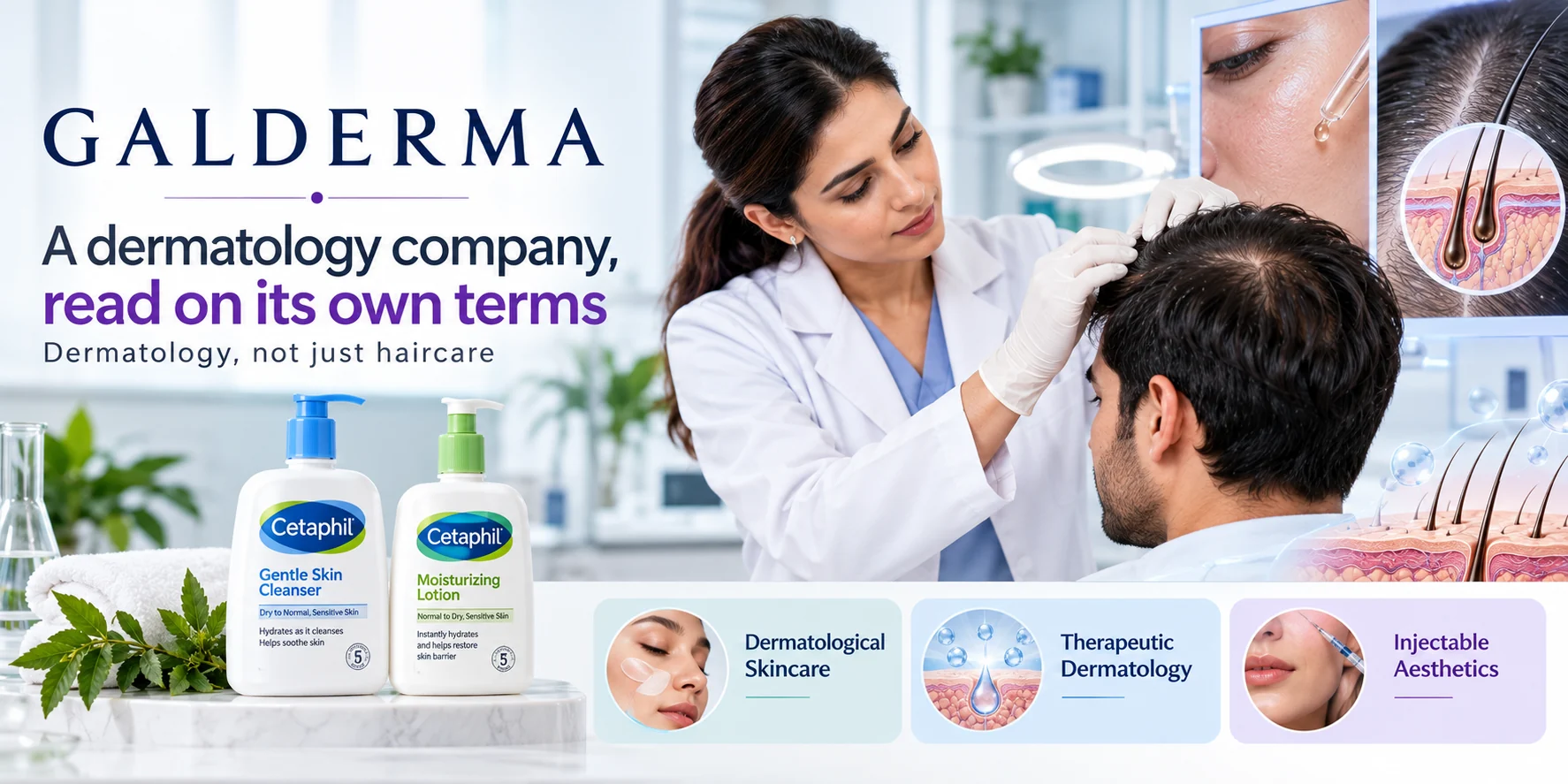
Galderma was built around dermatology from the outset rather than arriving at it through diversification. That heritage shows in how the portfolio is organised: consumer skincare aimed at barrier support and sensitive skin sits alongside prescription therapeutic products and a professional aesthetics business, each governed by different regulation.
For a HairsnCares visitor the practical consequence is straightforward. Arriving on a brand page and adding whatever appears is a reasonable instinct for a shampoo and a poor one here, because a meaningful share of this portfolio is not a self-purchase category at all — and another share is prescription-only in most markets.
The scalp connection is real but indirect. Scalp skin follows the same barrier biology as facial and body skin, so formulation principles genuinely transfer. What does not transfer automatically is the product itself: a facial cleanser is designed for skin that is not densely covered in hair, and texture, rinse-off behaviour and residue all change on a scalp.
Why I ask patients which category a product belongs toThe single most common confusion I see with dermatology brands is a patient assuming that because one product from a company was recommended to them, others from the same company are equally appropriate. Category, formulation and indication decide that — never the name on the box. A prescription retinoid and a gentle cleanser can share a manufacturer and share almost nothing else.
On sources. Corporate facts on this page come from Galderma's own communications and its India entity, linked in full at the foot of this guide. Where a claim could not be verified against a current official source, it has been omitted. [ADD OFFICIAL SOURCE CITATION — Galderma India corporate profile, retrieved date]
Audience
Four people arrive at a dermatology brand page with very different questions. The page is written so each of them can find their answer without wading through the other three.
Someone mentioned a product from this company and you want to understand what category it belongs to before deciding anything.
You have flaking, itching, oiliness or sensitivity and you are trying to work out whether a product or a consultation is the right next step.
You are weighing several dermatology names against each other and want a framework that does not simply declare a winner.
You have read about a product elsewhere and need to know whether it is sold here, under this name, in this strength.
Portfolio Universe
The company describes its work across three areas. Understanding which one a product belongs to answers most of the questions a shopper actually has — whether it needs a prescription, whether it can be bought at all, and whether it has anything to do with a scalp.
Consumer products centred on barrier support: cleansing, moisturisation and formulations intended for sensitive or reactive skin.
Doctor-guided treatment areas where the product is selected for a diagnosed condition and carries an approved indication.
A professional-use category administered by trained practitioners in clinical settings. Included here for completeness, not for discovery.
Scalp-Skin Intelligence
The scalp is specialised skin: same barrier, same lipid layers, same immune activity — with a far higher density of follicles and sebaceous glands, and a covering of hair that changes how anything applied to it behaves.
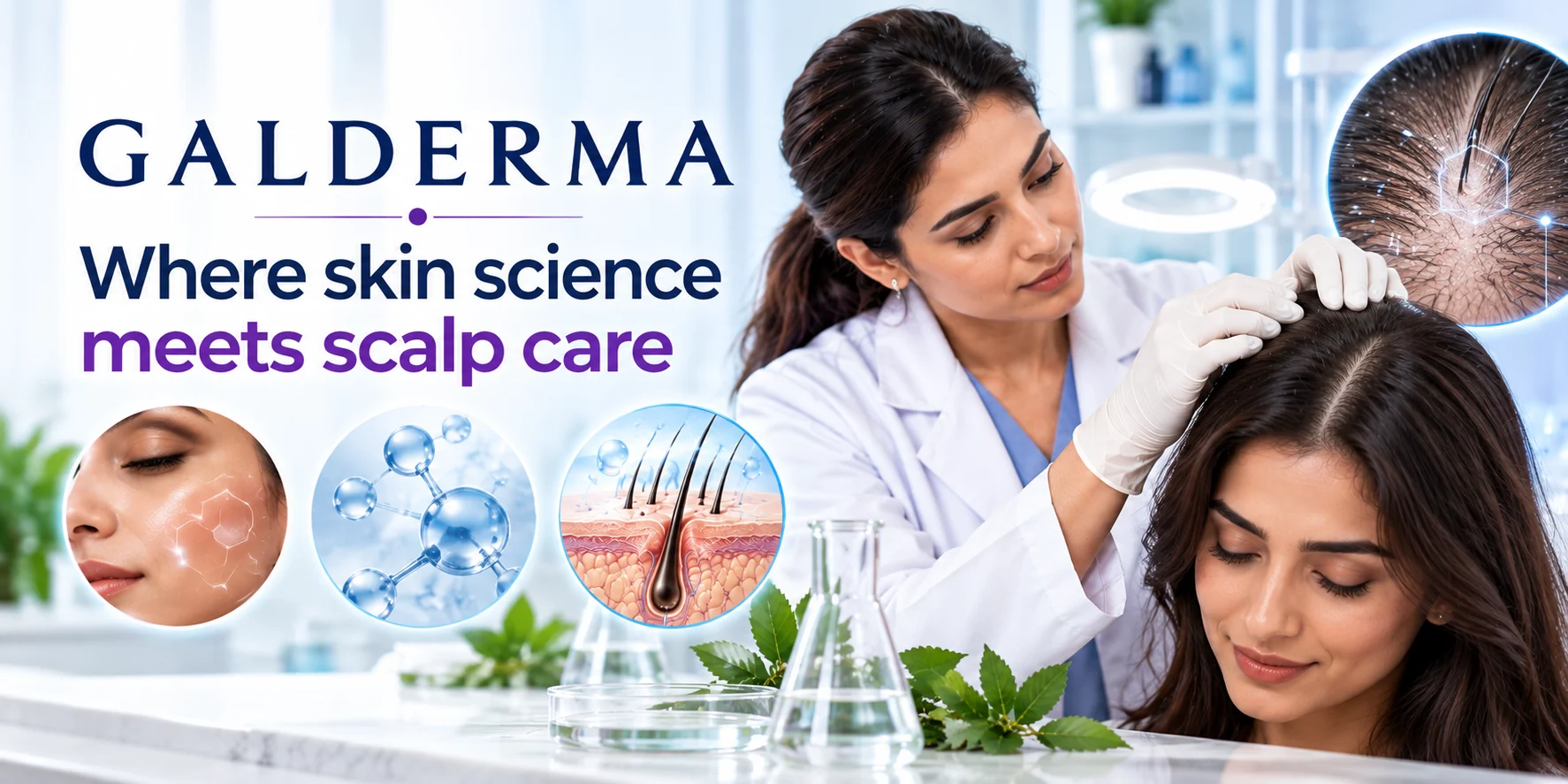
That shared biology is why dermatological skincare principles genuinely inform scalp care. Barrier disruption produces the same vocabulary of symptoms wherever it happens — tightness, stinging, sensitivity, fine flaking — and the same categories of ingredient are used to address it.
Scalp symptoms cannot be self-diagnosed from appearance alone. Dandruff, seborrhoeic dermatitis, psoriasis, contact dermatitis, tinea and folliculitis overlap considerably in how they look and feel, and they are managed differently. Matching a product to a guess is how routines get worse rather than better.
Verified Product Discovery
This catalogue is populated only from verified HairsnCares listing data. Nothing on this page is generated, inferred or copied from third-party marketplaces, which is why you may see a status here rather than a grid.
0 verified products match your filters
HairsnCares lists products only after checking their identity, category, formulation context and India-facing availability.
Until that check is complete for this brand, no product cards, prices, pack sizes, ingredients or ratings are shown here. We would rather show you an honest status than an unverified list assembled from elsewhere.
Editorial Standard
The catalogue above shows a status rather than a grid because these five checks have not yet been completed for this brand. They are the reason our brand pages are shorter than the marketplaces — and the reason you can act on what is on them.
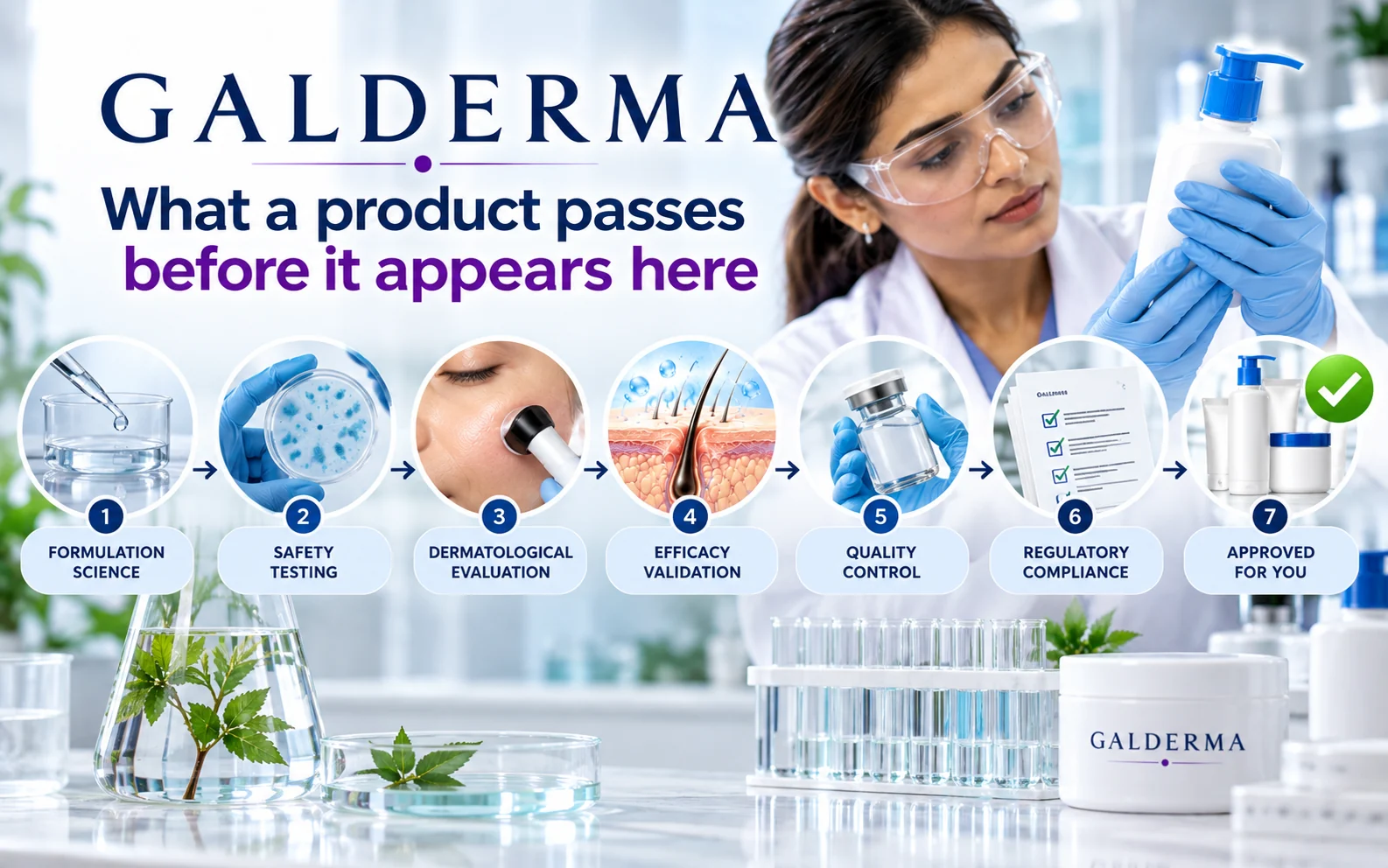
The product exists under that exact name and pack presentation, confirmed from the manufacturer or an authorised source rather than a reseller.
Cosmetic, medicated or prescription-only is established first, because it governs how the product may be described and to whom.
What it contains and what it is formulated to do is recorded as stated — never expanded into benefits the product does not itself claim.
Offered in this market, under this name, in this strength. A product sold elsewhere does not qualify on that basis alone.
A dermatologist reviews the claim language before publication, checking that nothing implies a treatment effect the evidence does not support.
Why the empty state stays until this is doneIt would take an afternoon to fill this page with product names pulled from marketplaces, and the result would look more useful than what you are reading. It would also be unverified, occasionally wrong about strengths, and in places describing products not sold in India. A visitor cannot tell the difference by looking — which is exactly why the standard has to sit with us rather than with them.
Scalp Pathway Finder · Interactive
Seven questions, answered on this page with nothing sent anywhere. The result is a direction of travel — which kind of care is sensible to consider first, and whether the honest answer is to see someone rather than to buy something.
Every question is optional, and the more you answer the more specific the pathway. Answers stay in your browser.
Suggested pathway
This tool provides educational product-discovery guidance and does not diagnose scalp disease. It cannot see your scalp, does not know your medical history, and is not a substitute for examination. If you are already under the care of a clinician, follow their advice over anything suggested here.
Ingredient Intelligence
These are general dermatology ingredient categories, not a list of what any particular product contains. None is linked to a specific Galderma product here, because that mapping requires verified label data we do not yet hold for this brand.

Orientation Table
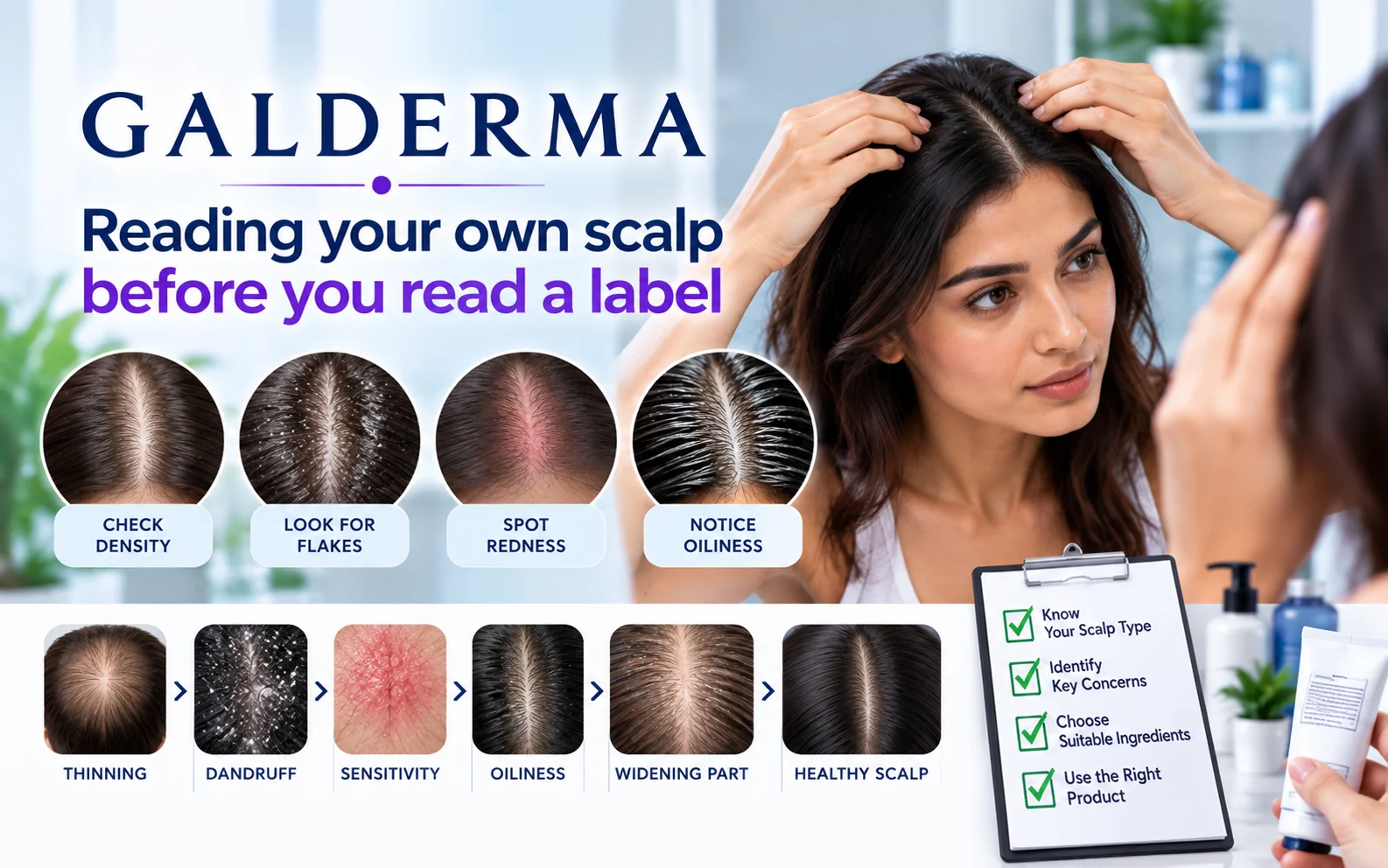
A way of organising what you are seeing — not a diagnostic tool, and not a prescription. The rightmost column is the one that matters most.
| Presentation | Typical clues | Category usually considered | When to stop and seek review |
|---|---|---|---|
| Dry scalp | Tightness, fine powdery flakes, worse in dry air | Gentle cleansing, barrier support | If flaking persists despite gentler washing, or itch becomes constant |
| Oily scalp | Rapid greasiness, root clumping, odour | Suitable regular cleansing | If oiliness comes with spots, pain or crusting |
| Sensitive scalp | Stinging or burning after products, easy reactivity | Simplified, fragrance-conscious routine | If reactions continue after simplifying, or spread beyond the scalp |
| Recurrent flaking | Greasier or adherent scale, returns after clearing | Medicated options, per directions | If it recurs despite treatment, or has never been formally assessed |
| Product buildup | Residue, dullness, heaviness after styling products | Occasional clarifying wash | If clarifying causes irritation, or buildup is actually scale |
| Inflamed scalp | Redness, tenderness, warmth, swelling | Clinical assessment first | Immediately — this is not a product-selection problem |
| Shedding with scalp symptoms | Increased hair loss alongside itch, pain or scale | Clinical assessment first | Immediately — the combination needs a cause, not a shampoo |
This table is not a diagnostic instrument. The presentations overlap, several conditions can be present at once, and appearance alone does not distinguish them. It is offered as a way to organise a conversation with a clinician, not to replace one.
Comparison Framework
No brand is universally better than another, and this page will not claim otherwise. What varies usefully between companies is portfolio shape, category focus and what is actually registered in your market.
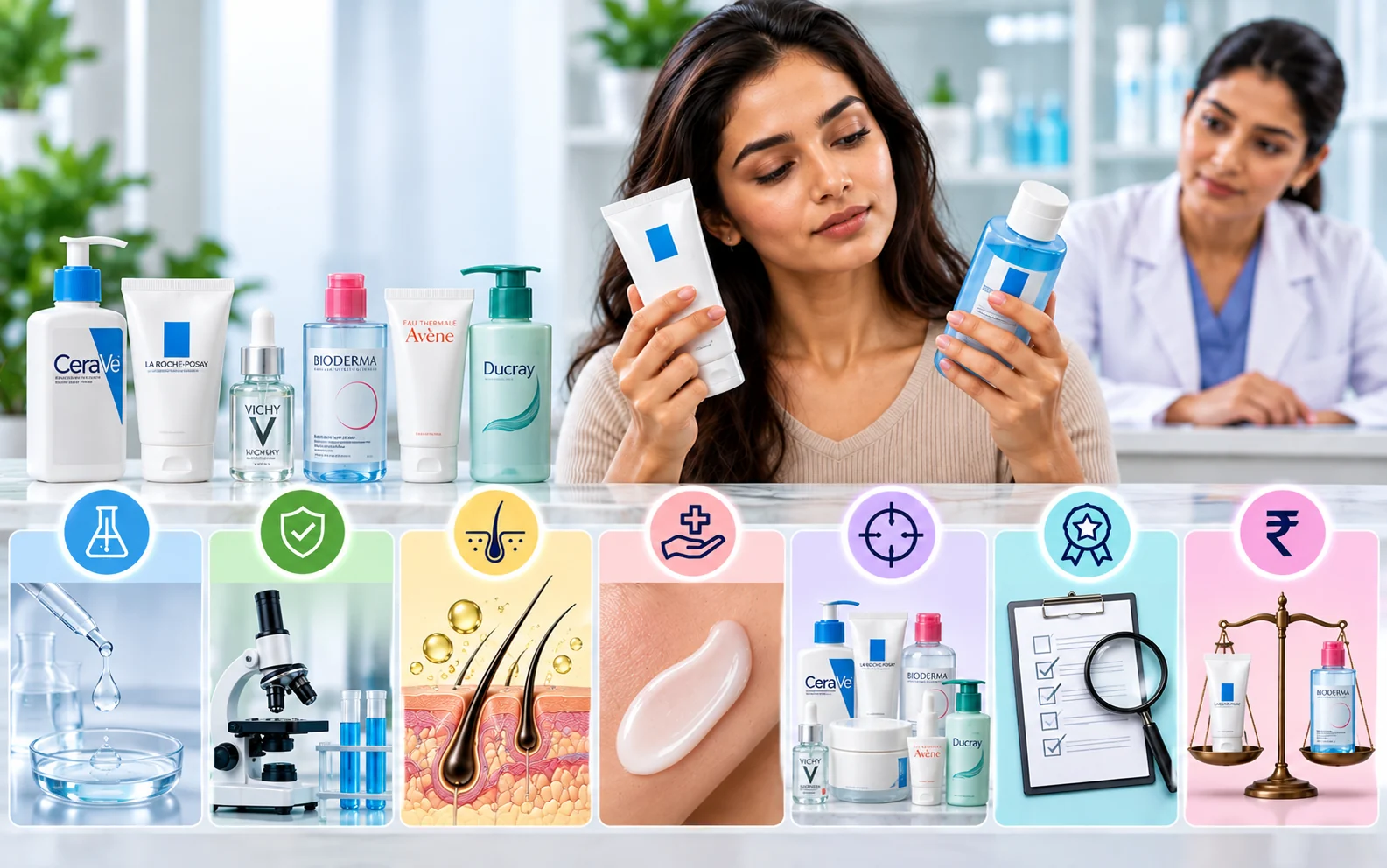
Two products from different companies may be near-identical in the ways that matter, and two products from the same company may be nothing alike. The ingredient list, concentration and intended use tell you more than the manufacturer.
Cosmetic, medicated and prescription products answer different questions. A brand with a broad therapeutic range is not therefore better for a cosmetic need — it is simply differently shaped.
A product praised in reviews from another country may not be registered here, may be formulated differently, or may carry a different name. Availability is a legitimate and often decisive comparison point.
Useful phrasing when weighing options: this may be more suitable when the concern is barrier-related; it depends on the individual product rather than the range; compare the formulation rather than the brand name alone. Each keeps the decision anchored to your situation.
Safety And Medical Responsibility
Dermatology products are effective because they are active. The considerations below apply across the category, whoever manufactures them.

These are reasons to be examined rather than to continue adjusting a routine.
"A brand page should make you better at choosing, not more loyal. What I asked for here was that we state only what we could source, show no product we have not verified, and be explicit about which parts of a dermatology portfolio are not a consumer purchase at all. If that means the catalogue shows a status instead of a grid today, that is the correct outcome."
Learning Hub
The reasoning on this page draws on the HairsnCares Hair Biology faculty. These are the directly relevant guides.
Hair Biology · 04
Barrier, sebum and microbiome — why the scalp is skin, and what actually disrupts it.
Read scalp biology →
Hair Biology · 02
Bulb, matrix and dermal papilla — which treatments can reach the follicle, and which cannot.
Understand the follicle →
Hair Biology · 03
Why shedding is often normal, and why any genuine treatment takes months to show.
Follow the growth cycle →
Product Science
Surfactant systems, pH and why "gentle" is a formulation property rather than a label.
Read shampoo science →
Terminology
Twelve terms that recur across dermatology brand pages, defined plainly. Several are routinely used loosely in marketing, and the looseness is usually where the misunderstanding starts.

FAQs
Brand, availability and safety questions, answered without claiming more than can be supported.
No. It is a dermatology-focused company whose portfolio spans dermatological skincare, therapeutic dermatology and injectable aesthetics. Some products in its wider portfolio relate to scalp skin, but the company should not be understood as a hair-growth business.
Its portfolio includes products relevant to scalp skin in some markets, because the scalp is skin and shares the same barrier biology as the rest of the face and body. Which specific products are registered and sold varies by country, so availability should always be checked locally.
No. Portfolio composition, regulatory approval and commercial availability differ from country to country. A product that exists in one market may be unavailable, differently formulated or sold under a different name in another. Galderma operates an India entity and an India-facing website, which is the appropriate place to confirm what is offered here.
This page makes no such claim. Hair loss has many possible causes — genetic, hormonal, autoimmune, inflammatory, nutritional and scarring among them — and treatment depends entirely on which one applies. Any product presented as a hair-loss treatment needs an approved indication for that use and a diagnosis to justify it.
Individual products may be recommended by individual clinicians for individual patients, which is not the same as a blanket endorsement. Recommendation should follow from the diagnosis and the formulation, not from the name on the packaging.
Not automatically. Facial and body skincare is formulated for application to skin that is not densely covered in hair, and texture, rinse-off behaviour and residue all differ on the scalp. Whether a given product is suitable depends on its own instructions and, where symptoms are present, on clinical advice.
Prescription status is set by each country's regulator and differs between markets, so it cannot be answered generically. Therapeutic dermatology products commonly require a prescription; injectable aesthetics are administered by trained professionals in clinical settings and are never a self-purchase category.
Suitability is a property of a specific formulation and a specific person, not of a company. Sensitive skin varies widely in what triggers it, and the useful questions are what a product contains, whether it has been tested for the intended use, and how your own skin has reacted to similar formulations before.
Buy from a licensed pharmacy or an authorised retailer, check that packaging, batch number and expiry are intact and legible, and be wary of prices far below the market. If anything about the packaging, texture or smell differs from what you have used before, stop and check with the pharmacy or the brand's official India contact.
Through licensed pharmacies and authorised sellers operating in your country. HairsnCares lists products only after checking identity, category, formulation context and India-facing availability, which is why this page shows a catalogue status rather than an unverified product list.
Combining actives without guidance is one of the more common causes of avoidable irritation, and it can also make it impossible to tell which product caused a reaction. Where two or more medicated products are involved, the combination is worth confirming with a clinician first.
For sudden or patchy hair loss, scalp pain, pus, crusting, bleeding, a rapidly spreading rash, severe swelling, fever, scarring, significant eyebrow or eyelash loss, or any symptom that persists despite reasonable care. Also whenever a new product or medicine appears to have triggered a reaction.
Approved internal guides for treatment context, routines and adjacent brands, so you can place this brand against the wider picture before buying anything.
Your Next Step
A brand tells you who made something. It does not tell you whether that something suits your scalp, whether it needs a prescription, or whether it is sold in your country. Those are the questions worth starting from.
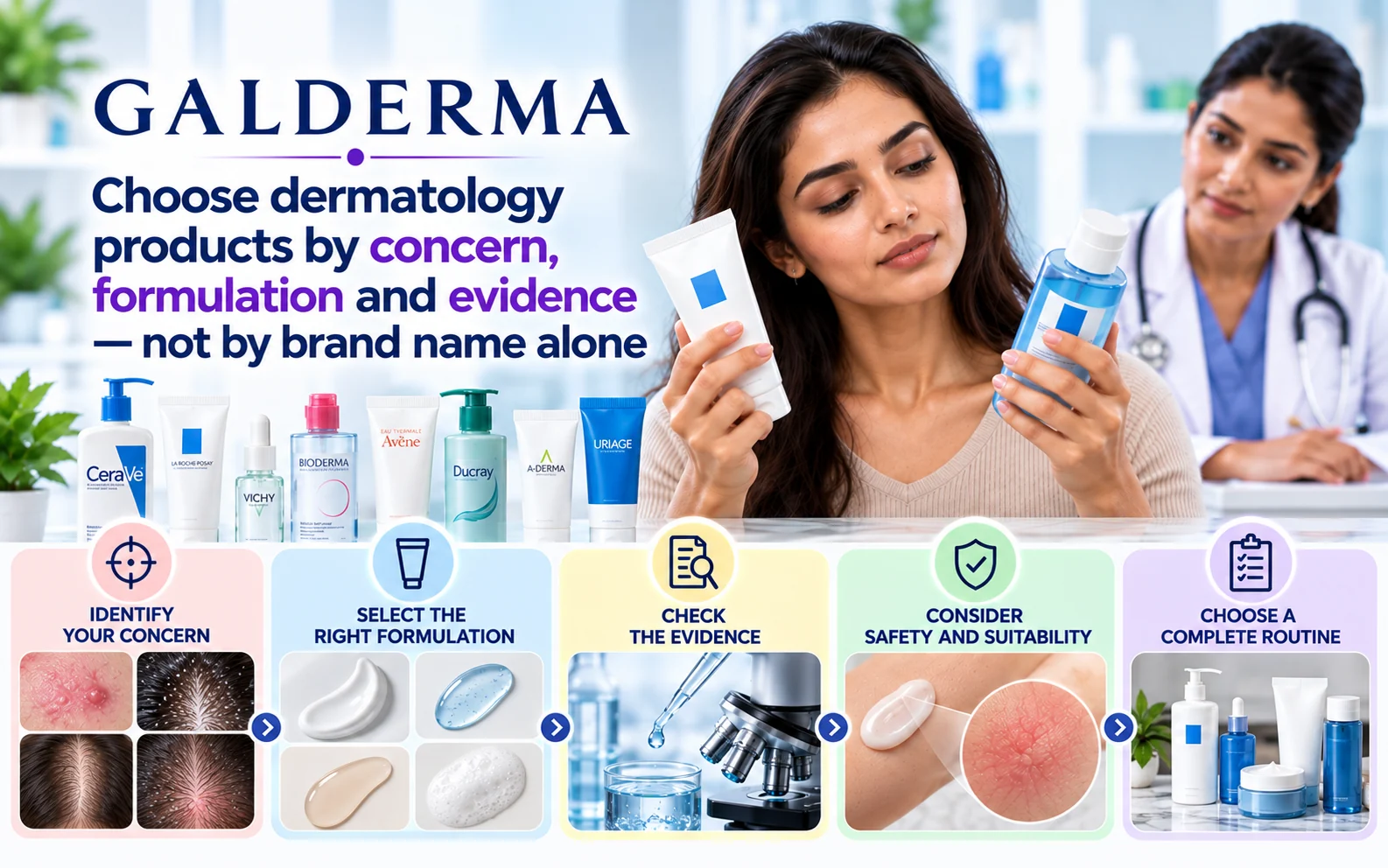
Corporate facts are taken from Galderma's own communications and its India entity. Nothing on this page is sourced from marketplaces, affiliate blogs or scraped product descriptions.
External links open in a new tab and lead to independent organisations whose content HairsnCares does not control. No link implies endorsement, partnership or affiliation. [CONFIRM RETRIEVAL DATES BEFORE PUBLICATION — corporate facts should be re-verified at each review cycle]
Medical Disclaimer: This page provides general educational information about a dermatology company and about scalp-skin care. It does not diagnose any skin or scalp condition, does not recommend any specific product for any individual, and makes no claim that any product treats, cures or prevents a medical condition. Prescription products require a valid prescription and clinical supervision; injectable aesthetic procedures are performed only by trained practitioners in clinical settings. Persistent, painful, spreading, scarring or hair-loss-associated scalp symptoms should be assessed by a qualified medical professional.
Trademark and Independence Disclaimer: HairsnCares is an independent dermatologist-led discovery platform. Galderma and all associated brand names and trademarks belong to their respective owners. HairsnCares is not affiliated with, sponsored by or endorsed by Galderma. Product availability, formulation and approved indications may vary by country and are subject to change.
Your cart is empty