Describe what is happening
Shedding, thinning, breakage and scalp symptoms are different problems with different answers.
Cosmetic Haircare Intelligence
Bontress is a cosmetic haircare range — a leave-on scalp serum built around peptide and botanical actives, plus shampoos. That is a real product category with real uses. It is not a licensed hair-loss medicine, and the marketing figures attached to it disagree with each other more than you would expect.
Quick Clinical Answer
Bontress is a cosmetic haircare range marketed in India by Glenmark Pharmaceuticals, comprising a leave-on scalp serum formulated around cosmetic actives such as Redensyl, Anagain, Capixyl and Procapil, together with shampoo products. Cosmetic formulations of this kind are intended to support scalp condition and the appearance of hair. They are a different regulatory category from licensed hair-loss medicines, they carry no approved medical indication, and they do not diagnose or treat the underlying cause of hair loss. Where shedding is persistent, sudden or patterned, assessment comes first.
Medically reviewed by Dr. Amit S. Agarkar — MBBS, MD Dermatology, FCPS, DDV · Reviewed 27 July 2026 · Next review July 2027
The Category Question
Almost every disappointment with products like this comes from a category error rather than a product failure. Getting the category right first makes everything else on this page straightforward.
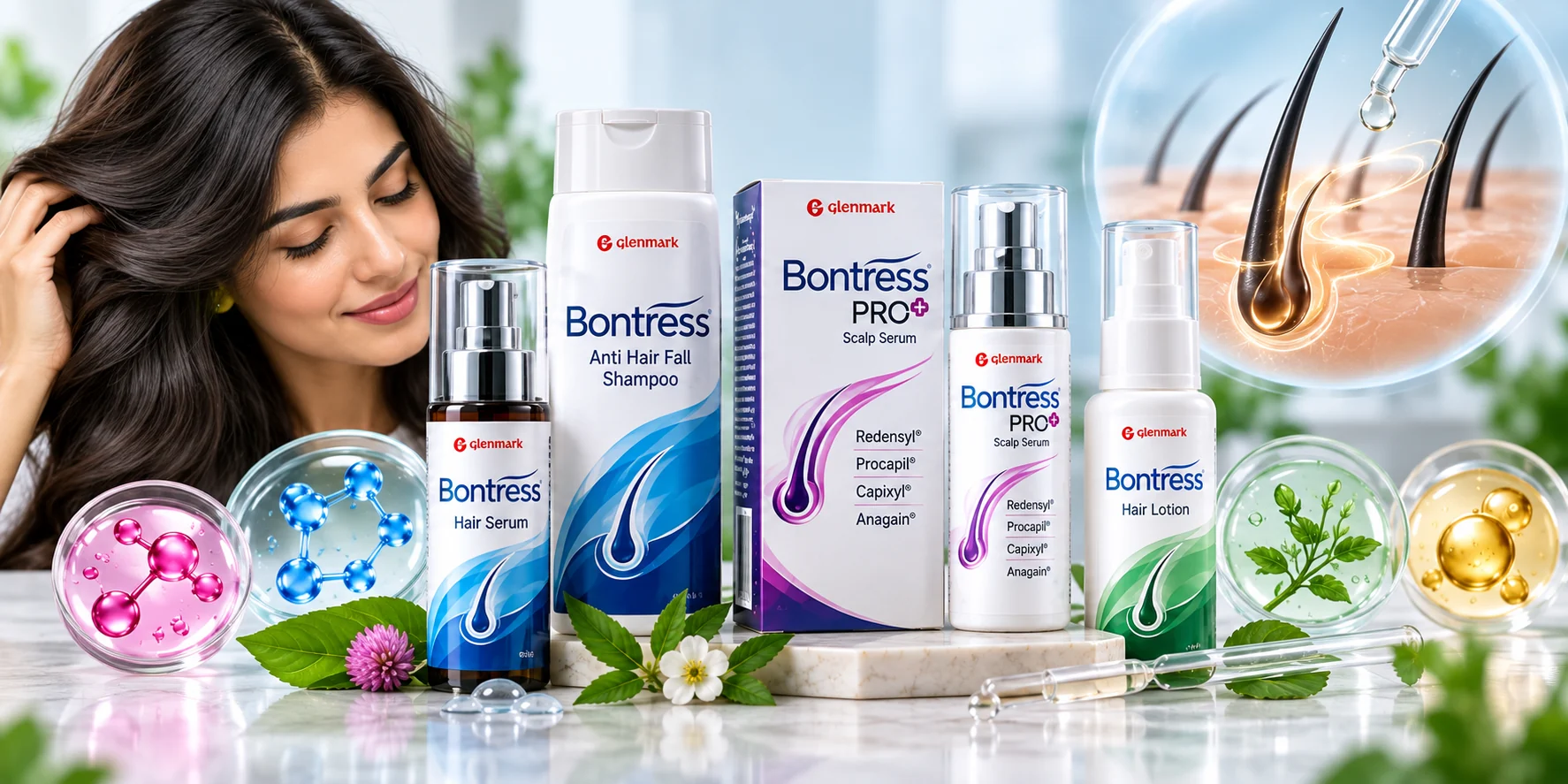
What this is
What it is not
Worth noting in the brand's favour: its own marketing positions the serum as a step before minoxidil rather than as a replacement for it. That is a more honest framing than much of the retail copy written about it downstream, and it aligns with how this page treats the category.
Brand Ownership · Correction
Our own working brief for this page named a different company. Checking it against the manufacturer's sources showed the brief was wrong, so the record is corrected here rather than quietly repeated.
Record corrected
Our brief stated
Ethicare Remedies
Verified owner
Glenmark Pharmaceuticals Ltd
Four independent lines of evidence, all traceable to the company itself:
Why this matters beyond pedantry: brand ownership determines who is accountable for a claim, which corporate communications are authoritative, and where a reader should go to verify a composition. Publishing the wrong company would have sent people to the wrong source.
A pharmaceutical company making a product does not make the product a medicine. Glenmark markets licensed medicines and cosmetics alike, and Bontress sits in the cosmetic part of that portfolio. The manufacturer's reputation is not a substitute for a regulatory category.
Claim Integrity · What We Found
Searching for this product returns confident, specific figures — percentages of users, counts of new strands, penetration multipliers. Reproduced below not to name retailers, but because the same claim changes depending on where you read it.
One listing says
5%
Another says
4%
What this means: Two listings say 5%, another says 4% for the same product.
One listing says
“Tetra-peptide formula”
Another says
“Advanced Tri Peptide formulation”
What this means: The same serum is described as having four peptides and three.
One listing says
“2.4x deep into your scalp”
Another says
“2x deep into your scalp”
What this means: A precise-sounding multiplier that changes between listings.
One listing says
“94% reported hair growth in 28 days”
Another says
“63% reduction in hair fall” over 56 days
What this means: Different endpoints, different durations, both presented as the headline result.
One listing says
“8,500+ new strands”
Another says
“95% / 85% / 75%” on three measures
What this means: Further figures appear on some listings and not others, with no study cited.
One listing says
“Denser, fuller, thicker hair in just 3 months”
Another says
“Reduction in hair fall after four to five washes”
What this means: Two very different promises for shampoos under the same brand.
Notice what kind of figures these are. A concentration and a peptide count are facts about the formula that should not move at all. A penetration multiplier of "2.4x" sounds like a measurement. When such numbers vary between listings for one product, the safest reading is that they are marketing copy rather than data — and none of them appears anywhere else on this page.
Each of these appears in retail copy for this brand. None is repeated here, because none could be traced to a citable published study.
A number is not evidence. A number you can trace to a published study is evidence.
The Sequence
Sixth. Not first. Everything before it establishes whether a cosmetic is the right kind of answer to the question you are actually asking.
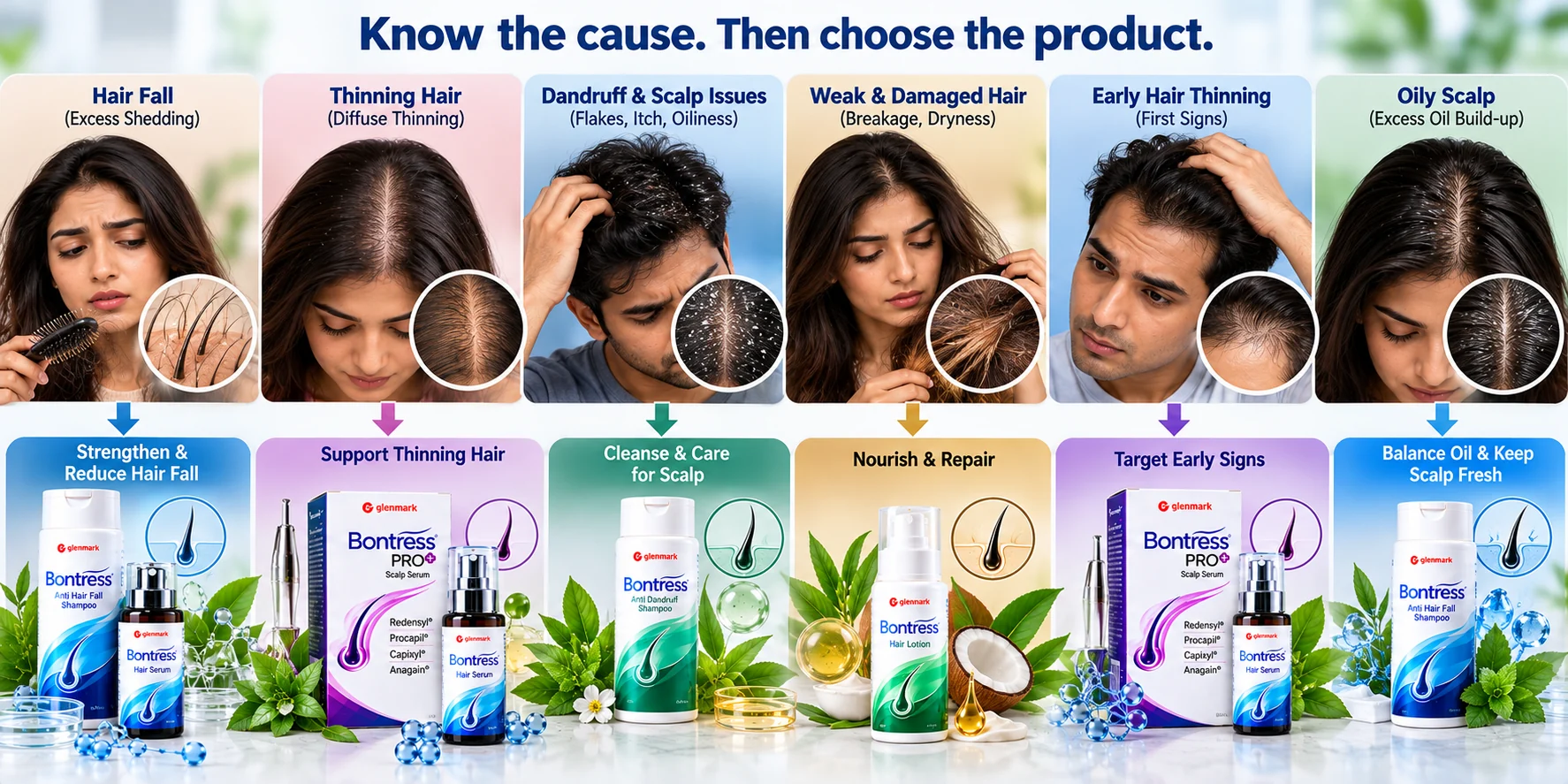
Shedding, thinning, breakage and scalp symptoms are different problems with different answers.
Sudden or patchy presentations need examining before anything is applied.
Inflammation, flaking or pain changes what should go on it.
Pattern hair loss and several other causes are medical questions, not cosmetic ones.
Cosmetic care runs alongside treatment. It does not stand in for it.
For scalp condition, hair appearance and routine comfort. Only at this point.
So any benefit or reaction can actually be attributed to something.
Against a recorded baseline — and revisit the diagnosis if nothing changes.
If the cause has not been established, no serum on the market is the missing piece.
Data Transparency
Product identity, category and the named actives converge across sources and are stated here. Concentrations and performance figures do not converge, so none is stated.
| Product | Category | Named actives |
|---|---|---|
| Bontress Pro+ Scalp Serum | Cosmetic leave-on scalp serum | Redensyl, Anagain, Capixyl and Procapil |
| Bontress Hair Revitalising Shampoo | Cosmetic shampoo | Not verified |
| Bontress Shampoo | Cosmetic shampoo | Not verified |
Company: Glenmark Pharmaceuticals Ltd. Sources: Glenmark corporate reporting and official brand storefront, plus convergence across independent retail listings for identity only. Status: identity, category and named actives — not concentrations, not performance.
Listings disagree on at least one active's percentage. No concentration appears anywhere on this page.
Ingredient lists appear on retail pages but could not be confirmed against a current physical label.
User percentages, strand counts and penetration multipliers — all unverifiable against a citable study.
Studies are referenced in marketing but not cited in a form that can be located and read.
The shampoos in the range have no verified ingredient breakdown at the time of writing.
Catalogue data rather than brand data. It belongs to a verified listing.
For a cosmetic, an unverified concentration matters less than it would for a medicine — nobody is going to be harmed by 4% rather than 5% of a peptide complex. It still matters for a different reason: if the published figure moves between listings, so might everything else printed alongside it. [RE-VERIFY AT EACH REVIEW CYCLE — confirm against the current pack and label before publication]
Verified Product Discovery
A cosmetic listing needs exact identity, category, composition, pack information and current availability — each confirmed, each dated. Where published figures for a product contradict each other, that confirmation has to come from the pack rather than from a shopping page.
0 verified products match your filters
HairsnCares publishes a product only after checking its exact identity, category, composition, pack information and current India-facing availability.
For this brand that check matters more than usual, because the figures printed on retail listings for these products do not agree with each other. Until each is confirmed against a current pack, no card appears here.
Cosmetic Actives
Each of these is a genuine cosmetic ingredient with a genuine rationale for being in a scalp formulation. None of them is a licensed drug, and none establishes an outcome on its own.
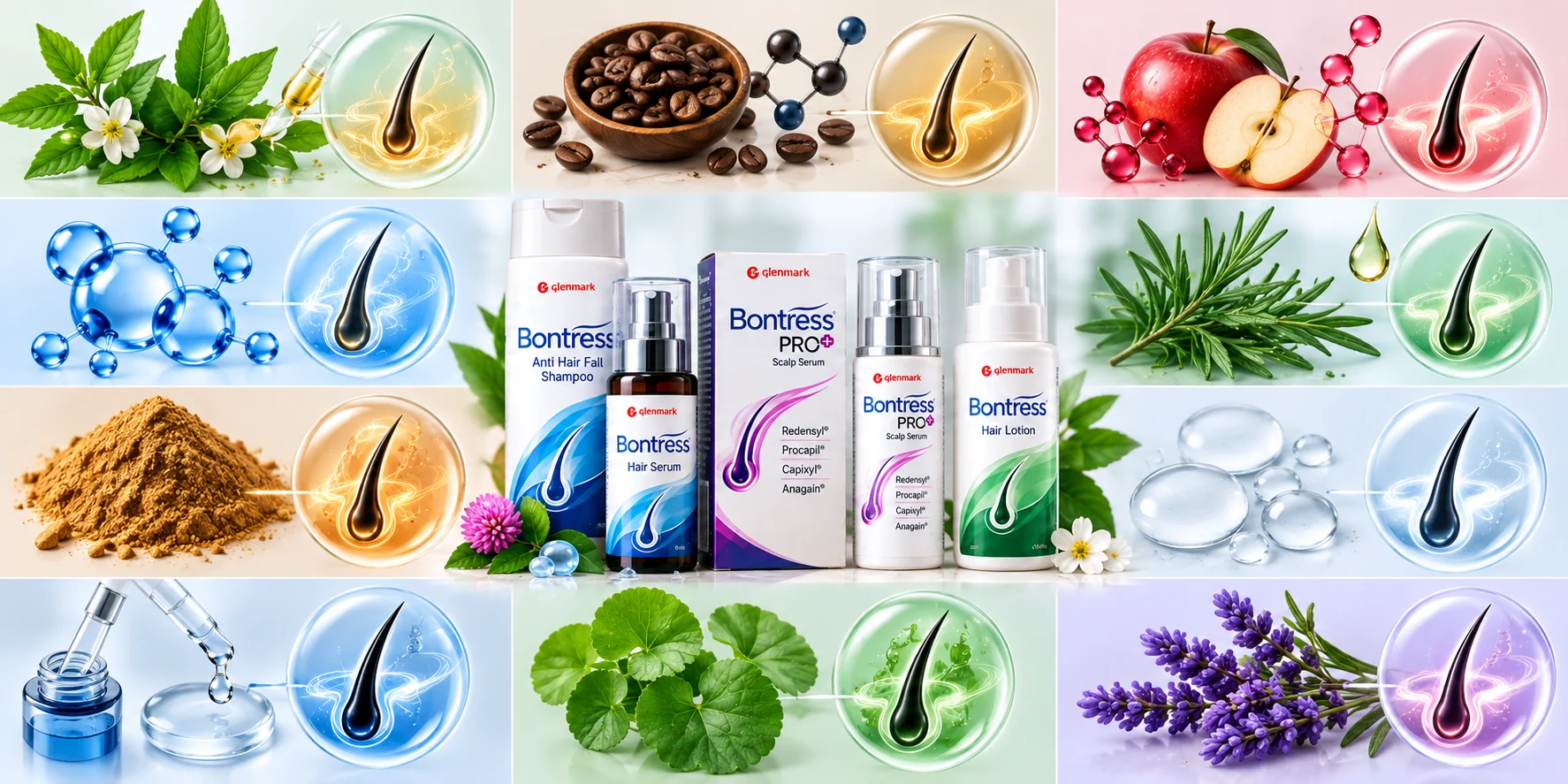
A recurring pattern in this category: research exists on the ingredient, tested in isolation, often in cell systems, at concentrations chosen for the experiment. The finished product is a different thing — different concentration, different vehicle, applied to a real scalp for minutes or hours. Ingredient evidence is a reason to formulate with something. It is not evidence about the bottle.
Evidence Literacy
Less than most people assume, and the phrase is not regulated in the way it sounds. Learning to read it is more useful than learning any individual product's claims.

| What it might mean | What it tells you | How to check |
|---|---|---|
| Consumer perception survey | How users rated their own hair. Subjective and unblinded. | Look for the word "reported" or "noticed" rather than "measured" |
| Ingredient study | Research on one ingredient, often in cells, not the finished product | Check whether the study named the product or only the ingredient |
| Dermatologically tested | Usually a tolerance or irritation test, not an efficacy test | Read it as a safety statement, which is what it is |
| Small finished-product study | The product was tested, though possibly without a control group | Ask how many participants and whether anything was compared against |
| Controlled published trial | The strongest form, and the rarest in this category | You should be able to find and read it. If you cannot, treat it as absent |
"94% of users" — out of how many, over what period, measured how? A percentage without its denominator and method is a shape, not a finding.
"8,500 new strands" sounds like something someone counted. Ask what was counted, on how many people, and against what baseline.
"2.4x deeper penetration" — deeper than what, measured how? When the same claim appears elsewhere as "2x", the precision was never real.
If you cannot locate the study, treat the claim as marketing. That is not cynicism — it is the only workable rule.
The Boundary
The most useful thing a cosmetic brand page can tell you is when to stop shopping. These presentations are not cosmetic problems.

Reasonable for cosmetic support
Stop and get assessed
The cost of getting this wrong is time. Months spent on a cosmetic routine while a scarring alopecia progresses is the scenario worth avoiding, because in those conditions the follicles lost during the delay do not come back. A serum is a reasonable thing to buy. It is not a reasonable thing to wait on.
Expectations
No timeline and no percentage appears here — the published claims for these products disagree on both, and a number on a brand page becomes a deadline people measure themselves against.
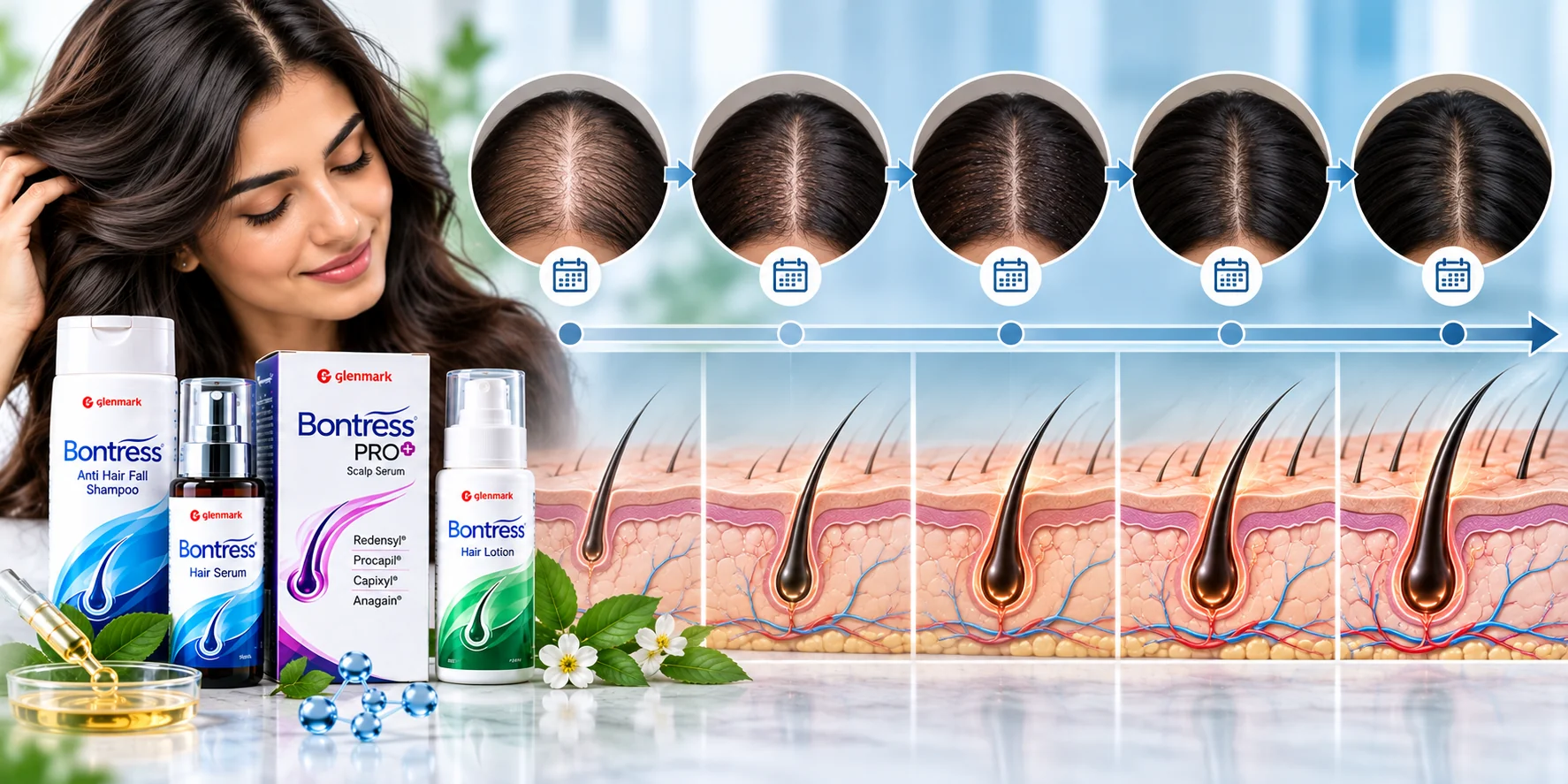
Cosmetic products act on how hair looks and feels. Any change shows up there first, and may not extend beyond it.
Nothing visible happens quickly with any topical. Judging a scalp product after a few weeks is judging it too early.
As with most cosmetics, effects on condition generally fade when use stops. Nothing underlying has been changed.
Photographs in consistent light and at consistent angles, before starting. Memory is a poor comparator over months.
If nothing changes, that points to the diagnosis or the category being wrong — not to needing more product.
Continued loss while using a cosmetic is a reason to be examined, not a reason to add another serum.
Judge a cosmetic on what cosmetics do. Judge a diagnosis on whether anyone has made one.
Application
Product-neutral principles. Quantity and frequency come from the pack you hold — this page gives neither, because published directions for this range differ between listings.
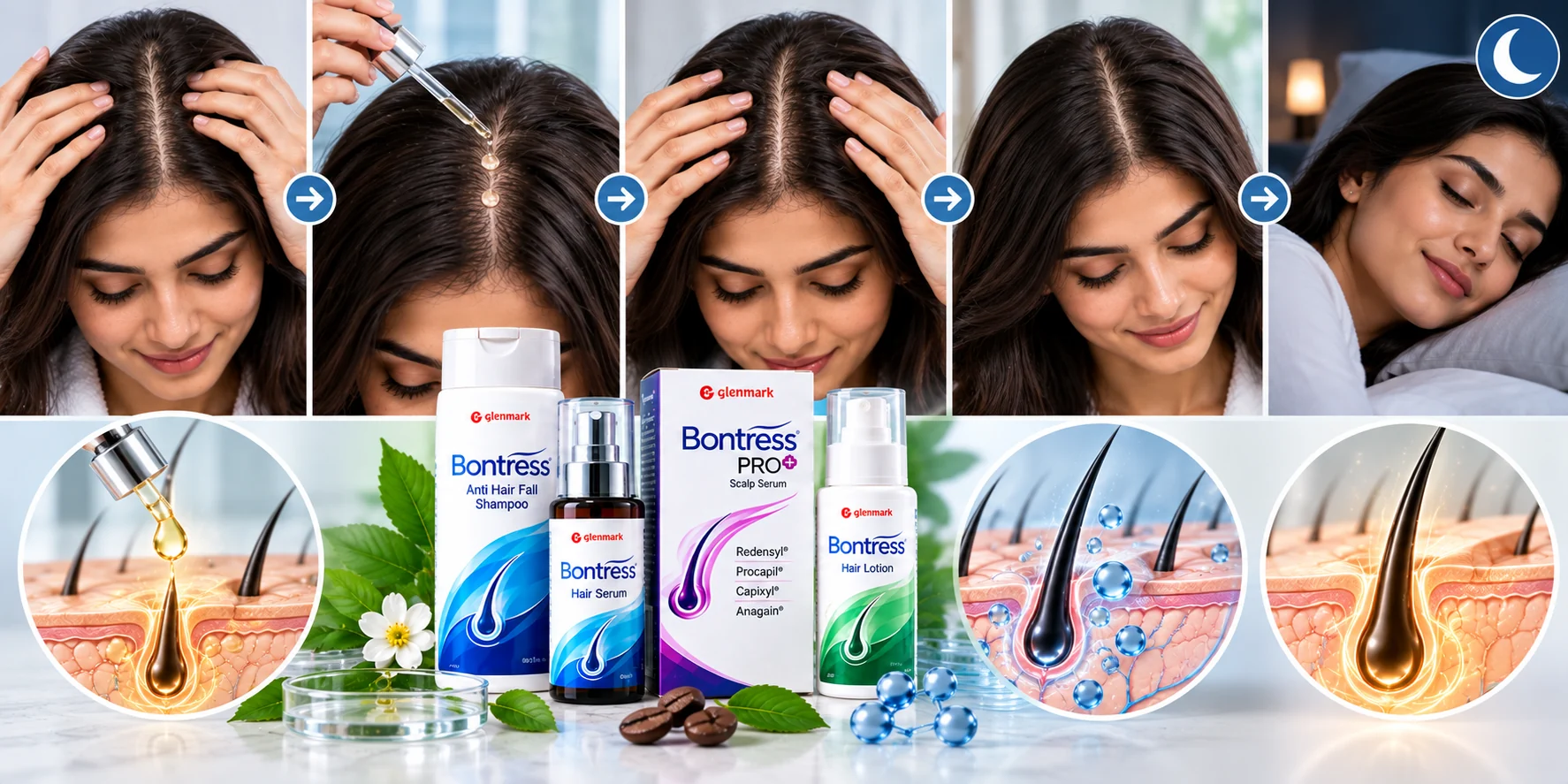
Layering is the most common cause of trouble here. A leave-on serum, a medicated shampoo and a scalp tonic used together will often irritate, and when they do, there is no way to know which one was responsible. One at a time is slower and considerably more informative.
Safety & Tolerance
Leave-on scalp products stay in contact for hours. That is what makes them useful and also what makes tolerance worth taking seriously.
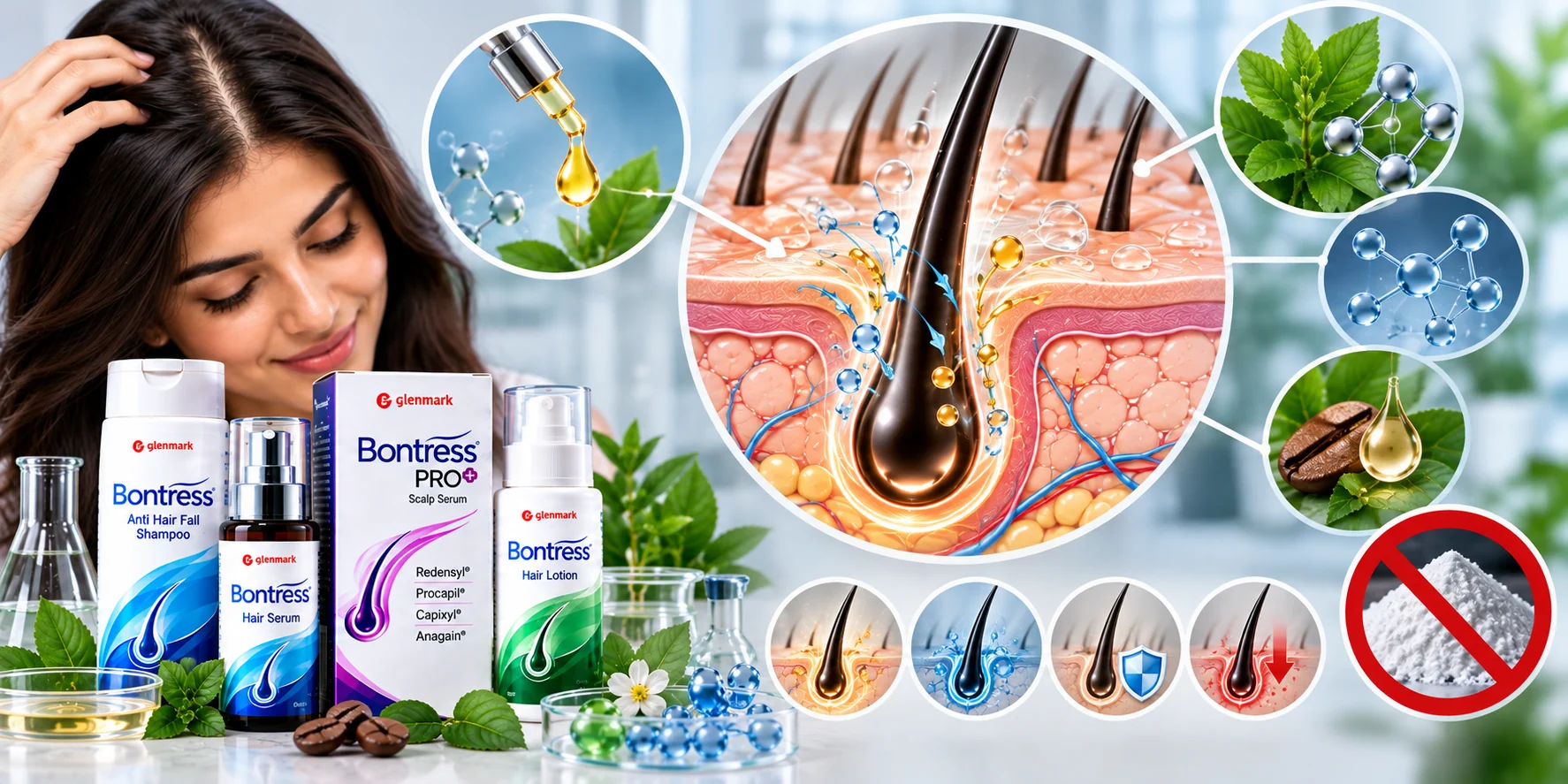
Pregnancy, breastfeeding, a broken or inflamed scalp, a recent transplant and a history of reacting to scalp products are all worth raising before starting something new. None is an automatic prohibition for a cosmetic — they are reasons to ask rather than assume.
Hair & Scalp Pathway Finder · Interactive
Twelve questions answered in your browser. The output is a pathway — which conversation makes sense first. It never names a product and never promises a result.
Answer what you can. Red-flag answers override everything else, because some presentations need examining before any product is considered.
Suggested pathway
This tool provides educational navigation only. It does not diagnose hair loss, recommend a product or replace a dermatologist. If you are already under the care of a clinician, follow their advice over anything suggested here.
Comparison
Categories compared on what each is for and what it demands. Not a ranking, and not a suggestion that one substitutes for another.
| Option | Category | Primary purpose | What it requires |
|---|---|---|---|
| Cosmetic scalp serum | Cosmetic | Scalp condition and hair appearance | Consistency; no prescription |
| Cosmetic shampoo | Cosmetic | Cleansing and hair feel | Routine use |
| Medicated shampoo | Medicated | A relevant scalp condition such as dandruff | Its own directions and contact time |
| Topical minoxidil | Medicine | Eligible pattern hair loss | Prescription context; long-term use |
| Oral prescription treatment | Medicine | A diagnosed condition | Prescription and ongoing review |
| Nutritional supplement | Supplement | Correcting an identified shortfall | Assessment; avoiding duplication |
| In-clinic procedures | Procedure | Adjunctive treatment courses | Clinic visits; protocols vary |
| Hair transplant | Surgery | Redistributing existing follicles | Surgical assessment; does not stop ongoing loss |
Read across the row, not down the column. A cosmetic serum and a prescription medicine are not competing entries on one list — they answer different questions. Choosing between them is only sensible once you know which question you have.
Post-Operative
Being cosmetic rather than medicated does not make a leave-on product safe to apply to a healing recipient area. Timing belongs to the operating surgeon.
Your operating surgeon. Their instructions override any general guidance, including everything here — cosmetic status does not exempt a product from that.
Authenticity
This range includes a serum and more than one shampoo. Confirming which one you are buying matters as much as confirming it is genuine.
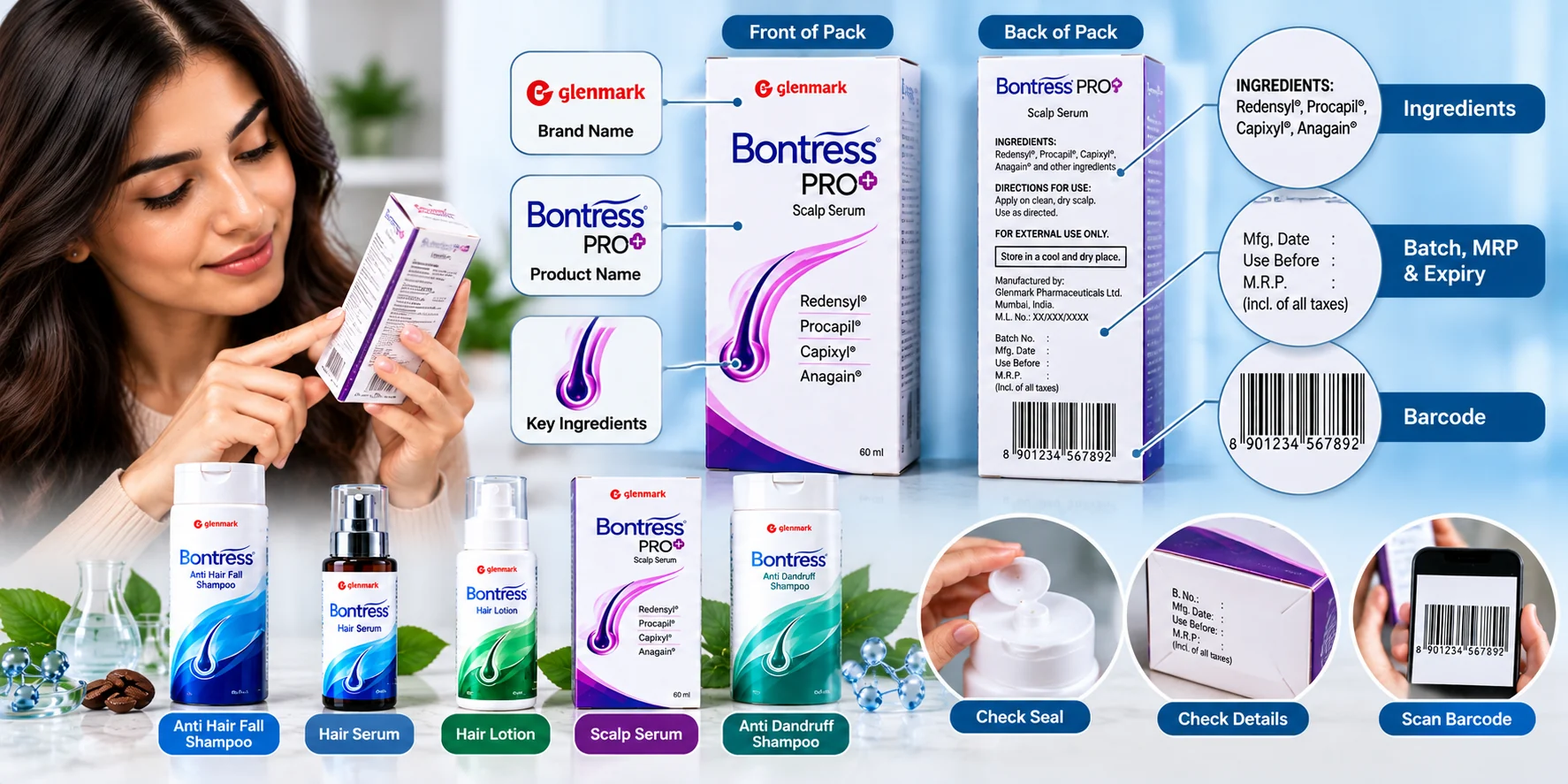
Visual inspection alone does not prove authenticity. Buying through an authorised seller is the substantive protection; these checks are a secondary layer.
"I have no objection to a well-made cosmetic serum. My objection is to someone using one for a year while a treatable diagnosis goes unmade. A serum can sit alongside treatment perfectly well — it just cannot stand in for the appointment."
Knowledge Journal
The biology underneath this page, from the HairsnCares Hair Biology faculty.
Why nothing visible happens quickly, and why shedding often follows a trigger by months.
Read the growth cycle →
Cuticle, cortex and medulla — what a topical can change about a fibre, and what it cannot.
Read hair anatomy →
Barrier, sebum and microbiome — the surface every scalp product actually acts on.
Read scalp biology →
Terminology
Fourteen terms for reading cosmetic haircare claims critically, defined plainly.
FAQs
No repeated marketing statistics, no promised timelines, and no suggestion that a cosmetic replaces a medicine.
It is a cosmetic haircare range marketed for hair-fall concerns and scalp condition — a leave-on scalp serum and shampoos. Cosmetic products of this kind support the appearance and condition of hair and scalp; they are not licensed medicines for a diagnosed hair-loss condition.
Glenmark Pharmaceuticals. The brand appears in Glenmark's own corporate reporting and on its official online store. A pharmaceutical company marketing a product does not make that product a medicine — Bontress sits in the cosmetic category regardless of who owns it.
No. It is a cosmetic formulation built around ingredients such as peptides and botanical-derived actives. That is a different regulatory category from a licensed hair-loss medicine, with a different evidence requirement and a different set of expectations.
This page makes no such claim, and notably the brand's own positioning describes the serum as a step before minoxidil rather than a replacement for it. If a diagnosis calls for a medicine, a cosmetic serum does not fill that role.
Cosmetic products are not approved in the way medicines are, so the question does not really apply to this category. Any claim of approval for a hair serum is worth reading sceptically, whoever makes it.
A cosmetic active combination studied for effects on cells associated with hair growth. Named ingredients like this appear on cosmetic labels because they are formulated in; that is not the same as an approved indication for treating hair loss.
A cosmetic active blend combining a peptide with plant-derived components, formulated into scalp products for hair-condition claims. Like the others in this category, it is a cosmetic ingredient rather than a licensed drug.
A cosmetic peptide-and-botanical complex used in scalp formulations. Published listings for this brand disagree on the concentration used, which is one reason composition should be read from the pack rather than from a shopping page.
A pea-sprout-derived cosmetic active used in hair formulations. Its inclusion tells you what is in the bottle; it does not by itself establish what the finished product will do for a particular person.
No — the actives named across sources for this range are cosmetic ingredients, not minoxidil. If you want minoxidil, that is a different product category with prescribing considerations attached.
It depends entirely on what you expect it to do. As a cosmetic, it may support scalp condition and hair appearance. As a treatment for a diagnosed hair-loss condition, it is not that, and expecting it to be leads to months lost.
Hair cycles run over months, so nothing visible happens quickly with any topical. This page gives no timeline, because the published claims for these products contradict each other on duration and endpoint.
Regrowth in areas of established loss is not something a cosmetic serum should be expected to deliver. Where follicles have miniaturised over years, that is a medical question rather than a cosmetic one.
No cosmetic product should be described that way. Shedding has causes — genetic, hormonal, nutritional, inflammatory, post-illness — and a cosmetic serum does not address any of them at their source.
Cosmetic benefits to hair and scalp condition generally depend on continued use, as with most topical cosmetics. Since it is not treating an underlying condition, stopping simply returns things to how they were.
Treat them carefully. The figures quoted for these products differ between retailers, use different endpoints and durations, and are generally presented without a citable published study. A precise number is not the same as a verified one.
Less than most people assume. It can mean a small study on the finished product, a study on one ingredient, or a consumer-perception survey where users rated their own hair. Without a citable study, the phrase does not tell you which.
People do use cosmetic and medical products alongside each other, and there is no inherent contradiction. It is still worth confirming with whoever manages your treatment, and worth introducing one product at a time so a reaction can be attributed.
The range is marketed as unisex. Suitability for any individual still depends on what is causing the hair concern, and hair loss in women in particular can have causes that a cosmetic will not address.
Timing depends on healing and on the operating surgeon's protocol. Nothing should be applied to an unhealed, crusted or inflamed recipient area without clearance, cosmetic or otherwise.
Leave-on scalp products can irritate, and the risk rises when several are layered. Introduce one product at a time, and treat persistent stinging, redness or itching as a reason to stop and review rather than to persist.
Pregnancy and breastfeeding are worth raising with a clinician before starting any new scalp product. Postpartum shedding also has its own natural course that is often mistaken for something a product should fix.
Follow the directions supplied with the pack you hold. This page gives no frequency, and using a leave-on scalp product more often than directed increases irritation risk without accelerating anything.
To the scalp rather than the hair lengths, on clean dry hair unless the label says otherwise, with hands washed afterwards. Take the quantity and frequency from the product's own directions.
Layering multiple leave-on actives is a common cause of irritation and makes it impossible to tell which product caused what. One at a time is the sensible approach.
No. A rinse-off shampoo and a leave-on serum differ in contact time, formulation and what they can reasonably claim. Published claims for the shampoos in this range also differ from each other.
Buy from a licensed pharmacy or authorised retailer, keep the invoice, and check that carton, batch number and expiry are intact and consistent. Confirm which product you are buying, since the serum and the shampoos are different things.
Through authorised sellers. HairsnCares publishes a listing only after checking exact identity, category, composition, pack information and current availability — which is why this page currently shows a catalogue status rather than purchasable cards.
Approved internal guides for treatment context, routines and adjacent brands, so you can place this brand against the wider picture before buying anything.
Your Next Step
A cosmetic serum can be a sensible part of a routine. It cannot tell you why your hair is shedding, and it cannot treat a diagnosis nobody has made. If the loss is persistent, patterned or accelerating, the assessment is the step that makes every later decision — including whether to buy a serum at all — a good one.
Brand ownership and product identity come from the manufacturer's own corporate reporting and official storefront. General information on hair loss and cosmetic regulation comes from recognised dermatology and regulatory bodies. Retail listings were consulted only to document where published claims disagree — never as evidence of composition or performance.
External links open in a new tab and lead to independent organisations whose content HairsnCares does not control. No link implies endorsement, partnership or affiliation. [RE-VERIFY BRAND OWNERSHIP, PRODUCT IDENTITY AND COMPOSITION AT EACH REVIEW CYCLE]
Category Disclaimer: The products described on this page are cosmetic haircare products. They are not licensed medicines, carry no approved medical indication, and are not substitutes for prescribed hair-loss treatment. Nothing here should be read as a claim that a cosmetic product treats, cures or prevents any condition, or as a comparison of equivalence to minoxidil or any other medicine.
Medical Disclaimer: This page provides general educational information and does not diagnose hair loss, prescribe, or give quantities or frequencies for any product. It is not a substitute for examination by a qualified clinician. Sudden, patchy, painful, inflammatory or scarring hair loss requires medical assessment, and delay can matter where scarring is involved. Pregnancy, breastfeeding, a broken or inflamed scalp, a recent hair transplant and previous reactions to scalp products all warrant professional guidance before starting something new. Stop use and seek advice if you develop persistent irritation, spreading rash or swelling.
Claims Disclaimer: Percentage claims, user-reported statistics, strand counts and penetration multipliers circulate widely for these products. This page deliberately repeats none of them, because published figures differ between sources and could not be traced to a citable published study. Where such figures are referenced, they are presented as evidence that the published claims disagree — not as findings.
Trademark and Independence Disclaimer: HairsnCares is an independent dermatologist-led haircare discovery and ecommerce platform. Bontress and associated trademarks belong to their respective owners. Product availability, formulation and claims may change. Always verify the current pack and label. HairsnCares is not affiliated with, sponsored by or endorsed by Glenmark Pharmaceuticals, and claims no distributorship or supply-chain guarantee.
Your cart is empty