DOCTOR-REVIEWED INGREDIENT GUIDE

Minoxidil for Hair: Uses, Evidence, Side Effects & Safety

Strong / medicine-levelSolution / FoamDoctor-guided

Minoxidil is a topical medicine with the strongest evidence among over-the-counter topical options for selected cases of pattern (androgenetic) hair loss — used under guidance. It is not a universal hair-fall product: it works for specific causes, takes months, and the benefit lasts only with continued use. Solution and foam are formats (neither automatically better), and a higher strength is not automatically better. Check suitability with the AI Hair Test, then a doctor. Results vary.

  • Strong evidence — for selected pattern loss
  • A medicine; doctor-guided, suitability check first
  • Solution vs foam: neither auto-better
  • Higher strength ≠ better
  • Not for sudden/patchy/scarring loss, pregnancy, teens, heart/BP without review
💉
MinoxidilStrong / medicine-level
CategoryTopical medicine
EvidenceStrong (selected pattern loss)
Best forCrown / vertex thinning
Doctor guidanceRecommended
FormatsSolution, foam

Illustrative summary only. This is education, not a diagnosis or prescription; results vary and depend on your situation.
🩺
Doctor-reviewedMD Dermatology
📊
Strong evidenceselected cases
⚠️
Safety-firstnot universally suitable
Suitability checkfree AI Hair Test
🚚
India-widedelivery
Image slot
🩺
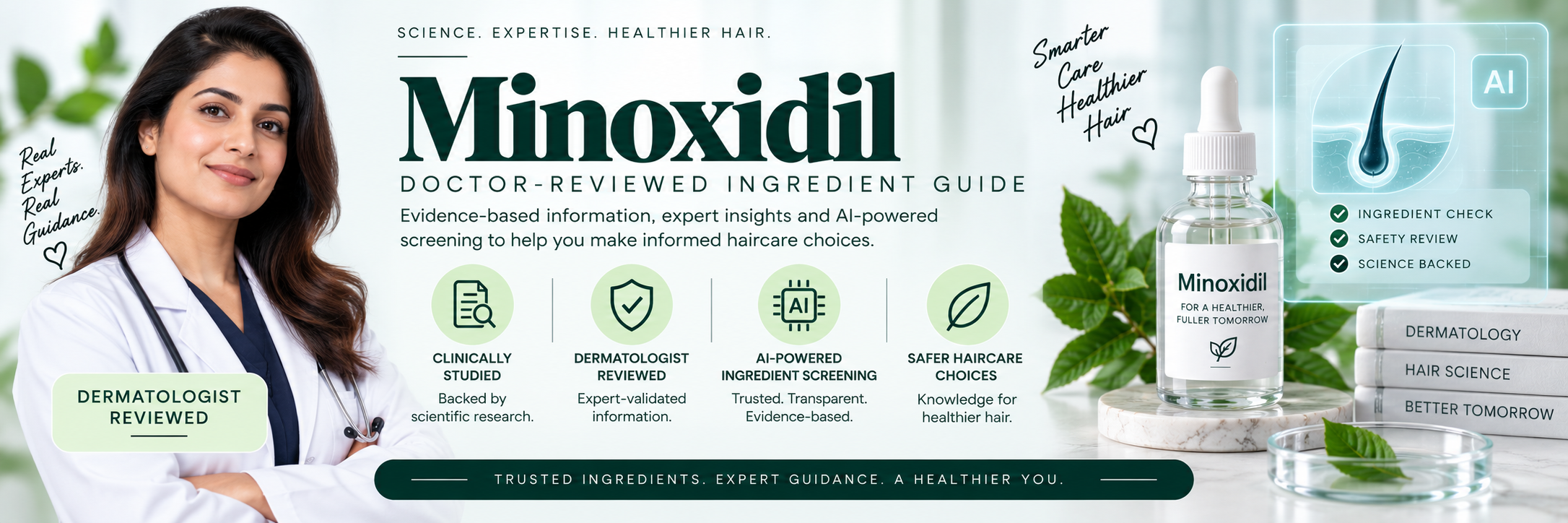
Doctor-reviewed ingredient guide — trust visualalt: "Dermatologist-reviewed minoxidil guide and AI screening" · 1200×400 WebP · loading="lazy"
Quick Answer

Does Minoxidil help hair growth — and is it right for me?

Minoxidil may help selected cases of pattern hair loss when suitable, but it should not be used blindly for sudden, patchy or medically unexplained hair fall. It is a medicine with good evidence for pattern (androgenetic) loss — the gradual thinning seen as a receding hairline, thinning crown or widening parting — used correctly, consistently and under guidance. It works only for specific causes, takes 3–6+ months, can cause an early shedding phase, and the benefit is maintained only with continued use. It does not help deficiency, thyroid, alopecia areata, scarring alopecia or scalp infection. Solution vs foam is about tolerance, not superiority (solution's propylene glycol can irritate; foam suits sensitive scalps); higher strength is not automatically better. See a doctor first for sudden/patchy/unexplained loss, scalp infection or inflammation, pregnancy, breastfeeding, teens, or heart/BP concerns. Stop and seek medical advice for dizziness, chest discomfort, palpitations, swelling, severe irritation or allergic reaction. Check suitability with the AI Hair Test, then a doctor. Results vary.

Doctor-guided medicine. Do not start Minoxidil for sudden unexplained shedding, patchy loss, alopecia areata, scarring alopecia, scalp infection (e.g. tinea), severe inflammation, pregnancy, breastfeeding, teenagers, or heart / blood-pressure concerns without a doctor's review. Stop and seek medical advice for dizziness, chest discomfort, palpitations, swelling, severe irritation or an allergic reaction. A suitability check is recommended.
The Basics

What Is Minoxidil?

Minoxidil is a topical medicine applied to the scalp for pattern (androgenetic) hair loss. Originally developed for blood pressure, its hair effect was noticed as a side effect, and it is now one of the most established topical options for selected pattern-loss cases. It is sold as a solution (applied with a dropper or spray) and as a foam.

It is a medicine, not a cosmetic ingredient — which is why it sits at the "strong evidence / doctor-guided" tier rather than alongside cosmetic actives like Redensyl or caffeine. People search for it because it is one of the few topical options with genuine evidence, but that evidence applies to pattern hair loss specifically, not to every kind of shedding.

Because it is a medicine, the sensible first step is confirming that your hair loss is the pattern type for which Minoxidil is used, and that it is suitable for you — ideally with the AI Hair Test suitability check and a doctor — rather than starting it blindly.
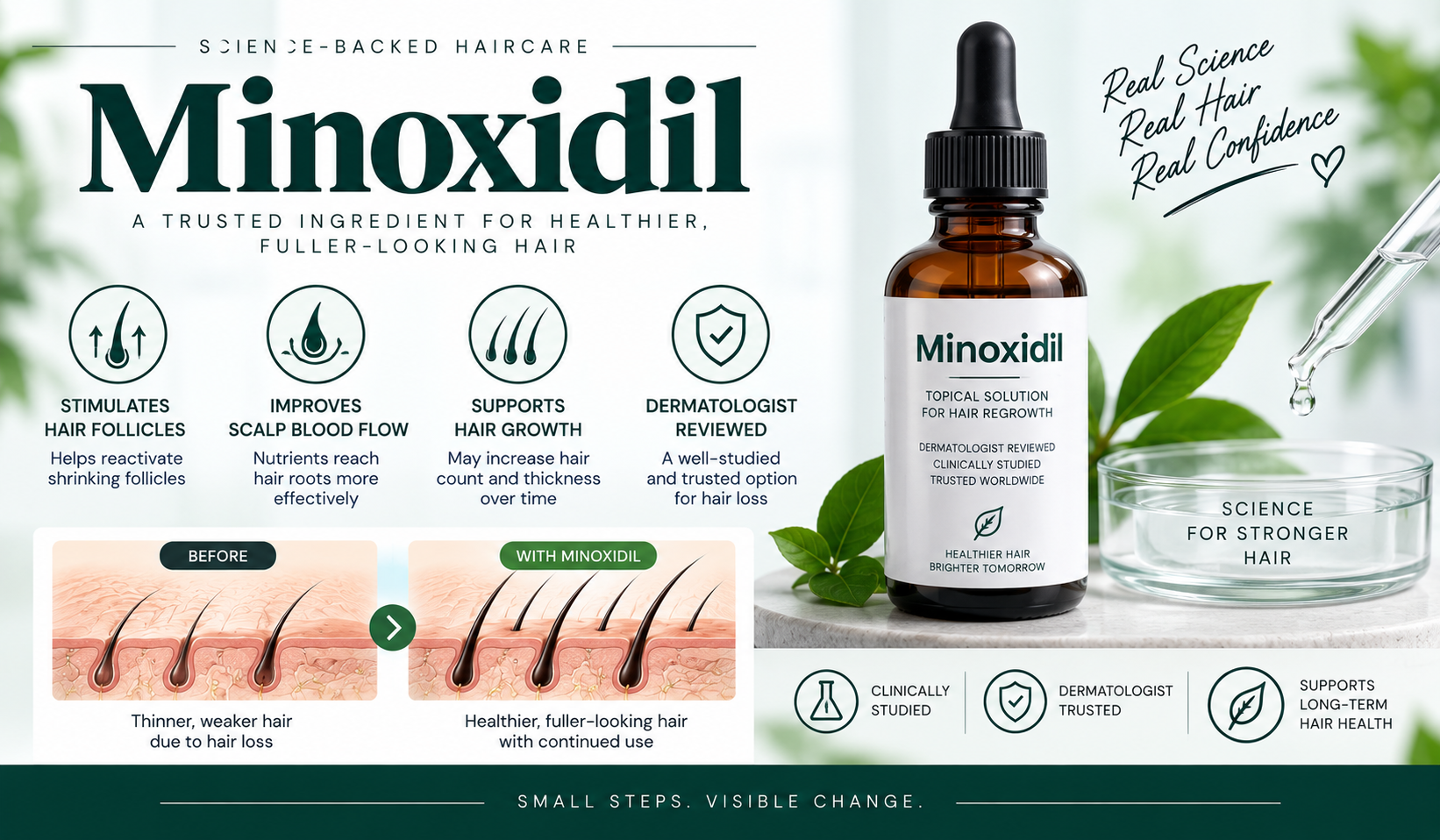
Image slot
🧪
Minoxidil — ingredient overview visualalt: "Minoxidil ingredient overview for haircare, dermatologist-reviewed" · 1200×700 WebP · loading="lazy"
Mechanism

How Minoxidil Works

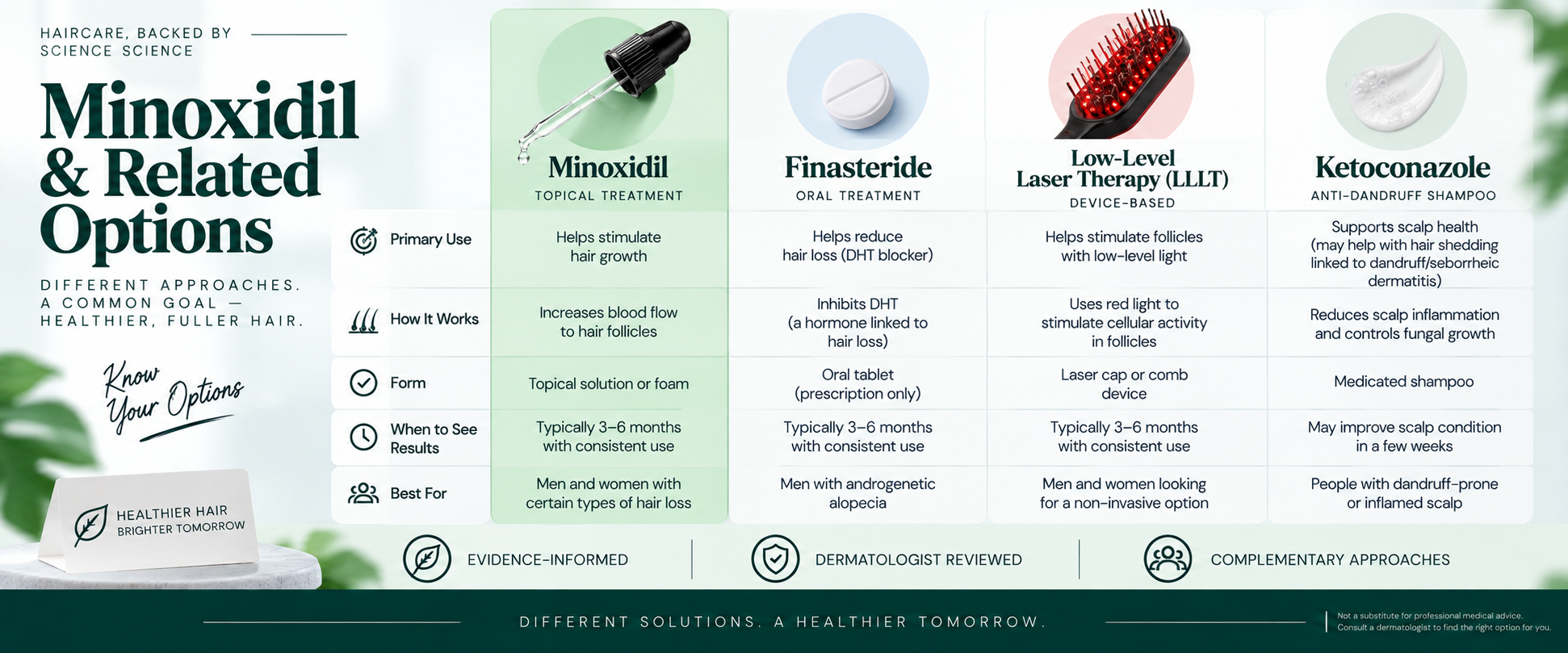
Minoxidil is thought to work mainly by prolonging the active growth (anagen) phase of the hair cycle and improving blood flow around the follicles, which can help maintain and thicken existing hair in pattern loss. The exact mechanism is not fully understood.

The practical consequence is that it supports existing follicles rather than creating new ones, so it works best where follicles are still present and not in scarring loss where follicles are gone. Because it acts on the hair cycle, results are gradual (months), there can be an initial shedding phase as the cycle resets, and the benefit reverses if you stop.

This is a medical, not a cosmetic, effect — and it depends on the diagnosis being right and on consistent, long-term use. Results vary between individuals.
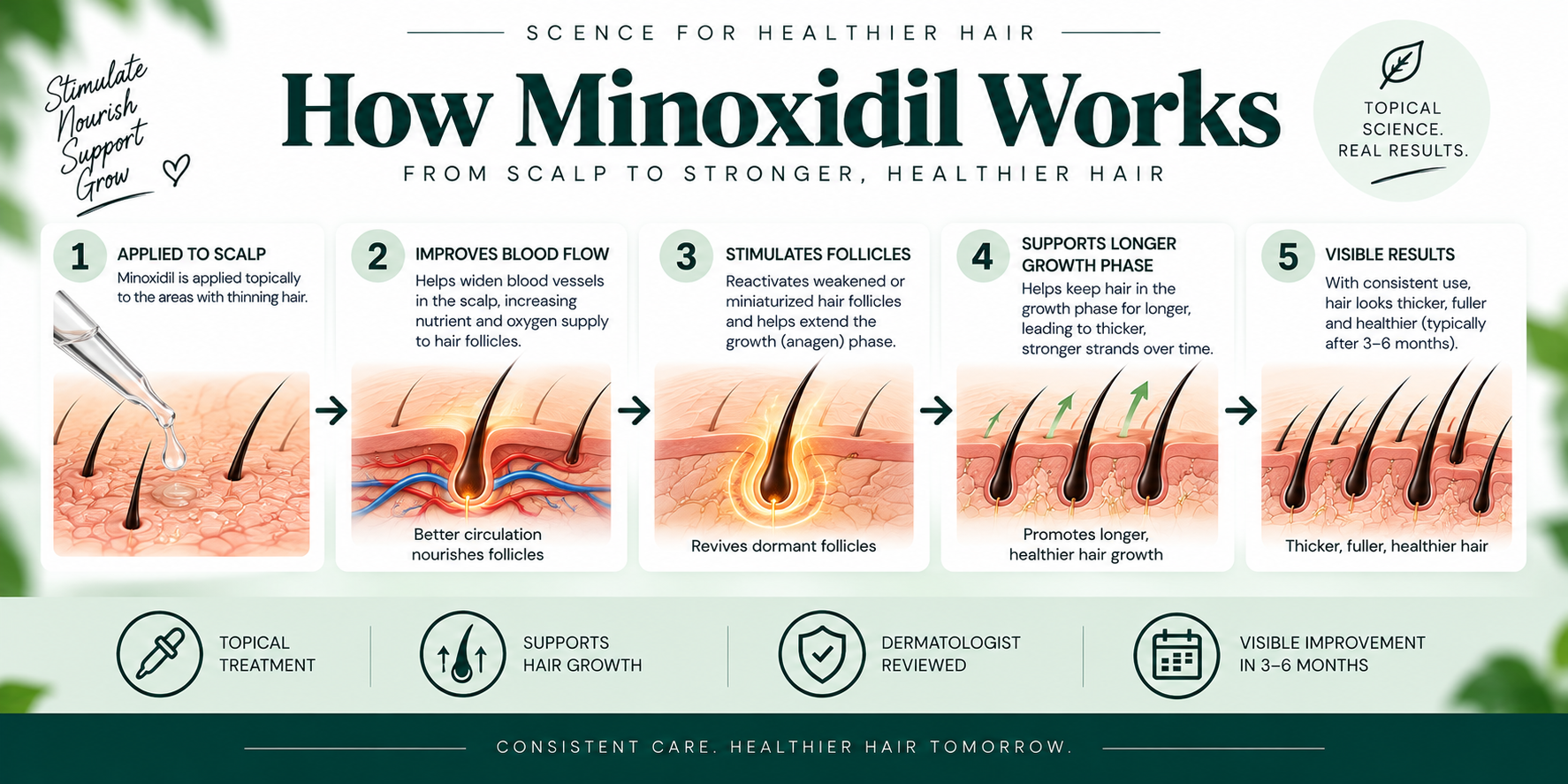
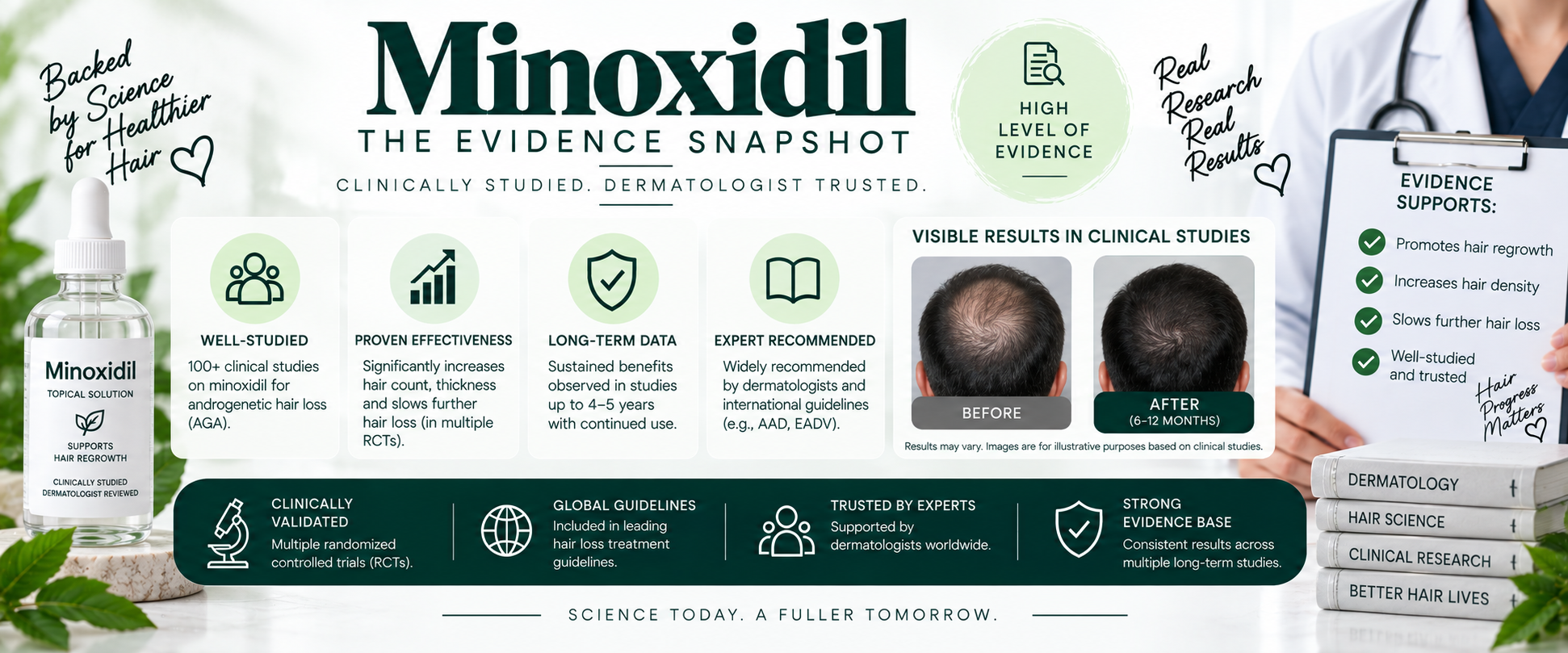
Image slot
⚙️
How Minoxidil works — mechanism visualalt: "How Minoxidil works on hair and scalp, illustrated" · 1200×600 WebP · loading="lazy"
Evidence

How Strong Is the Evidence?

Strong / medicine-level Minoxidil

Best supported for
Selected cases of pattern (androgenetic) hair loss — thinning crown/vertex and, for women, female pattern thinning where a doctor judges it suitable — used consistently and under guidance.
Not proven to
It is not proven to treat sudden or patchy loss, alopecia areata, scarring alopecia, scalp infection or deficiency-related shedding, and it does not regrow hair where follicles are already lost. It is not a guaranteed or permanent cure.
Doctor guidance
Recommended. Minoxidil is a medicine: a doctor confirms the diagnosis, checks suitability, and advises on strength and format. A suitability check comes first.
Image slot
📊
Evidence snapshot — visualalt: "Evidence level snapshot for Minoxidil in haircare" · 1200×500 WebP · loading="lazy"
Suitability

Best For

Pattern hair loss

Doctor-confirmed pattern (androgenetic) loss is the core, evidence-based use.

Crown / vertex thinning

Thinning at the crown is commonly studied and often responds better than a receding hairline.

Topical treatment route

For people who can apply consistently long-term and want a topical, doctor-guided option.

Daily routine step

Works as a consistent daily routine, with monthly photo tracking.

Realistic-expectation users

For people who understand it is slow, may shed first, and must be continued.

Solution or foam

Choose the format your scalp tolerates — foam for sensitive scalps, solution for precise use.

Caution

Not Suitable For / Use With Care

⚠️

Avoid or ask a doctor first

  • Sudden, unexplained or patchy hair loss
  • Alopecia areata or scarring alopecia suspicion
  • Tinea capitis or a fungal scalp infection
  • Scalp redness, pus, pain, crusting or severe inflammation
  • Pregnancy or breastfeeding (without medical advice)
  • Teenagers (assess the cause first)
  • Heart or BP concerns, or dizziness/palpitations history
  • Side effects from previous Minoxidil; unclear diagnosis
🩺

See a doctor first if

  • Sudden, patchy or unexplained loss
  • Suspected alopecia areata or scarring alopecia
  • Scalp infection or inflammation
  • Pregnancy, breastfeeding or being a teenager
  • Heart or BP concerns, or dizziness/palpitations history
  • Dizziness, chest discomfort, palpitations or swelling on treatment
  • Any uncertainty about diagnosis, strength or format
🧪

How to use safely

  • Confirm suitability (AI Hair Test + a doctor) first
  • Apply only the directed amount to the scalp
  • Avoid eyes, face and broken skin; wash hands after use
  • Let it dry before styling or sleeping
  • Do not apply to an inflamed or infected scalp
  • Use consistently; judge at 3–6+ months
  • Track monthly photos; review with a doctor
Usage

How to Use Minoxidil Safely

Follow the product label and your doctor's advice exactly. Apply only the directed amount to the scalp area indicated, avoid the eyes, face and broken skin, wash your hands afterwards, and let it dry before bed. Do not over-apply, do not apply to an inflamed or infected scalp, and do not start and stop repeatedly. Use it consistently and track progress with monthly photos. Seek medical help for systemic symptoms (dizziness, chest discomfort, palpitations, swelling) or severe irritation.

Not sure if this ingredient fits your situation? Screen the cause first.

Take AI Hair TestAsk a Hair Doctor
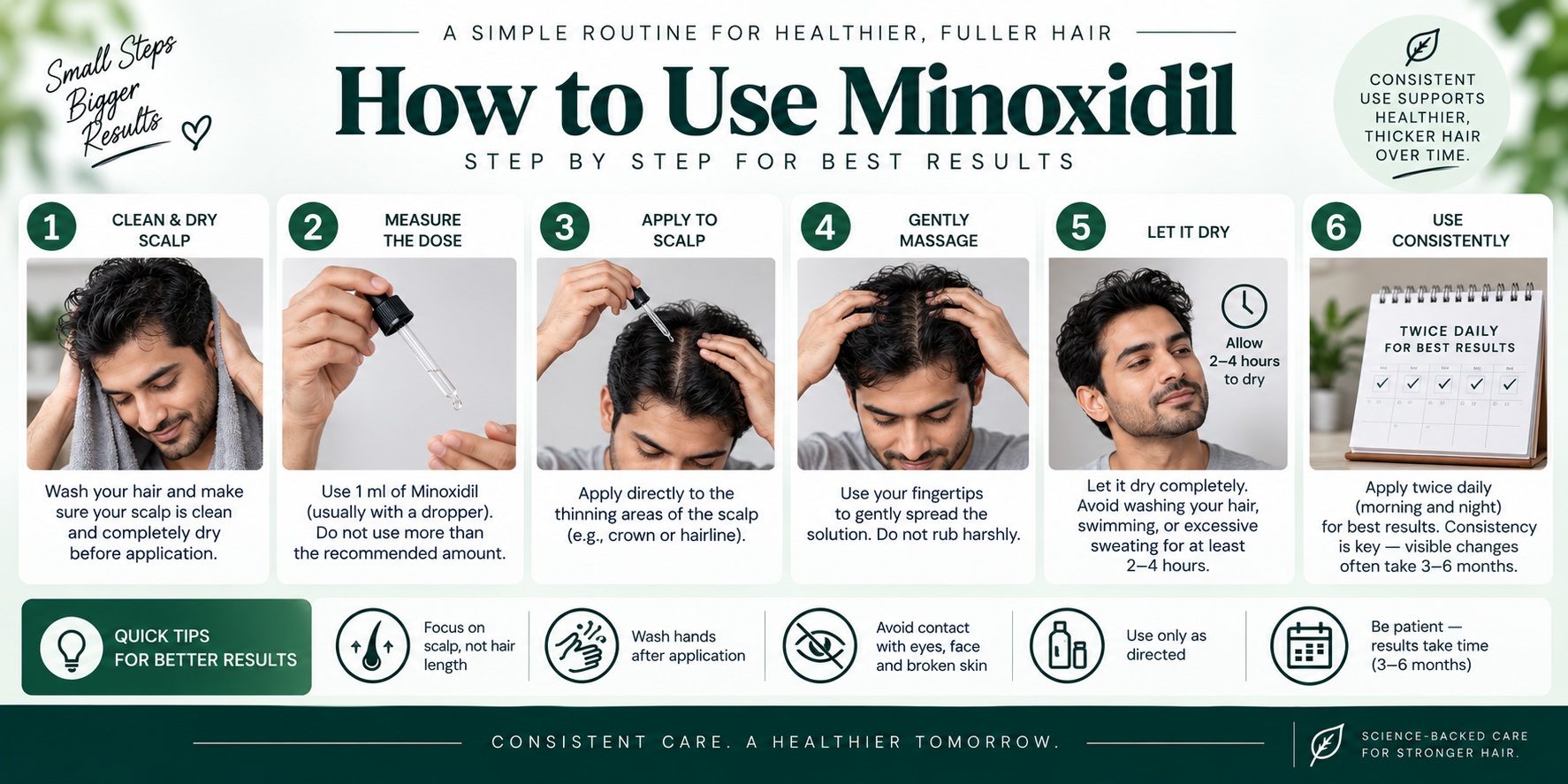
Image slot
📋
How to use Minoxidil — illustrated stepsalt: "How to use Minoxidil safely, step by step" · 1200×600 WebP · loading="lazy"
Safety

Possible Side Effects

Minoxidil is a medicine with real, if usually manageable, side effects. Most are local; systemic effects are rare but need urgent attention.

Initial shedding (often temporary)Scalp irritationItchingDryness / flakingUnwanted facial / body hairAllergic reactionDizziness / palpitations (rare — urgent)Chest discomfort / swelling (rare — urgent)

Local irritation and dryness are more common with the solution's propylene glycol; foam may be better tolerated. Unwanted facial hair is more often reported in women and is reduced by careful application and washing hands. Rare systemic symptoms — dizziness, chest discomfort, palpitations or swelling — mean stop and seek medical advice promptly.

Shop

Products With Minoxidil

Doctor-guided Minoxidil formats. Strengths, prices, ratings and stock are dynamic placeholders from the official label and database; we never invent strengths.

Catalogue connected · pin-code aware
View all 500+ products →
Products for this ingredient are being curated.

Minoxidil is a doctor-guided medicine for selected pattern hair loss — not for every hair fall. Confirm suitability with the AI Hair Test and a doctor before use. Foam is not automatically better than solution, and a higher strength is not automatically better. We do not invent strengths or fabricate prices, ratings, stock or reviews; these are placeholders from the official label and database. Results vary.
Want products matched to you? Use the finder or screen first.

Find My ProductsTake AI Hair Test
Image slot
🛒
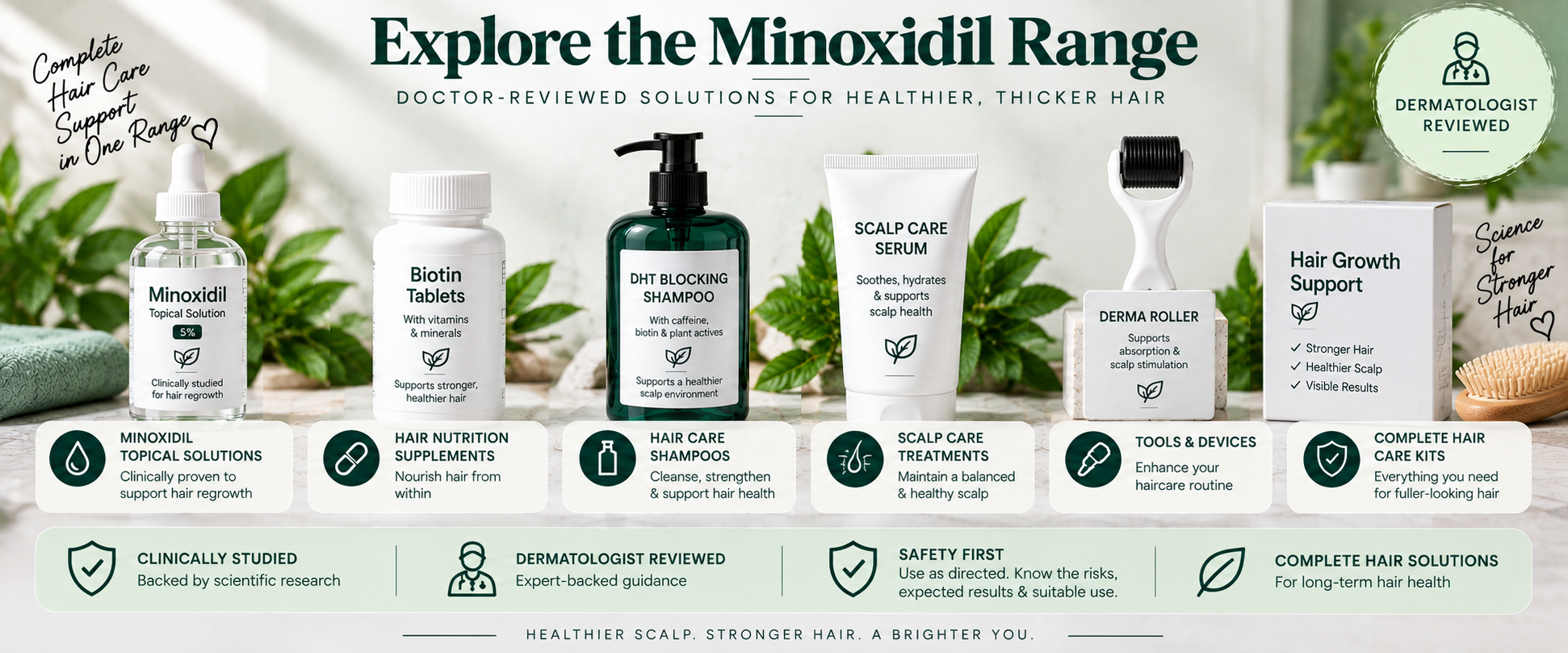
Shop strip — related range flat-layalt: "Doctor-reviewed product categories related to Minoxidil" · 1200×500 WebP · loading="lazy"
Compare

Minoxidil vs Rosemary Oil vs Redensyl

How this ingredient compares with similar options. It points to a pathway; it is not a diagnosis.

FeatureMinoxidilRosemary OilRedensyl
CategoryTopical medicineCosmetic natural oilCosmetic active
EvidenceStrong (selected pattern loss)LimitedCosmetic / limited–moderate
Best forPattern hair lossRoutine supportMild cosmetic support
Product typeSolution / foamHair oilSerum / tonic
Doctor guidanceRecommendedFor pregnancy/sensitivity/medical lossCosmetic; minimal
Side-effect riskReal (incl. rare systemic)Irritation / allergyLow
Not suitable forPatchy/sudden/scarring; pregnancy; teens; heart/BP (without review)Patchy/scarring/fungal loss; undiluted usePattern loss expecting a cure
PathwayDoctor-guided treatmentCosmetic routineCosmetic routine
Image slot
⚖️
Comparison — visualalt: "Minoxidil compared with related options" · 1200×500 WebP · loading="lazy"
🩺
Doctor's Note

I Choose Ingredients by Diagnosis, Not Trends

"As a dermatologist, I recommend choosing ingredients based on diagnosis, not trends. Minoxidil is one of the few topical ingredients with genuine evidence, and for the right person with pattern hair loss it is a valuable, well-established option. But it is a medicine, and the same ingredient that helps one person can be unnecessary or unsafe for another. I never start it without confirming the hair-loss pattern, and I always cover the shedding phase, the need for consistency, and the systemic symptoms that mean stop and call. Check suitability first, then let me confirm the diagnosis, format and strength."

Reviewed by Dr. Amit Agarkar, MD DermatologyDermatologist & Hair Specialist · Last reviewed 1 June 2026

Sudden, patchy or unexplained loss, pregnancy, teen, or heart/BP concerns? See a doctor before Minoxidil.

Consult Dr. Amit's Team
Evidence & Safety

Medical References Behind This Guidance

These references are provided for patient education and do not replace a dermatologist's diagnosis or individual medical advice.

AAD

Hair Loss: Causes & Treatment

Dermatologist-led overview of how hair loss is evaluated and the evidence behind common treatments.

View reference ›
NIH / PubMed Central

Topical Minoxidil for AGA (Review)

Peer-reviewed NIH-indexed review of minoxidil for androgenetic alopecia, covering topical use, mechanisms and safety.

View reference ›
PubMed

Peer-Reviewed Literature

Searchable index of peer-reviewed research on topical minoxidil for hair loss.

View reference ›
Cochrane Library

Systematic Reviews

Independent systematic reviews assessing the evidence behind hair-loss interventions.

View reference ›
Questions

Frequently Asked Questions

Section image
FAQs — banner900×160 WebP
Does Minoxidil help hair growth?
Minoxidil has good evidence for supporting hair in selected cases of pattern (androgenetic) hair loss when used correctly and consistently under guidance, so for the right person it can genuinely help. However, it is a medicine, not a universal product: it works for specific causes, takes months, can cause an early shedding phase, and the benefit lasts only while you keep using it. It does not regrow hair where follicles are already lost. So it helps growth in suitable pattern-loss cases, doctor-guided and with realistic expectations, not for any hair fall. Check suitability with the AI Hair Test, then see a doctor. Results vary.
Does Minoxidil stop hair fall?
In suitable pattern hair-loss cases, Minoxidil can help reduce shedding and support density over time, but it does not stop hair fall that has other causes, such as deficiency, thyroid disease, alopecia areata, scarring alopecia or scalp infection. There can also be a temporary increase in shedding when starting, before improvement. So whether it helps your hair fall depends on the cause, and it is not a blanket solution. If your shedding is sudden, patchy or unexplained, the cause should be diagnosed first rather than assuming Minoxidil will stop it. Screen with the AI Hair Test and see a doctor for genuine or worsening shedding. Results vary.
How does Minoxidil work?
Minoxidil is thought to work mainly by prolonging the active growth phase of the hair cycle and improving blood flow around the follicles, which can help maintain and thicken hair in pattern hair loss. The exact mechanism is not fully understood, but the practical effect is supporting existing follicles rather than creating new ones, which is why it works best where follicles are still present and not in scarring loss. Because it acts on the hair cycle, results take months and reverse if you stop. So it supports the hair you have in suitable cases, gradually and while continued, rather than being a permanent or instant fix. Results vary.
Is Minoxidil solution or foam better?
Neither is automatically better; they are formats of the same medicine, and the right one depends on you. Solution applies precisely with a dropper and may be more economical, but its propylene glycol can irritate or dry some scalps. Foam dries faster, leaves less residue and lacks propylene glycol, which can suit sensitive scalps or people irritated by solution, though it can be harder to apply through long hair. So the choice is about scalp tolerance, hair length and preference rather than superiority. A doctor can help you choose, and our solution-versus-foam comparison covers the differences. Both are doctor-guided medicines for selected pattern hair loss. Results vary.
Is Minoxidil 5% better than 10%?
A higher strength is not automatically better. Stronger Minoxidil such as 10% is not simply more effective and can increase the risk of side effects like scalp irritation, dryness and unwanted facial hair, while 5% is the more commonly used and studied topical strength for many people. The right strength depends on your situation and should be a doctor's decision rather than a default choice of the highest number. So do not assume 10% will outperform 5%; discuss the appropriate strength with a doctor, who will weigh likely benefit against side-effect risk. Our 5%-versus-10% comparison explains this in more detail. Results vary.
Who should use Minoxidil?
Minoxidil may be considered, under a doctor's guidance, by people with doctor-confirmed pattern hair loss, such as selected men with male pattern loss or crown thinning, and selected women with female pattern thinning where a doctor judges it suitable, who can apply it consistently long-term and understand the possibility of initial shedding and side effects. It suits people without active scalp infection or inflammation. So the right users are those with a confirmed suitable diagnosis and realistic expectations, ideally after a suitability check and doctor review, rather than anyone with any hair fall. Confirm suitability before starting. Results vary.
Who should avoid Minoxidil?
You should avoid starting Minoxidil on your own, and see a doctor first, if your hair fall is sudden, unexplained, patchy or possibly alopecia areata or scarring alopecia, if you have a scalp infection such as tinea capitis or scalp redness, pus, pain or crusting, if you are pregnant or breastfeeding, a teenager, or have heart or blood-pressure concerns or a history of dizziness or palpitations, if you had side effects from Minoxidil before, or if your diagnosis is unclear. These situations need evaluation rather than self-started Minoxidil. So it is not universally suitable, and these groups need a doctor's assessment first. Results vary.
How long does Minoxidil take to work?
Minoxidil works slowly, and you generally need to use it consistently for at least three to four months before judging any effect, with more noticeable results often taking around six months or longer, because of how the hair cycle works. An early shedding phase can occur before improvement appears. Because it is slow, consistency and patience matter, and stopping early means you may not see whether it would have helped. So do not expect quick results; give it several months of consistent use under guidance, track progress with monthly photos, and review with a doctor rather than abandoning or judging it too soon. Results vary.
What happens if I stop Minoxidil?
If you stop Minoxidil, any hair that was maintained or regrown with it will gradually be lost over the following months, returning toward where your hair loss would otherwise have been, because Minoxidil supports hair while it is being used rather than permanently changing the underlying pattern loss. This means it is generally a long-term commitment if you want to keep the benefit. So before starting, it is worth understanding that results depend on continued use, and any decision to stop is best discussed with a doctor, who can advise what to expect and whether other options are appropriate. Results vary.
Can Minoxidil cause shedding?
Yes, some people experience a temporary increase in shedding in the first weeks of starting Minoxidil, often called a shedding phase, which can be alarming but is usually a sign the hair cycle is resetting and typically settles after a couple of months as new growth comes through. It does not happen to everyone. Because it can look like worsening hair loss, it is worth knowing about in advance and discussing with a doctor if you are concerned, rather than stopping abruptly. So initial shedding can occur and is often temporary, but persistent or severe shedding, or uncertainty, should be reviewed by a doctor. Results vary.
Can Minoxidil cause side effects?
Yes, Minoxidil can cause side effects. Common local ones include scalp irritation, itching, dryness or flaking, especially with the solution's propylene glycol, plus an initial shedding phase. Unwanted facial or body hair can occur, more often in women, particularly with misapplication. Rarely, systemic effects such as dizziness, palpitations, chest discomfort or swelling occur and need urgent attention. So it is a medicine with real side effects: apply it correctly, wash your hands afterwards, and stop and seek medical advice for any systemic symptoms or severe irritation. Results vary.
Can Minoxidil cause unwanted facial hair?
Yes, unwanted facial or body hair growth is a recognised possible side effect of Minoxidil, more often reported in women, and it can result from the medicine spreading beyond the intended area, for example by applying too much, not washing hands after use, or it transferring onto the face. Applying only the directed amount to the scalp, washing your hands afterwards, and letting it dry before bed all reduce this risk. If unwanted hair growth occurs and concerns you, discuss it with your doctor. So this side effect is possible, particularly with misapplication, and careful use plus medical guidance help manage it. Results vary.
Can I use Minoxidil with other ingredients?
Minoxidil can often be used alongside other haircare ingredients, such as an anti-dandruff shampoo to keep the scalp healthy, or gentle scalp-support products, since a comfortable, non-inflamed scalp is a better base for it. The main cautions are not to apply Minoxidil to an irritated or inflamed scalp, not to overlayer many strong actives at once, and to follow correct timing and application. If you are combining it with other treatments, it is sensible to do so with a doctor's awareness. So combinations are often fine and sometimes helpful, but keep the routine sensible and get medical input for anything involving other actives or an irritated scalp. Results vary.
Is Minoxidil safe during pregnancy?
Minoxidil is generally not recommended during pregnancy or breastfeeding, and you should not start or continue it at these times without your doctor's explicit advice. Hair changes around pregnancy, including postpartum shedding, are common and usually settle on their own over several months without Minoxidil. So rather than using it during pregnancy or while breastfeeding, raise any hair concerns with your doctor, who can advise and reassure, and consider treatment later if still needed. The safest approach is to avoid Minoxidil in pregnancy and breastfeeding unless a doctor specifically advises otherwise. Results vary.
Is Minoxidil safe for teenagers?
Teenagers should not start Minoxidil on their own, because hair loss in a teenager needs proper evaluation to identify the cause rather than self-treatment, and Minoxidil's use in younger people is a decision for a doctor based on the diagnosis. Hair loss at a young age can have several causes that need assessment. So for teenagers, the priority is to understand why hair is thinning, with a doctor, rather than reaching for Minoxidil. If a doctor judges it appropriate after assessment, it would be used under guidance, but it is not something a teenager should begin independently. Get the cause assessed first. Results vary.
Should I consult a doctor before Minoxidil?
Yes, it is strongly advisable to have a doctor involved before starting Minoxidil, because it is a medicine suitable only for selected cases of pattern hair loss, and a doctor confirms the diagnosis, checks suitability and advises on strength and format. You should especially see a doctor first if your hair loss is sudden, patchy or unexplained, if you suspect alopecia areata or scarring alopecia, if you have scalp infection or inflammation, if you are pregnant, breastfeeding or a teenager, or if you have heart or blood-pressure concerns. So Minoxidil is not a product to start blindly; a suitability check and doctor review come first. Results vary.
Can the AI Hair Test recommend Minoxidil?
The AI Hair Test can help explore whether your hair-loss pattern looks like the pattern (androgenetic) type for which Minoxidil may be considered, and it flags situations where Minoxidil should not be started without a doctor, but it does not diagnose, prescribe Minoxidil, confirm it is safe for you, or replace a dermatologist. It is a suitability-screening and education aid that points you toward the right next step, which for a medicine like Minoxidil is a doctor's confirmation. So it can indicate whether Minoxidil is worth discussing and flag when it is not appropriate, while the decision to use it remains a medical one. Results vary.
Which Minoxidil product should I buy?
Which Minoxidil product suits you depends on your diagnosis, scalp tolerance and a doctor's advice rather than a brand ranking. Solution and foam are both options, with foam often preferred for sensitive scalps and solution for precise application; the appropriate strength is a doctor's decision, not automatically the highest. So rather than choosing a product first, confirm with the AI Hair Test and a doctor that Minoxidil is suitable for you, then select the format and strength they advise. Product prices, strengths, ratings and stock on our category pages are dynamic placeholders from the official label and database. Results vary.

Question not answered here? Ask Dr Aria for general guidance, or book a consultation.

Ask Dr AriaConsult a Doctor

A Real Treatment — for the Right Person, Doctor-Guided

Minoxidil is one of the strongest-evidence topical ingredients for hair — but only for selected pattern hair loss, and only when suitable for you. It is a medicine, not a universal product: not for sudden, patchy or unexplained loss, scalp disease, pregnancy, breastfeeding, teens, or heart/BP concerns without a doctor. Solution and foam are about tolerance, not superiority, and higher strength is not automatically better. Expect slow results, a possible shedding phase, and benefit only with continued use. Check suitability with the AI Hair Test, then see a doctor — and stop for any systemic symptoms. Results vary.

Medical disclaimer. This is educational content reviewed by a dermatologist. The AI tools help explore whether Minoxidil may suit your pattern and flag when a doctor is needed, but do not diagnose, prescribe, confirm Minoxidil is safe for you, endorse a brand, or replace a dermatologist. Minoxidil is a doctor-guided medicine for selected cases of pattern (androgenetic) hair loss; it is not suitable for every kind of hair fall. Do not start it for sudden, patchy or unexplained loss, alopecia areata, scarring alopecia, tinea or fungal infection, severe scalp inflammation, pregnancy, breastfeeding, teenagers, or heart or blood-pressure concerns or a history of dizziness or palpitations, without a doctor's review. Foam is not automatically better than solution, and a higher strength is not automatically better — strength is a doctor's decision. Initial shedding, irritation, dryness and unwanted facial hair can occur; benefit is maintained only with continued use. Stop and seek medical advice for dizziness, chest discomfort, palpitations, swelling, severe irritation or an allergic reaction. We do not invent strengths. Product price, stock, ratings and reviews are dynamic placeholders from the official label and database. Results vary.
Doctor-Reviewed Haircare Ingredient Guide

Minoxidil: Evidence, Safety & Best Use

A clear, dermatologist-reviewed summary of where Minoxidil fits in hair fall, scalp care, hair-growth support or product selection — without exaggerated regrowth claims.

Reviewed by DermatologistEvidence-TieredSafety-FirstIndia-Focused

Results vary based on diagnosis, consistency, formulation and scalp condition.
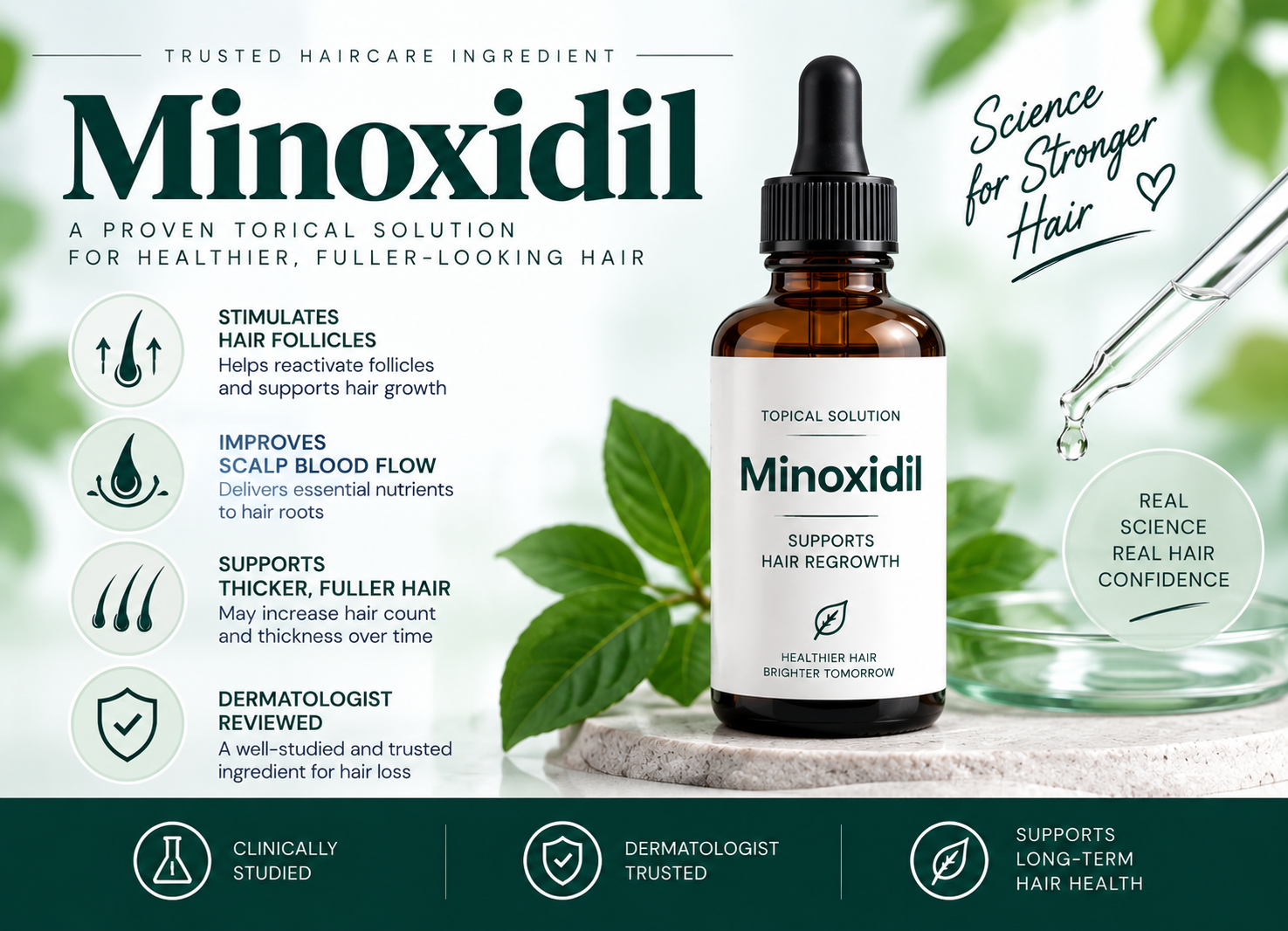
💉
Minoxidil

Premium ingredient visual slot · 720×520 WebP

Quick Summary

Minoxidil at a Glance

What it is

Topical medicine

Best for

Selected pattern (androgenetic) hair loss

Evidence level

Strong (medicine-level)

Doctor guidance

Recommended — doctor-guided

Medical Review & Editorial Transparency

Reviewed for Safety, Evidence & Honest Claims

🩺

Reviewed by: Dr. Amit Agarkar, MD Dermatology

Medical focus: Dermatology, trichology, hair loss, scalp disorders and hair restoration.

Last reviewed: 1 June 2026

Editorial promise: This page explains benefits, limitations, side effects and safe use without exaggerating hair-growth claims.

Content Transparency

Who, How & Why This Guide Was Created

Who created this guide?

Prepared by the Hairsncares editorial team and medically reviewed by a dermatologist experienced in hair and scalp disorders.

How was it reviewed?

Checked for ingredient role, evidence level, safety warnings, medical limitations and suitability for Indian haircare users.

Why was it created?

To help you choose ingredients safely and understand when a dermatologist diagnosis matters more than trying products randomly.

Evidence Grade

Evidence Grade for Minoxidil

ParameterAssessmentWhat it means
Evidence levelStrong (medicine-level)How strong the support is for this ingredient in hair or scalp care.
Best use caseSelected pattern (androgenetic) hair lossThe situation in which it may genuinely help.
Not suitable forSudden, patchy, scarring or unexplained loss; scalp infection; pregnancy; breastfeeding; teens; heart/BP without reviewWhen a dermatologist diagnosis is needed before use.
Expected timeline3–6+ months of consistent use; benefit only while continuedResults vary based on diagnosis, consistency, formulation and scalp condition.
Suitability & Safety

Best For vs Avoid If

May be suitable for

  • Selected pattern (androgenetic) hair loss
  • People with a clear, non-emergency concern and realistic expectations
  • Use within a sensible, dermatologist-aware routine

Avoid or ask a doctor if

  • Hair loss is sudden, severe, patchy, painful or with scalp infection.
  • You are pregnant, breastfeeding, a teenager, or using prescription medicines.
  • You have an unclear diagnosis, scarring hair loss, fungal infection or active scalp disease.

This ingredient should be used only with appropriate doctor guidance. Do not self-start, combine, stop, or increase dosage without medical advice.

Stop and seek care for dizziness, chest pain, palpitations or swelling.

Compare

Compare Minoxidil With Related Ingredients

Product Discovery

Explore Product Types Containing Minoxidil

Product results should be selected based on scalp type, diagnosis, sensitivity, routine compatibility and dermatologist guidance where needed.

Find Products After AI Hair Test
Visual Guide

Minoxidil Visual Guide

⚙️
How Minoxidil may support hair or scalp care.
🛡️
Safety and suitability depend on diagnosis and user profile.
📋
Routine compatibility matters more than random product use.
Quick Answers

Quick Answers About Minoxidil

Is Minoxidil good for hair growth?

Minoxidil may help in selected situations depending on its evidence level, diagnosis, formulation and consistency. It should not be treated as a guaranteed regrowth solution for every type of hair loss.

How long does Minoxidil take to work?

Timelines vary. Medicines and deficiency-based treatments may take months, while cosmetic oils or hydration ingredients may mainly improve feel, shine or manageability sooner.

Can I use Minoxidil without a diagnosis?

Cosmetic ingredients may be used carefully, but medicines, persistent hair fall, patchy loss, scalp disease or sudden shedding need dermatologist evaluation.

Can Minoxidil be combined with other ingredients?

Combination depends on scalp sensitivity, diagnosis, product type and whether the ingredient is cosmetic, supplement-based or prescription-guided.

Who should avoid Minoxidil?

People with allergies, irritation, active scalp disease, unclear diagnosis, pregnancy, breastfeeding or prescription-medicine concerns should check suitability before use.

Evidence LevelStrong / Doctor-Guided Medicine

Strong evidence for selected pattern hair loss, but not suitable for every hair fall. Doctor guidance is important.

AI Summary

Minoxidil for Hair and Scalp in Simple Terms

Minoxidil is a doctor-guided medicine for selected pattern hair loss.

It may help with selected pattern (androgenetic) hair loss, with guidance — but it should not be treated as a cure for every hair or scalp concern.

Bottom line: use this guide to understand evidence, safety and product suitability, then take the AI Hair Test or consult a dermatologist. Results vary.

Ingredient Type

Is Minoxidil a Medicine, Active or Cosmetic?

Minoxidil is a medicine used for selected pattern hair loss. It is not a cosmetic hair serum and is not suitable for every type of shedding.

Evidence-Safe Summary

What Minoxidil Can and Cannot Do

May Help With

  • Selected pattern (androgenetic) hair loss, with guidance
  • Maintaining/supporting density for suitable users
  • A recognised topical option after assessment

Cannot Promise

  • Regrowth in every person
  • Use for sudden, patchy or scarring loss
  • Safety without review in pregnancy, breastfeeding, teens or heart/BP concerns
  • Better results purely from higher strength
Medicine Safety

Minoxidil Is Not for Every Hair Fall

Minoxidil may be useful for selected pattern hair loss, but it should not be started casually for sudden, patchy, scarring, fungal or unexplained hair loss.

  • Doctor review is important in pregnancy, breastfeeding, teens, heart/BP concerns or scalp inflammation.
  • Higher strength is not automatically better.
  • Foam and solution differ in feel and irritation risk; neither is universally better.
  • Seek care for dizziness, chest symptoms, swelling, palpitations or severe irritation.
Pattern vs Sudden

Pattern Loss vs Sudden/Patchy Loss — and 5% vs 10%, Foam vs Solution

Minoxidil has the best support for patterned (androgenetic) thinning. It is not the right first move for sudden diffuse shedding, patchy loss, scarring or suspected fungal loss — those need a diagnosis. On strength, higher is not automatically better: 5% vs 10% is a tolerance trade-off, and 10% can irritate more. On format, solution vs foam differ in feel and propylene-glycol sensitivity; neither is universally superior.

Early "shedding" in the first weeks can occur and is different from a side effect — but dizziness, palpitations, swelling or chest symptoms mean stop and seek care. Read MedlinePlus minoxidil information, browse minoxidil, and check suitability via consultation.

Doctor-Guided Decision Matrix

Should You Consider Minoxidil?

Educational guidance, not a diagnosis. Results vary.

May Be Reasonable When

  • You have a patterned hair-loss pattern
  • A doctor has assessed suitability
  • You can use it consistently and be monitored

Be Careful When

  • Sudden, patchy, scarring or fungal-looking loss
  • Heart/BP conditions or scalp inflammation
  • Strong irritation, dizziness or palpitations
  • Pregnancy, breastfeeding, teens or medical conditions

See a Doctor First When

  • Sudden or severe hair fall
  • Patchy hair loss
  • Progressive thinning
  • Scalp pain, pus, crusting, bleeding or thick plaques
  • Child scalp scaling
  • Suspected fungal infection, psoriasis, folliculitis or scarring alopecia
Related Ingredient Guides

Compare More Hair & Scalp Ingredients

Personalised Hair & Scalp Guidance

Does Minoxidil Fit Your Concern?

This guide is educational. For sudden, patchy, progressive or unexplained hair loss, or scalp pain, pus, crusting or thick plaques, screen with an AI tool or see a dermatologist.

Your Cart (0)

Your cart is empty

Subtotal0
DeliveryFREE
Total0
🔒 Secure📦 Free above ₹499↩ Easy returns
💬 Hi! I'm Dr. Amit — your Hair Intelligence consultant
🌿
1
🌿
Dr. Amit
Virtual Dermatologist · Hairsncares.com
Online
What are you shopping for today?
Select a category to begin
AI-powered scalp diagnosis · Hairsncares.com
📸
Scalp Analyser
Upload scalp photo · Get conditions, root cause, and matched product protocol
📷
Drop scalp photo here or click to upload
JPG, PNG, WEBP · Clear, close-up, well-lit photo

Your image is processed privately by our AI engine and saved securely with your account.