Hair Loss: Causes & Treatment
Dermatologist-led overview of how hair loss is evaluated and the evidence behind common treatments.
View AAD reference ›Crown thinning — reduced density over the vertex, the top-back of the scalp — affects both men and women. In men it is often an early sign of pattern hair loss; in women it overlaps with female pattern thinning and causes like PCOS. It responds best when addressed early. Hairsncares helps you check the crown with an AI hair test and guides you toward dermatologist-reviewed products, a routine and the right medical referral.
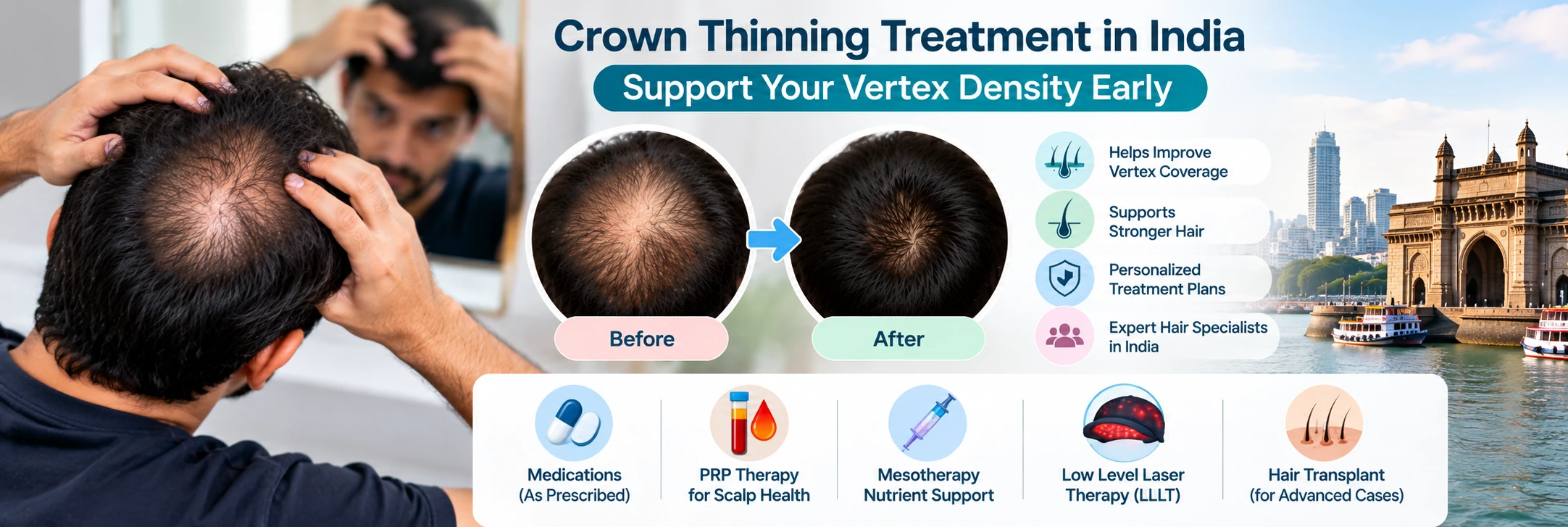
Illustrative sample only. AI screening helps guide product choice and does not replace a dermatologist's diagnosis.
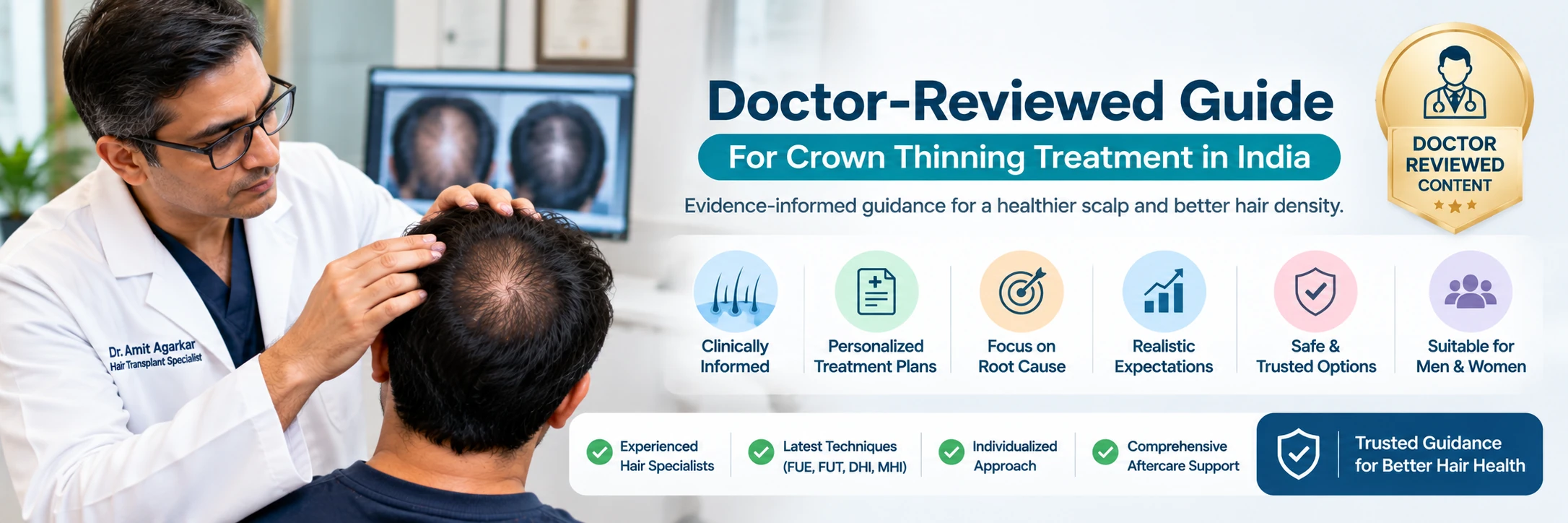
The most effective approach is to confirm the cause and act early. For pattern-related crown thinning, Minoxidil has the strongest evidence and may support vertex density in suitable, assessed cases, with serums, supportive shampoos and a healthy scalp adding to the routine. In women, treating any hormonal cause such as PCOS matters too. Active and prescription treatments need dermatologist guidance and are not used in pregnancy or breastfeeding. Start with an AI hair test to check your crown.
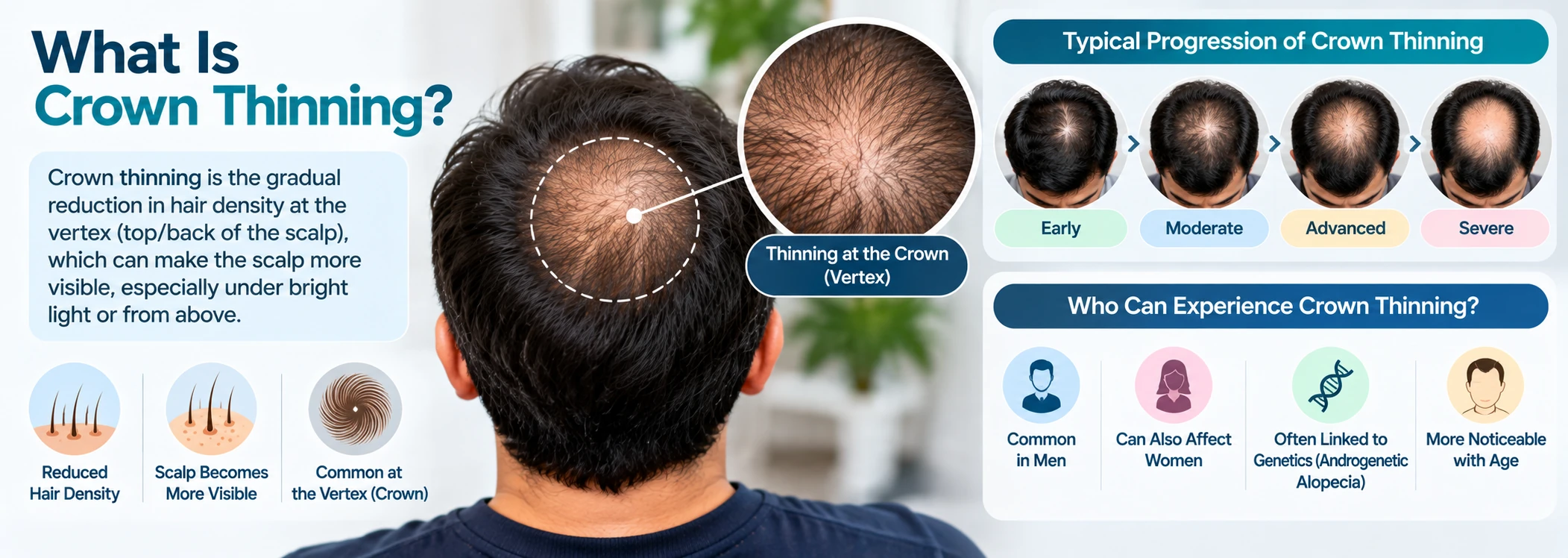
Crown thinning is reduced hair density over the crown or vertex — the top-back of the scalp, where the hair forms a natural swirl. As density drops, the scalp shows through more in this area, especially in photos taken from above or under bright light. It is one of the most common areas to thin first.
The most frequent cause is androgenetic alopecia (pattern hair loss), where androgen-sensitive follicles at the crown gradually miniaturise — growing finer and shorter over time. But crown thinning is not always pattern loss: it can also reflect PCOS in women, thyroid issues, nutritional deficiency, stress-related shedding or ageing. Because the causes differ in how they are treated, confirming the cause is the key first step.
| Aspect | What it means in crown thinning |
|---|---|
| Area | Crown / vertex (top-back of scalp) |
| Most common cause | Pattern hair loss (androgenetic alopecia) |
| Other causes | PCOS, thyroid, deficiency, stress, ageing |
| Affects | Both men and women |
| Best approach | Confirm cause + act early |
| Pace | Gradual; responds slowly over months |
Want to check your crown density?
Learn MoreCrown thinning can be hard to see in the mirror because it is at the back. These signs help you spot it early.
More scalp visible at the crown in photos from above
A widening swirl or whorl at the vertex
Reduced density at the top-back vs the sides
Scalp showing under bright or overhead light
Finer, shorter hairs over the crown
Others noticing the crown before you do
In men, sometimes alongside a receding hairline
In women, a widening parting toward the crown
Gradual change over months to years
Hard to judge the back of your head?
Learn More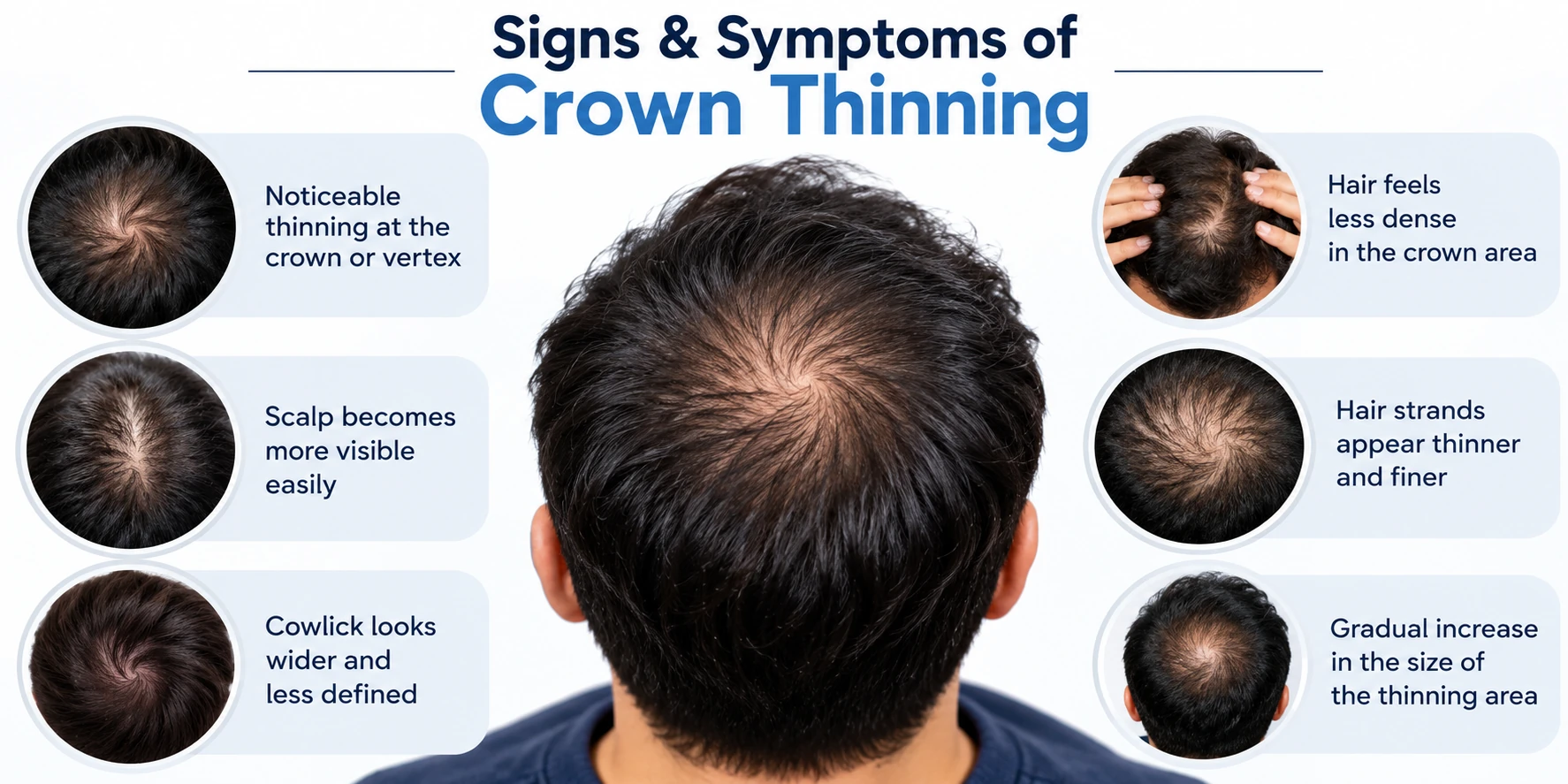
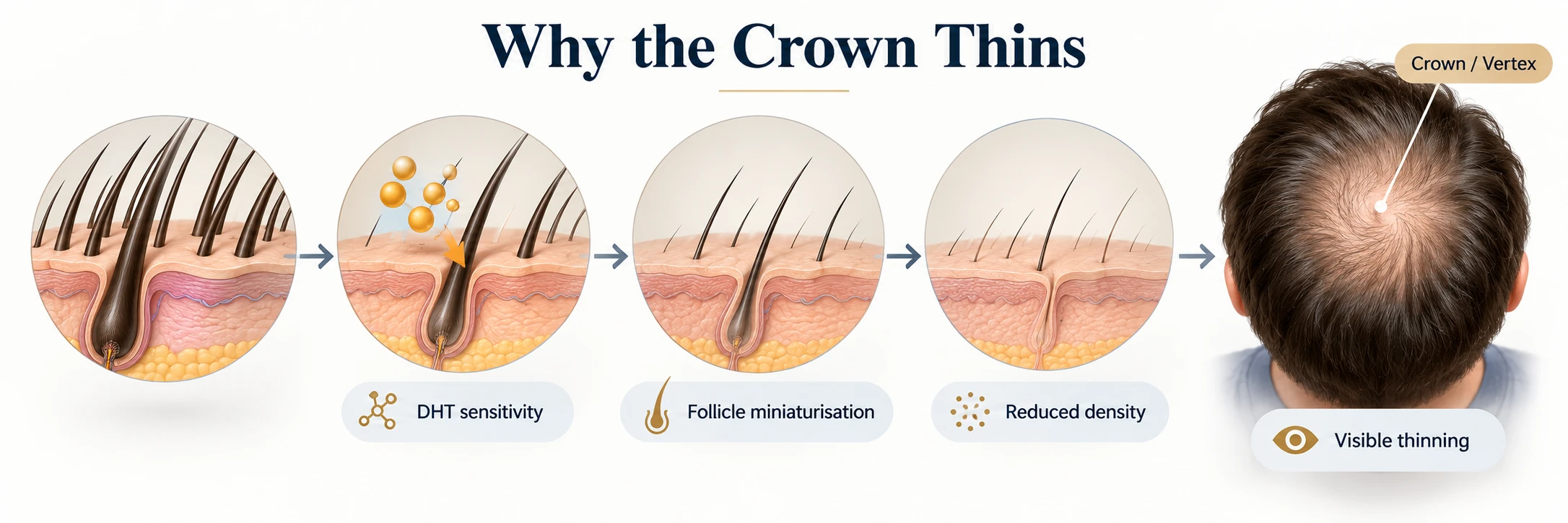
In pattern hair loss, follicles over the crown are especially sensitive to androgens (in particular DHT). Over repeated hair cycles, these follicles miniaturise: each new hair grows a little finer, shorter and lighter, until the area looks sparse. The crown and vertex are common early sites because of this sensitivity, which is why they often thin before other areas.
In women, the same androgen-driven process can affect the crown, sometimes amplified by PCOS or other hormonal factors. Separately, temporary causes — telogen effluvium from stress or illness, low iron or vitamin D, or thyroid changes — can reduce density across the scalp, including the crown, without being pattern loss.
This is why cause matters. Pattern-related crown thinning responds best to early, consistent treatment of the follicles, while thinning from a temporary trigger often recovers once that trigger is corrected. The two are managed differently, so confirming which applies guides the right plan.
Want to know your likely cause?
Learn MoreThis simple, educational guide is not a clinical grading. Men's pattern crown loss is often described on the Norwood scale and women's on the Ludwig scale — an assessment gives a more accurate picture.
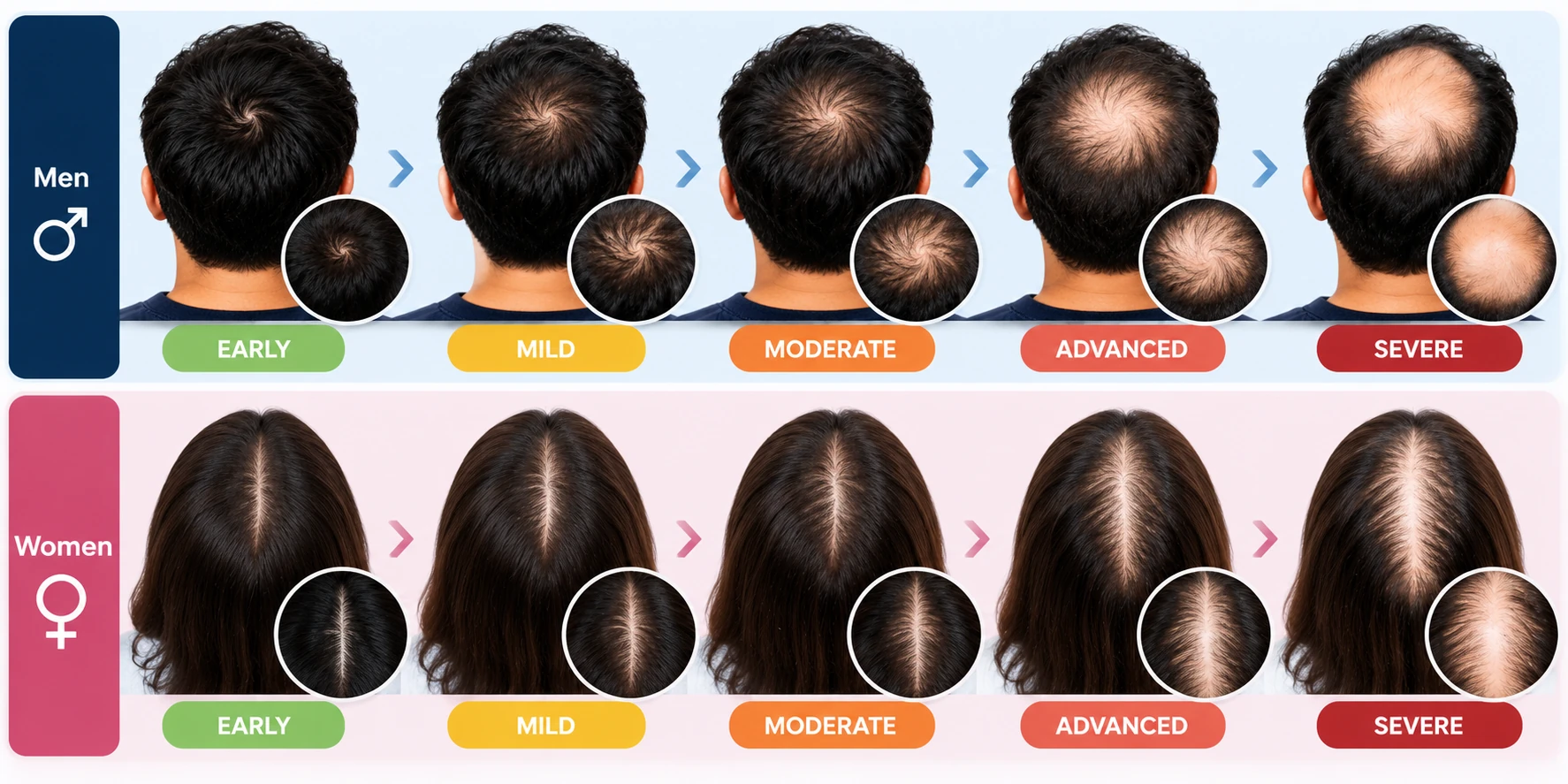
Wondering which stage you're at?
Learn MoreThe crown thins for related reasons in both, but the pattern, common causes and best-suited treatments differ.
| Aspect | Men | Women |
|---|---|---|
| Typical pattern | Vertex (crown) thinning, often with hairline recession | Crown thinning with a widening parting; hairline usually kept |
| Scale used | Norwood (vertex involvement) | Ludwig |
| Common causes | Androgenetic alopecia (DHT sensitivity) | Female pattern loss, PCOS, thyroid, deficiency |
| Often-suited actives | Topical Minoxidil; oral options under doctor care | Topical Minoxidil for women; treat hormonal cause |
| Key extra step | Assess overall Norwood pattern | Check for PCOS / thyroid / iron |
| Pregnancy / lactation | Not applicable | Avoid active treatments unless doctor-advised |
Want guidance specific to you?Explore the men's or women's hair loss guides.
Men's Hair LossWomen's Hair LossKnowing how crown thinning differs from other patterns helps target the right plan.
| Feature | Crown thinning | Receding hairline | Diffuse shedding (TE) | Patchy loss (areata) |
|---|---|---|---|---|
| Area | Crown / vertex | Front & temples | All over | Round patches |
| Onset | Gradual | Gradual | Sudden, after a trigger | Sudden, localised |
| Usual cause | Pattern hair loss | Pattern hair loss | Stress, illness, diet | Autoimmune |
| Recovery | Stabilise / support early | Stabilise / support early | Often recovers with cause fix | Needs dermatologist |
| Next step | Confirm cause, act early | Assess pattern | Find & fix trigger | See dermatologist |
Not sure which pattern you have? The cause finder weighs your pattern and symptoms.
Take Hair Fall Cause FinderTelogen Effluvium Guide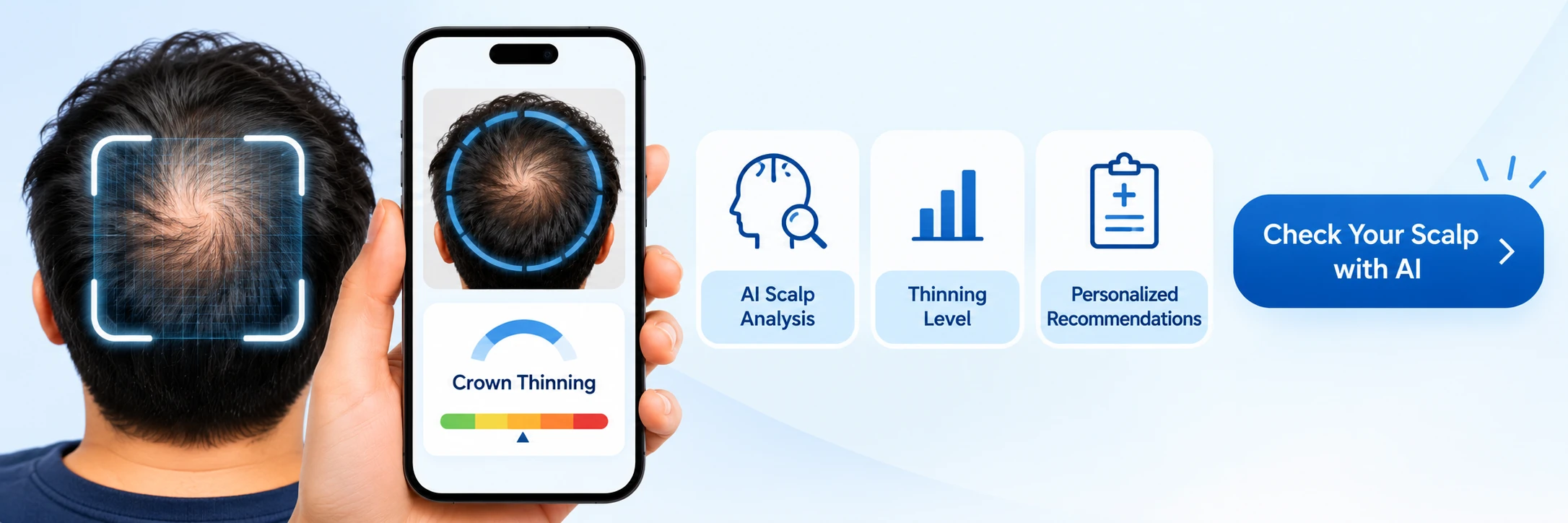
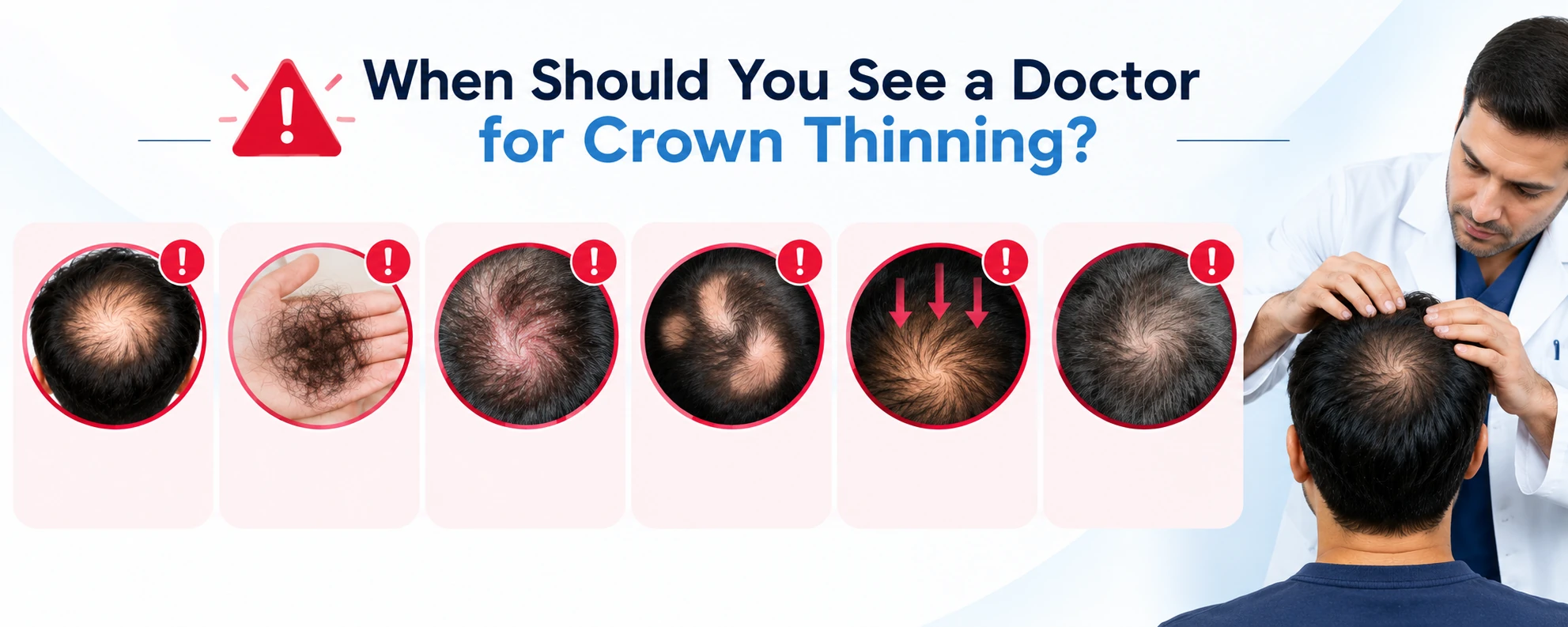
Crown thinning responds best when addressed early, so do not wait too long. Please see a doctor if any of the following apply.
These products support crown density alongside confirming and treating the cause. They are supportive, not a guaranteed cure for pattern hair loss.
Saw palmetto and similar; discuss with your doctor.
Not sure which fits you? The Product Finder matches options to your pattern.
Open Product FinderBrowse AllSample selection. Prices, ratings and availability shown are placeholders.
Final product suitability depends on diagnosis, age, sex, scalp condition, pregnancy/lactation status, medical history, current medicines, and doctor guidance where required. Supportive products do not guarantee regrowth or cure pattern hair loss. Prescription (Rx) items require a valid prescription from a Registered Medical Practitioner. Active treatments such as Minoxidil are generally not recommended during pregnancy or breastfeeding without medical advice.

Choose the routine closest to your situation. Use active or prescription items only under dermatologist guidance, and avoid them in pregnancy or breastfeeding unless a doctor advises.
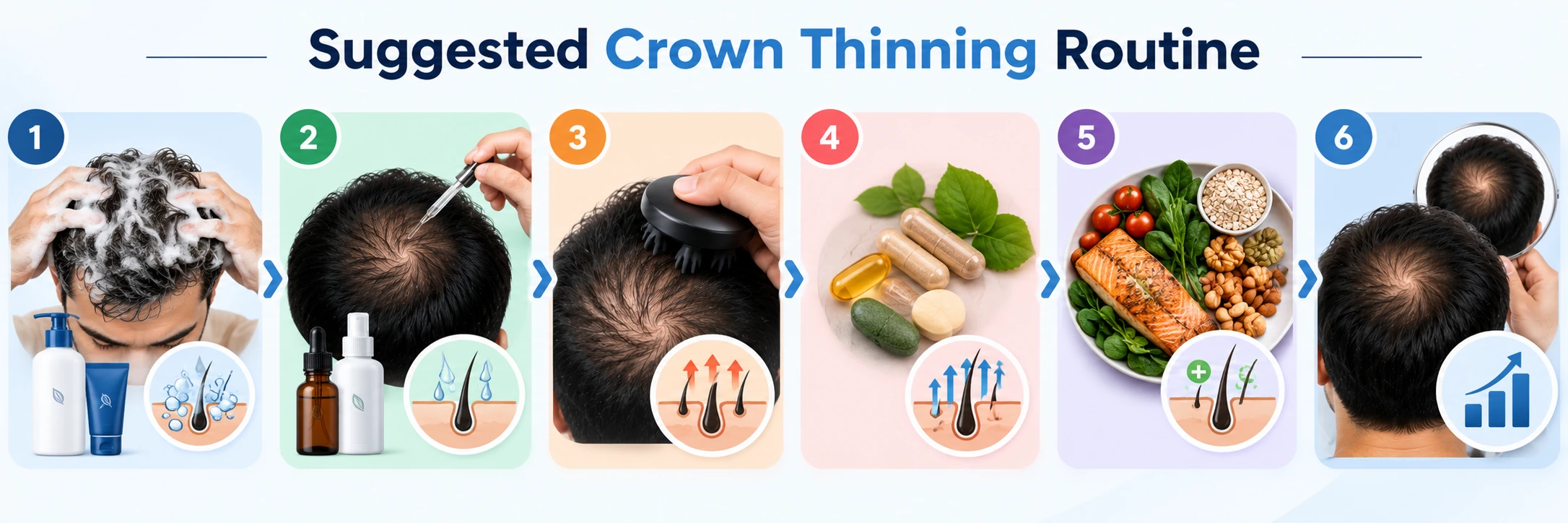
Gentle growth-support shampoo on wash days.
Apply a supportive density serum across the crown.
Light scalp care; avoid heavy products at the roots.
Crown photos from above at the same angle; note density.
Ketoconazole or anti-dandruff shampoo as directed.
Light scalp serum; density serum if advised.
Keep medicated shampoo on schedule; clarify gently.
Track oiliness, flaking and crown density together.
Gentle cleanse; take any prescribed treatment as directed.
Doctor-guided Minoxidil to the crown only if prescribed and suitable.
Maintain consistency; report side effects to your doctor.
Review crown density and tolerance with your dermatologist.
Style to add volume; apply hair fibres for instant crown cover.
Cleanse off fibres; continue your supportive serum.
Combine cosmetic cover with the underlying treatment plan.
Track real density separately from cosmetic cover.
Want a routine built around your result?
Learn MoreEvidence labels are a simple guide: strong, moderate, supportive or mainly cosmetic. Rx marks prescription items; the rose tag flags pregnancy/lactation caution.
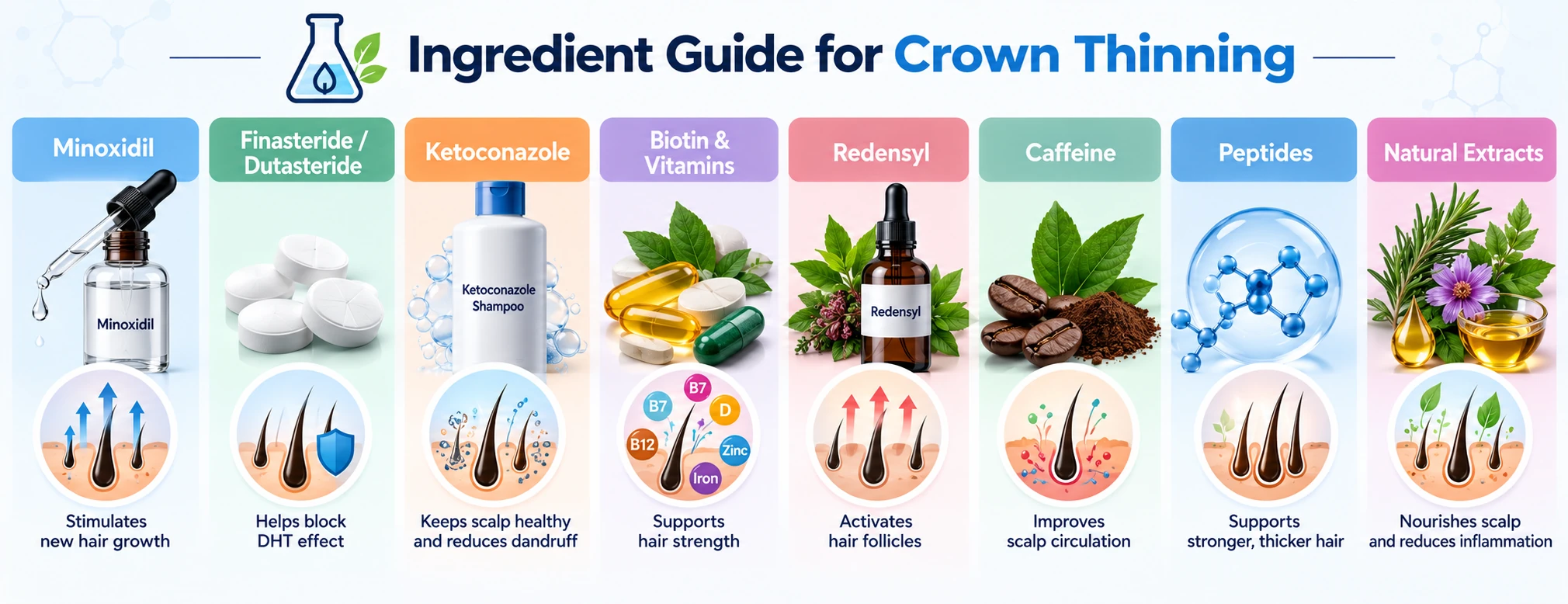
Pregnancy & breastfeeding note: if you are pregnant, trying to conceive or breastfeeding, do not start Minoxidil, saw palmetto or other active treatments without your doctor's advice. This applies to women using these products for crown thinning.
The best-evidenced topical for vertex / crown pattern thinning.
Best for: assessed crown thinning
Caution: doctor-guided; not in pregnancy/breastfeeding; consistent long-term use.
Related productsAn antifungal shampoo that also supports a healthy scalp.
Best for: oily, flaky scalp with thinning
Caution: follow directed frequency; ask a doctor if pregnant/nursing.
Related productsA cosmetic complex studied for supporting follicles.
Best for: early crown thinning
Caution: supportive, not a replacement for proven actives.
Related productsA cosmetic active marketed for density.
Best for: early thinning support
Caution: evidence is limited compared with Minoxidil.
Related productsA botanical marketed for DHT / androgen support.
Best for: supportive use, doctor-discussed
Caution: limited evidence; avoid in pregnancy; ask your doctor.
Related productsA common topical haircare ingredient.
Best for: supportive cosmetic use
Caution: evidence is limited.
Related productsA botanical with some small-study interest.
Best for: supportive cosmetic use
Caution: patch test; dilute; can irritate sensitive scalps.
Related productsA B-vitamin involved in hair structure.
Best for: confirmed deficiency
Caution: limited benefit without deficiency; can affect lab tests.
Related productsLow iron can add to thinning across the scalp.
Best for: confirmed low iron
Caution: take only under medical guidance after testing.
Related productsDeficiency is linked to increased shedding.
Best for: confirmed deficiency
Caution: test before high-dose use.
Related productsA mineral involved in hair tissue health.
Best for: confirmed deficiency
Caution: avoid excess; confirm need first.
Ask doctorCling to existing hair to mask a visible crown instantly.
Best for: appearance on the day
Caution: cosmetic only; does not treat thinning.
Related products"The crown is one of the first areas to show pattern hair loss, and it is also one of the most responsive when treated early. My main message is: confirm the cause first. In men I look at the overall Norwood pattern; in women I check for hormonal causes like PCOS or thyroid before assuming it is simple pattern loss. Minoxidil has the best evidence for the vertex, but it works best as part of a plan and needs consistency. Acting early, with the right cause in mind, gives the best chance of stabilising and supporting density."
Want a cause-based crown plan?
Learn MoreCurated supportive combinations. Timelines are general estimates; results vary and are not guaranteed.
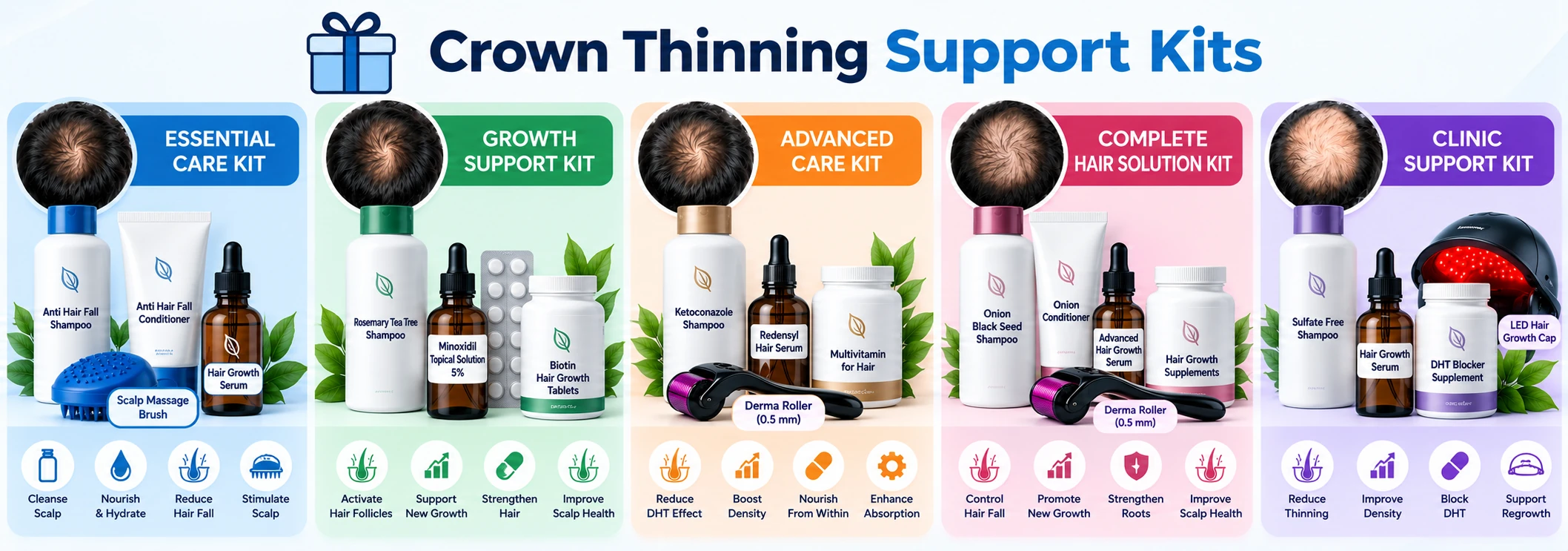
Prefer a kit tailored to you? Build a custom kit from your screening result.
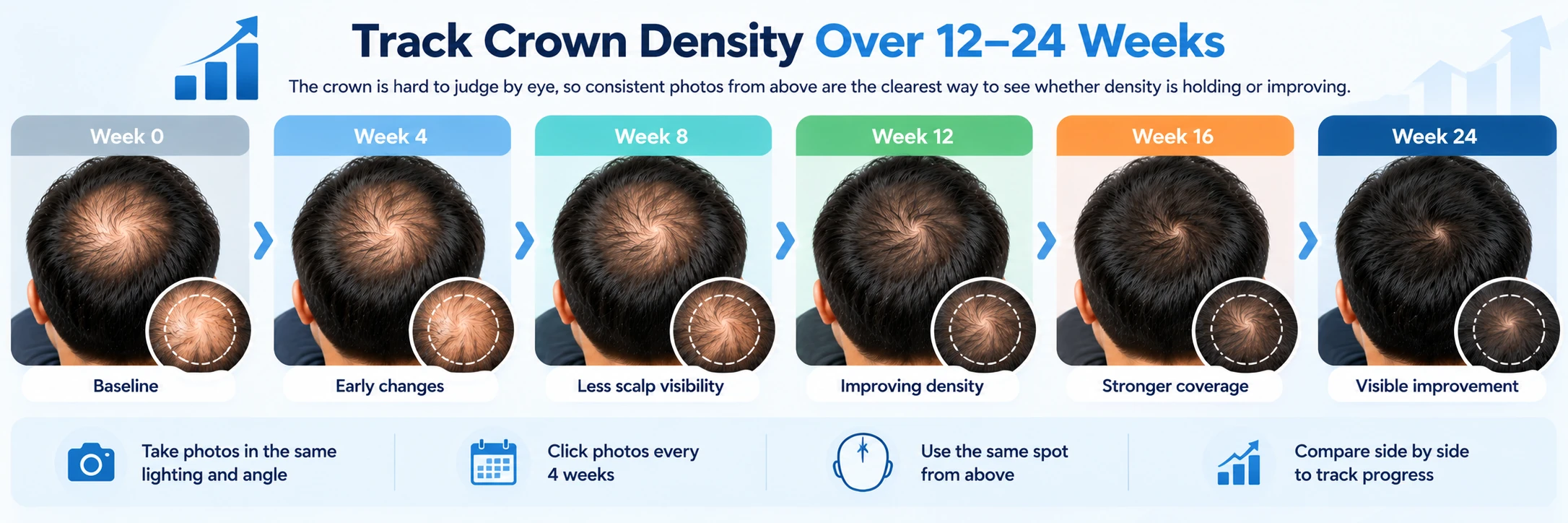
Build a Custom KitTake AI Hair TestThe crown is hard to judge by eye, so consistent photos from above are the clearest way to see whether density is holding or improving.

These references are provided for patient education and do not replace a dermatologist’s diagnosis or individual medical advice.
Dermatologist-led overview of how hair loss is evaluated and the evidence behind common treatments.
View AAD reference ›Patient-education summary of genetic, DHT-driven pattern hair loss in men and women.
View MedlinePlus reference ›Searchable index of peer-reviewed research on hair loss.
Search PubMed ›Independent systematic reviews assessing the evidence behind hair-loss interventions.
View Cochrane Library ›
Question not answered here? Ask Dr Aria for instant guidance or book a consultation.
Ask Dr AmitConsult a DoctorCrown thinning responds best when you act early. Take the Hairsncares AI Hair Test to check your vertex density, screen the likely cause, build a supportive routine, and get the dermatologist assessment that confirms the right plan.
A clear, dermatologist-reviewed overview — what it is, the evidence behind treatment options, and the red flags that mean a doctor should look first. No exaggerated regrowth claims.
Results vary based on diagnosis, consistency, formulation and scalp condition.
Premium concern visual slot · 720×520 WebP
Thinning at the crown or vertex, commonly part of pattern (androgenetic) hair loss
Adults with pattern hair loss — affects both men and women
Strong for Minoxidil at the crown; doctor-guided options
Recommended — confirm the diagnosis first
Reviewed by: Dr. Amit Agarkar, MD Dermatology
Medical focus: Dermatology, trichology, hair loss, scalp disorders and hair restoration.
Last reviewed: 1 June 2026
Editorial promise: This page explains causes, treatment evidence, limitations and safe next steps without exaggerating hair-growth claims.
Prepared by the Hairsncares editorial team and medically reviewed by a dermatologist experienced in hair and scalp disorders.
Checked for accuracy of causes, treatment evidence, safety warnings, limitations and suitability for Indian users.
To help you understand this concern and choose safe next steps, and to know when a dermatologist diagnosis matters most.
| Parameter | Assessment | What it means |
|---|---|---|
| What it is | Thinning at the crown or vertex, commonly part of pattern (androgenetic) hair loss | The nature of this concern in plain terms. |
| Who it affects | Adults with pattern hair loss — affects both men and women | The people in whom it is most commonly seen. |
| Best-evidence options | Strong for Minoxidil at the crown; doctor-guided options | Where the strongest support lies — most are doctor-guided. |
| When to see a doctor | Sudden, patchy, painful or rapidly worsening loss; scarring or fungal loss | Situations needing diagnosis before any treatment. |
| Expected timeline | Months of consistent treatment; benefit maintained only while continued | Results vary based on diagnosis, consistency, formulation and scalp condition. |
Sudden, patchy, painful or rapidly worsening crown loss needs a dermatologist before any treatment.
Product results should be selected based on diagnosis, scalp type, sensitivity, routine compatibility and dermatologist guidance where needed.
Find Products After AI Hair TestThinning at the crown or vertex, commonly part of pattern (androgenetic) hair loss. The exact cause should be confirmed, because look-alike conditions are treated differently.
Strong for Minoxidil at the crown; doctor-guided options. Most effective options are doctor-guided, and results depend on diagnosis, consistency and realistic expectations.
Months of consistent treatment; benefit maintained only while continued.
For sudden, patchy, painful or unexplained loss, yes — see a dermatologist before treating. A suitability screen helps you understand likely causes.
Sudden, patchy, painful or rapidly worsening loss; scarring or fungal loss — these need evaluation before any product or medicine.
Often pattern-related at the vertex, but may overlap with diffuse shedding, PCOS, thyroid, deficiency or stress-related hair fall.
This page provides educational guidance. The AI checker can screen patterns, but diagnosis and any prescription decision need a dermatologist. Results vary.
Visible scalp at the top-back, often pattern-related.
Overall shedding from stress, illness, deficiency or telogen effluvium.
Widening part and crown thinning in women, often needing assessment.
PCOS, thyroid, iron deficiency, postpartum or medication triggers may overlap.
The crown is hard to see, so consistent top-down photos (same light, angle and parting, every 4–8 weeks) are the most reliable way to judge real change versus a bad-lighting day. In men, isolated crown/vertex thinning is commonly pattern-related; in women, crown and a widening part often point to female pattern thinning that benefits from assessment. Either way, diffuse shedding and medical contributors — thyroid, iron deficiency, PCOS, postpartum or medication — can overlap and are worth ruling out with blood work where relevant.
Answer a few questions about your hairline, crown, shedding, family history, scalp symptoms and product use. This is a screening aid, not a diagnosis — sudden, patchy, scarring or painful loss needs a dermatologist.
Your cart is empty