ADVANCED DOCTOR-GUIDED DHT-BLOCKING MEDICINE

Dutasteride for Hair Loss in India: Uses, Benefits, Side Effects, Safety & Doctor-Guided Treatment

Strong / medicine-levelPrescription-typeSpecialist-guided

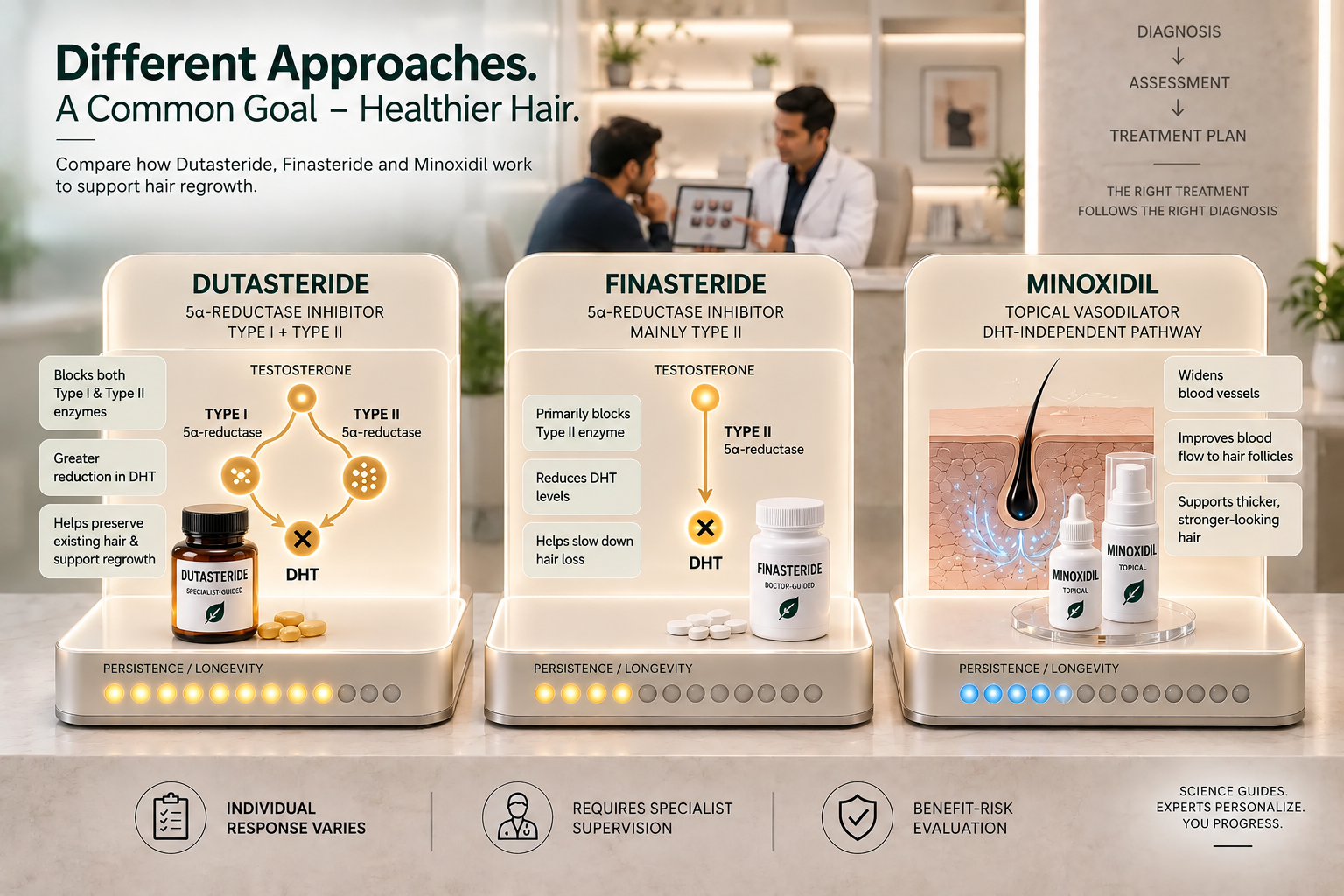
Dutasteride is a doctor-guided 5-alpha reductase inhibitor that affects DHT pathways more broadly than Finasteride, blocking both type I and type II enzymes and persisting longer in the body. It may be considered in selected male pattern hair-loss cases under specialist supervision, but it is not suitable for everyone, not automatically better than Finasteride, and should not be self-started. Not for women, pregnancy, breastfeeding or teenagers without specialist guidance. Check suitability with the AI Hair Test, then a specialist. Results vary.

  • Strong / specialist-guided — selected pattern loss
  • Blocks DHT more broadly than Finasteride
  • Longer half-life — persists in the body
  • NOT automatically better than Finasteride
  • Not for women / pregnancy / teens without specialist care
💉
DutasterideStrong / medicine-level
CategoryPrescription-type medicine
ActionLowers DHT broadly (type I+II)
EvidenceStrong / specialist-guided
Half-lifeLong — persists in body
Doctor guidanceStrictly required

Illustrative summary only. This is education, not a diagnosis or prescription; results vary and depend on your situation.

🩺
Doctor-reviewedMD Dermatology
📊
Specialist-guidedselected cases
⚠️
Potent medicinebroad, long-acting
Suitability checkfree AI Hair Test
🚚
India-widedoctor-guided
Image slot
🩺
Doctor-reviewed ingredient guide — trust visualalt: "Dermatologist-reviewed dutasteride guide and AI screening" · 1200×400 WebP · loading="lazy"
Quick Answer

Is Dutasteride better than Finasteride for hair loss?

Dutasteride is not automatically better for everyone. It may be considered in selected doctor-guided cases — sometimes when Finasteride has not given the desired result — but it may also carry side-effect and safety considerations, and it persists in the body longer. Finasteride is more commonly used in many hair-loss protocols, while Dutasteride should be chosen only after dermatologist evaluation. Pharmacologically, Dutasteride does lower DHT more broadly (it blocks both type I and type II 5-alpha reductase, where Finasteride mainly blocks one), but stronger DHT reduction is not the same as being the right choice — a broader, longer-lasting effect also influences side-effect and discontinuation considerations. It is a prescription-type, specialist-guided medicine, not a cosmetic or supplement, and it is not for women without specialist guidance, pregnancy or exposure risk, breastfeeding, teenagers, fertility concerns, a mood history, liver disease or unclear diagnosis. It should not be combined with Finasteride without a prescription. Side effects can include reduced libido, ED, ejaculatory changes, breast tenderness, mood changes and fertility concerns; pregnant women should avoid exposure. Results take months and reverse if you stop. Check suitability with the AI Hair Test, then a specialist. Results vary.

Potent, specialist-guided medicine. Dutasteride is not automatically better than Finasteride and is not for women without specialist guidance, pregnancy or exposure risk, breastfeeding, teenagers, fertility/conception concerns, sexual side-effect concerns, a mood/depression history, liver disease, unclear diagnosis, or patchy/sudden/scarring loss — without specialist evaluation. Do not combine with Finasteride without a prescription. Pregnant women should avoid exposure, including leaking capsules. Its long half-life means effects and side effects can persist after stopping. Use only if prescribed by a specialist.
The Basics

What Is Dutasteride?

Dutasteride is a 5-alpha reductase inhibitor — a prescription-type medicine that lowers DHT, the hormone involved in male pattern hair loss. Unlike Finasteride, it blocks both the type I and type II forms of the enzyme, so it reduces DHT more broadly, and it stays in the body longer (a long half-life).

It is used medically for prostate conditions, and may be used — off-label or doctor-guided depending on the country and a doctor's judgement — in selected male pattern hair-loss cases. It is a specialist-guided medicine, not a cosmetic or supplement.

Because it is potent and long-acting, it sits at the "strong / strictly doctor-guided" tier and should be used only under specialist supervision — never self-started, and never assumed to be a simple "stronger upgrade" from Finasteride.
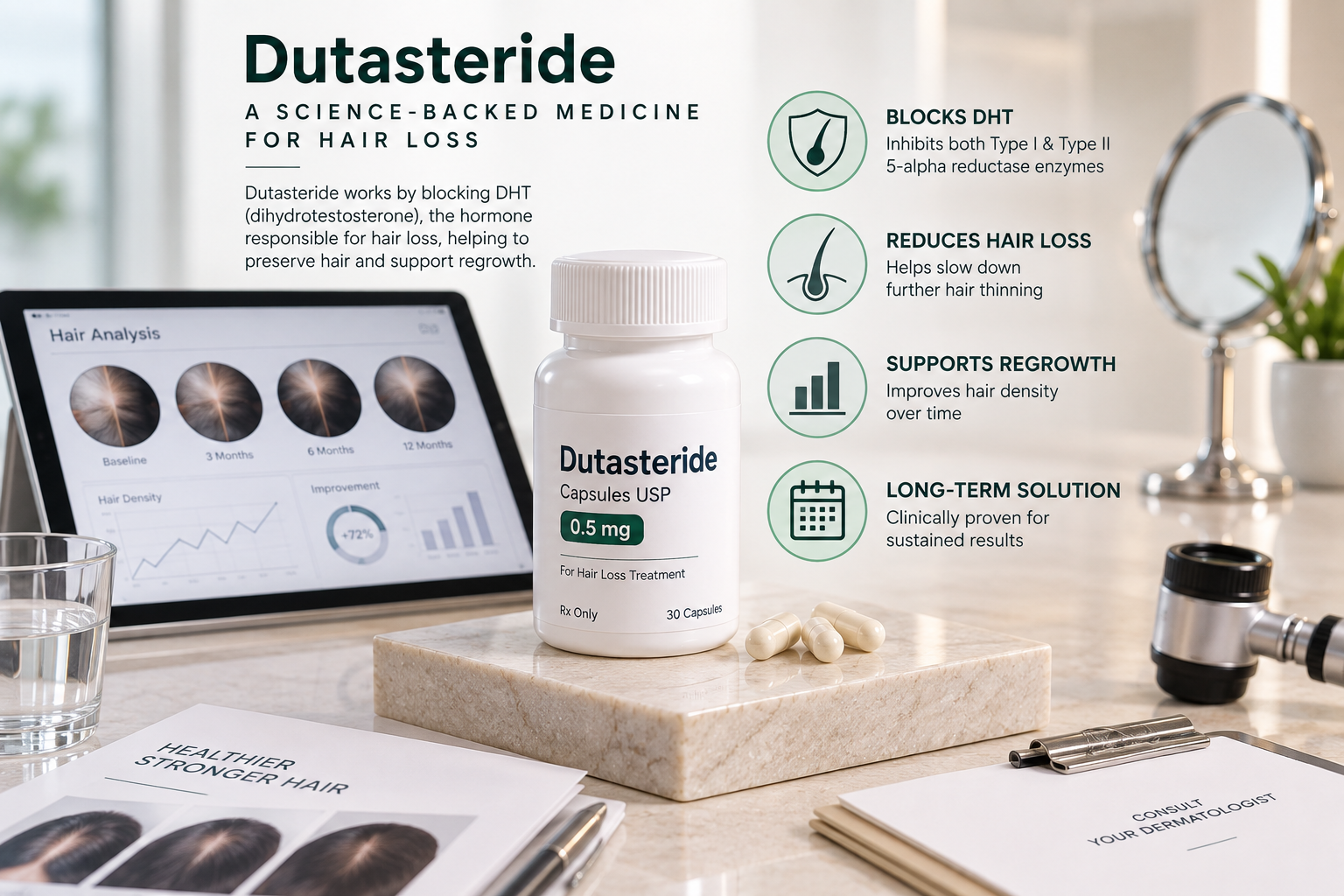
Image slot
🧪
Dutasteride — ingredient overview visualalt: "Dutasteride ingredient overview for haircare, dermatologist-reviewed" · 1200×700 WebP · loading="lazy"
Mechanism

How Dutasteride Works

In male pattern hair loss, DHT contributes to miniaturisation of genetically susceptible follicles. Dutasteride reduces DHT more broadly than Finasteride by inhibiting both type I and type II 5-alpha reductase, where Finasteride mainly blocks one form.

This greater DHT reduction may support selected male pattern hair-loss management in suitable, specialist-supervised cases — but more DHT suppression is not automatically better for a given person.

Its long half-life means it persists in the body for an extended period, so side effects and the timeline after stopping need careful, specialist discussion. Results take months, depend on a correct diagnosis and consistent use, and reverse over time if you stop. Results vary.
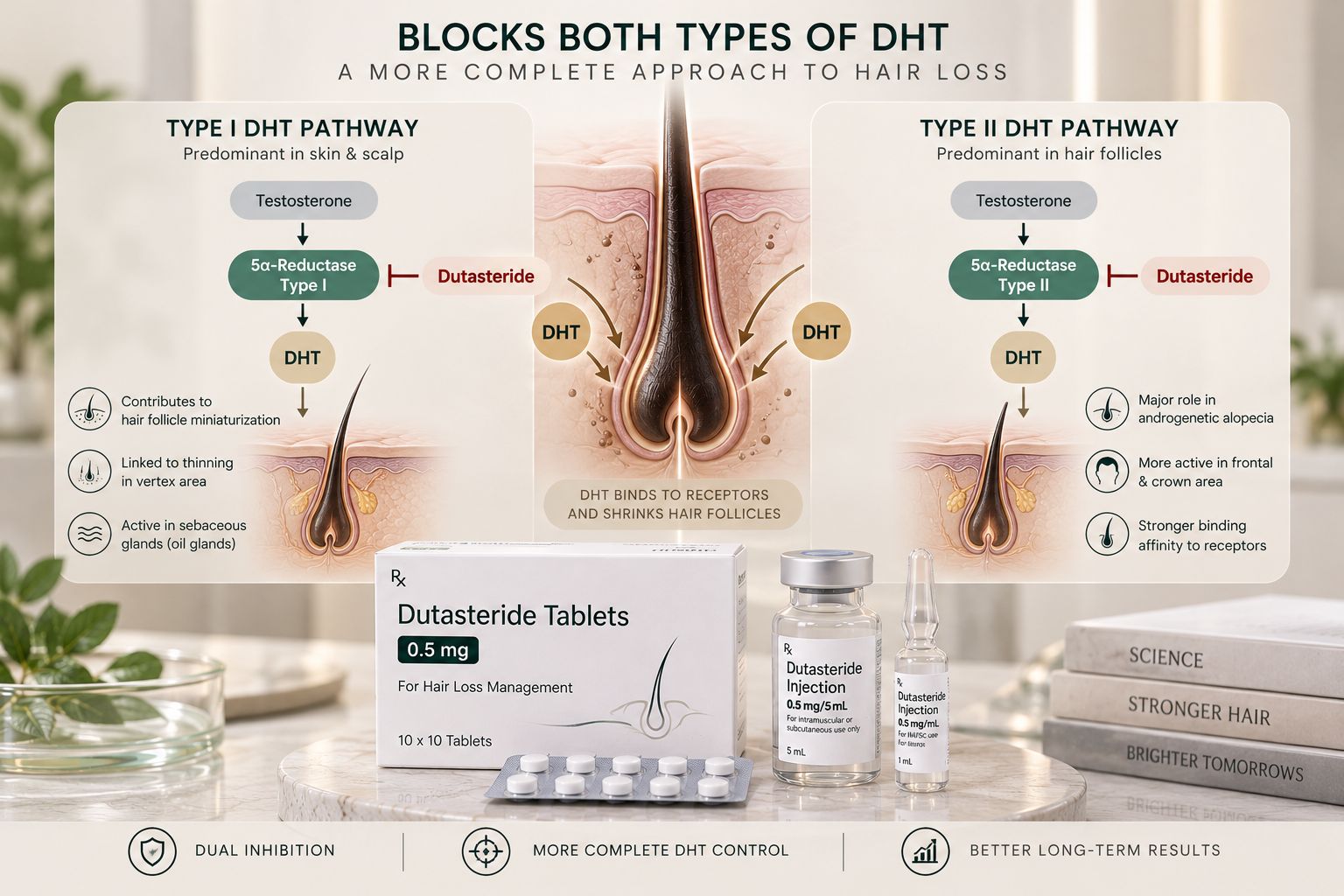
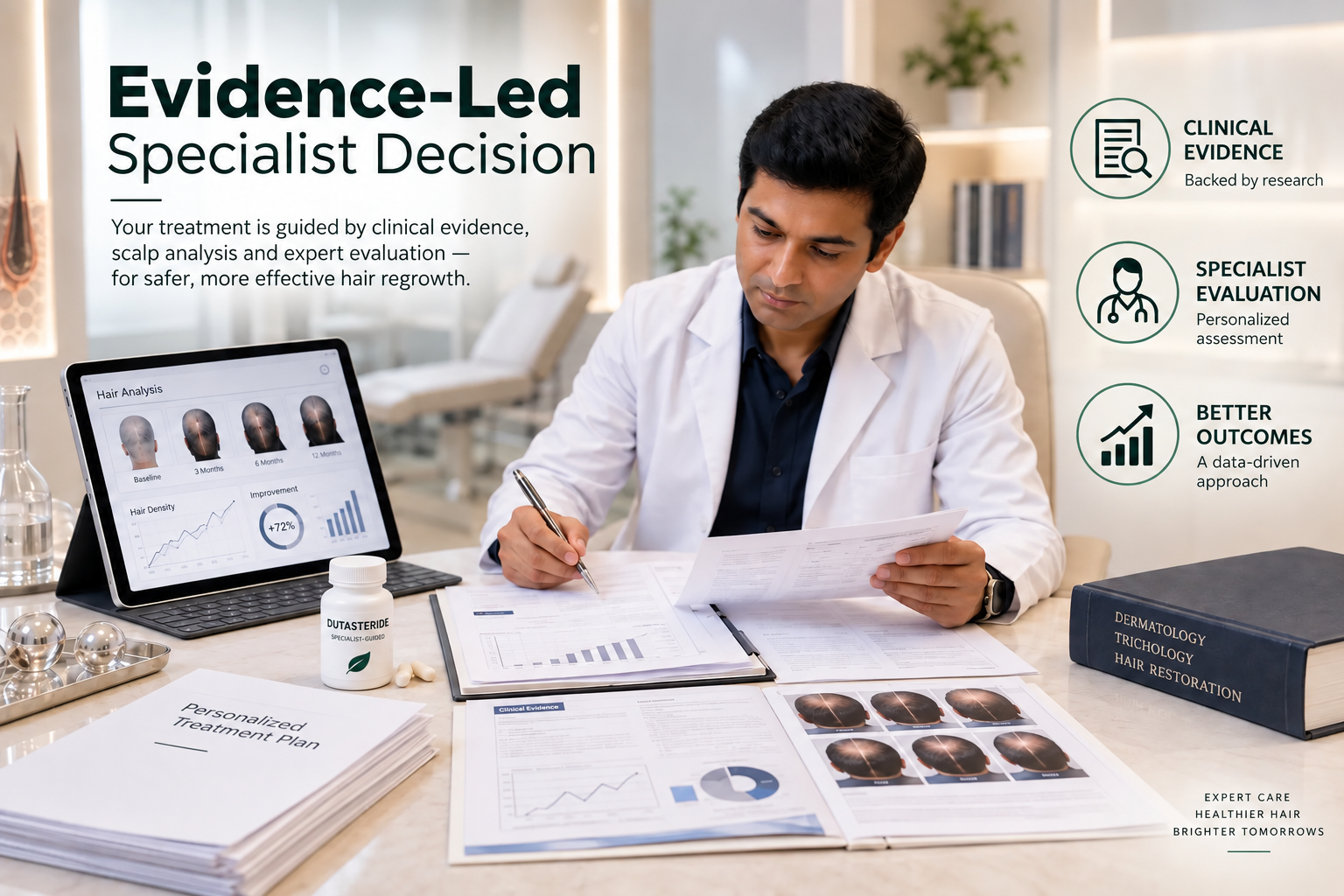
Image slot
⚙️
How Dutasteride works — mechanism visualalt: "How Dutasteride works on hair and scalp, illustrated" · 1200×600 WebP · loading="lazy"
Evidence

How Strong Is the Evidence?

Strong / medicine-level Dutasteride

Best supported for
Selected, specialist-confirmed cases of male pattern (androgenetic) hair loss — sometimes where Finasteride has not given the desired result — under close supervision.
Not proven to
It is not proven for non-pattern causes (telogen effluvium, patchy/alopecia areata, scarring alopecia, fungal infection, deficiency), is not automatically better than Finasteride, and is not a cosmetic, supplement or first-line self-started option.
Doctor guidance
Strictly required. Dutasteride is a potent, long-acting medicine: a specialist confirms the diagnosis, weighs it against Finasteride and other options, counsels on sexual, fertility and mood effects, and monitors closely.
Image slot
📊
Evidence snapshot — visualalt: "Evidence level snapshot for Dutasteride in haircare" · 1200×500 WebP · loading="lazy"
Suitability

Best For

Selected confirmed male pattern loss

Specialist-confirmed pattern loss where Dutasteride is judged appropriate.

Progressive DHT-sensitive loss

Where pattern loss is clearly DHT-driven and progressing.

After specialist judgement only

Sometimes considered when other options have not given the desired result.

Specialist-supervised plan

As part of an advanced, closely monitored hair-loss plan.

Close-monitoring users

For men who will attend follow-up and monitoring.

Informed, counselled users

For men who understand the broad, long-lasting effect and side-effect profile.

Caution

Not Suitable For / Use With Care

⚠️

Avoid or ask a doctor first

  • Women, without specialist guidance
  • Pregnancy or exposure risk (avoid leaking capsules)
  • Breastfeeding
  • Teenagers
  • Fertility concerns or planning conception
  • Sexual side-effect concerns
  • Mood or depression history
  • Liver disease; unclear diagnosis
  • Sudden or patchy hair loss
  • Scarring alopecia suspicion; tinea / fungal infection
  • Severe scalp inflammation
  • Combining with Finasteride without a prescription
🩺

See a doctor first if

  • Before considering it at all (specialist medicine)
  • Sudden, patchy or unexplained loss
  • Suspected alopecia areata or scarring alopecia
  • Being a woman, pregnant, breastfeeding or a teenager
  • Fertility, conception, sexual or mood concerns
  • Liver disease; combining DHT medicines
  • Any side effects (note its long persistence)
🧪

How to use safely

  • Use only if prescribed by a specialist; do not self-start
  • Do not combine with Finasteride unless specifically prescribed
  • Discuss fertility, sexual effects and mood history before use
  • Pregnant women must avoid exposure (incl. leaking capsules)
  • Disclose Dutasteride before PSA / prostate tests
  • Track progress and side effects; follow the review schedule
  • Note the long half-life when discussing stopping
Usage

How to Use Dutasteride Safely

Use Dutasteride only if prescribed by a dermatologist or specialist — never self-start. Do not combine it with Finasteride unless specifically prescribed. Discuss fertility, sexual side effects and mood history before use, and remember its long half-life means effects can persist after stopping. Pregnant women must avoid exposure, including leaking capsules. Disclose Dutasteride before PSA or prostate tests, track progress and side effects, and follow your specialist's review schedule rather than adjusting on your own.

Not sure if this ingredient fits your situation? Screen the cause first.

Take AI Hair TestAsk a Hair Doctor
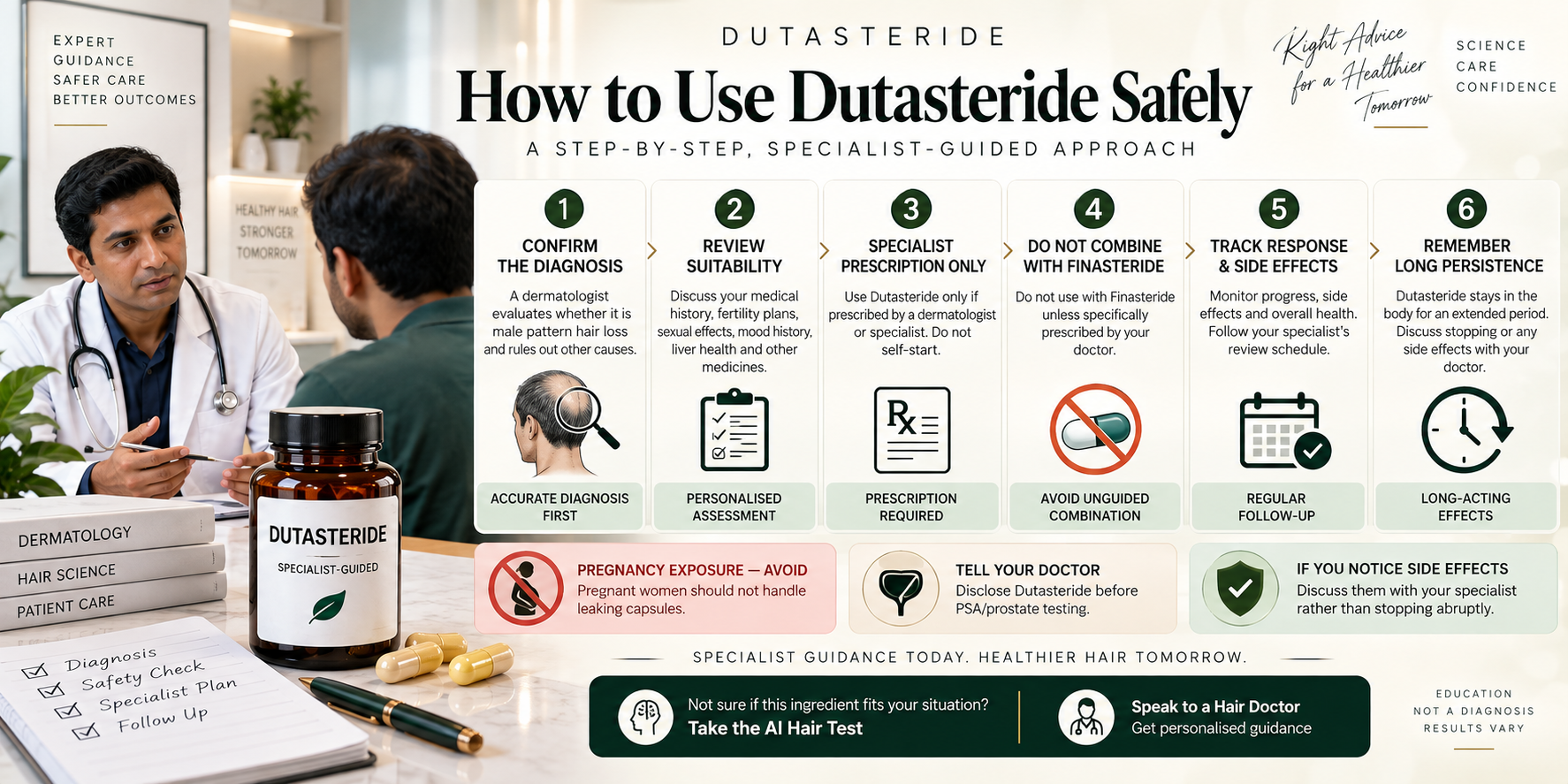
Image slot
📋
How to use Dutasteride — illustrated stepsalt: "How to use Dutasteride safely, step by step" · 1200×600 WebP · loading="lazy"
Safety

Possible Side Effects

Dutasteride is a potent medicine with recognised sexual, fertility and mood side effects, and a longer persistence than Finasteride that affects how they are managed.

Reduced libidoErectile dysfunctionEjaculatory changesBreast tenderness / swellingMood changesFertility / semen concernsLong persistence (half-life)Affects PSA prostate test

Many men tolerate Dutasteride, but sexual, fertility and mood effects are real possibilities, and its long half-life means effects and the timeline after stopping can last longer than with shorter-acting medicines. It can affect PSA prostate-test results, so disclose it to your doctor, and pregnant women must avoid exposure. If you develop side effects, discuss them with your specialist rather than stopping abruptly, bearing in mind its prolonged persistence.

Shop

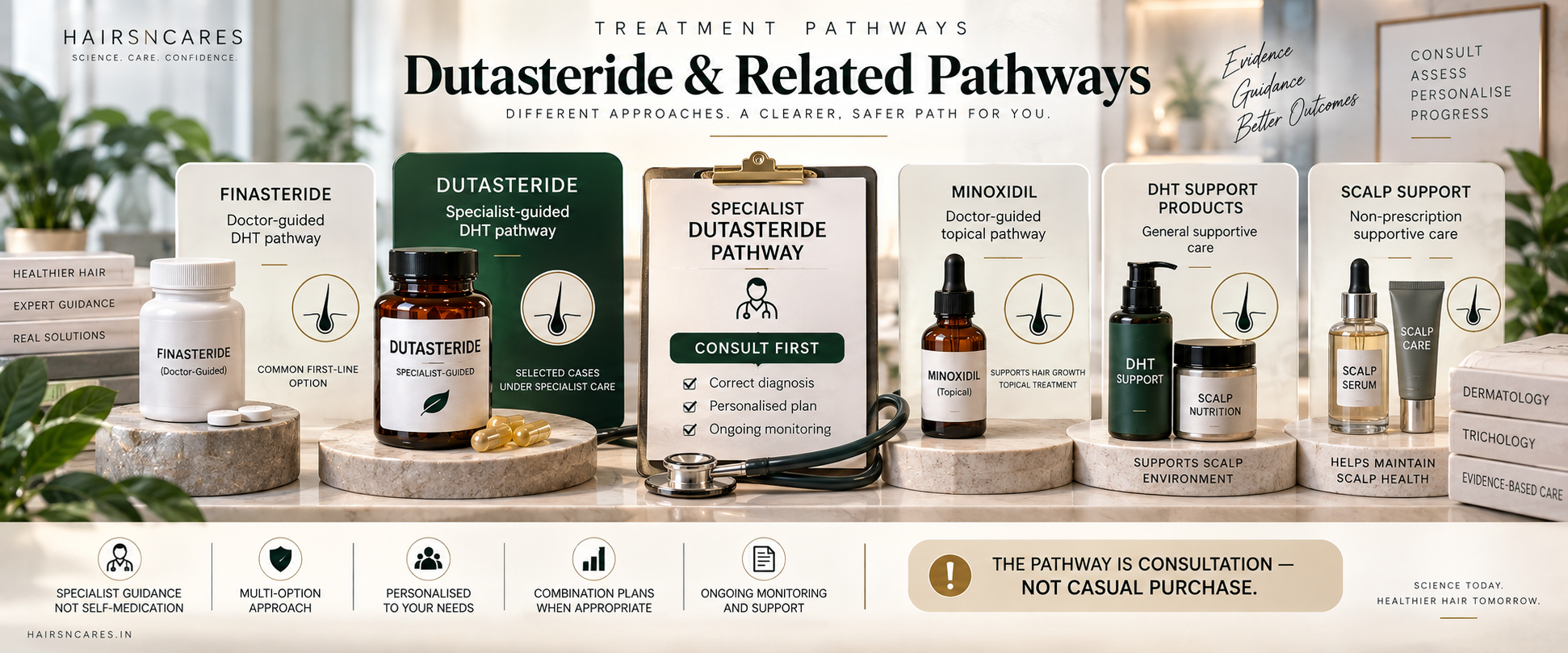
Dutasteride & Related Pathways

Dutasteride itself is specialist-guided — the pathway is a consultation, not a purchase. Related options are shown for context. Prices, ratings and stock are dynamic placeholders from the database and official label.

Dutasteride is a potent, prescription-type, specialist-guided medicine considered only in selected male pattern hair-loss cases — we do not sell or recommend it casually, and it is not automatically better than Finasteride. The appropriate first step is a dermatologist consultation, not buying a product. It is not for women, pregnancy, breastfeeding or teenagers without specialist guidance, and pregnant women must avoid exposure. Non-prescription options shown are for general context. We do not fabricate prices, ratings, stock or reviews; these are dynamic placeholders from the official label and database. Results vary.
Want products matched to you? Use the finder or screen first.

Find My ProductsTake AI Hair Test
Image slot
🛒
Shop strip — related range flat-layalt: "Doctor-reviewed product categories related to Dutasteride" · 1200×500 WebP · loading="lazy"
Compare

Dutasteride vs Finasteride vs Minoxidil

How this ingredient compares with similar options. It points to a pathway; it is not a diagnosis.

FeatureDutasterideFinasterideMinoxidil
CategoryPrescription-type medicinePrescription-type medicineTopical medicine
DHT pathwayBlocks type I + II (broad)Mainly type IIDoes not act on DHT
EvidenceStrong / specialist-guidedStrong (selected cases)Strong (selected cases)
Typical roleSelected / specialist casesCommon first-line 5-ARTopical support
Doctor guidanceStrictly requiredRequiredRecommended
Side-effect profileSexual, fertility, moodSexual, fertility, moodLocal; rare systemic
Half-life / persistenceLong — persistsShorterTopical; washes out
Pregnancy exposureAvoidAvoidCaution; selected women
Teenager cautionNot without doctorNot without doctorNot without doctor
PathwaySpecialist-guided treatmentDoctor-guided treatmentDoctor-guided topical
Image slot
⚖️
Comparison — visualalt: "Dutasteride compared with related options" · 1200×500 WebP · loading="lazy"
🩺
Doctor's Note

A Specialist-Guided Medicine, Not a Casual Upgrade

"As a dermatologist, I treat Dutasteride as a specialist-guided hair-loss medicine, not a casual product, and certainly not a routine 'stronger upgrade' from Finasteride. It may be useful in selected cases, sometimes where Finasteride has not delivered, but the decision must consider the diagnosis, fertility concerns, side effects, medical history and long-term monitoring — and its long half-life means its effects, good and bad, persist. I never start it lightly, I always weigh it against Finasteride and topical options, and I counsel honestly about sexual, fertility and mood effects. Pregnancy exposure must be strictly avoided."

Reviewed by Dr. Amit Agarkar, MD DermatologyDermatologist & Hair Specialist · Last reviewed 1 June 2026

Considering Dutasteride, or had side effects on Finasteride? Speak to a dermatologist before deciding.

Consult Dr. Amit's Team
Evidence & Safety

Medical References Behind This Guidance

These references are provided for patient education and do not replace a dermatologist's diagnosis or individual medical advice.

AAD

Hair Loss: Causes & Treatment

Dermatologist-led overview of how hair loss is evaluated and the evidence behind common treatments.

View reference ›
NIH / MedlinePlus

Dutasteride (Drug Information)

Official MedlinePlus drug information for dutasteride, including precautions and the warning that women who are or may become pregnant should not handle it.

View reference ›
PubMed

Peer-Reviewed Literature

Searchable index of peer-reviewed research on dutasteride for hair loss.

View reference ›
Cochrane Library

Systematic Reviews

Independent systematic reviews assessing the evidence behind hair-loss interventions.

View reference ›

Questions

Frequently Asked Questions

Section image
FAQs — banner900×160 WebP
What is Dutasteride?
Dutasteride is a prescription-type medicine known as a 5-alpha reductase inhibitor, which lowers DHT, the hormone involved in male pattern hair loss. Unlike Finasteride, it blocks both the type I and type II forms of the enzyme, so it reduces DHT more broadly, and it stays in the body longer. It is used medically for prostate conditions and may be used, off-label or doctor-guided depending on the country and doctor's judgement, in selected male pattern hair-loss cases. It is a specialist-guided medicine, not a cosmetic or supplement, and should be used only under supervision. So Dutasteride is a potent, specialist-level DHT-blocking medicine, not a casual hair product. Results vary.
Does Dutasteride help hair loss?
Dutasteride may help selected men with male pattern hair loss by reducing DHT more broadly than Finasteride, which can support hair maintenance or improvement in suitable, specialist-supervised cases. However, it is not a universal hair-loss treatment, does not address non-pattern causes such as telogen effluvium, scarring alopecia, fungal infection or deficiency, and carries side-effect and safety considerations along with a longer persistence in the body. Results take months and depend on a correct diagnosis and consistent use. So it can help selected pattern hair-loss cases under specialist guidance, but it is not for everyone and is not a casual or first-line self-started option. Results vary.
How does Dutasteride work?
Dutasteride inhibits 5-alpha reductase, the enzyme that converts testosterone to DHT, and because it blocks both type I and type II forms, it lowers DHT more broadly than Finasteride, which mainly blocks one. In male pattern loss, DHT miniaturises susceptible follicles, so reducing it may slow this and support hair in selected users. Its longer half-life means it persists in the body, affecting how side effects and discontinuation are managed. So it targets the same pathway as Finasteride but more broadly and for longer, which is why it is specialist-guided. Results vary.
Is Dutasteride stronger than Finasteride?
In terms of DHT reduction, Dutasteride does lower DHT more broadly and to a greater degree than Finasteride, because it blocks both type I and type II 5-alpha reductase rather than mainly one, and it persists longer in the body. However, stronger DHT reduction does not automatically mean it is better or safer for a given person, because greater and longer-lasting effects can also influence side-effect and discontinuation considerations. So while Dutasteride is pharmacologically more potent at lowering DHT, that is not the same as being the right choice for everyone, and the decision must weigh potential benefit against the broader, longer-lasting effect, with a specialist. Results vary.
Is Dutasteride better than Finasteride?
Dutasteride is not automatically better than Finasteride for everyone. It may be considered in selected doctor-guided cases, sometimes when Finasteride has not given the desired result, but it also carries side-effect and safety considerations and a longer persistence in the body. Finasteride is more commonly used in many hair-loss protocols and is often the first-line 5-alpha reductase inhibitor. So rather than assuming Dutasteride is the superior upgrade, the choice should be made by a dermatologist or specialist after weighing your diagnosis, prior response, risk profile and the implications of broader, longer-lasting DHT reduction. Neither is universally better. Results vary.
Is Dutasteride safe?
Dutasteride is not risk-free, and whether it is appropriate is a specialist judgement. Like Finasteride, it has recognised side effects, including sexual effects such as reduced libido or erectile difficulties, ejaculatory changes, breast tenderness, mood changes and fertility-related concerns, and its longer half-life means these and discontinuation need careful discussion. It also has specific cautions around pregnancy exposure, liver disease and certain histories, and can affect PSA prostate-test results. So Dutasteride can be reasonably managed in suitably screened men under specialist supervision, but it is a potent medicine with real risks and a longer-lasting effect, requiring a thorough benefit-risk discussion rather than casual use. Results vary.
What are Dutasteride side effects?
Recognised side effects of Dutasteride include sexual effects such as reduced libido, erectile dysfunction and ejaculatory changes, breast tenderness or swelling, mood changes, and concerns about fertility or semen parameters, along with rare allergic reactions. Because it has a long half-life and persists in the body, side effects and the timeline after stopping can last longer than with shorter-acting medicines. It can also affect PSA prostate-test results, so tell your doctor. Many men tolerate it, but these are real possibilities that need counselling. So if you experience side effects, discuss them with your specialist rather than stopping abruptly, bearing in mind its prolonged persistence. Results vary.
Can Dutasteride affect libido?
Yes, reduced libido is a recognised possible side effect of Dutasteride, as with other 5-alpha reductase inhibitors, along with other sexual effects such as erectile or ejaculatory changes, although many men do not experience them. Because Dutasteride persists in the body longer, any such effects and their resolution after stopping may take longer to settle, which is part of why it is specialist-guided. These effects matter to quality of life and should be part of the benefit-risk discussion before starting, with any change reported to your doctor. So libido changes are a possibility to be aware of and to raise with a specialist rather than a certainty. Results vary.
Can Dutasteride affect fertility?
Dutasteride can affect semen parameters and fertility-related measures in some users, which is an important consideration for men trying to conceive or planning to, and its longer persistence in the body means timing matters even more than with shorter-acting medicines. Pregnant women should also avoid exposure to Dutasteride because of effects on a developing male fetus. So if fertility or conception is relevant, this must be discussed with your specialist before starting, including the implications of its long half-life, rather than discovered afterwards. Fertility concerns are a clear reason for careful, specialist-led decision-making about Dutasteride. Results vary.
Can Dutasteride cause mood changes?
Mood changes, including low mood, have been reported as a possible side effect of 5-alpha reductase inhibitors including Dutasteride in some users, which is why a history of depression or mood problems should be discussed with your specialist before starting. Many men do not experience mood effects, but because they are possible and important, and because Dutasteride persists longer in the body, they form part of the benefit-risk conversation. Any new or worsening low mood while taking it should prompt a discussion with a doctor rather than continuing regardless. So mood changes are a recognised possibility to monitor, especially with a relevant history. Results vary.
Can women use Dutasteride?
Dutasteride is generally not used in women without specialist guidance, and it carries important cautions, especially for women who are pregnant or may become pregnant, because it can affect the development of a male fetus, so pregnancy exposure must be strictly avoided, including handling leaking capsules. Female hair loss has different causes and treatment considerations that need separate assessment, and Dutasteride's broad, long-lasting DHT effect makes caution even greater. So women should not use or be exposed to Dutasteride on their own; any consideration of it for a woman would be a specialist decision with full safety counselling, and pregnancy exposure must be avoided. Results vary.
Can teenagers use Dutasteride?
Teenagers should not use Dutasteride, and certainly not start it on their own, because hair loss in a teenager needs proper evaluation to find the cause, and a potent, long-acting DHT-blocking medicine is not an appropriate self-started option for a young person. Hair loss at a young age can have several causes that need assessment, and the hormonal effects of Dutasteride make it especially unsuitable without specialist judgement. So for teenagers, the priority is to understand why hair is thinning, with a doctor, rather than reaching for Dutasteride. It is a specialist medicine, not something a teenager should begin. Results vary.
How long does Dutasteride take to work?
Dutasteride works gradually, and as with other DHT-blocking treatments you generally need to use it consistently for several months, often around six months or longer, before judging its effect on hair, because it acts on the hair cycle and hormonal pathway. Early on, hair may simply stop worsening before any visible improvement. Its long half-life means it builds up and persists in the body. So patience and consistency matter, and the decision to continue or change is best made with your specialist over months rather than weeks, with progress tracked by photos and reviewed medically rather than judged too soon. Results vary.
What happens if I stop Dutasteride?
If you stop Dutasteride, the DHT-lowering effect eventually ends, and any hair maintained or improved with it will gradually be lost over the following months, returning toward where your hair loss would otherwise have been, because it controls a hormonal driver while taken rather than permanently changing the pattern. Because of its long half-life, the medicine persists in the body for a while after stopping, so effects and any side effects can take longer to resolve than with shorter-acting medicines. So it is a long-term commitment if you want to keep the benefit, and any decision to stop should be discussed with your specialist. Results vary.
Can I use Dutasteride with Minoxidil?
Dutasteride and Minoxidil work differently, Dutasteride lowering DHT and Minoxidil supporting the hair cycle, and a specialist may combine them in selected cases of male pattern hair loss. However, both have their own suitability and side-effect considerations, and Dutasteride is a potent, long-acting medicine, so any combination should be a specialist-guided decision rather than self-assembled. If you are considering both, a doctor can advise whether the combination suits you and how to use each correctly. So they can be combined under specialist guidance for suitable men, but it is a medical decision, not something to set up on your own. Results vary.
Can I combine Dutasteride and Finasteride?
You should not combine Dutasteride and Finasteride on your own, as both are 5-alpha reductase inhibitors acting on the same DHT pathway, so taking them together would not be a routine approach and could increase side-effect risk without clear added benefit. Both are potent, doctor-guided medicines, and Dutasteride already blocks DHT more broadly than Finasteride. If there is ever any reason to consider both, that is strictly a specialist decision based on individual circumstances. So combining them is not something to self-start; if your current treatment is not working, discuss the next step with your specialist rather than stacking these medicines. Results vary.
Is Dutasteride useful for sudden hair fall?
Dutasteride is not the treatment for sudden hair fall, because sudden, diffuse shedding is usually telogen effluvium or another non-pattern cause, such as illness, stress, deficiency or thyroid problems, rather than the DHT-driven pattern loss Dutasteride targets. Using a potent, long-acting DHT blocker for sudden shedding would not address the actual cause and could delay correct diagnosis. So if your hair fall came on suddenly, the priority is to find the cause with a doctor, not to start Dutasteride. It is relevant to gradual, patterned male hair loss in selected cases, while sudden shedding needs a different assessment and approach. Results vary.
Should I take the AI Hair Test first?
Using the AI Hair Test first is sensible, because it helps explore whether your hair loss looks like the male pattern type, and it flags strong cautions for a potent medicine like Dutasteride, such as being a woman, pregnancy, fertility or mood concerns, prior side effects, or patchy or sudden loss. However, it is a screening and education aid, not a diagnosis or prescription, and it does not confirm Dutasteride is safe for you. So the AI Hair Test is a useful starting point that points you toward the right next step, which for a specialist-guided medicine like Dutasteride is always a dermatologist's evaluation rather than self-treatment. Results vary.
When should I consult a dermatologist?
You should consult a dermatologist before considering Dutasteride at all, since it is a potent, specialist-guided medicine, and especially if your hair loss is sudden, patchy or unexplained, if you suspect alopecia areata or scarring alopecia, if you have scalp infection or inflammation, if you are a woman, pregnant, breastfeeding or a teenager, or if you have fertility or conception plans, sexual side-effect concerns, a mood or depression history, or liver disease. You should also see a doctor if you have side effects while taking it or are considering switching from Finasteride. So Dutasteride is never a self-start; specialist diagnosis, counselling and monitoring come first. Results vary.
Which product pathway should I choose?
For Dutasteride itself, the only appropriate pathway is a specialist-guided one, because it is a potent, prescription-type medicine needing diagnosis, screening, counselling and monitoring, so the first step is a dermatologist consultation rather than buying a product. In many cases Finasteride or topical Minoxidil are considered first, with Dutasteride reserved for selected situations under specialist judgement. Women, teenagers, and anyone with patchy, sudden or unexplained loss should see a doctor rather than self-selecting. So use the AI Hair Test to clarify your situation, then let a specialist guide whether Dutasteride is appropriate and how it fits with other options. Results vary.

Question not answered here? Ask Dr Aria for general guidance, or book a consultation.

Ask Dr AriaConsult a Doctor

Potent and Specific — Specialist-Guided, Never Casual

Dutasteride is a potent DHT-blocking medicine that lowers DHT more broadly than Finasteride and persists longer in the body — but that does not make it automatically better, and it is only for selected male pattern hair-loss cases under specialist supervision. It is a prescription-type medicine, not a supplement: not for women, pregnancy, breastfeeding or teenagers without a specialist, with sexual, fertility and mood considerations and a pregnancy-exposure warning. It should not be combined with Finasteride without a prescription. The right path is a suitability check, then a specialist's judgement weighing it against other options. Check suitability with the AI Hair Test, then see a specialist. Results vary.

Medical disclaimer. This is educational content reviewed by a dermatologist. The AI tools help explore whether your loss looks like male pattern loss and flag strong cautions, but do not diagnose, prescribe, confirm Dutasteride is safe for you, endorse a brand, or replace a dermatologist. Dutasteride is a potent, prescription-type, specialist-guided medicine considered only in selected cases of male pattern (androgenetic) hair loss; it is not suitable for every kind of hair fall, is not a cosmetic or supplement, and is not automatically better than Finasteride. It is not for women without specialist guidance, pregnancy or exposure risk, breastfeeding, teenagers, fertility or conception concerns, sexual side-effect concerns, a mood or depression history, liver disease, unclear diagnosis, or patchy/sudden/scarring loss — without specialist evaluation. It should not be combined with Finasteride without a prescription. Pregnant women should avoid exposure, including leaking capsules. Recognised side effects include reduced libido, erectile dysfunction, ejaculatory changes, breast tenderness, mood changes and fertility concerns; its long half-life means effects can persist after stopping; it can affect PSA prostate tests. Discuss any side effects with a specialist rather than stopping abruptly. Product price, stock, ratings and reviews are dynamic placeholders from the official label and database. Results vary.
Doctor-Reviewed Haircare Ingredient Guide

Dutasteride: Evidence, Safety & Best Use

A clear, dermatologist-reviewed summary of where Dutasteride fits in hair fall, scalp care, hair-growth support or product selection — without exaggerated regrowth claims.

Reviewed by DermatologistEvidence-TieredSafety-FirstIndia-Focused

Results vary based on diagnosis, consistency, formulation and scalp condition.
💊
Dutasteride

Premium ingredient visual slot · 720×520 WebP

Quick Summary

Dutasteride at a Glance

What it is

Specialist-guided medicine

Best for

Selected pattern hair loss under specialist care

Evidence level

Strong (specialist-guided)

Doctor guidance

Required — specialist-guided

Medical Review & Editorial Transparency

Reviewed for Safety, Evidence & Honest Claims

🩺

Reviewed by: Dr. Amit Agarkar, MD Dermatology

Medical focus: Dermatology, trichology, hair loss, scalp disorders and hair restoration.

Last reviewed: 1 June 2026

Editorial promise: This page explains benefits, limitations, side effects and safe use without exaggerating hair-growth claims.

Content Transparency

Who, How & Why This Guide Was Created

Who created this guide?

Prepared by the Hairsncares editorial team and medically reviewed by a dermatologist experienced in hair and scalp disorders.

How was it reviewed?

Checked for ingredient role, evidence level, safety warnings, medical limitations and suitability for Indian haircare users.

Why was it created?

To help you choose ingredients safely and understand when a dermatologist diagnosis matters more than trying products randomly.

Evidence Grade

Evidence Grade for Dutasteride

ParameterAssessmentWhat it means
Evidence levelStrong (specialist-guided)How strong the support is for this ingredient in hair or scalp care.
Best use caseSelected pattern hair loss under specialist careThe situation in which it may genuinely help.
Not suitable forWomen who are or may become pregnant; unclear diagnosis; self-started useWhen a dermatologist diagnosis is needed before use.
Expected timelineMonths; longer persistence than FinasterideResults vary based on diagnosis, consistency, formulation and scalp condition.
Suitability & Safety

Best For vs Avoid If

May be suitable for

  • Selected pattern hair loss under specialist care
  • People with a clear, non-emergency concern and realistic expectations
  • Use within a sensible, dermatologist-aware routine

Avoid or ask a doctor if

  • Hair loss is sudden, severe, patchy, painful or with scalp infection.
  • You are pregnant, breastfeeding, a teenager, or using prescription medicines.
  • You have an unclear diagnosis, scarring hair loss, fungal infection or active scalp disease.

This ingredient should be used only with appropriate doctor guidance. Do not self-start, combine, stop, or increase dosage without medical advice.

Longer persistence and pregnancy-exposure/fertility cautions apply — use only under specialist supervision.

Compare

Compare Dutasteride With Related Ingredients

Product Discovery

Explore Product Types Containing Dutasteride

Product results should be selected based on scalp type, diagnosis, sensitivity, routine compatibility and dermatologist guidance where needed.

Find Products After AI Hair Test
Visual Guide

Dutasteride Visual Guide

⚙️
How Dutasteride may support hair or scalp care.
🛡️
Safety and suitability depend on diagnosis and user profile.
📋
Routine compatibility matters more than random product use.
Quick Answers

Quick Answers About Dutasteride

Is Dutasteride good for hair growth?

Dutasteride may help in selected situations depending on its evidence level, diagnosis, formulation and consistency. It should not be treated as a guaranteed regrowth solution for every type of hair loss.

How long does Dutasteride take to work?

Timelines vary. Medicines and deficiency-based treatments may take months, while cosmetic oils or hydration ingredients may mainly improve feel, shine or manageability sooner.

Can I use Dutasteride without a diagnosis?

Cosmetic ingredients may be used carefully, but medicines, persistent hair fall, patchy loss, scalp disease or sudden shedding need dermatologist evaluation.

Can Dutasteride be combined with other ingredients?

Combination depends on scalp sensitivity, diagnosis, product type and whether the ingredient is cosmetic, supplement-based or prescription-guided.

Who should avoid Dutasteride?

People with allergies, irritation, active scalp disease, unclear diagnosis, pregnancy, breastfeeding or prescription-medicine concerns should check suitability before use.

Evidence LevelPrescription / Strong Evidence

Strong evidence for selected androgenetic alopecia cases, but strictly doctor-guided and not suitable for everyone.

AI Summary

Dutasteride for Hair in Simple Terms

Dutasteride is a doctor-guided, prescription-type medicine.

It may help with selected cases, under specialist supervision — but it should not be treated as a cure for all hair fall.

Bottom line: use this guide to understand evidence, safety and product type, then take the AI Hair Test or consult a dermatologist for medical hair loss. Results vary.

Ingredient Type

Is Dutasteride a Medicine, Supplement or Cosmetic?

Dutasteride is a doctor-guided, prescription-type medicine that acts on the DHT pathway. It is not a cosmetic haircare ingredient, oil or supplement.

Evidence-Safe Summary

What Dutasteride Can and Cannot Do for Hair

May Help With

  • Selected cases, under specialist supervision
  • A doctor-guided option after diagnosis
  • Situations a specialist judges appropriate

Cannot Promise

  • Guaranteed hair regrowth
  • A cure for every type of hair fall
  • A replacement for a dermatologist's diagnosis
  • Correcting pattern, patchy, scarring or medical hair loss on its own
Prescription Safety

Dutasteride Must Be Doctor-Guided

Dutasteride affects the DHT pathway and is not suitable for everyone. It should not be started, stopped, combined or switched without medical supervision.

Note: Dutasteride is not automatically better than Finasteride and persists longer in the body.

  • Not automatically superior to finasteride; the right choice is individual.
  • Longer body persistence affects timing and precautions.
  • Do not combine with similar medicines unless a specialist prescribes it.
Specialist-Only

Why Dutasteride Needs Specialist Supervision and Isn't Automatically 'Stronger'

Dutasteride acts on the DHT pathway more broadly than finasteride and persists longer in the body, which is exactly why it requires specialist supervision rather than self-experimentation. "Broader" does not mean "automatically better" for everyone — suitability depends on diagnosis, history and monitoring, and the longer persistence matters for planning, fertility and pregnancy-exposure precautions.

Read the Dutasteride guide and the Finasteride guide. Always consult a doctor.

Doctor-Guided Decision Matrix

Should You Consider Dutasteride?

Educational guidance, not a diagnosis. Results vary.

May Be Reasonable When

  • A specialist has assessed and is monitoring you
  • A confirmed diagnosis supports its use
  • You understand the longer-persistence precautions

Be Careful When

  • Fertility plans or pregnancy in the household
  • Mood, sexual or liver-related history
  • Considering combining DHT-pathway medicines
  • Pregnancy, breastfeeding, teens or medical conditions

See a Doctor First When

  • Sudden or severe hair fall
  • Patchy hair loss
  • Progressive thinning
  • Scalp pain, pus, crusting, scaling or infection
  • PCOS, thyroid, anaemia symptoms or postpartum shedding
Related Ingredient Guides

Explore More Haircare Ingredients

Personalised Hair Guidance

Does Dutasteride Fit Your Hair Concern?

This guide is educational. For sudden, patchy, progressive or unexplained hair loss, or scalp pain, pus or scaling, screen with an AI tool or see a dermatologist.

Your Cart (0)

Your cart is empty

Subtotal0
DeliveryFREE
Total0
🔒 Secure📦 Free above ₹499↩ Easy returns
💬 Hi! I'm Dr. Amit — your Hair Intelligence consultant
🌿
1
🌿
Dr. Amit
Virtual Dermatologist · Hairsncares.com
Online
What are you shopping for today?
Select a category to begin
AI-powered scalp diagnosis · Hairsncares.com
📸
Scalp Analyser
Upload scalp photo · Get conditions, root cause, and matched product protocol
📷
Drop scalp photo here or click to upload
JPG, PNG, WEBP · Clear, close-up, well-lit photo

Your image is processed privately by our AI engine and saved securely with your account.