Lower Strength
Minoxidil 2% Category
Lower-strength entry point considered in selected cases, especially female pattern hair loss, under guidance.
- 2% strength options
- Sensitivity-aware choice
- Doctor-guided suitability
Minoxidil 2% is a lower-strength Minoxidil option that may be considered in selected users when appropriate. It should not be chosen only because it appears "milder." Suitability depends on diagnosis, gender, scalp tolerance, medical history, pregnancy/lactation status and doctor guidance. Prescription required where applicable; use under medical supervision; results vary.
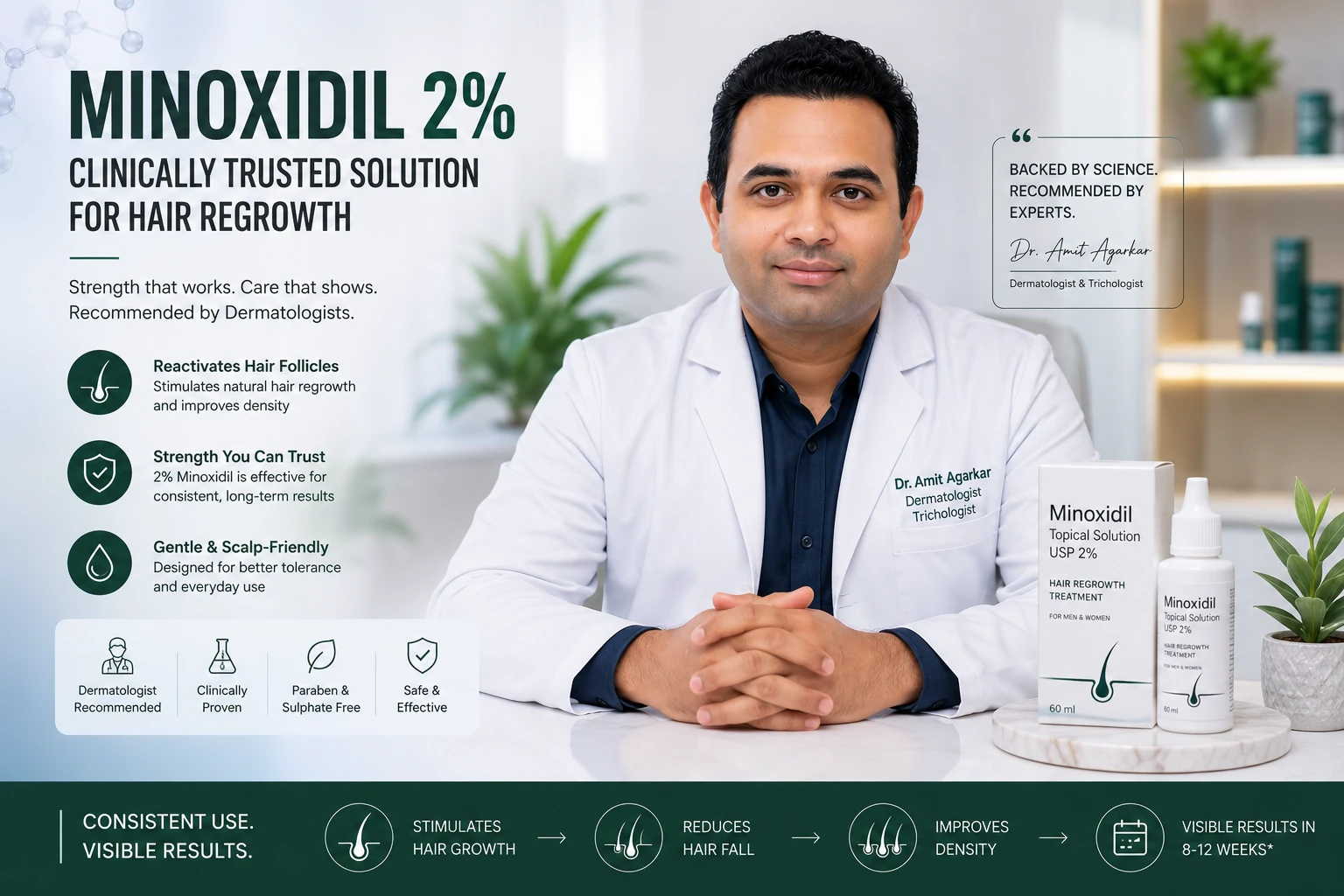
Minoxidil is doctor-guided, not suitable for everyone, and not a guaranteed cure. Prescription required where applicable. AI tools screen, not diagnose; results vary.
Minoxidil 2% may be considered in selected pattern hair loss cases where suitable, but it is not a universal hair fall treatment. It should not be used without medical advice in pregnancy, breastfeeding, teenagers, scalp infection, patchy hair loss, sudden severe shedding or heart/BP concerns. Prescription required where applicable; results vary.
Minoxidil 2% is a lower-strength Minoxidil option. It should not be chosen only because it appears "milder" — suitability depends on diagnosis, gender, scalp tolerance, medical history, pregnancy/lactation status and doctor guidance. Strength, format and stock are dynamic placeholders — [Dynamic Minoxidil 2% product grid from backend].
Cautious, diagnosis-first guidance. This is education, not a recommendation to start; confirm with a doctor.

Lower strength does not mean suitable for everyone. Strength should be chosen with a doctor, not by assuming milder is safer.

| Feature | Minoxidil 2% | Minoxidil 5% |
|---|---|---|
| Strength | Lower concentration | Higher concentration than 2% |
| Typical use context | Selected users where suitable | Commonly searched strength, selected pattern loss |
| Irritation potential | May be lower for some | May be higher for some |
| Scalp tolerance | Some prefer for sensitivity | Varies by user |
| Doctor guidance | Recommended before use | Recommended before use |
| Not for everyone | Yes | Yes |
| Product availability | Dynamic — from database | Dynamic — from database |
| Suitability checker | Recommended before choosing | Recommended before choosing |

Categories are dynamic and database-driven. Product names are never invented.

The checker weighs your age, gender, pregnancy and breastfeeding status, main concern, hair-fall duration and pattern (hairline, crown, diffuse, patchy, sudden or breakage), family history, scalp condition, dandruff, redness, wounds, pus or crusting, heart/BP concerns, palpitations or dizziness, medications, previous Minoxidil use and reactions, existing prescription, and PCOS, thyroid, anaemia or recent-illness signals. It flags suitability and when a doctor or prescription is needed. It does not diagnose, prescribe or give dosing.
Track your hair fall before guessing treatment. Upload progress photos and monitor shedding, crown, parting and hairline changes over time.
Minoxidil may cause side effects in some users. This is education, not a substitute for the product leaflet or a doctor’s advice.

Track shedding count, density and hairline/crown photos, scalp itching, flaking, redness, side effects, consistency, adherence and doctor follow-up reminders. Do not judge regrowth too early.

Browse dermatologist-reviewed categories around lower-strength Minoxidil — often discussed for selected female pattern hair loss and sensitivity-prone users. Doctor-guided and prescription-required where applicable.

Lower-strength entry point considered in selected cases, especially female pattern hair loss, under guidance.
Understand 2% vs 5% and foam vs solution before any decision — higher is not automatically better.
Mild shampoos and soothing care for sensitive scalps and irritation-prone users.
Pathways and supportive products for widening parting and diffuse thinning in women.
Suggested bundles around this topic. Final recommendations should be personalised using the AI Hair Test, scalp photos, medical history and dermatologist review where needed. Prices, stock and prescription status load from the product database.
Find a routine matched to your hair loss pattern. Get product-category guidance based on symptoms, scalp type and concern.
Enter your pincode to check medicine, haircare product and bundle delivery availability in your area.
Lower-strength routines still need consistency to maintain results. Add eligible gentle shampoos, serums, supplements and doctor-approved refills to a monthly plan with reminders before you run out.

Dermatologist Reviewed
This page is designed for patient education and structured hair-loss guidance. It does not replace personal medical diagnosis, prescription decisions or individual dermatologist consultation.
Selected reputable sources used to keep this Minoxidil 2% guidance aligned with mainstream dermatology. External links open in a new tab; they are for further reading, not endorsements of any product.
Hairsncares follows a who-how-why editorial process so you can see who stands behind this guidance and how it was checked.
Curated by the Hairsncares editorial team and medically reviewed by Dr. Amit Agarkar, MD Dermatology, a dermatologist and hair specialist.
Checked for honest claims (support, not cure or guaranteed regrowth), correct role and limitations, prescription/Schedule-H cautions, red-flag escalation to a doctor, dynamic-placeholder pricing, and suitability for Indian users.
To explain where Minoxidil 2% fits, set honest expectations and cautions, and make clear that prescription and doctor-guided actives are not a casual self-start — a dermatologist’s assessment comes first.

Minoxidil is safest diagnosis-first. Start with a screen, confirm with a doctor.
A lower strength is not automatically the right or safest choice. Minoxidil 2% is not suitable for everyone, is not a guaranteed regrowth or cure, and works only while continued. Strength should follow diagnosis and doctor guidance. Prescription required where applicable; use under medical supervision; results vary.
Used for selected pattern hair loss. Strength and format should be chosen by suitability, tolerance and doctor guidance.
Minoxidil 2% is a topical treatment for selected pattern hair loss, used for selected users where a lower strength is preferred.
It may be useful for selected users, but the right choice depends on diagnosis, scalp condition, age, gender, pregnancy/breastfeeding status, medical history and current medicines.
Bottom line: use this page for education. Take the AI Hair Test or consult a dermatologist before choosing prescription medicines, high-dose supplements or strong actives. Results vary.
Minoxidil may help selected pattern hair-loss cases, but it should not be self-started for sudden, patchy, scarring, fungal or medically unexplained hair loss.
| Strength | Typical context | Key caution |
|---|---|---|
| 2% | Selected users where a lower strength is preferred | Not automatically safer for everyone; suitability matters |
| 5% | Commonly considered for selected pattern hair loss | Can irritate; not for every hair fall |
| 10% | High-strength option only under careful guidance | Higher is not automatically better; more irritation risk |
A 2% strength is sometimes chosen for selected users or where a lower concentration is preferred, but lower does not automatically mean "safer for everyone" — suitability still depends on your pattern, scalp tolerance and health history. Many people are guided toward 5% for pattern loss; the right strength is individual.
Pregnancy, breastfeeding, teens and heart/BP concerns need doctor review. Compare strengths and formats, and screen with the AI Hair Test.
Answer a few questions about hair-fall pattern, scalp symptoms, age, medical history, pregnancy/breastfeeding status, current medicines and product use. This is a screening aid, not a diagnosis — do not self-medicate.
Your cart is empty