Stress & burnout
Sustained work stress raises shedding, often peaking months after a tough period.
Working professionals hair fall is where lifestyle and genetics often meet: chronic stress, broken sleep, skipped meals, hard water and pollution stack onto the years when pattern hair loss commonly begins. Telling temporary stress shedding from early pattern thinning is the key decision — because one recovers with lifestyle, and the other rewards early action.
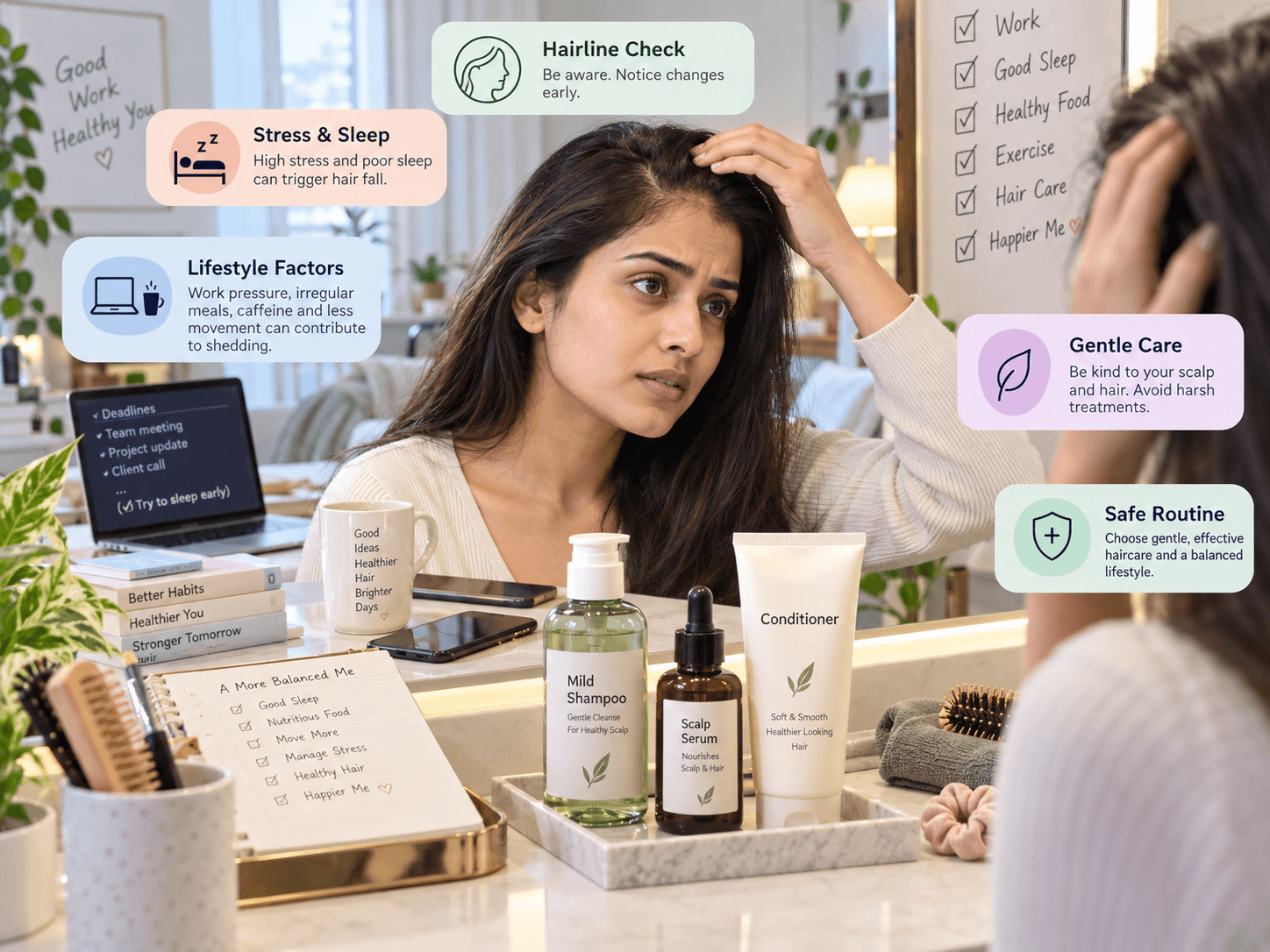
Working professionals often experience hair fall due to stress, burnout, poor sleep, irregular meals, low protein intake, dandruff, oily scalp, hard water, pollution or early pattern hair loss. If shedding is persistent, or crown thinning, a receding hairline or widening partition appears, a cause-based assessment is better than randomly changing products. The AI Hair Test helps map it.
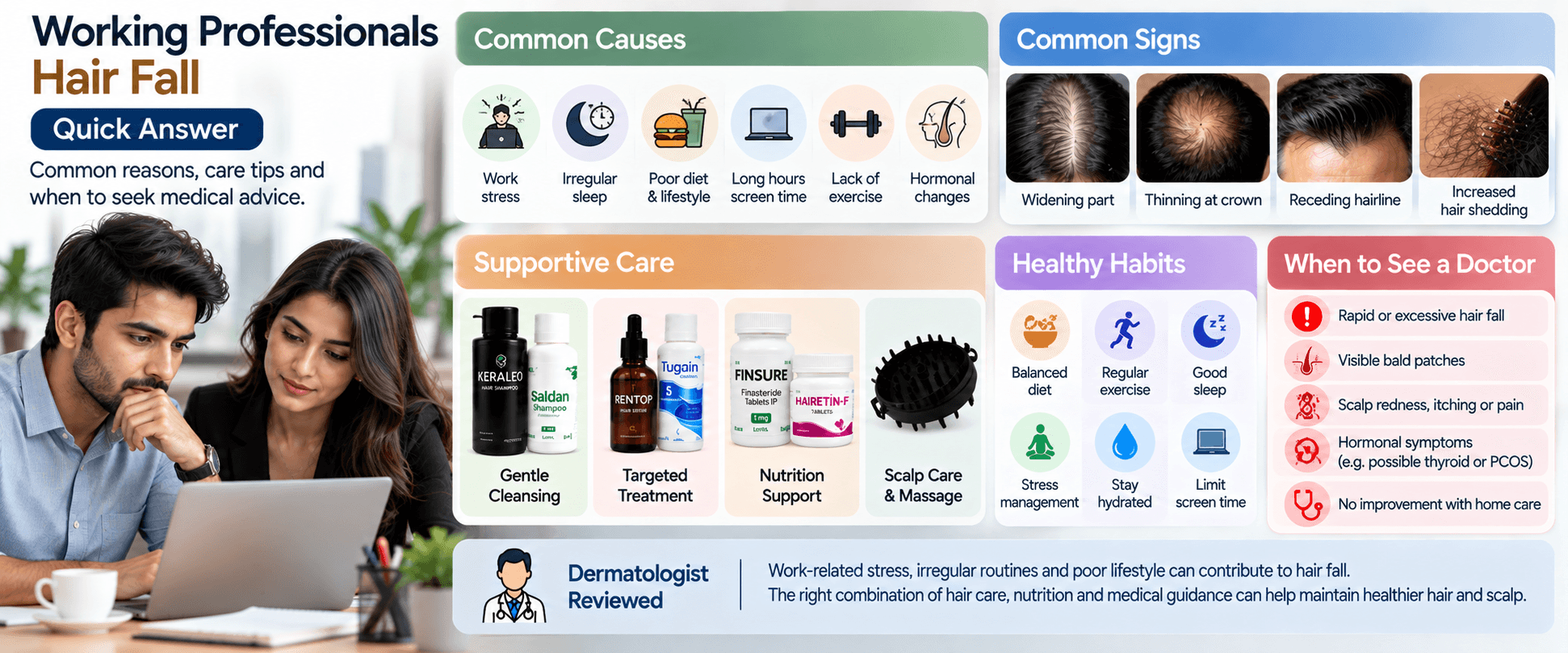
The working years combine high cognitive stress, compressed sleep, rushed meals, commuting, helmets, hard water and pollution — a steady load on both the scalp and the body. Any of these can lift shedding, and they often act together.
Crucially, this is also the typical window for male and female pattern hair loss to begin. So the real task is to separate the reversible lifestyle layer from any genetic pattern layer — because they need different plans.
| Feature | Stress / lifestyle shedding | Pattern hair loss |
|---|---|---|
| Distribution | Diffuse across scalp | Hairline, crown or parting focused |
| Speed | Often sudden, peaks after trigger | Gradual, progressive over months/years |
| Hair shaft | Normal thickness | Hairs getting finer over time |
| Family history | Less relevant | Often present |
| Recovery | Improves as stress/sleep/diet settle | Needs early supervised treatment |
Lifestyle and scalp factors layered over the age when pattern loss commonly starts.
Sustained work stress raises shedding, often peaking months after a tough period.
Chronic sleep loss adds physical stress that can worsen shedding.
Skipped meals and low protein or iron weaken the cycle where deficiency exists.
Deposits, helmets and grime irritate the scalp and add breakage.
Flakes and oil inflame the scalp and increase shedding.
Hairline, crown or parting changes that reward early, supervised care.
In men, professional-age pattern loss typically shows as a receding hairline and a thinning crown. In women, it more often appears as a widening parting and reduced density on top, and may link to thyroid issues or PCOS.
For both, lifestyle shedding can sit on top of the pattern, which is why a cause-based assessment beats guessing. The earlier a true pattern is identified, the more options remain.
Standardised monthly crown and parting photos make pattern change far easier to judge.
Small, repeatable habits that address the lifestyle layer — while you assess any pattern layer.
Educational, category-level directions matched to this life stage. Product availability is populated dynamically from the Hairsncares catalogue.
Shedding-focused care for stress and lifestyle hair fall.
Explore category →Growth-supporting actives for early thinning, where suitable.
Explore category →For flakes and itch worsening shedding.
Explore category →For sweaty, oily, helmet-and-commute scalps.
Explore category →Where deficiency exists — common with indoor lifestyles.
Explore category →Daily strand and scalp support.
Explore category →Targeted scalp-environment support.
Explore category →For suitable pattern cases — under medical guidance.
Explore category →Minoxidil may be considered only where pattern hair loss is likely and suitable. It is not suitable for everyone and should be used only as label-directed or doctor-directed. Minoxidil is a Schedule H medicine in India. Product suggestions are category-level educational guidance; results vary.
Cautious, evidence-led language applies: "may support", "where suitable", "where deficiency exists". Results vary; doctor guidance is recommended.
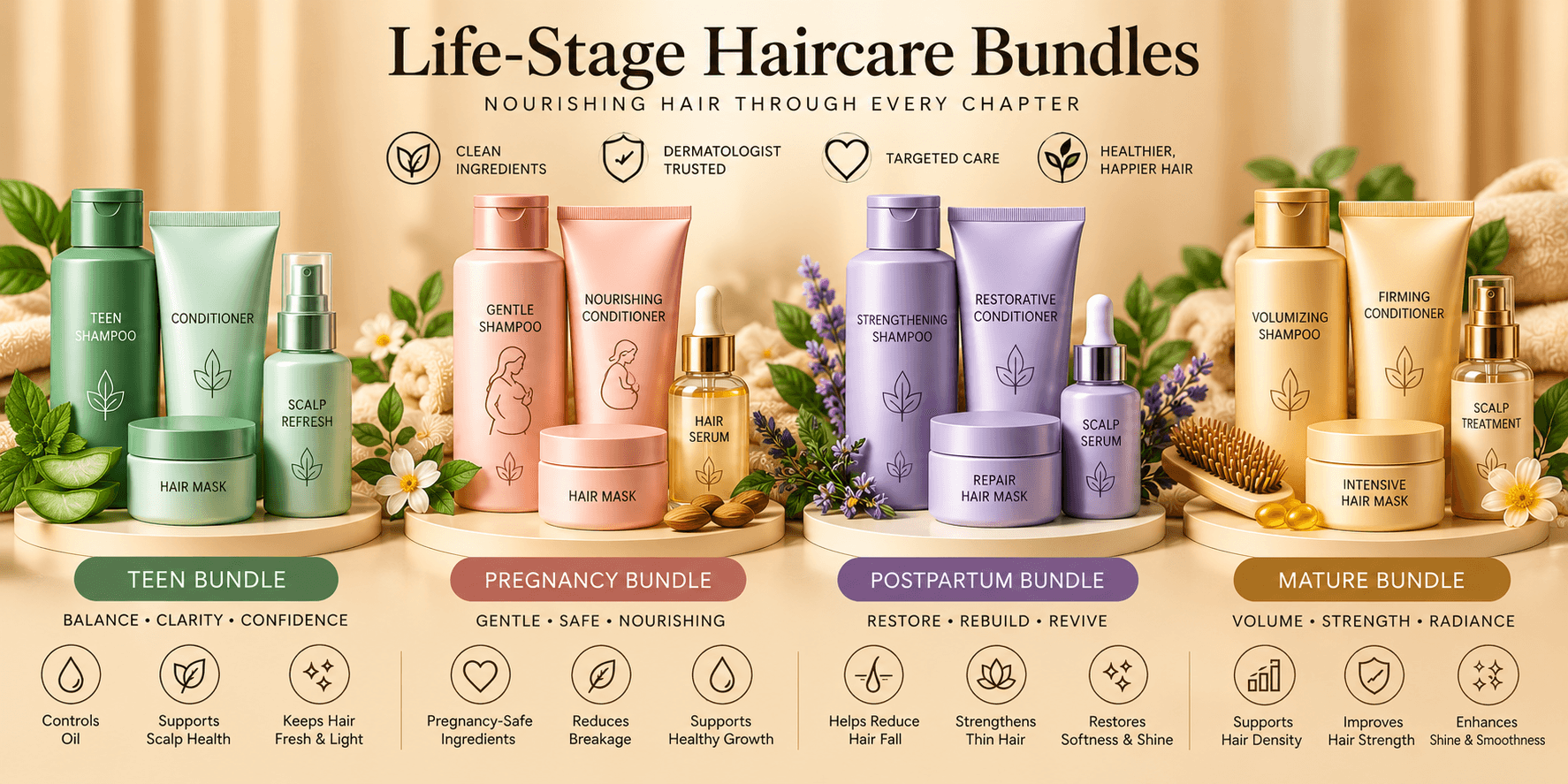
Browse dermatologist-reviewed product categories for teens, professionals, postpartum mothers, menopause-related thinning and senior haircare. For active or prescription treatments, take the AI Hair Test or consult a dermatologist before buying.

Suggested product bundles by life stage. Final recommendations should be personalised using the AI Hair Test, scalp photos, medical history and dermatologist review where needed.
Enter your pincode to check medicine, haircare product and bundle delivery availability in your area.
Many haircare routines need consistency. Add eligible shampoos, serums, supplements or scalp-care products to a monthly refill plan and get reminders before your product runs out.

The AI Hair Test factors in your stress, sleep, diet, scalp condition, pattern and family history to map a likely cause and a dermatologist-reviewed next step — instead of trial-and-error.
The Routine Builder sequences scalp control, treatment and support into a plan that fits a busy work schedule.
Pattern change is gradual and hard to judge daily. Standardised monthly photos reveal the real trend.
A combination of chronic stress, poor sleep, irregular meals, hard water, pollution and an oily or flaky scalp can increase shedding, often at the same age that pattern hair loss begins. Identifying which factors apply guides the right approach.
Yes. Sustained stress and burnout can push more hairs into the shedding phase (telogen effluvium), with hair fall often appearing a couple of months later. It usually improves as stress and routine stabilise.
Chronic sleep deprivation adds physical stress that can contribute to increased shedding. Improving sleep regularity supports recovery alongside good scalp care and nutrition.
Long indoor hours can lower vitamin D, and a genuine deficiency can affect the hair cycle. Where deficiency is confirmed, correcting it helps — but supplements should be guided by testing rather than guesswork.
Hard water can leave deposits that make hair feel rough and brittle and can irritate the scalp, contributing to breakage and shedding for some people. A suitable shampoo and scalp care help; it is rarely the sole cause of true loss.
Stress shedding is diffuse and trigger-linked; pattern loss is gradual and focused on the hairline, crown or parting with finer hairs and often family history. The AI Hair Test and a dermatologist can distinguish them.
Scalp control where dandruff or oiliness exists, hair fall and growth support, supplements where deficiency is confirmed, and pattern-focused options where suitable. The cause should guide the choice rather than trial and error.
Minoxidil is commonly used for suitable pattern hair loss, but it is not right for everyone and works best under guidance. Use only as label-directed or doctor-directed, and confirm suitability first — ideally after assessment.
Take standardised crown, hairline and parting photos monthly in consistent lighting, and compare them through a progress tracker. This is far more reliable than judging change in a daily mirror.
See a dermatologist if shedding persists beyond 2–3 months, if the crown, hairline or parting is changing, if there is a family history of pattern loss, or before starting prescription treatments such as minoxidil.
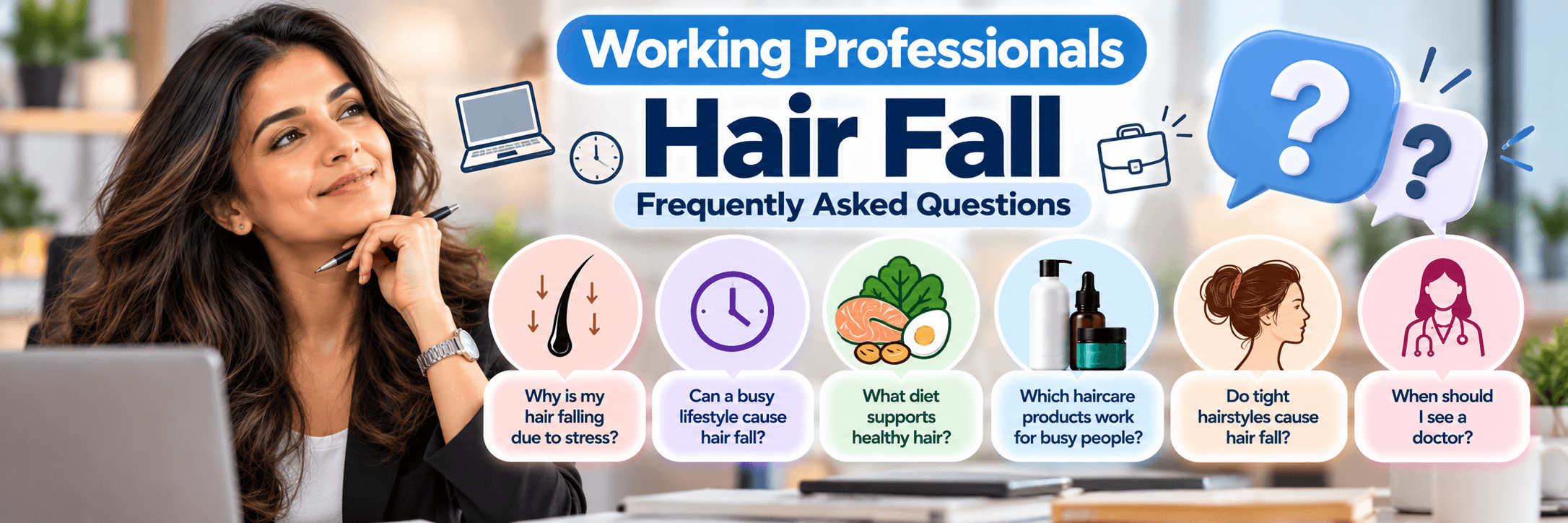
Often stress, sleep, diet, scalp, hard-water or early pattern-related. Persistent thinning needs evaluation.
Working Professionals Hair Fall is often linked to chronic work stress, poor sleep, irregular meals, commute pollution, hard water or early pattern hair loss.
The right next step depends on the pattern, how long it's lasted, scalp symptoms, medical history, nutrition, hormonal stage and product use.
Bottom line: use this page as educational guidance and take the AI Hair Test or consult a dermatologist if hair fall is sudden, patchy, progressive, painful or medically unexplained. Results vary.
For busy professionals, two things matter most: spotting early pattern hair loss versus stress-driven shedding, and a routine you'll actually keep. Pattern loss is gradual and patterned — a receding hairline or thinning crown (men), or a widening part (women) — and tends to progress, so earlier assessment gives more options. Stress/diet shedding is diffuse and often improves once sleep, meals and stress settle.
A realistic 5-minute routine: gentle shampoo matched to your scalp 2–3x/week, conditioner on the lengths, a weekly check of your part width, and fixing the obvious sleep/meal gaps. Screen with the AI Hair Test; for diffuse shedding see telogen effluvium. Persistent thinning deserves a doctor's review. AAD shedding guidance helps tell them apart.
Answer a few questions about hair fall, scalp symptoms, stress, sleep, nutrition, medical history, pregnancy/breastfeeding status and product use. This is a screening aid, not a diagnosis.
Your cart is empty