Hormonal Changes
Pregnancy, postpartum, PCOS, menopause and thyroid shifts can all change the hair cycle.
Pregnancy · Postpartum · MenopauseLearn more →Hair fall does not have one cause — and it should not have one fixed solution. The triggers change with age, hormones, stress, nutrition, pregnancy, delivery, menopause, lifestyle and medical history. This dermatologist-reviewed guide helps you find your life stage, understand what is likely driving your hair changes, and take a safe, suitable next step.
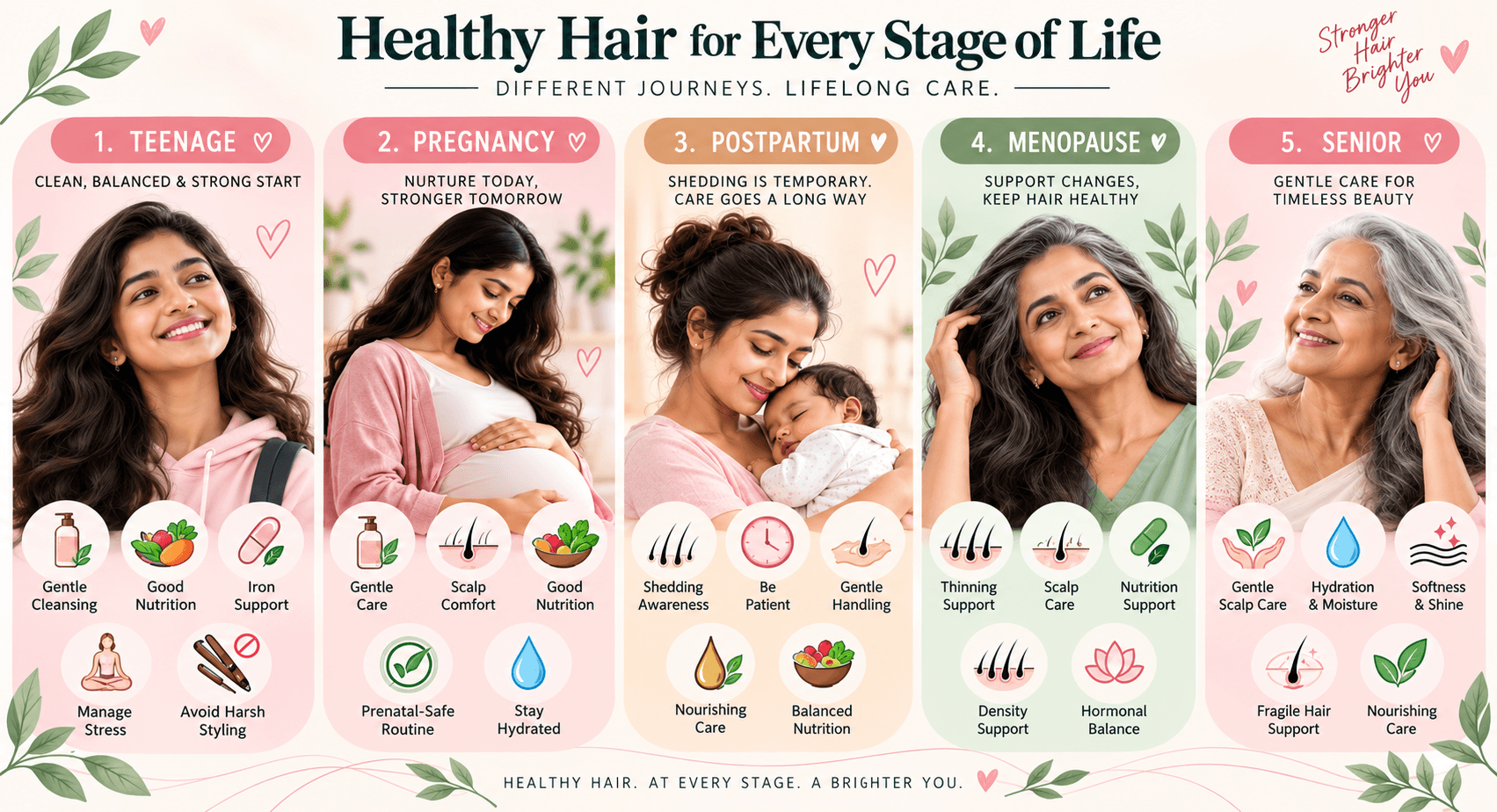
Hair care by life stage means choosing haircare, scalp care, nutrition support and treatment direction according to age, hormones, lifestyle, pregnancy status, postpartum recovery, menopause, stress level and medical context. A teenager with dandruff-linked shedding, a working professional with stress hair fall, a postpartum mother and a senior with age-related thinning may need very different care pathways.
Pick the stage closest to you. Each guide explains the common concerns, likely triggers and the safest next step for that stage.
Dandruff, oily scalp & early shedding
Common triggers: Hormones, diet, stress, styling
Explore Guide →AI Hair Test recommended before product selectionStudentsStress & lifestyle-linked shedding
Common triggers: Sleep loss, hostel diet, exams, styling
Explore Guide →AI Hair Test recommended before product selection20sEarly pattern loss & shedding
Common triggers: Genetics, stress, diet, scalp issues
Explore Guide →AI Hair Test recommended before product selectionProfessionalsStress shedding & early thinning
Common triggers: Work stress, poor sleep, hard water
Explore Guide →AI Hair Test recommended before product selectionPregnancySafe scalp care & product safety
Common triggers: Hormonal changes, product safety needs
Explore Guide →AI Hair Test recommended before product selectionPostpartumHair fall after delivery
Common triggers: Postpartum telogen effluvium, deficiency
Explore Guide →AI Hair Test recommended before product selectionAfter 40Gradual thinning & density loss
Common triggers: Hormonal shift, deficiency, pattern loss
Explore Guide →AI Hair Test recommended before product selectionMenopauseHormonal thinning & dryness
Common triggers: Oestrogen decline, widening parting
Explore Guide →AI Hair Test recommended before product selectionSeniorsAge-related thinning
Common triggers: Lower density, medical conditions
Explore Guide →AI Hair Test recommended before product selectionElderlyGentle care & scalp comfort
Common triggers: Medication, illness, fragile hair
Explore Guide →AI Hair Test recommended before product selectionA quick map from life stage to likely concerns, common triggers and the best next step.
| Life stage | Common hair concerns | Common triggers | Best next step |
|---|---|---|---|
| Teenagers | Dandruff, oily scalp, nutritional gaps, styling damage | Hormones, diet, stress, traction | AI Hair Test + Scalp Analysis |
| College students | Stress shedding, dandruff, styling | Sleep loss, hostel diet, exam stress | Routine Builder |
| Working professionals | Stress shedding, early pattern loss | Stress, poor sleep, diet gaps, hard water | AI Hair Test |
| Pregnancy | Safe scalp care, product safety, shedding worries | Hormonal changes | Doctor guidance |
| Postpartum | Hair fall after delivery | Postpartum telogen effluvium | Timeline + reassurance + doctor review if prolonged |
| Menopause | Hormonal thinning, widening parting, dryness | Oestrogen decline | Doctor-guided plan |
| Seniors | Age-related thinning | Medical conditions, medication, lower density | Dermatologist consultation |
Browse dermatologist-reviewed product categories for teens, professionals, postpartum mothers, menopause-related thinning and senior haircare. For active or prescription treatments, take the AI Hair Test or consult a dermatologist before buying.
Suggested product bundles by life stage. Final recommendations should be personalised using the AI Hair Test, scalp photos, medical history and dermatologist review where needed.
Enter your pincode to check medicine, haircare product and bundle delivery availability in your area.
Many haircare routines need consistency. Add eligible shampoos, serums, supplements or scalp-care products to a monthly refill plan.
Your hair cycle responds to hormones, stress, sleep, nutrition and medical history — and all of these shift as you move through life. That is why the same person can need very different care at 16, 26, during pregnancy, after delivery, through menopause and in their seventies.
In teenagers, hair fall is often linked to dandruff, an oily scalp, diet, stress or traction from tight styles. In college students, sleep disruption, hostel diets, exam stress and styling tend to dominate. Working professionals often face chronic stress, poor sleep, diet gaps and the early stages of pattern hair loss.
Pregnancy calls for extra caution in product selection, while postpartum hair fall is usually temporary but can overlap with deficiency or thyroid issues. Menopause can bring hormonal thinning and dryness, and seniors may experience age-related thinning alongside medical conditions. The AI Hair Test or a dermatologist can map it for you.
Most life-stage hair changes trace back to these overlapping drivers.
Pregnancy, postpartum, PCOS, menopause and thyroid shifts can all change the hair cycle.
Pregnancy · Postpartum · MenopauseLearn more →Exams, work stress, sleep loss and burnout can trigger increased shedding.
Students · ProfessionalsLearn more →Low protein, iron, vitamin D or B12, and crash dieting, can weaken hair where deficiency exists.
Teens · Postpartum · SeniorsLearn more →Dandruff, oily scalp, seborrheic dermatitis and itchy scalp can worsen shedding.
Teens · Students · AllLearn more →Heat, colouring, tight hairstyles and chemical treatments cause breakage and traction.
Teens · Students · ProfessionalsLearn more →Finer hair shafts, lower density, dryness and medical conditions affect older adults.
After 40 · Menopause · SeniorsLearn more →Educational, category-level directions — not a product dump. Price, stock and prescription status are populated dynamically from the product database.
Gentle scalp support for teenage oily, flake-prone scalps.
Explore category →Flake and itch control across stages where dandruff exists.
Explore category →Shedding-focused care for stress and lifestyle hair fall.
Explore category →Growth-supporting actives for thinning, where suitable.
Explore category →Biotin, iron and vitamin D support where deficiency exists.
Explore category →Gentle daily cleansing suitable across most life stages.
Explore category →Gentle, doctor-guided options for use during pregnancy.
Explore category →Gentle support for hair fall in the months after delivery.
Explore category →Moisturising, density-supporting care around menopause.
Explore category →Gentle, conditioning care for fragile, ageing hair.
Explore category →Leave-in strand support for fragile or thinning hair.
Explore category →Targeted scalp-environment support across stages.
Explore category →Product suggestions are category-level educational guidance. Choose products based on life stage, scalp type, symptoms, pregnancy/breastfeeding status, medical history and dermatologist guidance where needed. Prescription products require valid medical guidance where applicable. Results vary.
Cautious, evidence-led language applies throughout. Results vary; doctor guidance is recommended.
Avoid aggressive self-treatment. Hair fall in teenagers may need scalp, nutrition, stress and hormonal evaluation rather than strong actives.
Do not self-start medicated or prescription hair-loss products. Product safety must be checked with your doctor first.
Hair fall after delivery is often temporary, but prolonged, severe or patchy loss needs evaluation.
Hormonal thinning can be gradual. Early evaluation helps distinguish pattern loss from deficiency or thyroid-related shedding.
Hair fall may overlap with medical conditions, medications, nutrition, chronic illness or age-related density changes.
When in doubt, map the cause before buying products — the AI Hair Test and a dermatologist help avoid months on the wrong approach.
Take the Hairsncares AI Hair Test to map your age, gender, symptoms, scalp type, life stage, pregnancy/postpartum status, stress, diet, shedding pattern and photo inputs into a guided next step.
A teenager with oily dandruff, a postpartum mother, a stressed professional and a senior with dryness each need a different routine. The Routine Builder sequences the right steps.
Life-stage hair changes are best tracked with photos, shedding notes, parting width, crown visibility, scalp symptoms and routine consistency — not daily mirror checks.
Explore dermatologist-reviewed guides, AI tools, product categories and routines connected to your life-stage hair concern.
Trusted dermatology and medical education sources for patients who want to understand hair loss better.
Patient education on hair loss causes and when to seek dermatology care.
Read medical guidance →DermNetDermatology-reviewed overview of common hair loss conditions.
Explore dermatology reference →NHSPatient-friendly overview of hair loss symptoms and care pathways.
View NHS resource →Mayo ClinicGeneral medical overview of hair loss symptoms, causes and evaluation.
Read overview →NCBI / StatPearlsPeer-reviewed reference on pattern hair loss across ages and sexes.
Read reference →DermNetOverview of trigger-based shedding seen in postpartum, illness and stress.
Explore reference →Patient education note: These external resources are provided for education only. They do not replace a dermatologist consultation, diagnosis, prescription or personalised medical advice.
Hair care by life stage means matching haircare, scalp care, nutrition support and treatment direction to your age, hormones, lifestyle, pregnancy or postpartum status, menopause, stress and medical context. A teenager with dandruff, a stressed professional, a postpartum mother and a senior with age-related thinning each need different, individualised care pathways.
Hair changes because the factors driving the hair cycle change over time. Hormones shift through puberty, pregnancy, postpartum and menopause; nutrition, sleep and stress vary with lifestyle; and ageing reduces density and shaft thickness. Medical conditions and medicines add further influence, so the same person needs different care at different stages.
Teenage hair fall is often linked to dandruff or an oily scalp, nutritional gaps, exam stress, hormonal changes around puberty, and styling or traction from tight hairstyles. Most causes are manageable, but persistent shedding, bald patches or scalp symptoms in a teenager should be assessed by a dermatologist.
Yes. Sustained stress, disrupted sleep, irregular hostel diets and exam pressure can push more hairs into the shedding phase, a pattern called telogen effluvium. This shedding is often temporary and improves as routine and nutrition stabilise, though persistent loss is worth assessing.
Working professionals commonly face chronic stress, poor sleep, skipped or unbalanced meals and hard water, all of which can increase shedding. Early pattern hair loss may also begin in these years. Identifying whether it is temporary shedding or early pattern thinning guides the right approach.
During pregnancy, gentle shampoos, conditioners and basic scalp hygiene are generally the focus, but product safety should always be confirmed with your doctor. Avoid self-starting medicated or prescription hair-loss treatments.
Postpartum hair fall usually peaks a few months after delivery and often settles within several months to about a year as hormones rebalance. If shedding is severe, prolonged, or accompanied by other symptoms, a dermatologist can check for deficiency or thyroid involvement.
Around menopause, declining oestrogen and the relative influence of androgens can drive gradual thinning, often as a widening parting or reduced density, sometimes with dryness.
Some reduction in density and hair-shaft thickness is a normal part of ageing for many people. However, noticeable thinning, a widening parting, bald patches or sudden shedding may reflect treatable causes worth reviewing.
Supplements help mainly where a genuine deficiency exists. Taking them blindly is not advisable; testing is more reliable than guessing, and overlapping supplements should be avoided without medical advice.
Consult promptly for sudden bald patches, hair coming out in clumps, scalp pain, pus, crusting or severe redness, hair fall in young teenagers or during pregnancy, postpartum shedding lasting many months, progressive menopausal or senior thinning, or hair fall with a new illness or medicine.
Yes — it helps. The AI Hair Test maps your life stage, symptoms, scalp type, history and photos to a likely cause direction, so you can choose a suitable product category or care pathway instead of guessing.
Hair concerns differ by life stage. Pick your stage for the common triggers and a safe first move. This is educational guidance, not a diagnosis — results vary.
Common: Oily scalp, dandruff, exam stress, diet gaps
Safest next step: Gentle scalp care + AI Scalp Test; no self-medication
Common: Sleep debt, hostel diet, hard water, stress
Safest next step: Budget routine + AI Hair Test; check diet gaps
Common: Burnout, poor sleep, pollution, early pattern
Safest next step: 5-min routine + AI Hair Test; review persistent thinning
Common: Extra-caution stage; medicine/active choices
Safest next step: Doctor-guided choices; confirm actives with OB-GYN
Common: Post-delivery shedding; iron/thyroid overlap
Safest next step: Reassurance + check iron/thyroid; doctor if severe
Common: Hormonal change, FPHL, thyroid/iron overlap
Safest next step: AI Hair Test + blood-work discussion with a doctor
Common: Age, medicines, illness, deficiency, fragility
Safest next step: Medication review + gentle grooming; doctor for sudden loss
Age or life stage hints at likely causes, but it does not diagnose them — and it should not decide your medicines. Pattern hair loss, telogen shedding, thyroid, iron and scalp disease can appear at many ages and need the right, individual approach.
Answer a few questions about your stage, hair fall, scalp and history for a safer next step.
Your cart is empty