Hair Loss: Causes & Treatment
Dermatologist-led overview of how hair loss is evaluated and the evidence behind common treatments.
View AAD reference ›These are two different kinds of hair loss, and telling them apart matters because they're managed very differently. Male pattern baldness (androgenetic alopecia) is genetic and androgen-driven: it follows a recognisable pattern — a receding hairline at the temples and thinning at the crown — develops gradually, tends to be progressive, and without doctor-guided treatment it generally doesn't reverse on its own. Telogen effluvium is diffuse shedding all over triggered by something — illness, high stress, surgery, childbirth, rapid weight loss, a nutritional deficiency, thyroid problems or certain medicines — and it's usually temporary and reversible once the trigger is found and addressed. The two can also overlap. Both need a proper diagnosis, and any medical treatment is doctor-guided and prescription-gated — please don't start Minoxidil, Finasteride or Dutasteride on your own. Screen with the AI Hair Test, then see a doctor. Results vary.
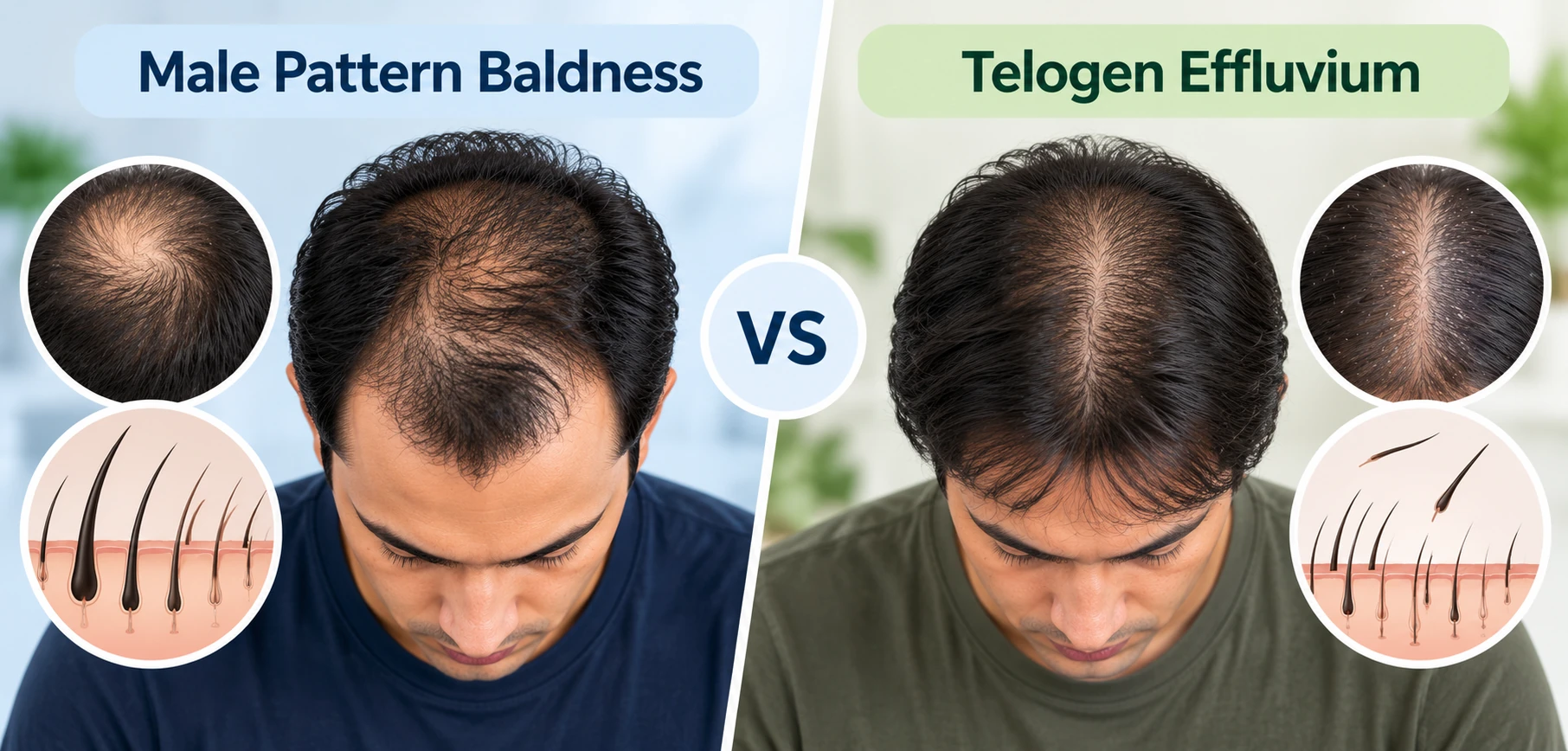
Illustrative sample only. The AI Hair Test screens patterns and does not diagnose, prescribe or endorse a brand. Both types need a doctor's diagnosis; any medication is prescription-gated and doctor-guided. Results vary.

Male pattern baldness (androgenetic alopecia) and telogen effluvium are two distinct kinds of hair loss. Pattern baldness is genetic and androgen-driven: hair follicles gradually miniaturise in a recognisable pattern — typically a receding hairline at the temples and thinning over the crown — it develops slowly over months and years, tends to be progressive, and generally does not reverse on its own without doctor-guided treatment. Telogen effluvium is diffuse shedding all over the scalp set off by a trigger — illness, high stress, surgery, childbirth, rapid weight loss, a nutritional deficiency, thyroid problems or certain medicines — and it is usually temporary and reversible once that trigger is identified and addressed, often improving over a few months. So the key contrasts are patterned vs diffuse, gradual vs sudden, and progressive vs usually temporary. The two can also coexist, which is one reason self-diagnosis is unreliable. Because they're managed very differently, a proper diagnosis comes first — and any medical treatment is doctor-guided and prescription-gated. Don't start Minoxidil, Finasteride or Dutasteride on your own. Use the AI Hair Test to screen your pattern, then see a doctor. Results vary.
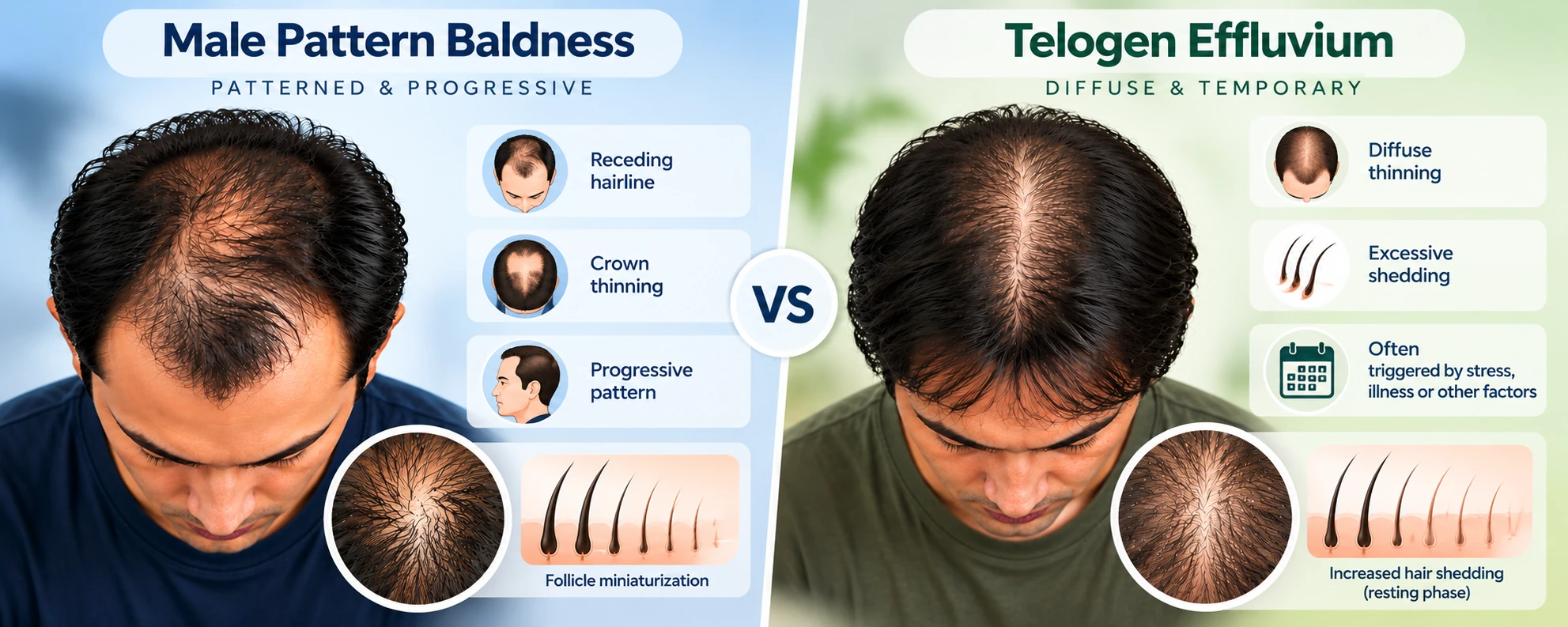
The clearest way to think about it: male pattern baldness is about a pattern, and telogen effluvium is about a trigger. In pattern baldness, genetics and androgens cause follicles to miniaturise in defined zones — the temples and crown in men — so the loss looks patterned and builds up gradually and progressively over years.
Telogen effluvium is different: a stressor pushes more hairs than usual into the shedding phase, so you notice diffuse thinning all over, often two to three months after the event. Common triggers include illness or fever, surgery, childbirth, rapid weight loss or crash dieting, iron or other deficiencies, thyroid disturbance, and certain medicines. Because it's trigger-based, it is usually temporary and reversible once the cause is found and corrected.
Two practical points. First, the two can overlap — a trigger can also unmask or accelerate underlying pattern loss — so what you see isn't always one single thing. Second, and most importantly, diagnosis comes before treatment. No product here cures hair loss or guarantees regrowth, and any medical treatment for either condition is doctor-guided and prescription-gated. Please don't start Minoxidil, Finasteride or Dutasteride on your own — see a doctor.
Two different scalp concerns. Recommended categories, prices, ratings, stock and badges are placeholders populated dynamically.
Not sure which you have? They overlap — screen your pattern, then get a diagnosis.
Take the AI Hair TestAsk a Hair DoctorA clean, extractable side-by-side. This helps you tell them apart; it isn't a diagnosis.
| Feature | Male Pattern Baldness | Telogen Effluvium |
|---|---|---|
| Main driver | Genetic + androgens | A trigger (stress, illness, etc.) |
| Distribution | Patterned (hairline + crown) | Diffuse, all over |
| Onset | Gradual, over years | Sudden, after a trigger |
| Course | Progressive | Usually temporary |
| Reversible? | Not on its own | Often, once trigger addressed |
| Follicle change | Miniaturisation | More hairs shed, follicles intact |
| Family history | Common | Not typically |
| Treatment | Doctor-guided, Rx-gated | Find & treat the trigger |
| Supplements | Not a treatment for it | Help only if a deficiency exists |
| Needs diagnosis? | Yes | Yes |
The table shows why self-treating is risky: the two look and behave differently and are managed differently, yet they can coexist. No casual medication — Minoxidil, Finasteride and Dutasteride are prescription-gated and doctor-guided, and supplements aren't a treatment for pattern loss (they help telogen effluvium only where a real deficiency exists). Get a diagnosis first.
Want this matched to you? Screen your scalp and the likely cause first.
Check Product SuitabilityTake the AI Hair TestUse this as guidance, not a prescription. With either type of hair loss, diagnosis comes first — and any medical treatment is doctor-guided.
Thinking of starting a hair-loss medicine? Please get diagnosed and prescribed properly first.
Take AI Hair TestDoctor Diagnosis Needed?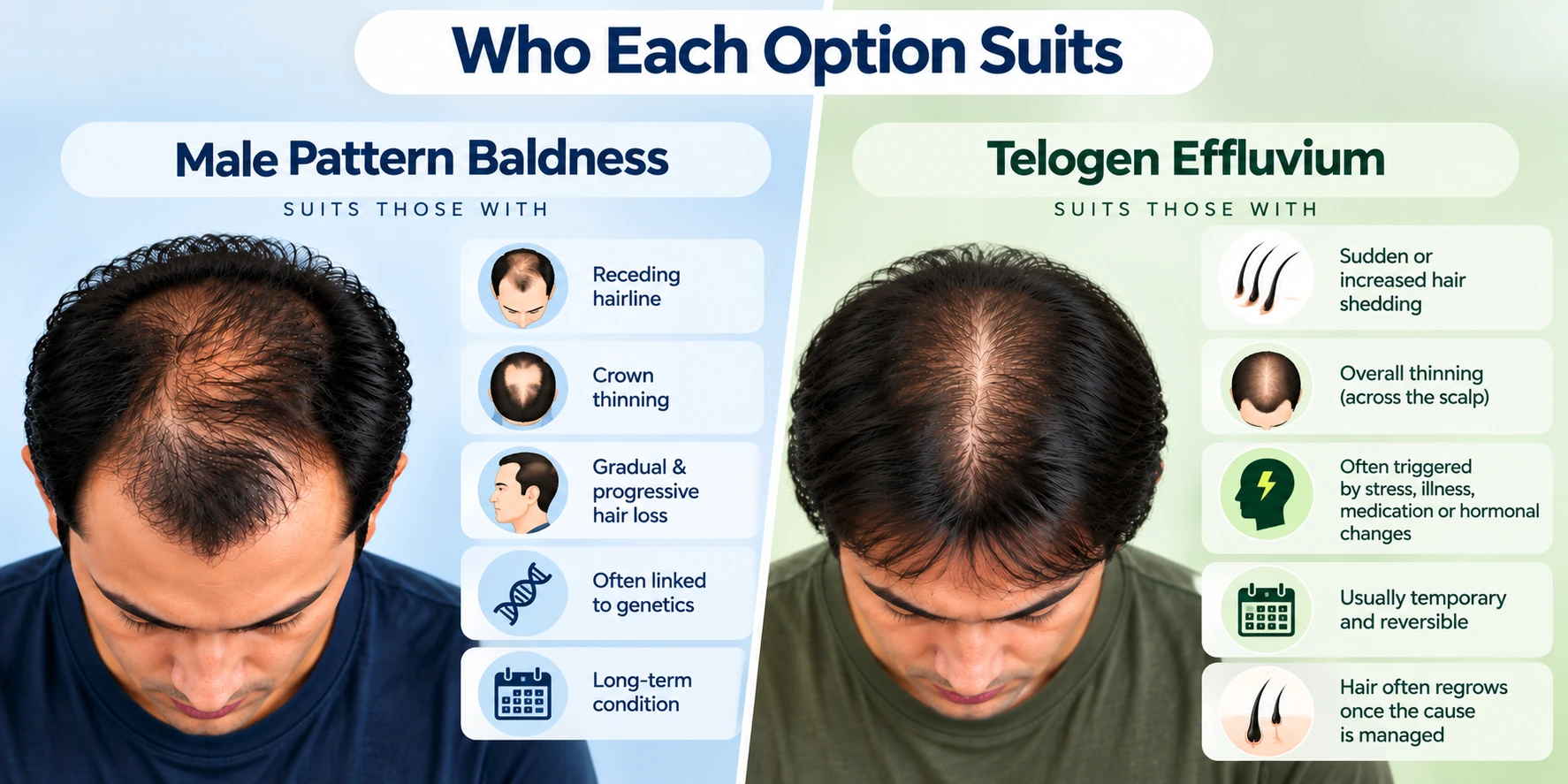

Neither type is an ecommerce-only problem, and medication is prescription-gated. Don't self-prescribe — see a doctor first for any of these.
Explore doctor-reviewed categories. These don't cure hair loss or guarantee regrowth; medical treatment is doctor-guided and prescription-gated. Exact products, prices, ratings, stock and Rx/OTC badges are placeholders populated dynamically from the database.
Male pattern baldness and telogen effluvium are two different kinds of hair loss that both need a doctor's diagnosis; no product here cures hair loss or guarantees regrowth. Pattern baldness is genetic, patterned and progressive, and its medical treatment is doctor-guided and prescription-gated — please do not start Minoxidil, Finasteride or Dutasteride on your own. Telogen effluvium is usually temporary and improves once the trigger is found and addressed; supplements help only where there is a genuine deficiency and are not a treatment for pattern loss. The two can overlap. We do not fabricate ingredient compositions, actives, strengths, prices, ratings, stock, discounts or reviews. Results vary.
Compare other options too, or check what suits you first.
Take AI Hair TestCompare PCOS vs Thyroid Hair Loss
A simple framework for supporting your hair alongside a doctor's plan — whichever type you have. General guidance, not medical or dosing advice; follow your doctor and the label.

AI Hair Test to explore pattern vs diffuse.
Sudden/patchy loss or scalp issues → see a doctor.
A doctor confirms which it is (they overlap).
Medication is doctor-guided & Rx-gated.
Pattern loss needs a professional plan.
Any medicine only on a doctor's advice.
Progress is slow; follow the plan.
Reassess with your doctor over time.
Illness, stress, childbirth, diet, deficiency, thyroid.
Correct the cause; check deficiencies with a doctor.
Iron & vitamin support only if needed.
Shedding often improves over a few months.
Avoid harsh handling; be patient.
Use the progress tracker.
No cure or guaranteed regrowth from products.
Reassess with a doctor if no improvement.
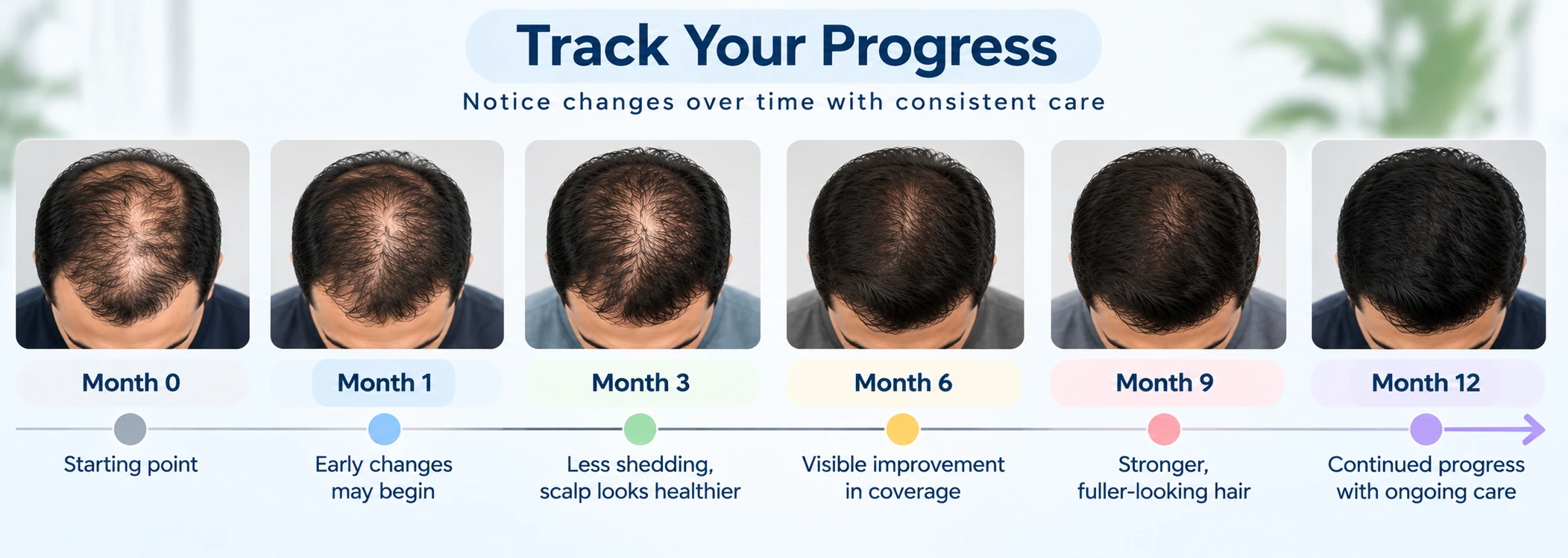
Pattern loss changes slowly and shedding recovers gradually, so logging shedding, density, hairline, any triggers and consistency over months gives you and your doctor an honest picture.
"The first question I ask is whether the loss is patterned or diffuse. A receding hairline and thinning crown that have crept up over years point towards pattern baldness; sudden shedding all over, a couple of months after an illness, a baby, a crash diet or a stressful period, points towards telogen effluvium. The reassuring part is that telogen effluvium is usually temporary and recovers once we find and fix the trigger. Pattern baldness is more persistent and needs a proper, doctor-guided plan. What worries me is people starting Minoxidil, Finasteride or Dutasteride on their own from the internet. Those are prescription decisions with real considerations, and the two conditions can overlap. Please get a diagnosis first, then let us guide the treatment safely."
Not sure which type you have? Get a proper diagnosis before any treatment.
Consult Dr. Amit's TeamThese references are provided for patient education and do not replace a dermatologist’s diagnosis or individual medical advice.
Dermatologist-led overview of how hair loss is evaluated and the evidence behind common treatments.
View AAD reference ›Patient-education summary of genetic, DHT-driven pattern hair loss in men and women.
View MedlinePlus reference ›Searchable index of peer-reviewed research on pattern hair loss and telogen effluvium.
Search PubMed ›Independent systematic reviews assessing the evidence behind hair-loss interventions.
View Cochrane Library ›
Question not answered here? Ask Dr Amit for general guidance, or book a consultation.
Ask Dr AmitConsult a DoctorGuidance, not a prescription. With both types, diagnosis comes first, and any medical treatment is doctor-guided and prescription-gated. Results vary.
If the loss is mild, early, non-progressive, recent, or you're unsure which type it is, the safest first step is to screen rather than self-treat. Gentle care and patience help, and if it's early telogen effluvium it may settle once a trigger is addressed. If your diagnosis is unclear, take the AI Hair Test first and consider a doctor — the two conditions overlap.
For moderate or ongoing shedding, weak or thinning hair, crown thinning, a widening or receding hairline, or doctor-confirmed pattern loss, this needs a doctor-guided plan rather than self-bought medicine. Pattern baldness is progressive and prescription-gated; persistent diffuse shedding needs the trigger and any deficiency assessed. Confirm the cause first.
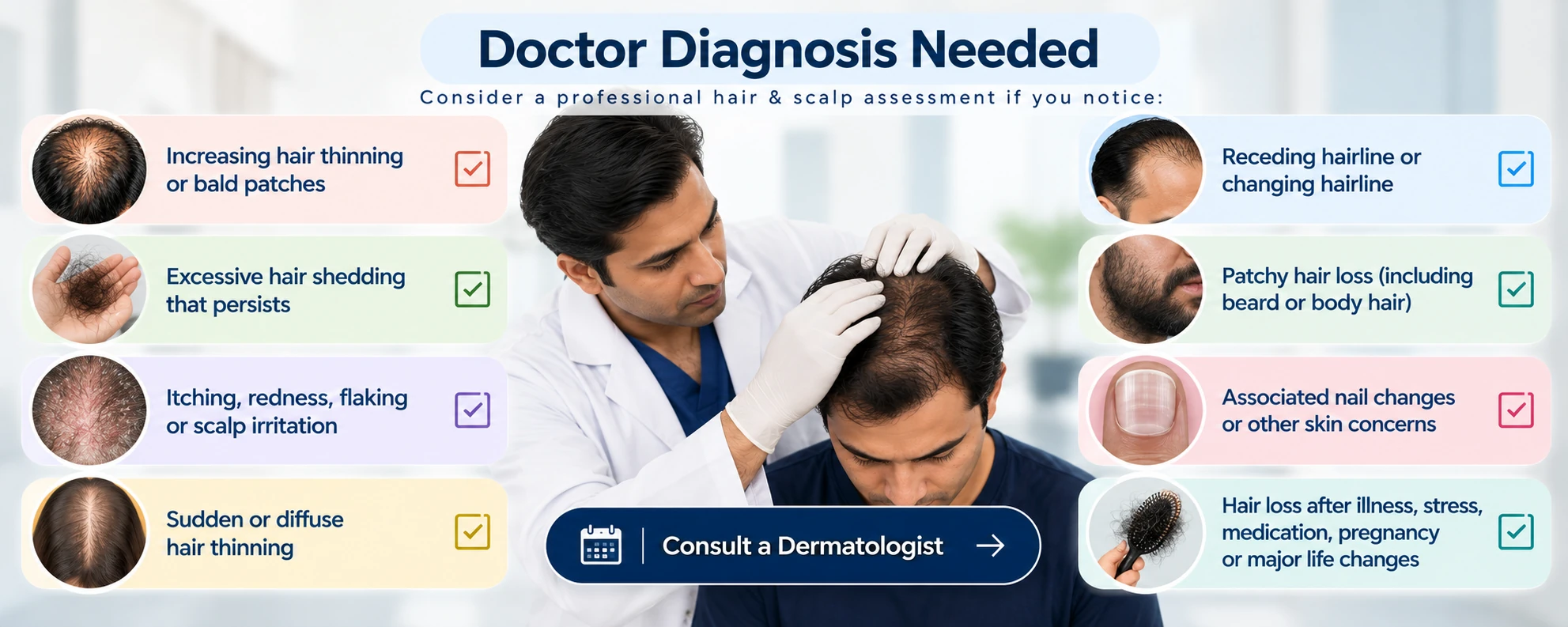
See a doctor before any treatment if you have any of: sudden hair fall; patchy hair loss; scalp redness, pus, pain or crusting; severe dandruff or infection; thick scalp plaques; scalp folliculitis or fungal concern; pregnancy or breastfeeding; teenagers; thyroid symptoms; PCOS symptoms; heavy periods or suspected anaemia; rapid weight loss; severe fatigue; side effects from previous products; or an unclear diagnosis. Assessment comes first.
Explore doctor-reviewed categories suited to your needs. Confirm the cause first; products don't cure hair loss or guarantee regrowth, and any medicine is doctor-guided and prescription-gated — not a casual self-start.
Unsure where to start? Screen whether your loss looks patterned or diffuse and whether a trigger may be involved — then talk to a doctor. It's a screening aid, not a diagnosis or prescription.

They're two different kinds of hair loss, so the honest answer is to get a diagnosis before deciding anything. Male pattern baldness is genetic, patterned (hairline and crown), gradual and progressive, and generally doesn't reverse on its own — its treatment is doctor-guided and prescription-gated. Telogen effluvium is diffuse shedding triggered by something like illness, stress, childbirth, rapid weight loss, a deficiency or a thyroid issue, and it's usually temporary, improving once the trigger is found and addressed. The two can overlap, which is exactly why self-diagnosis and self-prescribing are risky. Please don't start Minoxidil, Finasteride or Dutasteride on your own. Take the AI Hair Test to screen your pattern, then see a doctor — especially for sudden, patchy or unexplained loss, scalp pain or redness, thyroid or PCOS symptoms, suspected anaemia, rapid weight loss or severe fatigue. Results vary.
A balanced, dermatologist-reviewed guide to telling Male Pattern Baldness and Telogen Effluvium — a balanced, dermatologist-reviewed guide to telling them apart.
Signs overlap and can coexist — only a clinician can confirm which you have.
Comparison visual slot · 720×520 WebP
Genetic, DHT-driven pattern hair loss.
Temporary, diffuse shedding after a trigger.
Male pattern baldness is gradual, patterned (hairline and crown) and genetic; telogen effluvium is diffuse, all-over, follows a trigger and is usually temporary. They can also occur together.
More likely MPB if gradual at the hairline/crown with a family history; more likely TE if sudden and diffuse after a stress, illness or diet event with no clear pattern.
Reviewed by: Dr. Amit Agarkar, MD Dermatology
Medical focus: Dermatology, trichology, hair loss, scalp disorders and hair restoration.
Last reviewed: 1 June 2026
Editorial promise: This guide helps you understand the difference; it does not replace a clinical diagnosis.
The Hairsncares editorial team, medically reviewed by a dermatologist experienced in hair and scalp disorders.
Checked for accurate, balanced descriptions of both conditions and clear safety guidance.
To help you understand whether your signs fit Male Pattern Baldness or Telogen Effluvium, and when to get a diagnosis.
| Parameter | Male Pattern Baldness | Telogen Effluvium |
|---|---|---|
| What it is | Genetic, DHT-driven pattern hair loss | Temporary, diffuse shedding after a trigger |
| Typical signs | Receding hairline and/or crown thinning; gradual; finer, miniaturised hairs | All-over shedding about 2–3 months after a trigger; no distinct pattern |
| Common causes | Genetics combined with DHT | Stress, illness, childbirth, deficiency or a diet change |
| What helps | Minoxidil and Finasteride, doctor-guided | Addressing the trigger; usually self-resolving |
| When to see a doctor | Confirm the pattern and rule out other causes | Loss lasting beyond six to nine months, or patchy loss |
These signs overlap and the two can coexist — only a clinician can confirm which you have. Sudden, patchy, painful, red, spreading or persistent problems need a dermatologist.
Patchy or scarring loss is neither of these and needs prompt dermatologist assessment.
Male pattern baldness is gradual, patterned (hairline and crown) and genetic; telogen effluvium is diffuse, all-over, follows a trigger and is usually temporary. They can also occur together.
More likely MPB if gradual at the hairline or crown with a family history; more likely TE if sudden and diffuse after a stress, illness or diet event with no clear pattern. Because the signs overlap, a clinician is the reliable way to confirm.
Yes — the two can coexist, which is another reason to get a proper assessment rather than self-diagnosing.
Treatment differs by condition and cause, so an accurate diagnosis matters more than picking a product. Prescription options remain doctor-guided.
These signs overlap and the two can coexist — only a clinician can confirm which you have. Sudden, patchy, painful, red, spreading or persistent problems need a dermatologist.
| Factor | Male Pattern Baldness | Telogen Effluvium |
|---|---|---|
| Pattern | Hairline/crown, patterned | Diffuse, all over |
| Timeline | Gradual over years | Often 2–3 months after a trigger |
| Driver | Genetics + hormones (DHT) | Stress, illness, surgery, diet, meds |
| Course | Progressive without treatment | Often recovers once trigger resolves |
| Doctor needed? | For diagnosis & options | To find and address the trigger |
This matrix is educational and helps you understand which direction may fit your situation. It does not replace a dermatologist diagnosis. Results vary.
The clearest clue is shape. Male pattern loss is patterned — it concentrates at the temples and crown and advances gradually, often with a family history. Telogen effluvium is diffuse — increased shedding spread fairly evenly across the scalp, usually a couple of months after a trigger such as illness, surgery, major stress, crash dieting or certain medications.
The two can also coexist, which is why self-labelling is unreliable. Screen your pattern with the AI Hair Test and read more under hair loss and men's hair loss.
This page is educational and does not diagnose. For a tailored plan, ask a doctor.
Screening tools and product links are for education and discovery. They do not diagnose, prescribe or guarantee results, and they do not replace a doctor.
Your cart is empty