Skip to content
Expert-reviewed styling education · Root-lift spray and volume powder compared · Cosmetic volume, not hair-growth treatment Last reviewed: 23 July 2026 Cosmetic editorial policy Ingredient-claims policy Aerosol-safety policy Correction policy Commercial-affiliation disclosure Book a consultation
Persistent scalp irritation, sudden shedding, patchy hair loss or rapidly reducing density requires professional assessment rather than styling-product escalation.

Root Lift, Texture and Styling Intelligence

Volumizing Spray vs Volume Powder: Root Lift, Texture, Hold and Which One to Use

These two create fullness by different mechanisms. Volumizing spray distributes lightweight styling ingredients through damp or dry hair, usually working best alongside blow-drying and controlled root direction — it gives softer movement and broader body. Volume powder goes onto dry roots, where it increases friction between fibres, absorbs oil and delivers immediate matte grip — more concentrated, more targeted, more restylable. Both can leave residue or stiffness if overused, and with fine hair more product frequently produces less volume. Neither treats hair loss, and this page endorses no brand.

No Hair-Growth Claims
Cosmetic-science comparison of volumizing spray and volume powder for temporary root lift, texture and fuller-looking hair
Airy structure and mineral friction — two routes to the same visual goal.
Cosmetic Claims Audited

Quick Answer

Volumizing spray generally adds distributed body and root support, most effectively alongside blow-drying. Volume powder is applied to dry roots for immediate friction, matte grip and oil absorption. Spray often feels softer and suits longer styles; powder is useful for targeted root lift and shorter cuts. Formula, hair type and application technique determine the result. Neither product grows hair.

Read this first: Use the smallest effective amount — overapplication creates stiffness, residue or scalp discomfort, and with fine hair it frequently produces less volume rather than more.

At a Glance

Two Volume Mechanisms, Compared

Neither panel is ranked above the other. They build volume differently, and the right answer depends on your hair, your finish preference and how you actually style.

Volumizing Spray

Root liftGood, particularly when combined with blow-drying and root direction
Overall volumeDistributed body through the lengths as well as the roots
Matte finishFormula dependent — many leave a more natural finish than powder
ShineGenerally preserves more shine than a matte powder
GripModerate; depends on the polymer system rather than friction
HoldLight to medium in most formulas; firm-hold versions exist
TouchabilityUsually brushable and touchable; some formulas feel tacky if overapplied
Oil absorptionNot the mechanism — spray does not absorb sebum
Blow-dryingOften required for full effect. Applied to damp hair, activated by drying
Short hairCan work, though powder is frequently more practical for very short cuts
Long hairOften the stronger choice — distributed body suits length
Fine hairLightweight formulas suit well; heavy application collapses fine hair
Curly hairMay support diffused root lift if compatible with the curl routine
RestylingLimited once the styling film has set; re-wetting may be needed
BuildupPolymers can accumulate with repeated use without adequate cleansing
Scalp sensitivityAlcohol, fragrance and propellants are the usual considerations
CostAerosol vs pump, bottle size and quantity used per style drive cost
Aerosol Formats Are Flammable — Check the Label

Volume Powder

Root liftImmediate and concentrated at the point of application
Overall volumeTargeted rather than distributed — mainly a root-zone effect
Matte finishThe characteristic finish — matte texture is intrinsic to the mechanism
ShineReduces shine. This is a trade-off, not a defect
GripStrong — friction between fibres is precisely how it works
HoldGrip rather than hold; restylable rather than fixed
TouchabilityTextured and touchable, though excess can feel gritty
Oil absorptionYes — absorbent minerals and starches take up sebum. This is not the same as cleansing
Blow-dryingApplied after drying. Works on dry hair without heat
Short hairFrequently the stronger choice — targeted crown and separation
Long hairUseful at the roots; less effective for length-wide body
Fine hairExcellent grip, but excess is more visible and can look gritty
Curly hairMay disrupt curl grouping. Not automatically suitable for every curl routine
RestylingA key strength — texture can be reworked by hand through the day
BuildupLayering without washing is the most common cause of residue and waxy roots
Scalp sensitivityFine particles, fragrance and repeated layering are the considerations
CostContainer size, quantity per use and applicator design drive cost
Fine Particles — Avoid Inhalation

The Core Distinction

Spray Builds Structure. Powder Builds Friction.

Do you need airy structure through the hair, or concentrated grip at the roots? Answering that is more useful than comparing volume claims on packaging.

Airy structure

Distributed formula + technique + drying = body and root support

  • Fuller blow-dry with soft movement
  • Lift through the lengths, not only the roots
  • Flexible, brushable body
  • Long-hair volume
  • A finish that still moves

Likely direction: volumizing spray, root-lift mist, thickening spray, blow-dry tonic.

Concentrated root grip

Dry particles + friction + oil absorption = immediate grip

  • Immediate crown lift without heat
  • Matte texture and separation
  • Short-hair definition
  • Oil absorption at the roots
  • Restylable through the day

Likely direction: volume powder, root powder, powder wax, texturizing dust.

Mixed goal

Light spray + minimal finishing powder

  • Both distributed body and targeted grip
  • Spray before drying, powder after styling
  • Powder applied only where needed
  • Careful buildup management
  • Tested before an occasion that matters

Combining is not automatically better — two products means twice the residue potential.

A powder is not simply a dry version of volume spray, and a spray is not automatically lighter. Their finish and performance depend on the complete formula, the quantity and the application technique.

Adjacent Categories Worth Separating

These get conflated constantly — particularly the first two, which behave very differently in practice.

Adjacent styling and cosmetic categories that are frequently confused with volume products.
CategoryWhat it actually does
Volume powderDry particulate applied at the roots for friction, grip and matte texture. Absorbs some oil as a consequence of its mineral content.
Dry shampooPrimarily intended to absorb oil and refresh hair between washes. Texture is a secondary effect. It is not a volume product, and neither replaces washing.
Root-lift sprayDesigned mainly to elevate the root area, usually in combination with blow-drying.
Volumizing mistA lightweight spray for distributed body rather than concentrated root lift.
Thickening sprayCoats or structures individual fibres to create fuller-looking strands.
Texturizing sprayAdds grip, separation and undone texture rather than pure root lift.
Sea-salt sprayCreates dry, beach-like texture and may increase surface roughness.
Styling powder waxA powder that transforms into a wax-like texture during application — different finish from a pure volume powder.
Hair fibersA camouflage product that attaches to hair shafts to reduce the appearance of thinning. Not a styling powder.
Scalp concealerA pigment product that reduces scalp-to-hair colour contrast. Not a volume powder.

Volumizing products change the temporary arrangement, texture and appearance of existing hair fibres. They do not increase follicle count or treat medical hair loss.

How Each One Works

The Volume-Mechanism Pathway

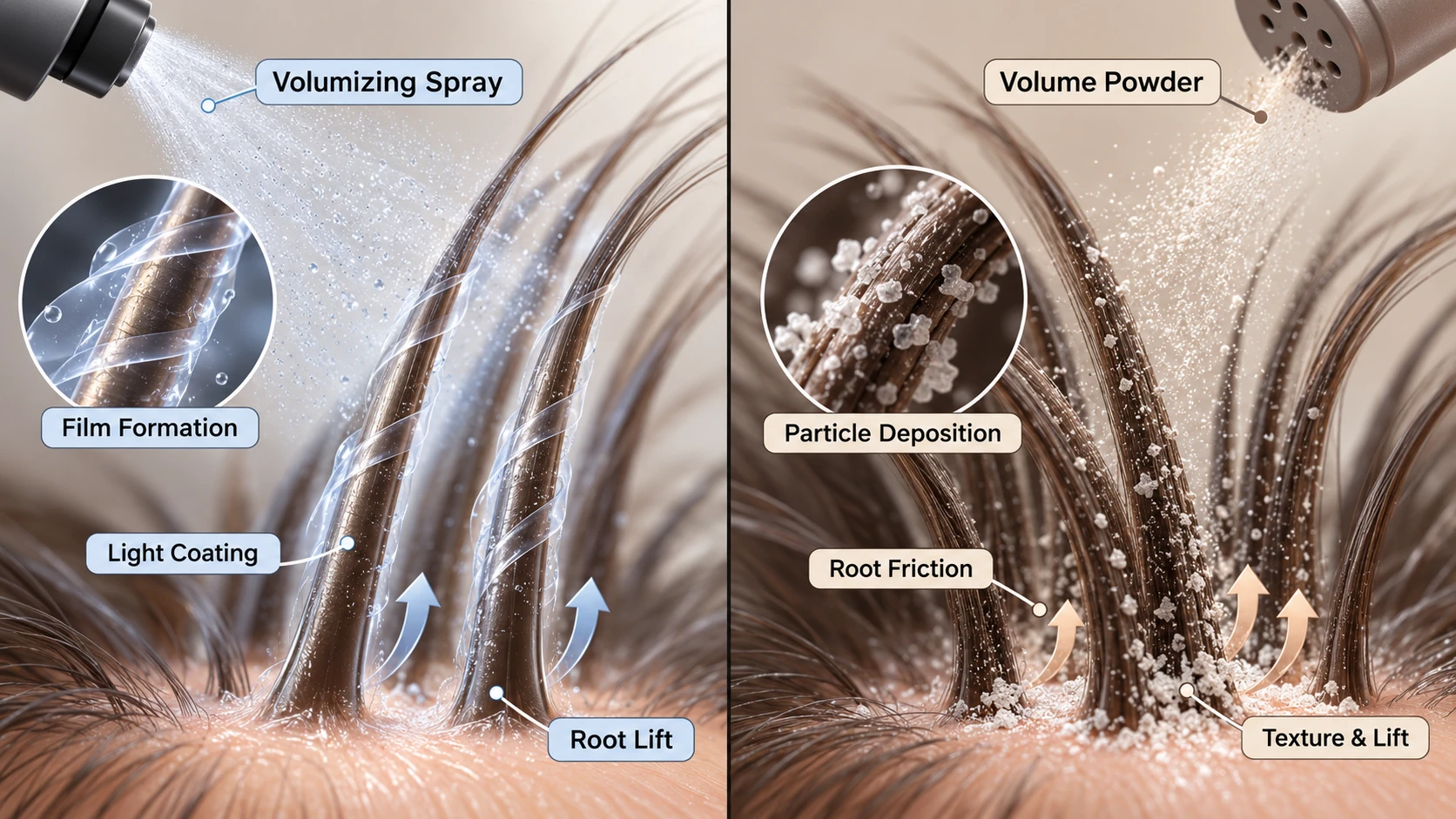
One deposits a film and needs drying to activate. The other deposits particles and works on contact. That single difference determines when in your routine each belongs.

Starting Condition

Hair condition, sebum level, fibre diameter and cut all affect the outcome before any product is applied. Flat hair caused by oil behaves differently from flat hair caused by fine fibre diameter.

Spray: Distribution and Deposition

Applied to damp or dry hair per the label. Styling polymers and conditioning agents distribute across the fibres, separating them and preparing the root zone for shaping.

Needs even distribution

Spray: Drying and Film Formation

Blow-drying with the roots directed away from the scalp sets the position. The styling film forms as the hair dries — which is why technique matters as much as the product here.

Blow-dry activated

Powder: Particle Deposition and Friction

Applied to dry roots. Absorbent particles take up surface sebum and increase friction between fibres, so hair holds a lifted position through grip rather than through a set film.

Works on contact

Wear and Removal

Both are temporary and removed by shampooing. Repeated layering without adequate cleansing produces buildup — which flattens hair rather than lifting it.

The exact mechanism depends on the ingredients, vehicle and styling technique of the individual product.

Abstract diagram comparing volumizing spray film formation with volume powder root friction and particle deposition
Film and technique on one side; particles and friction on the other.

In Detail

Full Comparison Table

Two rows deserve particular attention: the inhalation and flammability rows. These are the practical safety differences between the formats, and they are easy to overlook while comparing hold and finish.

Swipe to compare →

Volumizing spray and volume powder compared across mechanism, finish, hair type, durability and safety. General cosmetic education — performance varies by formula and technique, and neither is a hair-loss treatment.
ConsiderationVolumizing SprayVolume Powder
Product categoryLeave-on styling sprayDry particulate styling product
Primary mechanismPolymer or conditioning-agent deposition and film formationParticle deposition, inter-fibre friction and oil absorption
Application formatAerosol or pump sprayLoose powder, shaker or applicator nozzle
Aerosol or non-aerosolBoth exist — aerosols are flammableNon-aerosol, but fine particles should not be inhaled
Damp-hair useCommon — many are designed for itGenerally not — powder needs dry hair
Dry-hair useFormula dependentThe intended use
Root applicationYes, with the roots directed away from the scalpYes — this is the target zone
Length applicationOften, for distributed bodyOccasionally for texture; not the main use
Blow-dry requirementOften needed for full effectNot required — works on dry hair without heat
Immediate liftUsually develops during dryingImmediate on contact
Distributed bodyYes — a defining strengthLimited — concentrated at the roots
Matte textureFormula dependentCharacteristic — intrinsic to the mechanism
ShineGenerally better preservedReduced — a trade-off of the matte finish
GripModerate, polymer-basedStrong, friction-based
Flexible holdCommon in lighter formulasGrip rather than hold — stays restylable
Strong holdAvailable in firmer formulasNot the mechanism — powder grips rather than fixes
Oil absorptionNoYes — but absorbing oil is not cleansing
RestylingLimited once the film setsA key strength — reworkable by hand
BrushabilityGenerally goodBrushing removes much of the texture
TouchabilityGood unless overappliedTextured; excess feels gritty
Fine-hair suitabilityLightweight formulas suit wellExcellent grip; excess is more visible
Thick-hair suitabilityDistributes well through densityNeeds more product to reach all roots
Straight hairBlow-dry structure works wellTargeted lift is effective
Wavy hairSupports body without flattening the waveCan add separation and grip
Curly hairMay support diffused root liftMay disrupt curl grouping — not automatic
Coily hairFormula and routine dependentSome powders feel excessively rough on dry coily hair
Short hairCan work; powder is often more practicalFrequently the stronger choice
Long hairOften the stronger choiceRoot-zone only — limited for length
Oily rootsDoes not address sebumAbsorbs surface oil at the roots
Dry hairSome alcohol-containing formulas feel dryingMay make dry or damaged hair feel rougher
Colour-treated hairFormula dependent; concentrate at the rootsConcentrate at the roots when lengths are fragile
Bleached hairMay gain volume but feel rougherCan make damaged ends feel matte and tangle more
Sensitive scalpAlcohol, fragrance and propellants are the considerationsFine particles, fragrance and layering are the considerations
FragranceCommon; fragrance-free options existCommon; fragrance-free options exist
AlcoholCommon in sprays — not automatically harmfulGenerally not applicable
Inhalation concernAvoid intentional inhalation; ventilateFine particles — avoid inhaling during application
FlammabilityAerosols are flammable — keep away from flame, sparks and hot toolsNot typically flammable, but check the label
White residueUncommonPossible, particularly on dark hair with overapplication
Product transferPossible if overapplied or tackyPossible — to fingers, pillows and collars
BuildupPolymers accumulate with repeated useLayering without washing is the main cause
RemovalShampooShampoo — repeated layering may need thorough cleansing
Cost per useAerosol vs pump, size and quantity usedContainer size, quantity per use, applicator design
Main limitationOften needs blow-drying to work fullyMatte, root-zone only, and visible if overapplied

Volumizing Spray · Distributed Structure

Volumizing Spray: Distributed Body, Root Support and Blow-Dry Structure

The film sets as the hair dries. Whatever position you dried the roots into is the position it holds — which means technique contributes as much as the product does.

Styling polymers and film formers

The working ingredients in most volume sprays. They deposit across the fibre and form a film as the hair dries, holding the shape you dried it into. Firmness ranges from barely perceptible to noticeably stiff depending on the polymer system.

Why blow-drying matters so much

This is the most misunderstood point. The film sets as the hair dries, so the position you dry the roots into is the position the film holds. Applying the product and air-drying flat produces very little of the intended effect.

Aerosol versus pump format

Not merely a packaging preference. Aerosols are flammable and must be kept away from flame, sparks and hot styling tools, and used in a ventilated space. Pump sprays avoid propellants but still produce a fine mist that should not be deliberately inhaled.

Alcohol in spray formulas

Common, and not automatically harmful. It helps the product dry quickly and distribute evenly. Some people find alcohol-containing formulas feel drying on the hair or sting an already irritated scalp — that is a tolerance question rather than a damage claim.

Heat-protection claims require verification

Not every volume spray provides heat protection. A product that happens to be used before blow-drying is not thereby a heat protectant. If heat protection matters to you, look for it stated explicitly on the label rather than assumed from the category.

Damp versus dry application

Follow the specific label. Many are designed for towel-damp hair and rely on the drying process; some are formulated for dry refreshing. Using a damp-hair formula on dry hair usually produces a tacky result rather than lift.

Sectioning and root direction

Volume comes from lifting roots away from the scalp and drying them in that position — usually against the direction of natural fall. Technique contributes at least as much as the product, which is why the same spray gives different results in different hands.

Fine hair and the collapse point

Every fine-haired person has a quantity beyond which more product produces less volume. The weight of the deposit exceeds what the fibre can support and the hair goes flat. Building gradually and reassessing before adding more is the practical answer.

Stickiness and crunch

A tacky or crunchy finish generally signals either too much product or a formula with a firmer hold than you wanted. Some sprays are designed to be broken up by brushing once dry; others are not.

Humidity and durability

Styling polymers vary considerably in humidity resistance, and no numeric durability rating is published here because performance is entirely product-specific. High humidity can soften some styling films and reduce root lift over the day.

Buildup and scalp contact

Polymers accumulate with repeated use without adequate cleansing, and buildup flattens hair rather than lifting it. Saturating the scalp itself is rarely necessary and can sting where the skin is already irritated.

Volumizing-Spray Reality Check

Ten corrections worth carrying to the shelf

  1. Spray does not permanently thicken hair
  2. Not every volume spray includes heat protection
  3. Aerosol and pump formats have different safety considerations
  4. Alcohol is not automatically harmful, but can feel drying in some formulas
  5. More product can make fine hair collapse
  6. Incorrect blow-drying can eliminate the root lift entirely
  7. Humidity can weaken some styling films
  8. Spray can build up with repeated use
  9. Spraying onto an irritated scalp can sting
  10. Spray does not treat medical thinning
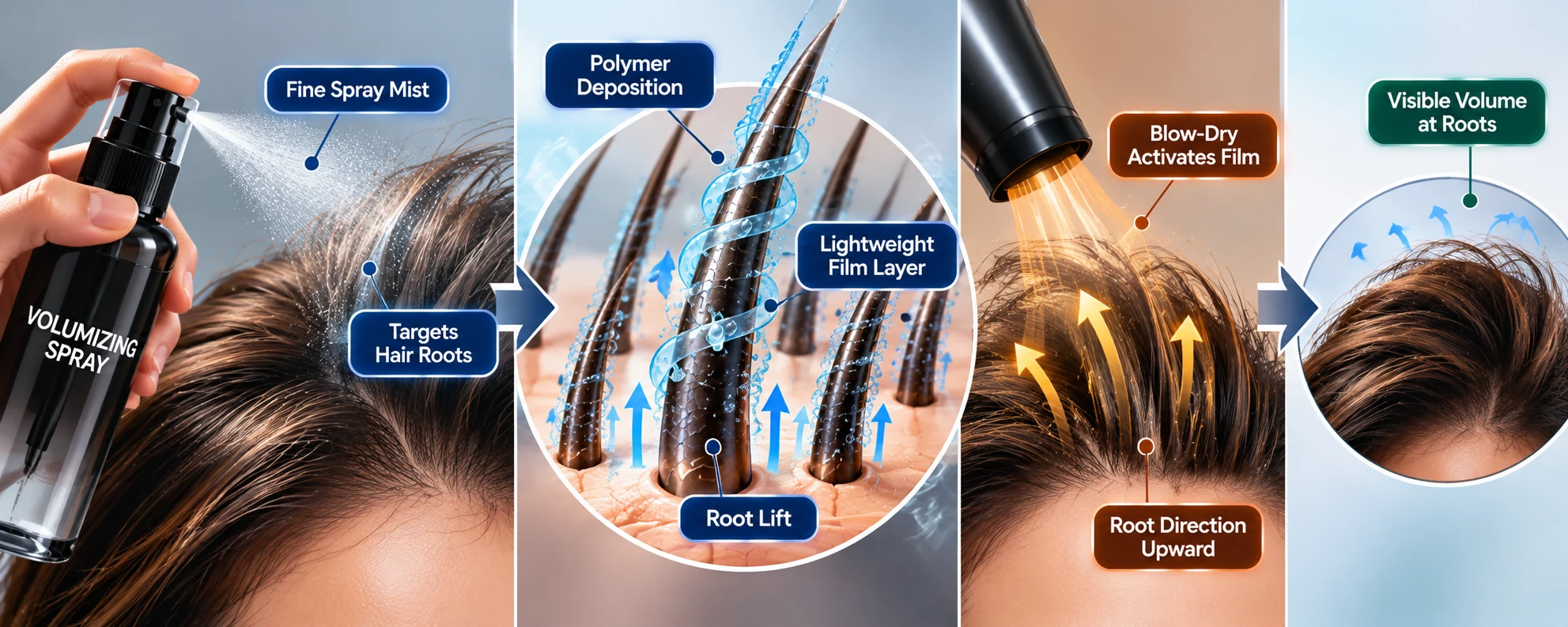
Abstract illustration of volumizing spray polymer deposition, root direction and blow-dry film formation
Deposition, root direction, drying — three steps, and skipping any of them costs the lift.

Volume Powder · Targeted Friction

Volume Powder: Immediate Root Friction, Matte Grip and Oil Control

Powder makes hair grip itself. That is the whole mechanism — and it explains both why it works instantly and why too much of it feels gritty.

Not the same as dry shampoo

The most common confusion on this page. Dry shampoo is primarily intended to absorb oil and refresh hair between washes; volume powder is primarily intended to create texture and grip. There is overlap in ingredients and some products blur the line — but neither replaces washing.

Absorbent and texturising ingredients

Silica and silica silylate, starches (tapioca, rice, corn), kaolin, zeolite and magnesium carbonate are common. Styling polymers and cellulose derivatives may be added for hold. The specific blend determines how matte, how grippy and how visible the result is.

Oil absorption is not cleansing

Powder takes up surface sebum, which is why oily roots look and feel better after application. It does not cleanse the scalp, and using more powder in place of washing is how buildup accumulates.

White residue and dark hair

Not every powder is invisible. On dark hair, overapplication or poor distribution can leave a visible cast — particularly under overhead lighting or camera flash. Applying a very small quantity and activating it properly is the answer.

Application and manual activation

Apply sparingly to sectioned dry roots, avoid creating a concentrated white patch, then massage or work it in gently. The friction develops as you activate it. Adding more before activating the first application is the usual mistake.

Short hair and crown lift

Frequently where powder performs best. Short cuts benefit from targeted separation and immediate crown lift without heat, and the restylable nature suits styles reworked through the day.

Fine hair: strong grip, visible excess

Fine hair responds well to the friction, but the same fineness makes excess powder more visible and more likely to feel gritty. Less product, better activated, is consistently better than more.

Dry, damaged and coily hair

Powder can make already-dry hair feel rougher, and increased friction can raise tangling. Some dry coily hair finds certain powders excessively rough. Concentrating at the roots rather than through the lengths limits this.

Curly hair is not automatic

Powder can provide targeted lift but may disrupt curl grouping, and matte finishes reduce the shine many curl routines are built around. No curl type automatically requires or excludes it — it depends on the routine and the finish you want.

Fine particles and inhalation

Fine powders should not be deliberately inhaled. Apply in a well-ventilated space, keep the product away from the face and eyes, and avoid dispensing directly toward the breathing zone.

Buildup, layering and cleansing

Repeated daily layering without washing is the single most common cause of waxy roots, dullness, tangling and scalp itching. When hair goes flat despite more powder, buildup is usually the reason — and the answer is cleansing, not more product.

Volume-Powder Reality Check

Ten corrections worth carrying to the shelf

  1. Volume powder is not identical to dry shampoo
  2. Powder absorbs oil but does not cleanse the scalp
  3. Excess powder can become visible, especially on dark hair
  4. Fine particles should not be deliberately inhaled
  5. Dry or damaged hair may feel rougher
  6. Repeated layering produces buildup
  7. Powder is not automatically suitable for curly hair
  8. Matte finish reduces shine — a trade-off, not a defect
  9. Root friction can increase tangling when overused
  10. Powder does not increase true hair density
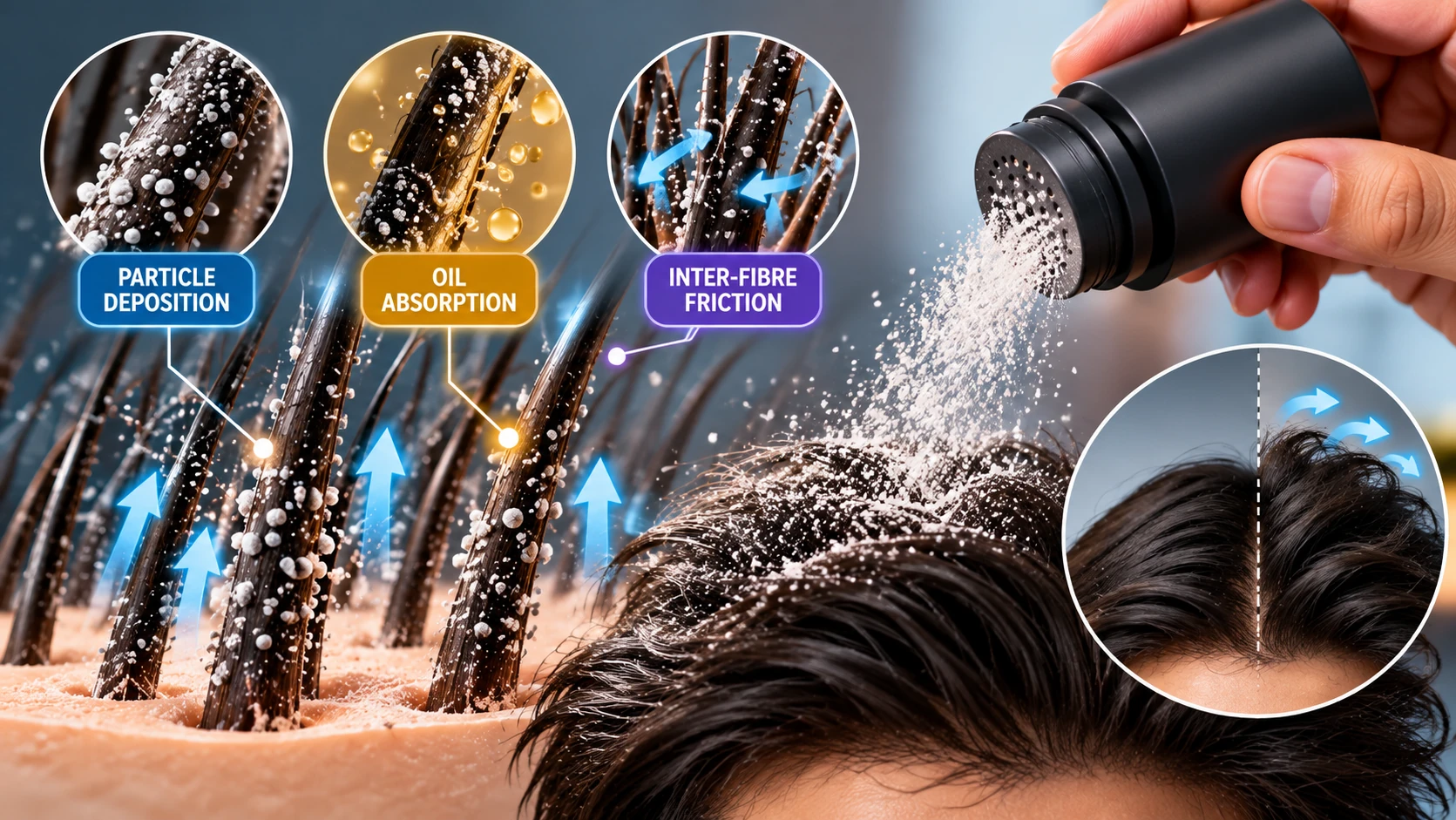
Abstract illustration of volume powder particle deposition, oil absorption and inter-fibre root friction
Particles, friction, grip — immediate, targeted and restylable.

By Hair Type

Which Product Suits Which Hair?

Fibre diameter, length, texture and root oiliness matter more than the marketing on either bottle. These are educational starting points, not prescriptions.

Fine Straight Hair

Main volume challenge
Collapses under product weight; the classic volume challenge.
Spray suitability
Lightweight formulas work well. Build gradually — there is a quantity beyond which volume decreases.
Powder suitability
Excellent grip, but excess is visible and can feel gritty.
Combined use
Light spray before drying, minimal powder after.
Main caution
Overapplication is the single biggest risk here.

Fine Wavy Hair

Main volume challenge
Wave gives some natural body, but roots still flatten.
Spray suitability
Supports body without over-setting the wave.
Powder suitability
Targeted root use preserves the wave pattern.
Combined use
Works well when both are used sparingly.
Main caution
Heavy product flattens the wave as well as the roots.

Thick Straight Hair

Main volume challenge
Weight of the hair itself pulls roots flat.
Spray suitability
Distributes well through density; may need generous sectioning.
Powder suitability
Needs enough product to reach roots throughout — section carefully.
Combined use
Reasonable; watch total product load.
Main caution
Distribution matters more than quantity.

Long Layered Hair

Main volume challenge
Length pulls down; layers need body throughout.
Spray suitability
Often the stronger choice — distributed body suits length.
Powder suitability
Root-zone only; limited for the lengths.
Combined use
Spray for body, powder for crown lift.
Main caution
Powder alone rarely satisfies for long hair.

Short Textured Crop

Main volume challenge
Needs separation and definition, not distributed body.
Spray suitability
Can work but is less targeted.
Powder suitability
Frequently the stronger choice — immediate, restylable.
Combined use
Powder alone is often sufficient.
Main caution
Excess is highly visible on short hair.

Pixie Cut

Main volume challenge
Crown lift and piecey separation are the goals.
Spray suitability
Useful before drying for overall shape.
Powder suitability
Excellent for targeted lift and definition.
Combined use
Small amounts of each.
Main caution
Very little product is needed at this length.

Medium-Length Bob

Main volume challenge
Root lift plus shape retention.
Spray suitability
Blow-dry structure supports the shape well.
Powder suitability
Crown lift and root refresh through the day.
Combined use
A common and effective combination.
Main caution
Buildup accumulates quickly with daily use.

Loose Curls

Main volume challenge
Root lift without disrupting curl clumping.
Spray suitability
May support diffused root lift if compatible with the routine.
Powder suitability
Can disrupt curl grouping — apply at roots only.
Combined use
Possible with restraint.
Main caution
Matte finish reduces the shine many curl routines want.

Tight Curls

Main volume challenge
Shrinkage and root flatness at the same time.
Spray suitability
Diffuser-compatible formulas may help.
Powder suitability
Targeted root use only; may increase friction.
Combined use
Use sparingly.
Main caution
Increased friction can raise tangling.

Coily Hair

Main volume challenge
Dryness is often the limiting factor before volume is.
Spray suitability
Formula and routine dependent.
Powder suitability
Some powders feel excessively rough on dry coily hair.
Combined use
Approach cautiously.
Main caution
Avoid unnecessary manipulation during application.

Low-Density Hair

Main volume challenge
Scalp visibility as well as flatness.
Spray suitability
Distributed body helps overall appearance.
Powder suitability
Targeted lift where scalp shows most.
Combined use
Reasonable.
Main caution
Neither product adds density — only apparent volume.

Oily Roots

Main volume challenge
Sebum causes collapse within hours.
Spray suitability
Does not address sebum at all.
Powder suitability
Absorbs surface oil — the more relevant choice here.
Combined use
Powder is usually the priority.
Main caution
Absorbing oil is not washing. Buildup follows if it substitutes for cleansing.

Dry Lengths

Main volume challenge
Product can worsen the dry feel.
Spray suitability
Some alcohol-containing formulas feel drying.
Powder suitability
May make dry lengths feel rougher and tangle more.
Combined use
Concentrate everything at the roots.
Main caution
Keep product off fragile lengths.

Bleached Hair

Main volume challenge
Volume gained, but texture already compromised.
Spray suitability
Formula dependent; concentrate at the roots.
Powder suitability
Can make damaged ends feel matte and tangle more.
Combined use
Use minimally.
Main caution
Bleached hair may gain volume but feel rougher.

Colour-Treated Hair

Main volume challenge
Balancing volume against colour longevity.
Spray suitability
Colour fading depends on the whole routine, not the volume product alone.
Powder suitability
Root-focused application limits exposure of coloured lengths.
Combined use
Reasonable with care.
Main caution
Not every alcohol-based product damages colour.

Grey Hair

Main volume challenge
Often coarser texture with different light behaviour.
Spray suitability
Works normally; texture may hold style well.
Powder suitability
Matte finish can read differently on grey — test in daylight.
Combined use
Reasonable.
Main caution
Check visibility of any powder residue carefully.

Hair Extensions

Main volume challenge
Attachment points must not be disturbed.
Spray suitability
Avoid saturating attachment areas.
Powder suitability
Avoid powder accumulating at bonds or wefts.
Combined use
Use minimally and away from attachments.
Main caution
Follow your extension provider’s product guidance.

Protective Styles

Main volume challenge
Limited scalp access; product can accumulate unseen.
Spray suitability
Limited practical benefit.
Powder suitability
Residue can build where it cannot easily be washed out.
Combined use
Generally not the priority.
Main caution
Buildup under protective styles is harder to detect and remove.

Sensitive Scalp

Main volume challenge
Product contact with reactive skin.
Spray suitability
Alcohol, fragrance and propellants are the considerations.
Powder suitability
Fine particles, fragrance and layering are the considerations.
Combined use
Introduce one product at a time.
Main caution
Address scalp irritation before adding styling products.

Buildup-Prone Routine

Main volume challenge
Multiple products layered between washes.
Spray suitability
Polymers accumulate without adequate cleansing.
Powder suitability
Layering is the most common cause of waxy roots.
Combined use
Combining increases the load further.
Main caution
When hair flattens despite more product, buildup is usually the cause.

Ingredient Intelligence

Ingredient Explorer

No ingredient group here is universally good or bad. What matters is the level, the rest of the formula and whether it suits your hair and scalp.

Styling polymers

What it is
Film-forming synthetic or modified natural polymers
Why it may be used
Form a flexible film on the fibre that holds the shape set during drying
Potential benefit
Hold ranges from barely perceptible to firm; the same class covers both
Potential limitation
Accumulate with repeated use without adequate cleansing
Label terms you may see
VP/VA copolymer, polyquaternium compounds, acrylates copolymer

Silica and silica silylate

What it is
Fine mineral particles
Why it may be used
Increase friction between fibres and absorb surface oil
Potential benefit
The core texturising mechanism in many volume powders
Potential limitation
Excess is visible and can feel gritty, especially on dark hair
Label terms you may see
Silica, silica silylate, hydrated silica

Starches

What it is
Plant-derived absorbent powders
Why it may be used
Absorb sebum and add soft texture at the roots
Potential benefit
Often gentler-feeling than mineral silicas
Potential limitation
Can build up; absorbing oil is not the same as cleansing
Label terms you may see
Tapioca starch, rice starch, corn starch, oryza sativa starch

Clay minerals

What it is
Absorbent mineral powders
Why it may be used
Absorb oil and add matte, textured grip
Potential benefit
Contribute a distinctly matte finish
Potential limitation
Can feel drying on already-dry hair
Label terms you may see
Kaolin, bentonite, zeolite, magnesium carbonate

Alcohol

What it is
Volatile solvent in spray formulas
Why it may be used
Helps the product distribute evenly and dry quickly
Potential benefit
Fast drying and even deposition
Potential limitation
Not automatically harmful, but can feel drying and may sting an irritated scalp
Label terms you may see
Alcohol denat., SD alcohol, ethanol

Humectants

What it is
Water-attracting ingredients
Why it may be used
Support flexibility and reduce brittleness in styling films
Potential benefit
Softer feel and less crunch
Potential limitation
Behaviour changes with ambient humidity
Label terms you may see
Glycerin, panthenol, propylene glycol

Salt

What it is
Sodium chloride and magnesium salts
Why it may be used
Create dry, textured, beach-like separation
Potential benefit
Adds grip and undone texture
Potential limitation
Can increase surface roughness and dryness with frequent use
Label terms you may see
Sodium chloride, magnesium sulfate, sea salt

Conditioning polymers

What it is
Cationic conditioning agents
Why it may be used
Improve combability and reduce static alongside styling
Potential benefit
Balance texture against manageability
Potential limitation
Can weigh down fine hair if the level is high
Label terms you may see
Polyquaternium-10, behentrimonium methosulfate

Silicones

What it is
Smoothing film formers
Why it may be used
Add slip and shine; reduce friction
Potential benefit
Improve manageability and reduce roughness
Potential limitation
Can counteract the very texture a volume product aims for
Label terms you may see
Dimethicone, cyclopentasiloxane, amodimethicone

Proteins and amino acids

What it is
Hydrolysed protein fragments
Why it may be used
Marketed for temporary fibre reinforcement and body
Potential benefit
May improve fibre feel
Potential limitation
Effects are formulation-specific and modest
Label terms you may see
Hydrolysed keratin, hydrolysed wheat protein, amino acids

Fragrance

What it is
Scent components
Why it may be used
User experience
Potential benefit
Makes the product pleasant to use
Potential limitation
A recognised contact sensitiser — relevant for sensitive scalps
Label terms you may see
Parfum, fragrance, linalool, limonene

Preservatives

What it is
Antimicrobial system
Why it may be used
Necessary for microbiological safety in water-containing formulas
Potential benefit
Prevents contamination
Potential limitation
Also a recognised sensitisation source
Label terms you may see
Phenoxyethanol, benzyl alcohol, sodium benzoate

Aerosol propellants

What it is
Liquefied gases that pressurise the can
Why it may be used
Deliver a fine, even spray
Potential benefit
Consistent atomised distribution
Potential limitation
Flammable. Keep away from flame, sparks and hot tools; ventilate; do not inhale intentionally
Label terms you may see
Butane, propane, isobutane, dimethyl ether

Heat-protection ingredients

What it is
Thermal-protective actives
Why it may be used
Reduce thermal damage during heat styling
Potential benefit
Genuine benefit where properly formulated and tested
Potential limitation
Presence must be verified on the label — not assumed because a product is used before blow-drying
Label terms you may see
Varies; look for an explicit heat-protection claim

Heat protection is the claim most often assumed rather than verified. A product used before blow-drying is not thereby a heat protectant — look for it stated explicitly on the label.

Educational Tool

Educational Volume Styling Guide

Answer a few questions to see which considerations matter most for your hair. This guide does not diagnose hair loss or verify the safety and performance of any specific product.

Educational Volume Styling Guide — Not a Scalp or Hair-Loss Diagnosis

How long is your hair?

How would you describe your hair-fibre diameter?

How dense is your hair?

Natural texture?

How oily are your roots by mid-day?

How dry are your lengths?

Is your hair chemically treated?

What finish do you want?

Do you blow-dry regularly?

Do you need to restyle through the day?

Do you have a sensitive or reactive scalp?

Do you layer several styling products between washes?

This educational guide cannot diagnose hair loss or verify the safety and performance of a specific styling product.

Your answers stay in your browser only.

Technique Studio

Root-Lift Application, Step by Step

Timelines vary by diagnosis, formulation, treatment route, adherence, baseline severity, individual biology and any concomitant treatment. A meaningful response cannot be judged after only a few days — standardised photographs, taken the same way each time, can help track real change.

Before starting

Start with towel-damp or dry hair according to the product label.

Early adjustment

Section the crown and root area so product actually reaches the roots.

First review

Apply a small amount and distribute evenly — saturating the scalp is rarely needed.

Intermediate assessment

Direct the roots away from the scalp, usually against the natural fall.

Longer-term assessment

Blow-dry in that position. The film sets as the hair dries.

Maintenance phase

Cool the root position, then reassess before adding any more product.

Safety, Without the Drama

Scalp, Inhalation and Flammability Safety

Flammability — the primary risk

  • Aerosol products are flammable
  • Keep away from open flame and sparks
  • Do not use near hot styling tools in operation
  • Do not spray toward any ignition source

Inhalation and ventilation

  • Use in a well-ventilated space
  • Do not inhale intentionally
  • Avoid spraying toward the breathing zone
  • Keep away from the eyes

Container safety

  • Pressurised container — do not pierce or burn
  • Store away from heat and direct sunlight
  • Do not leave in a hot vehicle

Other considerations

  • Overspray onto face, skin and surfaces
  • Fragrance sensitivity
  • Alcohol may sting an irritated scalp
Aerosol products are flammable — keep away from flame, sparks and hot styling tools in operation. Facial swelling or breathing difficulty after using any product requires urgent medical care. Eye injury or symptoms after inhaling product warrant prompt assessment.

Realistic Expectations

What Results Can Realistically Be Expected?

What these products realistically achieve: immediate, temporary improvement in how full the hair looks — distributed body and blow-dry structure from spray, targeted matte grip and root lift from powder. Both are genuine cosmetic results.

What they do not achieve: any change to follicle count, hair-growth rate or the underlying cause of reduced density. Volume products rearrange and texture the fibres you already have.

Durability varies with humidity, perspiration, wind, hats and how often you touch your roots. No numeric durability ratings are published here — styling polymers differ substantially in humidity resistance, powder can lose grip in heavy moisture, and neither category is automatically weatherproof. Test your own routine before an occasion that matters.

Immediate Apparent Volume

Root Lift and Separation

Matte Texture or Soft Body

Temporary and Washable

New Hair Growth — Not Possible

Weatherproof Volume — Not Established

Buildup

When More Product Gives Less Volume

This is the most useful troubleshooting insight on the page. Hair that goes flat despite increasing product is almost always carrying residue, and the answer is cleansing rather than more powder.

Where buildup comes from

  • Repeated powder layering between washes
  • Styling polymers accumulating
  • Dry shampoo used alongside volume products
  • Hair spray, oils and silicone-rich products
  • Incomplete shampooing and hard water

Possible signs

  • Waxy roots and white residue
  • Dullness and increased tangling
  • Scalp itching or flaking
  • Sticky texture and difficult brushing
  • Flat hair despite more product

What buildup is not

  • Not the same as dandruff — residue flaking differs from a scalp condition
  • Not solved by adding more volume powder
  • Not always solved by harsher cleansing — over-cleansing irritates too
  • Clarifying needs depend on your whole routine, not one product

Humidity and Durability

No numeric durability ratings are published here. Performance is entirely product-specific, and marketing claims require your own testing.

Conditions affecting volume-product durability. General principles only — individual formulas differ substantially.
ConditionVolumizing sprayVolume powder
Dry indoor conditionsGenerally holds wellGenerally holds well
High humiditySome styling films soften; polymer systems vary widelyMay lose grip as moisture is taken up
Light perspirationUsually toleratedUsually tolerated
Heavy exerciseRoot lift typically reducesSweat can cause residue or clumping
WindStyle may be disturbed; the film generally persistsTexture may be redistributed
Light rainSome films soften with moistureGrip reduces when wet
Hat useFlattens the root positionDisturbs texture at the band line
Helmet usePressure and sweat combined — the hardest caseSame combination applies
Touching the rootsCan break a set filmTransfers product to fingers
Day-to-night restylingLimited without re-wettingA key strength — reworkable by hand
Camera flashReveals any tacky or wet-looking finishReveals white residue, especially on dark hair
Overhead lightingShows the root position clearlyShows any concentrated powder patches

Product Label Audit

Label evaluation guide. Educational only — this page does not rank or recommend any brand.
What to checkWhat it tells you
Aerosol or pump?Determines flammability and propellant considerations. Aerosols require distance from flame, sparks and hot tools.
Damp or dry hair?Using a damp-hair formula on dry hair usually gives a tacky result rather than lift.
Is heat protection stated explicitly?Do not assume it. A product used before blow-drying is not thereby a heat protectant.
Flammability warning present?Its presence on an aerosol is expected. Its absence is worth questioning.
Inhalation warning present?Relevant for both aerosols and fine powders.
Alcohol position in the listHigh in the list means a fast-drying formula that some find drying or stinging on irritated skin.
Fragrance and preservativesThe usual sensitisers. Relevant for a sensitive scalp or a previous reaction.
Silicone contentAdds slip and shine, which can work against the texture a volume product aims for.
Powder: which absorbent?Silica, starch or clay behave differently in feel, matte level and roughness.
Humidity-resistance claimRequires your own testing. No universal rating applies across products.
Removal directionsVague or absent removal guidance suggests buildup may be harder to manage.
Any hair-growth claimA red flag on a styling product. Volume products do not affect follicles.
Value is an appropriate finish, predictable hold, controlled dispensing, minimal residue, scalp tolerance, honest heat-protection claims, clear flammability warnings and easy removal — not the biggest volume promise on the packaging.
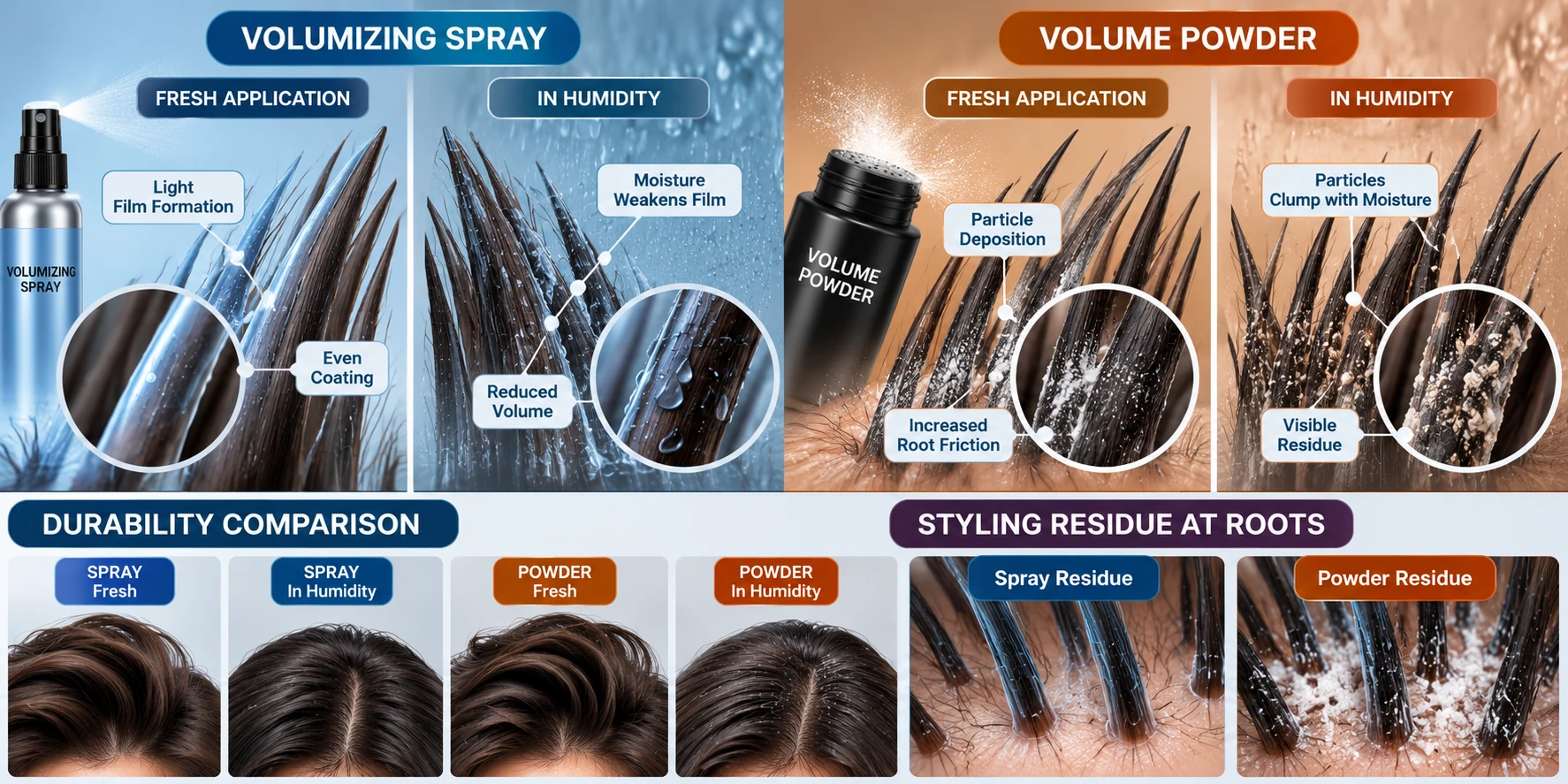
Abstract illustration of volume-product durability under humidity and the accumulation of styling residue at the roots
When hair flattens despite more product, residue is usually the reason.

Setting the Record Straight

Myths vs Cosmetic Reality

Myth

“Volume spray permanently thickens hair.”

Cosmetic Reality

It temporarily coats and structures the fibres you already have. The effect washes out.

Myth

“Volume powder grows new hair.”

Cosmetic Reality

It creates friction and absorbs oil at the roots. It has no effect on follicles or the growth cycle.

Myth

“Powder and dry shampoo are identical.”

Cosmetic Reality

Dry shampoo is primarily for absorbing oil and refreshing hair; volume powder is primarily for texture and grip. There is ingredient overlap, but the design intent differs — and neither replaces washing.

Myth

“Spray is always lighter than powder.”

Cosmetic Reality

Weight depends on the formula and the quantity used. A heavily applied spray can weigh hair down more than a light dusting of powder.

Myth

“Powder is always stronger than spray.”

Cosmetic Reality

Powder gives stronger grip; spray can give firmer hold. They are different properties, and firm-hold sprays exist.

Myth

“More product gives more volume.”

Cosmetic Reality

Beyond a certain point the opposite is true, particularly with fine hair — the weight of the deposit exceeds what the fibre can support.

Myth

“Volume powder cleans the scalp.”

Cosmetic Reality

It absorbs surface oil. That is not cleansing, and using powder in place of washing is how buildup accumulates.

Myth

“All powders are invisible.”

Cosmetic Reality

Not on dark hair, and not when overapplied. Check in bright light and camera flash before assuming it is undetectable.

Myth

“Alcohol always damages hair.”

Cosmetic Reality

Alcohol in styling sprays aids distribution and fast drying. Some formulas feel drying to some people — that is tolerance, not damage.

Myth

“Sulfate-free shampoo is required to remove styling powder.”

Cosmetic Reality

Removal depends on the product and the amount of residue, not on one surfactant class. Thorough cleansing matters more than the sulfate question.

Myth

“Powder cannot irritate the scalp.”

Cosmetic Reality

Fine particles, fragrance and repeated layering can all contribute to irritation and, in susceptible people, folliculitis.

Myth

“Pump spray has no inhalation risk.”

Cosmetic Reality

Pump sprays avoid propellants but still produce a fine mist that should not be deliberately inhaled.

Myth

“Aerosol spray is safe near hot styling tools.”

Cosmetic Reality

It is not. Aerosols are flammable and must be kept away from flame, sparks and hot tools in operation.

Myth

“Every volume spray provides heat protection.”

Cosmetic Reality

It does not. Heat protection must be stated explicitly on the label — being used before blow-drying does not make a product a heat protectant.

Myth

“Powder is best for every short hairstyle.”

Cosmetic Reality

It often suits short hair well, but hair condition, oiliness and desired finish still matter. Dry, damaged short hair may find powder too rough.

Myth

“Spray is best for every long hairstyle.”

Cosmetic Reality

It frequently suits length better, but someone with long hair, oily roots and no blow-drying routine may do better with powder.

Myth

“Curly hair should never use powder.”

Cosmetic Reality

No curl type automatically excludes it. Powder may disrupt curl grouping and reduce shine, which suits some routines and not others.

Myth

“Fine hair needs the strongest hold.”

Cosmetic Reality

Fine hair usually needs the lightest effective product. Strong hold on fine hair frequently produces stiffness rather than volume.

Myth

“Volume products prevent hair fall.”

Cosmetic Reality

They have no effect on shedding. Hair released during styling has usually already detached from the follicle.

Myth

“Styling buildup is the same as dandruff.”

Cosmetic Reality

Residue flaking and a scalp condition are different things, though they can look similar. Persistent flaking after thorough cleansing warrants assessment.

Myth

“Matte texture means hair is damaged.”

Cosmetic Reality

Matte is a deliberate finish produced by light-scattering particles. It says nothing about fibre integrity.

Myth

“Expensive volume products always perform better.”

Cosmetic Reality

Price reflects packaging, brand and margin alongside formulation. Matching the mechanism to your hair matters far more.

Myth

“Powder can remain in the hair indefinitely.”

Cosmetic Reality

Repeated layering without cleansing produces waxy roots, dullness and tangling. Product directions should control use.

Myth

“Using spray and powder together always gives better results.”

Cosmetic Reality

Combining can work well, but two products means twice the residue potential. It is not automatically better.

When Styling Is Not the Answer

Red Flags: Assess First, Style Second

The first sixteen are clinical or safety signs. The last four concern products making claims a styling product cannot support.

Sudden severe shedding
Patchy hair loss
Rapidly widening part
Scalp pain
Pus or crusting
Severe burning after application
Facial swelling
Breathing difficulty
Symptoms after inhaling product
Eye injury from spray or powder
Aerosol used near flame or a hot tool
Chemical or thermal scalp burn
Smooth shiny areas of scalp
Signs of scarring
Hair loss in a child
Fresh transplant wounds
A product claiming permanent hair thickening
A product claiming follicle growth
An aerosol with no flammability warning
Being told to continue despite irritation

Prepare for Your Visit

Styling and Purchase Checklist

Medically Reviewed

Medically Reviewed By

Dr. Amit S. Agarkar

Dermatologist, Trichologist and Hair Transplant Surgeon

Medical reviewer: Dr. Amit Agarkar, MD Dermatology Editorial role: Scalp-safety review and hair-loss claim review Review date: 23 July 2026 Next review date: 23 January 2027 Styling-science review: Cosmetic-formulation and professional styling review — named reviewer to be confirmed before publication Commercial affiliation: No brand sponsorship or affiliate arrangement informs this comparison

Full profile · Medical editorial policy · Correction policy · References

Medical information is periodically reviewed and may change as evidence, product labeling and regulatory guidance evolve.

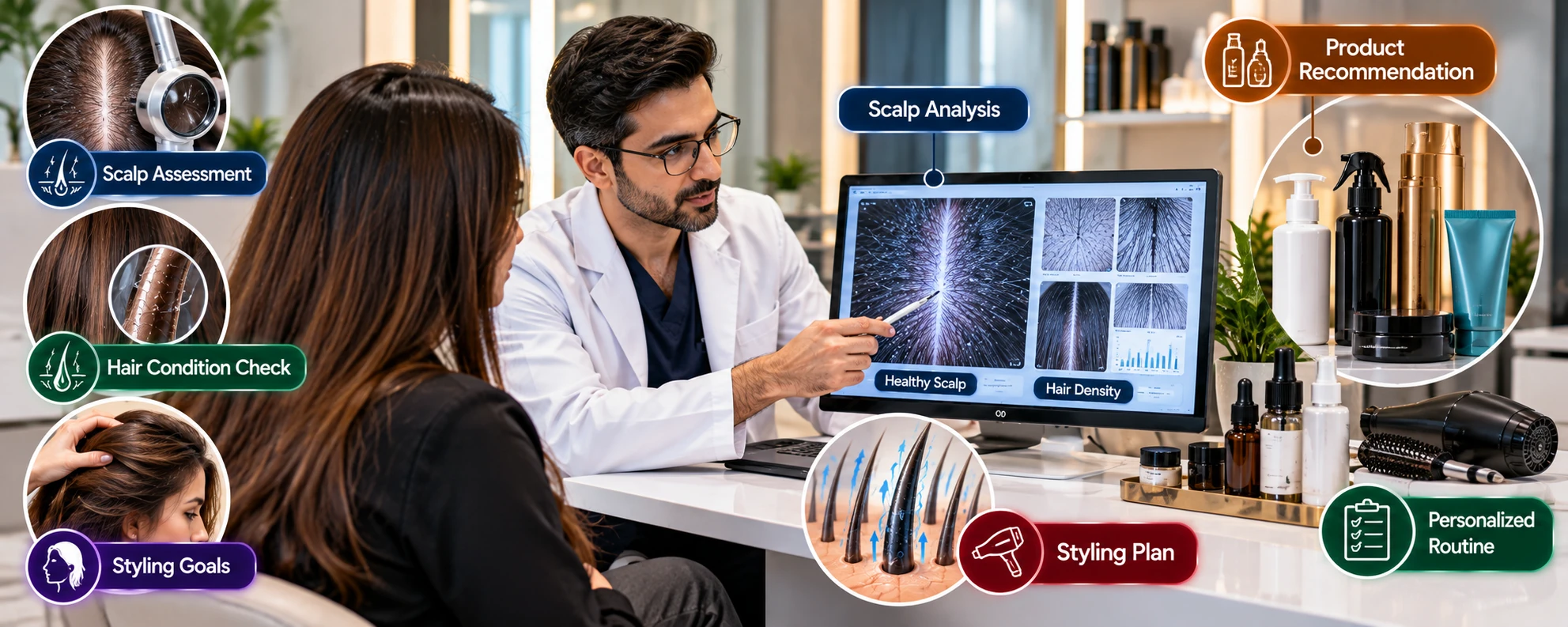
A calm expert-led styling consultation and scalp assessment environment
Hair type and styling routine come before the product choice.

Sources

References

This list reflects the categories of authoritative source used to inform this page’s general statements. Exact citation details, titles and access dates should be finalised and verified before publication. No hold-duration statistics, heat-protection percentages, humidity-resistance ratings or prices are fabricated anywhere on this page. Manufacturer technical data, where used, is identified as such. Retailer blogs and influencer reviews are not used as evidence.

  1. Hair-cosmetic science reference texts covering styling-product formulation, fibre interaction and finish. Standard reference literature — verify edition
  2. Peer-reviewed research on styling polymers, film formation and hold characteristics. PubMed To be cited individually
  3. Hair-fibre surface-friction studies relevant to texture, grip and combability. Journal of Cosmetic Science and equivalent — verify current
  4. Aerosol product safety guidance, including flammability and ventilation requirements. National safety authorities — verify current guidance
  5. Cosmetic powder safety assessments covering particle size, inhalation exposure and mineral ingredients. CIR and equivalent — verify current assessment
  6. Contact-dermatitis literature on fragrance, preservative and propellant sensitisation. PubMed / Contact Dermatitis To be cited individually
  7. Research on fine-hair styling, volume perception and product-load tolerance. PubMed To be cited individually
  8. Textured-hair cosmetic science covering curl pattern, product distribution and friction effects. PubMed To be cited individually
  9. Hair-breakage research relevant to mechanical damage from styling and manipulation. PubMed To be cited individually
  10. Cosmetic-claims regulations applicable to the Indian market. CDSCO cosmetics Verify current requirements
  11. Manufacturer technical data sheets — clearly identified as manufacturer-supplied rather than independent evidence. Cite supplier and document by name
  12. Consumer and occupational guidance on inhalation exposure to fine particulates and aerosols. National occupational-health authorities — verify current

Common Questions

Frequently Asked Questions

38 questions, grouped by what you are actually trying to work out.

The Two Products

Spray distributes styling ingredients through the hair and forms a film as it dries, giving distributed body. Powder goes on dry roots and creates friction between fibres for immediate, targeted grip.

Powder gives more immediate and concentrated root lift. Spray can match or exceed it, but generally only with blow-drying and correct root direction.

Spray, clearly — it distributes through the lengths rather than concentrating at the roots.

Usually spray, which tends to preserve movement and shine. Powder produces a characteristically matte, textured finish.

Powder. The matte look is intrinsic to how the particles scatter light.

They differ in kind rather than degree. Powder gives stronger grip; firm-hold sprays give firmer set. Powder stays restylable, spray generally does not.

Powder — texture can be reworked by hand through the day. Once a styling film has set, spray usually needs re-wetting.

No. Dry shampoo is primarily intended to absorb oil and refresh hair; volume powder is primarily for texture and grip. Ingredients overlap and some products blur the line, but neither replaces washing.

Hair Type & Suitability

Both can work, and both are easily overdone. Fine hair collapses under product weight, so use the smallest effective amount of either — a light spray plus a little powder often beats a generous amount of one.

Powder is frequently more practical — targeted, immediate and restylable without heat.

Spray usually suits length better, since it distributes body rather than concentrating at the roots.

Powder, which absorbs surface sebum while adding grip. Bear in mind that absorbing oil is not the same as washing.

Neither is ideal. Powder can make dry hair feel rougher, and some alcohol-containing sprays feel drying. Concentrate whichever you use at the roots.

It depends on the routine rather than the curl type. Spray may support diffused root lift; powder can add targeted lift but may disrupt curl grouping and reduce shine.

Dryness is often the limiting factor. Some powders feel excessively rough on dry coily hair. Formula choice and root-only application matter more than the category.

Yes, with care. Concentrate product at the roots when lengths are fragile. Colour fading depends on the whole routine, not the volume product alone — and not every alcohol-based product damages colour.

Application & Routine

Follow the specific label. Many are designed for towel-damp hair and rely on the drying process; some are formulated for dry refreshing.

Dry. Powder needs a dry surface to distribute and create friction properly.

Often, for the full effect. The styling film sets as the hair dries, so the position you dry the roots into is the position it holds. Air-drying flat produces very little lift.

Section dry roots, apply a very small quantity avoiding a concentrated patch, then massage or activate gently before adding any more. Keep it away from the face and eyes, and check in bright light.

Yes — spray first, dry thoroughly, then powder selectively where more grip is needed. Combining is not automatically better, since two products means twice the residue potential.

Spray, on damp hair, before blow-drying. Powder goes on afterwards, once the hair is fully dry.

Product directions should control use. Daily use is not universally safe — sensitive scalps may need less frequent application, and daily layering without washing is the main cause of buildup.

Shampooing. Repeated layering may need more thorough cleansing, and removal difficulty varies by formula.

Safety & Concerns

Yes — absorbent minerals and starches take up surface sebum. This is why oily roots look better after application, but it is not cleansing.

It can, particularly on dark hair and when overapplied. Not every powder is invisible. Apply sparingly and check under bright light.

Yes, if overapplied or if the formula has a firmer hold than intended. A tacky finish usually signals too much product.

Yes — increased friction is the mechanism, and on dry or damaged hair this can feel rough and increase tangling.

Both can. Styling polymers accumulate; powder layering is the most common cause of waxy roots. When hair goes flat despite more product, buildup is usually the reason.

Repeated layering without cleansing can contribute to irritation and, in susceptible people, folliculitis. Adequate removal matters.

It can. Alcohol, fragrance and propellants are the usual contributors, and spray on an already irritated scalp may sting.

Yes. Aerosol products are flammable and must be kept away from open flame, sparks and hot styling tools in operation. Use in a ventilated space.

Fine powders should not be deliberately inhaled. Apply in a well-ventilated space, keep the container away from the face, and avoid dispensing toward the breathing zone.

They are not established as a cause of hair loss. Hair released during styling has usually already detached from the follicle. Excessive manipulation and buildup can contribute to breakage, which is a separate issue.

No. Both act on the temporary arrangement and texture of existing fibres. Neither affects follicles or the growth cycle.

Not on fresh grafts or healing skin. Timing must be determined by your treating surgical team rather than a general guideline.

No, though they can look similar. Residue flaking differs from a scalp condition. Persistent flaking after thorough cleansing warrants assessment.

For sudden shedding, patchy loss, a rapidly widening part, scalp pain, pustules, crusting, signs of scarring, or hair loss in a child. Styling products should not substitute for assessment.

Next Step

Choose Airy Structure or Targeted Grip — not the Biggest Volume Claim

A structured styling assessment can identify whether your hair needs distributed body, targeted crown lift, oil control, matte grip or a lighter low-buildup routine, while a dermatologist can assess whether reduced density represents a medical hair-loss concern.

Disclaimer: This page provides educational cosmetic-styling information and does not replace professional medical advice, diagnosis or treatment. Volumizing products change the temporary arrangement, texture and appearance of existing hair fibres. They do not increase follicle count, permanently thicken hair, prevent hair loss or treat any medical cause of reduced density. Volumizing spray and volume powder create fullness by different mechanisms and are not interchangeable; volume powder is also not the same as dry shampoo, and neither replaces washing. Aerosol products are flammable and must be kept away from open flame, sparks and hot styling tools in operation, and used in a ventilated space. Fine powders and spray mists should not be deliberately inhaled. Heat protection must be stated explicitly on the product label — it should never be assumed because a product is used before blow-drying. No numeric durability, hold-duration or humidity-resistance ratings are published here; performance is product-specific and requires individual testing. Repeated layering without adequate cleansing causes buildup, which reduces rather than increases volume; styling buildup is not the same as dandruff. Do not apply these products to broken or inflamed skin, active scalp disease or fresh transplant grafts — post-procedure timing must be determined by the treating surgical team. No brand sponsorship or affiliate arrangement informs this comparison, and no product is recommended or ranked. Persistent scalp irritation, sudden shedding, patchy hair loss, a rapidly widening part or rapidly reducing density requires assessment by a qualified dermatologist rather than styling-product escalation. Content reviewed by Dr. Amit Agarkar, MD Dermatology.

Your Cart (0)

Your cart is empty

Subtotal0
DeliveryFREE
Total0
🔒 Secure📦 Free above ₹499↩ Easy returns
💬 Hi! I'm Dr. Amit — your Hair Intelligence consultant
🌿
1
🌿
Dr. Amit
Virtual Dermatologist · Hairsncares.com
Online
What are you shopping for today?
Select a category to begin
AI-powered scalp diagnosis · Hairsncares.com
📸
Scalp Analyser
Upload scalp photo · Get conditions, root cause, and matched product protocol
📷
Drop scalp photo here or click to upload
JPG, PNG, WEBP · Clear, close-up, well-lit photo

Your image is processed privately by our AI engine and saved securely with your account.