Hair Serum and Follicle Intelligence
Hair Growth Serum vs Hair Fall Serum: Differences, Ingredients and Which One You Need
These are marketing categories, not standard medical treatment classes — and their formulas frequently overlap. A product sold as a growth serum may target density claims, follicular pathways or simply the appearance of fuller hair. One sold as a hair-fall serum may target breakage, scalp comfort, retention claims or the same pathways under a different name. The same formula could carry either label. What actually determines value is the active ingredients, their disclosed concentrations, the vehicle, the quality of evidence behind them, and whether the product is a cosmetic or a medicine. Above all, it depends on the cause of your hair loss — which the front label cannot tell you.

Quick Answer
Neither is a standard medical category. “Hair growth serum” and “hair fall serum” are marketing descriptions, and their ingredient lists may be identical or heavily overlapping. A growth serum is usually marketed around density or follicular support; a hair-fall serum around shedding, retention, breakage or scalp comfort. Which is appropriate depends on the formula and your diagnosis, not the label. Cosmetic serums are not automatically evidence-equivalent to medically established treatments.
Read this first: Check whether the concern is shedding from the root, progressive thinning or hair-fibre breakage before choosing a serum. These are different problems, and a product that helps one may do nothing for another.
At a Glance
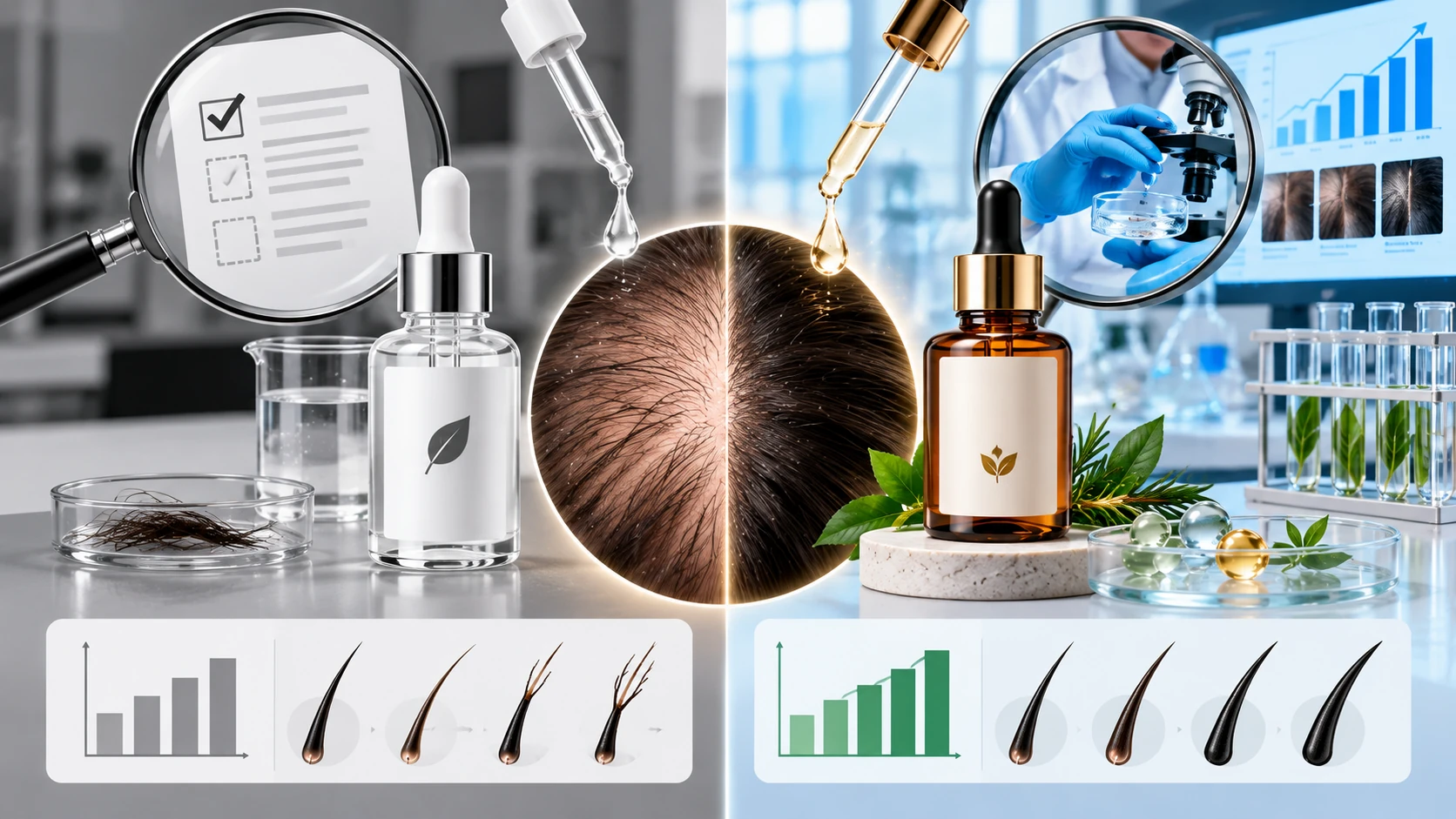
Two Labels, Compared Honestly
Neither panel is ranked above the other — and in many real products these two columns would describe the same bottle. Use "Compare by" to see how each marketing category typically positions itself, then judge the actual formula.
Hair Fall Serum
Terminology Correction
The Front Label Does Not Reveal What the Serum Actually Does
Neither “hair growth serum” nor “hair fall serum” is a regulated or standard medical classification. Both are descriptions chosen by a brand. The same formula could be sold under either name — or as a density serum, scalp serum or root-activation serum.
“Hair growth serum” may mean
- A cosmetic scalp serum
- A leave-on density serum
- A peptide serum
- A botanical-active serum
- A multi-active cosmeceutical product
- A fibre-thickening cosmetic
- A scalp-conditioning treatment
- A minoxidil-containing medicine
“Hair fall serum” may mean
- A breakage-reduction serum
- A scalp-soothing serum
- A cosmetic anti-shedding product
- A DHT-pathway cosmetic serum
- A peptide or botanical blend
- A product marketed around hair-anchoring claims
- A product marketed around retention support
- A medicated hair-loss treatment
What actually determines value
- Which actives are present
- Whether concentrations are disclosed
- The vehicle, pH and alcohol content
- Whether evidence is supplier or independent
- Whether the studied formula matches the sold one
- Regulatory category — cosmetic or medicine
- Your diagnosis and hair-loss pattern
- Scalp tolerance in real use
Two serums with different front labels may have nearly identical ingredient lists, while two products both called “hair growth serum” may have completely different mechanisms and evidence.
Four Product Categories Behind the Two Labels
Either front label can sit on any of these four. They are not evidence-equivalent to one another.
| Category | Primary role | Typical ingredients | Evidence position |
|---|---|---|---|
| A — Cosmetic hair-fibre serum | Smoothness, shine, frizz control, heat protection, breakage reduction, cuticle lubrication | Silicones, oils, esters, polymers, ceramides, proteins, conditioning agents | Well established for fibre feel and combability; no follicular claim |
| B — Cosmetic scalp-support serum | Hydration, scalp comfort, barrier support, supportive daily care | Niacinamide, panthenol, caffeine, peptides, botanical extracts, humectants | Supportive-care positioning; density claims usually cosmetic |
| C — Cosmeceutical density serum | Targeted cosmetic claims around follicular support and apparent density | Redensyl, Procapil, Capixyl, AnaGain, Baicapil, caffeine, copper peptides, amino acids | Varies widely by product; “cosmeceutical” is a marketing term and does not imply drug-level evidence |
| D — Medicated solution or serum | Delivery of a recognised pharmacologically active ingredient | Minoxidil or another locally authorised medicinal active | Regulated indications, defined label, contraindications and adverse effects — a different evidence class entirely |
Category D is a medicine. Packaging it in a dropper bottle does not make it a cosmetic serum, and calling a Category B or C product “clinical” does not make it a medicine.
Start With the Concern
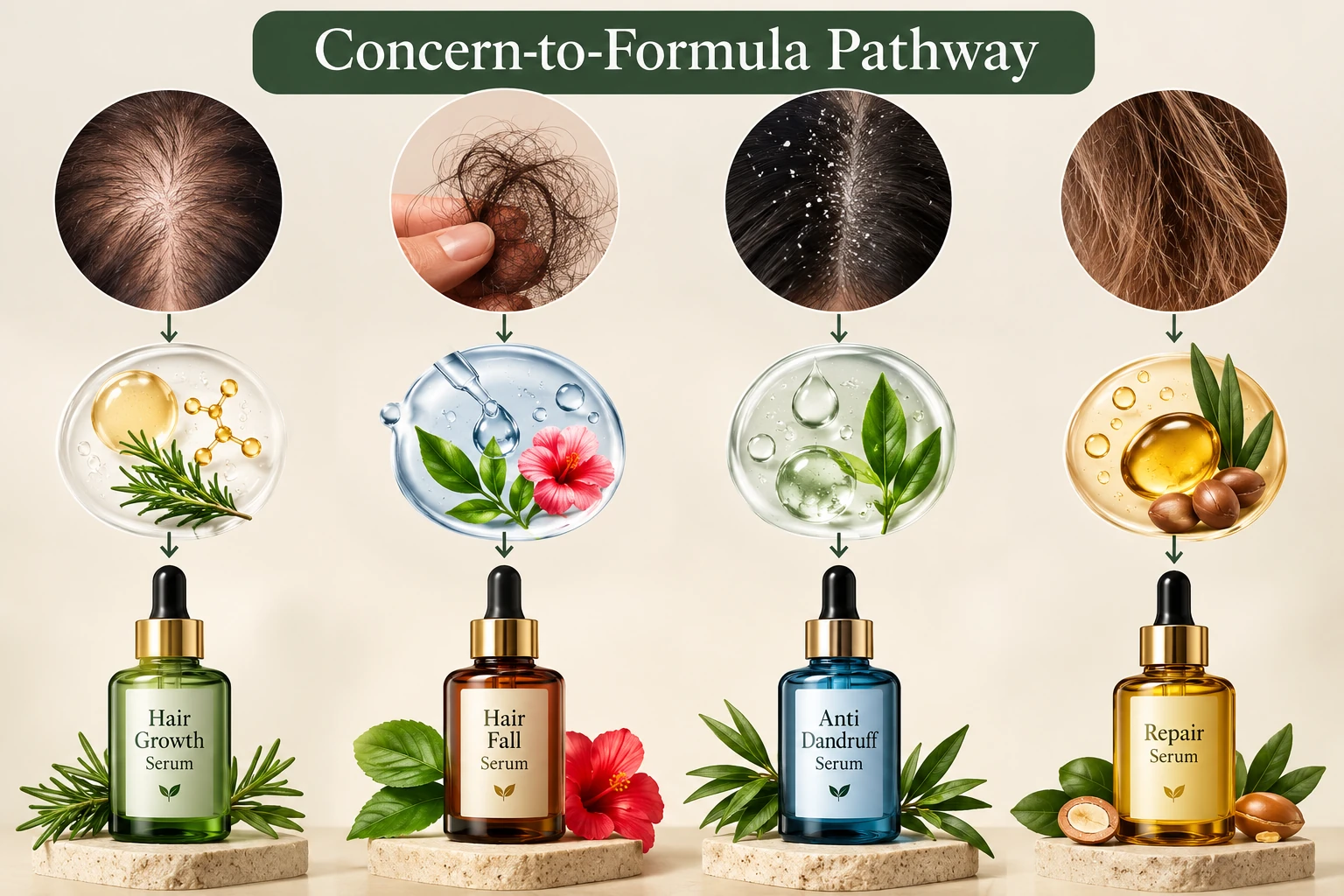
Concern-to-Formula Pathway
The same visible symptom — more hair on the pillow — has at least four different underlying explanations, and they do not respond to the same product.
What You Notice
Hair on the pillow or comb, reduced ponytail volume, a widening part, a receding hairline, crown thinning, short broken hairs, scalp itching, or a recent illness or stressor.
Follicular Miniaturisation Pathway
Pattern hair loss with progressive thinning and reduced density. Requires medical assessment and evidence-based treatment selection — cosmetic serums are supportive at best.
Diagnosis requiredTemporary Shedding Pathway
Telogen shift following illness, stress, rapid weight loss, childbirth or a medication change. The trigger matters far more than the serum; monitoring and correction of the trigger come first.
Trigger review firstHair-Fibre Breakage Pathway
Damage from bleaching, heat, chemical straightening, friction or tight styling. A Category A fibre-conditioning serum may genuinely help here — without changing follicular growth at all.
Fibre care relevantScalp-Inflammation Pathway
Dandruff, seborrhoeic dermatitis, folliculitis or contact irritation. Diagnosis-specific scalp treatment is the priority; applying a multi-active serum to inflamed skin may worsen it.
This pathway is educational and cannot diagnose the cause of hair loss. Many people have more than one of these processes at the same time.

In Detail
Full Comparison Table
Notice how many rows are identical or near-identical. That is the point: these are two marketing positions over a largely shared formulation space.
Swipe to compare →
| Consideration | Hair Growth Serum | Hair Fall Serum |
|---|---|---|
| Marketing category | Growth, density, follicle activation | Hair fall, retention, root strengthening |
| Standard medical definition | None — not a recognised treatment class | None — not a recognised treatment class |
| Main consumer goal | More hair, fuller appearance | Less hair falling out |
| Follicle vs fibre focus | Usually positioned at the follicle | Often delivers via the fibre, whatever the claim |
| Common cosmetic actives | Redensyl, Procapil, Capixyl, AnaGain, caffeine, peptides | Peptides, botanicals, caffeine, niacinamide, panthenol |
| Medicinal active possibility | Minoxidil appears in some products | Less common, but verify the label |
| Evidence quality | Formula dependent — supplier to controlled trial | Formula dependent — frequently self-reported outcomes |
| Formula standardisation | None across the category | None across the category |
| Ingredient concentration | Frequently undisclosed | Frequently undisclosed |
| Vehicle dependence | High — delivery affects everything | High — delivery affects everything |
| Alcohol content | Common in scalp solutions; may sting inflamed skin | Common; same consideration |
| Fragrance | Common sensitiser; check the list | Common sensitiser; check the list |
| Application area | Scalp, unless a fibre serum | Scalp or lengths — read the directions |
| Daily adherence | Generally required for any claimed benefit | Generally required for any claimed benefit |
| Time before assessment | Hair-cycle dependent — months, not weeks | Hair-cycle dependent — months, not weeks |
| Maintenance | Benefit generally requires continued use | Benefit generally requires continued use |
| Initial shedding claims | Sometimes claimed as proof of action — not established | Sometimes claimed; same caution applies |
| Breakage reduction | Possible via conditioning ingredients | Often the actual mechanism behind visible results |
| Hair-density claims | Central to positioning; verify the evidence | Secondary; verify the evidence |
| Hair-count evidence | Requires standardised measurement — rarely provided | Requires standardised measurement — rarely provided |
| DHT-related claims | Frequently made for cosmetic actives; scrutinise | Frequently made; scrutinise |
| Scalp hydration | Vehicle dependent | Often a formulation focus |
| Scalp irritation | Alcohol, fragrance and multi-active load are contributors | Same contributors |
| Contact dermatitis | Possible — botanicals and fragrance are common triggers | Possible — same triggers |
| Folliculitis | Possible with occlusive or heavy formulas | Possible with occlusive or heavy formulas |
| Pregnancy considerations | Review every product with a clinician; minoxidil has specific precautions | Review every product with a clinician |
| Breastfeeding considerations | Review with a clinician; do not assume cosmetic means safe | Review with a clinician |
| Pattern hair loss | Cosmetic serums are supportive at best; diagnosis-led treatment is the established route | Same — a cosmetic serum does not treat pattern loss |
| Telogen effluvium | Does not address the trigger | Does not address the trigger |
| Alopecia areata | Not a treatment for autoimmune hair loss | Not a treatment for autoimmune hair loss |
| Scarring alopecia | Not a treatment; requires prompt specialist care | Not a treatment; requires prompt specialist care |
| Post-transplant use | Only per the surgeon’s specific instructions | Only per the surgeon’s specific instructions |
| Cost | Trademarked complexes drive premium pricing | Ingredient count drives pricing |
| Product-label transparency | Varies widely; concentration disclosure is the key test | Varies widely; same test |
| Main limitation | Cannot restore follicles that are permanently absent | Cannot correct the underlying cause of shedding |
Hair Growth Serum · Density Claims
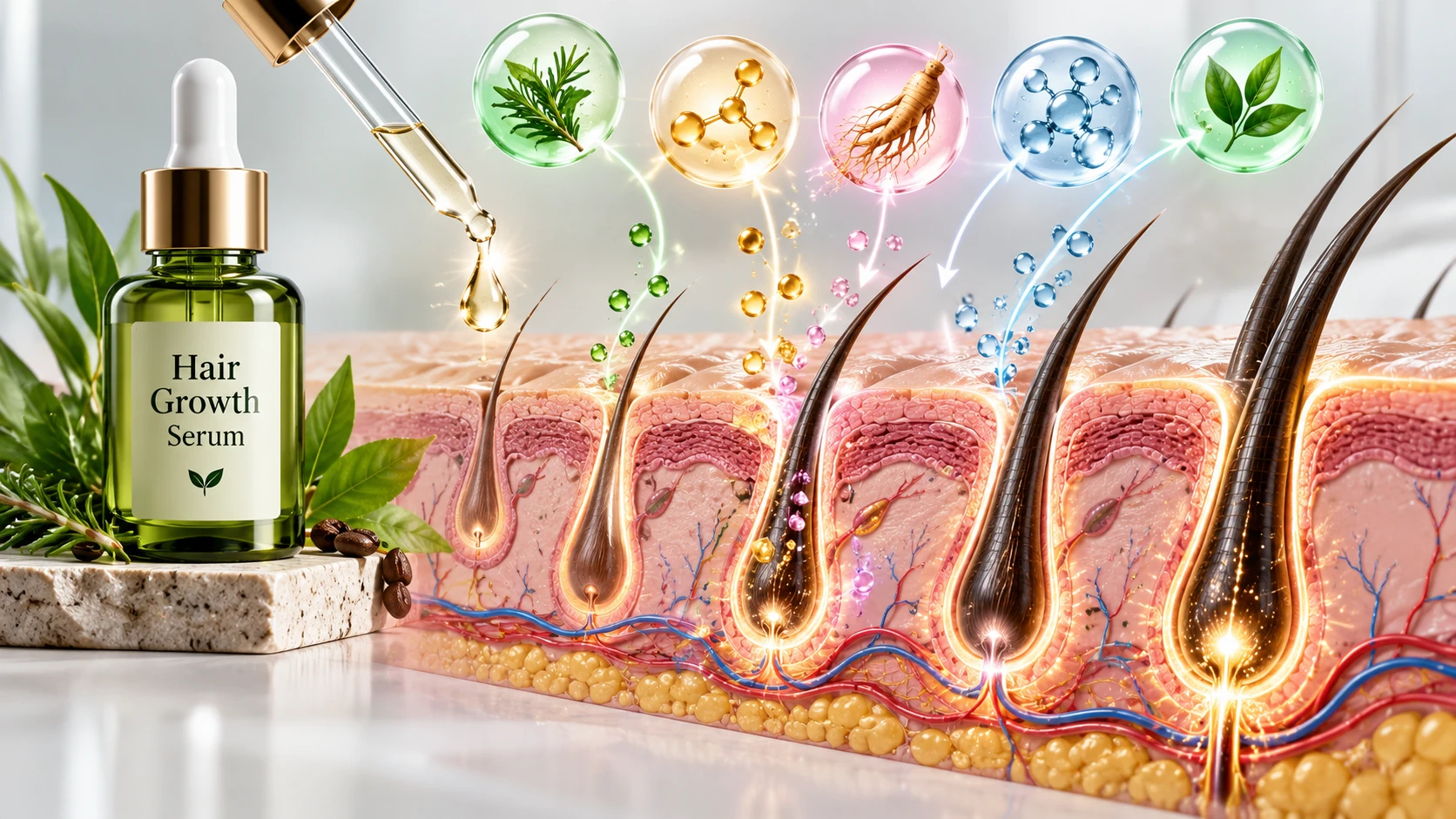
Hair Growth Serum: Density Claims, Follicular Support and Evidence Gaps
The useful question is never “is this a growth serum?” It is: which actives, at what concentration, in what vehicle, tested in whom — and was the tested formula the one in this bottle?
What the label generally means
A product positioned around density, regrowth or follicular activity. It carries no fixed regulatory meaning, so the same phrase can describe a lightweight scalp toner, a multi-active cosmeceutical or a minoxidil-containing medicine.
Cosmetic versus medicated products
This is the single most important distinction on the page. A cosmetic serum makes appearance and supportive-care claims. A medicated product has a defined active, a regulatory label, recognised indications, contraindications and adverse effects. They are not evidence-equivalent.
Follicle and density claims
Most products claim some form of follicular support. Whether that claim is backed by measured hair counts under standardised conditions, or by a supplier’s in-vitro assay, is the question worth asking.
The scalp-delivery vehicle
An active only works if it reaches the target in a usable amount. Vehicle, pH, alcohol content and formulation stability affect this as much as the active itself — and are almost never disclosed.
Redensyl
A cosmetic active complex marketed around follicular stem-cell signalling. Evidence is largely supplier-generated and product-specific. It is a cosmetic ingredient, not a medicine, and is not established as equivalent to any medicinal active.
Procapil
A cosmetic complex marketed around follicular anchoring and DHT-related pathways. As with other cosmetic actives, the strength of evidence depends on the specific study, the concentration used and whether the tested formula matches the one sold.
Capixyl and Baicapil
Botanical-and-peptide cosmetic complexes with supplier-supported positioning around density. Independent replication is limited. Their presence on a label does not itself establish an effect in your hair.
AnaGain
A pea-sprout-derived cosmetic active marketed around the hair cycle. Supplier studies exist; independent human evidence for the finished product is the relevant test, and it is often absent.
Caffeine and peptides
Both have mechanistic rationale and some human data, but results are formulation-specific. Copper peptides and biotinoyl tripeptide are common; the concentration in a given product is rarely stated.
Niacinamide, panthenol and amino acids
Generally well-tolerated supportive ingredients that contribute to scalp comfort and fibre condition. They are not established as regrowth agents on their own.
The minoxidil distinction
Minoxidil is a medicine with an established evidence base, a regulatory label and specific precautions — including in pregnancy. If a “serum” contains it, you are using a medicine, and it should be treated as one.
The multi-active attribution problem
When a product contains six actives and shows a result, the study cannot tell you which one produced it — or whether the vehicle alone would have done the same. More ingredients means less interpretable evidence, not more.
Hair Growth Serum Reality Check
Ten corrections worth carrying to the shelf
- “Hair growth serum” is not a standard drug class
- Cosmetic active complexes vary enormously by product
- Supplier evidence is not equal to independent clinical evidence
- Multi-active results cannot prove which ingredient caused the outcome
- Laboratory activity does not guarantee visible regrowth
- A serum cannot restore follicles that are permanently absent
- Pattern hair loss may require established medical treatment
- Reduced breakage can create an appearance of fuller hair without adding follicles
- More ingredients do not automatically mean better efficacy
- A higher price does not prove better regrowth

Hair Fall Serum · Retention Claims
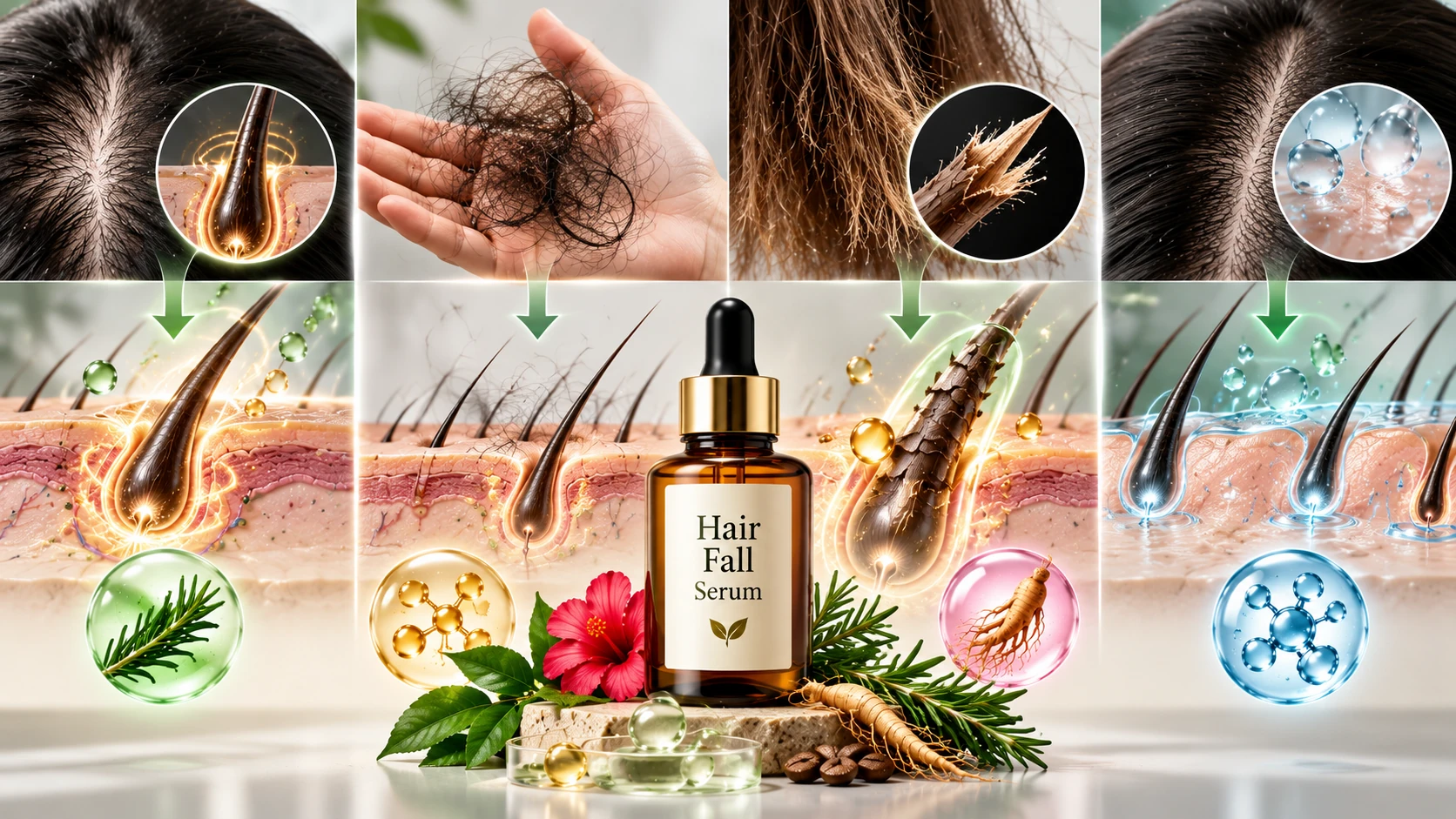
Hair Fall Serum: Retention, Shedding, Breakage and Scalp-Support Claims
A product that reduces breakage will reduce the hair you see on your comb. That is a genuine result — and it can be achieved without affecting follicular shedding by a single strand.
What the label generally means
A product positioned around reducing visible hair fall. Like the growth label, it has no fixed regulatory meaning and the formula underneath may be indistinguishable from a product sold as a growth serum.
Root hair fall versus fibre breakage
This distinction determines whether the product can help at all. Hair released from the follicle and hair snapping mid-length both appear as hair on the comb, but only one of them is addressed by fibre conditioning.
What anti-hair-fall data often measures
Cosmetic anti-hair-fall testing frequently counts hair collected during washing or combing. A product that reduces breakage will improve that number without changing follicular shedding at all.
Temporary shedding
Telogen effluvium following illness, stress, childbirth, rapid weight loss or a medication change is trigger-driven. It commonly improves as the trigger resolves — which can make any product applied during that window appear effective.
Pattern hair loss
Progressive miniaturisation is a long-term, diagnosis-led problem. A cosmetic serum may support scalp condition and fibre quality, but it does not treat the underlying process.
Scalp inflammation
Dandruff, seborrhoeic dermatitis and folliculitis can contribute to shedding and discomfort. These need diagnosis-specific treatment; applying a multi-active serum to inflamed skin may worsen it.
“Root strengthening” and anchoring claims
These are marketing phrases rather than measured clinical endpoints. There is no standard test a consumer can check them against, which is precisely why they are used.
DHT-related cosmetic claims
Frequently made for botanical and peptide actives. A cosmetic ingredient with a plausible mechanism is not the same as a medicine with an established, regulated indication.
Peptides, botanicals and caffeine
Largely the same actives found in growth serums. This overlap is the clearest evidence that the two labels do not describe different product classes.
Conditioning polymers and ceramides
These genuinely reduce breakage by improving fibre condition and lowering combing force. This is a real, useful benefit — it is simply not the same as reducing follicular hair loss.
What it cannot correct
A serum cannot correct thyroid disease, iron deficiency, a nutritional deficit or an autoimmune process. If one of those is driving the shedding, no topical product will resolve it.
Hair Fall Serum Reality Check
Ten corrections worth carrying to the shelf
- Hair fall is a symptom, not a single diagnosis
- A serum cannot correct thyroid disease or iron deficiency
- Anti-hair-fall data may measure breakage rather than follicular shedding
- Less hair on the comb does not automatically prove better follicle retention
- Acute telogen effluvium may improve as the trigger resolves
- Pattern thinning usually requires long-term diagnosis-led management
- Scarring alopecia requires prompt medical treatment
- “Root strengthening” is a marketing phrase, not a measured endpoint
- A scalp serum does not treat every inflammatory condition
- Continuing progression requires reassessment, not a stronger serum

By Scenario
Which Concern Are You Actually Treating?
Educational starting points for a conversation with a dermatologist — not a personal diagnosis or a product recommendation.
Receding Hairline
- Why this matters
- Frontal recession is a pattern feature, not a shedding problem.
- Growth-serum relevance
- Cosmetic actives may support scalp condition; they do not treat the pattern process.
- Hair-fall-serum relevance
- Retention claims do not apply to miniaturisation at the hairline.
- What no serum can guarantee
- That any cosmetic serum reverses a receding hairline.
- Appropriate next step
- Dermatologist assessment for pattern hair loss.
Crown Thinning
- Why this matters
- Progressive crown loss suggests miniaturisation rather than a temporary trigger.
- Growth-serum relevance
- Positioning fits the concern; evidence for reversing established loss is limited.
- Hair-fall-serum relevance
- Not the relevant mechanism.
- What no serum can guarantee
- That density will be restored to a previous state.
- Appropriate next step
- Assessment and discussion of evidence-based options.
Widening Part
- Why this matters
- A widening part is a recognised sign of reducing density, more common in women.
- Growth-serum relevance
- May be marketed for this; verify what evidence exists for the specific product.
- Hair-fall-serum relevance
- Not the primary mechanism.
- What no serum can guarantee
- That a serum halts progression without diagnosis.
- Appropriate next step
- Assessment for female-pattern hair loss and contributing factors.
Diffuse Shedding After Fever or Illness
- Why this matters
- Post-illness telogen effluvium is trigger-driven and usually self-limiting.
- Growth-serum relevance
- Not the mechanism — the trigger has already occurred.
- Hair-fall-serum relevance
- Marketed for this, but improvement often reflects natural resolution.
- What no serum can guarantee
- That the serum caused any recovery that occurs.
- Appropriate next step
- Trigger review; reassess if shedding persists beyond a few months.
Postpartum Shedding
- Why this matters
- A recognised, usually temporary hormonal telogen shift.
- Growth-serum relevance
- Not the mechanism.
- Hair-fall-serum relevance
- Marketed heavily for this; natural resolution confounds any assessment.
- What no serum can guarantee
- That a serum shortens the natural course.
- Appropriate next step
- Reassurance, nutrient review and dermatologist input if prolonged.
Rapid Weight-Loss Shedding
- Why this matters
- Nutritional and metabolic stress can trigger a telogen shift.
- Growth-serum relevance
- Does not address nutritional status.
- Hair-fall-serum relevance
- Does not address nutritional status.
- What no serum can guarantee
- That a topical product corrects a nutritional deficit.
- Appropriate next step
- Nutritional assessment and blood tests where indicated.
Stress-Related Shedding
- Why this matters
- Stress is a recognised telogen trigger in susceptible individuals.
- Growth-serum relevance
- Not the mechanism.
- Hair-fall-serum relevance
- Not the mechanism.
- What no serum can guarantee
- That any serum addresses the underlying stressor.
- Appropriate next step
- Trigger management; assessment if shedding is prolonged or patchy.
Short Broken Hairs
- Why this matters
- Short fragments of uneven length usually indicate breakage rather than shedding.
- Growth-serum relevance
- Follicular positioning is not the relevant target.
- Hair-fall-serum relevance
- A Category A fibre-conditioning serum may genuinely help here.
- What no serum can guarantee
- That breakage reduction indicates improved follicular retention.
- Appropriate next step
- Review heat, chemical and mechanical damage sources.
Bleach Damage
- Why this matters
- Bleaching causes real structural change to the fibre.
- Growth-serum relevance
- Not the relevant mechanism.
- Hair-fall-serum relevance
- Fibre conditioning may reduce further breakage.
- What no serum can guarantee
- That damaged fibre is restored to untreated condition.
- Appropriate next step
- Reduce further chemical processing; fibre-protective care.
Tight-Hairstyle Breakage
- Why this matters
- Sustained tension can cause both breakage and, over time, traction alopecia.
- Growth-serum relevance
- Does not address tension.
- Hair-fall-serum relevance
- Does not address tension.
- What no serum can guarantee
- That any serum protects against ongoing traction.
- Appropriate next step
- Reduce tension; assessment if hairline recession is developing.
Dandruff and Itching
- Why this matters
- Scalp inflammation needs treatment in its own right.
- Growth-serum relevance
- A multi-active serum applied to inflamed scalp may worsen irritation.
- Hair-fall-serum relevance
- Soothing positioning may help comfort but is not a treatment for the condition.
- What no serum can guarantee
- That a serum resolves seborrhoeic dermatitis.
- Appropriate next step
- Treat the scalp condition first, then reassess.
Scalp Folliculitis
- Why this matters
- Pustules and tender bumps require assessment before any leave-on product.
- Growth-serum relevance
- Occlusive or heavy formulas may aggravate it.
- Hair-fall-serum relevance
- Same consideration.
- What no serum can guarantee
- That a serum is safe to apply over active folliculitis.
- Appropriate next step
- Medical assessment before resuming any topical routine.
Sensitive Scalp
- Why this matters
- Alcohol, fragrance, essential oils and multi-active load are common irritants.
- Growth-serum relevance
- Alcohol-rich vehicles are common in this category.
- Hair-fall-serum relevance
- Botanical-heavy formulas carry allergy potential.
- What no serum can guarantee
- That “natural” or “fragrance-free” means no reaction risk.
- Appropriate next step
- Review the full ingredient list; patch test where appropriate.
Previous Serum Irritation
- Why this matters
- A prior reaction is important information for product selection.
- Growth-serum relevance
- Identify the likely trigger before trying a similar formula.
- Hair-fall-serum relevance
- Same — overlapping ingredients are common between the categories.
- What no serum can guarantee
- That a different front label means a different formula.
- Appropriate next step
- Compare ingredient lists; dermatologist input for recurrent reactions.
Male-Pattern Hair Loss
- Why this matters
- An established, progressive condition with recognised treatment options.
- Growth-serum relevance
- Cosmetic serums are supportive at best.
- Hair-fall-serum relevance
- Not a treatment for the underlying process.
- What no serum can guarantee
- That a cosmetic serum substitutes for evidence-based treatment.
- Appropriate next step
- Discuss established options with a dermatologist.
Female-Pattern Hair Loss
- Why this matters
- Requires assessment, as several conditions can present similarly.
- Growth-serum relevance
- Cosmetic serums are supportive at best.
- Hair-fall-serum relevance
- Not a treatment for the underlying process.
- What no serum can guarantee
- That a serum removes the need for diagnosis.
- Appropriate next step
- Assessment including relevant blood tests.
Alopecia Areata
- Why this matters
- An autoimmune condition with a distinct mechanism.
- Growth-serum relevance
- Not a treatment.
- Hair-fall-serum relevance
- Not a treatment.
- What no serum can guarantee
- That any cosmetic serum affects autoimmune hair loss.
- Appropriate next step
- Prompt specialist dermatology referral.
Scarring Alopecia
- Why this matters
- Follicle destruction is irreversible; early diagnosis materially changes outcome.
- Growth-serum relevance
- Not a treatment; delay is the real risk.
- Hair-fall-serum relevance
- Not a treatment; delay is the real risk.
- What no serum can guarantee
- That regrowth is possible where follicles are destroyed.
- Appropriate next step
- Urgent specialist assessment.
Hair Loss in a Child
- Why this matters
- Paediatric hair loss has a different differential and needs assessment.
- Growth-serum relevance
- Not appropriate without medical guidance.
- Hair-fall-serum relevance
- Not appropriate without medical guidance.
- What no serum can guarantee
- That an adult-marketed serum is suitable for a child.
- Appropriate next step
- Paediatric or dermatology assessment before any product.
Post-Hair-Transplant Care
- Why this matters
- The graft site has specific, time-sensitive care requirements.
- Growth-serum relevance
- Only per the surgeon’s explicit instructions.
- Hair-fall-serum relevance
- Only per the surgeon’s explicit instructions.
- What no serum can guarantee
- That any over-the-counter serum is safe on healing grafts.
- Appropriate next step
- Follow the operating surgeon’s protocol exactly.
Seeking a Minoxidil Alternative
- Why this matters
- Cosmetic actives and medicines occupy different evidence classes.
- Growth-serum relevance
- Marketed as alternatives; the evidence bases are not comparable.
- Hair-fall-serum relevance
- Same consideration.
- What no serum can guarantee
- That a cosmetic serum matches a medicine’s evidence base.
- Appropriate next step
- Discuss the actual reason for avoiding the medicine with a clinician.
Using Several Serums Together
- Why this matters
- Layering increases irritation risk and makes attribution impossible.
- Growth-serum relevance
- Actives frequently duplicate across products.
- Hair-fall-serum relevance
- Same overlap applies.
- What no serum can guarantee
- That more products produce proportionally better results.
- Appropriate next step
- Simplify to one product at a time; introduce changes singly.
Expecting Results in Two Weeks
- Why this matters
- Hair-cycle changes are measured in months.
- Growth-serum relevance
- No cosmetic serum produces follicular change in weeks.
- Hair-fall-serum relevance
- Reduced breakage may be felt sooner — that is a fibre effect.
- What no serum can guarantee
- That early cosmetic improvement predicts density change.
- Appropriate next step
- Set a realistic assessment window with standardised photography.
Considering Stopping Prescribed Treatment
- Why this matters
- Substituting a cosmetic product for an established treatment carries real risk.
- Growth-serum relevance
- Not evidence-equivalent to a prescribed medicine.
- Hair-fall-serum relevance
- Not evidence-equivalent to a prescribed medicine.
- What no serum can guarantee
- That stopping treatment for a serum is without consequence.
- Appropriate next step
- Discuss with the prescribing clinician before changing anything.
Ingredient Intelligence
Ingredient Evidence Explorer
Both marketing categories draw from this same list. Ingredients are ordered by regulatory category, not by marketing popularity — and the first entry belongs to a different evidence class from all the rest.
Minoxidil
- Ingredient class
- Medicinal active (vasodilator, mechanism not fully established)
- Regulatory category
- Medicine — not a cosmetic
- Human evidence
- Established evidence base for specified indications, with a regulatory label, defined contraindications and adverse effects.
- Main limitation
- Its presence changes the product's entire regulatory and safety category. Pregnancy precautions apply. Requires label adherence and, where appropriate, clinical supervision.
- Claims to avoid
- Do not describe any cosmetic active as equivalent to it.
Redensyl
- Ingredient class
- Cosmetic active complex (DHQG, EGCG2 and others)
- Regulatory category
- Cosmetic
- Human evidence
- Supplier-generated studies exist; independent replication in finished products is limited.
- Main limitation
- Concentration in the finished product is rarely disclosed. Marketed around follicular stem-cell signalling.
- Claims to avoid
- Not established as equivalent to any medicinal active.
Procapil
- Ingredient class
- Cosmetic complex (biotinyl-GHK, apigenin, oleanolic acid)
- Regulatory category
- Cosmetic
- Human evidence
- Supplier-supported; independent finished-product evidence is limited.
- Main limitation
- Anchoring and DHT-pathway positioning are mechanistic claims, not regulated indications.
- Claims to avoid
- Should not be described as blocking DHT in the way a prescription medicine does.
Capixyl
- Ingredient class
- Cosmetic complex (red clover extract, acetyl tetrapeptide-3)
- Regulatory category
- Cosmetic
- Human evidence
- Supplier-supported; concentration disclosure is uncommon.
- Main limitation
- Multi-component by design, so attribution to any single element is not possible.
- Claims to avoid
- Density claims should be checked against the specific product's data.
AnaGain
- Ingredient class
- Cosmetic active (pea sprout extract)
- Regulatory category
- Cosmetic
- Human evidence
- Supplier studies exist; independent human evidence for finished products is limited.
- Main limitation
- Marketed around hair-cycle signalling.
- Claims to avoid
- Mechanistic rationale is not proof of visible regrowth.
Baicapil
- Ingredient class
- Cosmetic complex (baicalin, soy and wheat sprout)
- Regulatory category
- Cosmetic
- Human evidence
- Supplier-supported; limited independent replication.
- Main limitation
- Botanical standardisation varies between suppliers and batches.
- Claims to avoid
- Same evidence caveats as other botanical complexes.
Caffeine
- Ingredient class
- Small-molecule cosmetic active
- Regulatory category
- Cosmetic
- Human evidence
- Some human data and mechanistic rationale; results are formulation-specific.
- Main limitation
- Delivery and concentration matter substantially and are often undisclosed.
- Claims to avoid
- Not established as a treatment for pattern hair loss.
Peptides
- Ingredient class
- Signal and carrier peptides
- Regulatory category
- Cosmetic
- Human evidence
- Varies enormously by specific peptide and product; not a single evidence class.
- Main limitation
- “Peptide serum” tells you almost nothing without naming the peptide.
- Claims to avoid
- Do not generalise evidence from one peptide to another.
Copper peptides
- Ingredient class
- Copper tripeptide-1 and related
- Regulatory category
- Cosmetic
- Human evidence
- Mechanistic rationale with some research; finished-product hair evidence is limited.
- Main limitation
- Formulation compatibility with other actives can be a genuine issue.
- Claims to avoid
- Claims should be product-specific.
Niacinamide
- Ingredient class
- Vitamin B3 derivative
- Regulatory category
- Cosmetic
- Human evidence
- Well-established for skin barrier support; hair-specific evidence is more limited.
- Main limitation
- Generally well tolerated.
- Claims to avoid
- Supportive-care ingredient rather than a regrowth agent.
Panthenol
- Ingredient class
- Provitamin B5
- Regulatory category
- Cosmetic
- Human evidence
- Established for fibre conditioning and moisture retention.
- Main limitation
- Generally well tolerated.
- Claims to avoid
- A fibre and comfort ingredient, not a follicular treatment.
Amino acids
- Ingredient class
- Building-block ingredients
- Regulatory category
- Cosmetic
- Human evidence
- Supportive positioning; direct hair-growth evidence is limited.
- Main limitation
- Frequently included at low levels for label appeal.
- Claims to avoid
- Presence on a label is not evidence of an effect.
Botanical extracts
- Ingredient class
- Varied plant-derived actives
- Regulatory category
- Cosmetic
- Human evidence
- Highly variable; standardisation and concentration are the key questions.
- Main limitation
- A recognised source of contact allergy in susceptible individuals.
- Claims to avoid
- “Natural” does not imply safer or more effective.
Ceramides and lipids
- Ingredient class
- Barrier and fibre lipids
- Regulatory category
- Cosmetic
- Human evidence
- Reasonable evidence for fibre condition and surface integrity.
- Main limitation
- Formulation-dependent.
- Claims to avoid
- A fibre-quality ingredient, not a growth agent.
Silicones and polymers
- Ingredient class
- Conditioning film formers
- Regulatory category
- Cosmetic
- Human evidence
- Well established for reducing combing force and breakage.
- Main limitation
- Can contribute to buildup with heavy use or inadequate cleansing.
- Claims to avoid
- Breakage reduction is a real benefit — not a follicular one.
Supplier evidence is not independent evidence. An ingredient manufacturer’s study establishes a rationale for including the ingredient. It does not establish that the finished product you are holding produces a visible result.
Evidence Grading
Not All “Clinically Tested” Means the Same Thing
When a product says its actives are supported by research, the question is which rung of this ladder that research sits on.
| Level | Evidence type | What it does and does not establish |
|---|---|---|
| 01 | Supplier mechanism claim | A rationale for including the ingredient. Establishes nothing about visible outcomes. |
| 02 | In-vitro study | Activity in cell culture. Cells in a dish are not a scalp. |
| 03 | Ex-vivo follicle study | Activity in isolated follicles. Closer, still not a person using a product. |
| 04 | Animal study | Hair biology differs meaningfully between species. |
| 05 | Open-label human study | No control group; expectation effects are uncontrolled. |
| 06 | Multi-ingredient product trial | Cannot attribute any result to a specific active or rule out the vehicle. |
| 07 | Controlled clinical trial | Meaningful evidence — if the tested formula matches the sold one. |
| 08 | Independent replication | Substantially stronger. Rare for cosmetic hair actives. |
| 09 | Systematic review | Synthesises the whole evidence base rather than one favourable study. |
| 10 | Regulatory assessment | Formal evaluation against a defined standard. |
| 11 | Guideline recommendation | The strongest position — where established treatments sit. |
Questions worth asking
- Was the studied formula identical to the one sold?
- Was there a control group?
- Were hair counts measured, or self-reported?
- Was photography standardised for lighting and angle?
- How long did the study run relative to the hair cycle?
- Who funded it, and was that disclosed?
Common evidence gaps
- Self-reported “less hair fall” presented as measured density
- Short studies that do not span a full hair cycle
- Supplier in-vitro data cited as clinical proof
- Multi-active formulas with single-ingredient claims
- Before-and-after images without standardisation
- Undisclosed active concentrations
What this does not mean
- Lower-tier evidence does not prove an ingredient useless
- It means the claim is not yet established
- Cosmetic actives can still support scalp and fibre condition
- The error is treating rung 01 as though it were rung 08
- No fabricated evidence scores appear on this page
- Verify each product individually

Educational Tool
Educational Hair Serum Guide
Answer a few questions to see which considerations matter most for your situation. This guide does not diagnose hair loss, prescribe treatment or verify any specific serum.
This educational guide cannot diagnose hair loss, prescribe treatment or verify the effectiveness of a specific serum.
Your answers stay in your browser only.
Realistic Assessment
How to Assess a Serum — Not a Fixed Result Date
Timelines vary by diagnosis, formulation, treatment route, adherence, baseline severity, individual biology and any concomitant treatment. A meaningful response cannot be judged after only a few days — standardised photographs, taken the same way each time, can help track real change.
Before starting
Baseline standardised photographs and a part-width note before starting anything.
Early adjustment
Early tolerance phase — watch for irritation, stinging or increased flaking.
First review
Adherence review: consistent daily use matters more than the product being premium.
Intermediate assessment
Hair-cycle changes take months, not weeks. Cosmetic feel may improve well before density.
Longer-term assessment
Longer-term density review using the same photography conditions as baseline.
Maintenance phase
If nothing has changed, reassess the diagnosis rather than escalating to a stronger claim.
Safety, Without the Drama
Safety Explorer by Product Type
Common irritation sources
- Alcohol-rich vehicles — may sting inflamed or broken skin
- Fragrance and essential oils
- Preservative sensitivity
- Cumulative multi-active load
Possible effects
- Scalp itching, redness or dryness
- Contact dermatitis in sensitised individuals
- Folliculitis with occlusive or heavy formulas
- Product buildup over time
Pregnancy and breastfeeding
- Cosmetic status does not establish safety
- Review each specific product with a clinician
- Botanical actives are not automatically safer
The non-physical risk
- Delayed diagnosis while trialling products
- Misleading claims creating false reassurance
- Progressive conditions advancing untreated
Formulation risks
- Multi-active irritation
- Botanical allergy — a recognised contact-sensitisation source
- Scalp sensitivity with frequent application
- Overuse beyond label directions
Interpretation risks
- Misreading temporary shedding as product failure or success
- Attributing natural trigger resolution to the serum
- Combining several products, making attribution impossible
The most serious risk
- Discontinuing an effective prescribed treatment in favour of a cosmetic serum
- Delaying assessment of a progressive or scarring condition
- Treating a symptom while the cause continues
Before starting
- Read the full ingredient list, not the front label
- Check whether concentrations are disclosed
- Note any prior reaction to a similar formula
This is a medicine
- If a “serum” contains minoxidil or another medicinal active, it is a medicine
- It carries a regulatory label with defined indications
- Contraindications and adverse effects apply
Route and active dependent
- Recognised side effects specific to the active
- Cardiovascular considerations where relevant to the active and route
- Unwanted hair growth at unintended sites
- Local irritation
Specific precautions
- Pregnancy precautions apply — review with a clinician
- Potential medicine interactions
- Wash hands after application; prevent transfer to others
Use requirements
- Follow the product label rather than general advice
- Clinical supervision where appropriate
- Do not dilute or mix unless specifically directed
Realistic Expectations
What Results Can Realistically Be Expected?
What a cosmetic serum can realistically contribute: improved scalp comfort, better fibre condition, reduced breakage during grooming, and an appearance of fuller hair from smoother, less damaged fibres. These are genuine, useful outcomes.
What it cannot do: restore follicles that are permanently absent, halt a progressive miniaturisation process, correct a nutritional or endocrine cause of shedding, or substitute for an established medical treatment. Improved appearance is not evidence that the underlying process has changed.
Assess with standardised photography under consistent lighting and angle, alongside a part-width note, over months rather than weeks. Self-reported “less hair fall” is the least reliable measure available, and it is the one most product claims rest on.
Improved Scalp Comfort
Better Fibre Condition
Reduced Grooming Breakage
Appearance of Fuller Hair
Follicle Restoration — Not Possible
Cure for Pattern Loss — Not Established
Label Audit
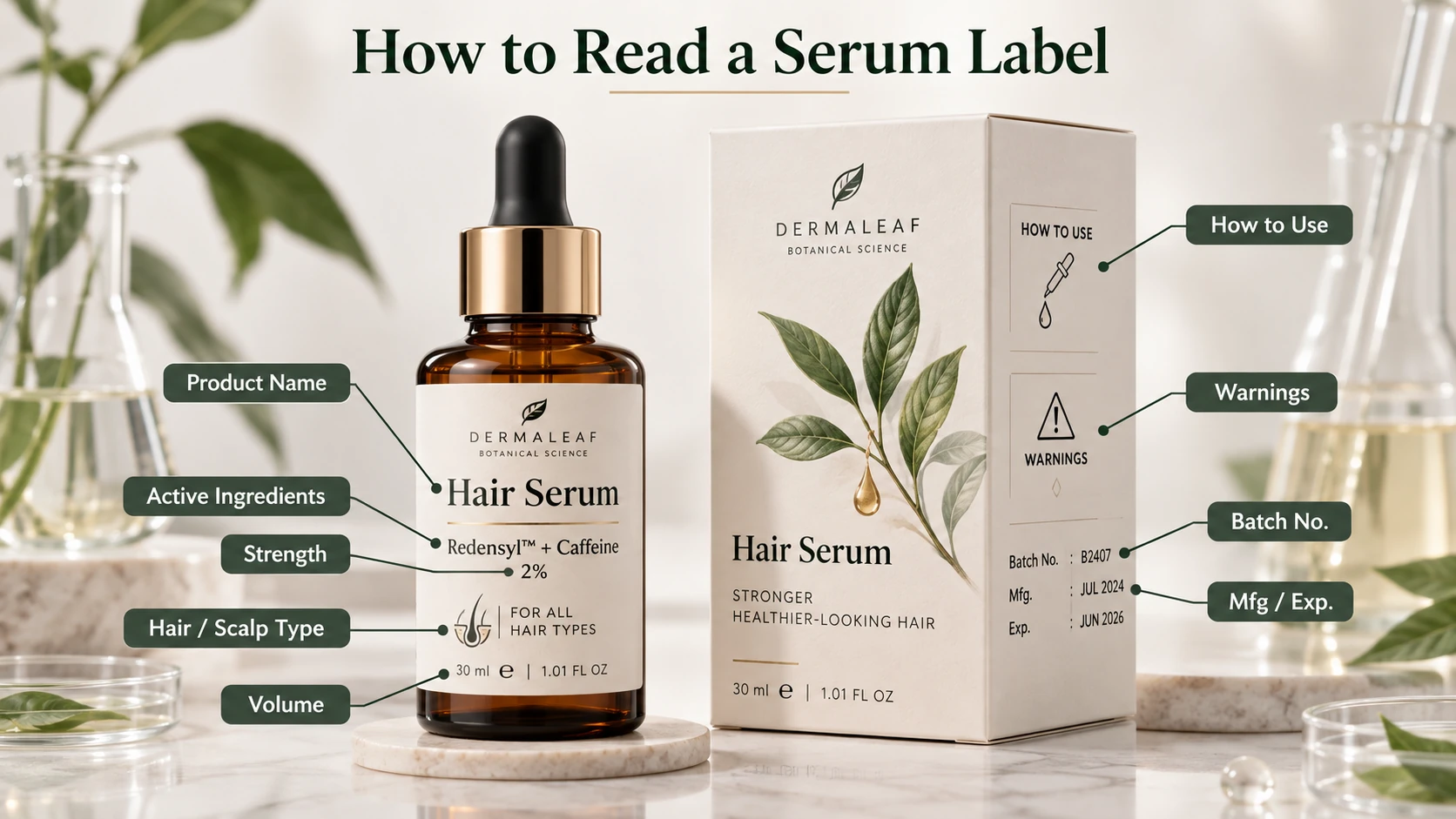
How to Read a Serum Label
Turn the bottle around. Almost everything that determines whether a serum can help you is on the back, and almost nothing on the front is regulated.
| What to check | What it tells you |
|---|---|
| Is a medicinal active present? | Minoxidil or another authorised active means this is a medicine, with a regulatory label, contraindications and pregnancy precautions. This is the single most important check. |
| Are active concentrations disclosed? | An active named without a percentage tells you it is present, not that it is present at a level any study used. Non-disclosure is the norm, and it is a meaningful limitation. |
| How many actives are listed? | A long active list looks impressive and makes evidence less interpretable, not more. No study of that product can attribute a result to any single component. |
| Where does alcohol sit in the list? | High in the list means an alcohol-rich vehicle. This affects feel and drying time, and may sting inflamed or broken scalp skin. |
| Fragrance, essential oils, preservatives | The usual contact-sensitisation triggers. Relevant for anyone with a sensitive scalp or a prior reaction. Fragrance-free does not mean allergy-free. |
| Scalp or lengths? | A fibre serum and a scalp serum are different products with different purposes. Applying the wrong one to the wrong place wastes it at best. |
| Cited study reference | Ask whether it studied this finished formula or a raw ingredient, whether there was a control group, and who funded it. |
| “Clinically tested” | Tested is not effective. Every product can be tested. The question is what was measured and against what. |
| “Dermatologist-tested” | Not the same as dermatologist-recommended, and neither establishes suitability for your specific diagnosis. |
| Before-and-after photographs | Were lighting, angle, hair styling and part position standardised? If not, the images demonstrate photography rather than efficacy. |
| Country of sale and regulatory category | Cosmetic and medicinal classification differ between markets. Verify locally rather than assuming. |
| Guaranteed-regrowth language | A red flag in itself. No cosmetic serum can responsibly guarantee regrowth. |
Packaging a medicine in a dropper bottle does not make it a cosmetic serum, and calling a cosmetic serum “clinical” does not make it a medicine.
Cosmetic Serum and Medicated Treatment Are Not Evidence-Equivalent
Cosmetic serum
- Cosmetic claims about appearance and supportive care
- Variable, frequently undisclosed active concentration
- Product-specific testing of varying quality
- No automatic disease-treatment status
- Evidence can be limited or supplier-generated
Medicated solution or serum
- Defined active ingredient at a stated strength
- Regulatory label with recognised indications
- Stated contraindications and adverse effects
- Route-specific instructions
- Continuing-treatment and supervision considerations
Cost drivers worth questioning
- Trademarked active complexes and imported ingredients
- Number of actives listed rather than their levels
- Dropper, pump and packaging quality
- Subscription models and repeat-purchase design
- Brand positioning rather than evidence

Setting the Record Straight
Myths vs Medical Reality
“Hair growth serum and hair fall serum are completely different product classes.”
Neither is a regulated or standard medical category. Their ingredient lists frequently overlap, and the same formula can be sold under either name.
“A growth serum always regrows hair.”
Cosmetic actives have mechanistic rationale and variable evidence. No cosmetic serum reliably produces regrowth in every user.
“A hair-fall serum stops every type of shedding.”
Hair fall is a symptom with many causes. A topical product cannot correct thyroid disease, iron deficiency or an autoimmune process.
“More active ingredients mean better results.”
A longer active list makes any study of that product less interpretable, not more. It also increases irritation potential.
“Natural serum has no side effects.”
Botanical extracts are a well-recognised source of contact allergy. Natural origin says nothing about tolerability.
“Tingling means the serum is working.”
Tingling usually reflects alcohol, menthol or an irritant response. It is not a marker of efficacy.
“Root-strengthening claims prove follicular benefit.”
“Root strengthening” is a marketing phrase with no standard measurement behind it.
“Reduced breakage proves reduced follicular shedding.”
These are different processes. Less hair on the comb can come entirely from stronger fibres, with no change in shedding from the root.
“All cosmetic serums are safer than minoxidil.”
Cosmetic products carry their own irritation and allergy risks, and a cosmetic that delays diagnosis of a progressive condition carries a real cost.
“Every peptide serum has the same evidence.”
“Peptide” describes a class, not a specific molecule. Evidence for one peptide does not transfer to another.
“Redensyl is equivalent to minoxidil.”
Redensyl is a cosmetic active with largely supplier-generated evidence. Minoxidil is a medicine with a regulatory label. They are not in the same evidence class.
“Procapil blocks DHT like a prescription medicine.”
A cosmetic ingredient with a plausible mechanism is not the same as a medicine with an established, regulated indication.
“Caffeine serum cures pattern hair loss.”
Caffeine has mechanistic rationale and some human data. It is not established as a treatment for androgenetic alopecia.
“Initial shedding always means the treatment is working.”
Increased shedding after starting a product has several possible explanations, including irritation. It is not a reliable sign of efficacy.
“Hair serums work in seven days.”
Hair-cycle changes are measured in months. Anything visible within days reflects fibre condition, not follicular change.
“Oily serum clogs every scalp.”
Tolerance is individual. Some people do well with oil-containing formulas; others do not. There is no universal rule.
“Water-based serum cannot cause irritation.”
Vehicle type does not determine irritancy. Preservatives, fragrance and actives can all trigger reactions regardless of base.
“Fragrance-free means allergy-free.”
Preservatives, botanicals and actives are all potential sensitisers. Removing fragrance removes one trigger, not the category.
“A premium dropper proves a premium formula.”
Packaging is a manufacturing decision. It tells you nothing about active concentration or evidence.
“Dermatologist-tested means dermatologist-recommended.”
These are different statements, and neither establishes that the product suits your specific diagnosis.
“Serum can replace diagnosis.”
Choosing a product without knowing what is causing the hair loss is guesswork. The diagnosis determines whether any serum can help.
“Hair serum can restore a completely bald scalp.”
Where follicles are no longer present or have been destroyed, no topical product regenerates them.
“Multiple serums always work better than one.”
Layering duplicates actives, raises irritation risk and makes it impossible to tell what caused any effect — good or bad.
“Stopping prescribed treatment for a cosmetic serum is harmless.”
Substituting a product with limited evidence for an established treatment can allow a progressive condition to advance. Discuss any change with the prescriber first.
When a Product Is Not the Answer
Red Flags: Assess First, Choose a Serum Second
The first eleven are clinical signs. The last eleven are marketing signs. Both are reasons to stop and reassess before buying anything.
Prepare for Your Visit
Serum Consultation Checklist
Medically Reviewed
Medically Reviewed By
Dr. Amit S. Agarkar
Dermatologist, Trichologist and Hair Transplant Surgeon
Full profile · Medical editorial policy · Correction policy · References
Medical information is periodically reviewed and may change as evidence, product labeling and regulatory guidance evolve.

Sources
Medical and Cosmetic-Science References
This list reflects the categories of authoritative source used to inform this page’s general statements. Exact citation details, titles and access dates should be finalised and verified by the reviewing dermatologist before publication. No specific study outcomes, percentages, efficacy figures or prices are fabricated anywhere on this page. Supplier technical documents, where used, are identified as supplier evidence rather than independent clinical evidence. Retailer blogs, influencer content and product testimonials are not used as evidence.
- Clinical guidelines on the diagnosis and management of androgenetic alopecia and other hair-loss conditions. IADVL Verify current guideline
- Official medicinal-product labels for topically applied hair-loss actives, including approved indications, contraindications and precautions. CDSCO Verify current label and classification
- Peer-reviewed hair-follicle biology research covering the hair cycle, miniaturisation and follicular signalling. PubMed To be cited individually
- Independent studies of cosmetic hair actives, distinguished from supplier-generated data. PubMed To be cited individually
- Ingredient supplier technical documentation — clearly identified as supplier evidence, not independent clinical evidence. Cite supplier and document by name
- Finished-product clinical trials, with attention to whether the studied formula matched the marketed product. PubMed To be cited individually
- Scalp-delivery and topical-penetration research relevant to vehicle and formulation effects. PubMed To be cited individually
- Contact-dermatitis literature on fragrance, preservative, botanical and essential-oil sensitisation. PubMed / Contact Dermatitis To be cited individually
- Hair-fibre science literature on breakage, weathering and combing-force measurement. Cosmetic science literature — verify current
- Cosmetic-regulation guidance applicable to the Indian market, including permitted claims. CDSCO cosmetics Verify current requirements
- Pregnancy and lactation safety sources for topically applied actives. PubMed / national formularies Verify current
- American Academy of Dermatology (AAD) — patient-education resources on hair loss and hair products. AAD Verify current resource
Common Questions
Frequently Asked Questions
36 questions, grouped by what you are actually trying to work out.
The Two Labels
In marketing terms, one is positioned around gaining density and the other around losing less hair. In formulation terms, they frequently contain the same actives. Neither is a standard medical category, and the same formula can carry either name.
Not in any regulated sense. Both are brand-chosen descriptions. What differs between real products is the actives, their concentrations, the vehicle and the evidence — not the label.
Neither label answers that. Progressive thinning usually reflects miniaturisation, which needs assessment. A cosmetic serum of either name may support scalp and fibre condition without treating the underlying process.
It depends entirely on what is driving the shedding. If it is a temporary trigger, neither product addresses it. If it is breakage being mistaken for shedding, a fibre-conditioning serum is the relevant one.
It may reduce breakage-related hair loss through conditioning. It does not correct the causes of shedding from the root, such as a telogen trigger or a nutritional or endocrine issue.
Cosmetic anti-hair-fall products are not established as regrowth treatments. Any apparent improvement in fullness may come from better fibre condition rather than new hair.
Identify the concern first — shedding, breakage, miniaturisation or scalp inflammation — then read the actual ingredient list. The front label should be the last thing you consider, not the first.
Conditions & Claims
A cosmetic serum is not an established treatment for androgenetic alopecia. Evidence-based options exist and are worth discussing with a dermatologist.
Same answer, with the addition that female-pattern loss warrants assessment because several conditions present similarly and some are investigable.
It does not address the trigger. Telogen effluvium commonly settles as the trigger resolves, which can make any product used during that window appear effective.
No. This is an autoimmune condition with a distinct mechanism that requires specialist assessment.
Frontal recession is a pattern feature. No cosmetic serum is established as reversing it.
Where follicles are no longer present or have been destroyed, no topical product regenerates them.
Increased shedding after starting a product has several possible explanations, including irritation. It is not a reliable sign that the product is working.
Any cosmetic benefit generally depends on continued use. Fibre-condition improvements fade as treated hair is replaced.
Ingredients
There is no required list. What matters is whether the actives present have evidence relevant to your concern, at disclosed concentrations, in a formula that has itself been tested.
They are not in the same evidence class. Redensyl is a cosmetic active with largely supplier-generated data. Minoxidil is a medicine with a regulatory label and an established evidence base.
A cosmetic complex of biotinyl-GHK, apigenin and oleanolic acid, marketed around follicular anchoring and DHT-related pathways. Its evidence is supplier-supported and product-specific.
A cosmetic complex combining red clover extract with acetyl tetrapeptide-3. Because it is multi-component by design, results cannot be attributed to any single element.
A pea-sprout-derived cosmetic active marketed around hair-cycle signalling. Supplier studies exist; independent finished-product evidence is limited.
Caffeine has mechanistic rationale and some human data, but results are formulation-specific and it is not established as a treatment for pattern hair loss.
“Peptide” is a class, not a molecule. Evidence varies enormously between specific peptides and specific products, and does not transfer from one to another.
Minoxidil is a medicine. If it appears in a product labelled as a serum, that product is a medicine with a regulatory label, contraindications and pregnancy precautions.
Cosmetic products carry their own irritation and allergy risks. There is also a less obvious risk: a cosmetic product that delays diagnosis of a progressive condition.
Practical & Safety
Their actives frequently duplicate, layering raises irritation risk, and starting both at once makes it impossible to attribute any effect. Introduce one change at a time.
Yes. Alcohol content, fragrance, essential oils, preservatives and cumulative multi-active load are the usual contributors.
A serum does not cause seborrhoeic dermatitis, but an irritating formula can worsen flaking and discomfort on an already reactive scalp.
Occlusive or heavy formulas can contribute in susceptible individuals. Pustules or tender bumps warrant stopping the product and seeking assessment.
Every product needs review with a clinician. Cosmetic status does not establish safety, and any product containing a medicinal active has specific precautions.
Hair-cycle changes are measured in months. Anything noticeable within days reflects fibre condition rather than follicular change.
Follow the specific product label. Daily use is common but not universal, and more frequent application does not improve outcomes.
This is formulation-dependent and stated on the label. Applying against the directions can change how much active is delivered.
The directed amount. More product does not increase absorption proportionally and does increase irritation and buildup risk.
Full-length hairs with a small bulb at the end suggest shedding from the root. Short fragments of uneven length suggest breakage. Home inspection is suggestive, not diagnostic.
Standardised photography under consistent lighting, angle and part position, plus a part-width note, assessed over months. Memory and impression are unreliable.
For sudden or severe shedding, patchy loss, scalp pain, pustules, crusting, signs of scarring, eyebrow or eyelash loss, hair loss in a child, or any progression despite consistent product use.
Keep Exploring
Explore Related Guides
Next Step
Choose the Formula That Matches the Cause — not the Most Impressive Claim
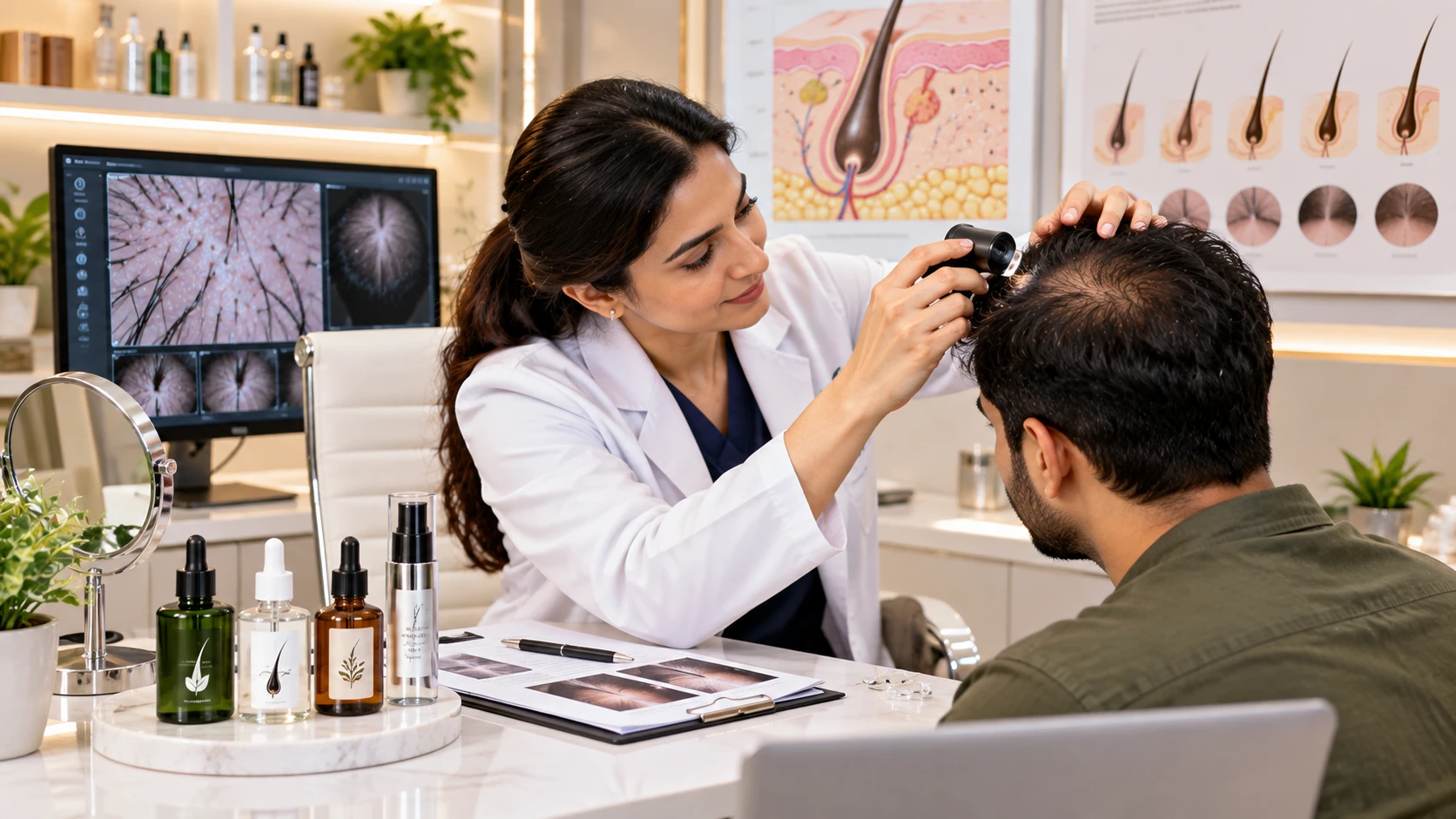
A dermatologist-led assessment can distinguish progressive miniaturisation, temporary shedding, hair-fibre breakage and scalp inflammation, then determine whether cosmetic scalp support, fibre protection, medical treatment or further investigation is appropriate.