Skip to content
Dermatologist-reviewed camouflage education · Temporary cosmetic coverage compared · Not a hair-loss treatment Last reviewed: 23 July 2026 Cosmetic editorial policy Product-claims policy Medical correction policy Commercial-affiliation disclosure Scalp-safety guidance Book a consultation
New, sudden, patchy, painful or rapidly progressing hair loss requires medical assessment even when camouflage products provide temporary coverage.

Hair-Loss Camouflage and Density Intelligence

Hair Fibers vs Scalp Concealer: Coverage, Volume, Durability and Which Looks More Natural

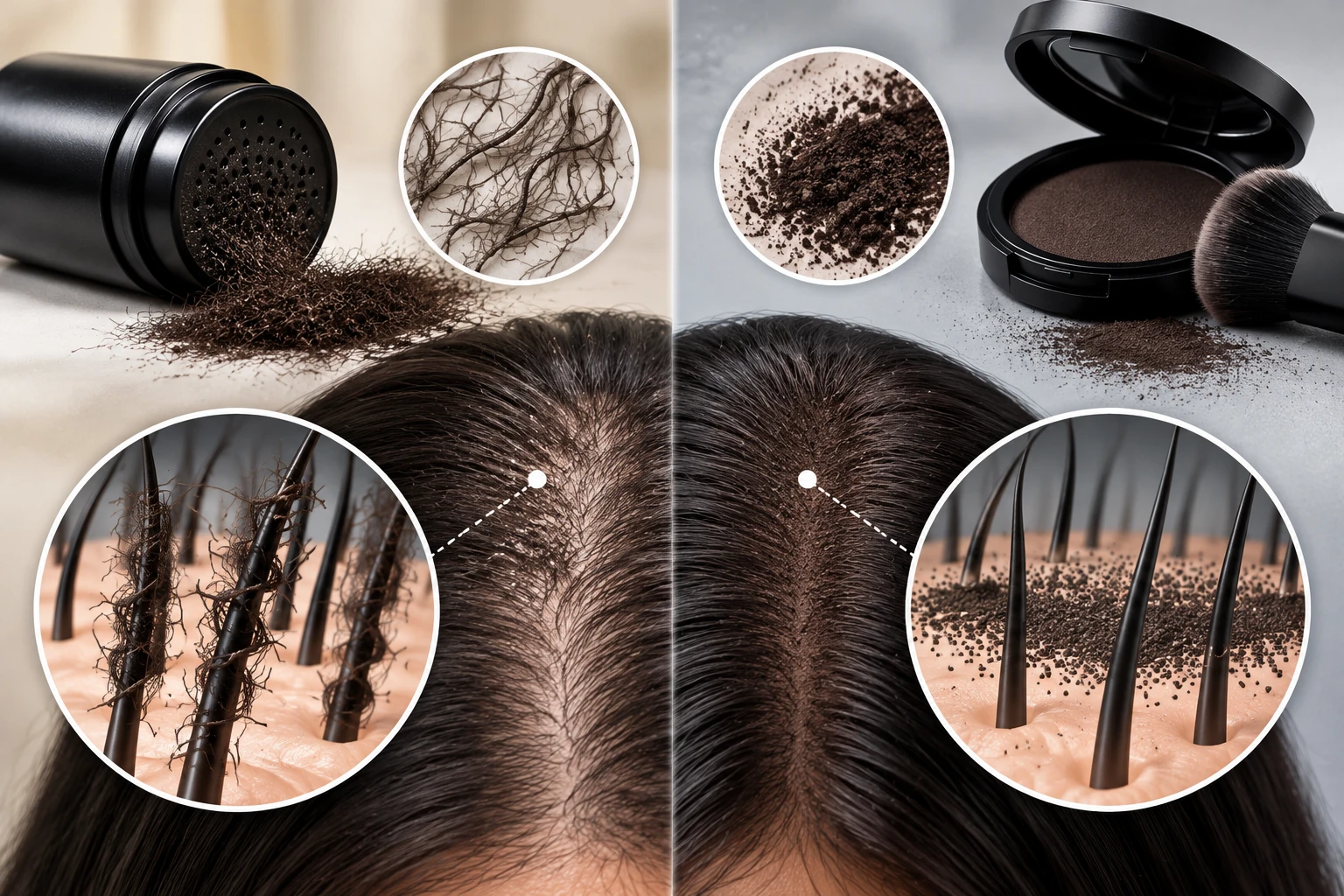
These two products solve different visual problems. Hair-building fibers attach primarily to existing hair shafts, increasing apparent shaft diameter to create dimensional volume. Scalp concealers apply pigment to visible scalp, reducing the colour contrast that makes thinning obvious. Which suits you depends on how much hair remains, the pattern of thinning, your shade match, scalp sensitivity and how much sweat, rain or contact the coverage needs to survive. Many people use both, applied in sequence. Neither product creates new follicles, stops hair loss or replaces diagnosis-led treatment — and this page endorses no brand.

No Regrowth Claims
Scientific cosmetic comparison of hair-building fibers and scalp concealer for temporary thinning-hair camouflage
Volume camouflage and contrast camouflage — two different visual problems.
Cosmetic Claims Audited

Quick Answer

Hair fibers attach to existing hair shafts and create fuller-looking volume. Scalp concealer colours exposed scalp to reduce the contrast that makes thinning visible. Fibers usually work better where enough hair remains for attachment; concealer may suit a widening part or localised visible scalp. They can be combined, concealer first. Neither product grows hair or treats the cause of thinning.

Read this first: Choose according to remaining hair, thinning pattern, shade match, scalp sensitivity and durability needs — not according to which product claims the most coverage.

At a Glance

Two Camouflage Methods, Compared

Neither panel is ranked above the other. They address different visual problems, and for many people the honest answer is both — or neither, if the priority is diagnosis.

Hair-Building Fibers

Apparent volumeThe core mechanism — fibers increase apparent shaft diameter, creating dimensional bulk
Scalp colour correctionLimited. Fibers sitting directly on bare scalp tend to read as dusty rather than as hair
Widening partCan help where adjacent hair remains; keep product away from a sharply defined part edge
Crown thinningOften effective where crown hair remains. Whorl direction and mirror access affect application
HairlineRequires restraint. Fibers need existing terminal or miniaturised hairs; a smooth frontal scalp looks artificial
Advanced baldnessLimited value where insufficient hair remains for attachment
Fine hairCan work well — fine shafts gain proportionally more apparent diameter. Build gradually
Curly and coily hairAttachment differs on a curved shaft; distribution and blending technique matter more
Grey and mixed hairMixing shades often reads more naturally than a single flat grey
SweatResistance varies by product. Heavy perspiration can dislodge fibers or cause streaking
RainWater-resistant is not waterproof. Heavy rain challenges most formulations
WindStrong wind can disturb loosely attached fibers, particularly without a fixing product
TransferRubbing, pillows and collars are the usual routes. Fixing spray reduces but does not eliminate it
Sensitive scalpFiber material, fixing-spray propellants and fragrance are the usual considerations
Application speedGenerally quick once technique is established; crown application needs mirrors
RemovalShampoo, though fixing products may require more thorough cleansing
Cost per useFiber material, shade range, quantity used and any fixing spray drive cost
Requires Existing Hair — Not a Treatment

Scalp Concealer

Apparent volumeMinimal. Pigment reduces contrast; it does not add dimensional bulk
Scalp colour correctionThe core mechanism — pigment reduces the scalp-to-hair contrast that makes thinning visible
Widening partOften the strongest use case — directly reduces part-line contrast and softens the visual edge
Crown thinningHelps reduce visible scalp, especially under overhead light. Blending the centre matters
HairlineCan create subtle shadow, but cannot recreate real hairline texture. Hard edges look painted
Advanced baldnessMay reduce scalp shine or contrast; heavy pigment can appear flat or opaque
Fine hairUseful where scalp shows between fine hairs; apply lightly to avoid a coated look
Curly and coily hairScalp is often more visible at the part; pigment can address this directly
Grey and mixed hairShade choice must account for both hair colour and scalp tone; blending beats one flat shade
SweatVaries by format. Heavy sweat can cause pigment migration, particularly at the hairline
RainFormat dependent. Powders, creams and sprays behave differently in moisture
WindGenerally more stable than loose fibers, since pigment adheres to the scalp surface
TransferFingers, pillowcases, collars and hat bands are the usual routes. Test before an event
Sensitive scalpPigments, fragrance, alcohol, preservatives and propellants are the usual considerations
Application speedLayer-building takes longer than fibers but gives more control at a part line
RemovalDepends on the pigment and setting system; some formats need more thorough cleansing
Cost per useFormat, pigment quality, shade range and any setting product drive cost
Shade Dependent — Not a Treatment

The Core Distinction

Are You Missing Apparent Hair Volume — or Seeing Too Much Scalp?

Almost every camouflage decision comes down to this question. Answer it honestly in front of a mirror, in the lighting where the problem bothers you most, and the product choice becomes considerably simpler.

Apparent-volume problem

Existing hair + attached fibers = fuller-looking hair

  • Fine hair that looks flat
  • Diffuse thinning with hair still present throughout
  • Reduced bulk and a flat crown
  • Hair looks sparse under light
  • Scalp is not especially visible — the hair just looks thin

Possible role: hair fibers, volumising styling, root lift, a strategic cut.

Scalp-contrast problem

Visible scalp + matched pigment = reduced contrast

  • A widening centre part
  • High contrast between dark hair and pale scalp
  • Crown show-through under overhead light
  • Localised exposed scalp or hairline gaps
  • Scalp obvious in photographs

Possible role: scalp concealer, root powder, pigmented spray, strategic part placement.

Mixed concern

Volume camouflage + contrast camouflage

  • Both thin-looking hair and visible scalp
  • Moderate diffuse thinning
  • Photography or an event
  • Wanting more complete cosmetic coverage
  • Willing to learn a two-step routine

Possible sequence: concealer first, allow it to set, then fibers, then minimal setting product.

The two products are not exact substitutes. The better option depends on whether the main visual concern is thin-looking hair, visible scalp, a widening part, crown show-through or localised hairline contrast.

Camouflage Is Not Treatment

What camouflage does

  • Changes appearance temporarily
  • Works immediately
  • Is removed by cleansing
  • Can meaningfully improve confidence

What it does not do

  • Alter the hair-growth cycle
  • Reverse follicular miniaturisation
  • Treat androgenetic alopecia, telogen effluvium or alopecia areata
  • Halt scarring alopecia
  • Correct thyroid, nutritional or hormonal causes
  • Create transplant grafts or preserve donor follicles

The risk worth naming

  • Effective camouflage can make progression harder to notice
  • It should not replace a medically recommended treatment
  • It should not delay diagnosis
  • Photograph without product periodically to track the underlying picture

Cosmetic improvement can be immediate even when the underlying hair-loss condition remains unchanged.

How Each One Works

The Camouflage-Mechanism Pathway

One attaches to hair. The other adheres to skin. That single difference explains almost every practical distinction between them.

Starting Surface

Dry hair and scalp. Both methods perform better on a dry surface, and both are affected by what is already on the scalp — oil, styling product or previous residue.

Fibre Distribution and Attachment

Fibers are dispersed over the area and adhere to existing hair shafts through static and physical attachment. Adhesion quality depends on how much hair is there to catch them.

Requires existing hair

Pigment Application and Diffusion

Pigment is applied to visible scalp and blended outward. The goal is reduced contrast with a soft edge — not an opaque block of colour along a hard line.

Shade dependent

Optional Setting

A fixing or setting product may improve retention. It reduces transfer; it does not make any formulation waterproof, and multiple sprays can increase irritation.

Wear, Transfer and Removal

Sweat, rain, wind, touching and fabric contact all affect durability. Both are removed by cleansing, though setting products may require more thorough shampooing.

This diagram represents general cosmetic principles. Product materials, adhesion and transfer resistance vary between formulations.

Abstract diagram comparing hair-fibre attachment to existing hair shafts and scalp-concealer pigment diffusion across visible scalp
One adheres to hair; the other adheres to skin.

In Detail

Full Comparison Table

The two bottom rows are the ones worth remembering: fibers require existing hair, and concealer adds no real volume. Everything else follows from those two facts.

Swipe to compare →

Hair-building fibers and scalp concealer compared across mechanism, pattern suitability, hair type, durability and safety. General cosmetic education — performance varies by product and technique, and neither is a hair-loss treatment.
ConsiderationHair-Building FibersScalp Concealer
Product categoryTemporary cosmetic particlesPigmented cosmetic — powder, cream, liquid or spray
Primary mechanismAttachment to existing hair shaftsPigment adhesion to visible scalp
Main application surfaceHairSkin
Existing-hair requirementYes — needs shafts to attach toMinimal — works on exposed scalp
Apparent volumeThe core benefitMinimal — pigment adds no bulk
Scalp colour correctionLimited; can look dusty on bare scalpThe core benefit
Hairline shadowRequires restraint; needs existing hairsCan create subtle shadow; hard edges look painted
Crown coverageOften effective where crown hair remainsReduces visible scalp, especially under overhead light
Widening-part coverageHelps if adjacent hair remains; avoid the sharp edgeFrequently the strongest use case
Diffuse thinningWell suited where hair remains throughoutWell suited where scalp shows between hairs
Completely bald areaLimited value — nothing to attach toMay reduce contrast or shine; cannot create volume
Alopecia-areata patchMay not attach to a smooth patchMay reduce contrast; must not delay diagnosis
Fine hairProportionally large apparent gain; build graduallyUseful where scalp shows between fine hairs
Thick hairLess needed, but useful for localised thinningUseful at the part line
Straight hairEven distribution is usually straightforwardPart lines are well defined and easy to target
Wavy hairDistribution needs a little more attentionScalp visibility varies with styling
Curly hairAttachment differs on a curved shaftScalp often visible at the part — pigment addresses it directly
Coily hairTechnique and distribution matter more than quantityFrequently effective for part and edge areas
Short hairNeeds adequate length for convincing attachmentOften works well — scalp is the visible surface
Long hairWorks where the thinning zone has hair presentTargets the part and crown
Grey hairMixing shades usually beats one flat greyUndertone matching becomes more important
Salt-and-pepper hairBlending two shades often reads more naturallyConsider a softer shade rather than the darkest
Highlighted hairMatch the root zone, not the lightest highlightSame principle — root zone, not highlight
Shade complexityModerate — hair colour is the referenceHigher — must consider both hair colour and scalp tone
Application speedGenerally quick once technique is establishedLayer-building takes longer but gives more control
Learning curveModerate — quantity control is the main skillModerate — blending and edge control are the main skills
Natural appearanceDimensional when matched; dusty when overappliedSkin-like when matched; flat when overapplied
Bright-light performanceShade mismatch becomes visibleReflectivity and edges become visible
Photography performanceCheck with and without flashCheck for hard pigment edges and shine
Sweat resistanceFormula dependent — heavy sweat challenges mostFormat dependent — migration possible at the hairline
Rain resistanceWater-resistant is not waterproofWater-resistant is not waterproof
Wind resistanceLoose fibers can be disturbedGenerally more stable — adheres to skin
Touch transferRubbing dislodges fibersPigment transfers to fingers readily
Pillow transferPossible — removal before sleep reduces itPossible — pale pillowcases show it most
Clothing transferCollars are the usual siteCollars and hat bands are the usual sites
Helmet useFriction can disturb coverageFriction and pressure can disturb coverage
Scalp irritationFiber material, fixing spray, fragrancePigments, alcohol, fragrance, preservatives, propellants
Inhalation considerationAvoid inhaling loose fibers during applicationRelevant for loose powders and aerosol sprays
Eye exposureAvoid; keep clear of the eye areaAvoid; keep clear of the eye area
RemovalShampoo; fixing products may need more thorough cleansingDepends on pigment and setting system
Daily-use practicalityPractical for many; sensitive scalps may need less frequent usePractical for many; sensitive scalps may need less frequent use
Cost per useMaterial, shade range, quantity and fixing sprayFormat, pigment quality, quantity and setting product
Main limitationRequires existing hairAdds no real volume

Hair Fibers · Dimensional Volume

Hair-Building Fibers: Dimensional Camouflage for Existing Hair

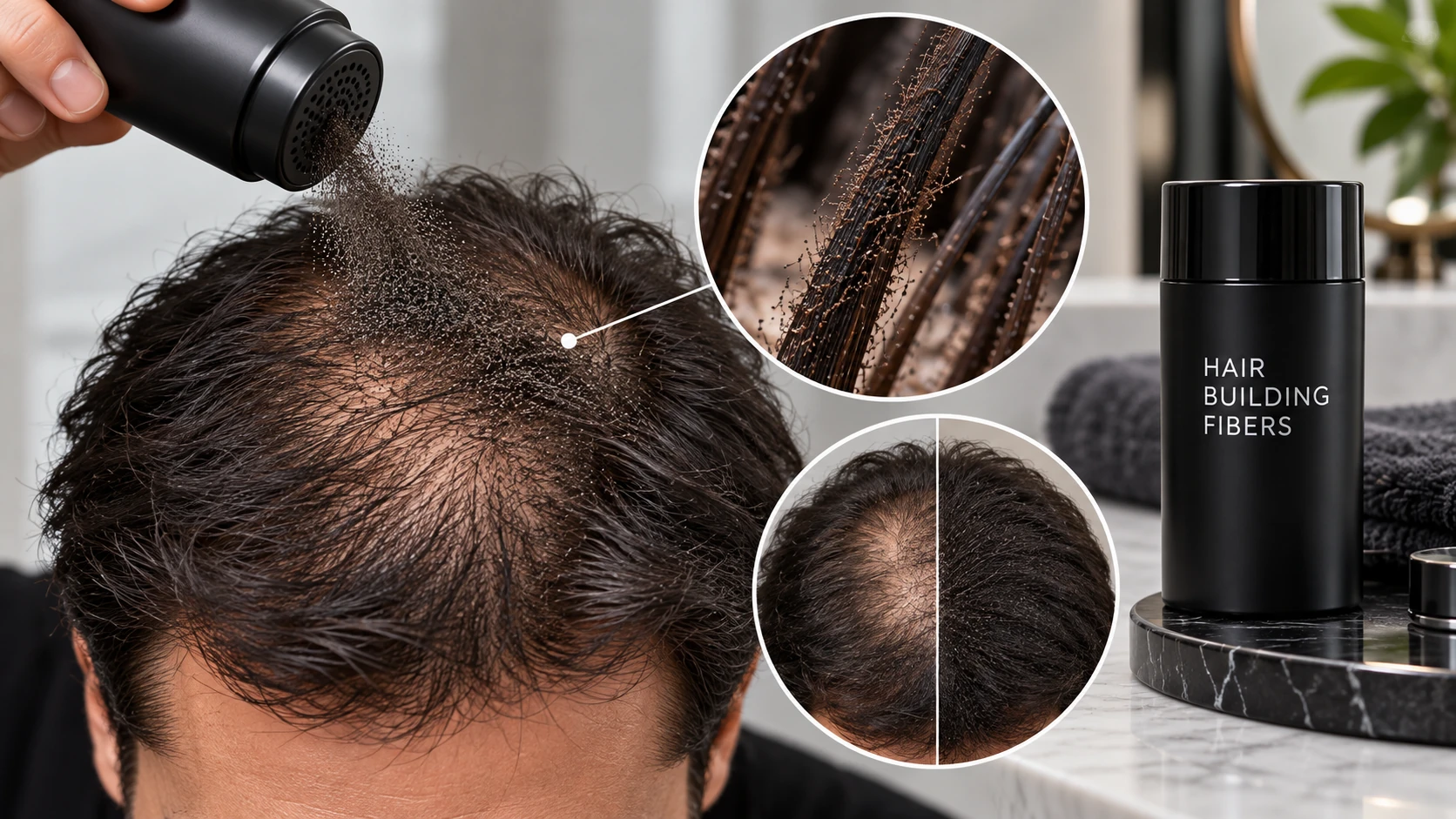
Everything about how fibers perform follows from one constraint: they attach to hair, not to scalp. Where hair remains, they work well. Where it does not, no amount of product compensates.

Material claims require verification

Products are marketed as keratin, cellulose, cotton, rayon, plant-derived or proprietary multi-component systems. Not every product is natural keratin, and a marketing claim is not a verified composition. Read the actual ingredient list.

How attachment works

Fibers adhere through a combination of static attraction and physical entanglement with the hair shaft. This is why the amount of hair present in the area matters more than the amount of product applied.

The existing-hair requirement

The single most important constraint. Fibers need shafts to catch on. On a smooth bald scalp there is nothing to attach to, and product sitting on bare skin reads as dust rather than as hair.

Hair length

Very short hair provides less surface for attachment. There is no universal minimum, but convincing results generally require enough length for fibers to sit within the hair rather than on the scalp.

Crown and diffuse-thinning use

Often where fibers perform best — hair remains throughout, giving good attachment. Crown application needs mirrors, and whorl direction affects how the fibers sit.

Part-line and hairline restraint

A sharply defined part edge or a smooth frontal hairline is where overapplication becomes obvious. Fine, irregular blending reads far more naturally than a dense, evenly filled line.

Fine, curly and coily hair

Fine shafts gain proportionally more apparent diameter, which can be very effective. Curved shafts hold fibers differently, so distribution and gentle blending matter more than quantity.

Grey and mixed-colour hair

A single flat grey rarely matches real hair, which contains multiple tones. Mixing shades usually produces a more convincing result than choosing one product shade.

Application density and clumping

Build gradually. Excess product clumps, looks granular and is the most common reason fibers appear artificial. Blend without aggressive rubbing, which dislodges what has attached.

Fixing sprays and durability

A fixing spray may improve retention and reduce transfer. It does not make any formulation waterproof, and additional aerosol products introduce their own irritation potential.

Sweat, rain, wind and touch

Resistance varies by product and none should be assumed waterproof. Rubbing, heavy perspiration and strong wind are the usual failure points. Test your routine before an important event, not on the day.

Hair-Fiber Reality Check

Ten corrections worth carrying to the shelf

  1. Fibers need existing hair for convincing attachment
  2. Excess product looks dusty or granular
  3. Fibers do not create real follicle density
  4. Shade mismatch becomes visible in bright light
  5. Fixing spray does not make every formula waterproof
  6. Fibers may transfer with rubbing or heavy moisture
  7. Application on a smooth hairline can look artificial
  8. Fibers do not stop or slow hair loss
  9. Fibers may irritate a sensitive scalp
  10. Fiber material must be verified from the actual ingredient list
Abstract illustration of hair-building fibers attaching to existing hair shafts to increase apparent shaft diameter
Attachment to existing shafts — the mechanism and the limitation in one image.

Scalp Concealer · Contrast Reduction

Scalp Concealer: Pigment-Based Reduction of Visible Scalp Contrast

Pigment sits between two reference points — your hair colour and your scalp tone. Matching only one of them is the most common reason concealer reads as makeup rather than as scalp.

Formats behave differently

Powders, creams, liquids and sprays differ in finish, water resistance, transfer and removal. Choosing a format is as consequential as choosing a shade, and a claim made for one format does not transfer to another.

Contrast reduction, not volume

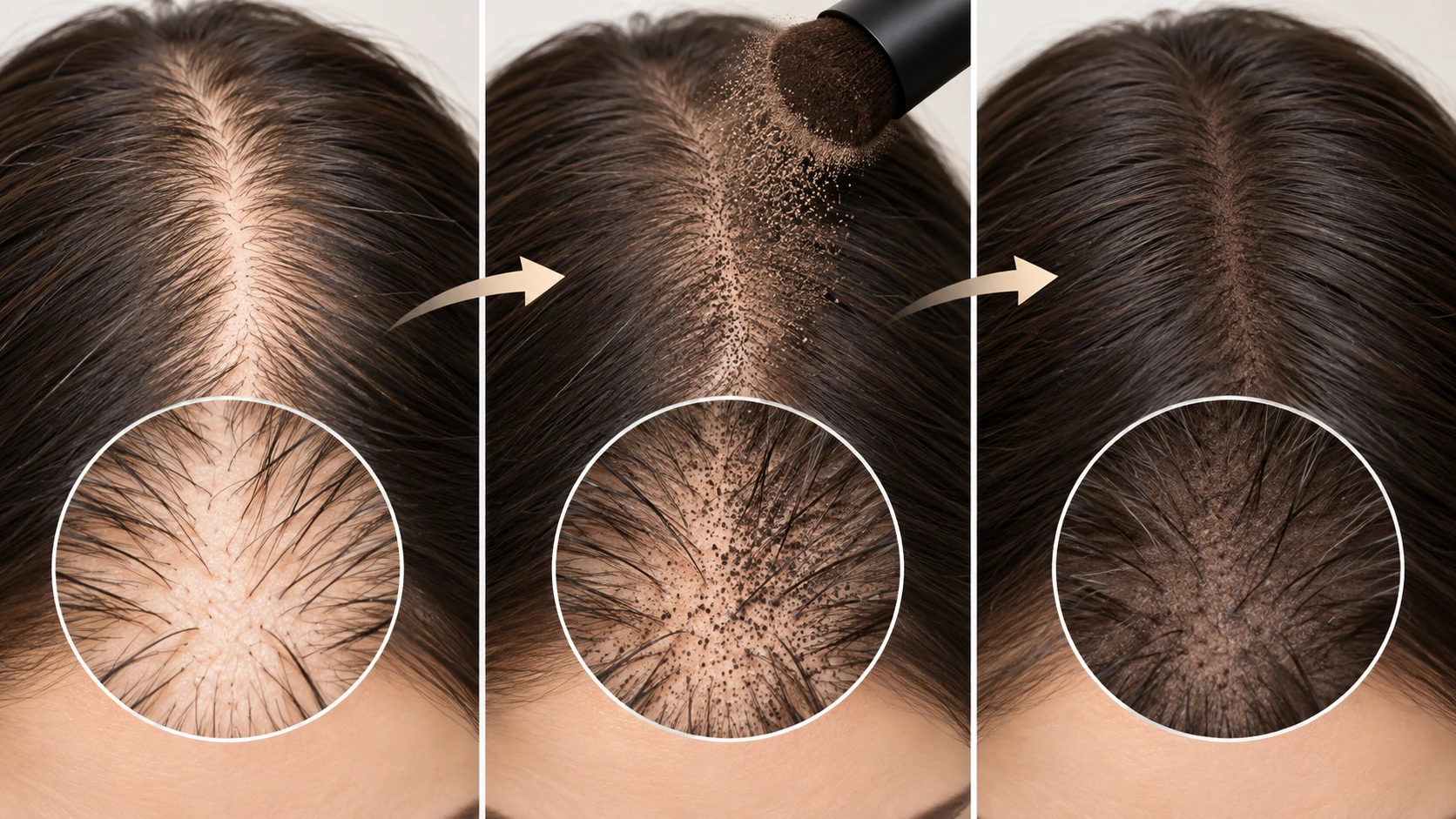
Pigment makes visible scalp less obvious. It adds no dimensional bulk. This is why concealer alone rarely satisfies someone whose actual complaint is that their hair looks flat.

Matte versus reflective finish

A matte finish generally reads more scalp-like. Reflective or shimmery finishes catch overhead light and can draw attention to exactly the area being camouflaged.

Shade and undertone matching

Uniquely complex here, because the product sits between two reference points — hair colour and scalp tone. Undertone matters as much as depth; a shade correct in depth but wrong in warmth still reads as makeup.

Part-line and crown use

Frequently the strongest use case. Apply along the part, then diffuse outward so no hard edge remains. Check the crown from above, since that is how others see it.

Hairline restraint

Pigment can suggest subtle shadow but cannot recreate the irregular texture of a real hairline. A dark, hard-edged line is the most recognisable sign of camouflage.

Advanced baldness limitations

Concealer may reduce scalp shine and colour contrast, but heavy pigment across a large smooth area tends to look flat or painted. Hair systems, scalp micropigmentation or surgical assessment are different conversations with their own candidacy requirements.

Not scalp micropigmentation

Worth stating plainly: temporary pigment washes off. Scalp micropigmentation is a permanent procedure with entirely separate candidacy, technique and risk considerations. They are not comparable products.

Application technique

Thin layers, built gradually, diffused at every edge. Brushes and sponges give more control than fingers; sprays require managing overspray onto skin and clothing.

Transfer and setting

Pigment reaches fingers, pillowcases, collars and hat bands. Setting products may reduce this. Water-resistant is not waterproof, and heavy sweat can cause visible migration at the hairline.

Scalp tolerance

Pigments, fragrance, alcohol, preservatives and propellants are all potential irritants. Do not apply over infected, ulcerated or severely inflamed skin, and treat active scalp disease before regular camouflage use.

Scalp-Concealer Reality Check

Ten corrections worth carrying to the shelf

  1. Concealer reduces contrast but does not add real volume
  2. Heavy application can appear flat or painted
  3. Matte finish usually appears more scalp-like than high shine
  4. Shade choice must consider both hair colour and scalp tone
  5. A dark hard-edged hairline often looks unnatural
  6. Water resistance varies and is never guaranteed
  7. Product can transfer to fingers, pillows, collars or hats
  8. Concealer does not treat hair loss
  9. It should not be applied over infected or severely inflamed skin
  10. It is not the same as scalp micropigmentation
Abstract illustration of scalp-concealer pigment diffusion and blending across visible scalp to reduce colour contrast
Reduced contrast with a soft edge — not an opaque block of colour.

By Pattern

Which Method Suits Which Thinning Pattern?

Suitability tracks remaining hair more than anything else. These cards are educational starting points — they do not diagnose the pattern you have.

Mild Diffuse Thinning

Visual challenge
Hair looks slightly less dense; scalp barely visible.
Hair-fiber suitability
Good — plenty of shafts for attachment.
Scalp-concealer suitability
Optional; may not be needed yet.
Combined use
Rarely necessary at this stage.
Main limitation
Small amounts go a long way; overapplication is the main risk.
When diagnosis is required
If thinning is new or progressing, get it assessed.

Moderate Diffuse Thinning

Visual challenge
Hair thin throughout with scalp showing between hairs.
Hair-fiber suitability
Good — the classic use case.
Scalp-concealer suitability
Good — addresses the show-through directly.
Combined use
Often the strongest combination.
Main limitation
Blending both products takes practice.
When diagnosis is required
Progression warrants assessment regardless of coverage quality.

Widening Centre Part

Visual challenge
A defined line of exposed scalp.
Hair-fiber suitability
Helpful adjacent to the part; avoid filling the line itself.
Scalp-concealer suitability
Frequently the single best use case.
Combined use
Concealer first along the line, fibers to surrounding hair.
Main limitation
A hard pigment edge along the part looks painted.
When diagnosis is required
A widening part is a recognised sign worth assessing.

Crown Thinning

Visual challenge
Circular show-through, often first noticed in photographs.
Hair-fiber suitability
Good where crown hair remains.
Scalp-concealer suitability
Reduces visible scalp under overhead light.
Combined use
Commonly used together.
Main limitation
Mirror access and whorl direction complicate application.
When diagnosis is required
Crown thinning has several possible causes.

Frontal Thinning

Visual challenge
Reducing density behind the hairline.
Hair-fiber suitability
Reasonable where miniaturised hairs remain.
Scalp-concealer suitability
Can soften contrast; restraint required.
Combined use
Possible, with careful blending.
Main limitation
Frontal areas are the most scrutinised.
When diagnosis is required
Frontal change is worth assessing early.

Receding Temples

Visual challenge
Smooth or near-smooth recession at the temples.
Hair-fiber suitability
Limited — little to attach to.
Scalp-concealer suitability
Subtle shadow only; cannot recreate texture.
Combined use
Limited benefit.
Main limitation
Sharp edges here look immediately artificial.
When diagnosis is required
Recession has recognised patterns worth diagnosing.

Short Miniaturised Hair

Visual challenge
Fine, short hairs providing minimal surface.
Hair-fiber suitability
Limited attachment surface.
Scalp-concealer suitability
Can reduce contrast around them.
Combined use
Concealer usually contributes more.
Main limitation
Fibers may sit on scalp rather than in hair.
When diagnosis is required
Miniaturisation is a diagnostic finding, not just cosmetic.

Advanced Crown Baldness

Visual challenge
A large smooth area with little remaining hair.
Hair-fiber suitability
Limited value.
Scalp-concealer suitability
May reduce shine and contrast; can look flat.
Combined use
Limited.
Main limitation
Heavy pigment over a large area rarely convinces.
When diagnosis is required
Hair systems, SMP or surgical assessment are separate discussions.

Smooth Frontal Baldness

Visual challenge
An absent frontal hairline.
Hair-fiber suitability
Not suitable — nothing to attach to.
Scalp-concealer suitability
Cannot recreate a hairline convincingly.
Combined use
Not recommended.
Main limitation
This page does not promise convincing reconstruction here.
When diagnosis is required
Discuss realistic options with a specialist.

Alopecia-Areata Patch

Visual challenge
A well-defined, often smooth patch.
Hair-fiber suitability
May not attach to a smooth patch.
Scalp-concealer suitability
May reduce contrast in selected patches.
Combined use
Limited by the patch surface.
Main limitation
Camouflage must not delay diagnosis or treatment.
When diagnosis is required
Active inflammation, scaling or broken skin needs medical review.

Linear Scar

Visual challenge
A defined line lacking follicles.
Hair-fiber suitability
Little to attach to along the scar itself.
Scalp-concealer suitability
May reduce contrast; texture difference remains.
Combined use
Adjacent hair styling often helps more.
Main limitation
Do not apply to unhealed or inflamed scar tissue.
When diagnosis is required
New or changing scars need assessment.

Hair-Transplant Donor Scar

Visual challenge
A linear or diffuse donor-area change.
Hair-fiber suitability
Depends on surrounding hair density.
Scalp-concealer suitability
May reduce contrast once fully healed.
Combined use
Possible once healing is complete.
Main limitation
Timing must be determined by the treating surgical team.
When diagnosis is required
Discuss with your surgeon before applying anything.

Female-Pattern Hair Loss

Visual challenge
Widening part with preserved frontal hairline.
Hair-fiber suitability
Good where hair remains.
Scalp-concealer suitability
Often very effective at the part.
Combined use
Frequently combined.
Main limitation
Progression is gradual and easy to miss under coverage.
When diagnosis is required
Assessment is worthwhile — several causes present this way.

Male-Pattern Hair Loss

Visual challenge
Recession, crown thinning or both.
Hair-fiber suitability
Depends entirely on remaining density.
Scalp-concealer suitability
Depends on the area and contrast.
Combined use
Depends on the pattern stage.
Main limitation
Coverage quality declines as density decreases.
When diagnosis is required
Established treatment options exist — worth discussing.

Traction-Related Thinning

Visual challenge
Thinning along tension-bearing areas, often the edges.
Hair-fiber suitability
Depends on remaining hair.
Scalp-concealer suitability
May reduce contrast at the edges.
Combined use
Possible.
Main limitation
Camouflage does not reduce the tension causing it.
When diagnosis is required
Early traction change may be reversible — assess promptly.

Postpartum Shedding

Visual challenge
Diffuse shedding, usually temporary.
Hair-fiber suitability
Often works well — hair remains throughout.
Scalp-concealer suitability
Useful if scalp shows at the part.
Combined use
Reasonable short-term coverage.
Main limitation
This commonly recovers on its own.
When diagnosis is required
Prolonged or patchy shedding warrants review.

Telogen Effluvium

Visual challenge
Diffuse shedding following a trigger.
Hair-fiber suitability
Good — hair generally remains.
Scalp-concealer suitability
Useful for part-line show-through.
Combined use
Reasonable while recovery occurs.
Main limitation
Camouflage does not shorten the natural course.
When diagnosis is required
Identifying the trigger matters more than the coverage.

Scarring Alopecia

Visual challenge
Smooth shiny areas with loss of follicular openings.
Hair-fiber suitability
Limited — follicles are absent.
Scalp-concealer suitability
May reduce contrast on healed skin only.
Combined use
Limited.
Main limitation
Do not apply pigmented products to ulcerated, infected or severely inflamed skin.
When diagnosis is required
Pain, burning, redness, scale or loss of follicular openings requires prompt dermatologist assessment. Camouflage must not delay treatment of active inflammatory disease.

Shade Intelligence

The Shade-Matching Studio

Shade is where most camouflage attempts succeed or fail. Every shade below carries a written depth value and a tone description, so the guidance works whether or not you can see the swatch.

Before you choose

  • Identify your root colour, not your mid-lengths or highlights
  • Note whether your tone is warm, neutral or cool
  • Note your scalp tone — concealer sits between hair and skin
  • Estimate your grey percentage honestly
  • Decide which lighting matters most to you

General principles

  • Match the root zone rather than the lightest highlight
  • A slightly softer shade usually looks more natural than a harsh dark one
  • Mixed shades frequently improve realism
  • Grey hair generally needs blending rather than one flat grey
  • Test in daylight, indoor light and photography
  • Concealer may need undertone adjustment that fibers do not

Warning signs of a mismatch

  • A visible colour block rather than diffuse coverage
  • Orange or red cast where none exists in the hair
  • A grey area that reads as flat and lifeless
  • Colour that looks correct indoors and wrong in daylight
  • A dark halo at the hairline in photographs

Shade Families

Depth values and tone descriptions are given in text for every entry. The colour swatch is visual reinforcement only and carries no information that is not also written.

Soft Black

Depth 1 — Deepest

A muted near-black with low reflectance. Reads softer than true black in daylight.

Often more natural than natural black for most hair, since real black hair rarely appears flat.

Natural Black

Depth 1 — Deepest

A true deep black with cool undertone.

Can look harsh against a pale scalp; consider soft black unless hair is genuinely jet black.

Cool Dark Brown

Depth 2 — Very Deep

Dark brown with ashy, cool undertone and no visible red.

Suits hair that looks brown rather than black in direct daylight.

Warm Dark Brown

Depth 2 — Very Deep

Dark brown with a warm, slightly golden undertone.

Undertone matters as much as depth — check yours in daylight, not indoor light.

Medium Brown

Depth 3 — Deep

A mid-tone brown, neither notably warm nor cool.

The most commonly suitable depth for mid-brown hair worldwide.

Ash Brown

Depth 3 — Deep

Mid-brown with grey-leaning, cool undertone and no warmth.

Useful where warm shades look orange against the scalp.

Light Brown

Depth 4 — Medium

A lighter brown with visible warmth.

Match the root zone rather than lighter mid-lengths.

Auburn

Depth 4 — Medium

Brown with distinct red-copper undertone.

Red tones are the hardest to match; a slightly softer shade usually blends better.

Dark Blonde

Depth 5 — Light-Medium

Deep blonde with golden-brown warmth.

Frequently the correct root shade for people who consider themselves blonde.

Medium Blonde

Depth 5 — Light-Medium

Mid blonde with clear golden warmth.

Check against the root, which is usually darker than you expect.

Light Blonde

Depth 6 — Lightest

Pale blonde with soft warmth.

On light hair, too dark a shade is far more visible than too light.

Grey

Depth — Neutral Grey

A neutral mid grey with no warm or cool bias.

Real grey hair contains multiple tones; one flat grey rarely convinces on its own.

Silver

Depth — Light Neutral

A light, cool-leaning grey with slight sheen.

Consider blending with grey rather than using alone.

White

Depth — Lightest Neutral

An off-white with minimal warmth.

Rarely used alone; usually blended to soften a grey or silver match.

Salt-and-Pepper

Depth — Mixed Neutral

A blended dark-and-grey tone approximating mixed hair.

Mixing a dark shade with grey generally reads more naturally than any single product shade.

No shade match can be guaranteed from a screen. Monitor calibration, ambient lighting and individual hair tone all vary. Treat these families as a starting point for narrowing the choice, then test in your own lighting.

Abstract shade-matching reference showing hair root tone, scalp tone and blended camouflage depth families
Root zone, undertone and scalp tone — three references, not one.

Educational Tool

Educational Hair Camouflage Guide

Answer a few questions to see which considerations matter most for your situation. This guide does not diagnose hair loss, guarantee shade matching or verify the safety of any specific product.

Educational Hair Camouflage Guide — Not a Hair-Loss Diagnosis

What is your main visible concern?

Where is the thinning?

How much hair remains in that area?

How long is your hair?

Hair texture?

Roughly what proportion is grey?

How much contrast between hair and scalp?

How much sweat exposure?

Rain or humidity exposure?

Hat, helmet or frequent scalp contact?

Do you have a sensitive or reactive scalp?

Any active scalp condition, wound or recent procedure?

This educational guide cannot diagnose hair loss, guarantee shade matching or verify the safety of a specific product.

Your answers stay in your browser only.

Technique Studio

Application Technique, Step by Step

Timelines vary by diagnosis, formulation, treatment route, adherence, baseline severity, individual biology and any concomitant treatment. A meaningful response cannot be judged after only a few days — standardised photographs, taken the same way each time, can help track real change.

Before starting

Start with dry hair, styled roughly into the position you will wear it.

Early adjustment

Protect your face and clothing. Apply a small amount and build gradually.

First review

Keep distance from a completely bare hairline — fibers need hair to attach to.

Intermediate assessment

Blend with fingers or an applicator without aggressive rubbing.

Longer-term assessment

Inspect from above, especially at the crown, using a second mirror.

Maintenance phase

Apply setting product only as needed, then check in more than one lighting condition.

Safety, Without the Drama

Scalp Safety Explorer

Local effects

  • Scalp itching
  • Sensitivity to the fiber material or its coating
  • Fragrance reaction
  • Buildup with repeated use without cleansing

Application precautions

  • Avoid inhaling loose fibers
  • Keep clear of the eye area
  • Fixing-spray propellants and alcohol can irritate
  • Do not apply to broken skin

Hygiene

  • Keep applicators clean
  • Do not share products casually
  • Remove adequately rather than layering repeatedly
Facial swelling or breathing difficulty after applying any product requires urgent medical care. Severe itching, pustules, crusting or a reaction that does not settle after stopping the product needs prompt assessment.

Realistic Expectations

What Results Can Realistically Be Expected?

What camouflage realistically achieves: immediate, meaningful improvement in how thinning looks — more apparent volume from fibers, less visible scalp from concealer, and better results still from a well-blended combination. For many people this genuinely improves confidence.

What it does not achieve: any change to the underlying condition. Camouflage does not slow progression, and effective coverage can make progression harder to notice. Photographing the area without product periodically is worth doing.

Appearance also varies by lighting. Daylight, warm indoor light, cool LED, overhead spotlights and camera flash each reveal different things — shade mismatch, hard pigment edges, powder accumulation or scalp reflectivity. Check in more than one before an occasion that matters. No product is invisible under every lighting condition.

Immediate Cosmetic Improvement

More Apparent Volume

Reduced Scalp Contrast

Temporary and Reversible

New Hair Growth — Not Possible

Waterproof Coverage — Not Established

Durability

Sweat, Rain, Wind and Transfer

Resistance varies by product, format and technique. No universal performance ratings are published here — the only reliable test is your own routine, under your own conditions, before an occasion that matters.

Environmental and contact conditions affecting camouflage durability. General principles only — individual products differ substantially and marketing claims require product-specific testing.
ConditionHair fibersScalp concealer
Light perspirationUsually tolerated, especially with a fixing productUsually tolerated; hairline is the first area to show migration
Heavy exerciseSignificant challenge; streaking and loss both possiblePigment migration likely at the hairline and temples
Humid weatherAdhesion may reduce; formula dependentFormat dependent; creams and powders differ
Light rainSome formulations cope; none should be assumed waterproofSome cope; water-resistant is not waterproof
Heavy rainChallenges most products regardless of claimChallenges most products regardless of claim
Strong windLoosely attached fibers can be disturbedGenerally more stable — pigment adheres to skin
Touching the scalpRubbing dislodges fibers readilyPigment transfers to fingers readily
HatsFriction at the band line is the usual issueFriction and pressure both affect coverage
HelmetsSustained pressure and sweat combined — the hardest caseSame combination applies
SleepingTransfer to bedding likely; removal beforehand reduces itTransfer likely; pale pillowcases show it most
Shirt collarsPossible, particularly at the napePossible, particularly at the nape and behind the ears
Camera flashReveals shade mismatch and powder accumulationReveals hard edges and scalp reflectivity
Overhead lightingReveals gaps and uneven distributionReveals the crown centre and any flat patches

Hair Transplant and Medical-Treatment Compatibility

Camouflage must not be applied to fresh grafts or healing wounds. Post-transplant timing must be determined by your treating surgical team — no fixed number of days is published here, because it depends on the procedure, the individual and the healing course.

After a transplant

  • Do not apply to fresh grafts or unhealed skin
  • Do not rub crusting, redness or healing skin
  • Follow your surgical team’s timing, not a general guideline
  • Ask specifically about both fibers and pigment — they behave differently

Clinical examination

  • Fiber or pigment residue can obscure scalp examination
  • Remove camouflage before clinical photography or trichoscopy
  • Tell your dermatologist what you have been using
  • Residue can make progression harder to assess accurately

With topical treatment

  • Topical medicines may change fibre adhesion or pigment behaviour
  • Never mix camouflage directly into a medicinal product
  • Microneedling increases irritation and absorption — discuss timing
  • Treat active inflammatory scalp disease before regular camouflage use

Product Label Audit

Label evaluation guide. Educational only — this page does not rank or recommend any commercial product.
What to checkWhat it tells you
Fibre or pigment based?Determines the mechanism, and therefore whether it can address your actual concern. Some products are hybrids.
What is the fibre material?Keratin, cellulose, cotton, rayon or proprietary. A “natural keratin” claim on the front is not a verified composition — check the ingredient list.
Is the full ingredient list available?An incomplete list makes sensitivity assessment impossible. This is itself a finding.
Fragrance, alcohol, preservativesThe usual irritants. Relevant for anyone with a sensitive scalp or a previous reaction.
Is it an aerosol?Propellants and inhalation precautions apply. Use in a ventilated space.
“Water resistant” vs “waterproof”These are different claims. Waterproof requires product-specific evidence and should be treated sceptically.
“Transfer resistant”Resistant is not proof. Test on a pale cloth before wearing light clothing.
Application and removal instructionsAbsent or vague removal instructions suggest buildup may be difficult to manage.
Eye and inhalation warningsTheir presence is a good sign of a considered product; their absence is worth noting.
Shade rangeA narrow range makes a good match less likely, particularly for grey or highlighted hair.
Country of saleDetermines the applicable cosmetic regulatory framework.
Claims exceeding the ingredientsAny hair-growth or follicle claim on a camouflage product is a red flag in itself.
Value is a realistic shade match, a natural finish, controlled application, low transfer, scalp tolerance, a clear ingredient list, honest durability claims and easy removal — not the biggest coverage promise on the packaging.
Abstract illustration of camouflage durability under sweat, rain, wind and contact transfer conditions
Test your own routine under your own conditions — not on the day it matters.

Setting the Record Straight

Myths vs Cosmetic Reality

Myth

“Hair fibers grow new hair.”

Cosmetic Reality

They are cosmetic particles that attach to existing shafts. They have no effect on follicles or the hair-growth cycle whatsoever.

Myth

“Scalp concealer stimulates follicles.”

Cosmetic Reality

It is pigment applied to skin. It reduces visual contrast and does nothing biological.

Myth

“Fibers and scalp concealer are the same product.”

Cosmetic Reality

They solve different problems. Fibers add apparent volume to hair; concealer reduces scalp-to-hair contrast.

Myth

“Fibers work on a completely bald scalp.”

Cosmetic Reality

They need hair shafts to attach to. On smooth skin they read as dust rather than as hair.

Myth

“Scalp powder creates real hair volume.”

Cosmetic Reality

Pigment adds colour, not bulk. If the complaint is flat-looking hair, concealer alone will disappoint.

Myth

“All hair fibers are made from keratin.”

Cosmetic Reality

Products use keratin, cellulose, cotton, rayon or proprietary blends. The marketing claim is not a verified composition — read the ingredient list.

Myth

“Natural fibers cannot cause irritation.”

Cosmetic Reality

Natural origin says nothing about tolerability. Any material, plus fragrance and fixing sprays, can irritate a sensitive scalp.

Myth

“Water resistant means waterproof.”

Cosmetic Reality

These are different claims. Water-resistant describes some tolerance; waterproof implies performance that few, if any, of these products deliver.

Myth

“Fixing spray prevents all transfer.”

Cosmetic Reality

It can meaningfully reduce transfer. It does not eliminate it, and it does not make a formulation waterproof.

Myth

“The darkest shade gives the best coverage.”

Cosmetic Reality

A shade darker than your hair creates visible contrast against the scalp. A slightly softer shade usually looks more natural.

Myth

“Scalp concealer should exactly match skin tone.”

Cosmetic Reality

It sits between two references — hair colour and scalp tone. Matching skin alone leaves the contrast with your hair unaddressed.

Myth

“A painted, sharp hairline looks more natural.”

Cosmetic Reality

A hard edge is the most recognisable sign of camouflage. Real hairlines are irregular and diffuse.

Myth

“More product creates more realistic density.”

Cosmetic Reality

Overapplication is the single most common reason results look artificial — dusty with fibers, flat with pigment.

Myth

“Fibers cannot be seen under camera flash.”

Cosmetic Reality

Flash reveals shade mismatch and powder accumulation particularly clearly. Photograph yourself with and without flash before an event.

Myth

“Scalp concealer never stains clothing.”

Cosmetic Reality

Pigment transfers to collars, hat bands and pillowcases. Test on a pale cloth before wearing light clothing.

Myth

“Camouflage products can be left on indefinitely.”

Cosmetic Reality

Repeated layering without cleansing creates buildup. Product directions should control use, and sensitive scalps may need less frequent application.

Myth

“Daily camouflage treats hair loss.”

Cosmetic Reality

It changes appearance only. The underlying condition continues unchanged, and good coverage can make progression harder to notice.

Myth

“Fibers are safe immediately after transplantation.”

Cosmetic Reality

They must not be applied to fresh grafts or healing wounds. Timing is a decision for your surgical team.

Myth

“Camouflage products can replace medical assessment.”

Cosmetic Reality

They cannot. New, sudden, patchy, painful or progressing hair loss needs diagnosis regardless of how good the coverage looks.

Myth

“Hair fibers are suitable for every alopecia patch.”

Cosmetic Reality

A smooth patch offers no attachment. Concealer may reduce contrast, but neither should delay diagnosis or treatment.

Myth

“Scalp concealer is the same as scalp micropigmentation.”

Cosmetic Reality

Concealer washes off. Micropigmentation is a permanent procedure with entirely separate candidacy, technique and risk considerations.

Myth

“Expensive camouflage always looks more natural.”

Cosmetic Reality

Price reflects packaging, brand and margin alongside formulation. Shade match and technique matter far more than cost.

Myth

“One shade works for highlighted hair.”

Cosmetic Reality

Highlighted hair contains multiple tones. Match the root zone, and consider blending shades rather than choosing one.

Myth

“Camouflage products never cause folliculitis.”

Cosmetic Reality

Occlusive formulations, inadequate removal and repeated layering can all contribute in susceptible individuals.

When Coverage Is Not the Answer

Red Flags: Assess First, Camouflage Second

The first sixteen are clinical signs. The last five are situations where camouflage is being used in place of something it cannot replace.

Sudden hair loss
Rapidly expanding thinning
Patchy hair loss
Broken hairs
Painful scalp
Burning sensation
Pus or pustules
Crusting
Bleeding
Smooth shiny patches
Loss of follicular openings
Eyebrow or eyelash loss
Hair loss in a child
Severe itching after application
Facial swelling
Breathing difficulty
Any product applied to open wounds
Any product on fresh surgical grafts
A guaranteed hair-growth claim
A permanent waterproof claim without evidence
Pressure to hide progressive disease rather than assess it

Prepare for Your Visit

Consultation and Purchase Checklist

Medically Reviewed

Medically Reviewed By

Dr. Amit S. Agarkar

Dermatologist, Trichologist and Hair Transplant Surgeon

Medical reviewer: Dr. Amit Agarkar, MD Dermatology Editorial role: Medical review, hair-transplant aftercare review and cosmetic-camouflage review Review date: 23 July 2026 Next review date: 23 January 2027 Commercial affiliation: No brand sponsorship or affiliate arrangement informs this comparison

Full profile · Medical editorial policy · Correction policy · References

Medical information is periodically reviewed and may change as evidence, product labeling and regulatory guidance evolve.

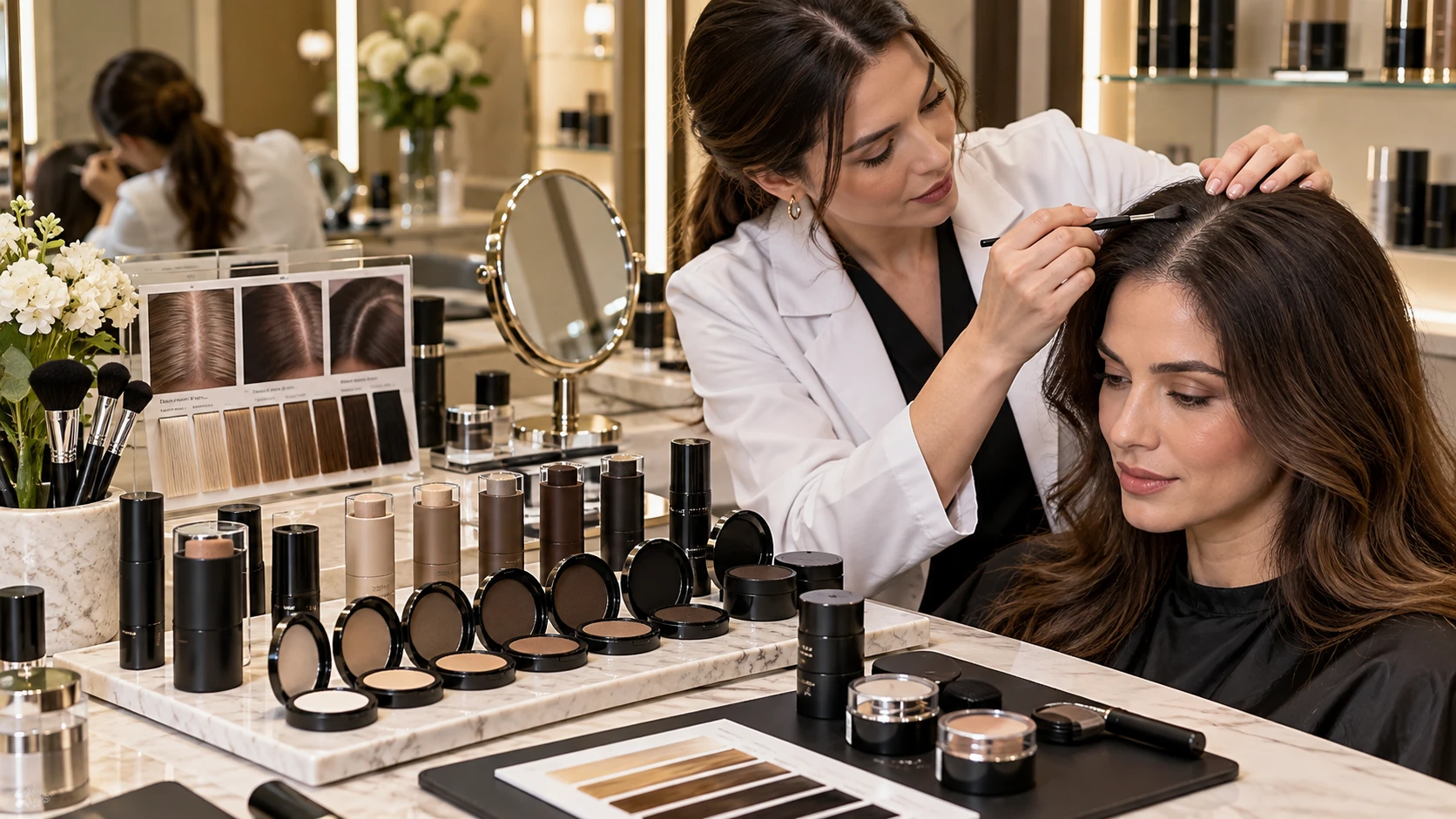
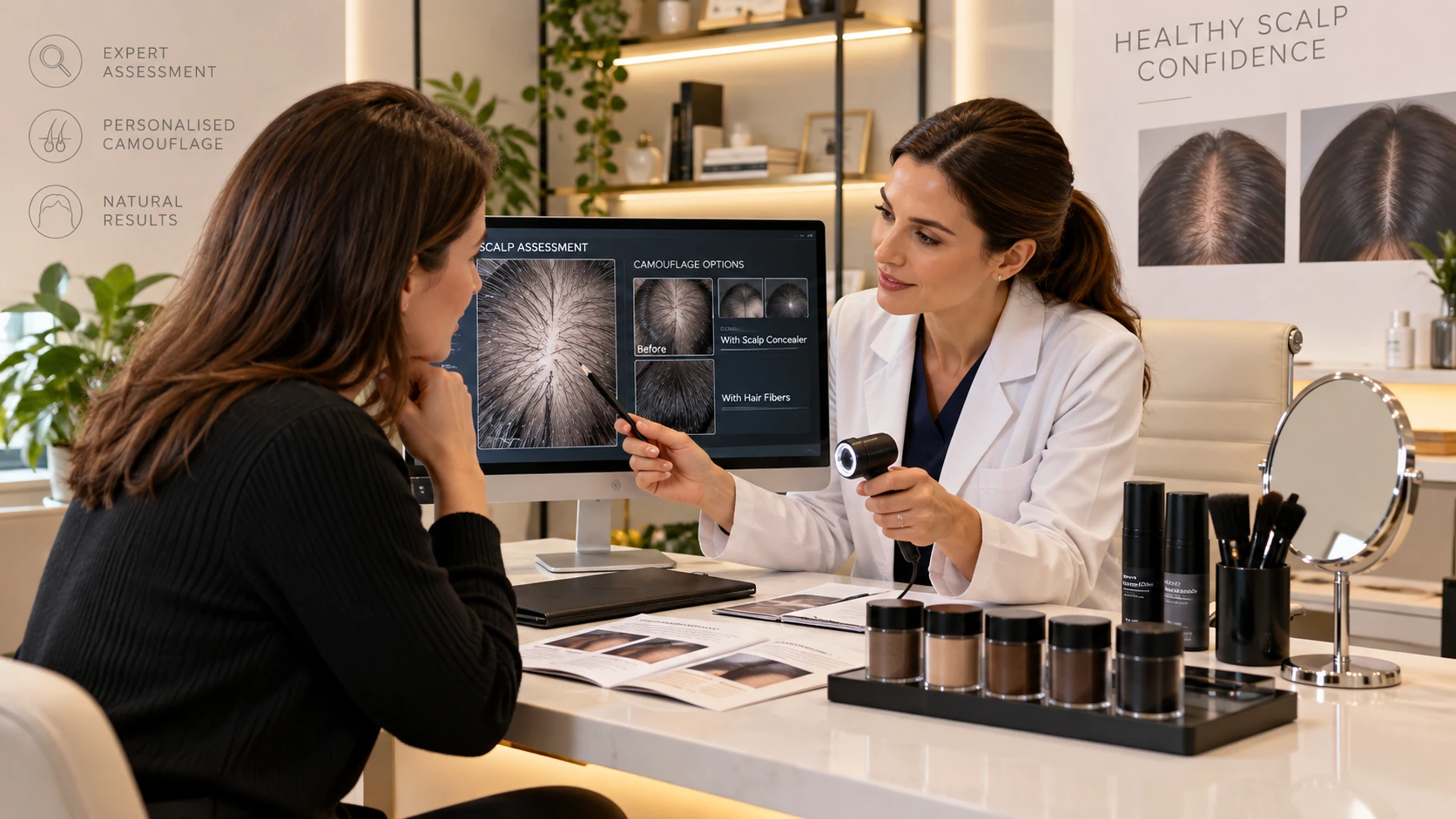
A calm dermatologist-led hair camouflage and scalp assessment consultation environment
Assessment first, then the camouflage decision.

Sources

References

This list reflects the categories of authoritative source used to inform this page’s general statements. Exact citation details, titles and access dates should be finalised and verified by the reviewing dermatologist before publication. No specific durability percentages, performance ratings, adhesion figures or prices are fabricated anywhere on this page, and no shade match is guaranteed. Retailer pages, affiliate blogs and product testimonials are not used as evidence.

  1. Peer-reviewed reviews of cosmetic camouflage in alopecia, covering technique, patient satisfaction and limitations. PubMed To be cited individually
  2. Dermatology literature on camouflage options across hair-loss diagnoses, including pattern hair loss and alopecia areata. PubMed To be cited individually
  3. Studies of hair-fibre products covering composition, adhesion behaviour and user-reported outcomes. PubMed To be cited individually
  4. Cosmetic-ingredient safety assessments for pigments, film formers and aerosol propellants used in scalp products. CIR and equivalent — verify current assessment
  5. Contact-dermatitis literature on fragrance, preservative, pigment and propellant sensitisation relevant to scalp exposure. PubMed / Contact Dermatitis To be cited individually
  6. Clinical guidelines on the diagnosis of hair loss, including pattern hair loss, alopecia areata and scarring alopecia. IADVL Verify current guideline
  7. Hair-transplant aftercare guidance on post-procedure scalp care and the timing of cosmetic product use. PubMed / surgical society guidance Verify current — timing is individual
  8. Textured-hair care and camouflage guidance addressing curl pattern, part visibility and product distribution. PubMed To be cited individually
  9. Scalp micropigmentation literature — cited here for differentiation only, to distinguish a permanent procedure from temporary cosmetic pigment. PubMed To be cited individually
  10. Cosmetic-regulatory sources applicable to the Indian market, covering permitted ingredients and claims. CDSCO cosmetics Verify current requirements
  11. American Academy of Dermatology (AAD) — patient-education resources on hair loss and cosmetic camouflage. AAD Verify current resource

Common Questions

Frequently Asked Questions

36 questions, grouped by what you are actually trying to work out.

The Two Methods

Fibers attach to existing hair shafts and increase apparent volume. Concealer applies pigment to visible scalp and reduces contrast. One adheres to hair, the other to skin.

Neither inherently. Both look natural when well matched and lightly applied, and both look obvious when overapplied. Technique and shade matter more than the category.

Fibers, clearly. Pigment adds colour, not bulk.

Concealer, clearly. It targets exactly that problem.

No. They need hair shafts to attach to. On smooth skin they read as dust rather than as hair.

It can reduce colour contrast and shine, but heavy pigment across a large smooth area tends to look flat rather than like hair.

No. Concealer washes off. Micropigmentation is a permanent procedure with entirely separate candidacy, technique and risk considerations.

No. Both are temporary cosmetic coverage. Neither affects follicles, the growth cycle or the underlying condition.

Pattern & Suitability

Both can help. Fibers where hair remains throughout; concealer where scalp shows between hairs. Many people combine them.

Concealer is frequently the strongest option here, applied along the part and diffused outward. Fibers can help adjacent hair but should not fill the line itself.

Fibers where crown hair remains; concealer to reduce show-through under overhead light. Mirror access is the practical challenge for both.

Both require restraint. Fibers need existing hairs, and pigment cannot recreate real hairline texture. A hard edge is the most obvious sign of camouflage.

They may not attach to a smooth patch. More importantly, camouflage must not delay diagnosis or treatment of the condition itself.

It may reduce contrast in selected patches on healed, unbroken skin. The same caution about not delaying assessment applies.

Yes. Suitability tracks the thinning pattern and remaining hair, not gender.

Very short hair provides less surface for attachment. There is no universal minimum length, but convincing results need enough hair for fibers to sit within rather than on the scalp.

Yes, though attachment differs on a curved shaft. Distribution and gentle blending matter more than quantity.

Shade & Application

Match your root zone rather than your lightest hair. Consider undertone as well as depth, and for concealer consider your scalp tone too. Test in daylight.

Real grey hair contains multiple tones, so a single flat grey rarely convinces. Blending shades usually reads more naturally.

Yes, and for grey, salt-and-pepper or highlighted hair it frequently produces a better result than any single product shade.

Scalp concealer first, allowed to set, then fibers applied to existing hair. Applying fibers onto freshly pigmented scalp tends to disturb both.

Yes, and for mixed concerns it often works well. Layering does increase transfer and removal difficulty, so test the routine before an occasion that matters.

Product directions should control use. Daily use is not universally safe — sensitive scalps may need less frequent application, and repeated layering without cleansing creates buildup.

Sleeping in these products increases transfer to bedding and contributes to buildup. Removal is generally the better practice.

Durability & Safety

No product should be assumed waterproof. Water-resistant describes some tolerance; heavy rain challenges most formulations regardless of the claim.

Same answer. Resistance varies by format and product, and any waterproof claim requires product-specific evidence.

Light perspiration is usually tolerated, particularly with a fixing product. Heavy exercise is a significant challenge.

Yes, it can — pale pillowcases show it most. Collars and hat bands are the other usual sites.

Friction at the band line is the usual issue. Test before relying on it for an occasion.

Sustained pressure combined with sweat is the hardest case for either product. Expect some disturbance.

They are not established as a cause of hair loss. Inadequate removal and repeated layering can contribute to scalp irritation, which is a separate issue worth avoiding.

Occlusive formulations, inadequate removal and repeated layering can contribute to folliculitis in susceptible individuals. Removing product properly matters.

Yes. Fiber materials, pigments, fragrance, alcohol, preservatives and aerosol propellants are all potential irritants.

Topical medicines may change fibre adhesion and pigment behaviour. Never mix camouflage into a medicinal product, and discuss the combination with your clinician.

Not on fresh grafts or healing wounds. Timing must be determined by your treating surgical team — no general number of days applies.

For sudden, rapidly expanding or patchy hair loss, broken hairs, scalp pain, burning, pus, crusting, bleeding, smooth shiny patches, loss of follicular openings, eyebrow or eyelash loss, or hair loss in a child.

Next Step

Choose the Camouflage Method That Matches the Visual Problem — not the Biggest Coverage Claim

A dermatologist-led hair assessment can identify the cause and pattern of thinning, while a structured camouflage consultation can determine whether dimensional fibers, scalp-colour correction, combined coverage or another cosmetic option will look most natural.

Disclaimer: This page is for educational purposes only and does not replace professional medical advice, diagnosis or treatment. Hair-building fibers and scalp concealers are temporary cosmetic camouflage products. Neither creates new follicles, stops or slows hair loss, alters the hair-growth cycle, reverses follicular miniaturisation, or replaces diagnosis-led treatment. Fibers attach primarily to existing hair shafts and therefore require sufficient remaining hair; scalp concealers reduce colour contrast and add no dimensional volume. Neither performs convincingly on a completely smooth bald area. Fiber material claims — including “natural keratin” — require verification from the actual ingredient list rather than the marketing on the packaging. Water-resistant is not the same as waterproof, and no universal durability, transfer or performance ratings are published here; resistance varies by product, format and technique and requires individual testing. No shade match can be guaranteed from a screen. These products should not be applied to open wounds, ulcerated or infected skin, severely inflamed skin or fresh surgical grafts; post-transplant timing must be determined by the treating surgical team. Camouflage should be removed before clinical photography or trichoscopy, and should never be mixed into a medicinal product. Effective coverage can make progression harder to notice — it must not delay assessment. No brand sponsorship or affiliate arrangement informs this comparison, and no product is recommended or ranked. New, sudden, patchy, painful or rapidly progressing hair loss, broken hairs, pustules, crusting, bleeding, smooth shiny patches, loss of follicular openings, eyebrow or eyelash loss, or hair loss in a child requires assessment by a qualified dermatologist. Content reviewed by Dr. Amit Agarkar, MD Dermatology.

Your Cart (0)

Your cart is empty

Subtotal0
DeliveryFREE
Total0
🔒 Secure📦 Free above ₹499↩ Easy returns
💬 Hi! I'm Dr. Amit — your Hair Intelligence consultant
🌿
1
🌿
Dr. Amit
Virtual Dermatologist · Hairsncares.com
Online
What are you shopping for today?
Select a category to begin
AI-powered scalp diagnosis · Hairsncares.com
📸
Scalp Analyser
Upload scalp photo · Get conditions, root cause, and matched product protocol
📷
Drop scalp photo here or click to upload
JPG, PNG, WEBP · Clear, close-up, well-lit photo

Your image is processed privately by our AI engine and saved securely with your account.