Clean professional
A defined, deliberate shape that reads as groomed rather than grown.
HairsnCares Grooming Intelligence · Shape, Hold, Routine & Skin Health
Two things decide how a beard looks, and neither is the product. The first is the shape — the neckline, the cheek line and a silhouette that works with where your hair actually grows. The second is the facial skin under it, which is where itch, flaking, bumps and most of the discomfort begin. This page covers both properly, then explains what each product genuinely does. Written for Indian conditions, helmet commutes included, and reviewed by a dermatologist.

Get the shape right first: a deliberate neckline about two finger-widths above the Adam’s apple, and a cheek line left natural unless growth genuinely demands otherwise. Then use oil on the skin, not just the hair — that one change resolves more beard complaints than any product swap. Add balm when you need conditioning plus light hold, and wax only when you need the shape to survive wind, humidity or a moustache curl. Trim dry, never wet. And treat itch, flaking and bumps as skin conditions rather than beard problems, because that is what they usually are.
Decide in this order
Shape comes first because it is the only one a product cannot rescue, and skin comes before conditioning because most beard complaints are skin complaints.
Apply in this order
A different order from the one above, and running inward to outward — skin, then hair, then edges. That is why the two are drawn separately.
Outside both ladders because it is not a decision: it is the hand you were dealt. Everything above changes how a beard is shaped and kept; none of it changes where the follicles are.
Start here
Almost every goal on this list is delivered by a line, a trim schedule or a drying technique, with the product only holding the result. That is why buying something new so rarely fixes any of them.
A defined, deliberate shape that reads as groomed rather than grown.
Short, even, controlled — the beard equivalent of a pressed shirt.
Deliberate short growth held at a fixed length.
Length and density carried as one continuous shape.
A beard cut to a defined silhouette rather than allowed to find its own.
Substantial length, worn deliberately.
The beard reading as thicker than it sits naturally.
A healthy sheen rather than a dry, dusty surface.
A beard that is pleasant to touch and does not feel like wire.
No halo of hairs standing away from the shape.
The beard staying where it is put, all day.
A shape that survives a monsoon commute.
Ends trained and held in a deliberate curl.
A full, natural moustache shaped over the lip line.
A moustache and chin beard with the cheeks kept clear.
Chin and mouth framed, cheeks clear.
Skin and hair both comfortable rather than tight and flaking.
Scale
The length you wear decides which products matter, how often you trim, and — more than anything else — how much attention the skin underneath needs.
| Length | What it is | Styling needs | Trim frequency | What changes here |
|---|---|---|---|---|
| Stubble | Short deliberate growth, skin clearly visible through it. | Almost no styling product. A light moisturiser on the skin matters far more. | Every two to three days. | The length where skin care outweighs hair care completely. Most stubble complaints are skin complaints. |
| Short beard | Full coverage, the skin no longer visible, still close to the face. | A light balm for direction and conditioning. | Weekly shaping, daily brushing. | The length where a beard starts needing a neckline decision. Get it right once and maintain it. |
| Medium beard | Enough length to hold a shape and to show texture and curl. | Balm for hold and conditioning; a comb becomes essential. | Every one to two weeks. | The length where texture and growth direction begin to fight you, and where drying with direction starts to pay off. |
| Long beard | Substantial length carried below the jaw. | Oil at the skin and base, balm or butter through the length, wax only where shape is needed. | Every two to four weeks for shape; daily for condition. | Length retention here is a breakage question as much as a growth one, exactly as it is on the scalp. |
| Extra long | Beard worn at its full potential length. | Layered conditioning, gentle detangling from the ends upward, and protection from friction. | Trims for split ends rather than for shape. | The ends are the oldest hair on your face and have the most accumulated wear. They need the most protection. |
| Corporate | Deliberately restrained length, uniform all over. | One light product, one guard setting, sharp edges. | Weekly, without fail. | Defined by consistency rather than length. The discipline is the style. |
| Designer / sculpted | Cut to a specific silhouette with deliberate length variation. | Medium-hold balm to keep the shape between visits. | Every two to three weeks with a barber. | The one length category where a professional genuinely outperforms home trimming, because it is a cutting problem. |
The pattern across the whole table: as length increases, hair care rises and skin care never falls away. At stubble the skin is almost the entire job; at full length it is still half of it, and it is the half most routines drop.
Structure
Beard hold comes mostly from wax rather than from the polymers that hold scalp hair. That changes the trade-off: more hold means more material sitting on your facial skin, and more washing to remove it.
Movement preserved almost entirely. Conditioning with a hint of direction.
Not really hold at all. It is conditioning that happens to lay hairs down, and for short beards that is often enough.
A gentle shape that survives an indoor day.
The correct default for short and corporate beards, and the band most people skip past unnecessarily.
The beard holds its shape and returns to it after being disturbed.
The everyday band for most beards past stubble. If you own one styling product, it should be this.
The shape resists wind, movement and moderate humidity.
Necessary for shape control on unruly growth. Heavier on the hair and harder to wash out.
A trained shape held rigidly for a defined period.
This is moustache territory. Very few beards need it, and on facial skin the residue matters more than it does on the scalp.
Layered hold intended to survive a full event.
A technique rather than a product. Also the maximum amount of material you will ever have sitting on your facial skin — wash it out properly the same day.
Formats
Grouped by the job they do rather than by marketing category. The tools are in the same list as the products deliberately — on a beard, the trimmer and the comb do more of the styling than anything in a jar.
Conditions the skin beneath the beard and the base of the hair; adds slip and shine.
Conditions and provides light to medium hold with direction.
Heavy conditioning with very little hold.
Firm hold and water resistance; keeps a shape against gravity and humidity.
Very firm hold for training and holding a curl or a defined lip line.
Soft control and conditioning without a set.
Smooth control with visible shine.
Light body and control with almost no weight.
Surface smoothing, slip and shine without the weight of an oil.
Cleans beard hair and the facial skin under it with gentler surfactants than scalp shampoo.
Softens, detangles and reduces friction damage.
Ongoing softening and slip between washes.
A light polymer film that locks a finished shape.
Distributes product evenly and sets direction; the fine teeth define a moustache.
Exfoliates the skin, distributes sebum and product, and trains growth direction.
Temporarily straightens curl and adds apparent length.
Sets and maintains length and lines.
Removes individual stray hairs and split ends without changing the overall length.
A starting collection, usually oil, balm, comb and brush.
Reduces friction during shaving and calms the skin afterwards.
No products in that group.
Diagnosis
Several of these are sold as hair problems and are actually skin problems, and one of them — patchiness — is neither, because it is follicle distribution and nothing applied to the outside changes it.
Hair that feels brittle and looks dull, often with tight skin underneath.
Persistent itch, often worst in the first weeks of growth or after a product change.
White or yellowish flakes in the beard and on the collar.
Individual hairs standing away from the shape, especially in humidity.
The beard standing out from the face rather than following its shape.
A few hairs escaping the outline.
Areas where growth is sparse or absent, most often the cheeks.
Hair that feels like wire and resists sitting flat.
Tight curl that will not sit in a shape and can grow back into the skin.
Small painful bumps, most often on the neck, sometimes with darkening afterwards.
Beard heavy, dull and unresponsive; skin underneath uncomfortable.
A styled shape falling apart within an hour outdoors.
Hairs repelling each other and standing out, mostly in dry air.
Tool
Eleven questions produce a written specification — hold band, product classes, application sequence, trimming schedule and cautions. It deliberately does not name a product, and where your answers point at a skin condition it says so before it says anything about styling.
What this tool will not do. It will not name a product, quote a price, promise density, or tell you that anything is clinically proven. It returns a specification you can take to any shelf or any barber.
Shapes
Each carries the method, a barber’s note on the step that decides the result, and a dermatologist’s note where the shape has a genuine skin consideration — usually the amount of shaving it requires.
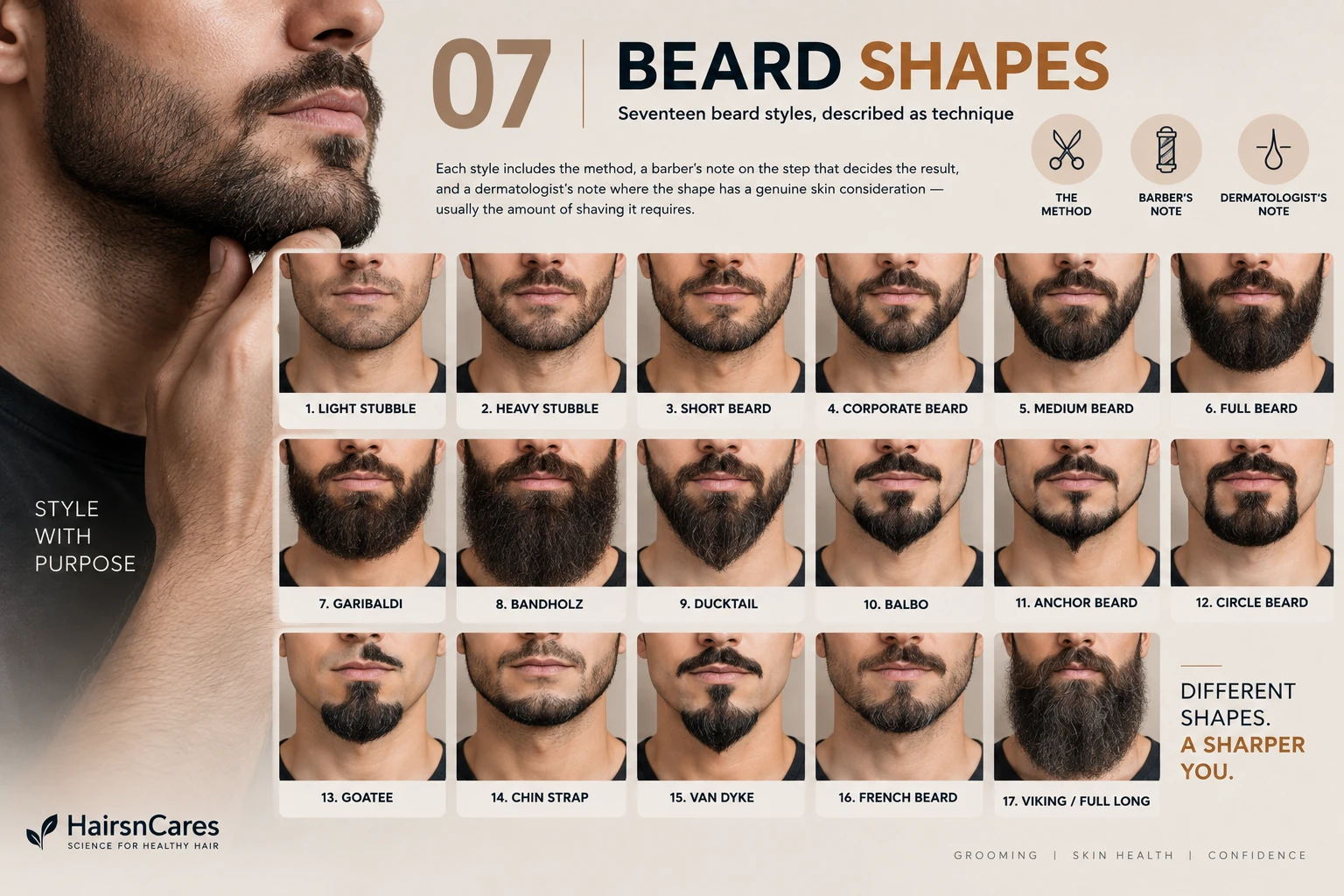
Barber’s note. Keep one guard setting and never deviate. Consistency is the entire look.
Dermatologist’s note. The length with the highest skin exposure. If you get razor bumps, stubble is often more comfortable than shaving, because the hair is not cut below the skin surface.
Barber’s note. This is the length where a defined neckline starts to matter visibly. Do that one thing well.
Dermatologist’s note. Still primarily a skin-care length. Persistent itch here is usually dry skin or early growth, not the beard itself.
Barber’s note. Check your outline in daylight, not bathroom light. Almost every uneven line is cut under a downlight.
Dermatologist’s note. The first length where product sits on the skin for extended periods. Fragrance-free is the safer starting point.
Barber’s note. Book the same slot every week and keep it. The style is the discipline more than the shape.
Dermatologist’s note. Frequent edge shaving is the risk here rather than the beard. Single-pass, with the grain, on the neck.
Barber’s note. Trim less than you think, then reassess. You can always take more; you cannot put it back.
Dermatologist’s note. The length where the skin underneath stops getting air and light. Wash it properly, and work the wash to the skin.
Barber’s note. The first significant trim should be with a barber. Home-correcting an over-cut full beard takes months.
Dermatologist’s note. Coverage this dense traps sweat and product against the skin. If you get flaking or redness underneath, that is a skin condition to have assessed.
Barber’s note. The rounded base is what separates this from an untrimmed beard. Shape it deliberately.
Dermatologist’s note. Long beards accumulate more product. Increase wash frequency at the skin rather than reducing conditioning.
Barber’s note. The hardest part is the first few months, when it looks untidy and every instinct says to trim. Do not.
Dermatologist’s note. The style with the longest product-to-skin contact time. Fragrance-free products are worth considering here specifically.
Barber’s note. The taper at the sides is what makes the point read as deliberate. Do the sides first.
Dermatologist’s note. Nothing specific to this shape beyond ordinary long-beard skin care.
Barber’s note. Three separate shapes, three separate lines. Work on each in turn rather than trying to see it all at once.
Dermatologist’s note. Extensive shaved area on the cheeks and neck. Single-pass shaving with the grain matters more here than on a fuller beard.
Barber’s note. This is a precision style. If your lines are not confident, choose something more forgiving.
Dermatologist’s note. High shave frequency. If you are prone to razor bumps, this shape and its neighbours are the ones to reconsider.
Barber’s note. The circle should be a circle. Check symmetry in a mirror at arm’s length, not close up.
Dermatologist’s note. Ordinary. The shaved cheek area is the only skin consideration.
Barber’s note. The most common goatee error is widening over time. Set a width and stop trimming inward.
Dermatologist’s note. Ordinary.
Barber’s note. The narrowest tolerance of any style here. If the two sides differ by a millimetre, it shows.
Dermatologist’s note. Very high shave frequency on the neck, which is the area most prone to razor bumps.
Barber’s note. The gap between moustache and chin is the whole point. Keep it clean and deliberate.
Dermatologist’s note. Ordinary, with the usual shaving considerations for the cleared areas.
Barber’s note. Keep the connection points crisp. When they blur, the shape stops reading as intentional.
Dermatologist’s note. Ordinary.
Barber’s note. Width is as important as length. Brush outward from the skin, then set with a balm.
Dermatologist’s note. Long, dense coverage traps moisture. Dry the beard properly after washing, particularly in humid weather.
Before you pick one: your growth pattern constrains this list more than your face shape does. A style that fights where your hair actually grows will never look settled, however well it is executed.
Upper lip
The moustache is the part of a beard that most rewards patience: every trained shape here is built by doing the same thing daily for weeks, not by finding the right wax.
Full, covering the top lip, angled slightly downward at the ends.
Keep it clear of the lip line. Growth over the lip is the most common untended-moustache problem.
Long enough at the ends to be trained upward into a curl.
Train it the same way every single day. The shape is built over weeks of repetition, not in one morning.
A shorter handlebar with a modest upturn at the ends.
The forgiving version. A good place to find out whether you want to commit to a full handlebar.
Long, narrow, with the ends extended sideways and the centre of the lip trimmed short.
The centre must be kept short and the ends long. Most failures come from trimming evenly across.
Full with the ends curled upward toward the cheeks.
Needs both length and density. Not achievable on a sparse moustache, however long you grow it.
A full moustache with the sides extended downward to the jawline.
The two vertical arms need to match. Check them from the front, not in profile.
Very full and long, overhanging the top lip.
Trim the overhang enough to eat and drink comfortably. That is the only real maintenance requirement.
A thin, precise line following the top lip.
The tightest tolerance here. Use scissors and a fine comb rather than a trimmer.
A trimmed rectangle over the centre of the lip, angled at the sides.
The angles at the sides define it. Keep them symmetrical and slightly sloped.
The rule for every trained shape: trim the centre, never the ends. The ends are the length you are growing into the shape, and trimming evenly across is why most handlebar attempts never develop.
Mechanism
Beard products are built from a small number of functional families, and two of them — the structural waxes and the fragrance components — account for most of both the performance and the problems in this category.
Typical members Cera alba, yellow and white beeswax
Forms a pliable, water-resistant film that holds a shape mechanically rather than chemically.
The bulk of the hold in beard and moustache wax, and most of the humidity resistance.
It is the reason moustache wax works at all. It also does not dissolve in water, which is why wax-heavy products need a proper wash rather than a rinse.
Typical members Copernicia cerifera wax
A much harder plant wax with a high melting point.
The firm end of moustache wax; holds a trained curl in heat.
The hardest wax in common use. Products relying on it need genuine warming between the fingers before they will spread at all.
Typical members Euphorbia cerifera wax, rice bran wax
Plant-derived alternatives to beeswax with similar film behaviour.
Hold in vegan formulations.
Functionally close to beeswax. The choice is an ethical one far more than a performance one.
Typical members Wool wax, lanolin alcohol
An occlusive that is unusually good at holding water in skin and hair.
Softness and pliability in balms; conditioning at the skin.
Genuinely effective and a well-documented contact allergen. If a balm irritates and you cannot identify why, this is worth checking on the label.
Typical members Shea, cocoa, mango, kokum
Heavy occlusives that seal moisture into hair and skin.
The conditioning body of balms and butters.
Excellent on coarse dry beards, and comedogenic enough to matter on acne-prone facial skin. Skin type decides this more than beard type.
Typical members Jojoba, argan, grapeseed, sweet almond, sunflower
The bulk of a beard oil; deliver conditioning to skin and hair.
Slip, shine and skin comfort.
Jojoba most closely resembles human sebum in structure, which is why it sits comfortably on facial skin where heavier oils can feel occlusive.
Typical members Ricinus communis seed oil
A very thick, high-viscosity oil with strong film-forming behaviour.
Weight, shine and apparent thickness in beard oils.
Frequently marketed as promoting beard growth. There is no good evidence for that. It is a heavy conditioning oil and should be judged as one.
Typical members Tea tree, cedarwood, sandalwood, peppermint, eucalyptus
Provide fragrance and, in some cases, mild antimicrobial activity.
Scent, which is a large part of what people buy beard oil for.
The most common avoidable cause of facial irritation in this category. They sit on facial skin for hours, and tea tree and peppermint in particular are frequent sensitisers.
Typical members Parfum, limonene, linalool, geraniol, citral
Adds scent, usually as an undisclosed blend.
Product appeal, and a substantial share of adverse reactions.
‘Parfum’ on a label can represent dozens of compounds. If your skin reacts and you cannot identify the trigger, a fragrance-free product for two weeks is the cleanest test available to you.
Typical members PVP, VP/VA copolymer, acrylates copolymer
Dry into a continuous flexible film bridging adjacent hairs.
Hold in beard holding sprays and some modern balms.
Borrowed directly from scalp styling. They give a lighter hold than wax but wash out far more easily, which on facial skin is a real advantage.
Typical members Dimethicone, cyclopentasiloxane, amodimethicone
Deposit a smooth, low-friction, water-repellent layer.
Slip, shine, frizz control and detangling in beard serums.
Effective and, on acne-prone facial skin, worth watching. The lighter volatile ones evaporate; the heavier ones accumulate and need proper washing.
Typical members Glycerin, panthenol, sodium PCA, hyaluronic acid
Draw water into the hair and the skin beneath it.
Hydration and flexibility.
Climate-dependent in the same way as on the scalp. In coastal humidity, high glycerin levels can add more water than a styled shape tolerates.
Typical members Behentrimonium chloride, cetrimonium chloride
Bind to the negatively charged hair surface and reduce friction.
Detangling and softness in beard conditioners and softeners.
The active softening mechanism in most beard conditioners. Softness is a surface effect that lasts while the product is present.
Typical members Tocopherol, tocopheryl acetate
An antioxidant that slows oxidative rancidity in the oils around it.
Product shelf life, primarily.
Usually present to protect the formula rather than to treat your beard. That is a legitimate function; it is just not the one the marketing implies.
Typical members Cocamidopropyl betaine, sodium cocoyl isethionate, decyl glucoside
Lift oil, residue and dirt from hair and skin so they can be rinsed away.
Cleansing, and how stripped the skin feels afterwards.
Beard washes use milder surfactant systems than scalp shampoo because facial skin is thinner and more reactive. That difference is real, unlike many product-category distinctions.
Typical members Silicones, quaternised proteins, panthenol
Slow heat transfer into the fibre and lubricate the surface.
The rate of damage during beard straightening or blow-drying.
The same chemistry as scalp heat protection, and the same limits: it reduces the damage rate rather than removing it, and no formulation makes a very high setting safe.
Substrate
Beard hair is not scalp hair, and the skin it grows from is not scalp skin. Almost every place where grooming advice transfers badly from the head to the face traces back to one of these twelve.
Facial hair grows from follicles with a different response to androgens, and the fibre itself is coarser, more elliptical in cross-section and more likely to curl. That elliptical shape is why beard hair resists lying flat, and why products formulated for scalp hair frequently underperform on it.
A straight follicle produces straight hair; a curved one produces curl. Beard follicles are often markedly curved, which produces tight curl close to the skin — and makes a cut hair more likely to re-enter the skin as it grows.
How full a beard looks is determined by how many follicles there are and where they sit, which is set by genetics and androgen sensitivity. Nothing applied to the surface changes it. Styling can work with a growth pattern; it cannot add follicles.
Each follicle sits at an angle and produces hair in that direction, and the directions across a face rarely agree. This is why beards need training and drying with direction rather than simply combing, and why two people with the same length can have very different amounts of trouble.
Sebaceous glands open into the follicle and produce the skin’s own conditioner. On a longer beard it does not travel far down the shaft, which is exactly the scalp’s oily-root-dry-ends problem transferred to the face.
How readily the fibre takes up and releases water. Coarse beard hair is often lower porosity, which is why products can sit on the surface and why conditioning takes longer to feel like it is working.
It is thinner, more reactive and more prone to acne and dermatitis than scalp skin, and once a beard covers it, it gets less air, less light and more trapped moisture and product. Most beard complaints are actually complaints about this skin.
The skin barrier holds water in and irritants out. Occlusive products, trapped sweat and infrequent washing all put pressure on it. When it is compromised, the result is itch, flaking, redness and sensitivity to products that were previously fine.
Facial hair greys, often earlier than scalp hair, and grey beard hair is frequently coarser, more wiry and more porous. A routine that worked for years can stop working without anything having gone wrong.
Every follicle has a growth phase of finite duration, and its length when that phase ends is that hair’s terminal length. It varies between people and between areas of the same face. A beard stops getting longer because of this, not because of anything you did or failed to buy.
Beard hair is subject to combing, brushing, pillow contact, helmet straps and collars. On long beards this is the dominant cause of split ends and breakage — the same length-retention question as on the scalp.
A hair cut below the skin surface, or cut at a sharp angle, can re-enter the skin as it grows. Curved follicles make this more likely. The resulting inflammation is a genuine dermatological condition rather than a shaving inconvenience.
The honest section
This is the part of beard grooming where the category and the mechanism diverge most. Nine things worth knowing before you buy anything else.
Itch, flaking, redness, bumps and a beard that will not feel comfortable are, far more often than not, complaints about the facial skin underneath rather than about the hair. The category sells hair products for them, which is why so many of them do not resolve.
Before changing a styling product, work the wash to the skin, rinse thoroughly, and moisturise. That resolves a surprising proportion of it.
A beard oil or balm is applied to facial skin in the morning and stays there. That is a long contact time with a fragrance blend, and fragrance is among the most common causes of contact dermatitis. Essential oils are fragrance for this purpose — tea tree and peppermint are frequent sensitisers, not gentle alternatives.
If your skin reacts and you cannot identify the cause, run two weeks fragrance-free. It is the cleanest test available without a patch test.
Flaking in a beard is most often seborrhoeic dermatitis, sometimes simple dryness, and sometimes nothing more than unrinsed product. These have different treatments, and a strong scalp anti-dandruff shampoo applied to facial skin is not a safe default.
Rule out residue first. If flaking persists, particularly with redness or greasy yellowish scale, have it assessed rather than escalating shampoos.
Pseudofolliculitis barbae is cut hair re-entering the skin and causing inflammation. It is strongly associated with coarse, curly facial hair, and it can leave lasting dark marks and, in some cases, scarring. It is not a shaving inconvenience and it does not respond to shaving harder.
Shave less closely: single pass, with the grain, leaving the hair slightly proud of the skin. Growing the beard out often resolves it entirely. If it is scarring or persistent, see a dermatologist.
Firm bumps along the posterior hairline that persist and can scar are a distinct condition and are not treated the same way as ordinary razor bumps. They are more common in coarse, curly hair.
This one is not a grooming problem at any stage. If you have persistent firm bumps at the back of the neck, that is a dermatologist’s assessment.
Facial skin is acne-prone in a way scalp skin is not. Heavy butters, comedogenic oils and thick waxes sit in the follicle openings, and a dense beard traps them there with sweat.
If you break out under the beard, move to lighter carrier oils and a non-comedogenic routine before you conclude that beard products do not suit you.
Cheek coverage is determined by follicle distribution and androgen sensitivity. No oil, balm, serum, roller or supplement changes how many follicles you have. This is the single largest gap between what this category sells and what it can deliver.
Style around your actual growth pattern. If you want to discuss medical options for facial hair density, that is a conversation with a doctor about a prescription decision — not a product choice, and not something this page will put a number on.
Beard straighteners work the same way scalp straighteners do, with the same cumulative cost to the fibre, and the skin they pass close to is thinner and more heat-sensitive than the scalp.
Use the lowest setting that produces the result, on a completely dry beard, with a protectant applied first. This page publishes no temperature, deliberately — a number here would be read as a safe threshold and none exists universally.
The common advice to wash a beard rarely is aimed at preserving natural oils on the hair. It ignores the skin, which is accumulating sebum, sweat, product and airborne particulate under an occlusive layer of hair.
Separate the two: wash the skin regularly with a mild cleanser worked down to it, and condition the hair to compensate. That is a better structure than washing everything less.
Two things this page deliberately will not give you. A temperature for a beard straightener, because a number here would be read as a safe threshold and the right setting depends on your hair, your skin and the accuracy of your particular tool. And a strength or schedule for any medicine used on facial hair, including minoxidil — that is a decision to make with a doctor who can examine you, not one to take from a shopping page.
Conditions
Almost no international beard advice accounts for a daily helmet strap, a monsoon, or the dust load of an Indian dry season. These seven are where most of the real difficulty comes from.
Daily two-wheeler commuting across most Indian cities.
Mumbai, Chennai, Kochi, Goa — high ambient moisture most of the year.
Weeks of saturated air, rain and damp indoor conditions.
Delhi, Jaipur, Ahmedabad in summer — high temperature, low humidity, dust.
Urban particulate, heaviest in the dry months.
Much of northern and western India.
Long outdoor exposure across most of the year.
The single most useful rule across all seven: never leave a damp beard damp. Under a helmet strap, a collar or simply against the skin, a beard that stays wet is where itch, flaking and irritation cluster — and it is entirely avoidable.
Sequence
Each names product classes rather than products, so it works with whatever is already on your shelf. The times are honest — if a routine says three minutes, it takes three minutes.
Every morning
The skin step is first and it is the one people skip. Everything else is easier once it is habitual.
Every morning
Detangle from the ends upward, always. Combing from the top down drags every tangle into a knot.
Working days
Two products and one weekly trim. Anything more elaborate does not survive a busy week.
Events, long days, photographs
Book the barber for four or five days ahead. A fresh cut line softens in that time and photographs better.
Evenings out
High-shine oils flare under flash. Matte or satin photographs as groomed; shine photographs as greasy.
Around exercise
Sweat under a beard sits against the skin. Rinsing afterwards resolves most post-workout beard complaints.
Daily riding
The strap line under the jaw is where friction damage and trapped sweat both concentrate. Treat it as its own area.
Through the wet months
The single rule is never to leave a damp beard damp. Almost every monsoon beard complaint follows from that.
The hot months
Heavy butters plus heat plus sweat is the combination that produces breakouts under a beard.
The cold, dry months
Winter beard complaints are dryness and static, and both are skin and conditioning problems rather than styling ones.
Daily, for a trained shape
The shape is built by repetition. Training the same way daily for a few weeks does more than any single application.
Starting a beard
The itchy phase is skin adjusting to hair growing against it, and it passes. Moisturising helps; trimming does not.
Side by side
Several of these pairs are treated as interchangeable in shops and in advice. Some genuinely are close. The last one is not a product comparison at all — it is a medical decision wearing a grooming question’s clothes.
| Criterion | Beard balm | Beard butter |
|---|---|---|
| Primary job | Conditions and holds | Conditions heavily |
| Hold | Light to medium | Essentially none |
| Wax content | Present, gives the hold | Minimal or none |
| Best on | Short to medium beards needing shape | Long, coarse or dry beards |
| Finish | Natural, slightly matte | Soft, richer |
In practice. If you want the beard to stay where you put it, balm. If you want it soft and the shape looks after itself, butter.
| Criterion | Beard wax | Moustache wax |
|---|---|---|
| Hold | Strong | Extra strong |
| Hardness | Spreadable with hand warmth | Needs deliberate warming |
| Coverage | Whole beard | Small area, worked precisely |
| Purpose | Shape control and humidity resistance | Training and holding a curl |
| Substitutable? | Not upward | Can be used sparingly on a beard edge |
In practice. Beard balm will not hold a handlebar and moustache wax is impractical across a full beard. These are genuinely different products.
| Criterion | Beard oil | Beard serum |
|---|---|---|
| Base | Carrier oils | Silicones or light esters |
| Primary target | The skin beneath the beard | The hair surface |
| Feel | Nourishing, can feel heavy | Light, silky, non-greasy |
| Frizz control | Moderate | High |
| Skin benefit | Direct | Little to none |
In practice. They are not competitors. Oil is a skin product that also helps the hair; serum is a hair product that does nothing for the skin.
| Criterion | Beard wash | Scalp shampoo |
|---|---|---|
| Surfactant system | Milder, built for facial skin | Stronger, built for the scalp |
| Skin it contacts | Facial skin, thinner and more reactive | Scalp, thicker and more resilient |
| Stripping | Lower | Higher |
| Frequency tolerated | Regular use | Occasional on a beard |
| Genuine difference? | Yes | Yes |
In practice. One of the few product distinctions in grooming that reflects a real formulation difference rather than a marketing one.
| Criterion | Beard conditioner | Hair conditioner |
|---|---|---|
| Formulated for | Facial skin contact | Scalp contact |
| Weight | Lighter | Often heavier |
| Comedogenic risk | Lower by design | Not considered in the formulation |
| Softening effect | Comparable | Comparable |
| Interchangeable? | In a pinch | Riskier on acne-prone skin |
In practice. The softening performance is similar. The difference that matters is what the formulation assumed about the skin it would touch.
| Criterion | Beard comb | Beard brush |
|---|---|---|
| Best length | Medium to long | Short to medium |
| Detangling | Yes | No — it breaks tangles rather than clearing them |
| Exfoliation | None | Genuine, at the skin |
| Product distribution | Good through length | Excellent at the base |
| Breakage risk on long beards | Low | High |
In practice. Brush a short beard, comb a long one. The crossover is around the length where a brush stops reaching the skin.
| Criterion | Trimmer | Scissors |
|---|---|---|
| Job | Bulk length and lines | Individual hairs and split ends |
| Precision | Consistent length | Precise placement |
| Best for | Setting and maintaining length | Strays, moustache lip line, refinement |
| Risk | Removes more than intended, fast | Slow, but errors stay small |
| Needed? | Yes, essential | Yes, for anything past short |
In practice. The trimmer sets the length and the scissors finish the job. Using either for the other's task is where most home-grooming errors come from.
| Criterion | Beard oil | Beard balm |
|---|---|---|
| Delivers to | Skin and hair base | Hair, mostly the surface |
| Hold | None | Light to medium |
| Weight | Light | Noticeable |
| When | Every day, first | After oil, when shape is needed |
| Can one replace the other? | No | No |
In practice. They are sequential rather than alternative. Oil first, at the skin; balm second, for the shape.
| Criterion | Growing the beard out | Continuing to shave |
|---|---|---|
| Effect on bumps | Often resolves them entirely | Maintains the cause |
| Mechanism | The hair is never cut below the skin surface | Cut hairs re-enter the skin |
| Trade-off | You have a beard | Ongoing management required |
| If shaving is required | — | Single pass, with the grain, hair left slightly proud |
| When to get help | If bumps persist despite growth | If there is scarring or dark marking |
In practice. This is a medical question wearing a grooming question's clothes. If razor bumps are scarring or persistent, see a dermatologist rather than changing razors again.
Labels
Enough to read most beard labels with confidence. Pay particular attention to the essential-oil entries: they are the most common avoidable cause of irritation in this category, and they are usually sold as the gentle option.
Forms a pliable, water-resistant film that mechanically holds a shape.
Found in Beard wax, moustache wax, most balms.
The reason moustache wax works. It does not dissolve in water, so wax-heavy products need a proper wash rather than a rinse.
A very hard plant wax with a high melting point.
Found in Firm moustache waxes.
Holds a trained curl in heat where beeswax alone softens. Needs genuine warming before it will spread.
A plant-derived alternative to beeswax with similar film behaviour.
Found in Vegan waxes and balms.
Functionally close to beeswax. The choice between them is ethical rather than performance-driven.
Holds water in skin and hair unusually effectively, and keeps waxes pliable.
Found in Balms, softeners, some waxes.
Genuinely effective and a well-documented contact allergen. Worth checking for if a balm irritates you and nothing else explains it.
A heavy occlusive that seals moisture into hair and skin.
Found in Beard butters, rich balms.
Excellent on coarse dry beards; heavy enough to matter on acne-prone facial skin. Your skin type decides this, not your beard.
A firmer occlusive butter that adds body to a balm.
Found in Balms and butters.
Firmer than shea and more comedogenic. Fine on the hair, worth watching where it sits on the skin.
Closely resembles human sebum in structure; conditions without feeling heavy.
Found in Beard oils, leave-ins.
Technically a wax ester rather than an oil. The most comfortable common carrier for facial skin, which is why it dominates good beard oils.
Fills surface irregularities, adds slip and shine.
Found in Beard oils and serums.
Light, well tolerated and largely a surface treatment. Good for shine, limited for anything deeper.
A very thick, high-viscosity oil with strong film-forming behaviour.
Found in Beard oils, often as a minority ingredient.
Widely marketed as promoting beard growth. There is no good evidence for that. Judge it as the heavy conditioning oil it is.
A light, fast-absorbing oil that leaves little residue.
Found in Lightweight beard oils.
One of the better options if heavier oils cause breakouts under your beard.
A mid-weight conditioning oil with good slip.
Found in Beard oils and balms.
Well tolerated by most, though it is a tree-nut derivative and worth noting if you have a nut allergy.
Provides fragrance and has some antimicrobial activity.
Found in Beard oils and washes positioned for itch or flaking.
Frequently sold as the gentle natural option and it is one of the more common facial sensitisers in this category. Natural origin does not predict skin tolerance.
Fragrance, in the woody register most beard products use.
Found in Almost every scented beard oil and balm.
Largely present for scent, which is a legitimate reason. It is still fragrance for the purpose of working out what irritated your skin.
Fragrance plus a cooling sensation.
Found in Beard washes and oils marketed as refreshing.
The cooling feeling is a sensory effect, not evidence of anything working. A common sensitiser on facial skin.
Penetrates the fibre, holds water and forms a light flexible film.
Found in Beard washes, conditioners, softeners.
One of the few ingredients that conditions the hair and supports the skin barrier at the same time.
Draws water from the air into the hair and skin.
Found in Washes, conditioners, softeners.
Climate-dependent. In coastal humidity a high level can pull in more water than a styled shape tolerates.
Slows oxidative rancidity in the oils around it.
Found in Practically every beard oil.
Usually there to protect the formula rather than to treat your beard. That is a real function, just not the marketed one.
Dries into a continuous flexible film bridging adjacent hairs.
Found in Beard holding sprays, some modern balms.
Lighter hold than wax and far easier to wash out, which on facial skin is a genuine advantage.
Deposits a smooth, water-repellent layer over the hair.
Found in Beard serums and smoothing products.
Effective on frizz and worth watching if your skin is acne-prone. It accumulates, so clarify periodically.
A mild amphoteric surfactant used to soften harsher cleansing systems.
Found in Beard washes.
Part of why beard washes are gentler than scalp shampoo. Also an occasional contact allergen in its own right.
Craft
All twelve are free. Between them they account for most of the visible difference between a beard that looks kept and one that does not — considerably more than any product does.
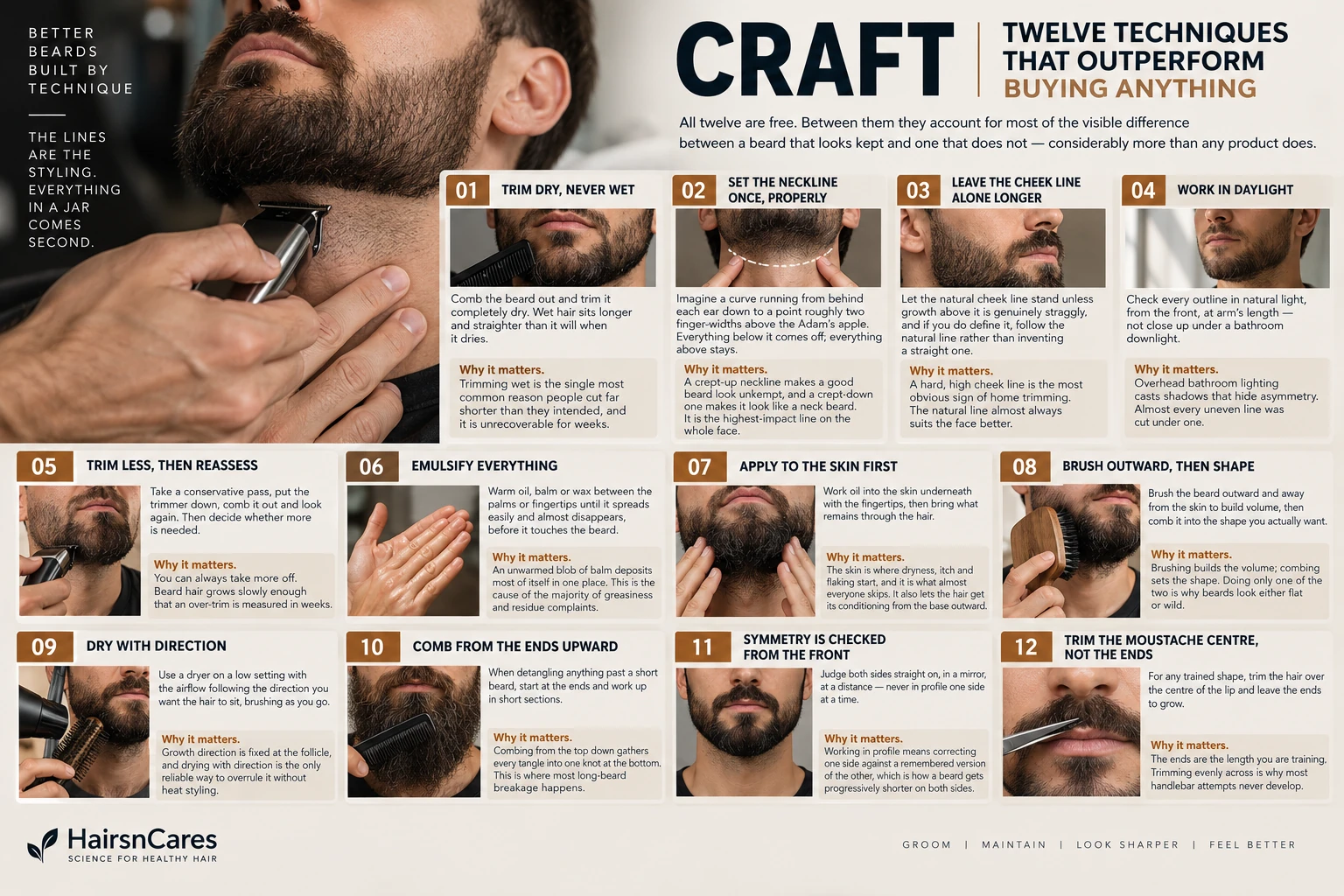
Comb the beard out and trim it completely dry. Wet hair sits longer and straighter than it will when it dries.
Why it matters. Trimming wet is the single most common reason people cut far shorter than they intended, and it is unrecoverable for weeks.
Imagine a curve running from behind each ear down to a point roughly two finger-widths above the Adam’s apple. Everything below it comes off; everything above stays.
Why it matters. A crept-up neckline makes a good beard look unkempt, and a crept-down one makes it look like a neck beard. It is the highest-impact line on the whole face.
Let the natural cheek line stand unless growth above it is genuinely straggly, and if you do define it, follow the natural line rather than inventing a straight one.
Why it matters. A hard, high cheek line is the most obvious sign of home trimming. The natural line almost always suits the face better.
Check every outline in natural light, from the front, at arm’s length — not close up under a bathroom downlight.
Why it matters. Overhead bathroom lighting casts shadows that hide asymmetry. Almost every uneven line was cut under one.
Take a conservative pass, put the trimmer down, comb it out and look again. Then decide whether more is needed.
Why it matters. You can always take more off. Beard hair grows slowly enough that an over-trim is measured in weeks.
Warm oil, balm or wax between the palms or fingertips until it spreads easily and almost disappears, before it touches the beard.
Why it matters. An unwarmed blob of balm deposits most of itself in one place. This is the cause of the majority of greasiness and residue complaints.
Work oil into the skin underneath with the fingertips, then bring what remains through the hair.
Why it matters. The skin is where dryness, itch and flaking start, and it is what almost everyone skips. It also lets the hair get its conditioning from the base outward.
Brush the beard outward and away from the skin to build volume and train direction, then comb it into the shape you actually want.
Why it matters. Brushing builds the volume; combing sets the shape. Doing only one of the two is why beards look either flat or wild.
Use a dryer on a low setting with the airflow following the direction you want the hair to sit, brushing as you go.
Why it matters. Growth direction is fixed at the follicle, and drying with direction is the only reliable way to overrule it without heat styling.
When detangling anything past a short beard, start at the ends and work up in short sections.
Why it matters. Combing from the top down gathers every tangle into one knot at the bottom. This is where most long-beard breakage happens.
Judge both sides straight on, in a mirror, at a distance — never in profile one side at a time.
Why it matters. Working in profile means correcting one side against a remembered version of the other, which is how a beard gets progressively shorter on both sides.
For any trained shape, trim the hair over the centre of the lip and leave the ends to grow.
Why it matters. The ends are the length you are training. Trimming evenly across is why most handlebar attempts never develop.
Medical review
Eight things worth knowing that no beard product label will tell you.
A dense beard reduces air and light reaching the skin and holds sweat, sebum, product and airborne particulate against it for the whole day. That is not an argument against beards — it is the reason the skin underneath needs deliberate cleansing rather than whatever reaches it incidentally.
Itch in the first weeks of growth, as hair grows against the skin, is common and passes. Itch that persists, particularly with redness, flaking or tenderness, is a skin condition. It will not resolve by waiting, and it will not resolve by changing beard oil either.
Flaking in a beard is most often seborrhoeic dermatitis, sometimes simple dryness, and sometimes only unrinsed product. These need different treatments. Reaching for a strong anti-dandruff scalp shampoo and applying it to facial skin, without knowing which of the three you have, is not a safe default.
Beard oils and balms sit on facial skin for hours. Fragrance, including essential oils, is among the most frequent causes of contact dermatitis, and tea tree and peppermint are common sensitisers rather than gentle alternatives. If your skin reacts and you cannot identify why, two weeks fragrance-free is the cleanest test you can run without a patch test.
Pseudofolliculitis barbae is cut hair re-entering the skin, and it is strongly associated with coarse, curly facial hair. It can leave lasting dark marks and, left alone, can scar. Shaving more closely creates it; shaving less closely, with the grain, in a single pass, reduces it. Growing the beard out often resolves it entirely.
Persistent firm bumps along the posterior hairline that do not settle, and that can scar, are a distinct condition from ordinary razor bumps and are not managed the same way. This one is not a grooming problem at any stage — it needs assessment.
How much of a face grows terminal hair is determined by follicle distribution and androgen sensitivity. Nothing applied to the surface changes it. If you want to discuss medical options for facial hair density, that is a prescription conversation with a doctor who can examine you and explain the trade-offs — including that any effect requires indefinite continued use. It is not a product choice, and it is not something a webpage should put a number on.
Persistent itch, flaking, redness or tenderness. Bumps or pustules that are not settling, or that are leaving dark marks or scars. Any patch of hair loss within the beard with a clear edge. Skin that reacts to products that were previously fine. A sore or a lesion that does not heal. None of these are grooming questions, and several of them are ones where getting seen early changes the outcome.
Reviewed by Dr. Amit Agarkar — MBBS, MD Dermatology, FCPS, DDV. Dermatologist, trichologist and hair transplant surgeon.
Consult a dermatologistCorrection
Nine are simply false. Nine are misleading — there is something real underneath that has been overstated, and those are usually the more useful ones to understand, because the true part is what keeps them in circulation.
Beard oil makes your beard grow thicker.
Beard density is determined by follicle distribution and androgen sensitivity. Oil conditions the hair and the skin beneath it, which makes an existing beard look and feel better — a real and worthwhile effect. It does not create follicles.
Shaving makes hair grow back thicker and darker.
Shaving cuts the shaft at its widest point and leaves a blunt tip, which feels coarser and looks darker against the skin. The follicle is untouched and the growth rate and diameter are unchanged.
A patchy beard will fill in if you keep growing it.
Longer growth from surrounding areas can visually bridge sparse patches, and coverage does change through the twenties. But the underlying distribution of follicles does not change, and no product alters it.
Trimming your beard makes it grow faster.
Growth happens at the follicle and is unaffected by cutting the ends. Trimming removes split ends, which preserves length — that is retention, not growth.
Beard itch is just part of growing a beard.
Early itch as hair grows against the skin is common and passes. Persistent itch, particularly with redness or flaking, is a skin condition and will not resolve by waiting it out.
Beard dandruff is the same as scalp dandruff.
Both are often seborrhoeic dermatitis, but facial skin is thinner and more reactive, and a strong scalp anti-dandruff shampoo is not a safe default for it. Flaking in a beard is also frequently just unrinsed product.
Natural and essential-oil products are gentler on skin.
Essential oils are among the most common causes of facial contact dermatitis in this category. Tea tree and peppermint in particular are frequent sensitisers. Natural origin does not predict skin tolerance.
Beard balm and beard wax are basically the same thing.
Balm conditions with light to medium hold. Wax is beeswax-dominant and holds firmly with water resistance. Trying to hold a moustache curl with balm is the most common demonstration of the difference.
You should wash your beard as little as possible.
That advice is about preserving oils on the hair and ignores the skin underneath, which is accumulating sweat, sebum, product and particulate under an occlusive layer. Wash the skin regularly and condition the hair to compensate.
Regular shampoo is fine on a beard.
It will clean it. Scalp shampoo is formulated for scalp skin, which is thicker and more resilient than facial skin, so used daily on a beard it tends to leave the face stripped. This is one of the few real formulation distinctions in grooming.
More beard oil means a better-conditioned beard.
Excess oil sits on the surface, attracts dust, and can block follicle openings on acne-prone skin. A few drops worked into the skin outperforms a palmful applied to the hair.
Razor bumps mean you are not shaving closely enough.
The opposite. Bumps are caused by hairs cut at or below the skin surface re-entering the skin. Shaving closer creates them; shaving less closely, with the grain, is what reduces them.
A beard protects your face from the sun completely.
It reduces ultraviolet exposure to the skin it covers, meaningfully but not completely, and it offers nothing to the exposed skin above the beard line. Sunscreen there is still worth using.
Beard straighteners are safe because beard hair is tough.
Facial hair takes the same cumulative thermal damage as scalp hair, and the skin the tool passes close to is thinner and more heat-sensitive than the scalp. The lowest effective setting rule applies just as it does elsewhere.
Expensive beard products work better.
The functional ingredients — carrier oils, beeswax, butters, mild surfactants — are inexpensive and widely available. Price mostly buys fragrance, packaging and sensory quality. Those are worth something; they are not performance.
A beard hides a weak jawline, so shape does not matter.
Shape is what does the work. A well-set neckline and a shape suited to your face change the jawline far more than length does, and a poorly set neckline actively works against it.
If it works on your scalp hair it will work on your beard.
Beard hair is coarser, more elliptical in cross-section and more likely to curl, and it sits on facial skin rather than scalp skin. Both the fibre and the skin are different, which is why scalp products frequently underperform.
Beard growth supplements and rollers work.
If you are deficient in something, correcting the deficiency helps — that is a medical question worth asking your doctor. Supplementing beyond a deficiency has no good evidence behind it for facial hair, and neither does the equipment marketed alongside it.
No claims with that verdict.
Evidence
This section would normally show transformations. It shows a standard instead — because in this category the photographs are where the misleading happens, and publishing the rules is more useful than publishing images that meet none of them.
Not because there is nothing to show, but because we do not yet hold photographs that meet the standard below. When we do, they will appear here with the capture conditions and the consent reference attached to each pair. Until then this space stays empty, which is a more honest thing to look at than a gallery assembled from images that were never comparable.
How to read any before-and-after you see elsewhere. Check the parting, the lighting direction, the camera distance and whether the hair is wet in one image and dry in the other. Four of those five can produce a dramatic apparent transformation with no product involved at all.
Catalogue
Filter by the same four decisions this page is built on — goal, hold, finish and product type — plus your hair type and where the product sits in a routine.
This page ships with its product array deliberately empty. We do not publish invented product names, prices, pack sizes, ratings or stock levels, and we would rather show you nothing than show you something we have not verified. The filters above are live and will work the moment real catalogue data is connected.
What you will not find on this page. No star ratings, no review counts, no ‘bestseller’ or ‘trending’ badges, no countdown timers, no stock-scarcity messages and no delivery dates. Every one of those is a number we would have to invent, and inventing them is how this category lost its credibility.
Most beard trouble is mechanical or irritant and settles with gentler technique. These do not. Each one below is a reason to be examined rather than to try the next product, and the first three are reasons not to wait for a routine to be given time to work.
Same day, or as soon as you can be seen
Worth being examined, not worth panicking about
Nothing on this page treats any of the above. Beard styling changes how facial hair sits; it does not treat skin disease, and using a stronger product on inflamed skin usually makes the inflammation worse.
Answers
Grouped into twelve categories and searchable. Where the honest answer is ‘it depends’, it says so and then says what it depends on.
Wash, working the water and cleanser down to the skin; pat dry; a few drops of oil worked into the skin first and then through the hair; comb into shape. That is under three minutes and covers most of the practical difference between a well-kept beard and a neglected one. Add a balm only when the shape needs holding.
Wash, then condition if you use one, then oil to the skin, then balm or butter through the hair, then wax where shape is needed, then a holding spray if the occasion calls for it. Lightest and closest to the skin first. A heavy product applied early blocks everything that follows it.
Fewer drops than you think, worked into the skin rather than the hair. A short beard needs very little; a long one needs more, but it is still a matter of drops rather than palmfuls. Excess sits on the surface, attracts dust and can block follicle openings on acne-prone skin.
They do different jobs and are sequential rather than alternative. Oil conditions the skin beneath the beard and the base of the hair; balm conditions the hair and provides hold. If you only want one product and your beard is short, oil is the more useful of the two.
Skin care from day one, hair products once there is enough length for them to reach the skin easily — usually a few weeks in. The itchy early phase is a skin problem, so a moisturiser is more useful in the first fortnight than any beard-specific product.
Oil goes on a clean, towel-dried beard while the skin is still slightly damp. Balm, wax and any styling product go on a completely dry beard, because they need to grip the hair rather than the water on it. Applying wax to a damp beard distributes it without holding anything.
Decide three things: whether you need conditioning, hold or both; how much hold; and whether your skin tolerates fragrance. Those answers narrow the field far more reliably than any brand name, and they transfer between brands in a way product names do not.
Sometimes, and less often than the price gap suggests. The functional ingredients — carrier oils, beeswax, plant butters, mild surfactants — are inexpensive and widely available. Price mostly buys fragrance, packaging and sensory quality, which are worth something but are not performance.
The carrier oils, which make up almost all of it, and whether there is a fragrance or essential-oil component. Jojoba sits comfortably on facial skin; grapeseed is light if you break out easily; castor is heavy. If your skin has reacted to products before, look for a fragrance-free option.
It is a convenient way to start and rarely the best value. Kits are assembled to a price point, so the individual items are usually not the ones you would have chosen separately. A decent oil, a decent balm and a smooth-edged comb bought individually will serve you better.
There is no chemical reason they need to be. Ranges are designed to layer well and often do, which is a genuine convenience, but mixing brands causes no problem. Choose on what each product does.
Scent is a large part of why people enjoy these products, and there is nothing wrong with wanting it. But the product sits on facial skin for hours, and fragrance — including essential oils — is the most common avoidable cause of irritation in this category. If your skin is reactive, start fragrance-free and add scent back later if you want it.
Balm contains wax, so it holds a shape as well as conditioning. Butter is largely plant butters and oils with little or no wax, so it conditions heavily and holds almost nothing. If you want the beard to stay where you put it, balm; if you want it soft and the shape looks after itself, butter.
Both are wax-based, but moustache wax is considerably harder and holds far more firmly, because it has to train and hold a curl in a small area. Beard wax spreads with hand warmth; moustache wax needs deliberate warming. Beard balm will not hold a handlebar.
They target different things. Oil is a skin product that also conditions the base of the hair; serum is usually silicone-based and works on the hair surface, giving more frizz control and shine but doing nothing for the skin underneath. Most people are better served by oil, with serum added for frizz.
Shampoo will clean it, but scalp shampoo is formulated for scalp skin, which is thicker and more resilient than facial skin. Used daily on a beard it tends to leave the face feeling stripped. This is one of the few product distinctions in grooming that reflects a genuine formulation difference.
It deposits conditioning agents on the hair surface, which reduces friction and makes coarse hair feel smoother. That effect is real and it lasts while the product is present. It does not permanently change the fibre — coarse beard hair usually softens on its own as it grows past the initial length.
For long beards, occasions and humid days, yes. It gives a light polymer hold that washes out far more easily than wax, which on facial skin is a real advantage. The alcohol content makes it a poor choice for daily use on dry or reactive skin.
Medium is the right default for most beards past stubble. Light suits short and corporate beards and is skipped past more often than it should be. Strong and extra strong are for shape control on unruly growth, humidity, and moustache training — not for everyday use.
Usually one of three things: the beard was not completely dry when the product went on, the product was not warmed and distributed properly, or you are using a conditioning product and expecting hold from it. Check all three before moving to a stronger product.
Dry it with direction rather than letting it dry however it wants, brush it into shape while it dries, then set it with a balm. Puffiness is growth direction plus curl, and it is a drying problem before it is a product problem.
It depends on the product. Balms and light waxes can be reworked with the fingers and a comb. Firm waxes and holding sprays are designed to be finished when they are finished, and disturbing them usually looks worse than leaving them alone.
No. Hold comes from an even film of wax or polymer across the hair. Excess product produces weight, greasiness and residue against the skin, and a thick uneven layer holds worse than a thin even one. Distribution matters more than quantity.
The general principle is to balance the proportions: length at the chin adds length to a round face, width at the sides adds width to a long one, and a defined jawline shape suits a softer jaw. But your growth pattern constrains this more than your face shape does — a style that fights where your hair actually grows will never look right.
Imagine a curve running from behind each ear down to a point roughly two finger-widths above your Adam's apple. Everything below that comes off, everything above stays. Set it too high and the beard loses its jawline; let it creep down and a well-kept beard reads as unkempt.
Leave it alone longer than feels comfortable. The natural cheek line suits most faces better than an invented straight one, and a hard high cheek line is the most obvious sign of home trimming. If growth above it is genuinely straggly, tidy it while following the natural line.
Several weeks without trimming anything, including the neckline. The growth pattern needs to declare itself before you can shape around it, and shaping early usually means shaping around a pattern that has not finished appearing.
Anything sculpted, faded or precision-shaped — Balbo, anchor, chin strap, and the first significant shaping of a full beard. These are cutting problems, and home-correcting an over-cut line is measured in weeks or months of regrowth.
Anything that keeps hair above the skin surface rather than cutting it below. Stubble held at a fixed length, and fuller shapes with minimal shaved area, are usually far more comfortable than styles requiring extensive daily shaving. The shapes that tend to aggravate razor bumps are the precision ones — chin strap, anchor, Balbo — because they need large areas kept clean. If bumps are scarring or leaving dark marks, see a dermatologist before choosing based on looks alone.
For a shaped or faded beard, every two to three weeks. For a long beard where you are only maintaining condition, every four to six weeks or when the shape has drifted. If you are only maintaining a set guard length, you may not need a barber at all.
Warm a firm moustache wax thoroughly between the fingers, work it in from the centre outward along the hair, comb into position with a fine comb, and shape the ends in the same direction. Do that every day. The shape is built by repetition over weeks, not in a single application.
For a chevron or any untrained shape, yes — balm gives enough direction. For anything trained, including a handlebar or English, no. The hold levels are not comparable, and this is the most common reason handlebar attempts never develop.
Trim along the lip line with scissors and a fine comb, weekly, rather than waiting until it becomes a problem. Comb it downward first so you can see the actual length. This is the single most common untended-moustache issue.
Usually insufficient length, wax that is not firm enough, or wax that was not warmed properly before application. Length is the most common: a curl needs enough hair to wrap. Trim the centre of the moustache and leave the ends to grow.
Warm water, a beard wash worked in thoroughly, and patience. Beeswax and carnauba do not dissolve in water, so a rinse will not do it. Some people warm the wax with a towel first to soften it. Leaving firm wax in overnight is worth avoiding.
Separate the hair from the skin. The skin underneath benefits from regular cleansing — for most people every day or every other day — while the hair does not need a full wash that often. Wash at the skin and condition the hair to compensate, rather than washing everything less.
Past a short beard, it helps considerably with softness, detangling and friction damage. Use one formulated for beards if you can, because facial skin is more acne-prone than scalp skin and hair conditioners are not formulated with that in mind.
For short and medium beards, nothing is needed. For long beards, a loose plait or a satin pillowcase reduces friction damage, which is the main cause of split ends and breakage at length. Avoid going to bed with wax still in.
Skip styling product beforehand and rinse the beard and the skin under it afterwards, every time. Sweat sits against the skin under a beard, and rinsing resolves most post-workout beard complaints on its own.
Take oil and a comb and leave the rest. Cabin air and hotel water are both drying, so conditioning matters more than styling for a few days. Restyle properly when you get back rather than trying to maintain a full routine on the road.
Have the shape cut four or five days beforehand rather than on the day, so the cut line has time to soften. Wash the evening before rather than the morning of, because a slightly lived-in beard holds a shape better. Then oil, balm, wax where needed, and a light holding spray.
In the first weeks, hair growing against the skin, which passes. After that, it is usually dry skin, unrinsed product, or a reaction to a fragrance or essential oil. Wash and rinse properly, moisturise, and try two weeks fragrance-free. Persistent itch with redness or flaking is a skin condition and should be assessed.
Often the same underlying condition, seborrhoeic dermatitis, but on much thinner and more reactive skin. It can also be simple dryness or nothing more than product residue, and those need different responses. Rule out residue first; if flaking persists, particularly with redness or greasy scale, see a dermatologist rather than escalating shampoos.
Yes, and it is common. These products sit on facial skin for hours at a time, and fragrance — including essential oils such as tea tree and peppermint — is among the most frequent causes of contact dermatitis. Natural origin does not predict skin tolerance. A fragrance-free product for two weeks is the cleanest test you can run yourself.
Facial skin is acne-prone in a way scalp skin is not, and heavy butters, comedogenic oils and thick waxes sit in follicle openings while a dense beard traps them there with sweat. Switch to lighter carrier oils and a non-comedogenic routine before concluding that beard products do not suit you.
Cut hairs re-entering the skin, which is strongly associated with coarse, curly facial hair. Shaving closer makes it worse, not better. Shave in a single pass, with the grain, leaving the hair slightly proud of the skin — or grow the beard out, which often resolves it entirely. If there is scarring or dark marking, see a dermatologist.
On the skin above the beard line, yes. A beard reduces ultraviolet exposure to the skin it covers, meaningfully but not completely, and it does nothing for the cheeks above the beard, the nose or the forehead.
Condition first, then lay the surface down with a balm. Frizz on a beard is usually dryness or ambient humidity, and adding hold over a dry beard sets the frizz rather than resolving it. On humid days, seal with a wax-based product.
Most often build-up. Wax and butter accumulate faster than a light wash removes them, leaving the beard heavy, dull and unresponsive. A proper beard wash worked down to the skin usually resolves it. If it does not, your water or your skin may have changed.
Usually split ends and breakage rather than reduced growth. Beard hair is subject to combing, brushing, pillow contact, collars and helmet straps, and at length that mechanical wear is the dominant cause. Detangle from the ends upward and trim splits.
Check it from the front, at a distance, in daylight rather than under a bathroom downlight. Then correct the shorter side to match rather than trimming the longer one down — which usually means waiting for growth. Working in profile is how a beard gets progressively shorter on both sides.
Condition consistently at the skin and through the hair, and wait. Beard hair is genuinely coarser than scalp hair because of its elliptical cross-section, and texture usually improves as growth passes the initial length. Softeners work on the surface for as long as they are present.
Use a conditioning product and switch from a plastic comb to a smooth-edged one, ideally wood or horn. Static is charge separation from friction, so hold products do nothing for it — which is the usual mistake.
No. Beard density is determined by follicle distribution and androgen sensitivity, both set by genetics. Oil conditions the hair and the skin beneath it, which makes an existing beard look and feel considerably better. It does not create follicles, and no topical styling product does.
Coverage does change through the twenties for many people, and longer growth from surrounding areas can visually bridge sparse patches. But the underlying follicle distribution does not change, and styling around your actual growth pattern will always look better than fighting it.
If you are genuinely deficient in something, correcting that deficiency helps — and that is a question for your doctor, who can test rather than guess. Supplementing beyond a deficiency has no good evidence behind it for facial hair, and neither does the equipment usually marketed alongside it.
It comes up often. Using it on the face is outside its approved indication, it has genuine side effects, any effect requires indefinite continued use, and facial skin tolerates it differently from the scalp. That combination makes it a medical decision rather than a shopping one, and this page will not put a strength or a schedule on it. Discuss it with a dermatologist who can examine you.
Every follicle has a growth phase of finite duration, and the length reached when that phase ends is that hair's terminal length. It varies between people and between areas of the same face. Your beard stops lengthening because of this, not because of anything you did or failed to buy.
No. Shaving cuts the shaft at its widest point and leaves a blunt tip, which feels coarser and looks darker against the skin. The follicle is untouched, and both the growth rate and the diameter of the hair are unchanged.
Dry, always, and combed out first. Wet hair sits longer and straighter than it will when dry, which is the single most common reason people cut far shorter than they intended.
Brush a short to medium beard and comb a long one. A brush exfoliates the skin, distributes product at the base and trains direction; a comb detangles and sets shape without the breakage a brush causes at length. The crossover is roughly where a brush stops reaching the skin.
Smooth, rounded teeth. Cheap moulded plastic combs have sawn edges along the teeth that snag and split the hair, and the difference is noticeable within a few weeks. Tooth spacing should match your beard: wider for long, finer for a moustache.
They carry the same cumulative thermal cost as scalp straighteners, and the skin the tool passes close to is thinner and more heat-sensitive than the scalp. Use the lowest setting that produces the result, on a completely dry beard, with a protectant applied first. This page publishes no temperature deliberately, because the right setting depends on your hair, your skin and your particular tool.
Both, for different jobs. The trimmer sets and maintains bulk length and lines; scissors remove individual strays and split ends and refine the moustache lip line. Using either for the other's task is where most home-grooming errors come from.
One pass, in the direction the hair grows, with a sharp blade and without stretching the skin taut. Stretching and multiple passes both cut the hair below the skin surface, which is exactly what produces razor bumps. Skip alcohol-based aftershaves, which irritate skin that is already inflamed. If the bumps recur or leave marks, that is pseudofolliculitis barbae and worth having assessed.
On a low setting with the airflow following the direction you want the hair to sit, it is the most reliable way to overrule an awkward growth direction without heat styling. Do not dry it hot, and do not dry it bone dry — the skin underneath does not benefit from that.
Make sure the beard is completely dry before the helmet goes on, gather or plait a long beard so the strap does not press it flat, and rinse the skin under your jaw when you arrive. The strap line is where friction damage and trapped sweat both concentrate, so treat it as its own area.
Wash the skin more often rather than less, dry the beard thoroughly every time it gets wet, and switch from an oil-only routine to something wax-containing for hold. The single rule is never to leave a damp beard damp — almost every monsoon beard complaint follows from that.
Start from a completely dry beard and use a wax-based product with genuine water resistance. Oil conditions but holds nothing, which is why oil-only routines fail on the coast. Seal the surface rather than adding more hold.
Yes. Dissolved calcium and magnesium deposit on the hair and leave it rough, dull and harder to wet, and products stop performing. Periodic clarifying helps and a tap filter helps more. Adding conditioner does not, because it sits on top of the mineral deposit.
Regular washing worked down to the skin matters more here than any product. Particulate settles into the beard and binds to oil and wax, and that combination against facial skin is what irritates it. This is the condition where skipping washes to preserve conditioning backfires most clearly.
Generally yes. Heavy butters plus heat plus sweat is the combination that produces breakouts under a beard. Move to lighter carrier oils, use less overall, and wash at the skin more frequently through the hot months.
No questions match that search.
Still unanswered?
Ask Dr. AmitOne decision at a time
If you take one thing from this page, take the order: goal, then hold, then finish, then format. It survives every change of brand, every change of season and every change in your hair.
Free, no account needed, and it will not recommend a product it cannot justify.
Evidence
Three sources, each read from the publisher's own site, with the date it was read and the statement it is cited for.
Most of this page is about how a style looks and how to achieve it, which is a matter of craft rather than evidence. The parts that are not — what heat does to the hair shaft, what tension does to the follicle, and the difference between hair breaking and hair being lost — are set out below with what supports them. Each entry says which statement it is cited for, because a reference list that does not say what it is supporting is decoration.
General information, not medical advice. This page is educational. It is not a diagnosis, not a treatment plan, and not a substitute for seeing a dermatologist about your own hair and scalp. If you have a scalp symptom, a changing hairline or hair loss, have it assessed.
No product claims. No product on this page is named, rated, priced or ranked. No brand has paid for placement here and nothing in this page is sponsored. Where a product category is described, that description is of the category, not of any particular product in it.
What we have deliberately left out. Specific heat-tool temperatures, because a number here would be read as a safe threshold and no such universal threshold exists. Fixed timelines for damage or recovery, because they vary too widely to state. Star ratings, review counts, delivery estimates and stock levels, because we would have to invent them. Before-and-after imagery, because we do not hold photographs meeting the standard published in section 19.
Reviewed 2026-07-28 by Dr. Amit Agarkar, MBBS, MD Dermatology, FCPS, DDV. Scheduled for next review within twelve months. Corrections are published on the page rather than made silently — see our editorial policy and medical review policy.
Your cart is empty