Ask Dr. Amit

Hairline Precision Blend Atelier · Hairsncares

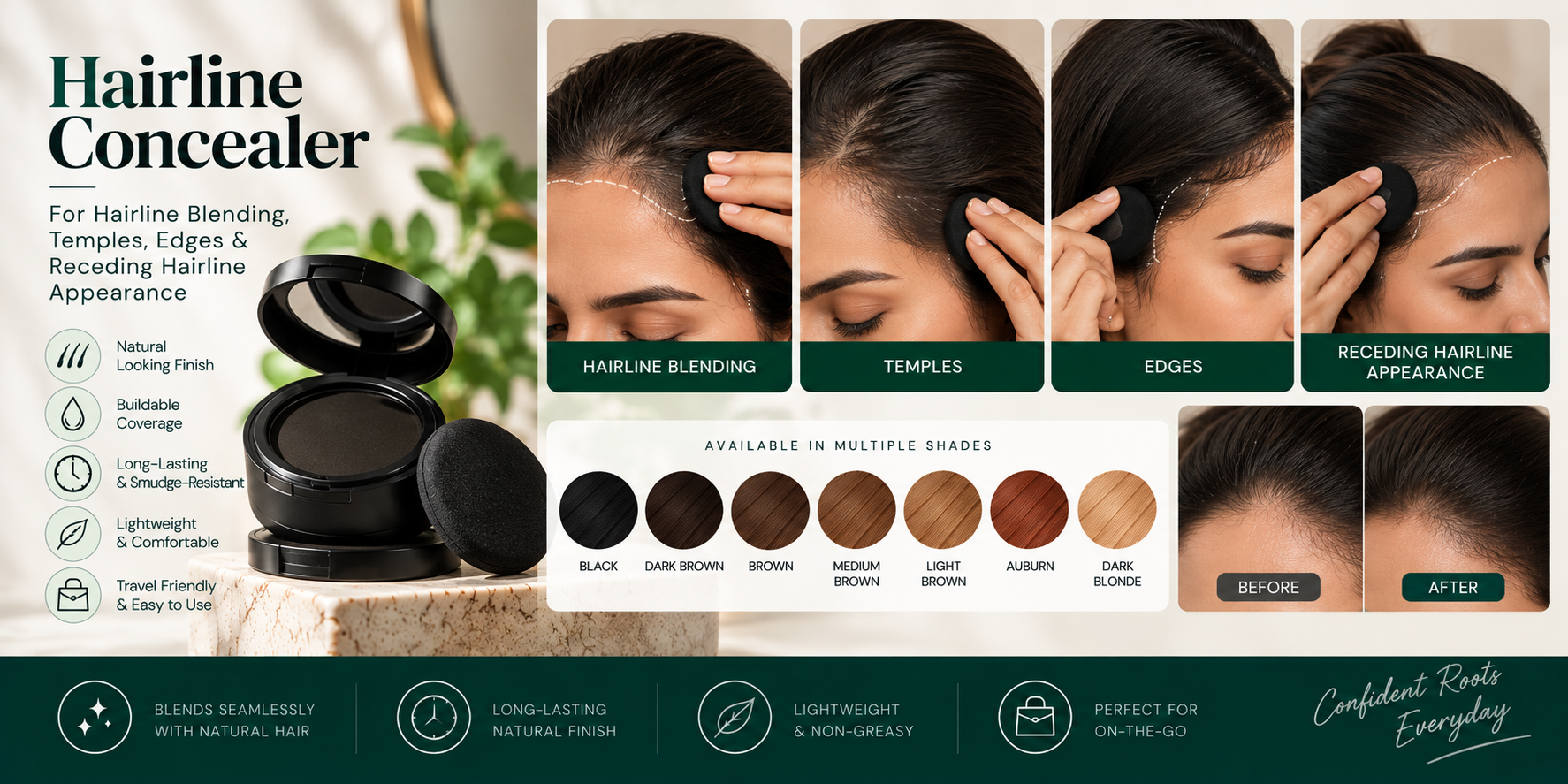
Hairline Concealer for Hairline Blending, Temples, Edges & Receding Hairline Appearance

A dermatologist-guided hair cosmetic guide for front hairline blending, temple shadowing, edge definition, forehead-hairline contrast and photo-ready confidence — with shade matching, precision application, wash-out safety and AI product matching.

⚠️ Safety First: Hairline concealer is a temporary cosmetic blending product. It can soften the appearance of temples, edges and front hairline gaps but does not regrow hair, stop hair fall, halt hairline recession or treat alopecia. Use only on dry, healthy skin/scalp and wash out properly.
Does Not Halt Recession: Progressive hairline recession, temple thinning or patchy edge loss require dermatologist evaluation — not just cosmetic coverage.
Hairline BlendingTemple CoverageEdge DefinitionReceding Hairline AppearancePrecision ApplicationTemporary Wash-Out CosmeticPatch-Test AdvisedDoes Not Treat Hair LossAI Shade Finder Available

Hairline concealer is temporary cosmetic blending. Does not regrow hair or halt recession. Consult a dermatologist for progressive hairline recession or traction edge loss.

Shade Range

Jet Blk
Nat Blk
Dk Brn
Med Brn
Lt Brn
Grey
Auburn
Blonde
Ultra-luxury hairline concealer pencil compact and precision brush in matte black rose-gold and champagne-gold packaging — front hairline and temple blending before-and-after visual, soft natural shadow at temples, shade swatches, dark emerald cocoa background
AI Shade Finder →
Does Not Halt Recession
Dr. Amit Agarkar
MD Dermatology · Trichologist
🛈 Reviewed by Dr. Amit Agarkar MD
🔬 Dermatologist-Guided Product Selection
Cosmetic Claims Only — No Regrowth Claims
Safe-Use Guidance Included
🤖 AI Shade & Product Matching Available

What You'll Learn on This Page

What hairline concealer does — blends receding edges, temples and front hairline visibility

Who benefits most — early recession appearance, temple thinning, edge framing for events

Application technique for natural blending at the hairline without harsh edges

Shade matching for hairline coverage — matching scalp and hair roots for seamless blending

Hairline concealer vs hair fibers vs scalp concealer — choosing the right product

Safety, limitations and when hairline thinning needs medical evaluation

✅ Best for

People with visible hairline recession, temple thinning or edge concerns wanting precise cosmetic blending for a natural appearance.

⚠️ Not a substitute for

A hair loss treatment. Concealer blends visible hairline gaps but does not regrow hair or slow recession.

🩺 Doctor review if

Hairline recession is progressive, rapid or accompanied by scalp symptoms — concealer should complement evaluation, not replace it.

Featured Snippet Answer

What Is Hairline Concealer Best For?

Hairline concealer — also called temple concealer, edge concealer, hairline makeup or hairline powder — is best for temporary blending of temples, edges, front hairline gaps and receding hairline appearance. It adds cosmetic shadow or colour around the hairline to soften contrast and make the face-framing hairline look more balanced. It is temporary, washes out and does not treat hairline recession or regrow hair.

Best for: temples, edges, front hairline, baby-hair gaps, hairline contrast, event photos
Finish: natural / matte / soft shadow depending on format
Tool: pencil, compact brush, sponge, micro-applicator or precision powder
Shade rule: match root or hairline colour, test under natural daylight and check from side profile
Not ideal for: wet skin, irritated scalp, open wounds, active folliculitis, fresh transplant zones
Medical note: progressive recession, temple thinning or edge loss needs AI Hair Test or dermatologist diagnosis

Dermatologist-Reviewed

Dermatologist-Guided Hairline Concealer Guide

Dr. Amit Agarkar — MD Dermatology, Trichologist & Hair Transplant Surgeon
Hairsncares / Vplant Advanced Hair Clinic, Mumbai

Hairline concealer is a cosmetic product used to soften the appearance of front hairline gaps, temple recession, edge thinning and uneven hairline contrast. It is useful for grooming, photo confidence, weddings, events and camera-facing situations when used correctly. The key is shade matching and feather-stroke application — not drawing a solid line.

Hairline concealer is not a medical treatment. It does not treat androgenetic alopecia, male pattern baldness, female pattern hair loss, traction alopecia, alopecia areata, telogen effluvium, scarring alopecia, nutritional deficiency or hormonal hair loss.

⚠️ Avoid on irritated, wounded, inflamed, infected, painful, sunburned or recently transplanted scalp/skin. Wash out properly. Stop if itching, burning, pimples, redness, rash, swelling or worsening flakes occur.

Ask Dr. Amit About Hairline Recession

Cosmetic Reality

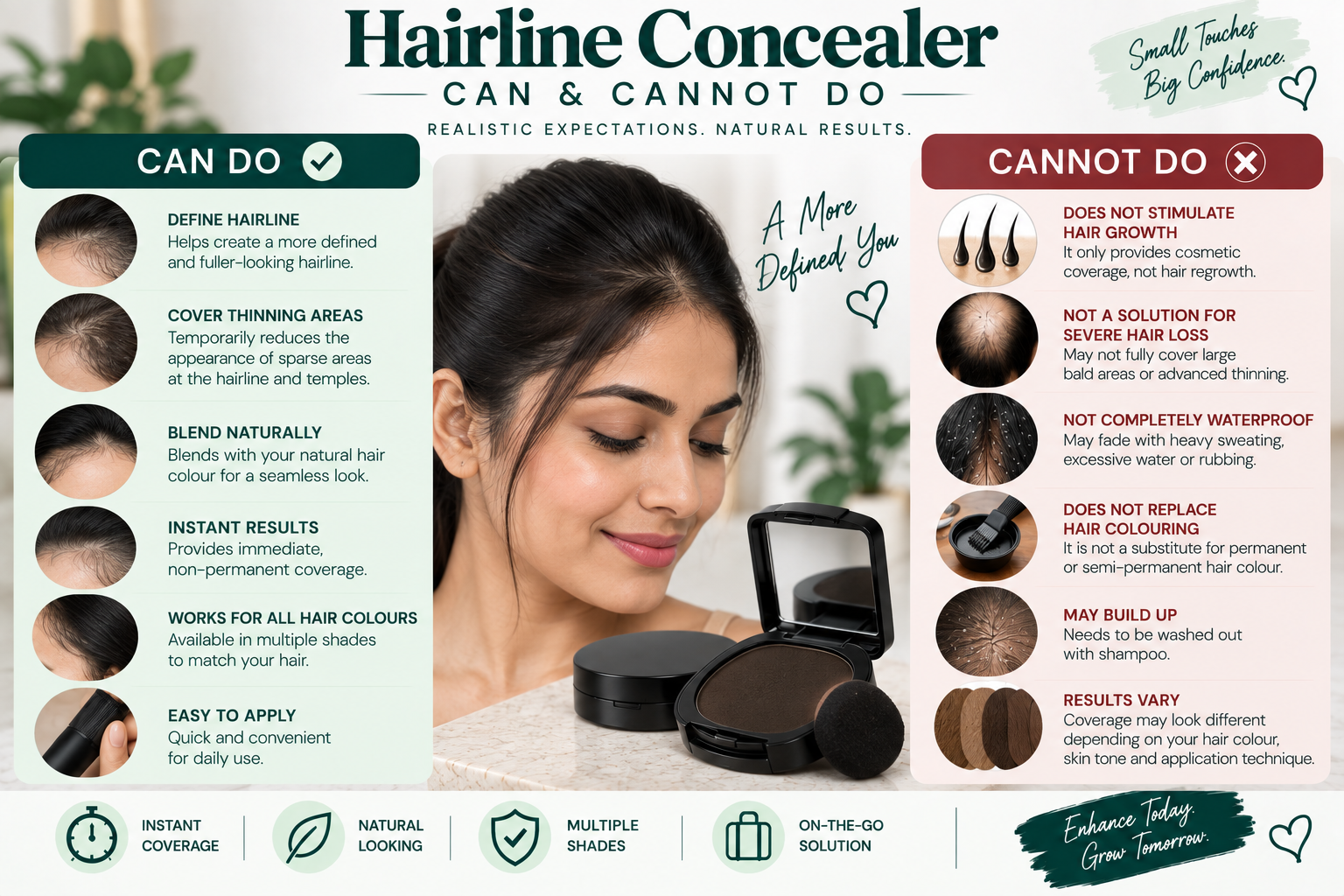
Hairline Concealer — Can & Cannot Do

Can Help With
  • Blend temple gaps temporarily
  • Soften front hairline contrast
  • Define edges and baby-hair zones
  • Improve receding hairline appearance
  • Create face-framing shadow
  • Improve photo-ready and event confidence
  • Men's hairline grooming
  • Women's edge and temple blending
  • Pair with scalp concealer for broader forehead/parting visibility
  • Pair with hair fibers when density is also low
  • Wash out with shampoo/cleanser
Cannot Do
  • Regrow hair
  • Stop hair fall
  • Halt hairline recession
  • Activate follicles
  • Treat androgenetic alopecia
  • Treat male pattern baldness
  • Treat female pattern hair loss
  • Treat traction alopecia
  • Treat alopecia areata
  • Treat telogen effluvium
  • Permanently thicken hair
  • Replace minoxidil or medical treatment
  • Replace hair transplant planning
  • Replace dermatologist diagnosis
Hairline Concealer hairline blending and temple coverage can cannot matrix editorial image for Hairsncares
Hairline Concealer — can cannot matrix visual guide.

Suitability Guide

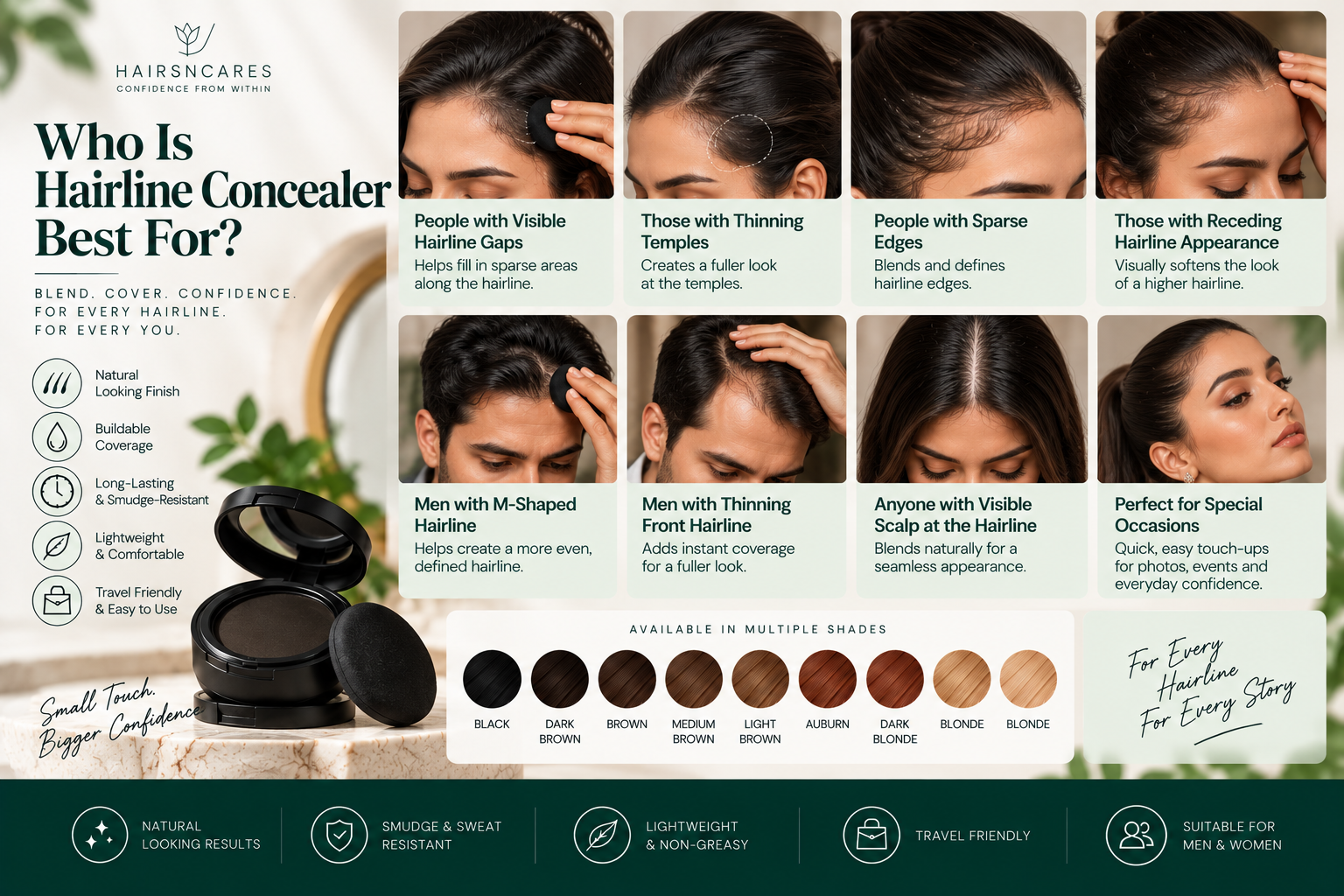
Who Is Hairline Concealer Best For?

Excellent Match

Best Hairline Concealer Candidates

  • Temple blending
  • Front hairline gaps
  • Receding hairline appearance
  • Uneven hairline outline
  • Edge definition
  • Baby-hair zone blending
  • Forehead-hairline contrast softening
  • Mild temple visibility
  • Event-ready and camera-facing grooming
  • Men's hairline finishing
  • Women's edge and temple softening
Pair With Other Products

May Need Combination

  • Temple thinning + crown → hairline concealer + hair fibers
  • Hairline gap + scalp visibility → hairline concealer + scalp concealer
  • Grey hairline → hairline concealer + root touch-up
  • Low-density hairline → precision powder + fiber applicator
  • Events/sweat → add compatible setting support after testing
  • Strong recession → AI Hair Test + dermatologist review
Poor Match

Not Recommended For

  • Wet or oily hairline
  • Active scalp pimples or folliculitis
  • Open wounds near hairline
  • Eczema or psoriasis flare
  • Severe dandruff near hairline
  • Sunburned skin
  • Recent hair transplant healing
  • Allergy or cosmetic irritation history
  • Heavy sweating without trial
Hairline Concealer hairline blending and temple coverage suitability guide editorial image for Hairsncares
Hairline Concealer — suitability guide visual guide.

Blending Intelligence

Why Hairline Concealer Works for Temples & Edges

Hairline gaps and temple recession look more visible because the contrast between scalp or skin and hair increases along the face-framing line. Hairline concealer creates a temporary soft shadow or colour blend that reduces harsh contrast and makes the hairline look more balanced in photos and daily grooming.

👁️
Temple Contrast

Light scalp or skin at the temples creates a sharper visual edge — concealer reduces this contrast.

🎭
Soft Shadow Blend

A matched concealer shade creates a softer face-framing transition from hair to skin.

✍️
Feather Stroke

Short hair-like strokes look far more natural than a solid drawn line along the hairline.

🖊️
Edge Definition

Precision compact or pencil can define baby-hair zones and edges for a groomed finish.

🔄
When Concealer Is Not Enough

If recession is progressing or edges are continuously thinning, cosmetic blending must be paired with diagnosis and treatment.

Shade Intelligence

Find Your Natural Hairline Concealer Shade

Match to root or hairline colour — not hair ends. Test under natural daylight and check from front and side profile. A shade too dark looks painted; too light won't blend.

Luxury hairline concealer shade guide grid — Natural Black, Dark Brown, Medium Brown, Light Brown, Ash Brown, Grey Blend, Salt and Pepper, Auburn Brown, Blonde — pearl background rose-gold labels
Jet Black
Very dark black hair only. May look too harsh for soft temple blending. Test under daylight first.
Natural Black
Most versatile for Indian black hairline. Slightly softer than Jet — more natural for temple shadow.
Dark Brown
Best for dark brown hairlines. Creates a softer shadow than black — recommended for softer blending.
Medium Brown
Medium brown roots. Natural face-framing hairline shadow for forehead-hairline transition.
Light Brown
Lighter brown or highlighted hairlines. Match root zone — not lighter ends or highlights.
Ash Brown
Cool neutral hairline without warm red. Best for muted brown or ashy hairline roots.
Grey Blend
Greying or predominantly grey temples. Avoids a dark harsh edge contrast at the hairline.
Salt & Pepper
Mixed grey and dark temples. Blend with brown or black shades for a natural salt-pepper result.
Auburn Brown
Warm reddish-brown hairline. Match root base, not faded or lighter ends.
Blonde / Dark Blonde
Light blonde hairline. Match base shadow at root — not brighter ends or highlights. Flash-test before events.

Hairline Concealer Shade Matching Rules

  • Match root or hairline colour — not hair ends or dyed length
  • Test under natural daylight — not bathroom or indoor lighting
  • Check from front and side profile in natural light
  • Check with phone camera and mirror
  • Avoid harsh black if hair is dark brown — Dark Brown blends more naturally
  • Use a softer shade for shadow finish vs high-contrast coverage
  • For salt-and-pepper temples, use grey blend or mix grey with brown and black
  • For dyed hair, match current root zone — not the dyed length
  • For highlighted hair, match the base root shadow — not highlights
  • For men's hairline, match temple and side hair colour closely
  • For women's edges, match baby-hair or root zone shade
  • Use AI Shade Finder if choosing between two shades

Application Tutorial

How to Apply Hairline Concealer for Natural Temple & Edge Blending

12 dermatologist-guided steps for natural hairline blending with feather strokes — no harsh painted lines.

01
Clean, Dry Hairline

Apply only on completely dry skin, scalp and hair. Damp, oily or sweaty hairline causes streaking or smudging.

02
Style First

Set your hairline, side part, fringe or pulled-back style before applying product so coverage lands correctly.

03
Choose Closest Shade

Match root or hairline colour. Test under natural daylight. Check front and side profile for accuracy.

04
Use Precision Tool

Use a pencil, compact brush, sponge or micro-applicator. Pick up a very small amount of product.

05
Apply at Temples

Start at the thinnest or most visible temple zone with a light touch. Less product, more control.

06
Feather Strokes

Use short hair-like feather strokes — never draw a solid painted line along the hairline.

A drawn line looks artificial. Feather strokes look like hair.

07
Blend Softly

Tap or brush gently into surrounding hair and skin so coverage is seamless and natural.

08
Balance Both Sides

Check temple symmetry without over-darkening either side. Step back to assess balance.

09
Build Gradually

Layer slowly if more coverage is needed. Overapplication looks harsh, painted or unnatural.

10
Camera Check

Review from front, side profile and phone camera under natural light and flash before stepping out.

11
Let It Set

Avoid touching, sweating or rubbing the hairline immediately after applying product.

12
Wash Out Properly

Cleanse product thoroughly from hairline and skin to reduce buildup and irritation risk.
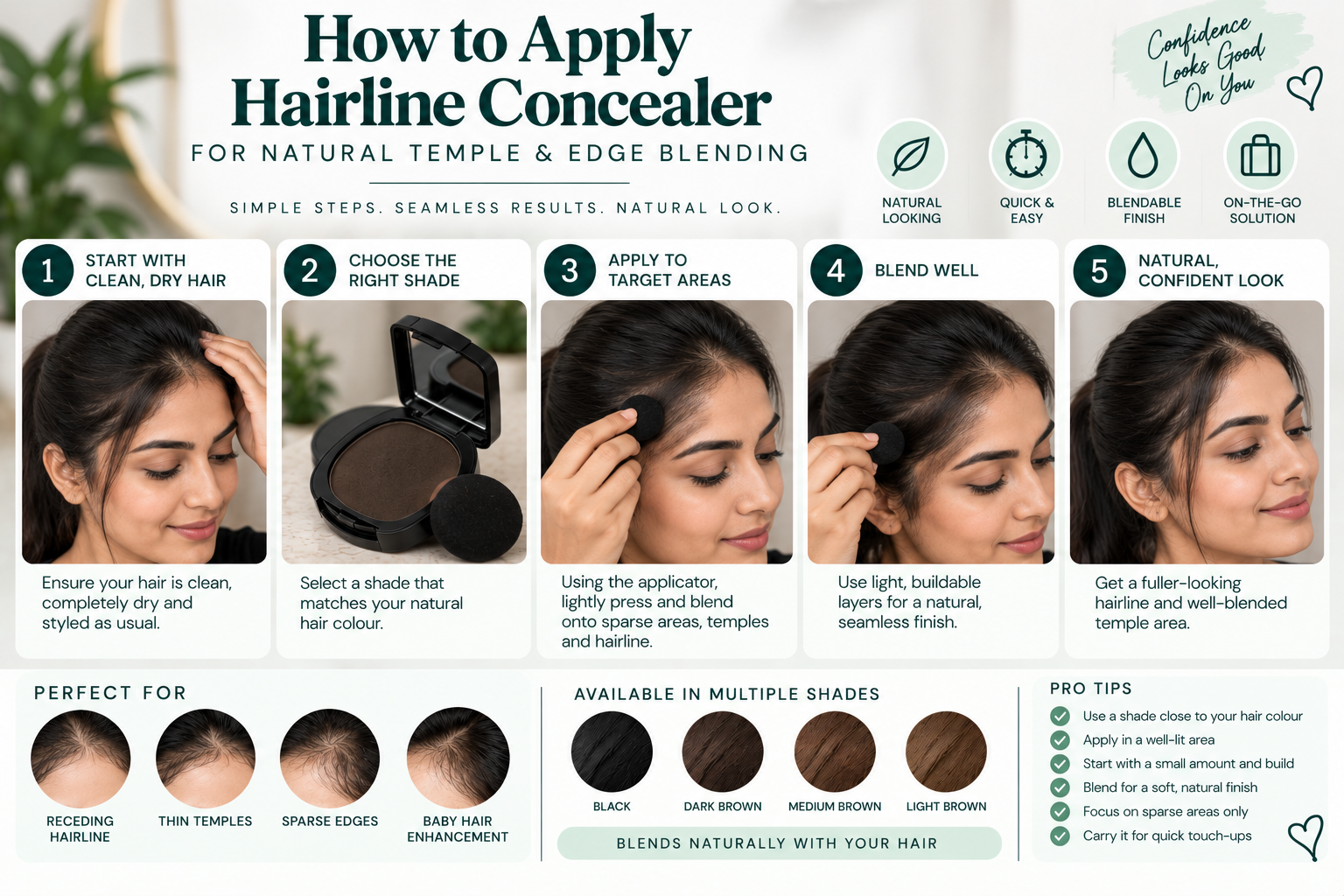
Stop immediately if itching, burning, pimples, redness, rash, swelling, eye irritation or worsening flakes occur after use.
Hairline Concealer hairline blending and temple coverage application guide editorial image for Hairsncares
Hairline Concealer — application guide visual guide.

Shop Hairline Concealer

Hairline Concealer & Temple Blending Range

Dermatologist-curated selection for temple blending, edge definition and front hairline coverage. Price available on product page. Patch-test before use.
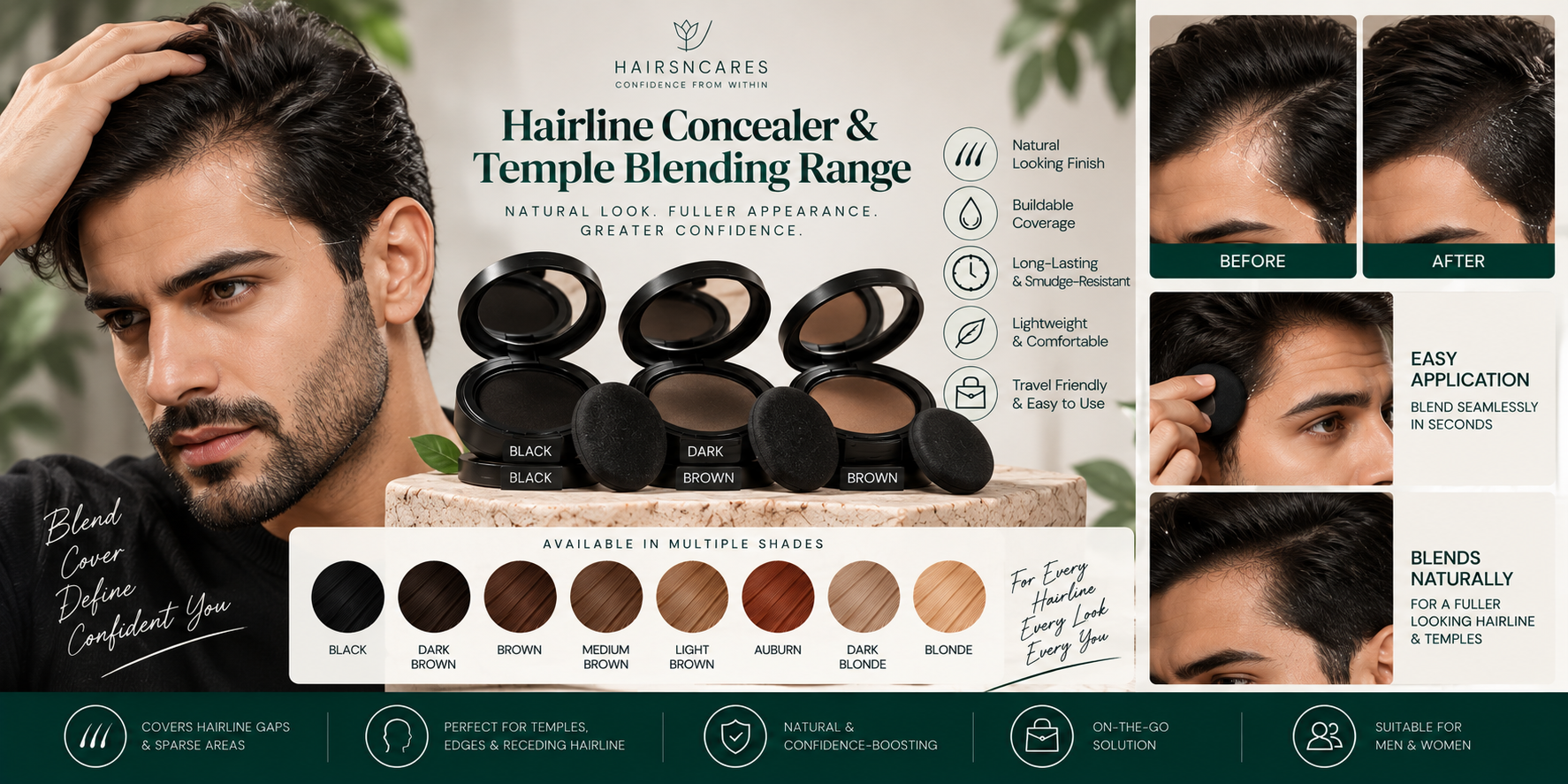
This collection is being curated. Please check back shortly.
Hairline Concealer hairline blending and temple coverage product range editorial image for Hairsncares
Hairline Concealer — product range visual guide.

Hairline Coverage Kits

Temple Blending & Hairline Kits for Every Need

Product Comparison

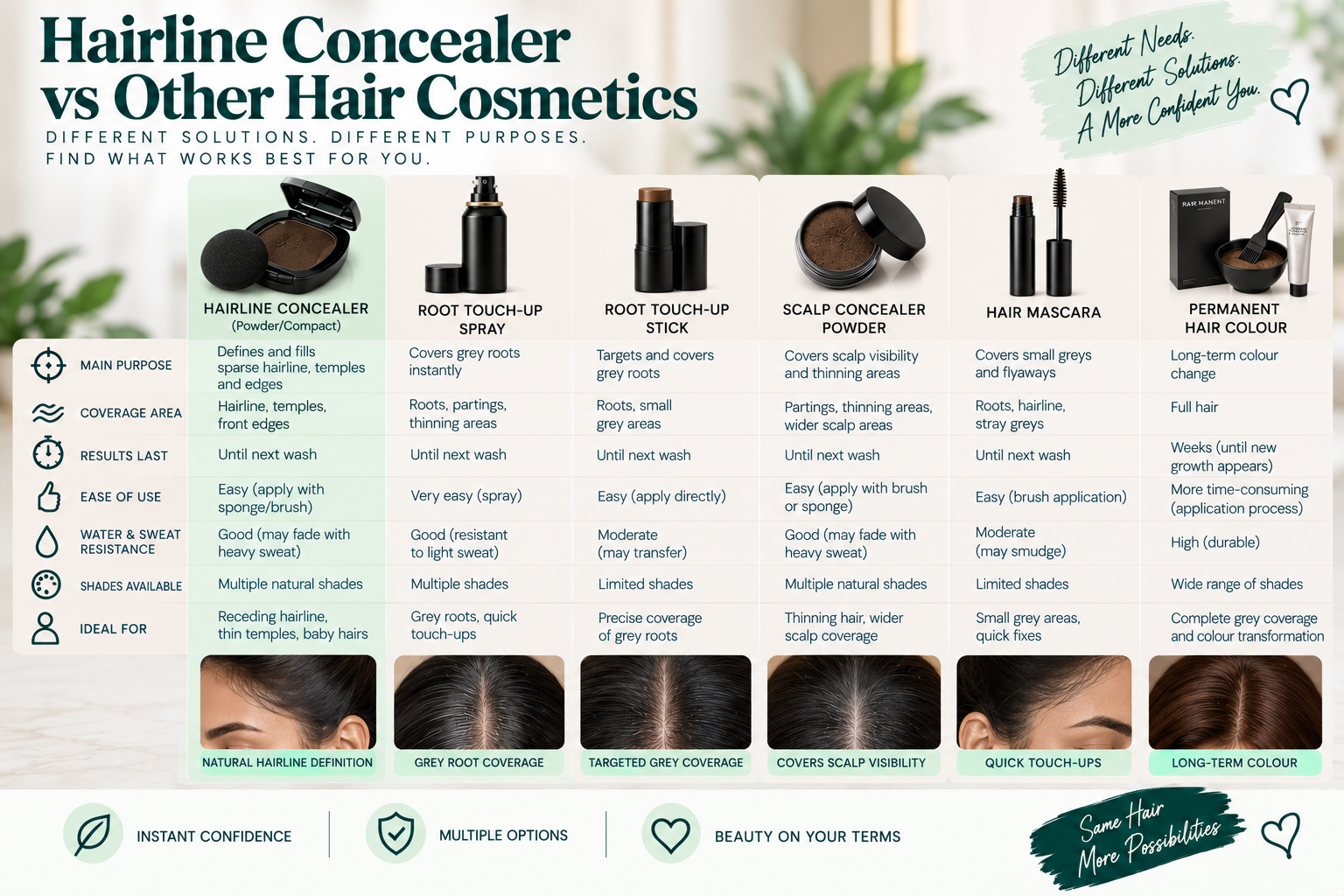
Hairline Concealer vs Other Hair Cosmetics

Hairline Concealer
  • Best for temples, front hairline and edges
  • Creates shadow/blend at face frame
  • Precision pencil or compact format
  • Useful when shape and edge definition is the goal
Hair Fibers
  • Best for crown thinning and low density with existing hair
  • Creates density illusion on hair strands
  • Less precise for hairline edge definition
  • Can be paired with hairline concealer for combined coverage
Hairline Concealer
  • Front hairline, temples and edges
  • Edge blending and face-framing shadow
  • Pencil or brush precision
Scalp Concealer
  • Widening part and scalp visibility
  • Broader top-scalp contrast coverage
  • Applied to scalp skin directly
  • Can pair with hairline concealer for combined face + scalp coverage
Hairline Concealer
  • Precise hairline shape and temple blending
  • Feather strokes and controlled shadowing
  • No aerosol — safe near eyes and face
Root Touch-Up Spray
  • Grey roots and colour gaps further back on hair
  • Faster but has overspray risk near face
  • Less precise for hairline edge work
Hairline Concealer
  • Hairline-specific shape correction
  • Pencil, brush or compact format
  • Best for edge and temple precision work
Hair Makeup Compact
  • Multipurpose scalp, temple, parting or root blending
  • Compact format with applicator brush
  • Can function as a hairline concealer with a small precision brush
Hairline Concealer
  • Temporary daily wash-out cosmetic
  • No procedure, no recovery
  • Immediate result, immediate removal
Scalp Micropigmentation
  • Semi-permanent cosmetic procedure
  • Requires specialist and careful hairline design planning
  • Not wash-out — not a daily cosmetic
  • Not a hair regrowth treatment
Hairline Concealer
  • Instant temporary cosmetic blending
  • No surgery, no recovery time
  • Suitable while assessing longer-term options
Hair Transplant
  • Surgical hairline restoration with donor follicles
  • Requires dermatologist or surgeon evaluation
  • Long-term planning and donor assessment needed
Hairline Concealer
  • Cosmetic appearance blending only
  • No follicle or scalp biology effect
  • Apply after minoxidil has dried and absorbed
Minoxidil
  • Medical hair growth treatment for suitable candidates
  • Needs consistent use and dermatologist guidance
  • Apply to hairline/scalp first — allow full absorption before any cosmetic
Hairline Concealer hairline blending and temple coverage comparison editorial image for Hairsncares
Hairline Concealer — comparison visual guide.

Medical Context

Hairline Concealer with Minoxidil & After Hair Transplant

💊

Can You Use Hairline Concealer with Minoxidil?

Hairline concealer may be used with minoxidil in many routines, but timing matters. Apply minoxidil first to clean dry hairline and scalp. Allow it to fully dry and absorb. Style hair. Only then apply hairline concealer lightly.

Minoxidil first — to dry hairline and scalp
Wait until completely dry and absorbed
Style hair then apply concealer lightly
Avoid aggressive rubbing near hairline
Wash out concealer properly each use
Ask dermatologist if irritation occurs

⚠️ Do not trap wet minoxidil under cosmetic buildup. Stop if itching, flakes, burning or redness worsens. Do not use concealer to hide worsening recession without diagnosis.

Ask About Minoxidil + Hairline Concealer
🏥

Can Hairline Concealer Be Used After Hair Transplant?

Do not use hairline concealer during post-transplant healing without explicit surgeon clearance. Healing grafts and hairline recipient skin are vulnerable to irritation, infection, pigment residue, buildup and mechanical disturbance.

No concealer on fresh grafts or scabs
No compact or pencil rubbing on healing hairline
No powder or spray on donor or recipient zones during healing
Use only after full surgeon clearance
Follow clinic post-op protocol exactly

⚠️ Post-transplant hairline grafts are healing. Product application near new grafts risks infection or graft disturbance. Always confirm with your surgical team.

Hairline Transplant Information

Traction & Edge Safety

Hairline Concealer for Edges — When Cosmetic Coverage Is Not Enough

⚡ Edge Thinning Warning

Hairline concealer can temporarily blend edge gaps, but edge thinning from tight hairstyles, traction, chemical damage, extensions, braids or repeated pulling needs early diagnosis and correction. Continuing traction while only covering the area cosmetically may worsen long-term hairline loss.

Warning Signs That Need Dermatologist Evaluation:

Temple thinning from tight hairstyles
Edge thinning after braids or extensions
Painful bumps along hairline
Broken hairs at edges
Itching or scaling near hairline
Progressive recession not from genetics
Shiny smooth temple skin without hair
Uneven or asymmetric hairline loss

Safe Next Steps:

Reduce tight hairstyles — loose styles reduce traction on edges
Avoid tight ponytails, buns or braids on vulnerable edges
Stop harsh edge gels if scalp irritation occurs
Consult a dermatologist for persistent edge loss or traction alopecia diagnosis
Track hairline photos monthly to monitor progression
Use hairline concealer as cosmetic support only — not as a substitute for treatment

AI-Powered Matching

Find the Right Hairline Concealer Shade & Blending Routine

🎨
AI Shade Finder

Matches hairline colour, temple shade, grey percentage and skin tone to recommend the best hairline concealer shade and format.

Start AI Shade Finder →
🤖
AI Product Finder

Identifies the right hairline concealer format — pencil, compact, powder or brush kit — based on hairline concern, scalp type and event need.

Start AI Product Finder →
🧬
AI Hair Test

Identifies whether hairline concern is cosmetic coverage or progressive recession that needs medical evaluation and treatment planning.

Take AI Hair Test →
🔬
AI Scalp Test

Checks hairline scalp sensitivity, folliculitis risk and buildup tendency so you know if hairline concealer is safe for your scalp.

Check Scalp Safety →
📊
Progress Tracker

Track hairline changes monthly to distinguish cosmetic variation from genuine recession that needs dermatologist assessment.

Track My Hairline →

Event-Ready Coverage

Photo-Ready Hairline Blending for Every Occasion

💼
Office Hairline Grooming

Soft matte temple blending, minimal product, natural shade. Check under office and daylight.

💍
Wedding / Bridal Edge

Trial shade under daylight and flash before event. Never first use on wedding day.

💻
Video Call Grooming

Temple shadowing, hairline symmetry and low-shine finish for camera-facing calls.

📸
Stage / Photoshoot

Hairline concealer + scalp concealer + fibers for combined coverage. Flash-test before shoot.

🏋️
Gym / Sweat Risk

Use caution — sweat and friction can shift concealer near forehead. Trial before relying on it.

🌧️
Rain / Humidity

Use compatible setting support only after testing transfer and comfort. Not waterproof.

Important: Always trial hairline concealer before an important event. Do not use a new shade or formula for the first time on wedding day, photoshoot day or stage day.

Safety Guide

How to Use Hairline Concealer Safely

Safety Rules

  • Patch-test before first use
  • Use on dry hairline and healthy skin/scalp only
  • Avoid wet, oily or sweaty hairline
  • Avoid wounded or inflamed hairline
  • Avoid infected scalp or skin
  • Avoid active folliculitis or scalp pimples
  • Avoid heavy dandruff or scaling near hairline
  • Avoid contact with eyes
  • Avoid inhalation of powder or spray formats
  • Wash out thoroughly with shampoo or cleanser
  • Do not sleep with heavy product buildup repeatedly
  • Clean pencils, brushes, sponges and applicators regularly
  • Do not use on post-transplant hairline without clearance
  • Stop immediately if any reaction occurs

Reaction & Buildup Signs — Stop and Cleanse

  • Itching after application
  • Redness or rash near hairline
  • Pimples or folliculitis-like bumps at edges
  • Burning or stinging sensation
  • Swelling near hairline or temples
  • Worsening flakes near hairline
  • Scalp discomfort or tightness
  • Eye watering from product
  • Product residue persisting after wash
  • Hairline feels clogged or painful
  • Product clumping along edge line
  • Worsening irritation with repeated use

Myths vs Facts

10 Hairline Concealer Myths — Balanced View

Myth

Hairline concealer regrows hair

Fact

It provides temporary cosmetic hairline blending only. It does not activate follicles or treat hair loss of any kind.

Myth

Hairline concealer stops recession

Fact

It does not halt, reverse or slow hairline recession. Progressive recession requires medical evaluation and treatment planning.

Myth

Hairline concealer treats alopecia

Fact

It is a cosmetic product only. It does not treat androgenetic alopecia, traction alopecia, alopecia areata or any medical hair loss.

Myth

Darker shade always looks fuller

Fact

Too-dark concealer can look harsh or painted at the temples. Shade matching and soft blending matter more than shade darkness.

Myth

A solid drawn line looks natural

Fact

Feather-like strokes and soft blending look far more natural. A solid line at the hairline edge always looks artificial.

Myth

Hairline concealer needs no washing out

Fact

Thorough wash-out reduces buildup, follicle congestion and irritation risk near the hairline. Always cleanse after use.

Myth

Safe on irritated hairline skin

Fact

Avoid use on wounded, inflamed, painful or infected scalp and hairline skin. Stop if burning, redness or rash occurs.

Myth

Hairline concealer replaces minoxidil

Fact

Hairline concealer is cosmetic blending. Minoxidil is a medical hair growth treatment for suitable candidates under dermatologist guidance.

Myth

Edge loss is always cosmetic

Fact

Progressive edge loss may be traction alopecia or another medical diagnosis. Covering cosmetically without evaluation may worsen long-term loss.

Myth

Hair cosmetics mean no diagnosis needed

Fact

Progressive recession, patchy loss or scalp symptoms still need dermatologist evaluation. Cosmetic confidence does not replace medical care.
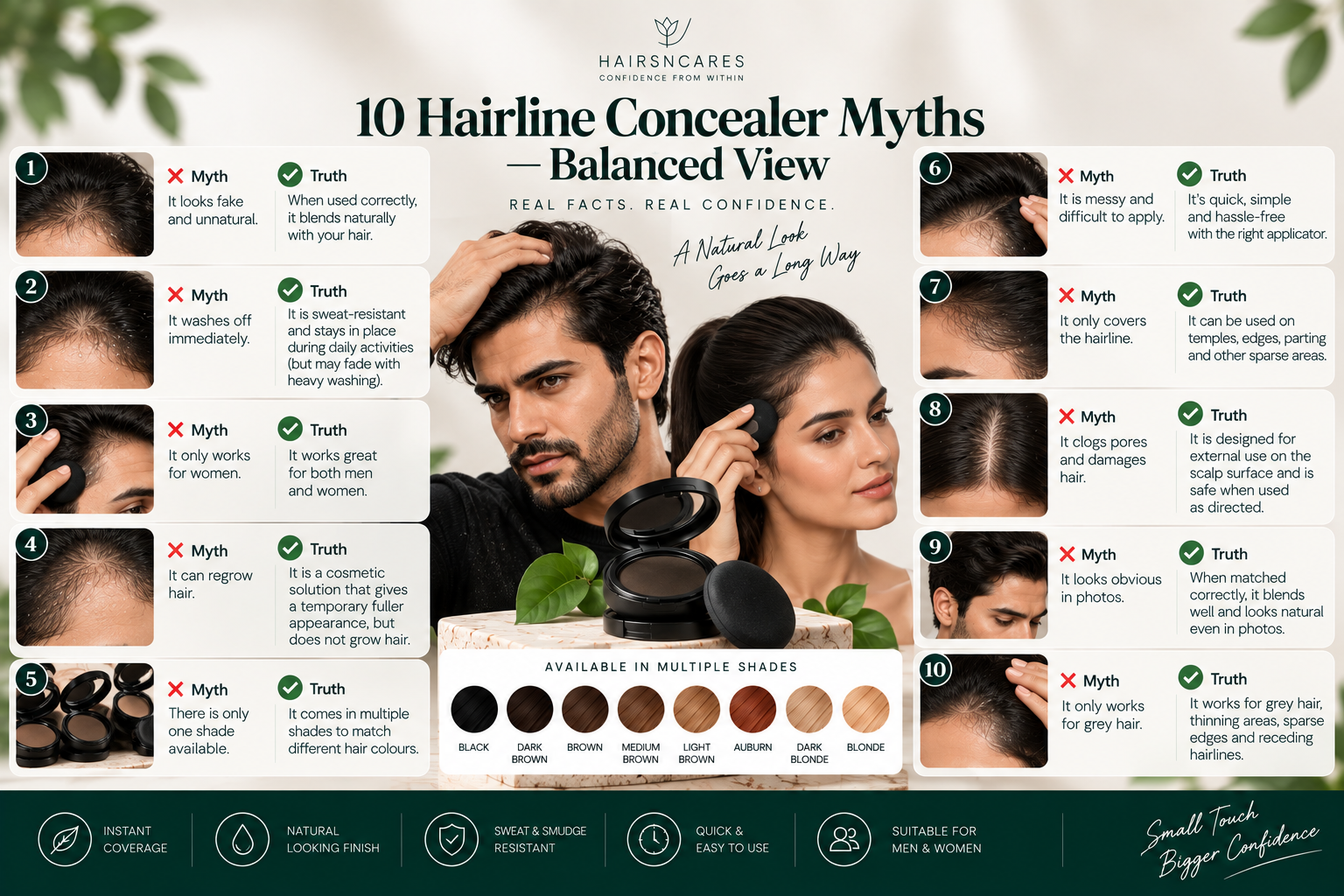
Hairline Concealer hairline blending and temple coverage myths debunked editorial image for Hairsncares
Hairline Concealer — myths debunked visual guide.

When Cosmetics Are Not Enough

Consult a Dermatologist — These Need Medical Evaluation

Progressive hairline recession
Temple thinning worsening
Patchy hairline loss
Shiny smooth hairless temples
Edge thinning after tight hairstyles
Painful bumps along hairline
Scalp pain or tenderness
Pus or crusting near hairline
Severe itching near hairline
Severe dandruff or thick scales
Sudden heavy hair fall
Hair fall after fever, surgery or crash diet
Hair fall with PCOS symptoms
Hair fall with thyroid symptoms
Postpartum shedding
Hairline worsening despite cosmetic coverage

Stop hairline concealer and consult if after use:

Itching or burning starts
Redness or rash appears
Pimples develop near edges
Eye irritation occurs
Breathing irritation from powder
Swelling near temples
Flakes worsen near hairline
Hairline feels clogged or painful

Expert Answers

Frequently Asked Hairline Concealer Questions

Hairline concealer — also called temple concealer, edge concealer, hairline makeup or hairline powder — is a temporary cosmetic blending product applied to the front hairline, temples and edges. It softens their appearance, reduces contrast and improves face-framing balance. Available as pencil, compact, powder or cream. Washes out with shampoo or cleanser. Does not regrow hair or treat hair loss.
Hairline concealer adds temporary colour, shadow or powder to the face-framing hairline zone to reduce the contrast between hairless skin or scalp and existing hair. Applied with feather strokes and blended softly, it creates the appearance of a denser, more defined hairline. The effect is cosmetic and temporary.
Yes. Hairline concealer is specifically useful for temple blending. It softens the visible contrast at thinning or receding temples. Shade match to temple and side hair colour is critical. It does not stop temple recession — consult a dermatologist if temples are progressively thinning.
Yes. Hairline concealer can temporarily improve receding hairline appearance by blending the contrast between the hairline and forehead skin. It does not stop, reverse or slow recession. Progressive recession needs dermatologist evaluation.
Yes. Hairline concealer is well suited for edge blending, baby-hair gap coverage and defining the hairline boundary. A pencil or compact with a small brush gives the most controlled edge result.
Yes. Women can use hairline concealer for edge blending, temple softening and baby-hair gap coverage. However, edge thinning from tight hairstyles should be evaluated by a dermatologist — not just covered cosmetically.
Yes. Men commonly use hairline concealer for temple shadowing, front hairline softening and hairline symmetry. A pencil or compact works well. Shade should match temple and side hair colour.
Yes. Hairline concealer can soften baby-hair gaps and fill the appearance of sparse front hairline zones. Use feather strokes to mimic the direction of baby hair for a natural result.
Hairline concealer can soften the appearance of bare temples and create a shadow-like transition. On fully smooth or shiny bald skin it requires careful blending. SMP is more durable for significant temple baldness but is a semi-permanent procedure.
No. Hairline concealer is a temporary cosmetic blending product. It does not regrow hair, activate follicles or treat any form of hair loss.
No. Hairline concealer provides cosmetic appearance blending only. It does not treat the cause of hair fall. Consult a dermatologist for hair fall evaluation.
No. Hairline concealer does not halt, reverse or slow hairline recession. Progressive recession needs medical evaluation and treatment.
No. Hairline concealer does not treat androgenetic alopecia, male pattern baldness, female pattern hair loss, traction alopecia, alopecia areata, telogen effluvium or scarring alopecia.
Hairline concealer is generally safe on healthy, dry, clean hairline skin and scalp. Patch-test before use. Avoid on irritated, wounded, inflamed, infected or recently transplanted scalp. Avoid eyes. Wash out thoroughly. Stop if itching, burning, pimples, redness or rash occurs.
Hairline concealer does not directly cause hair fall when used correctly and washed out properly. Product buildup or use on irritated skin may worsen scalp reactions. Wash out thoroughly after each use.
Yes. Hairline concealer can irritate sensitive, reactive, inflamed or wounded scalp and skin. Patch-test before use. Stop if burning, itching, redness or rash occurs.
Product buildup, clogged follicles or use on sensitive hairline skin may trigger pimples. Patch-test, wash out properly and avoid use on folliculitis-prone hairline.
Thorough wash-out is important to prevent product accumulation near hairline follicles. Use a gentle cleanser and shampoo and do not leave product on overnight repeatedly.
Yes. Wash out hairline concealer thoroughly with shampoo or cleanser after each use. Proper removal reduces buildup, follicle congestion and irritation risk near the hairline.
Most hairline concealers can be used daily on healthy skin with thorough wash-out each time. On sensitive or reactive hairline skin, assess tolerance before daily use.
Start with clean, dry hairline. Style hair. Choose the right shade. Use a precision pencil, compact brush or sponge. Apply lightly with feather strokes at temples or edges. Blend softly. Build coverage gradually. Check under natural daylight and camera. Wash out thoroughly after use.
Yes. Apply only on completely dry hairline and scalp. Damp, oily or sweaty skin causes hairline concealer to streak, smudge or look unnatural.
No. Wet or damp hair and scalp causes hairline concealer to clump and look unnatural. Always dry hair and scalp fully and style before applying.
Match to root or hairline colour — not hair ends. Test under natural daylight and check from front and side profile. Too dark may look painted; too light may not blend. Use AI Shade Finder if unsure.
Natural Black hairline concealer suits most Indian black hair. For a softer shadow look, Dark Brown may actually blend more naturally at temples. Test under daylight before choosing.
Dark Brown hairline concealer is best for dark brown hair and temples. More forgiving than black for most Indian hairlines — blends softer at the temple edge. Test under natural light.
Grey Blend or Salt and Pepper hairline concealer suits grey or greying temples. Match the dominant temple shade. For mixed grey and dark, Salt and Pepper gives a more natural blended result.
Hairline concealer is best for temples, edges and front hairline shape blending. Hair fibers are best for crown thinning and low-density zones with existing hair. Different areas and can be combined.
Hairline concealer targets front hairline and temples. Scalp concealer targets visible scalp and widening part on the top head. They cover different zones and can be paired for combined coverage.
Hairline concealer is more precise for temple shape and edge blending. Root touch-up spray is better for broader grey root coverage but has overspray risk near the face. Choose based on whether precision or speed is the priority.
Hairline concealer is hairline-specific. Hair makeup compact is multipurpose for scalp, temple, parting and root blending. A compact with a small precision brush can serve as a hairline concealer.
Hairline concealer is temporary daily wash-out cosmetic. SMP is a semi-permanent cosmetic procedure requiring specialist planning. Both address appearance — not hair regrowth.
Hairline concealer provides instant temporary blending. Hair transplant is a surgical procedure for long-term hairline restoration using donor follicles. A dermatologist evaluates which approach suits the case.
Yes, but timing matters. Apply minoxidil first to dry hairline and scalp. Allow to dry and absorb fully. Style then apply hairline concealer. Do not apply over wet or freshly medicated scalp. Consult your dermatologist if irritation occurs.
Do not use hairline concealer during post-transplant healing without explicit surgeon clearance. Healing grafts and hairline skin are vulnerable to irritation, infection, pigment residue and product buildup.
Avoid hairline concealer during active dandruff flares near the hairline. Product buildup on reactive scalp may aggravate flaking. Wait until scalp is settled.
Patch-test before use on sensitive skin. Choose fragrance-free or gentle formulations. Avoid during active skin reactions. Stop if itching, redness or rash develops.
Yes. Hairline concealer can transfer to collars, caps, scarves or pillowcases if not fully set or if rubbed. Wash out before sleep. A compatible setting product may reduce daytime transfer.
Most hairline concealers are not waterproof. Rain or moisture can smudge or shift coverage near the forehead. A compatible setting product may improve weather resistance.
Light sweat with a compatible setting product may be tolerable. Heavy sweating can shift or smudge coverage near the forehead and temples. Trial before relying on it for active wear.
Setting spray is not always required. For events, photos or outdoor wear, a compatible light setting product may improve wear and reduce transfer. Avoid heavy products near hairline follicles.
Hairline concealer usually lasts through a normal day until cleansing. Wear depends on oiliness, sweat, rubbing and product formula. Pencil or cream formats may have slightly better staying power than loose powders.
Yes, with preparation. Trial the shade and formula before the event. Check under daylight and camera flash. Do not use a new formula or shade for the first time on wedding day or photoshoot day.
Hairline concealer can temporarily blend edge and temple gaps from traction alopecia appearance. However, continued traction while only covering cosmetically may worsen long-term loss. Dermatologist evaluation is important for persistent edge thinning.
Stop if itching, redness, burning, pimples, rash, swelling, eye irritation, breathing irritation or worsening flakes occur. Allow skin to recover and consult a dermatologist if symptoms persist.
Consult a dermatologist if you have progressively receding hairline, temple thinning, patchy hairline loss, shiny smooth temples, edge thinning after tight hairstyles, scalp pain, pus, crusting, severe itching or burning scalp, hair fall with PCOS or thyroid symptoms or postpartum shedding.

Your Hairline Confidence Starts Here

Find the Right Hairline Concealer Shade & Temple Blending Kit

Hairline concealer can instantly soften temple contrast and edge visibility — when the shade matches, the hairline is dry and the skin is healthy. Let AI match your shade and kit, or speak to Dr. Amit Agarkar if recession or edge thinning is progressing.

Disclaimer: Hairline concealer is a temporary cosmetic blending product for front hairline appearance, temples, edges, baby-hair gaps and receding hairline appearance. It does not diagnose, treat, cure or prevent hair loss, baldness, alopecia, androgenetic alopecia, male pattern baldness, female pattern hair loss, traction alopecia, telogen effluvium, scalp infection, dandruff, PCOS-related hair fall, thyroid-related hair fall, postpartum shedding or nutritional deficiency hair fall. It does not regrow hair, activate follicles, stop hair fall, stop hairline recession or slow hair loss progression. Use only on dry hairline and healthy skin/scalp. Avoid eyes, inhalation, wet scalp, wounded scalp, inflamed scalp, infected scalp, painful scalp and recently transplanted scalp. Patch-test before first use and wash out thoroughly to reduce buildup. Consult a dermatologist for sudden, patchy, progressive or scalp-associated hair fall, including worsening temple recession or traction-related edge loss.
Your Cart (0)

Your cart is empty

Subtotal0
DeliveryFREE
Total0
🔒 Secure📦 Free above ₹499↩ Easy returns
💬 Hi! I'm Dr. Amit — your Hair Intelligence consultant
🌿
1
🌿
Dr. Amit
Virtual Dermatologist · Hairsncares.com
Online
What are you shopping for today?
Select a category to begin
AI-powered scalp diagnosis · Hairsncares.com
📸
Scalp Analyser
Upload scalp photo · Get conditions, root cause, and matched product protocol
📷
Drop scalp photo here or click to upload
JPG, PNG, WEBP · Clear, close-up, well-lit photo

Your image is processed privately by our AI engine and saved securely with your account.