Skip to content
Dermatologist-reviewed education · Cosmetic active and medication compared · Not a prescription or product endorsement Last medically reviewed: 23 July 2026 Medical editorial policy Correction policy Advertising disclosure Ingredient-claims policy Book a consultation

Cosmetic Active vs Medical Treatment Intelligence

Redensyl vs Minoxidil for Hair Loss: Evidence, Results, Safety and Key Differences

Redensyl and minoxidil are not equivalent treatment categories. Redensyl is a trademarked cosmetic active used within selected leave-on hair-serum formulations, supported by supplier and emerging human data. Minoxidil is a regulated medicine — available topically and, in selected clinical contexts, orally under medical supervision — supported by a broader clinical evidence history and formal regulatory labeling. Neither treats every cause of hair loss, and a serum containing Redensyl often contains several other active ingredients as well, which complicates attributing any observed result to Redensyl alone. This page compares what each actually is, how their evidence differs, what safety considerations apply to each, and why a dermatologist's assessment — not marketing language — should guide your decision.

Dermatologist Reviewed Cosmetic vs Drug Clarified Evidence Quality Compared Product Claims Audited Topical and Oral Routes Separated India-Focused Guidance
Scientific comparison of the cosmetic active Redensyl and the medication minoxidil for dermatologist-guided hair-loss care
A cosmetic active and a medication, compared honestly — not treated as equivalent categories.
Dermatologist-Reviewed Evidence-Aware Content No Data Collected by Tools on This Page India-Focused Guidance Prescription Required Where Applicable

Quick Answer

Redensyl is a cosmetic active used in selected serums, supported by promising but comparatively limited and formulation-dependent evidence. Minoxidil is a medication with a broader clinical evidence base for hair regrowth. Redensyl is not established as an evidence-equivalent replacement for minoxidil — which, if either, may be relevant depends on your diagnosis, safety profile and personal preference, ideally discussed with a dermatologist.

Read this first: Do not stop medically advised minoxidil solely because a cosmetic serum is marketed as a natural alternative. This page is educational — a dermatologist should confirm your diagnosis before you start, stop or combine any hair-loss treatment.

At a Glance

Redensyl and Minoxidil, Side by Side

These panels are not evidence-equivalent, and this comparison does not present them as equivalent categories. Use "Compare by" to highlight one consideration across both at once — the goal is clarity, not a declared winner.

Redensyl

CategoryTrademarked cosmetic active used within finished serum formulations
Typical formatLeave-on scalp serum, usually combined with other actives
Ingredient identityA defined blend including DHQG and EGCG2, marketed under a single trade name
Proposed mechanismSupplier-proposed support of the follicle stem-cell microenvironment and dermal-papilla activity
Evidence typeSupplier laboratory data, small human studies, mostly on finished multi-active products
Regulatory categoryCosmetic ingredient — not evaluated or approved as a drug
Formulation dependenceHigh — concentration, vehicle, stability and co-actives all vary by product
ResultsEarly or limited evidence; not established as equivalent to minoxidil's evidence base
SheddingNot well characterised in independent literature
Irritation potentialDepends on the full formulation — fragrance, preservatives and vehicle all contribute
Safety flagNot established as side-effect free; patch-testing has practical limitations
MenSometimes used as supportive cosmetic care alongside diagnosis-led treatment
WomenSometimes marketed toward women; evidence base is not sex-specific or robust
Daily useTypically once or twice daily as part of a cosmetic routine
MaintenanceContinued use generally required to sustain any observed cosmetic benefit
Cost driverBrand positioning and multi-active formulation, not concentration alone
Combination useOften sold pre-combined with other actives; combination with minoxidil is not independently proven superior
Cosmetic Active — Evidence Formulation-Dependent

Minoxidil

CategoryMedication, available topically and, in select clinical contexts, orally
Typical formatTopical solution or foam; low-dose oral tablet under medical supervision
Ingredient identityA single, standardised active pharmaceutical ingredient regardless of brand
Established mechanismSupports the follicular growth cycle, encouraging longer time in the active (anagen) phase
Evidence typeRegulatory labeling, controlled clinical studies, systematic reviews, long real-world use
Regulatory categoryRegulated medicine with formal drug labeling
Formulation dependenceLower — concentration is standardised and route-specific, though brand vehicles can still vary tolerability
ResultsBroader clinical evidence base; response still varies between individuals
SheddingA recognised, often temporary initial-shedding phase is documented
Irritation potentialDocumented — scalp dryness, contact dermatitis and propylene-glycol sensitivity are recognised
Safety flagOral and topical forms are not interchangeable in safety profile
MenCommonly discussed for diagnosed male-pattern hair thinning
WomenCommonly discussed for diagnosed female-pattern hair loss, subject to individual assessment
Daily useTypically once or twice daily; oral route is once daily under supervision
MaintenanceContinued use is required in many users to sustain benefit
Cost driverConcentration, route, brand versus generic, and consultation/monitoring costs
Combination useMay be combined with a cosmetic serum, but this does not require or imply that the serum is equally proven
Medication — Regulatory-Grade Evidence Base

The Core Distinction

Redensyl and Minoxidil Do Not Occupy the Same Evidence Category

In , genetically susceptible follicles gradually shrink and spend less time in the with each cycle. Before comparing Redensyl and minoxidil as treatment options, it helps to understand that they sit on entirely different evidence levels — a distinction this page keeps visible throughout, not just in this section.

Cosmetic-Active Level

Ingredient supplier research, laboratory rationale, finished serum formulation, cosmetic claims — performance is formulation-dependent.

Where Redensyl Sits

A cosmetic active with and comparatively limited independent human evidence.

Redensyl sits here

Medication Level

Defined active ingredient, regulatory labeling, clinical trials, recognised adverse effects, route-specific treatment guidance.

Where Minoxidil Sits

A regulated medicine with route-specific labeling, a longer clinical-use history and recognised safety data.

Minoxidil sits here

Dermatologist-Decision Level

Diagnosis, evidence interpretation, risk, treatment goal, adherence and monitoring — where the two categories are weighed together.

Diagram comparing the evidence levels of the cosmetic active Redensyl and the medication minoxidil
A simplified view of where each sits on the evidence ladder — not a ranking of treatment value.

In Detail

Full Comparison Table

Swipe to compare →

Redensyl and minoxidil compared across classification, evidence, safety and practical-use considerations. This is general, non-personalised information and always requires individual medical assessment — not a claim of equivalence.
ConsiderationRedensylMinoxidil
Product categoryCosmetic activeRegulated medicine
Active typeDefined ingredient blend, trademarkedSingle standardised pharmaceutical ingredient
StandardisationConcentration and vehicle vary by finished productConcentration is standardised and labeled by route
Typical formulationLeave-on serum, usually multi-activeTopical solution/foam; oral tablet in select cases
Regulatory positionCosmetic ingredient — not drug-regulatedDrug — formally regulated and labeled
Approval statusNot evaluated or approved as a hair-loss drugApproved topical drug; oral hair-loss use is generally off-label
Evidence quantityLimited — mostly supplier and small studiesLarger — regulatory trials, systematic reviews, long real-world use
Evidence independenceLargely supplier-generated or supplier-fundedIndependent regulatory and academic evidence available
Human trialsSmall, often uncontrolled, short follow-upLarger controlled trials with longer follow-up
Direct comparative evidenceDirect head-to-head evidence vs minoxidil is insufficientDirect head-to-head evidence vs Redensyl is insufficient
Mechanism certaintyProposed, laboratory-supported — not fully established clinicallyEstablished growth-cycle mechanism, route-dependent detail still studied
Product variationHigh — every branded serum can differLow — active ingredient is consistent across brands
Concentration variationOften undisclosed or inconsistent across productsLabeled and route-specific
RouteTopical onlyTopical or oral (oral requires medical supervision)
Daily adherenceTypically once or twice daily as cosmetic routineTypically once or twice daily; oral is once daily
Time before assessmentNot well established; product-specific claims varySeveral months of consistent use, per clinical judgement
MaintenanceContinued use generally required for any cosmetic benefitContinued use generally required for many users
After stoppingNot well characterised in independent literatureBenefit generally does not persist
Initial sheddingNot well characterisedA recognised, often temporary phase
Scalp irritationDepends on full formulation — fragrance, alcohol, preservativesDocumented; dryness and contact dermatitis are recognised
Contact dermatitisPossible, formulation-dependentDocumented, sometimes linked to propylene glycol
Unwanted facial hairNot established as a riskDocumented with topical spillover
Cardiovascular considerationsNot established as relevantRelevant, particularly for oral route
Pregnancy considerationsNot established as safe or unsafe — verify local product labelRequires direct medical guidance
Breastfeeding considerationsNot established — verify local product labelRequires direct medical guidance
Male-pattern hair lossSometimes marketed for this; evidence formulation-dependentCommonly discussed once diagnosis is confirmed
Female-pattern hair lossSometimes marketed for this; evidence formulation-dependentCommonly discussed once diagnosis is confirmed
Telogen effluviumNot established as a targeted treatmentNot a first-line treatment; diagnosis should guide approach
Alopecia areataNot established as a targeted treatmentNot a standard first-line treatment
Scarring alopeciaNot established as effectiveNot established as effective — requires diagnosis
Advanced baldnessNot proven to revive absent folliclesLimited effect on completely inactive follicles
Combination useOften sold pre-combined with other activesMay be combined with a cosmetic serum after assessment
CostVaries by brand positioning and formulationVaries by concentration, route, brand versus generic
AccessibilityWidely available without prescriptionSome strengths OTC; oral route requires prescriptionDoctor Review Essential
Medical supervisionNot required to purchase; recommended if replacing treatmentAdvised, essential for oral routeDoctor Review Essential
Primary limitationFormulation dependent; evidence not established as equivalent to a medicineRequires ongoing use; not effective for every hair-loss cause

Minoxidil

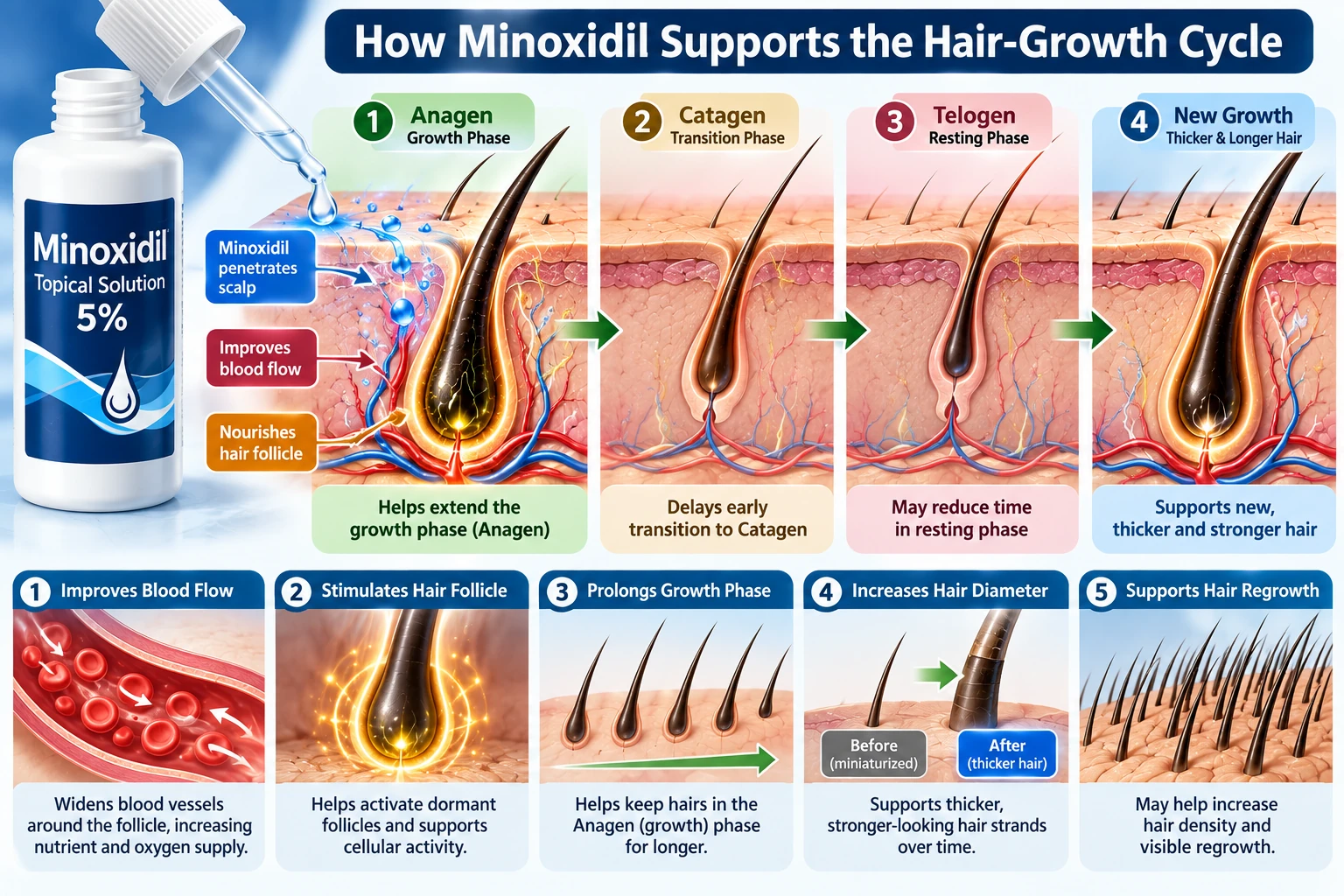
Minoxidil: Supporting the Hair-Growth Cycle

What minoxidil is

Minoxidil was originally developed for a different medical purpose and was later found, as a side effect, to influence hair growth. It is now widely used specifically for that purpose, available as a topical solution or foam, and — in selected, doctor-supervised cases — as a low-dose oral tablet.

How it may support hair growth

Minoxidil is understood to prolong the anagen (active growth) phase of the hair cycle and may improve blood flow to the follicle. Unlike a cosmetic active such as Redensyl, minoxidil's mechanism is supported by regulatory-grade evidence, though individual response still varies.

Topical minoxidil

Applied directly to the scalp in solution or foam form, at concentrations that vary by product and formulation. Local absorption is the primary route, though some systemic absorption can occur depending on scalp condition and application area.

Oral minoxidil

Low-dose oral minoxidil for hair loss is an evolving area of dermatological practice and is generally considered off-label for this indication in most markets, meaning it is used based on clinical judgement rather than an approved hair-loss label. Its systemic safety profile is different from the topical route and requires blood-pressure and cardiovascular history review before consideration. It is not a self-started option.

Different concentrations and formulations

Products vary in strength and vehicle (solution vs. foam). A concentration or formulation suited to one person's scalp and diagnosis should not be assumed to apply identically to another person.

Foam versus solution

Foam formulations are often better tolerated by people with oily scalps or sensitivity to certain solution-based carriers, but tolerance is individual. A dermatologist can help match formulation to scalp type.

Who may be assessed for it

People with diagnosed male- or female-pattern hair thinning are commonly discussed as candidates, subject to individual assessment. It is not automatically appropriate for every type of hair loss, including some inflammatory, autoimmune or nutritional causes.

Temporary shedding

Some people notice increased shedding in the early weeks of use. This is a recognised, typically temporary phenomenon related to the hair cycle resetting — but any shedding that is heavy, prolonged or accompanied by scalp symptoms should be discussed with a dermatologist rather than assumed to be normal.

Scalp irritation and tolerance

Itching, dryness or flaking can occur, more often with solution-based products than foam. Formulation switching or a treatment pause may be discussed with a dermatologist if irritation persists.

Consistency and long-term maintenance

Minoxidil is a maintenance therapy — its supportive effect is generally understood to require continued use, and benefits are not expected to persist indefinitely after stopping.

What it cannot do

Minoxidil does not address the hormonal (DHT) driver of androgenetic alopecia, cannot reverse scarring hair loss, and is not a treatment for autoimmune or infectious causes of hair loss.

When to stop and contact a clinician

Persistent scalp irritation, chest discomfort, unexplained swelling, rapid heart rate, or lightheadedness (particularly relevant to oral minoxidil) warrant prompt medical contact rather than self-management.

Questions to ask a dermatologist

Which formulation and concentration fit my scalp and diagnosis? Is the oral route relevant to me, and what monitoring would that involve? How will we judge whether it is working, and by when?

Minoxidil Reality Check

  • It does not work for every patient
  • Topical and oral routes are different — not interchangeable in safety profile
  • Results require time; a few days or weeks is not enough to judge effectiveness
  • Ongoing use is often necessary to sustain any benefit
  • Initial shedding may occur — a recognised, usually temporary phase
  • Topical products can irritate the scalp in some users
  • Oral use requires medical supervision
  • It does not diagnose the underlying cause of hair loss
  • It cannot guarantee full restoration
Minoxidil's role in supporting the hair-growth cycle, illustrated for patient education
How minoxidil is understood to support the active growth phase of the hair cycle.

Redensyl

Redensyl: Cosmetic Hair-Serum Active with Emerging Evidence

What Redensyl is

Redensyl is a trademarked cosmetic active — not a medicine — developed for use in leave-on scalp and hair products. It is supplied to cosmetic manufacturers as an ingredient, who then formulate it into finished serums, often alongside other actives.

Trademark and supplier context

Redensyl is a brand name owned by its ingredient supplier. As with any trademarked cosmetic ingredient, the supplier's own technical literature and marketing material is not the same as independent, peer-reviewed clinical evidence.

Ingredient components

Redensyl is typically described as a blend including dihydroquercetin-glucoside (DHQG) and epigallocatechin gallatoglucoside (EGCG2), among other components, combined under a single trade name rather than sold as separate standardised actives.

Proposed biological targets

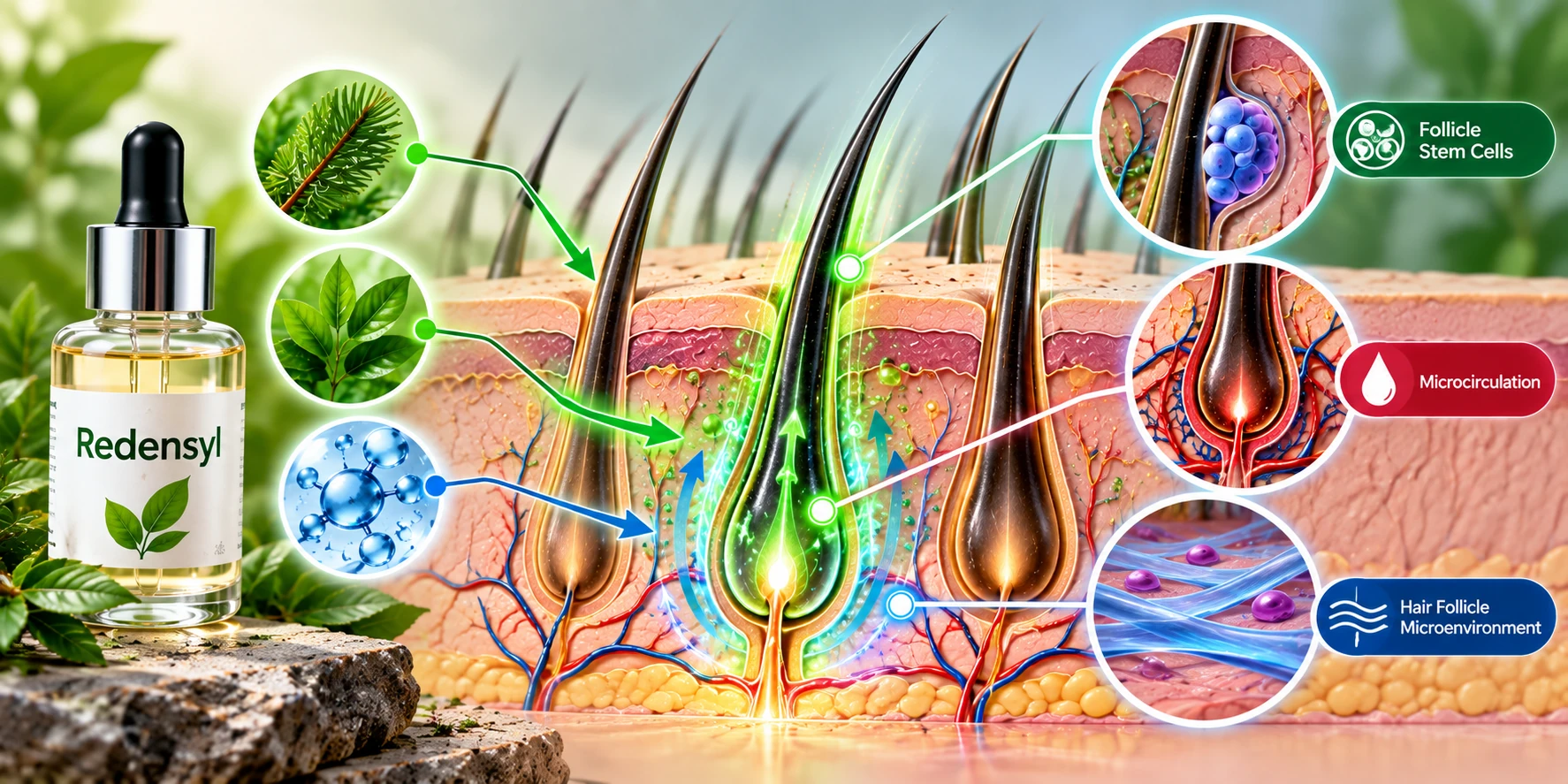
Supplier material proposes that Redensyl's components support the follicle stem-cell microenvironment and dermal-papilla cell activity. These are laboratory-derived hypotheses about mechanism, not confirmed clinical effects in the way a regulated drug's mechanism is established.

Follicle stem-cell claims

Claims about supporting follicle stem cells originate from in-vitro or ex-vivo laboratory research. This is an earlier stage of evidence than a controlled human clinical trial, and laboratory activity does not automatically translate into visible scalp regrowth.

Dermal-papilla fibroblast claims

Similarly, proposed effects on dermal-papilla fibroblast activity are mechanistic and supplier-supported rather than independently confirmed as clinically meaningful across the general population.

Cosmetic formulation role

Within a finished serum, Redensyl is one ingredient among potentially several — it does not determine the whole product's safety or performance profile on its own.

Typical leave-on serum use

Products are usually applied directly to the scalp once or twice daily, left on rather than rinsed out, as part of a cosmetic hair-care routine.

Concentration claims

Marketed concentrations vary between products and are not always independently verified or disclosed in a standardised way, unlike a regulated drug's labeled concentration.

Vehicle dependence

How Redensyl performs may depend heavily on the serum's base formulation — its solvents, stabilisers and delivery system — which differs from product to product.

Stability

Cosmetic actives can degrade over time or under certain storage conditions. Product stability testing, where available, is typically conducted by the manufacturer rather than published independently.

The combination-serum problem

A serum containing Redensyl may also contain Anagain, Capixyl, Procapil, peptides, caffeine, botanical extracts or other actives. Improvement observed with the finished serum cannot automatically be attributed to Redensyl alone.

Supplier studies

Much of the available evidence originates from studies commissioned or conducted by the ingredient supplier — useful as a starting point, but not equivalent in independence to externally funded, peer-reviewed research.

Independent evidence

Independent replication of Redensyl's proposed effects — studies conducted by researchers unconnected to the supplier — remains limited compared to the independent evidence base for minoxidil.

Human evidence

Where human studies exist, they are often small, sometimes uncontrolled, frequently conducted on a finished multi-active product rather than Redensyl in isolation, with relatively short follow-up periods.

Study limitations

Common limitations include small participant numbers, lack of blinding, absence of a control group, short duration, and unclear or self-reported outcome measures rather than objective density measurement.

Irritation and allergy

Because Redensyl is used within multi-ingredient serums, irritation or allergic reactions may relate to fragrance, preservatives, alcohol content or other actives in the formulation rather than Redensyl itself — patch-testing a specific product is more informative than assuming Redensyl is the variable.

Product-label review

Before relying on a Redensyl-containing serum, review the full ingredient list, check whether the study referenced in marketing matches the actual sold formulation, and note whether the Redensyl concentration is disclosed at all.

What Redensyl cannot claim

It cannot claim to be an approved hair-loss medicine, a guaranteed minoxidil replacement, a stem-cell treatment, or a cure. Products should not be marketed with these claims regardless of what is written on packaging.

When dermatologist assessment matters

If hair loss is progressive, patchy, sudden, or associated with scalp symptoms, a serum containing Redensyl is not a substitute for diagnosis. A dermatologist can clarify whether cosmetic support, established treatment, or both may be relevant.

Redensyl Reality Check

  • It is a cosmetic active, not a hair-loss drug
  • Finished products may contain several active ingredients
  • Supplier evidence and independent evidence are not equivalent
  • Laboratory effects do not guarantee visible regrowth
  • One serum's results cannot be applied to every Redensyl product
  • Product concentration alone does not guarantee effectiveness
  • Long-term comparative evidence is limited
  • It is not proven to revive permanently absent follicles
  • It should not be marketed as universally superior to minoxidil
Redensyl's proposed follicle-microenvironment mechanism, illustrated for patient education
A conceptual view of the proposed follicle stem-cell mechanism Redensyl is marketed around — not confirmed clinical proof.

By Scenario

Redensyl and Minoxidil by Patient Scenario

These are educational starting points for a conversation with a dermatologist — not personalised treatment recommendations.

Early Male-Pattern Thinning

Why diagnosis matters
Early intervention decisions can influence which options remain relevant later, so diagnosis matters before choosing a routine.
Whether cosmetic support may be discussed
Cosmetic support with a serum may be discussed as part of a broader routine, not as a stand-alone answer.
Whether established treatment may be discussed
Minoxidil is commonly discussed once androgenetic alopecia is confirmed.
What neither can guarantee
That either option alone will fully halt genetically driven progression.
Appropriate next step
Dermatologist assessment to confirm pattern and candidacy.

Female-Pattern Thinning

Why diagnosis matters
Diffuse thinning in women can have several causes, so diagnosis should precede any product or medicine choice.
Whether cosmetic support may be discussed
May be discussed as supportive cosmetic care once diagnosis is confirmed.
Whether established treatment may be discussed
Minoxidil is commonly discussed for diagnosed female-pattern hair loss.
What neither can guarantee
That a serum alone will address a hormonal or nutritional driver if one is present.
Appropriate next step
Diagnostic evaluation, including possible blood tests.

Diffuse Shedding

Why diagnosis matters
Diffuse shedding can reflect stress, nutrition, thyroid function or pattern hair loss — each needs a different approach.
Whether cosmetic support may be discussed
Not a targeted treatment for the underlying cause of diffuse shedding.
Whether established treatment may be discussed
Not automatically appropriate until the cause is identified.
What neither can guarantee
That either option treats the root cause without diagnosis.
Appropriate next step
Cause-finding evaluation before any treatment discussion.

Stress-Related Shedding

Why diagnosis matters
Telogen effluvium often follows a different course than pattern hair loss and may resolve as the trigger resolves.
Whether cosmetic support may be discussed
Not established as a targeted treatment for this cause.
Whether established treatment may be discussed
Not a first-line treatment for telogen effluvium.
What neither can guarantee
That faster resolution is achieved by adding either product.
Appropriate next step
Identify and address the underlying trigger with medical input.

Scalp Sensitivity

Why diagnosis matters
Sensitive skin increases the risk of reacting to fragrance, alcohol or preservatives in leave-on products.
Whether cosmetic support may be discussed
Multi-active serums carry a real irritation risk that needs individual patch-testing.
Whether established treatment may be discussed
Formulation and concentration should be selected with sensitivity in mind.
What neither can guarantee
That a cosmetic product is automatically gentler because it is marketed as natural.
Appropriate next step
Patch-test any new product and consult if reactions occur.

Contact Dermatitis History

Why diagnosis matters
A prior history of contact dermatitis raises the stakes of introducing new leave-on formulations.
Whether cosmetic support may be discussed
Full ingredient-list review is essential before use.
Whether established treatment may be discussed
Formulation switching may be discussed if irritation occurred previously.
What neither can guarantee
That either option is guaranteed not to trigger a reaction.
Appropriate next step
Dermatologist review before introducing any new product.

Previous Minoxidil Irritation

Why diagnosis matters
Understanding what caused prior irritation matters before deciding on next steps.
Whether cosmetic support may be discussed
May be raised as an alternative cosmetic approach, but is not guaranteed better tolerated.
Whether established treatment may be discussed
A different formulation, strength or vehicle may be discussed.
What neither can guarantee
That switching away from minoxidil guarantees comfort or results.
Appropriate next step
Dermatologist review of the specific irritation experienced.

Concern About Initial Shedding

Why diagnosis matters
Worry about temporary shedding is common and should not drive premature discontinuation without medical input.
Whether cosmetic support may be discussed
Not well characterised for shedding patterns in independent literature.
Whether established treatment may be discussed
A recognised, often temporary phase — but should be discussed if heavy or prolonged.
What neither can guarantee
That either option is guaranteed shedding-free.
Appropriate next step
Discuss expected patterns with a dermatologist before starting.

Unable to Maintain a Daily Routine

Why diagnosis matters
Both options generally require consistent use to sustain any benefit.
Whether cosmetic support may be discussed
Adherence challenges affect cosmetic routines just as much as medicine schedules.
Whether established treatment may be discussed
Missed applications reduce the likelihood of sustained benefit.
What neither can guarantee
That either option works effectively with inconsistent use.
Appropriate next step
Discuss realistic adherence and simplified routines with a dermatologist.

Cardiovascular History

Why diagnosis matters
Cardiovascular history is particularly relevant to certain treatment routes.
Whether cosmetic support may be discussed
Not established as cardiovascularly relevant.
Whether established treatment may be discussed
Oral minoxidil specifically requires blood-pressure and cardiovascular history review.
What neither can guarantee
That a cosmetic serum is automatically the safer choice due to route.
Appropriate next step
Full cardiovascular history review before considering oral minoxidil.

Pregnancy

Why diagnosis matters
Pregnancy changes the risk calculus for many topical and oral products.
Whether cosmetic support may be discussed
Not established as safe or unsafe during pregnancy — verify the specific product label.
Whether established treatment may be discussed
Suitability during pregnancy requires direct medical guidance.
What neither can guarantee
That either option is automatically safe because it's over-the-counter.
Appropriate next step
Direct discussion with an obstetric or dermatology provider.

Breastfeeding

Why diagnosis matters
Systemic absorption during breastfeeding is a relevant consideration for any leave-on or oral product.
Whether cosmetic support may be discussed
Not established — verify the specific product label and ingredient list.
Whether established treatment may be discussed
Suitability during breastfeeding requires direct medical guidance.
What neither can guarantee
That either option is automatically safe during breastfeeding.
Appropriate next step
Direct discussion with a healthcare provider.

Alopecia Areata

Why diagnosis matters
This autoimmune condition has a different mechanism than androgenetic alopecia.
Whether cosmetic support may be discussed
Not established as an effective treatment for this cause.
Whether established treatment may be discussed
Not a standard first-line treatment for alopecia areata.
What neither can guarantee
That either option addresses an autoimmune process.
Appropriate next step
Dermatologist evaluation for autoimmune hair loss.

Scarring Alopecia

Why diagnosis matters
Scarring alopecia involves follicle destruction, which changes what any topical product can achieve.
Whether cosmetic support may be discussed
Not established as effective on scarred, non-functional follicles.
Whether established treatment may be discussed
Limited effect on follicles that are no longer active.
What neither can guarantee
That either option can restore hair where follicles are destroyed.
Appropriate next step
Specialist evaluation for scarring or inflammatory hair loss.

Active Scalp Inflammation

Why diagnosis matters
Applying new products to an actively inflamed scalp can worsen irritation and confound diagnosis.
Whether cosmetic support may be discussed
Should generally wait until inflammation is medically addressed.
Whether established treatment may be discussed
Should generally wait until inflammation is medically addressed.
What neither can guarantee
That either option is appropriate to start during active flare.
Appropriate next step
Treat the active scalp condition first, under medical guidance.

Advanced Baldness

Why diagnosis matters
Donor follicle activity, not just product choice, determines what is realistically achievable.
Whether cosmetic support may be discussed
Not proven to revive follicles that are no longer active.
Whether established treatment may be discussed
Limited effect on completely inactive follicles.
What neither can guarantee
That either option can restore hair where follicles no longer function.
Appropriate next step
Discuss realistic expectations and alternative options with a dermatologist.

Smooth Bald Scalp

Why diagnosis matters
A fully smooth, long-bald scalp usually indicates follicles are no longer active.
Whether cosmetic support may be discussed
Not established as effective on inactive follicles.
Whether established treatment may be discussed
Not established as effective on inactive follicles.
What neither can guarantee
That either option will regrow hair on a long-smooth scalp.
Appropriate next step
Realistic discussion of options, which may not include either product.

Previous Failed Cosmetic Serums

Why diagnosis matters
A prior serum not working doesn't necessarily mean every formulation or every active will fail.
Whether cosmetic support may be discussed
Product-specific factors — concentration, co-actives, adherence — may explain prior results.
Whether established treatment may be discussed
May be discussed as an alternative evidence-based option.
What neither can guarantee
That switching serums alone is likely to change the outcome without diagnosis.
Appropriate next step
Diagnostic review before trying another cosmetic product.

Previous Poor Minoxidil Response

Why diagnosis matters
Understanding why minoxidil didn't work matters before considering alternatives.
Whether cosmetic support may be discussed
May be raised as a supportive option, but is not proven equivalent.
Whether established treatment may be discussed
Formulation, concentration or route change may be discussed first.
What neither can guarantee
That a cosmetic serum will succeed where minoxidil did not.
Appropriate next step
Dermatologist review of diagnosis and prior treatment response.

Patient Seeking a "Natural Alternative"

Why diagnosis matters
"Natural" and "cosmetic" do not mean risk-free or evidence-equivalent to a medicine.
Whether cosmetic support may be discussed
May be discussed as supportive cosmetic care within a broader plan.
Whether established treatment may be discussed
Remains the more evidence-supported option for diagnosed pattern hair loss.
What neither can guarantee
That a serum marketed as natural is clinically equivalent to minoxidil.
Appropriate next step
Discuss goals and evidence expectations with a dermatologist.

Patient Wishing to Stop Minoxidil Immediately

Why diagnosis matters
Stopping medically advised treatment abruptly can allow gained benefit to diminish.
Whether cosmetic support may be discussed
Should not be presented as an immediate substitute for stopping minoxidil.
Whether established treatment may be discussed
Discontinuation should be discussed with the prescribing dermatologist first.
What neither can guarantee
That switching to a serum on the same day preserves existing results.
Appropriate next step
Discuss any concerns about minoxidil with a dermatologist before stopping.

Combination Use

Can Redensyl and Minoxidil Be Combined?

Combination products exist, and using a Redensyl-containing serum alongside minoxidil is common in practice. However, evidence for the exact combination — rather than either ingredient studied separately — may be limited, and the combination itself is not typically what has been formally studied.

Added ingredients can increase irritation risk, and introducing several new products at the same time can make it harder to identify which one is responsible for an adverse effect if one occurs. Layering multiple leave-on products can also affect tolerability and absorption in ways that are not always predictable.

A staged plan — introducing one product, assessing tolerance and effect, then considering the second — is often easier to evaluate than starting everything simultaneously. Combination use should not be presented or assumed to guarantee outperforming minoxidil alone.

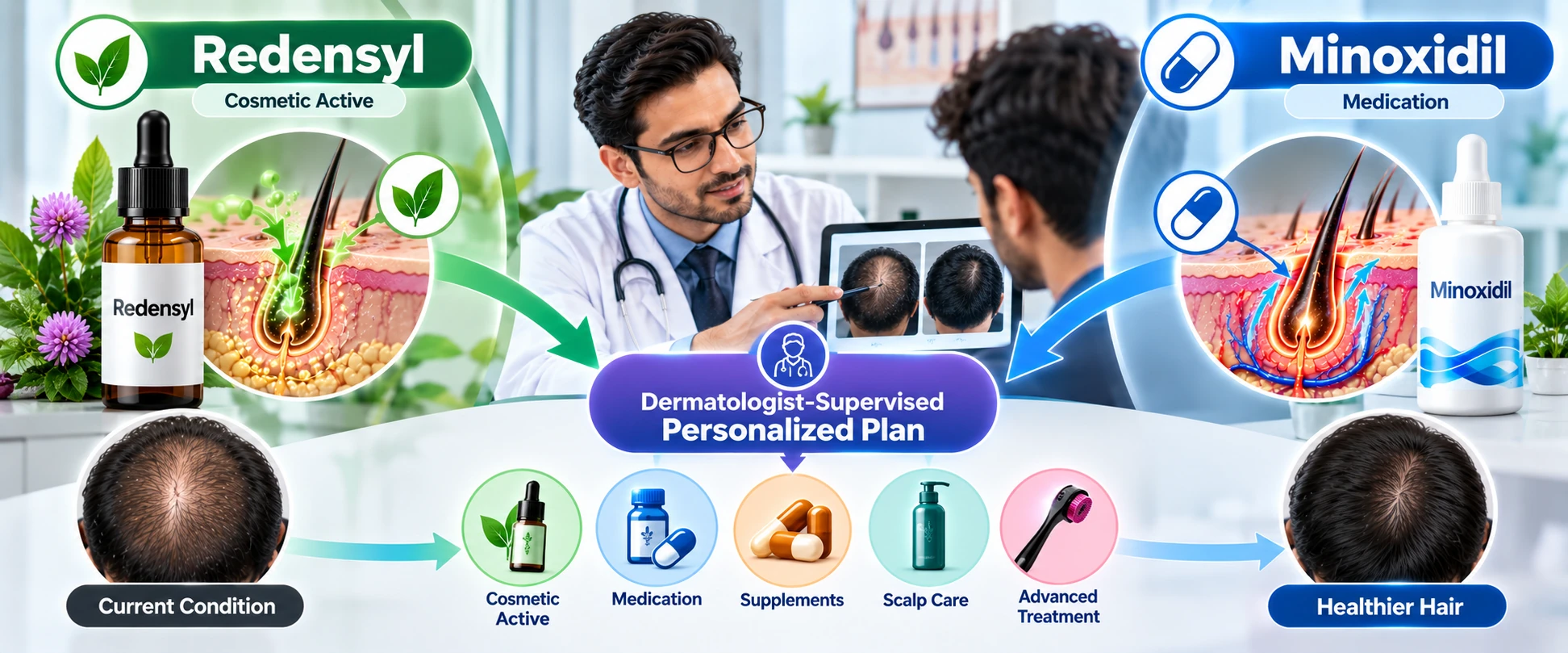
Two Categories · One Supervised Plan

Redensyl
Minoxidil
Dermatologist-Supervised Plan
A cosmetic active and a medication converging into one dermatologist-supervised plan
Combination use, when relevant, is planned and staged — not self-assembled.

Educational Tool

Educational Redensyl–Minoxidil Discussion Guide

Answer a few questions to see which topics are most relevant to raise with your dermatologist. This tool does not diagnose hair loss, prescribe minoxidil or verify the effectiveness of any Redensyl product.

Educational Guide — Not a Diagnosis or Prescription

What is your age group?

Which category best applies to you?

What best describes your main hair-loss pattern?

How long has this been happening?

Was the onset sudden or gradual?

Has a dermatologist confirmed your diagnosis?

Do you have any scalp sensitivity — itching, pain, redness, flaking?

Have you used minoxidil before?

Have you used a cosmetic hair-growth serum before?

Do you have a cardiovascular history (blood pressure, heart conditions)?

Are you pregnant, breastfeeding, or is this relevant to you?

What is your primary goal right now?

This educational result cannot diagnose hair loss, prescribe minoxidil or verify the effectiveness of a Redensyl product.

Your answers stay in your browser only. Nothing is collected, stored, or sent anywhere — closing this page clears everything.

What to Expect Over Time

Treatment Timeline — Not a Fixed Result Date

Timelines vary by diagnosis, formulation, treatment route, adherence, baseline severity, individual biology and any concomitant treatment. A meaningful response cannot be judged after only a few days — standardised photographs, taken the same way each time, can help track real change.

Before starting

Diagnosis confirmation and product-label review are commonly recommended before starting any cosmetic serum.

Early adjustment

Patch-testing and initial tolerance to the full formulation are assessed here — not just Redensyl in isolation.

First review

Assessment is commonly based on consistency of use and tolerability — product-specific timelines vary, and short studies limit what can be expected here.

Intermediate assessment

Self-assessment bias is a recognised limitation here — objective density measurement, not impression alone, is more informative.

Longer-term assessment

Any meaningful response, if present, is best evaluated with standardised photographs — evidence for exact timelines is limited and formulation-dependent.

Maintenance phase

Continued use is generally expected to be needed to sustain any observed cosmetic benefit.

Safety, Without the Drama

Side-Effect and Safety Explorer

Possible common effects

  • Irritation from fragrance or preservatives
  • Alcohol-related dryness in some formulations
  • Mild scalp tingling on application

Warrants medical advice

  • Persistent or worsening irritation
  • Signs of an allergic reaction
  • Rash spreading beyond the application area

Recognised limitations

  • Patch-testing tests the whole formulation, not Redensyl alone
  • Product contamination risk exists as with any cosmetic
  • Unclear or undisclosed labeling limits informed decisions

Groups needing special caution

  • Those with fragrance or preservative sensitivities
  • Those with a history of contact dermatitis
  • Anyone combining several leave-on products at once

Discuss before use

  • Full ingredient list, not just Redensyl
  • Any known scalp sensitivities
  • Whether the product is being used instead of or alongside diagnosis-led treatment
If you experience severe or rapidly worsening symptoms — such as difficulty breathing, chest pain, signs of a severe allergic reaction, or a mental-health crisis — seek local emergency medical care immediately rather than waiting for a scheduled appointment.

Realistic Expectations

What Results Can Realistically Be Expected?

Redensyl: Evidence limitations mean timelines are largely product-specific rather than generalisable. Short study duration, self-assessment bias in the available human data, and the need for objective density measurement rather than impression alone all limit how confidently any timeline can be stated.

Minoxidil: An early-adjustment phase (including possible initial shedding) is followed by a several-month period before meaningful assessment is possible, then a longer-term review stage. Continuing maintenance is generally required, and benefit is not expected to persist indefinitely after stopping.

Neither is guaranteed to restore a fully juvenile hairline or reverse advanced, long-inactive follicle loss. Cosmetic density (how full hair looks) and biological response (what is actually happening at the follicle) are related but different outcomes — and photography conditions must be standardised for any before/after comparison to mean anything.

Possible Reduced Shedding

Possible Stabilisation

Possible Cosmetic Density Change

Supportive Scalp Care (Redensyl)

Evidence-Led Treatment (Minoxidil)

Complete Restoration — Not Guaranteed by Either

The Honest Answer

Promising Ingredient Data Is Not the Same as Drug-Level Evidence

This is a qualitative evidence ladder, not a numeric score — no fabricated ratings are used anywhere on this page.

Where Redensyl and minoxidil evidence typically sits on the evidence hierarchy — for discussion with your dermatologist, not self-selection.
Evidence LevelRedensylMinoxidil
In-vitro mechanismPresent — supplier laboratory dataPresent — historically established
Ex-vivo follicle researchPresent, supplier-associatedPresent, independently replicated
Supplier testingPrimary evidence sourceNot the primary evidence source
Uncontrolled human studySome available, often on finished productsHistorically present, superseded by later work
Controlled human trialLimitedPresent
Independent replicationLimitedPresent
Systematic reviewNot established as availablePresent
Regulatory evaluationNot evaluated or approved as a drugApproved, route-specific labeling
Long-term surveillanceNot establishedPresent through regulatory pharmacovigilance
Neither treatment's evidence position is a verdict on personal suitability — but the evidence gap between the two categories is real, and this page does not pretend otherwise.

Setting the Record Straight

Myths vs Medical Reality

Myth

"Redensyl is clinically proven better than minoxidil."

Medical Reality

No robust, independent head-to-head evidence supports this. Direct comparative studies between the two are insufficient to make this claim.

Myth

"Natural ingredients have no side effects."

Medical Reality

"Natural" does not automatically mean risk-free; formulation, concentration and individual sensitivity all still matter.

Myth

"Redensyl is a stem-cell treatment."

Medical Reality

It is a cosmetic active with proposed effects on the follicle stem-cell microenvironment — a laboratory hypothesis, not an actual stem-cell procedure.

Myth

"Redensyl is an approved hair-loss medicine."

Medical Reality

It is a cosmetic ingredient, not evaluated or approved by drug regulators as a hair-loss medicine.

Myth

"Every Redensyl serum is identical."

Medical Reality

Concentration, vehicle, co-actives and formulation quality vary considerably between branded products.

Myth

"Higher Redensyl percentage guarantees better results."

Medical Reality

A higher disclosed concentration does not, by itself, guarantee a better outcome — formulation and delivery matter too.

Myth

"A multi-active serum proves Redensyl works."

Medical Reality

Improvement with a finished multi-active product cannot be attributed to Redensyl alone unless it was isolated in the study design.

Myth

"Minoxidil permanently damages hair."

Medical Reality

No credible evidence supports permanent damage from appropriate use; some users experience temporary irritation or shedding.

Myth

"Initial shedding means minoxidil has failed."

Medical Reality

Early shedding is a recognised, often temporary phase related to the hair cycle resetting — not necessarily treatment failure.

Myth

"Minoxidil works for every type of hair loss."

Medical Reality

It is primarily relevant to diagnosed pattern hair loss, not autoimmune, scarring or nutritional causes.

Myth

"Redensyl works for completely bald scalp."

Medical Reality

It is not established as effective on follicles that are no longer active — a long-bald, smooth scalp is a different situation from early thinning.

Myth

"Redensyl requires no maintenance."

Medical Reality

Like most cosmetic and medical hair-care approaches, continued use is generally required to sustain any observed benefit.

Myth

"Minoxidil dependency means addiction."

Medical Reality

Needing continued use to sustain benefit is a pharmacological maintenance requirement, not addiction in the clinical sense.

Myth

"Cosmetic serum and medication are evidence-equivalent."

Medical Reality

They are not. Minoxidil carries a broader, more independently verified clinical evidence base than any single cosmetic serum ingredient.

Myth

"Redensyl has zero systemic risk."

Medical Reality

This has not been independently and comprehensively established; formulation-dependent absorption is not fully characterised.

Myth

"Topical minoxidil has no systemic considerations."

Medical Reality

Some systemic absorption can occur with topical products depending on scalp condition and area treated.

Myth

"Oral minoxidil is merely stronger topical minoxidil."

Medical Reality

Oral minoxidil has a distinct systemic safety profile requiring cardiovascular history review — it is not simply a stronger version of the topical product.

Myth

"Using both guarantees maximum regrowth."

Medical Reality

Combining products is not proven to guarantee superior results and can complicate identifying the cause of any adverse effect.

Before Choosing a Product

Red Flags: When Diagnosis Comes Before Any Product Choice

If any of the following apply, the right first step is medical evaluation — not choosing between a serum and a medicine.

Sudden shedding
Patchy loss
Scarring signs
Painful scalp
Pus or crusting
Severe inflammation
Hair loss in a child
Pregnancy
Breastfeeding
Cardiovascular symptoms
Unexplained systemic symptoms
No diagnosis
Guaranteed-regrowth claims
"Better than minoxidil" claims without published evidence
Ingredient concentration not disclosed
Study formula differs from sold product
Before-and-after images without standardisation
Pressure to stop prescribed treatment
Subscription pressure
Fake dermatologist endorsement

Prepare for Your Visit

Consultation Checklist

Medically Reviewed

Medically Reviewed By

Dr. Amit S. Agarkar

Dermatologist, Trichologist and Hair Transplant Surgeon

Medical reviewer: Dr. Amit Agarkar, MD Dermatology Editorial role: Medical review, ingredient-claim review and content oversight Review date: 23 July 2026 Next review date: 23 January 2027

Full profile · Medical editorial policy · Correction policy · Advertising disclosure · References

Cosmetic ingredient claims should be clearly distinguished from drug evidence, regulatory approval and diagnosis-led treatment recommendations. Medical information is periodically reviewed and may change as evidence, product labeling and regulatory guidance evolve.

A calm dermatologist-led consultation weighing a cosmetic active against a medication
Assessment starts with diagnosis and evidence review, not a product choice.

Sources

Medical References

This list reflects the categories of authoritative source used to inform this page's general statements. Editorial note: exact citation numbers, article titles and access dates should be finalised and verified by the reviewing dermatologist before publication — this page intentionally avoids inventing specific study outcomes, percentages or journal citations that have not been verified. Retailer pages are not cited as clinical evidence.

  1. US FDA-approved prescribing information (label) for topical minoxidil — mechanism, application guidance, and safety labeling language. FDA Verify current label version
  2. Central Drugs Standard Control Organisation (CDSCO) — current approved prescribing information for minoxidil formulations marketed in India. CDSCO Verify current listing
  3. Peer-reviewed systematic reviews and clinical trials on topical and oral minoxidil for androgenetic alopecia, indexed in recognised medical literature databases. PubMed To be cited individually once selected by reviewing dermatologist
  4. Ingredient supplier technical literature for Redensyl (dihydroquercetin-glucoside and EGCG2 components) — presented here as supplier-sourced material, not independent clinical evidence. To be cited individually with clear supplier attribution once selected by reviewing dermatologist
  5. Independent, non-supplier-funded human studies on Redensyl or its components, where identified in indexed literature. PubMed To be cited individually once selected by reviewing dermatologist
  6. Published studies on finished multi-active serum products containing Redensyl, with explicit notation of co-active ingredients tested. PubMed To be cited individually once selected by reviewing dermatologist
  7. Direct comparative studies of Redensyl versus minoxidil, where independently identified — noted here as insufficient in number and quality at the time of writing. PubMed To be reviewed for updates
  8. Cosmetic-ingredient regulation sources (e.g. BIS or relevant cosmetic-regulatory guidance in India) for classification of cosmetic actives versus drugs. Bureau of Indian Standards Verify current relevance
  9. Contact-dermatitis and cosmetic-irritant literature relevant to leave-on scalp serums. PubMed To be cited individually once selected by reviewing dermatologist
  10. Indian Association of Dermatologists, Venereologists and Leprologists (IADVL) — clinical guidance on androgenetic alopecia management. IADVL Verify current guideline version
  11. American Academy of Dermatology (AAD) — patient-education resources on androgenetic alopecia and treatment options. AAD Verify current resource

Common Questions

Frequently Asked Questions

Thirty-two questions, organised by what you're actually trying to figure out — grouped below, not just listed.

Comparison

Redensyl is a trademarked cosmetic active used within selected leave-on hair serums, proposed by its supplier to support the follicle stem-cell microenvironment.

No. It is a cosmetic ingredient, not evaluated or approved by drug regulators as a medicine.

It is not approved as a hair-loss drug. It is marketed as a cosmetic active within finished serum products.

Redensyl is a cosmetic active with formulation-dependent, comparatively limited evidence. Minoxidil is a regulated medicine with a broader clinical evidence base.

No robust, independent head-to-head evidence supports this claim. The two are not evidence-equivalent categories.

This is not established. Direct substitution has not been proven, and stopping medically advised minoxidil for a cosmetic serum alone is not recommended without medical discussion.

Minoxidil has a broader, more independently verified clinical evidence base. Redensyl's evidence is comparatively limited and largely supplier-associated.

Who It May Suit

Some laboratory and limited human evidence proposes supportive effects, but this is not established as reliable regrowth in the way minoxidil's evidence is characterised.

It may support the growth cycle and reduce shedding in some users, but response varies and it does not work for everyone.

It is sometimes marketed for this, but evidence is formulation-dependent and not established as equivalent to diagnosis-led treatment.

Similarly marketed toward women in some products, but the evidence base is not sex-specific or robust.

This is not established as safe or unsafe — verify the specific product's label and consult a healthcare provider.

Suitability during pregnancy requires direct medical guidance rather than self-decision.

Neither is established as a treatment for this autoimmune condition, which has a different mechanism than pattern hair loss.

Neither is established as a targeted treatment for this type of diffuse, trigger-related shedding.

Effects & Timeline

This is not well characterised in independent literature.

Some users notice a temporary increase in shedding early on, related to the hair cycle resetting.

This is not well established; timelines are largely product-specific and evidence is limited.

Meaningful assessment typically requires several months of consistent, correctly diagnosed use.

No. Concentration, vehicle, co-actives and formulation quality vary considerably between branded products.

Not necessarily. A higher disclosed concentration alone does not guarantee a better outcome.

It is not established as effective on follicles that are no longer active, such as a long-smooth bald scalp.

Practical & Safety

It is a laboratory-processed cosmetic ingredient derived from botanical sources — not simply a raw natural extract.

No. It is a cosmetic active with proposed, supplier-supported effects on the follicle stem-cell microenvironment — not an actual stem-cell procedure.

It is used within multi-ingredient serums, so irritation or allergic reactions can relate to fragrance, preservatives or other actives, not necessarily Redensyl itself.

It has a recognised safety profile with documented possible effects such as scalp irritation and initial shedding — individual tolerance varies.

It requires cardiovascular history review and medical supervision; it is not a self-started option.

Combination use is common in practice, but direct evidence for the combination itself may be limited — a staged introduction is generally easier to evaluate.

Benefit generally does not persist, and hair loss may resume its untreated course over time.

This is not well characterised in independent literature.

Standardised photographs taken the same way each time, alongside objective density assessment, are more reliable than self-impression alone.

Before starting any hair-loss product or medicine, and sooner if you notice sudden or patchy loss, scalp symptoms, or hair loss alongside other unexplained health changes.

Next Step

Choose Evidence and Diagnosis — Not the Most Persuasive Serum Claim

A dermatologist-led assessment can identify the cause and stage of hair loss, review scalp sensitivity, evaluate whether minoxidil is appropriate, and explain whether a cosmetic active such as Redensyl has a supportive role within a broader plan.

Disclaimer: This page is for educational purposes only and does not replace professional medical advice, diagnosis or treatment. Individual results vary. Redensyl is a cosmetic active used within selected serum formulations; it is not evaluated or approved as a hair-loss medicine, and its evidence base is formulation-dependent and comparatively limited. Minoxidil is a medication with a broader clinical evidence base; it is not presented here as guaranteed to work for every patient. Oral minoxidil for hair loss is generally an off-label use requiring medical supervision. Redensyl is not established as an evidence-equivalent replacement for minoxidil, and combination use has not been independently proven to outperform either product alone. Always consult a qualified dermatologist before starting, stopping or combining any hair-loss product or treatment. Content reviewed by Dr. Amit Agarkar, MD Dermatology.

Your Cart (0)

Your cart is empty

Subtotal0
DeliveryFREE
Total0
🔒 Secure📦 Free above ₹499↩ Easy returns
💬 Hi! I'm Dr. Amit — your Hair Intelligence consultant
🌿
1
🌿
Dr. Amit
Virtual Dermatologist · Hairsncares.com
Online
What are you shopping for today?
Select a category to begin
AI-powered scalp diagnosis · Hairsncares.com
📸
Scalp Analyser
Upload scalp photo · Get conditions, root cause, and matched product protocol
📷
Drop scalp photo here or click to upload
JPG, PNG, WEBP · Clear, close-up, well-lit photo

Your image is processed privately by our AI engine and saved securely with your account.