Skip to content
Dermatologist-reviewed education · Not a prescription · Treatment suitability requires individual medical assessment Last medically reviewed: 22 July 2026 Medical editorial policy Book a consultation

Procedure vs Medication Treatment Intelligence

PRP vs Minoxidil for Hair Loss: Results, Safety, Cost and Which May Suit You

PRP and minoxidil work in fundamentally different ways. PRP is an in-clinic procedure using a preparation made from your own blood, injected into the scalp in sessions. Minoxidil is a medication-based treatment — applied topically, or in selected cases taken orally under medical supervision — that depends on consistent, ongoing use. Topical and oral minoxidil carry separate safety discussions and are not interchangeable. PRP's quality depends on preparation and injection protocol; minoxidil's effect depends heavily on adherence. Neither is universally better, and combination treatment may be discussed in selected patients. This page is educational, not a prescription.

Dermatologist Reviewed Procedure vs Medication Explained Evidence Limitations Disclosed Safety by Treatment Route India-Focused Guidance
Scientific comparison of PRP scalp treatment and minoxidil therapy for dermatologist-guided hair-loss care
A procedure and a continuing treatment — compared, not ranked.
Dermatologist-Reviewed Evidence-Aware Content No Data Collected by Tools on This Page India-Focused Guidance Autologous or Topical — Not Automatically Risk-Free

Quick Answer

PRP is an in-clinic injectable treatment prepared from your own blood, delivered in sessions. Minoxidil is a medication used topically or, in selected cases, orally under medical supervision, and generally requires ongoing consistent use to sustain any benefit. Evidence, cost, risk and convenience differ between them, and neither is universally superior — they may also be discussed together in selected patients after assessment.

Do not start oral minoxidil or undergo PRP without appropriate medical assessment. This page is educational — a dermatologist should confirm your diagnosis before any treatment decision.

At a Glance

PRP and Minoxidil, Side by Side

Neither panel is ranked above the other. Use "Compare by" to highlight one consideration across both treatments at once — the goal is clarity, not a declared winner.

PRP

What it isAn in-clinic procedure using a platelet-rich plasma preparation made from your own blood
Delivery routeInjected into selected scalp areas after blood processing
Evidence qualitySupportive clinical literature, though preparation protocols vary considerably between clinics
Adherence burdenRequires clinic visits for each session rather than daily home effort
Pain and downtimeBlood draw and injection discomfort; minimal downtime typically discussed
Cost structureUpfront per-session cost; varies by clinic, protocol and number of sessions
MaintenancePeriodic maintenance sessions may be discussed depending on response
Safety flagAutologous does not mean risk-free — injection and infection-related risks require sterile technique
Diagnosis Confirmation Essential

Minoxidil

What it isA medication used topically or, in selected cases, orally to support the hair-growth cycle
Delivery routeTopical solution/foam applied at home; low-dose oral minoxidil in select, doctor-supervised cases
Evidence qualityLonger and broader clinical evidence history, though route and formulation-specific differences matter
Adherence burdenRequires consistent daily application or dosing at home — no clinic visit needed per use
Pain and downtimeGenerally painless application; possible scalp irritation with topical use, no procedural downtime
Cost structureLower per-unit cost but ongoing, continuing expense for as long as treatment continues
MaintenanceRequires continued, regular use; effects generally do not persist after stopping
Safety flagTopical and oral forms are not interchangeable in safety profile — oral route needs cardiovascular review
Medical Review Recommended

The Core Distinction

PRP Is a Procedure. Minoxidil Is an Ongoing Treatment.

In , genetically susceptible follicles gradually shrink over successive growth cycles. PRP and minoxidil both may support the growth-cycle side of this process, but the treatment experience is fundamentally different: PRP is a clinic-based procedure delivered in sessions, while minoxidil is a continuing, adherence-dependent treatment used at home or under supervision.

Diagnosis

Confirms the type and stage of hair loss before either treatment is discussed.

Blood Collection & Processing

For PRP: blood is drawn and to prepare a platelet-rich plasma injectable.

PRP pathway

Scalp Injection

The preparation is injected into selected scalp areas in a clinic session.

PRP pathway

Route Selection

For minoxidil: topical application or, in selected cases, supervised oral use is chosen based on diagnosis and history.

Minoxidil pathway

Consistent, Continuing Treatment

Minoxidil requires ongoing, regular use at home — its supportive effect depends on adherence over months, not a single visit.

Minoxidil pathway

Follow-Up & Reassessment

Both pathways require standardised photography and periodic clinical review to judge real response.

Treatment Burden — PRP

Clinic attendance for each session · procedure discomfort · upfront session cost · protocol quality varies by clinic

Treatment Burden — Minoxidil

Home-based daily adherence · recurring application or dosing · continuing medication expense · formulation quality varies by product

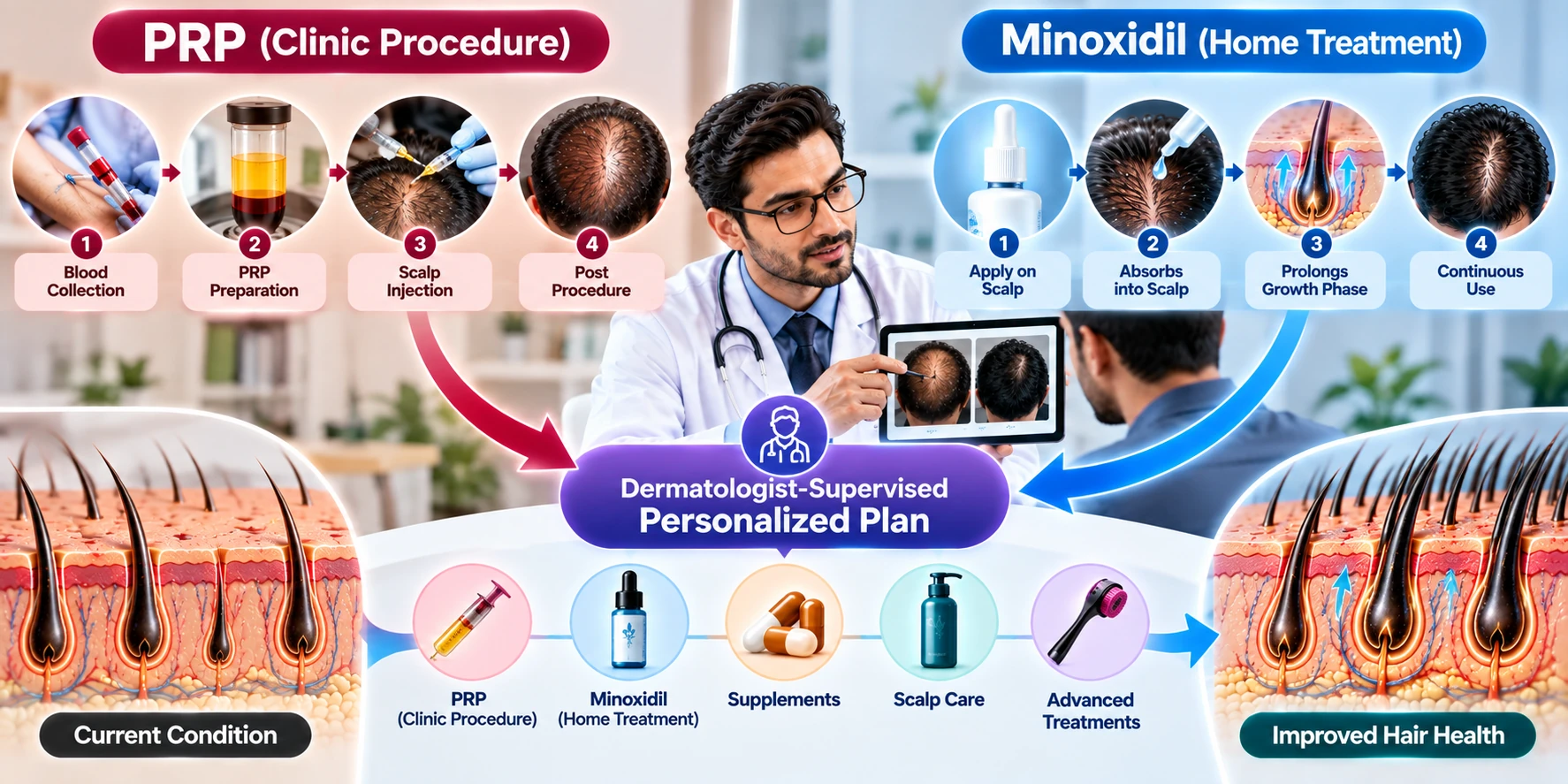
Diagram comparing the PRP clinic-procedure pathway and the minoxidil continuing-treatment pathway
A simplified view of how the PRP procedure and minoxidil treatment pathways differ — not a diagnostic tool.

In Detail

Full Comparison Table

Swipe to compare →

PRP and minoxidil compared across treatment format, evidence, practical experience, safety and cost. Reflects general, non-personalised information — protocols and formulations vary, and individual medical assessment is always required.
ConsiderationPRPMinoxidil
Treatment categoryIn-clinic autologous procedureMedication — topical or, in selected cases, oral
Treatment routeInjection into the scalpTopical application, or supervised oral dosing
Clinic requirementRequired for every sessionNot required for routine daily use; periodic review still matters
Starting materialYour own bloodManufactured medication
Regulatory statusProcedure, not a licensed drug productTopical forms widely approved; oral use may be off-label depending on jurisdictionVerify Current Status
Evidence quantitySupportive clinical literature; preparation protocols vary considerablyLonger and broader clinical evidence history, route-dependent
Protocol / formulation variationCentrifugation method, activation and kit vary by clinicConcentration, formulation and brand vary by product
Initial treatment burdenMultiple in-clinic sessions typically discussedDaily application or dosing from day one
Daily adherenceNot required between sessionsEssential — effect depends on consistency
Procedure durationA single visit per session, duration varies by clinicNot applicable — ongoing daily routine instead
PainBlood-draw and injection discomfortGenerally painless; topical irritation possible
DowntimeMinimal typically discussed; individual variation existsNone expected from routine use
Common temporary effectsInjection-site tenderness, redness, bruisingScalp irritation (topical); dizziness or fluid effects (oral)
Cardiovascular considerationsNot a primary concernOral route requires blood-pressure and heart-rate history review
Scalp irritationPossible at injection sites, generally short-livedRecognised with topical formulations, formulation-dependent
Unwanted hair growthNot a typical considerationPossible with topical spillover or oral systemic exposure
Temporary sheddingNot typically describedRecognised, usually temporary phenomenon in early weeks
Infection riskPresent — requires sterile techniqueNot applicable to topical or oral use
Pregnancy considerationsRequires individual medical guidanceNot established as suitable — requires medical guidance
Number of sessionsMultiple initial sessions commonly discussed, then maintenanceNot session-based — continuous daily use
Time before assessmentSeveral months, with standardised photographySeveral months of consistent use, per clinical judgement
MaintenancePeriodic maintenance sessions may be discussedContinued use required to sustain any benefit
After stoppingBenefit may fade gradually without maintenanceBenefit generally does not persist
Male-pattern hair lossMay be discussed after diagnosis confirmationMay be considered after assessment
Female-pattern hair lossMay be discussed after diagnosis confirmationMay be considered after assessment; formulation-dependent
Post-transplant supportSometimes discussed with surgeon coordinationSometimes discussed with surgeon coordination
CostUpfront per-session cost; varies by clinic and protocolLower per-unit cost, but ongoing for as long as treatment continues
ConvenienceRequires clinic attendance for each sessionFits into a daily routine at home
Combination useMay be discussed alongside minoxidil after assessmentMay be discussed alongside PRP after assessment
Clinician dependenceSignificant — technique and protocol quality affect outcomeLower for topical use; oral route needs ongoing prescriber input
Need for monitoringPeriodic dermatologist review regardless of session countPeriodic review, more intensive for oral route

PRP

PRP: In-Clinic Platelet-Rich Plasma Treatment

What PRP is

Platelet-Rich Plasma is a preparation made from your own blood, processed to concentrate platelets within the plasma fraction, then injected into selected scalp areas. It is a procedure performed in a clinical setting, not a medication you take home.

Blood collection

A sample of your own blood is drawn after medical assessment, using standard venepuncture technique.

Centrifugation

The blood sample is spun at controlled speed to separate red cells, white cells, platelets and plasma by density, isolating the platelet-rich fraction for use.

Platelet concentration

Published research often references platelet concentration relative to baseline blood levels. A higher concentration in the final preparation does not automatically translate into a proportionally better clinical result.

Leukocyte-rich versus leukocyte-poor concepts

Some PRP protocols aim to include more white blood cells (leukocyte-rich), others aim to minimise them (leukocyte-poor). Which approach is preferable for hair loss specifically is not settled in the published literature.

Single-spin versus double-spin methods

A single centrifugation step versus two sequential spins can produce different platelet concentrations and cellular content in the final product — protocol choice is clinic-dependent.

Activation

Some protocols activate platelets before injection to trigger growth-factor release outside the body; others rely on activation occurring naturally after injection into tissue. Both approaches are used in practice.

Scalp injection

The prepared plasma is injected into selected scalp areas in a single clinic visit per session, using a series of small injections across the treatment area.

Proposed follicular effects and growth-factor signalling

Growth factors released from platelets are proposed to support angiogenesis (new blood-vessel formation) and cell signalling around the follicle, which may influence the growth cycle in responsive follicles. This is a biological rationale supported by laboratory and early clinical research, not a guaranteed mechanism in every patient.

Diagnoses in which PRP may be discussed

PRP is most commonly discussed for diagnosed androgenetic (pattern) hair loss, sometimes alongside other treatments. It is not automatically appropriate for every type of hair loss — diagnosis should come first.

Procedure discomfort and anaesthesia options

Blood draw and scalp injections can cause discomfort. Topical numbing cream or local anaesthetic may be discussed depending on clinic protocol and patient sensitivity.

Initial session planning and maintenance

Multiple initial sessions are commonly discussed, with response assessed over time using standardised photography. Maintenance sessions may be raised depending on individual response — this is not a one-time procedure with guaranteed permanence.

Response variation and protocol heterogeneity

Response to PRP varies meaningfully between individuals and depends on diagnosis, hair-loss stage, follicle viability, preparation quality and injection technique. Because protocols differ by clinic, results from one provider cannot be assumed to apply to another.

Safety and contraindications

Because PRP uses your own blood, it avoids some risks associated with foreign biological material, but it is not risk-free. Bleeding disorders, active scalp infection, certain anticoagulant medicines, low platelet counts and some systemic conditions may affect suitability — these require medical review, not assumption.

What PRP cannot do

PRP does not create new hair follicles where follicles are permanently absent, cannot reverse scarring alopecia, and does not replace diagnosis-based treatment when another condition is present.

When to contact the clinician

Persistent pain, spreading redness, signs of infection, or symptoms that feel disproportionate to a routine procedure should prompt contact with your treating clinician rather than waiting.

PRP Reality Check

  • PRP is not one completely standardised treatment — protocols vary by clinic
  • Clinic preparation quality matters as much as the treatment name
  • More platelets do not automatically mean better results
  • Results vary meaningfully between individuals
  • Multiple sessions may be required, and maintenance may be discussed
  • PRP cannot create follicles in permanently bald areas
  • PRP does not replace diagnosis-based treatment
PRP procedure and platelet-signalling concept, illustrated for patient education
Platelet-rich plasma is prepared from your own blood in a clinical setting — preparation quality varies by clinic.

Minoxidil

Minoxidil: Medication-Based Hair-Growth Support

Topical and oral minoxidil are not equivalent and are discussed separately below — their safety profiles, evidence and monitoring needs differ.

Topical Minoxidil

What topical minoxidil is

A medication applied directly to the scalp as a solution or foam, available in different concentrations. It is the more established and widely used route of minoxidil for hair loss.

Available formulations, foam versus solution

Products vary in strength and vehicle. Foam formulations are often better tolerated by people with oily scalps or sensitivity to certain solution-based carriers, but tolerance is individual — a dermatologist can help match formulation to scalp type.

Concentration differences

A concentration or formulation suited to one person's scalp and diagnosis should not be assumed to apply identically to another person.

Scalp application and consistency

Applied on a regular schedule directly to the scalp. Its supportive effect is generally understood to require continued, consistent use.

Scalp irritation and sensitivity

Itching, dryness or flaking can occur, more often with solution-based products than foam, and in some cases related to propylene-glycol sensitivity where relevant to the formulation. Formulation switching or a treatment pause may be discussed with a dermatologist if irritation persists.

Temporary shedding

Some people notice increased shedding in the early weeks of use — a recognised, typically temporary phenomenon related to the hair cycle resetting. Heavy, prolonged shedding or shedding with scalp symptoms should be discussed with a dermatologist rather than assumed to be normal.

Unwanted facial or body hair, application errors

Unwanted hair growth can occur with topical spillover onto adjacent skin. Careful, limited application to the intended area reduces this risk.

What happens after stopping

Benefits gained during treatment are generally not expected to persist after stopping, and hair loss may resume its untreated course over time.

Oral Minoxidil

Original pharmacological use and off-label context

Minoxidil was originally developed for a different medical purpose. Low-dose oral minoxidil for hair loss is generally considered an off-label use in most markets, meaning it is used based on clinical judgement rather than an approved hair-loss label — this must be confirmed with a prescriber rather than assumed.

Need for medical supervision

Oral minoxidil is not a self-started option. Its systemic safety profile differs from the topical route and requires structured medical oversight.

Blood-pressure history and cardiovascular considerations

Blood-pressure and cardiovascular history review is required before considering oral minoxidil, given its systemic vasodilator effect.

Fluid retention, heart-rate considerations, dizziness

Fluid retention, changes in heart rate, and dizziness are recognised considerations with oral use and should be monitored by the prescribing clinician.

Unwanted hair growth

Systemic exposure with oral use carries a different, generally more noticeable, likelihood of unwanted hair growth on the face or body compared with topical use.

Medicine interactions and patient-selection importance

Current medicines should be reviewed for potential interactions before starting oral minoxidil, and candidacy should be individually assessed rather than assumed.

Shared Minoxidil Discussion

Who may be assessed, what minoxidil cannot treat

People with diagnosed male- or female-pattern hair thinning are commonly discussed as candidates for either route, subject to individual assessment. Minoxidil does not diagnose the underlying cause of hair loss and is not established as a treatment for every type of alopecia.

Pregnancy and breastfeeding considerations

Minoxidil's suitability during pregnancy or breastfeeding, by either route, requires direct medical guidance rather than self-directed use.

When to contact the clinician, when urgent review may be appropriate

Persistent scalp irritation, chest discomfort, unexplained swelling, rapid heart rate, or lightheadedness (particularly relevant to oral minoxidil) warrant prompt medical contact rather than self-management.

Minoxidil Reality Check

  • Topical and oral routes are not equivalent — separate safety discussions apply
  • Consistency is essential; results depend heavily on adherence
  • Results vary meaningfully between individuals
  • Benefits may fade after discontinuation
  • Scalp irritation can occur with topical products
  • Oral treatment requires cardiovascular assessment and is not self-started
  • Minoxidil does not diagnose the cause of hair loss
  • It does not guarantee complete restoration
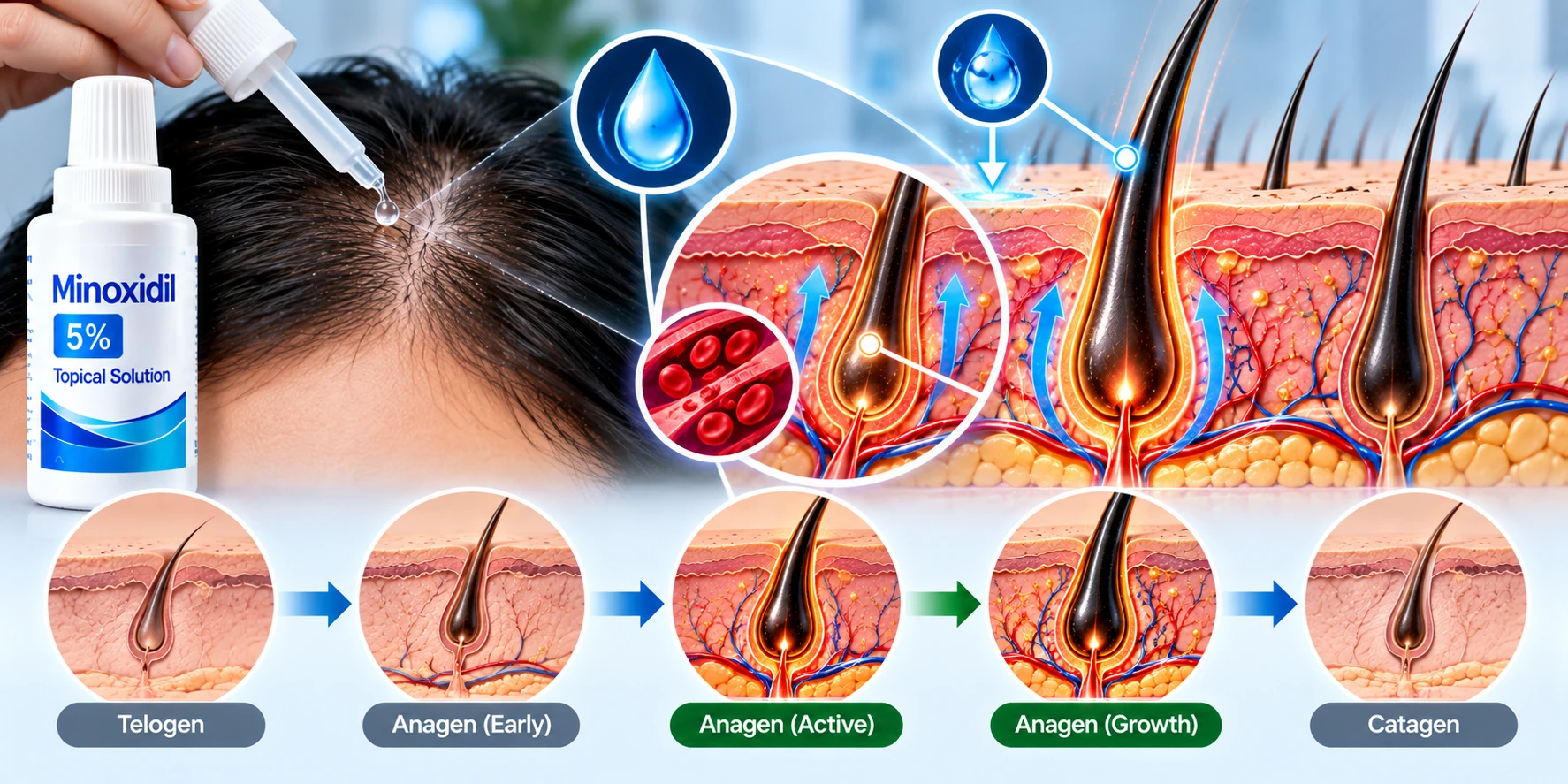
Minoxidil's role in supporting the hair-growth cycle, illustrated for patient education
How minoxidil is understood to support the active growth phase of the hair cycle.

By Scenario

PRP vs Minoxidil by Patient Scenario

These are educational starting points for a conversation with a dermatologist — not personalised treatment recommendations.

Early Male-Pattern Thinning

Why diagnosis matters
Early confirmation of pattern hair loss helps establish realistic goals and keeps more options available.
Which treatment may be discussed
Either PRP or minoxidil may be raised once diagnosis is confirmed, sometimes together.
What requires medical review
Baseline photography and a documented diagnosis before starting.
What neither treatment can guarantee
A specific rate or amount of regrowth.
Next step
Dermatologist assessment to confirm pattern and discuss realistic options.

Female-Pattern Hair Loss

Why diagnosis matters
Hormonal, thyroid and iron status all warrant review in women with thinning.
Which treatment may be discussed
Topical minoxidil is more commonly discussed for women; PRP may also be raised after assessment.
What requires medical review
Endocrine and nutritional assessment where relevant.
What neither treatment can guarantee
Reversal of hormonally driven thinning without addressing the underlying cause.
Next step
Dermatologist and, where relevant, endocrine assessment.

Diffuse Thinning

Why diagnosis matters
Diffuse shedding often has causes unrelated to pattern hair loss, such as nutritional or thyroid factors.
Which treatment may be discussed
Underlying cause should be identified before either treatment is considered.
What requires medical review
Blood tests and detailed history first.
What neither treatment can guarantee
Improvement without addressing the underlying cause.
Next step
Blood tests and detailed history before any treatment decision.

Recent Telogen Effluvium

Why diagnosis matters
This is often self-limiting and stress- or illness-related, distinct from pattern hair loss.
Which treatment may be discussed
Supportive care is often prioritised over starting new treatment immediately.
What requires medical review
Reassessment if shedding persists beyond the expected recovery window.
What neither treatment can guarantee
A guaranteed faster recovery from starting either treatment.
Next step
Monitor and reassess; treat the underlying trigger first.

Advanced Baldness

Why diagnosis matters
Follicle viability in long-bald areas is typically limited.
Which treatment may be discussed
Neither treatment is expected to work well on areas with little remaining follicle activity.
What requires medical review
Realistic discussion of what is and is not achievable.
What neither treatment can guarantee
New follicles in areas with none remaining.
Next step
Dermatologist assessment of follicle viability before any treatment.

Smooth Bald Scalp

Why diagnosis matters
A completely smooth, long-bald scalp usually indicates no viable follicles remain in that area.
Which treatment may be discussed
Neither PRP nor minoxidil is expected to regrow hair on a fully bald scalp.
What requires medical review
Discussion of surgical or other options if relevant.
What neither treatment can guarantee
Regrowth on a scalp with no viable follicles.
Next step
Dermatologist discussion of realistic alternatives.

Post-Hair-Transplant Support

Why diagnosis matters
Ongoing native-hair protection is often part of post-transplant planning.
Which treatment may be discussed
Either may be discussed as part of a maintenance plan for surrounding native hair.
What requires medical review
Coordination with your transplant surgeon.
What neither treatment can guarantee
A substitute for the transplant procedure itself.
Next step
Follow your surgeon's and dermatologist's combined maintenance plan.

Topical Minoxidil Irritation

Why diagnosis matters
Persistent scalp irritation can affect adherence and comfort.
Which treatment may be discussed
Formulation switching, or PRP as an alternative, may be discussed.
What requires medical review
Trying a different formulation before assuming minoxidil cannot be tolerated at all.
What neither treatment can guarantee
Guaranteed resolution by switching treatments.
Next step
Discuss formulation options and alternatives with your dermatologist.

Unable to Maintain Daily Application

Why diagnosis matters
Minoxidil's benefit depends heavily on consistent use.
Which treatment may be discussed
PRP's session-based format may be discussed as a lower-adherence-burden alternative.
What requires medical review
Honest discussion of realistic adherence before committing to either plan.
What neither treatment can guarantee
PRP results without any ongoing commitment at all — maintenance sessions still apply.
Next step
Discuss which treatment format realistically fits your routine.

Needle Anxiety

Why diagnosis matters
Comfort with the treatment format affects which option is realistic to sustain.
Which treatment may be discussed
Topical minoxidil may be discussed as a needle-free alternative.
What requires medical review
Discussing anxiety openly rather than avoiding treatment altogether.
What neither treatment can guarantee
That anxiety about needles is irrelevant to treatment choice.
Next step
Raise needle anxiety directly with your dermatologist.

Low Platelet Count

Why diagnosis matters
A low platelet count may limit the usefulness of a platelet-based procedure.
Which treatment may be discussed
PRP suitability needs specific medical review; minoxidil may be discussed instead.
What requires medical review
Blood-test review before considering PRP.
What neither treatment can guarantee
That PRP will work the same regardless of baseline platelet count.
Next step
Share recent blood-test results with your dermatologist.

Bleeding Disorder

Why diagnosis matters
Bleeding disorders affect the safety of any injectable procedure.
Which treatment may be discussed
PRP requires specific medical clearance; topical minoxidil may be more straightforward.
What requires medical review
Haematology input before considering PRP.
What neither treatment can guarantee
That autologous blood makes PRP automatically safe regardless of bleeding risk.
Next step
Medical clearance from your treating physician first.

Anticoagulant Use

Why diagnosis matters
Blood-thinning medicines affect bleeding and bruising risk with injections.
Which treatment may be discussed
PRP needs coordinated review with your prescribing physician; minoxidil may be more straightforward.
What requires medical review
Discuss whether anticoagulant timing can be adjusted, and by whom.
What neither treatment can guarantee
That stopping anticoagulants for PRP is a decision to make independently.
Next step
Coordinate with your prescribing physician before considering PRP.

Cardiovascular History

Why diagnosis matters
Oral minoxidil has systemic cardiovascular effects; PRP is generally not a cardiovascular concern.
Which treatment may be discussed
Topical minoxidil or PRP may be discussed; oral minoxidil needs cardiology-aware review.
What requires medical review
Blood-pressure and cardiovascular history review before oral minoxidil.
What neither treatment can guarantee
That oral minoxidil is automatically appropriate given a cardiovascular history.
Next step
Full cardiovascular history disclosure to your prescriber.

Low Blood Pressure

Why diagnosis matters
Oral minoxidil is a vasodilator and can affect blood pressure further.
Which treatment may be discussed
Topical minoxidil or PRP may be discussed instead of oral minoxidil.
What requires medical review
Blood-pressure monitoring if oral minoxidil is still being considered.
What neither treatment can guarantee
That oral minoxidil carries no blood-pressure-related risk.
Next step
Discuss your blood-pressure history explicitly before any oral treatment.

Pregnancy

Why diagnosis matters
Both PRP and minoxidil carry pregnancy-related considerations requiring medical guidance.
Which treatment may be discussed
Treatment is generally deferred or requires specific individual guidance during pregnancy.
What requires medical review
Direct discussion with your obstetric and dermatology providers.
What neither treatment can guarantee
That either treatment is established as routinely safe during pregnancy.
Next step
Discuss timing and safety directly with your obstetric and dermatology providers.

Breastfeeding

Why diagnosis matters
Minoxidil's suitability during breastfeeding requires direct medical guidance.
Which treatment may be discussed
Individual guidance from your dermatologist, considering the breastfeeding period.
What requires medical review
Direct medical guidance before starting either treatment.
What neither treatment can guarantee
That either treatment is automatically safe while breastfeeding.
Next step
Discuss with your dermatologist and, where relevant, your child's paediatrician.

Scalp Infection

Why diagnosis matters
Active scalp infection is a reason to delay any scalp procedure or topical treatment.
Which treatment may be discussed
Neither PRP nor minoxidil is appropriate until the infection resolves.
What requires medical review
Treatment of the active infection first.
What neither treatment can guarantee
That either treatment can proceed safely alongside an active infection.
Next step
Treat the infection first, then reassess.

Scarring Alopecia

Why diagnosis matters
Scarring alopecia generally reflects permanently damaged follicles.
Which treatment may be discussed
Neither treatment is expected to be effective in truly scarred areas.
What requires medical review
Dermatologist evaluation of the extent and activity of scarring.
What neither treatment can guarantee
Regrowth in areas of established scarring.
Next step
Dermatologist evaluation of disease activity and realistic options.

Alopecia Areata

Why diagnosis matters
Alopecia areata is an autoimmune condition with a different mechanism than pattern hair loss.
Which treatment may be discussed
Neither PRP nor minoxidil is a standard first-line treatment for it.
What requires medical review
Dermatologist evaluation for appropriate autoimmune-directed treatment.
What neither treatment can guarantee
Resolution of an autoimmune process using either treatment.
Next step
Dermatologist evaluation for condition-appropriate treatment.

Previous Poor Response to Minoxidil

Why diagnosis matters
A poor response may reflect adherence, diagnosis, formulation, or genuine non-response.
Which treatment may be discussed
Reviewing adherence and diagnosis first; PRP may be raised as a separate discussion afterward.
What requires medical review
Structured reassessment rather than assuming minoxidil universally failed.
What neither treatment can guarantee
That switching to PRP guarantees a different outcome.
Next step
Structured reassessment with your dermatologist.

Previous Poor Response to PRP

Why diagnosis matters
A poor response may reflect protocol quality, diagnosis, or genuine non-response.
Which treatment may be discussed
Reviewing what protocol was used and whether diagnosis was correct; minoxidil may be discussed separately.
What requires medical review
Review of the prior PRP protocol and technique.
What neither treatment can guarantee
That switching to minoxidil guarantees a different outcome.
Next step
Ask your dermatologist to review the prior treatment course.

Patient Expecting Permanent Results

Why diagnosis matters
Neither treatment is established as producing permanent results without maintenance.
Which treatment may be discussed
Realistic expectation-setting before starting either treatment.
What requires medical review
Honest discussion of what maintenance either option may require.
What neither treatment can guarantee
Permanent results from either treatment without ongoing management.
Next step
Discuss realistic, maintained expectations with your dermatologist.

Combination Treatment

Can PRP and Minoxidil Be Used Together?

PRP and minoxidil work through different mechanisms and formats — one is a clinic-based procedure, the other a continuing medication-based treatment. Because their mechanisms differ, combination treatment is sometimes discussed for selected patients after individual assessment of each option.

PRP does not automatically replace minoxidil, and minoxidil does not automatically eliminate the potential role of PRP. More treatment is not automatically better — starting both together can make it harder to identify which one is responsible for a particular response or side effect if one occurs.

A structured plan may use staged introduction — starting one, assessing tolerance and response, then considering the second — rather than beginning both on day one. Combination treatment should not be presented as guaranteed to produce superior results compared with either option alone.

Two Formats · One Supervised Plan

PRP
Minoxidil
Dermatologist-Supervised Plan
PRP clinic procedure and minoxidil home treatment shown converging into one dermatologist-supervised plan
Combination treatment, when relevant, is planned — not self-assembled.

Educational Tool

Educational PRP–Minoxidil Discussion Guide

Answer a few questions to see which topics are most relevant to raise with your dermatologist. This tool does not diagnose hair loss, prescribe minoxidil, or determine whether PRP is medically appropriate for you.

Educational Guide — Not a Diagnosis or Prescription

What is your age group?

Which category best applies to you?

What best describes your main hair-loss pattern?

How long has this been happening?

Was the onset sudden or gradual?

Do you have a confirmed diagnosis from a dermatologist?

Do you have any active scalp symptoms — itching, pain, redness, flaking?

Have you used minoxidil before?

Have you had PRP treatment before?

Do you have any cardiovascular or blood-pressure history?

Do you have a bleeding disorder or take blood-thinning medicines?

Do you prefer in-clinic procedures or a daily home-based treatment?

This educational result cannot diagnose hair loss, prescribe minoxidil or determine whether PRP is medically appropriate.

Compare PRP and GFC

Your answers stay in your browser only. Nothing is collected, stored, or sent anywhere — closing this page clears everything.

What to Expect Over Time

Treatment Timeline — Not a Fixed Result Date

Timelines vary by diagnosis, formulation, treatment route, adherence, baseline severity, individual biology and any concomitant treatment. A meaningful response cannot be judged after only a few days — standardised photographs, taken the same way each time, can help track real change.

Before starting

Diagnosis confirmation, medical-history review and baseline photographs are commonly recommended before the first PRP session.

Early adjustment

Blood draw, processing and scalp injections are completed in a single visit; mild tenderness or redness afterward is common.

First review

Clinical assessment focuses on tolerability so far — not visible density yet, since biological response takes longer to appear.

Intermediate assessment

Additional sessions are commonly discussed at intervals set by your clinic's protocol, with response reviewed between sessions.

Longer-term assessment

A more meaningful response, if present, is typically evaluated with standardised photographs after the initial session series.

Maintenance phase

Periodic maintenance sessions may be discussed depending on individual response; benefit is not expected to be permanent without it.

Safety, Without the Drama

Side-Effect and Safety Explorer

Possible common effects

  • Injection-site pain, redness or swelling
  • Mild scalp tenderness for a few days
  • Temporary bruising at injection points

Less common complications

  • Headache
  • Vasovagal symptoms (light-headedness) around blood draw
  • Temporary swelling beyond a few days

Symptoms requiring prompt evaluation

  • Signs of infection — warmth, pus, fever
  • Severe or worsening pain
  • Signs of an allergic reaction

Contraindications / groups needing special assessment

  • Bleeding disorders or anticoagulant use
  • Low platelet counts
  • Active scalp infection or inflammation

Discuss before treatment

  • Current medicines, including anticoagulants
  • Any bleeding or clotting history
  • Realistic expectations for your specific diagnosis
If you experience severe or rapidly worsening symptoms — such as difficulty breathing, chest pain, signs of a severe allergic reaction, or symptoms that feel disproportionate to routine treatment — seek local emergency medical care immediately rather than waiting for a scheduled appointment.

Realistic Expectations

What Results Can Realistically Be Expected?

Depending on the patient and diagnosis, treatment may reduce the rate of shedding, improve density, or support regrowth in responsive follicles. Stabilisation — hair loss simply progressing more slowly, or not at all — can be a clinically meaningful outcome on its own, even without dramatic new growth.

Response varies significantly between individuals. Earlier diagnosis and treatment may keep more options available; severely miniaturised or long-inactive follicles may respond differently, or not at all, compared to follicles caught earlier in the process.

Neither PRP nor minoxidil can guarantee restoration of a fully juvenile hairline, and neither creates new follicles where follicles are permanently absent. Cosmetic density (how full hair looks) and biological/medical response (what is actually happening at the follicle) are related but different outcomes — and photography conditions (lighting, angle, hair styling) must be standardised for any before/after comparison to mean anything.

Reduced Shedding

Stabilisation

Increased Shaft Thickness

Improved Density in Responsive Areas

Cosmetic Coverage Support

New Follicles Where None Remain — Not Possible

The Honest Answer

"Which One Is Better?" — A Decision Matrix, Not a Winner

How different treatment considerations map to PRP and minoxidil — for discussion with your dermatologist, not self-selection.
Treatment ConsiderationPRP DiscussionMinoxidil DiscussionWhy Medical Assessment Matters
Preference for in-clinic proceduresDirectly relevantNot applicable — home-basedConfirms which format realistically fits your routine
Preference for daily home treatmentNot applicable — session-basedDirectly relevantAdherence capacity affects which option is realistic
Established evidence baseSupportive but protocol-variableLonger, broader history — route-dependentConfirms what outcome expectations are realistically supported
Needle toleranceRequiredNot relevantPersonal tolerance affects which option is sustainable
Female-pattern hair lossMay be discussed after diagnosisMore commonly discussed, formulation-dependentHormonal status affects suitability either way
Pregnancy considerationsRequires individual guidanceNot established as suitable — requires guidanceBoth carry pregnancy-specific precautions
Bleeding or platelet disordersRequires medical clearanceNot typically a concernPRP is an injectable procedure with its own risk profile
Cardiovascular historyNot a primary concernRelevant for oral route specificallyFull medical history changes the risk calculus
Scalp sensitivityInjection-site reaction possibleFormulation-dependent irritation possibleTolerance testing or protocol adjustment may be needed
Progressive pattern hair lossMay be discussed after diagnosisMay be discussed after diagnosisDiagnosis confirms the pattern and stage
Uncertain diagnosisNot the starting pointNot the starting pointDiagnosis should precede treatment selection
Long-term adherence capacitySession attendance requiredDaily consistency requiredConfirms realistic commitment before starting
Combination treatmentMay be one half of a staged planMay be one half of a staged planNeeds staged, supervised introduction
Post-transplant supportSometimes discussed with surgeon coordinationSometimes discussed with surgeon coordinationSurgeon and dermatologist alignment matters
The right treatment is the one that matches the diagnosis, fits realistically into your life, and offers an acceptable risk-benefit balance — not the one that is more expensive or more convenient by default.

Setting the Record Straight

Myths vs Medical Reality

Myth

"PRP is always better because it is natural."

Medical Reality

Being derived from your own blood does not automatically mean better clinical results — outcomes depend on diagnosis, protocol quality and individual response, not on the "natural" framing.

Myth

"Minoxidil is just a temporary cosmetic product."

Medical Reality

Minoxidil is a recognised medication with a long clinical evidence history, used topically or, in selected cases, orally under medical supervision — not a cosmetic.

Myth

"PRP permanently cures hair loss."

Medical Reality

PRP is not established as a cure; maintenance sessions may be needed to sustain any benefit gained.

Myth

"Minoxidil damages follicles after stopping."

Medical Reality

Stopping minoxidil generally means hair loss resumes its untreated course over time — this is not the same as minoxidil causing lasting follicle damage.

Myth

"One PRP session is enough."

Medical Reality

Meaningful assessment typically requires an initial series of sessions and several months, not a single visit.

Myth

"Minoxidil works for everyone."

Medical Reality

Response varies significantly between individuals, and minoxidil is not established as effective for every type of hair loss.

Myth

"PRP regrows hair on a completely bald scalp."

Medical Reality

PRP does not create new hair follicles where follicles are permanently absent.

Myth

"Oral minoxidil is simply stronger topical minoxidil."

Medical Reality

Oral and topical minoxidil have different safety profiles and monitoring needs — oral use is not just "more" of the topical product.

Myth

"Topical minoxidil has no systemic considerations."

Medical Reality

Some systemic absorption can occur with topical products depending on scalp condition and area treated.

Myth

"PRP has no risks because it uses your own blood."

Medical Reality

Autologous does not mean risk-free — injection and infection-related risks require sterile technique and appropriate clinical judgement.

Myth

"Initial shedding always means minoxidil has failed."

Medical Reality

Early shedding is a recognised, often temporary phase related to the hair cycle resetting.

Myth

"More PRP injections guarantee better results."

Medical Reality

Session number should follow a clinically reasoned protocol, not be added indefinitely on the assumption that more is automatically better.

Myth

"PRP can replace every medical treatment."

Medical Reality

PRP does not replace diagnosis-based treatment when another condition is present, and is not established as a substitute for all other options.

Myth

"Minoxidil and PRP work for every type of alopecia."

Medical Reality

Both are primarily discussed for diagnosed androgenetic (pattern) hair loss — not a universal solution for every cause of hair loss.

Myth

"The more expensive treatment must be more effective."

Medical Reality

Cost can reflect clinic location, protocol and consumables rather than clinical superiority — price alone does not indicate effectiveness.

Myth

"PRP results are permanent."

Medical Reality

Benefit may fade gradually without maintenance sessions, depending on individual response.

Myth

"Minoxidil must never be stopped."

Medical Reality

Minoxidil can be stopped; the realistic expectation is that benefit gained will generally fade over time, not that stopping is inherently dangerous.

Myth

"Combination treatment guarantees maximum regrowth."

Medical Reality

Combining PRP and minoxidil may be discussed for selected patients, but is not automatically superior to either option used alone.

Before Comparing Treatments

Red Flags: When Diagnosis Comes Before Comparison

If any of the following apply, the right first step is medical evaluation — not choosing between PRP and minoxidil.

Sudden hair loss
Patchy hair loss
Scarring signs or painful scalp
Pus, crusting or active scalp infection
Severe inflammation
Hair loss in a child
Severe anaemia
Bleeding disorder or low platelet count
Anticoagulant (blood-thinning) medicine use
Cardiovascular symptoms or uncontrolled blood pressure
Pregnancy or severe systemic illness
Unexplained weight change or thyroid symptoms
Unrealistic expectations of guaranteed results
No confirmed diagnosis

Prepare for Your Visit

Questions to Ask the Dermatologist

Medically Reviewed

Medically Reviewed By

Dr. Amit S. Agarkar

Dermatologist, Trichologist and Hair Transplant Surgeon

Medical reviewer: Dr. Amit Agarkar, MD Dermatology Editorial role: Medical review and content oversight Review date: 22 July 2026 Next review date: 22 January 2027

Full profile · Medical editorial policy · Correction policy · References

Medical information is periodically reviewed and may change as evidence, product labeling and regulatory guidance evolve.

A calm dermatologist-led consultation and scalp assessment environment
Assessment starts with diagnosis, not a treatment choice.

Sources

Medical References

This list reflects the categories of authoritative source used to inform this page's general statements. Editorial note: exact citation numbers, article titles and access dates should be finalised and verified by the reviewing dermatologist against current official labeling before publication — this page intentionally avoids inventing specific study outcomes, percentages or journal citations that have not been verified. Clinic blogs are not cited as primary clinical evidence.

  1. Official minoxidil prescribing information (topical and oral, where applicable) and current local regulatory information relevant to India. CDSCO Verify current listing and off-label status for oral use
  2. US FDA-approved prescribing information (label) for topical minoxidil — mechanism, application guidance, and safety labeling language, used here for internationally consistent description. FDA Verify current label version
  3. Topical minoxidil systematic reviews and randomised trials for androgenetic alopecia, indexed in recognised medical literature databases. PubMed To be cited individually once selected by reviewing dermatologist
  4. Oral minoxidil consensus statements and review literature, including cardiovascular-safety discussion relevant to off-label hair-loss use. Cochrane Library To be cited individually once selected by reviewing dermatologist
  5. PRP systematic reviews and randomised controlled trials for androgenetic alopecia, noting protocol heterogeneity across studies. PubMed To be cited individually once selected by reviewing dermatologist
  6. Direct PRP-versus-minoxidil comparative studies where available, with explicit note of small sample sizes and short follow-up limiting generalisability. PubMed To be cited individually once selected by reviewing dermatologist
  7. Combination-treatment studies assessing PRP alongside minoxidil, where methodologically sound. PubMed To be cited individually once selected by reviewing dermatologist
  8. Procedure-safety literature on injectable autologous blood-derived treatments, including infection-risk and technique-related complication data. Cochrane Library To be cited individually once selected by reviewing dermatologist
  9. Indian Association of Dermatologists, Venereologists and Leprologists (IADVL) — clinical guidance on androgenetic alopecia management. IADVL Verify current guideline version
  10. American Academy of Dermatology (AAD) — patient-education resources on androgenetic alopecia and treatment options. AAD Verify current resource
  11. Recognised drug-information databases (e.g. national formularies) for dosing-category and interaction information, and general patient-education context. MedlinePlus Verify current entry

Common Questions

Frequently Asked Questions

Thirty questions, organised by what you're actually trying to figure out — grouped below, not just listed.

Comparison

PRP is an in-clinic procedure using a preparation made from your own blood, delivered in sessions. Minoxidil is a medication used topically or, in selected cases, orally, that generally requires ongoing daily use. They differ in format, evidence, cost structure and adherence burden — neither is automatically better.

Not automatically. Suitability depends on your diagnosis, follicle viability, medical history, budget and how well each treatment format fits your life — a dermatologist can help weigh these factors.

Neither is established as universally more effective — they work differently and have different evidence profiles. Minoxidil has a longer, broader evidence history; PRP protocols vary considerably between clinics.

Not automatically. PRP does not automatically replace minoxidil, and the two may be discussed as separate options or, in selected patients, together after individual assessment.

Combination treatment may be discussed for selected patients after individual assessment of each option, often with staged introduction rather than starting both immediately. This should be planned with a dermatologist.

Topical minoxidil has a longer and broader clinical evidence history. PRP studies show potentially useful outcomes, but preparation protocols vary, and direct head-to-head evidence against minoxidil remains limited.

Neither produces overnight results. Meaningful assessment for either treatment typically requires several months and, for PRP, an initial series of sessions.

Neither is established as producing permanent results without maintenance. PRP benefit may fade gradually without maintenance sessions; minoxidil's benefit generally fades once consistent use stops.

Who It May Suit

No. PRP is not established as producing permanent results — periodic maintenance sessions may be discussed depending on individual response.

Benefits gained during treatment are generally not expected to persist after stopping, and hair loss may resume its untreated course over time.

No. PRP does not create new hair follicles where follicles are permanently absent — it depends on some degree of existing follicle viability.

Response varies by individual and by how advanced the hairline recession is. It is not guaranteed to work for every pattern or every person, and severely miniaturised follicles may respond less.

Both may be discussed once crown thinning is confirmed as androgenetic (pattern) hair loss — which fits better, or whether combination treatment is worth exploring, depends on your full profile.

Topical minoxidil is more commonly discussed as an option for women with diagnosed female-pattern hair loss; PRP may also be raised after diagnosis and individual assessment.

Yes, topical minoxidil is commonly discussed for women with diagnosed female-pattern hair loss, subject to individual assessment and formulation review. Oral minoxidil requires more careful, individual evaluation.

Yes, PRP may be discussed for women with diagnosed hair loss, subject to the same individual assessment and contraindication review as for any patient.

Effects & Timeline

Low-dose oral minoxidil for hair loss is generally considered an off-label use in most markets, meaning it is used based on clinical judgement rather than an approved hair-loss label. Verify current status with your prescriber.

Oral minoxidil requires structured medical supervision, including blood-pressure and cardiovascular history review. It is not a self-started option and carries a different safety profile from topical use.

Topical minoxidil is generally well-tolerated, though scalp irritation can occur with some formulations. It is not automatically risk-free simply because it is applied to the scalp — some systemic absorption can occur.

Blood draw and scalp injections can cause discomfort. Topical numbing cream or local anaesthetic may be discussed depending on clinic protocol and individual sensitivity — PRP should not be assumed painless.

Some people notice a temporary increase in shedding in the early weeks, related to the hair cycle resetting. Heavy, prolonged shedding should be discussed with a dermatologist.

PRP typically involves minimal downtime after each session, with possible short-lived tenderness or redness. Minoxidil involves no procedural downtime but requires ongoing daily commitment instead.

Standardised photography taken under consistent lighting, angle and styling conditions is the most reliable way to track change over time for either treatment — informal comparisons are not a fair assessment.

Typically after an initial period of several months of consistent use (minoxidil) or a completed initial session series (PRP), using standardised photographs and clinical review.

Practical & Safety

People with bleeding disorders, low platelet counts, active scalp infection, certain anticoagulant use, or without a confirmed diagnosis should have PRP discussed carefully with a physician before proceeding.

PRP typically involves a higher upfront per-session cost; minoxidil has a lower per-unit cost but is an ongoing, continuing expense for as long as treatment continues. Total cost over time depends on your specific plan.

Telogen effluvium often has a different course than pattern hair loss and may improve as the underlying trigger resolves. Diagnosis should confirm which type of hair loss is present before choosing treatment.

Alopecia areata is an autoimmune condition with a different mechanism than androgenetic alopecia. Neither PRP nor minoxidil is a standard first-line treatment for it — a dermatologist can advise on appropriate options.

Both may be discussed as part of a maintenance plan for surrounding native hair after a transplant, coordinated with your surgeon rather than decided independently.

Before starting either treatment, and sooner if you notice sudden or patchy loss, scalp symptoms, or hair loss alongside other unexplained health changes.

Next Step

Choose the Treatment That Fits the Diagnosis—Not the Most Expensive or Convenient Option

A dermatologist-led assessment can determine the cause and stage of hair loss, evaluate follicle viability, review medical risks and explain whether PRP, topical minoxidil, supervised oral minoxidil, combination treatment or another approach is appropriate.

Disclaimer: This page is for educational purposes only and does not replace professional medical advice, diagnosis or treatment. Individual results vary. PRP is an in-clinic autologous procedure and minoxidil is a medication-based treatment; they have different mechanisms, evidence profiles, costs and safety considerations, and neither is presented here as universally superior. Being derived from your own blood does not make PRP automatically risk-free, and being inexpensive does not make minoxidil inferior. Topical and oral minoxidil are not interchangeable — oral use is generally off-label for hair loss and requires structured medical supervision, including cardiovascular review. Neither treatment creates new hair follicles where follicles are permanently absent, and neither guarantees permanent results without maintenance. Always consult a qualified dermatologist before starting, stopping, switching or combining any hair-loss treatment. Content reviewed by Dr. Amit Agarkar, MD Dermatology.

Your Cart (0)

Your cart is empty

Subtotal0
DeliveryFREE
Total0
🔒 Secure📦 Free above ₹499↩ Easy returns
💬 Hi! I'm Dr. Amit — your Hair Intelligence consultant
🌿
1
🌿
Dr. Amit
Virtual Dermatologist · Hairsncares.com
Online
What are you shopping for today?
Select a category to begin
AI-powered scalp diagnosis · Hairsncares.com
📸
Scalp Analyser
Upload scalp photo · Get conditions, root cause, and matched product protocol
📷
Drop scalp photo here or click to upload
JPG, PNG, WEBP · Clear, close-up, well-lit photo

Your image is processed privately by our AI engine and saved securely with your account.