DHT Pathway Intelligence
Finasteride vs Dutasteride: What Is the Difference and Which May Fit Your Diagnosis?
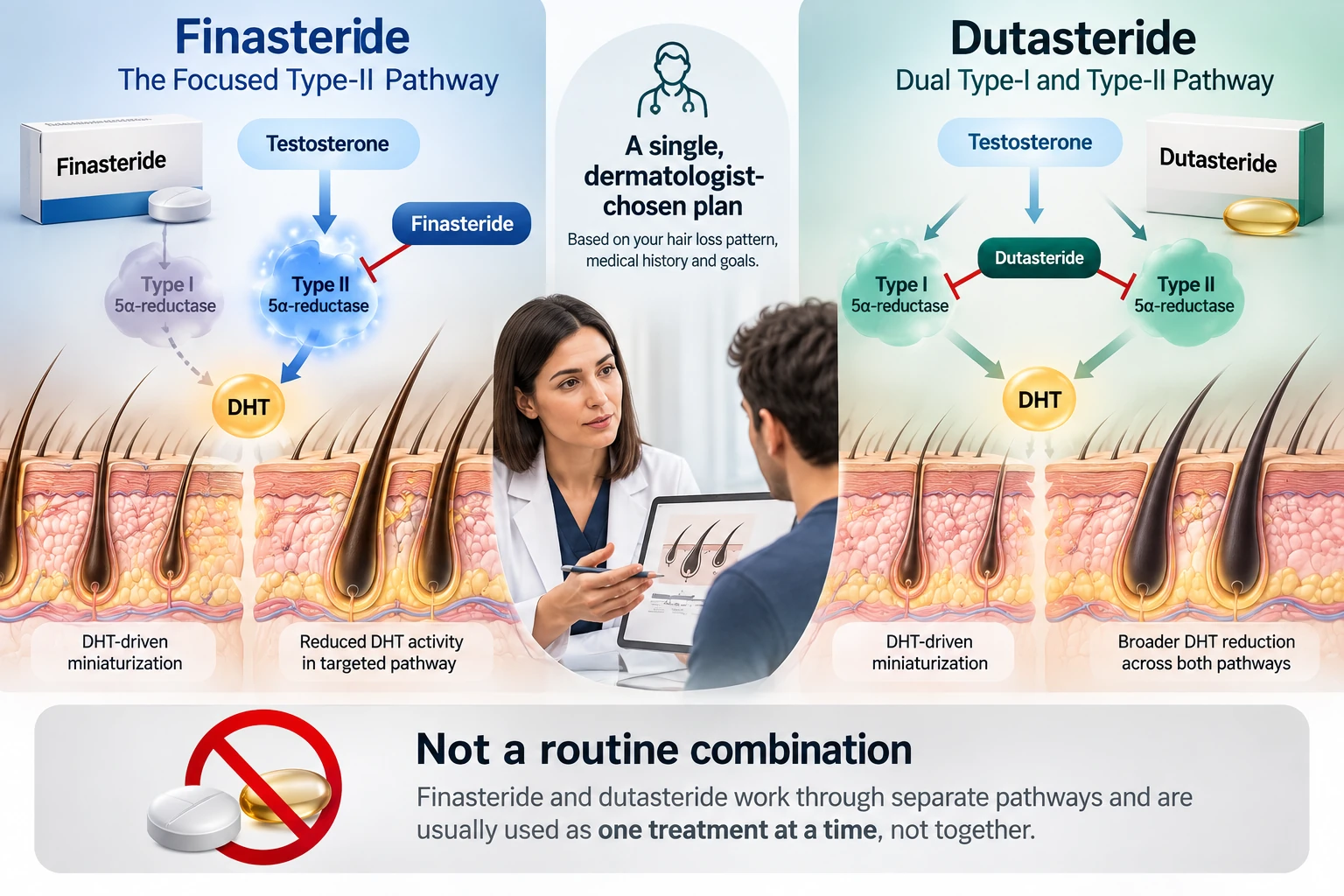
Finasteride and dutasteride are both 5-alpha-reductase inhibitors, but they don't work identically — finasteride targets one enzyme pathway, dutasteride targets two, and their approval status for hair loss varies by market. Broader enzyme inhibition is not automatically the better choice; it is a different pharmacological profile with its own candidacy, safety and monitoring considerations. This page offers education, not a prescription — a dermatologist should confirm your diagnosis and review your history before either medicine is considered.

Quick Answer
Both finasteride and dutasteride reduce DHT by inhibiting 5-alpha-reductase, but finasteride mainly blocks the Type-II form of the enzyme while dutasteride blocks both Type-I and Type-II. Broader enzyme inhibition is a pharmacological difference, not proof that dutasteride works better for hair loss — evidence, approval status and individual risk-benefit balance vary, and dutasteride is used off-label for hair loss in several markets including India. Which one — if either — is relevant should be decided with a dermatologist, not by assuming "broader is stronger is better."
Read this first: Neither medicine is described here with a universal dose or a guaranteed outcome. This page is educational — a dermatologist should confirm your diagnosis, review your history and current local labeling before you start, stop or switch between these medicines.
At a Glance
Finasteride and Dutasteride, Side by Side
Neither panel is ranked above the other. Dutasteride's broader enzyme inhibition is a pharmacological difference, not a declared winner. Use "Compare by" to highlight one consideration across both medicines at once.
Dutasteride
The Core Distinction
One Enzyme Pathway, or Two?
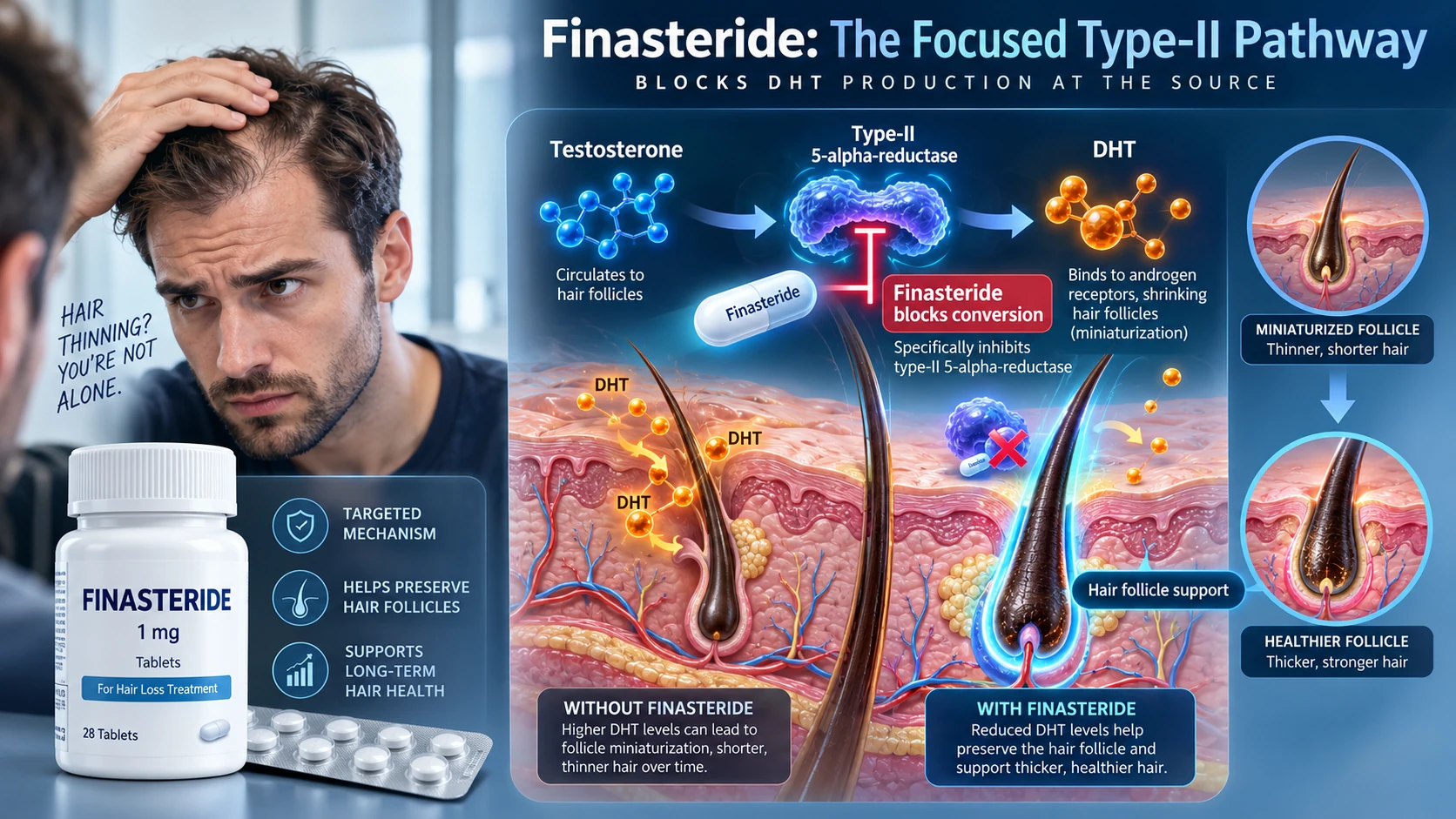
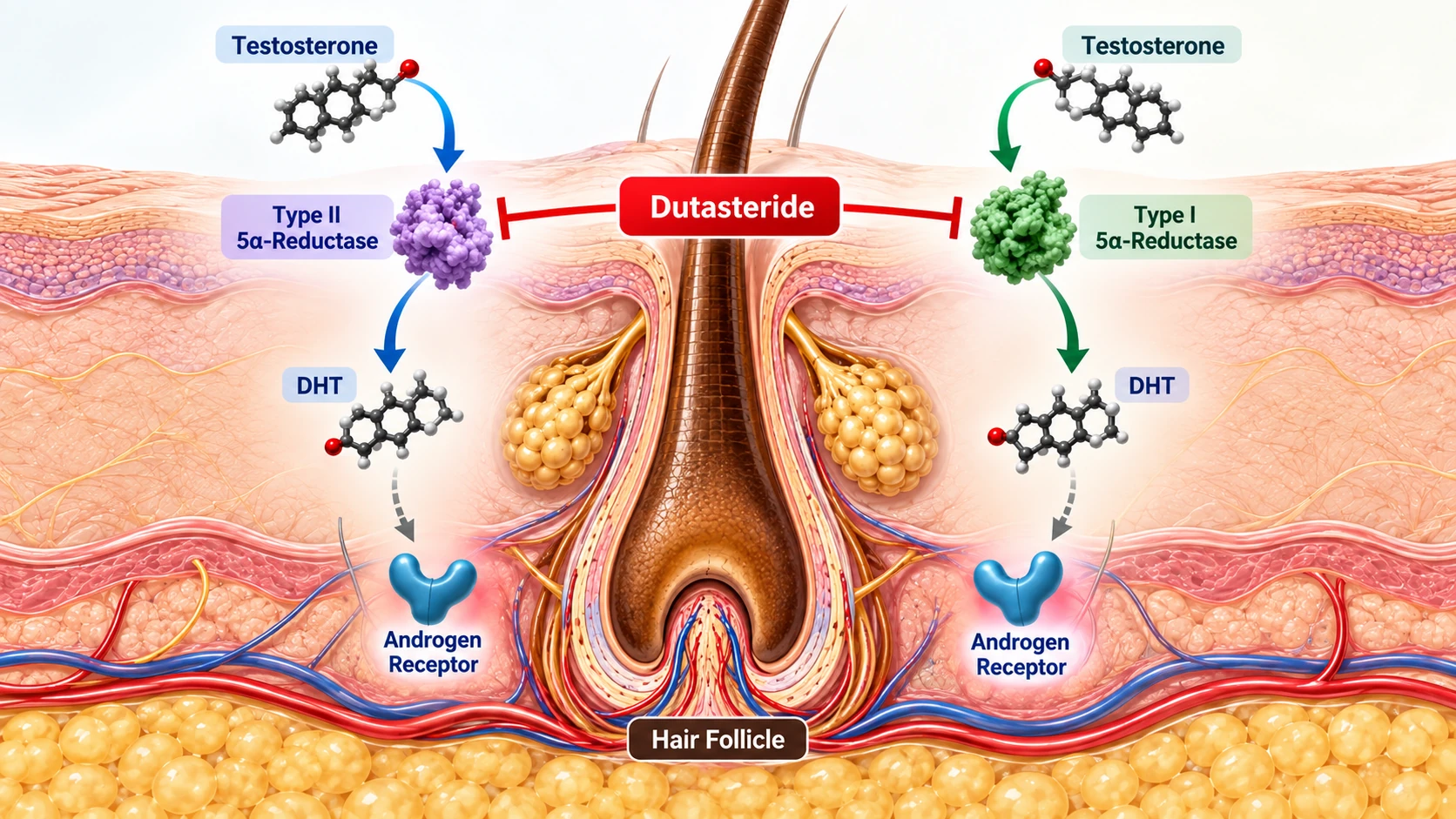
In , genetically susceptible follicles gradually shrink under the influence of , produced when converts testosterone to DHT. Finasteride mainly blocks the Type-II form of this enzyme; dutasteride blocks both Type-I and Type-II. That is a real pharmacological difference — but "blocking more of the enzyme" does not automatically mean "more hair regrowth" for a given patient, and dutasteride's regulatory status for hair loss differs from finasteride's in several markets.
Testosterone
Circulating testosterone is the substrate for the 5-alpha-reductase enzyme.
Type-II Enzyme
Found mainly in hair follicles and the prostate. Finasteride primarily inhibits this form.
Finasteride acts hereType-I Enzyme
Found more broadly in skin and liver tissue. Dutasteride inhibits this form as well as Type-II.
Dutasteride also acts hereDHT Convergence
converge on DHT production, which then affects genetically susceptible follicles.
Progressive Thinning
becomes visible as reduced density over time.
Broader enzyme inhibition is a pharmacological difference — not an automatic treatment recommendation. Which pathway is relevant to discuss depends on diagnosis, regulatory context and individual risk-benefit balance.

In Detail
Full Comparison Table
Swipe to compare →
| Consideration | Finasteride | Dutasteride |
|---|---|---|
| Medicine category | 5-alpha-reductase inhibitor (Type-II selective) | 5-alpha-reductase inhibitor (Type-I and Type-II) |
| Primary mechanism | Reduces DHT via the Type-II enzyme pathway | Reduces DHT via both Type-I and Type-II enzyme pathways |
| Main clinical role | Slow DHT-driven follicle miniaturisation | Slow DHT-driven follicle miniaturisation more broadly |
| Typical route | Oral tablet; topical formulations exist and are handled differently | Oral capsule; topical/combination formulations exist in some markets |
| Regulatory status for hair loss | Approved in many markets, including India, at the standard hair-loss doseDoctor Review Essential | Approved for hair loss in some markets; off-label for hair loss in others, including commonly in IndiaVerify Current Labeling |
| Diagnosis relevance | Primarily relevant to male-pattern, DHT-driven loss — requires assessment | Primarily relevant to male-pattern, DHT-driven loss — requires assessment, often specialist-led |
| Men | May be considered after assessment | May be considered after assessment, often when finasteride response is incomplete or under specialist review |
| Women | Not a default option; requires careful, individual evaluation | Not a default option; requires careful, individual evaluation — evidence base is more limited |
| Pregnancy / handling | Contraindicated for use by, and handling precautions apply around, pregnant individuals per current official labeling | Contraindicated for use by, and handling precautions apply around, pregnant individuals — precautions are typically more stringent given longer persistence |
| Enzyme selectivity | Mainly Type-II | Type-I and Type-II — broader inhibition, not proportionally greater benefit for every patient |
| Persistence in the body | Shorter half-life; DHT suppression declines relatively quickly after stopping | Longer half-life; DHT suppression can persist for weeks to months after stopping |
| Sexual side-effect discussion | Recognised possible effects — requires informed discussion | Similar recognised effects — requires informed discussion, with persistence relevant to how long any effect may last |
| Fertility planning | Discuss timing given shorter washout | Discuss timing given considerably longer washout before conception attempts |
| Treatment consistency | Regular ongoing use required | Regular ongoing use required |
| Time before assessment | Several months, with periodic clinical review | Several months, with periodic clinical review, often specialist-led |
| After discontinuation | Benefit generally fades relatively promptly | Benefit generally fades more gradually, consistent with longer persistence |
| PSA monitoring | Reduces PSA; prescriber applies a standard adjustment factor | Reduces PSA more than finasteride; prescriber applies a larger adjustment factor |
| Monitoring | Periodic prescriber review | Periodic review, often with specialist input given broader inhibition and off-label status in some markets |
| Cost considerations | Varies by brand and dose; ongoing cost as long-term therapy | Varies by brand and dose; ongoing cost as long-term therapy |
| Combination or alternating use | Not typically combined with dutasteride — same pathway, added complexity | Not typically combined with finasteride — same pathway, added complexity |
| Dermatologist supervision | Essential — prescription medicine | Essential — prescription medicine, frequently specialist-guided |
Finasteride
Focused Pathway
Finasteride: The Focused Type-II Pathway
What finasteride is
Finasteride is an oral 5-alpha-reductase inhibitor. It works by blocking the enzyme that converts testosterone into DHT, primarily targeting the Type-II form of that enzyme, which is concentrated in hair follicles and the prostate.
Why "Type-II selective" matters
5-alpha-reductase exists in more than one form. Finasteride's action is weighted toward Type-II, which is the dominant form in scalp follicles for many people — this is part of why it has an established evidence base and approval history specifically for male-pattern hair loss.
Oral finasteride
The established route for hair loss. At the standard hair-loss dose, oral finasteride is approved in many markets, including India, for adult men with diagnosed male-pattern hair loss, and requires an initial history review and periodic follow-up.
Topical finasteride
Topical finasteride formulations exist and are of growing clinical interest, generally intended to reduce systemic absorption relative to the oral route. Approval status and evidence maturity vary by market and formulation — this should be confirmed with a dermatologist rather than assumed to carry the same profile as oral tablets.
Who may be assessed for it
Adult men with a confirmed diagnosis of male-pattern hair loss are the primary group discussed. It is not a default option for women, is not appropriate for minors, and is not a treatment for non-hormonal causes of hair loss.
Sexual and reproductive health discussion
A recognised subset of users report sexual side effects such as reduced libido or erectile difficulty. These do not occur in everyone, and not experiencing them is not guaranteed either — an honest, individual discussion before starting is important.
Mood-related considerations
Regulatory bodies in several markets have required labeling to reflect reports of mood-related changes in some users. This is a recognised, actively monitored area — current official guidance should be reviewed with a prescriber.
Fertility-related questions
People with active fertility plans should raise this specifically with their prescriber. Finasteride's relatively shorter half-life means its effect on semen parameters, where reported, is generally understood to resolve more quickly after stopping than with longer-acting 5-alpha-reductase inhibitors — but individual circumstances vary and deserve a tailored discussion.
Handling precautions
Tablets should not be handled by pregnant individuals if broken or crushed, per standard labeling precautions for finasteride products.
PSA and prostate-screening considerations
Finasteride reduces PSA (prostate-specific antigen) readings by a fairly predictable, well-established factor. Anyone undergoing PSA-based prostate screening should inform the ordering physician that they are taking finasteride so results are interpreted correctly.
Maintenance requirements
Finasteride's effect is generally understood to require continued use. Because of its comparatively shorter persistence in the body, DHT suppression — and any associated benefit — is expected to fade relatively promptly after stopping.
What finasteride cannot treat
It is not a treatment for non-hormonal causes of hair loss and does not address the growth-cycle support that other categories of hair-loss treatment provide.
When to contact a clinician
New mood changes, persistent sexual side effects, breast tenderness or lumps, or any symptom that feels concerning should prompt a conversation with the prescriber rather than silent discontinuation or continuation.
Questions to ask a dermatologist
Am I a reasonable candidate given my diagnosis and history? Is finasteride's Type-II selectivity likely to be enough for my pattern, or is broader inhibition worth discussing? What is the plan if I experience a side effect?
Finasteride Reality Check
- Targets one specific enzyme pathway — Type-II — not the whole DHT picture
- Diagnosis matters more than enthusiasm to start
- Not suitable for every type of hair loss or every patient
- Benefits require continued, supervised use
- Effect fades relatively promptly after stopping, given shorter persistence
- The risk-benefit discussion is individual, not generic

Dutasteride
Broader Pathway
Dutasteride: The Broader Dual-Enzyme Pathway
What dutasteride is
Dutasteride is an oral 5-alpha-reductase inhibitor that blocks both the Type-I and Type-II forms of the enzyme, giving it broader enzymatic coverage than finasteride's largely Type-II-selective action.
Why dual-enzyme inhibition is not simply "more"
Blocking a wider range of the enzyme responsible for DHT production is a real pharmacological difference, but it does not automatically translate into proportionally greater hair benefit for every patient. Response still depends on diagnosis, follicle biology and individual factors — broader inhibition is a different profile, not a guaranteed upgrade.
Regulatory status for hair loss
Dutasteride's approval status for hair loss varies by country. It is approved for hair loss in some markets, while in others — including commonly in India — it is used off-label for this indication, meaning prescribers apply clinical judgement rather than a specific hair-loss label. Current local labeling should always be verified.
Oral dutasteride
The established route. Because of its broader mechanism and, in many places, off-label status for hair loss, oral dutasteride for this purpose is often discussed after specialist review, particularly where finasteride has been tried without the expected result.
Topical and combination formulations
Topical dutasteride and combination formulations exist in some markets, generally intended to modify systemic exposure relative to oral capsules. Evidence and approval status vary considerably by formulation and region — this should be confirmed with a dermatologist rather than assumed.
Candidate assessment
Diagnosis confirmation, prior treatment history (including finasteride response), family history, reproductive plans and personal risk tolerance are typically reviewed before dutasteride is discussed as an option.
Contraindications and precautions
Dutasteride is not intended for use by women who are or may become pregnant. Handling precautions apply to capsules, and given dutasteride's longer persistence in the body, these precautions are generally treated as more stringent than finasteride's.
Sexual and reproductive health discussion
A recognised subset of users report sexual side effects broadly similar in nature to those associated with finasteride. Because dutasteride persists longer in the body, any such effect may also take longer to resolve after stopping — this should be part of an honest, individual discussion before starting.
Mood-related considerations
Mood-related changes have been reported with 5-alpha-reductase inhibitors as a class, including dutasteride. This is a recognised, actively monitored area — current official guidance should be reviewed with a prescriber.
Fertility-related questions — why persistence matters
Dutasteride's longer half-life means DHT suppression, and any related effect, can persist for considerably longer after stopping than with finasteride. People with active fertility plans should discuss timing and washout specifically with their prescriber rather than assuming the same interval as finasteride.
Handling precautions
Capsules should not be handled by pregnant individuals if leaking or damaged, per standard labeling precautions for dutasteride products.
PSA and prostate-screening considerations
Dutasteride reduces PSA readings more than finasteride does. Anyone undergoing PSA-based prostate screening should inform the ordering physician that they are taking dutasteride, as a larger adjustment factor is typically applied when interpreting results.
Maintenance requirements
Dutasteride's effect is generally understood to require continued use. Its longer persistence means that after stopping, DHT suppression — and any associated benefit — is expected to fade more gradually than with finasteride, though it still fades over time.
What dutasteride cannot treat
It is not a treatment for non-hormonal causes of hair loss, is not established as a first-line option for most women, and is not appropriate for use in minors.
When to contact a clinician
New mood changes, persistent sexual side effects, breast tenderness or lumps, or any symptom that feels concerning should prompt a conversation with the prescriber rather than silent discontinuation or continuation.
Questions to ask a dermatologist
Why is broader enzyme inhibition being discussed for my case specifically? What does dutasteride's longer persistence mean for my fertility plans and washout timing? What monitoring is expected, and how does that differ from finasteride's?
Dutasteride Reality Check
- Broader enzyme inhibition is a pharmacological difference — not an automatic treatment recommendation
- Not approved for hair loss in every market — verify current local labeling
- Diagnosis and prior treatment history matter more than assuming "stronger is better"
- Persists considerably longer in the body than finasteride — relevant to fertility and washout
- Benefits require continued, supervised management, often specialist-led
- The risk-benefit discussion is individual, not generic

Why Not Just Assume "Stronger"
Why Dutasteride Is Not Simply "Stronger Finasteride"
Four things actually differ between these medicines — and none of them is a simple strength dial.
Enzyme Selectivity
- What differs
- Finasteride mainly blocks Type-II 5-alpha-reductase; dutasteride blocks Type-I and Type-II.
- Practical implication
- Broader inhibition is a different biochemical profile, not a multiplier on results.
- Ask your dermatologist
- Is Type-II selectivity likely sufficient for my pattern, or is broader coverage relevant to my case?
Biological DHT Suppression
- What differs
- Dutasteride typically produces greater serum DHT suppression than finasteride.
- Practical implication
- Greater suppression does not automatically mean proportionally greater visible hair benefit for a given patient.
- Ask your dermatologist
- How is DHT suppression connected to my specific expected outcome?
Persistence in the Body
- What differs
- Dutasteride has a considerably longer half-life than finasteride.
- Practical implication
- Longer persistence affects washout timing, fertility planning, and how quickly any side effect resolves after stopping.
- Ask your dermatologist
- What washout period is relevant to my fertility plans or any procedure I'm considering?
Clinical Decision Relevance
- What differs
- Approval status, evidence maturity and typical prescribing context differ between the two medicines by market.
- Practical implication
- Where dutasteride is off-label for hair loss, its use is based on clinical judgement, not a specific approved indication.
- Ask your dermatologist
- What is the current regulatory status for dutasteride for hair loss where I live, and what does that mean for how it's prescribed?
By Scenario
Finasteride vs Dutasteride by Patient Scenario
These are educational starting points for a conversation with a dermatologist — not personalised treatment recommendations.
Early Male-Pattern Thinning
- Why diagnosis matters
- Early intervention decisions can influence which options remain relevant later.
- What may be discussed
- Finasteride is typically the first 5-alpha-reductase inhibitor discussed once diagnosis is confirmed.
- Do not self-start
- Either medicine without a prescriber review.
- Next step
- Dermatologist assessment to confirm pattern and candidacy.
Crown-Predominant Thinning
- Why diagnosis matters
- Crown thinning can have several causes beyond androgenetic alopecia.
- What may be discussed
- Once confirmed as DHT-related, finasteride is usually discussed first, with dutasteride sometimes raised depending on response and local approval status.
- Do not self-start
- Assuming the cause without examination.
- Next step
- Scalp examination and pattern mapping.
Incomplete Finasteride Response
- Why diagnosis matters
- "Not working" can mean too little time, inconsistent use, or a genuinely limited response — these need different next steps.
- What may be discussed
- Adherence and duration are reviewed first; dutasteride may be raised as a specialist-guided option afterward, not as an automatic upgrade.
- Do not self-start
- Switching to dutasteride on your own without a reassessment.
- Next step
- Structured reassessment with your dermatologist — see the reassessment pathway below.
Diffuse Shedding
- Why diagnosis matters
- Diffuse shedding often has causes unrelated to DHT, such as nutritional or thyroid factors.
- What may be discussed
- Underlying cause should be identified before either 5-alpha-reductase inhibitor is considered.
- Do not self-start
- Either medicine before basic bloodwork is reviewed.
- Next step
- Blood tests and detailed history first.
Female-Pattern Hair Loss
- Why diagnosis matters
- Hormonal, thyroid and iron status all warrant review in women with thinning.
- What may be discussed
- Neither finasteride nor dutasteride is a default option for most women; evidence and evaluation requirements differ from the male-pattern context.
- Do not self-start
- Either medicine without specialist guidance.
- Next step
- Dermatologist and, where relevant, endocrine assessment.
Fertility Planning
- Why diagnosis matters
- Both medicines carry fertility-related considerations, but persistence in the body differs significantly between them.
- What may be discussed
- Timing, washout period and choice between the two medicines should be planned around your specific fertility timeline.
- Do not self-start
- Assuming the same washout period applies to both medicines.
- Next step
- Discuss timing explicitly, especially before conception attempts.
Mood-Health Sensitivity
- Why diagnosis matters
- Mood-related changes are a recognised consideration for 5-alpha-reductase inhibitors as a class.
- What may be discussed
- Personal or family mental-health history should be part of the candidacy conversation for either medicine.
- Do not self-start
- Continuing silently if mood changes appear after starting.
- Next step
- Raise mental-health history proactively before starting, and report changes promptly if they occur.
Sudden Patchy Hair Loss
- Why diagnosis matters
- This pattern may suggest an autoimmune or other non-pattern cause.
- What may be discussed
- Neither medicine is a first-line answer here until diagnosis is clarified.
- Do not self-start
- Either medicine before proper evaluation.
- Next step
- Prompt dermatologist evaluation.
Hair Loss With Thyroid or Nutritional Symptoms
- Why diagnosis matters
- Underlying deficiency or thyroid imbalance may be the primary driver.
- What may be discussed
- Correcting the underlying cause is typically prioritised before either medicine is considered.
- Do not self-start
- Either medicine as a substitute for addressing the root cause.
- Next step
- Relevant blood tests and medical evaluation.
Post-Hair-Transplant Maintenance
- Why diagnosis matters
- Ongoing native-hair protection is often part of post-transplant planning.
- What may be discussed
- Either medicine may be discussed as part of a maintenance plan for surrounding native hair, coordinated with your surgeon.
- Do not self-start
- Changing your transplant surgeon's maintenance plan independently.
- Next step
- Follow your surgeon's or dermatologist's maintenance protocol.
Uncertain Diagnosis
- Why diagnosis matters
- Comparing two specific medicines is premature if the underlying cause of hair loss hasn't been confirmed.
- What may be discussed
- Neither medicine should be the starting point without a confirmed diagnosis.
- Do not self-start
- Choosing between finasteride and dutasteride before diagnosis is confirmed.
- Next step
- Full diagnostic evaluation first.
Already Taking Prostate-Related Medication
- Why diagnosis matters
- Both medicines affect PSA readings and overlap pharmacologically with some prostate treatments.
- What may be discussed
- Coordinated review with your treating physician, particularly around PSA interpretation.
- Do not self-start
- Either medicine without disclosing current prostate-related medication or monitoring.
- Next step
- Share your full medication and monitoring history with your dermatologist.
Planning Pregnancy (Partner)
- Why diagnosis matters
- Both medicines carry specific pregnancy-related handling precautions relevant to a partner who may become pregnant.
- What may be discussed
- Timing, handling precautions and choice of medicine should be planned with your dermatologist.
- Do not self-start
- Either medicine without disclosing your partner's pregnancy plans.
- Next step
- Discuss handling precautions and timing explicitly before starting or continuing treatment.
Under 18
- Why diagnosis matters
- Hair loss in minors needs its own dedicated evaluation for underlying causes.
- What may be discussed
- Neither finasteride nor dutasteride is a default option for minors.
- Do not self-start
- Either medicine without pediatric or dermatology guidance.
- Next step
- Pediatric or dermatology evaluation focused on underlying cause.
Unexplained Rapid Hair Loss
- Why diagnosis matters
- Rapid, unexplained loss can reflect an acute medical issue needing prompt attention.
- What may be discussed
- Comparison of medicines is not the first step here.
- Do not self-start
- Any self-directed treatment before evaluation.
- Next step
- Prompt medical evaluation — see Red Flags below.
A Caution, Not a Combination Plan
Combining or Alternating Finasteride and Dutasteride
Finasteride and dutasteride act on the same overall hormonal pathway — both reduce DHT by inhibiting 5-alpha-reductase. Because dutasteride already inhibits the Type-II enzyme that finasteride targets, plus the Type-I enzyme, taking both together does not add a genuinely new mechanism — it mostly duplicates and complicates a single pathway.
More medicine is not automatically better. Combining or alternating between them makes it harder to identify which medicine is responsible if a side effect occurs, complicates monitoring, and is not a standard, well-established approach.
Online switching or alternating schedules found on forums or social media are not personalised medical guidance. If a finasteride response has been incomplete, the appropriate next step is a structured reassessment with a dermatologist — not self-directed combination or alternation.
Same Pathway · Separate, Not Combined

Educational Tool
Understand What Questions Matter for Your Situation
Answer a few questions to see which topics are most relevant to raise with your dermatologist. This tool does not diagnose or prescribe.
This educational result cannot confirm a diagnosis or replace medical assessment.
Your answers stay in your browser only. Nothing is collected, stored, or sent anywhere — closing this page clears everything.
What to Expect Over Time
Treatment Timeline — Not a Fixed Result Date
Timelines vary by diagnosis, formulation, treatment route, adherence, baseline severity, individual biology and any concomitant treatment. A meaningful response cannot be judged after only a few days — standardised photographs, taken the same way each time, can help track real change.
Before starting
Diagnosis confirmation and baseline photographs are commonly recommended before starting.
Early adjustment
Early weeks focus on tolerability — any sexual, mood or other symptoms should be tracked and reported.
First review
Clinical assessment is commonly based on adherence and tolerability so far — DHT-related change takes longer to show visibly.
Intermediate assessment
Some patients may notice a slowing of shedding rate, depending on individual response.
Longer-term assessment
A more meaningful response, if present, is typically evaluated with standardised photographs and clinical review at this stage.
Maintenance phase
Continued use and periodic prescriber review are generally required to sustain any benefit gained.
Safety, Without the Drama
Side-Effect and Safety Explorer
Possible common effects
- Reduced libido in some users
- Erectile difficulty in some users
- Breast tenderness in some users
Warrants medical advice
- Persistent sexual side effects
- New mood changes
- Breast lumps or nipple discharge
May require prompt evaluation
- Significant mood or mental-health changes
- Signs of an allergic reaction
- Testicular pain
Groups needing special assessment
- Anyone with active fertility plans
- Individuals with liver conditions
- Anyone due for PSA-based prostate screening
Discuss before treatment
- Reproductive and fertility plans
- Personal or family mental-health history
- Any current PSA monitoring
Possible common effects
- Reduced libido in some users
- Erectile difficulty in some users
- Breast tenderness in some users
Warrants medical advice
- Persistent sexual side effects — may take longer to resolve given longer persistence
- New mood changes
- Breast lumps or nipple discharge
May require prompt evaluation
- Significant mood or mental-health changes
- Signs of an allergic reaction
- Testicular pain
Groups needing special assessment
- Anyone with active fertility plans — washout takes considerably longer than finasteride
- Individuals with liver conditions
- Anyone due for PSA-based prostate screening — larger adjustment factor applies
Discuss before treatment
- Reproductive and fertility plans, given longer persistence
- Personal or family mental-health history
- Any current PSA monitoring
- Current local regulatory/approval status for hair loss
Realistic Expectations
What Results Can Realistically Be Expected?
Depending on the patient and diagnosis, treatment may reduce the rate of shedding, improve density, or support regrowth in responsive follicles. Stabilisation — hair loss simply progressing more slowly, or not at all — can be a clinically meaningful outcome on its own, even without dramatic new growth.
Response varies significantly between individuals. Earlier diagnosis and treatment may keep more options available; severely miniaturised or long-inactive follicles may respond differently, or not at all, compared to follicles caught earlier in the process.
Neither finasteride nor dutasteride can guarantee restoration of a fully juvenile hairline, and dutasteride's broader enzyme inhibition does not mean a proportionally larger cosmetic result for every patient. Cosmetic density (how full hair looks) and biological/medical response (what is actually happening at the follicle) are related but different outcomes — and photography conditions (lighting, angle, hair styling) must be standardised for any before/after comparison to mean anything.
Reduced Shedding
Stabilisation
Increased Shaft Thickness
Improved Density
Cosmetic Coverage
Complete Restoration — Not Guaranteed
The Honest Answer
"Which One Is Better?" — A Decision Matrix, Not a Winner
| Treatment Consideration | Finasteride Discussion | Dutasteride Discussion | Why Medical Assessment Matters |
|---|---|---|---|
| Type-II enzyme inhibition | Primary mechanism | Included, alongside Type-I | Confirms whether Type-II selectivity is enough for your case |
| Type-I enzyme inhibition | Limited | Included | Broader coverage is a difference, not automatically an advantage |
| Established evidence and approval | Longer-established, widely approved for hair loss | Newer to this indication in many markets; off-label in some, including commonly India | Regulatory context shapes how the medicine is prescribed and monitored |
| First-choice discussion | Typically the starting point | Often raised after an incomplete finasteride response, or specialist-led | Sequencing matters — this is not usually a first-choice-vs-first-choice decision |
| Persistence in the body | Shorter half-life | Considerably longer half-life | Affects washout timing, fertility planning and how long a side effect may last |
| Fertility planning | Shorter washout typically discussed | Longer washout typically discussed | Timeline needs to match your actual fertility plans |
| Female-pattern hair loss | Requires careful individual evaluation | Requires careful individual evaluation; evidence base more limited | Hormonal status and evidence maturity affect suitability |
| Pregnancy considerations | Contraindicated for use/handling by pregnant individuals | Contraindicated for use/handling; precautions typically more stringent given persistence | Both carry pregnancy-specific precautions |
| PSA / prostate monitoring | Standard adjustment factor applied | Larger adjustment factor applied | Full medical history changes how test results are read |
| Sexual-side-effect concerns | Requires informed discussion | Requires informed discussion; effects may persist longer if they occur | Personal risk tolerance and timeline both matter |
| Uncertain diagnosis | Not the starting point | Not the starting point | Diagnosis should precede medicine selection |
| Long-term adherence | Required for benefit | Required for benefit | Confirms realistic commitment before starting |
| Combining or alternating | Not typically combined with dutasteride | Not typically combined with finasteride | Same pathway — added complexity without a clear new mechanism |
| Post-transplant support | Often discussed | Sometimes discussed, often specialist-led | Surgeon and dermatologist alignment matters |
The right treatment is the one that matches the diagnosis, evidence, regulatory context, medical history and an acceptable individual risk-benefit balance — not the one with the broader-sounding mechanism.
Setting the Record Straight
Myths vs Medical Reality
"Dutasteride is just a stronger finasteride."
It inhibits a broader range of the enzyme, which is a pharmacological difference, not a strength multiplier — and its regulatory status for hair loss differs by market.
"More DHT suppression always means more hair regrowth."
Response depends on follicle biology and diagnosis, not suppression alone — greater biochemical effect doesn't guarantee proportionally greater visible benefit.
"Dutasteride is approved for hair loss everywhere."
Approval status varies by country — it's used off-label for hair loss in several markets, including commonly in India. Always verify current local labeling.
"If finasteride didn't work, dutasteride definitely will."
Broader enzyme inhibition may help some patients with an incomplete finasteride response, but it is not a guaranteed fix — reassessment of diagnosis and adherence comes first.
"Finasteride is suitable for every person with thinning hair."
It is primarily discussed for diagnosed, DHT-related male-pattern loss — not a universal option.
"Stopping either medicine always makes hair worse than baseline."
Discontinuation generally means gradual loss of gained benefit, returning hair loss toward its untreated course — not automatically worse than the original baseline. Dutasteride's fade is more gradual given its longer persistence.
"Topical formulations have no systemic considerations."
Topical finasteride or dutasteride formulations are generally intended to reduce systemic absorption, but are not necessarily free of systemic effects — evidence and approval status vary by formulation.
"Side effects happen to everyone."
Many users do not experience significant side effects, but individual risk should still be discussed honestly for either medicine.
"No side effects means no monitoring is required."
Periodic review still matters to track effectiveness, PSA interpretation, and catch delayed-onset issues.
"Combining finasteride and dutasteride guarantees better results."
They act on the same overall pathway — combining them mostly duplicates and complicates rather than adding a genuinely new mechanism. See the caution section above.
"Hair supplements can replace diagnosis-based treatment."
Supplements may help where a specific deficiency is confirmed, but are not a substitute for diagnosis-driven treatment.
Before Comparing Medicines
Red Flags: When Diagnosis Comes Before Comparison
If any of the following apply, the right first step is medical evaluation — not choosing between finasteride and dutasteride.
Prepare for Your Visit
What to Tell Your Dermatologist Before Choosing Treatment
Medically Reviewed
Medically Reviewed By
Dr. Amit S. Agarkar
Dermatologist, Trichologist and Hair Transplant Surgeon
Full profile · Medical editorial policy · Correction policy · References
Medical information is periodically reviewed and may change as evidence, product labeling and regulatory guidance evolve.

Sources
Medical References
This list reflects the categories of authoritative source used to inform this page's general statements. Editorial note: exact citation numbers, article titles and access dates should be finalised and verified by the reviewing dermatologist against current official labeling before publication — this page intentionally avoids inventing specific study outcomes, percentages or journal citations that have not been verified.
- Central Drugs Standard Control Organisation (CDSCO) — current approved prescribing information for finasteride and dutasteride formulations marketed in India. CDSCO Verify current listing and hair-loss indication status
- US FDA-approved prescribing information (label) for finasteride — mechanism, contraindications, and safety labeling language, used here only for internationally consistent mechanism-of-action description. FDA Verify current label version
- US FDA-approved prescribing information (label) for dutasteride — mechanism, contraindications, and safety labeling language, used here only for internationally consistent mechanism-of-action description; hair-loss indication status varies by market. FDA Verify current label version
- Indian Association of Dermatologists, Venereologists and Leprologists (IADVL) — clinical guidance on androgenetic alopecia management. IADVL Verify current guideline version
- American Academy of Dermatology (AAD) — patient-education resources on androgenetic alopecia and treatment options. AAD Verify current resource
- Peer-reviewed clinical trials and pharmacovigilance data on oral finasteride for male-pattern hair loss, including regulatory safety-communication updates. PubMed To be cited individually once selected by reviewing dermatologist
- Peer-reviewed clinical trials comparing dutasteride and finasteride for androgenetic alopecia, including enzyme-selectivity and persistence data. Cochrane Library To be cited individually once selected by reviewing dermatologist
- Recognised drug-information databases (e.g. national formularies) for dosing-category, half-life and interaction information, and general patient-education context. MedlinePlus Verify current entry
- World Health Organization — general reference on medicine safety communication and essential-medicines context where relevant. WHO Verify current relevance
Common Questions
Frequently Asked Questions
Twenty-three questions, organised by what you're actually trying to figure out — grouped below, not just listed.
Comparison
Neither is universally "better" — dutasteride inhibits a broader range of the enzyme responsible for DHT, but that's a pharmacological difference, not proof of superior results for every patient. Suitability depends on diagnosis, prior response, regulatory status and individual risk-benefit balance.
No. Finasteride mainly blocks the Type-II form of 5-alpha-reductase; dutasteride blocks both Type-I and Type-II. Broader inhibition is a different mechanism, not simply "more" of the same one.
This is not a standard, well-established approach. Both act on the same overall pathway, so combining or alternating them mostly duplicates and complicates rather than adding a genuinely new mechanism. Discuss with a dermatologist rather than self-combining.
Neither produces overnight results. Meaningful assessment for either medicine typically requires several months of consistent, correctly diagnosed use — dutasteride's broader mechanism does not mean a faster visible response.
Who It May Suit
Finasteride is typically the starting point for discussion in men with a confirmed diagnosis; dutasteride is sometimes raised afterward, depending on response and local regulatory status — not as a default first choice.
Starting with the medicine with the most established evidence and approval history — usually finasteride — is the typical approach. Dutasteride is generally discussed later, based on individual response and specialist input, not chosen upfront for being "stronger."
Neither is a default option for most women and both require careful, individual evaluation; the evidence base for dutasteride in women is more limited than for finasteride.
Both carry pregnancy-related precautions. Neither is intended for use by pregnant individuals, and handling precautions apply — dutasteride's precautions are generally treated as more stringent given its longer persistence in the body.
Approval status for hair-loss use varies by market. In several markets, including commonly in India, dutasteride is used off-label for hair loss, meaning prescribers apply clinical judgement rather than a specific hair-loss approval. Always verify current local labeling.
Effects & Timeline
A recognised subset of users report effects such as reduced libido or erectile difficulty. Not everyone experiences them, and not experiencing them isn't guaranteed either — this should be discussed honestly before starting.
The general categories of possible effects are broadly similar between the two medicines. The key practical difference is persistence — because dutasteride stays in the body longer, any effect that occurs may also take longer to resolve after stopping.
Finasteride has a relatively short half-life, so its effect on DHT suppression tends to decline fairly quickly after stopping. Exact timelines vary by individual — discuss specifics with your prescriber.
Dutasteride has a considerably longer half-life than finasteride, and DHT suppression can persist for weeks to months after the last dose. This is particularly relevant to fertility planning and washout timing.
DHT-related progression is generally expected to resume gradually after stopping, with benefit fading over time — more quickly with finasteride, more gradually with dutasteride given its longer persistence.
Clinical assessment for either medicine typically requires several months of consistent use; a few days or weeks is not enough time to judge effectiveness for either one.
Not necessarily. An incomplete finasteride response is best addressed through a structured reassessment — reviewing adherence, duration and diagnosis — before assuming dutasteride is the automatic next step.
Not automatically. Response depends on follicle biology and diagnosis, not suppression level alone — greater biochemical effect doesn't guarantee a proportionally greater visible result for every patient.
Practical & Safety
Alopecia areata is an autoimmune condition with a different mechanism than androgenetic alopecia. Neither finasteride nor dutasteride is a standard first-line treatment for it — a dermatologist can advise on appropriate options.
Supplements are most useful when a specific nutritional deficiency is confirmed by blood testing. They are not a substitute for diagnosis-based pharma treatment when a hormonal or pattern cause is present.
Yes — both finasteride and dutasteride are prescription-only medicines. Doctor consultation is required before starting either, and especially important given dutasteride's off-label status for hair loss in many markets.
Depending on your history, a dermatologist may review PSA-related history, relevant blood tests (such as ferritin or thyroid markers), and reproductive plans before or during treatment with either medicine.
Yes. Both reduce PSA readings, with dutasteride reducing them more than finasteride. Always inform any physician ordering a PSA test that you are taking one of these medicines so results are interpreted correctly.
Before starting either medicine, before considering a switch between them, and sooner if you notice sudden or patchy hair loss, scalp symptoms, or hair loss alongside other unexplained health changes.
Keep Exploring
Explore Related Guides
Next Step
Choose Diagnosis-Led Treatment, Not the Strongest-Sounding Medicine
The right treatment is the one that matches the diagnosis, evidence, regulatory context, medical history and an acceptable individual risk-benefit balance — a dermatologist-led assessment can help determine whether finasteride, dutasteride, another treatment, or no medicine at all is appropriate for you.